What Are the Surprising Benefits of Building a Net-Zero Home in Fairfax County?
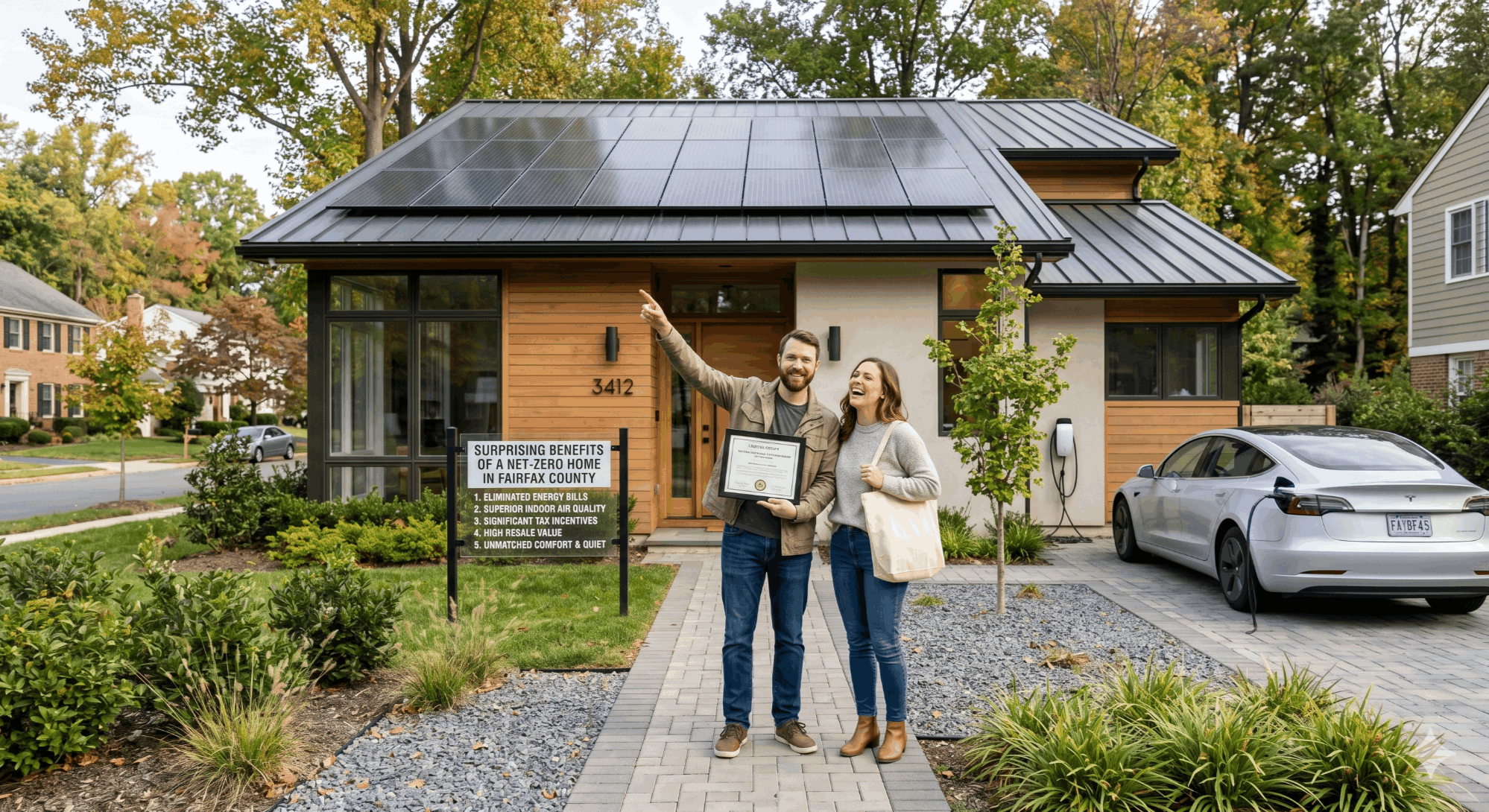
Building a net-zero home in Fairfax County is no longer a niche experiment for early adopters. It has quietly become one of the smartest long-term moves a homeowner can make in Northern Virginia, and the Fairfax County real estate services see the demand growing every season. A net-zero home produces about as much clean energy as it uses across a year, which means dramatically lower utility bills, a measurable resale edge, and a level of comfort and resilience that standard new construction rarely matches.
Quick Answer: The surprising benefits of building a net-zero home in Fairfax County go well beyond saving the planet. Owners gain near-zero energy bills through Dominion net metering, a real resale premium (solar-equipped homes have sold for roughly 4.1% more in one Zillow study), Fairfax County's local property tax exemption on solar equipment, steadier comfort, and protection against rising electricity rates. Even though the 30% federal solar tax credit ended at the close of 2025, Virginia's state and local incentives plus long-term energy savings still make net-zero construction pencil out.
Key Takeaways
- A net-zero home in Fairfax County combines a tight building envelope, efficient heat pumps, and rooftop solar to offset nearly all of its annual energy use.
- The biggest surprises are financial: lower monthly costs, a documented resale premium, and a Fairfax County exemption that keeps solar equipment off your real estate tax bill.
- The federal Residential Clean Energy Credit (Section 25D) expired December 31, 2025, so 2026 buyers and builders lean on Virginia incentives, net metering, and energy savings instead.
- Net-zero homes tend to sell faster and appeal to a wider, more motivated buyer pool, which matters most when it is time to list.
- When you eventually sell a high-value Fairfax County home, The Jamil Brothers' 1.5% full-service listing program helps you keep more of the equity your efficient home earned.
In This Guide
- What a Net-Zero Home Is, and Why Fairfax County Fits
- The Surprising Benefits of Building Net-Zero
- What It Costs to Build Net-Zero in Northern Virginia
- Net-Zero Incentives You Can Still Use in 2026
- How Net-Zero Affects Resale Value and Net Proceeds
- Net-Zero Pros and Cons for Fairfax County Owners
- Planning a Net-Zero Build: Step by Step
- Features That Make a Home Net-Zero
- Common Mistakes to Avoid
- Your Net-Zero Move Starts Here
- Frequently Asked Questions
- Glossary
Northern Virginia is a strong environment for high-performance homes. Electricity rates have climbed steadily in recent years, summers are humid and air-conditioning heavy, and buyers in markets like McLean, Vienna, Great Falls, and Oakton increasingly ask about efficiency, indoor air quality, and operating costs. Add Fairfax County's own solar incentives to that picture and the case for building net-zero gets stronger than most homeowners expect. The sections below break down exactly what you gain, what it costs, and how it shapes the number you walk away with the day you sell.
What a Net-Zero Home Is, and Why Fairfax County Fits
A net-zero energy home generates as much renewable energy over the course of a year as it consumes. It does not mean the house is off-grid. Instead, it stays connected to Dominion Energy, draws power on cloudy days or winter nights, and sends surplus solar production back to the grid when the sun is strong. Over twelve months, those two flows roughly cancel out, which is where the term net-zero comes from.
Reaching that balance is not about one gadget. It is the result of a layered approach that starts with reducing how much energy the home needs in the first place, then covers the remaining demand with on-site solar. A useful benchmark is the HERS Index (Home Energy Rating System): a typical new home scores around 100, while a net-zero home targets a score at or near zero. The lower the number, the less energy the home wastes.
The Core Components of a Net-Zero Build
| System | What It Does | Why It Matters in Fairfax County |
|---|---|---|
| Tight building envelope | Advanced insulation and air sealing reduce heating and cooling loss | Tames humid summers and cold snaps without oversized equipment |
| High-performance windows | Triple or coated double glazing cuts solar gain and drafts | Keeps interiors comfortable on hot, west-facing exposures |
| Heat pump HVAC | Electric heating and cooling with no on-site combustion | Pairs with solar and removes gas and oil from the equation |
| Heat pump water heater | Heats water using ambient air, far more efficiently than gas | Cuts one of the largest energy uses in a typical home |
| Energy recovery ventilation | Brings in fresh air while recovering heat and humidity | Maintains air quality in a tightly sealed house |
| Rooftop solar (PV) | Generates the clean electricity that offsets annual use | Feeds Dominion net metering for bill credits |
| Battery storage (optional) | Stores daytime solar for evening use and backup | Adds resilience during storm-related outages |
Fairfax County receives roughly four to five peak sun hours per day, enough to support a properly sized solar array, and the county sits within Dominion Energy's full retail net metering territory. That combination, plus larger-than-average homes with higher cooling demand, is exactly why net-zero designs perform so well here compared with lower-cost, lower-rate markets.
The Surprising Benefits of Building Net-Zero
Most people assume the only reason to build net-zero is environmental. The bigger story is financial and practical. Here are the benefits that surprise Fairfax County homeowners most.
1. Near-Zero Energy Bills Through Net Metering
A well-designed net-zero home can erase most or all of its annual electricity cost. Dominion Energy currently offers full retail, one-to-one net metering for residential systems under 25 kilowatts, meaning each surplus kilowatt-hour you push to the grid is credited at the same rate you would pay to buy it back. When summer production banks credits that carry into the shoulder seasons, the result can be a string of near-zero utility bills.
Here is how a net-zero home compares with conventional construction on estimated annual energy spend. Figures are illustrative for a single-family home in the Fairfax County area.
Estimates only. Actual results depend on home size, system sizing, occupancy, and Dominion rates.
2. A Real Resale Premium
Energy efficiency is no longer a soft selling point. A widely cited Zillow analysis found that homes with solar sold for about 4.1% more than comparable homes without it, which on a higher-priced Fairfax County property can translate into a meaningful five-figure premium. Beyond solar alone, net-zero homes signal lower operating costs, modern systems, and healthier living to a buyer pool that is paying closer attention to all three.
3. Steadier Comfort and Healthier Indoor Air
A tight envelope and balanced ventilation hold temperatures more evenly from room to room and floor to floor, with fewer drafts and cold spots. Energy recovery ventilation continuously exchanges stale indoor air for filtered fresh air, which helps with allergens and humidity. Removing gas appliances also removes a source of indoor combustion byproducts. For families, this comfort and air-quality difference is often what they notice first, well before they see the bill.
4. Resilience When the Grid Goes Down
Pair solar with battery storage and a net-zero home can keep essential circuits running during the storm-related outages that hit Northern Virginia each year. Even without a battery, an efficient home holds its temperature far longer than a leaky one, buying valuable hours of comfort during an outage. That resilience is increasingly part of how buyers value a property.
5. A Hedge Against Rising Electricity Rates
Virginia electricity prices have risen sharply, climbing roughly 18% since 2020 according to U.S. Energy Information Administration data. When you generate your own power, future rate increases work in your favor rather than against you, because every kilowatt-hour you do not buy is worth more over time. In a region where households use more electricity than the national average, that hedge compounds year after year.
Whether your home is net-zero, newly built, or decades old, get a personalized valuation from The Jamil Brothers using street-level Fairfax County comps, not an automated guess. Response within 24 hours.
What It Costs to Build Net-Zero in Northern Virginia
Building net-zero usually adds a premium over conventional new construction, but that premium is smaller than most homeowners assume, and a large share of it is recovered through lower bills and stronger resale. The added cost concentrates in a few systems rather than spreading across the whole project. If you are still deciding whether to build at all, it helps to weigh the tradeoffs in our comparison of new construction versus resale homes in Northern Virginia before committing to a net-zero project.
| Upgrade Area | Typical Added Cost | Long-Term Payoff |
|---|---|---|
| Enhanced insulation and air sealing | Low to moderate | Permanent savings, smaller HVAC needed |
| High-performance windows | Moderate | Comfort plus reduced cooling load |
| Heat pump HVAC and water heater | Often comparable to gas systems | Lower operating cost, no fuel deliveries |
| Rooftop solar array | The largest single line item | Offsets most or all electricity cost |
| Battery storage (optional) | Significant, but optional | Backup power and evening solar use |
Because efficiency reduces the size of the heating and cooling equipment a home requires, some of the envelope investment pays for itself at the moment of construction. The remaining premium is then offset over time by the energy savings and the resale strength discussed below. The key is to model the full picture, including incentives and the eventual sale, rather than judging net-zero on upfront cost alone.
Our seller net sheet breaks down every cost, from commission to Virginia transfer taxes to closing fees, so you know your real bottom line on any Fairfax County home, efficient or not.
Net-Zero Incentives You Can Still Use in 2026
The incentive landscape shifted significantly in 2025, so it is worth being precise. The federal 30% Residential Clean Energy Credit (Section 25D), which once covered solar, geothermal, and battery storage on homeowner-owned systems, expired for property placed in service after December 31, 2025. The companion Energy Efficient Home Improvement Credit (Section 25C) ended on the same date. The builder-side New Energy Efficient Home Credit (Section 45L), worth up to $5,000 per qualifying home, applies only to homes acquired on or before June 30, 2026, so its window is effectively closing.
Important 2026 update
For systems you own outright in 2026, there is no longer a federal solar tax credit. The remaining federal pathway is third-party ownership: with a solar lease or power purchase agreement, the system owner claims the commercial credit (Section 48E) and passes the savings to you through lower payments, while that credit runs through 2027. Always confirm current rules with a tax professional, since this is general information, not tax advice.
The good news for Fairfax County homeowners is that the incentives doing the heaviest lifting are state and local, and those remain in place. Here is the current stack.
| Incentive | What It Provides | Status in 2026 |
|---|---|---|
| Fairfax County solar property tax exemption | Exempts qualifying solar equipment from local real estate tax | Active |
| Virginia sales tax exemption | Exempts solar equipment from state sales tax (Code 58.1-609.10) | Active |
| Dominion net metering | Full retail credit for surplus power, systems under 25 kW | Active, changes under review |
| Virginia SRECs | Sellable credits, one per 1,000 kWh produced | Active |
| Waived county solar permit fees | Lowers soft costs of installation | Active |
| Federal Section 25D (homeowner-owned) | Former 30% solar and geothermal credit | Expired Dec 31, 2025 |
Two notes worth flagging. First, Fairfax County has adopted the local solar property tax exemption authorized under Virginia Code 58.1-3661, which means the added value of a qualifying solar system does not push up your real estate tax bill. Second, both Dominion and Appalachian Power have proposed net metering changes (sometimes called NEM 2.0) that could reduce credit rates for new customers, with a State Corporation Commission decision expected in 2026. Homeowners who interconnect before the ruling are generally grandfathered under current full retail rules, which is one reason timing your build matters.
Professional photography, drone video, 3D tours, expert negotiation, and full MLS marketing, all included at a 1.5% full-service listing fee. No hidden costs and no reduction in service, so the savings your efficient home earned stay with you.
How Net-Zero Affects Resale Value and Net Proceeds
A net-zero home gives you two advantages when it is time to sell. The first is the premium itself: lower documented operating costs and modern systems support a stronger price and often a faster sale, because efficiency-minded buyers see immediate value. The second advantage is more subtle. The higher your sale price, the more a difference in commission rate matters to your bottom line. The same pattern holds across the wider DMV, where even owners selling a home with solar panels in Maryland are finding that documented energy savings strengthen buyer interest.
That is where listing strategy comes in. Selling a high-value Fairfax County home through The Jamil Brothers' 1.5% full-service listing program means you keep more of the equity your efficient home worked to build. Use the calculator below to see the difference on a range of price points, then explore how the program works in detail. And if your Fairfax County home already has panels in place rather than a full net-zero build, our guide to selling a home with solar panels in Fairfax County walks through documenting and marketing that value to buyers and appraisers.
Seller Savings Calculator
How much more do you keep with our 1.5% listing fee?
Select your home's estimated value to see your real net proceeds, side by side.
Traditional Agent: 3%
| Sale price | $400,000 |
| Listing fee (3%) | −$12,000 |
| Buyer's agent (2.5%) | −$10,000 |
| Est. closing (1%) | −$4,000 |
| Net Proceeds | $374,000 |
Our Fee: Only 1.5%
| Sale price | $400,000 |
| Listing fee (1.5%) | −$6,000 |
| Buyer's agent (2.5%) | −$10,000 |
| Est. closing (1%) | −$4,000 |
| Net Proceeds | $380,000 |
Extra in your pocket
$6,000vs. a traditional 3% listing agent, with zero reduction in service or marketing.
Traditional Agent: 3%
| Sale price | $500,000 |
| Listing fee (3%) | −$15,000 |
| Buyer's agent (2.5%) | −$12,500 |
| Est. closing (1%) | −$5,000 |
| Net Proceeds | $467,500 |
Our Fee: Only 1.5%
| Sale price | $500,000 |
| Listing fee (1.5%) | −$7,500 |
| Buyer's agent (2.5%) | −$12,500 |
| Est. closing (1%) | −$5,000 |
| Net Proceeds | $475,000 |
Extra in your pocket
$7,500vs. a traditional 3% listing agent, with zero reduction in service or marketing.
Traditional Agent: 3%
| Sale price | $600,000 |
| Listing fee (3%) | −$18,000 |
| Buyer's agent (2.5%) | −$15,000 |
| Est. closing (1%) | −$6,000 |
| Net Proceeds | $561,000 |
Our Fee: Only 1.5%
| Sale price | $600,000 |
| Listing fee (1.5%) | −$9,000 |
| Buyer's agent (2.5%) | −$15,000 |
| Est. closing (1%) | −$6,000 |
| Net Proceeds | $570,000 |
Extra in your pocket
$9,000vs. a traditional 3% listing agent, with zero reduction in service or marketing.
Traditional Agent: 3%
| Sale price | $750,000 |
| Listing fee (3%) | −$22,500 |
| Buyer's agent (2.5%) | −$18,750 |
| Est. closing (1%) | −$7,500 |
| Net Proceeds | $701,250 |
Our Fee: Only 1.5%
| Sale price | $750,000 |
| Listing fee (1.5%) | −$11,250 |
| Buyer's agent (2.5%) | −$18,750 |
| Est. closing (1%) | −$7,500 |
| Net Proceeds | $712,500 |
Extra in your pocket
$11,250vs. a traditional 3% listing agent, with zero reduction in service or marketing.
Traditional Agent: 3%
| Sale price | $1,000,000 |
| Listing fee (3%) | −$30,000 |
| Buyer's agent (2.5%) | −$25,000 |
| Est. closing (1%) | −$10,000 |
| Net Proceeds | $935,000 |
Our Fee: Only 1.5%
| Sale price | $1,000,000 |
| Listing fee (1.5%) | −$15,000 |
| Buyer's agent (2.5%) | −$25,000 |
| Est. closing (1%) | −$10,000 |
| Net Proceeds | $950,000 |
Extra in your pocket
$15,000vs. a traditional 3% listing agent, with zero reduction in service or marketing.
Estimates only. Closing costs vary. Buyer's agent commission is negotiable.
| 500+ Five-Star Reviews · Top 1% Nationwide · 840+ Homes Sold | TheJamilBrothers.com · (703) 782-4830 |
If you are buying or building rather than selling, the same efficiency story applies in reverse: a net-zero home holds its value and broadens your future buyer pool. You can also browse current homes for sale in Fairfax County to compare new construction and efficient resale options side by side.
Net-Zero Pros and Cons for Fairfax County Owners
No home strategy is right for everyone. Weighing the trade-offs honestly is part of making a confident decision.
| Pros | Cons |
|---|---|
| Near-zero annual energy bills | Higher upfront cost than a standard build |
| Documented resale premium | Federal solar tax credit no longer available to owners |
| Local solar property tax exemption | Roof orientation and shade can limit solar output |
| Steadier comfort and cleaner indoor air | Requires experienced builders and good design |
| Hedge against rising electricity rates | Pending net metering changes add some uncertainty |
Planning a Net-Zero Build: Step by Step
Net-zero performance is designed in, not bolted on. This is the general path a Fairfax County project follows.
Set the energy target early
Decide on a net-zero or near-net-zero goal before design, so the envelope, orientation, and systems are sized together rather than patched later.
Design for the envelope first
Insulation, air sealing, and high-performance windows reduce demand. A smaller demand means a smaller, less expensive solar array.
Electrify the major systems
Heat pump heating, cooling, and water heating remove on-site combustion and pair cleanly with solar generation.
Size and install solar
Match the array to projected annual use and confirm net metering interconnection with Dominion early in the process.
Verify and document performance
A HERS rating and energy modeling give you proof of performance, which becomes a powerful asset when you eventually sell.
Features That Make a Home Net-Zero
Use this checklist when evaluating a builder's net-zero plan or assessing an efficient home already on the market.
Net-Zero Home Feature Checklist
- ✓ Continuous insulation and verified air sealing with a low blower-door result
- ✓ High-performance windows suited to the home's sun exposure
- ✓ All-electric heat pump heating, cooling, and water heating
- ✓ Energy recovery ventilation for fresh, filtered air
- ✓ A correctly sized rooftop solar array with net metering interconnection
- ✓ A documented HERS Index rating at or near zero
- ✓ Optional battery storage for backup and evening solar use
Common Mistakes to Avoid
A few avoidable errors keep net-zero projects from reaching their potential or hurt their resale value later.
| Mistake | Better Approach |
|---|---|
| Adding solar to an inefficient house | Cut demand with the envelope first, then size solar smaller |
| Ignoring roof orientation and shade | Plan the roofline and tree placement for solar from the start |
| Assuming the old 30% federal credit still applies | Build your numbers around 2026 state and local incentives |
| Skipping documentation of performance | Keep HERS ratings and energy data to support resale value |
| Choosing a listing agent who undersells efficiency | Work with a team that markets net-zero features to the right buyers |
Explore Fairfax County Communities
See market insights, listings, and neighborhood details across Fairfax County and nearby areas.
Your Net-Zero Move Starts Here
Building a net-zero home in Fairfax County rewards you twice. It pays you back month after month in lower energy costs, steadier comfort, and resilience, and it pays you again at the closing table through a stronger price and a wider buyer pool. The federal incentive picture changed in 2025, but Virginia's net metering, the state sales tax exemption, Fairfax County's solar property tax exemption, and the simple economics of generating your own power keep the case for net-zero firmly intact.
When the time comes to sell, the right strategy makes sure the value your efficient home created stays in your pocket. The Jamil Brothers Realty Group, part of Samson Properties and serving Virginia, Maryland, DC, and West Virginia, pairs full-service marketing with a 1.5% listing fee, so the equity you built does not get eroded by an outdated commission. Start with a free valuation, run your numbers on the net sheet, and you will have a clear, confident picture before you make a single move.
Know your equity, understand your costs, and see exactly what you will walk away with before you make any decisions. The Jamil Brothers provide a full seller consultation at no cost or obligation.
Frequently Asked Questions
What are the main benefits of building a net-zero home in Fairfax County?
The main benefits are near-zero annual energy bills through Dominion net metering, a documented resale premium, Fairfax County's local property tax exemption on solar equipment, steadier year-round comfort with cleaner indoor air, and protection against rising electricity rates. Together these advantages make a net-zero home cheaper to operate, more comfortable to live in, and easier to sell than standard new construction in Northern Virginia.
How much does it cost to build a net-zero home in Northern Virginia?
A net-zero home usually carries a premium over conventional construction, concentrated in the solar array, high-performance windows, and enhanced insulation. The premium is smaller than many expect because efficiency lets you install smaller heating and cooling equipment, and much of the added cost is recovered through lower energy bills and stronger resale. The best approach is to model the full lifetime picture, including incentives and the eventual sale, rather than judging the home on upfront cost alone.
Is the federal solar tax credit still available in 2026?
No, not for systems you own outright. The federal Residential Clean Energy Credit (Section 25D), which returned 30% of solar, geothermal, and battery costs, expired for property placed in service after December 31, 2025. In 2026 the remaining federal pathway is third-party ownership, such as a solar lease or power purchase agreement, where the system owner claims the commercial credit and passes the savings along. This is general information, so confirm your situation with a tax professional.
What solar incentives can Fairfax County homeowners still use?
Fairfax County offers a local property tax exemption that keeps qualifying solar equipment off your real estate tax bill, along with waived solar permit fees. At the state level, Virginia exempts solar equipment from sales tax and provides full retail net metering through Dominion Energy for systems under 25 kilowatts. Homeowners can also earn and sell Solar Renewable Energy Credits, with one earned per 1,000 kilowatt-hours produced. These state and local programs now do most of the work the federal credit once did.
Do net-zero and solar homes sell for more in Fairfax County?
Evidence points to yes. A widely cited Zillow study found homes with solar sold for roughly 4.1% more than comparable homes without it, which on a higher-priced Fairfax County property can mean a meaningful five-figure premium. Net-zero homes also tend to attract a wider, more motivated buyer pool because lower operating costs and modern systems are increasingly valued. Marketing those features correctly is essential to capturing the premium.
How does Dominion net metering work for a net-zero home?
Net metering credits you for surplus electricity your solar system sends to the grid. Dominion Energy currently offers full retail, one-to-one credit for residential systems under 25 kilowatts, so each surplus kilowatt-hour is worth the same as a kilowatt-hour you buy. Credits build during sunny months and offset usage during cloudy or high-demand periods. Note that Dominion has proposed net metering changes for new customers, with a State Corporation Commission decision expected in 2026, so timing your interconnection can matter.
How long does it take to break even on a net-zero home?
Payback depends on system size, electricity rates, and how the home is used, but most Virginia solar investments fall in a single-digit to low-double-digit year range when state and local incentives and net metering are factored in. For a net-zero build, the math improves further because the efficiency upgrades reduce energy demand and the resale premium captures value at the eventual sale. Rising electricity rates also shorten the effective payback over time.
Will solar panels increase my property taxes in Fairfax County?
Generally no. Fairfax County has adopted the local solar energy equipment tax exemption authorized under Virginia Code 58.1-3661, which exempts the value of qualifying solar equipment from local real estate taxation. That means a solar system can add value to your home without increasing the related portion of your property tax bill. You should confirm current exemption details and the application process with the Fairfax County tax administration before you build.
How do I choose a listing agent for a net-zero or high-efficiency home?
Look for an agent who can document and market efficiency features, reach the buyers who value them, price the home using accurate local comps, and be transparent about commission and net proceeds. Ask how they will present HERS ratings, energy data, and solar benefits to buyers and appraisers. The Jamil Brothers Realty Group brings full-service marketing, including professional photography, drone video, and 3D tours, at a 1.5% listing fee, which is well suited to higher-value Fairfax County homes where keeping more equity matters.
Does a homeowners association affect building net-zero in Fairfax County?
It can, since many Fairfax County communities have HOAs with architectural review guidelines that may address solar placement and exterior changes. Virginia law limits how far an HOA can restrict solar installations, but reasonable placement and aesthetic requirements may still apply. Before building, review your HOA covenants and submit plans early so solar siting and roof design clear approval without delaying the project.
What is a HERS Index and why does it matter for resale?
The HERS Index, or Home Energy Rating System, scores a home's energy performance, where a typical new home is around 100 and a net-zero home targets a score at or near zero. A lower score means a more efficient home. For resale, a documented HERS rating gives buyers and appraisers concrete proof of low operating costs, which helps justify a premium price and differentiate your home from standard listings.
Is a net-zero home worth it in Northern Virginia without the federal tax credit?
For many homeowners, yes. Even without the federal solar credit, the combination of full retail net metering, Virginia's sales tax exemption, the Fairfax County property tax exemption, sellable SRECs, rising utility rates, and a documented resale premium keeps the long-term economics attractive. The non-financial benefits, including comfort, indoor air quality, and resilience, add value that does not depend on any tax incentive at all.
Glossary
Net-Zero Energy Home
A home that produces about as much renewable energy over a year as it consumes, while staying connected to the grid.
HERS Index
The Home Energy Rating System score for a home's energy use, where lower is better and zero indicates net-zero performance.
Net Metering
A billing arrangement that credits you for surplus solar electricity sent to the utility grid, offsetting power you draw later.
Building Envelope
The insulated, air-sealed shell of a home, including walls, roof, windows, and foundation, that controls energy loss.
Heat Pump
An electric system that moves heat to warm or cool a home efficiently without burning fuel on site.
Energy Recovery Ventilation
A system that supplies fresh outdoor air while recovering heat and humidity from outgoing air, key to a tight home.
SREC
A Solar Renewable Energy Credit, earned for each 1,000 kilowatt-hours your system produces, that can be sold for income.
Power Purchase Agreement
An arrangement where a third party owns the solar system and you pay for the power it produces, often at a reduced rate.
This article is for general informational purposes and is not legal, tax, or financial advice. Incentive programs, tax credits, and utility policies change. Confirm current rules with the relevant agency, your utility, and a licensed tax professional before making decisions.
Explore More
Browse Every Corner of the DMV Market
Whether you're searching by budget, neighborhood, or buying situation — find exactly what you need below.
Virginia Homes by Budget
Washington DC Homes by Budget
Maryland Homes
Explore Northern Virginia Communities
Loudoun County
Fairfax County & Surrounding
Ready to Make a Move?
Full-Service · No Tradeoffs
List for 1.5% & Keep More Equity
Professional photography, drone video, 3D tours, and expert negotiation — all included. On an $800K home, that's $12,000 more in your pocket vs. a 3% agent.
See the 1.5% Program →Need Speed or Certainty?
Get a No-Obligation Cash Offer
Skip the showings, skip the contingencies. If timing or condition matters more than top dollar, a cash offer may be the right fit. We'll walk you through every option.
Explore Cash Offers →Categories
- All Blogs (1238)
- Buyer Guide (7)
- Buying a home (2)
- Buying Strategies (30)
- festivals (1)
- General Blog (66)
- Market Intelligence (28)
- Market Updates (7)
- Notable Properties For Sale (32)
- Real Estate Tips, News, and More (396)
- Seller Guide (1)
- Seller Guides (59)
- Selling Your Home (525)
- Top Realtors in Northern Virginia (58)
Recent Posts



Let's Connect