
New Construction vs Resale Homes in Northern Virginia 2026: A Buyer's Complete Guide
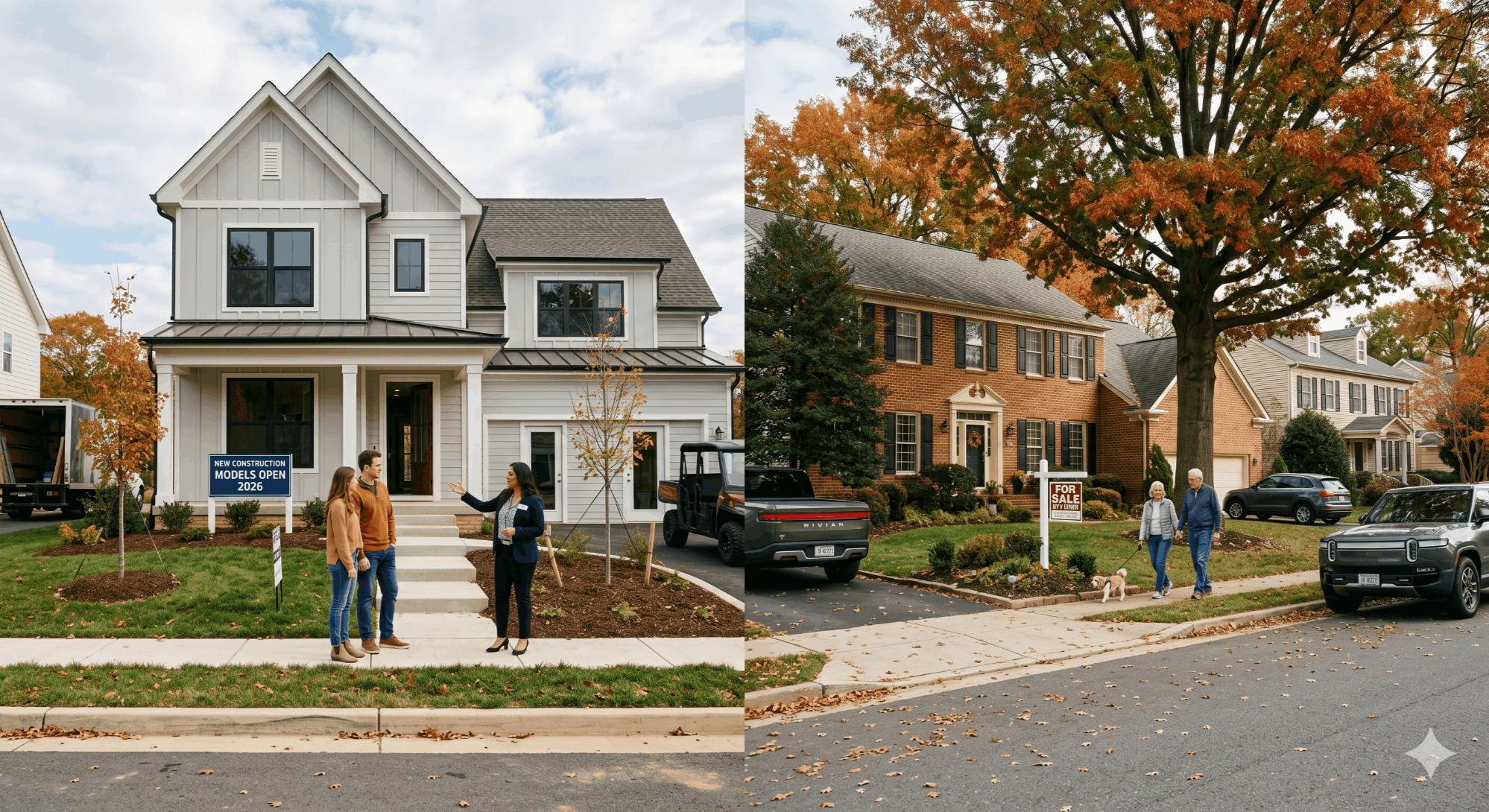
Quick Answer: In Northern Virginia's 2026 market, new construction homes typically carry a 10-18% price premium over comparable resales, with the trade-off being modern layouts, warranty coverage, and builder incentives (especially on rate buydowns). Resale homes offer established neighborhoods, mature trees, negotiable pricing, and faster closings, but often require updates and have no structural warranty. The right choice depends on your timeline, location priorities, and tolerance for renovation.
Key Takeaways
- New construction in NOVA typically commands a 10-18% premium, but builder rate buydowns and closing-cost credits can offset 1-3 points of interest for qualified buyers.
- Resale homes in Fairfax and Arlington often sell within 7-14 days and frequently above list price; negotiation leverage is lower but the inventory is broader.
- Builder contracts are builder-friendly by default. A buyer's agent representing you (not the builder) protects your earnest money, inspection rights, and upgrade pricing.
- Property taxes on new construction often reset higher after the first assessment cycle, so budget for a 15-25% tax increase in year two.
- Loudoun County leads NOVA for new construction inventory; Arlington, Alexandria, and inner Fairfax lead for resale activity.
- Both paths have hidden costs (HOA capitalization fees, transfer taxes, builder upgrade markups) that can add $10,000-$40,000 to your total cost.
In This Guide
- The Northern Virginia Market in 2026
- What Counts as New Construction vs. Resale
- Pricing Reality: Side-by-Side Comparison
- Pros and Cons of New Construction
- Pros and Cons of Resale Homes
- Hidden Costs Buyers Miss
- What You Can Actually Negotiate
- Builder Lenders vs. Independent Financing
- Warranties, Inspections, and Due Diligence
- Best NOVA Areas for New Construction
- Best NOVA Areas for Resale Value
- How to Decide: A Buyer's Framework
- Frequently Asked Questions
- Glossary
Buying a home in Northern Virginia in 2026 comes down to one of the most consequential choices on the market: should you buy new construction with a builder warranty, modern layout, and builder incentives or a resale home with established character, mature landscaping, and a proven neighborhood? Both paths can be the right call. Neither is universally better. The difference in a typical NOVA purchase can be $75,000+ in total cost, months of timeline, and a very different post-closing experience which is exactly why the right Northern Virginia real estate agent makes all the difference in getting it right.
This guide walks through the real pricing data, the pros and cons buyers usually find out too late, the negotiation leverage in each path, and the financing traps to avoid, all based on current NOVA market conditions in 2026. We'll cover the counties where new construction inventory is actually available, the resale markets with the strongest long-term appreciation, and the decision framework we use with our own buyer clients. By the end, you'll know which path fits your budget, timeline, and lifestyle, and what to ask before you sign anything.
The Northern Virginia Housing Market in 2026
Northern Virginia entered 2026 with one of the tightest inventory pictures in a decade. Active resale listings across Fairfax, Loudoun, Arlington, Prince William, and Alexandria are sitting roughly 30-45% below the 2019 baseline, and median days on market for well-priced resale homes in close-in Fairfax and Arlington remains under two weeks.
New construction has stepped in to absorb some of that demand, particularly in Loudoun County, eastern Prince William, and western Fairfax, but builder pipelines cannot match the supply gap. Steady job growth across the Dulles Technology Corridor, federal and defense employment, and continued expansion along the Metro Silver Line keep buyer demand high and inventory turning over quickly. The result is a market where both paths carry competitive pressure, just different kinds.
Interest rates in early 2026 have settled into the mid-6% range on 30-year conventional loans, with builders aggressively buying rates down to the high 4s and low 5s through their preferred lender partnerships. Resale sellers rarely match that, which is the single most important pricing dynamic in the current market: builders are competing on monthly payment, not sticker price. For a buyer focused on affordability, that distinction reshapes the math, and it is worth mapping out what your budget buys new vs. resale before you start touring.
| Market Indicator | New Construction (2026) | Resale (2026) |
|---|---|---|
| Median list price (NOVA) | $865,000-$1.15M | $745,000-$925,000 |
| Median days on market | 45-90 (contract to delivery varies) | 9-16 days |
| Typical negotiation room | Incentives over price (rate, closing credits) | Price, repairs, closing cost credits |
| Builder rate buydown (typical) | 1.0-2.5 percentage points | Rare, seller-funded only |
| Closing cost credit | $10,000-$25,000 (builder-tied) | $5,000-$15,000 (negotiated) |
| Typical move-in timeline | 2-12 months | 30-45 days |
Inventory distribution is also uneven. If you want new construction inside the Beltway, you're almost entirely limited to high-end custom builds and a handful of infill townhome projects. New single-family production at scale is happening in Loudoun (Brambleton, Ashburn, Aldie), western Fairfax (Centreville, Chantilly), and eastern Prince William (Haymarket, Gainesville, Manassas). Resale is the only path if you're anchored to Arlington, Alexandria, Vienna, McLean, or close-in Fairfax.
Before you tour a single home or sign a builder contract, know your budget, your timeline, and your negotiation position. Our buyer strategy session is free and covers both new construction and resale paths side by side.
What Counts as New Construction vs. Resale
The terms get fuzzy in practice, so it's worth anchoring them. These categories have different contracts, different financing paths, and different buyer protections.
New Construction Subtypes
To-be-built (spec-to-order): You select a lot and floor plan, then customize finishes. Delivery is typically 6-12 months. This is the path that gives you the most control over finishes but the least price flexibility.
Inventory (spec) homes: The builder is already framing or has completed a home without a specific buyer. These close faster (30-90 days) and carry the strongest incentives because builders want them off the books before quarter-end.
Quick move-ins (QMI): Completed or near-complete inventory homes ready in under 60 days. These are the builder equivalent of "motivated seller" listings. The strongest deals on new construction in NOVA almost always come from QMIs at the end of a builder's fiscal quarter.
Custom builds: You own or buy the lot and hire a builder. These run 12-24 months and require separate construction-to-perm financing. A very different transaction, so we treat it as its own category and don't include it in the production-builder comparisons in this guide.
Resale Subtypes
Recent resale (under 10 years old): Modern systems, energy efficiency close to new construction, often still within transferable warranty windows. This is where buyers priced out of new construction find the best near-new experience.
Mid-age resale (10-30 years): The bulk of NOVA inventory. Established neighborhoods, mature landscaping, and a settled community feel define this tier, and established resale communities like Virginia Run in Centreville are a clear example. Homes in this range typically require HVAC, roof, or kitchen updates within the ownership window.
Vintage/historic resale (30+ years): Arlington, Alexandria, McLean, and inner Fairfax have significant inventory in this category. Charm, location premium, and often land value over structure value, but inspection scrutiny is critical.
Pricing Reality: New Construction vs. Resale Cost Comparison
The sticker-price premium for new construction is real, but it's not the whole story. The table below compares a typical 4-bedroom, 2,800-3,200 sq ft single-family home in two NOVA submarkets where both options exist.
| Cost Component | New Construction (Ashburn/Brambleton) | Resale (Ashburn, 8-yr-old home) |
|---|---|---|
| Base price | $985,000 | $855,000 |
| Lot premium / location premium | $25,000-$60,000 | Built into price |
| Structural upgrades (morning room, sunroom, finished basement) | $35,000-$90,000 | Included if existing |
| Finish upgrades (flooring, cabinets, counters, fixtures) | $40,000-$120,000 | Varies, buyer can update later |
| Builder closing-cost credit | −$10,000 to −$25,000 | Negotiable: −$5,000 to −$15,000 |
| Rate buydown value (PV) | −$15,000 to −$40,000 | Rarely available |
| HOA capital contribution | $1,500-$4,000 | $500-$2,000 (resale cap fee) |
| Estimated near-term repairs / updates | $0 (warranty coverage) | $8,000-$30,000 (typical) |
| Estimated all-in cost (first 24 months) | $1.03M-$1.16M | $870K-$930K |
Two takeaways jump out. First, the new construction "premium" once all upgrades are factored is typically larger than the base-price comparison suggests: $100K-$200K once finishes are chosen. Second, builder incentives materially reduce the monthly payment burden even when the total price is higher. A buyer planning to hold the home 7+ years may actually come out ahead on a 30-year basis with new construction if the rate buydown saves enough interest over the first 5-7 years.
Monthly Mortgage Payment Comparison (Illustrative)
Based on 20% down, P&I only. New construction loan amount $800K, resale loan amount $684K.
The math changes by submarket. In Loudoun County's higher-volume new construction zones, builder incentives are stronger. In inner Fairfax and Arlington, where new construction is rare and resale is the dominant path, the comparison isn't really available; you're choosing between resale homes, not between paths.
Pros and Cons of New Construction Homes
| ✓ Pros | ✗ Cons |
|---|---|
| Structural and systems warranty (typically 1/2/10 year) | 10-18% base price premium over comparable resale |
| Modern energy-efficient systems (lower utilities) | Upgrade pricing from builders is 40-70% above market cost |
| Customize floor plan, finishes, lot orientation | Limited geography, mostly outer NOVA submarkets |
| Aggressive builder rate buydowns (1-2.5 points) | Construction delays can extend 2-6 months beyond estimate |
| No prior owner wear, no deferred maintenance | Builder contracts protect the builder, so buyer protections are minimal unless negotiated |
| Larger closing-cost credits through preferred lender | Mature landscaping, fencing, window treatments typically not included |
| Modern open layouts, smart-home pre-wiring | Property tax assessment resets higher after year one |
| Community amenities (pool, clubhouse) in master-planned builds | HOA/HOA capital contribution fees often higher in new communities |
ℹ️ Builder Upgrade Markup Reality
A builder may charge $18,000 for a kitchen island upgrade that a local contractor would install post-closing for $6,000-$8,000. Two categories are worth paying the builder premium on: structural upgrades (you can't add a morning room later without major cost) and anything behind drywall (rough-in plumbing, electrical circuits, basement finishing). Everything else (flooring, cabinets, backsplash, fixtures, paint) is usually cheaper to do after closing.
Pros and Cons of Resale Homes in Northern Virginia
| ✓ Pros | ✗ Cons |
|---|---|
| Lower base price than comparable new construction | Compressed days-on-market, fast decisions required |
| Established neighborhoods, mature trees, known schools | Frequent multiple-offer situations in inner NOVA |
| Full negotiation leverage (price, repairs, credits, contingencies) | Updates/renovations usually needed in first 1-5 years |
| Access to locations unavailable in new construction (Arlington, Alexandria, Vienna) | Older systems (HVAC, roof, water heater) nearing replacement |
| Faster closing, typically 30-45 days | No structural warranty, buyer assumes all risk |
| Fenced yards, landscaping, window treatments typically included | Dated layouts (walled-off kitchens, smaller bathrooms) |
| Proven track record of appreciation in established submarkets | Energy efficiency typically lower than new construction |
| Broader lot and architectural variety | Potential hidden issues (radon, mold, galvanized pipes, polybutylene) |
Browse live Northern Virginia listings, including new construction, quick move-ins, and resale inventory, updated every 15 minutes directly from Bright MLS.
Hidden Costs Buyers Miss in New Construction and Resale
Both paths have cost categories that don't show up in the advertised price. Budgeting for these up front prevents the "I didn't know that was extra" surprise at closing.
New Construction Hidden Costs
Items not typically included in base price
- ✓ Lot premium ($15,000-$75,000 for corner, wooded, or cul-de-sac lots)
- ✓ HOA capital contribution / initiation fee ($1,500-$4,000)
- ✓ Rear yard fencing ($6,000-$15,000)
- ✓ Window treatments / blinds ($3,000-$10,000)
- ✓ Landscaping beyond builder's basic package ($4,000-$20,000)
- ✓ Appliance upgrades (refrigerator often not included)
- ✓ Year-two property tax reset (15-25% increase typical)
- ✓ Structural upgrades priced 40-70% above market replacement cost
Resale Hidden Costs
Common post-purchase costs in NOVA
- ✓ HVAC replacement on 15+ year systems ($8,000-$15,000)
- ✓ Roof replacement on 20+ year roofs ($12,000-$25,000)
- ✓ Kitchen refresh ($15,000-$60,000)
- ✓ Radon mitigation if above 4 pCi/L ($1,200-$2,500)
- ✓ Water heater replacement ($1,800-$3,500)
- ✓ Polybutylene or galvanized pipe replacement (if present)
- ✓ Resale HOA capital/working capital fees ($500-$2,000)
- ✓ Cosmetic updates (paint, flooring, lighting: $8,000-$25,000)
What You Can Actually Negotiate: New Construction vs. Resale
This is where the two paths diverge most sharply. Knowing what's on the table, and what isn't, before you open negotiation protects your position.
New Construction Negotiation Levers
Production builders rarely reduce base price, because doing so lowers the appraised value of every other home in the community and is contractually avoided. But they will move aggressively on:
Builder concessions available to informed buyers
- ✓ Closing cost credits (through preferred lender, $10K-$25K typical)
- ✓ Rate buydown (permanent or temporary 2-1 buydown)
- ✓ Included upgrade packages (flooring, blinds, appliance upgrades)
- ✓ Upgraded structural options at reduced cost on QMIs
- ✓ Finished basements or decks at cost or reduced markup
- ✓ Extended warranty enhancements
- ✓ Lot premium waivers on slower-moving homesites
⚠️ The Agent Registration Rule
Every major builder requires your agent to be present and registered on your first visit to the community. If you walk in alone, the sales counselor, who works for the builder, becomes your only point of contact. You lose independent representation and typically lose access to full negotiation on incentives. This is the single most common and costly mistake buyers make with new construction.
Resale Negotiation Levers
Resale in NOVA has been a seller's market for most of the past five years, but 2026 conditions vary sharply by submarket. Homes sitting over 30 days, often because they were overpriced or showed poorly, give buyers substantial leverage. In competitive close-in markets, negotiation is less about price and more about structuring an offer that wins, often with escalation clauses and appraisal gap coverage.
| Market Condition | What You Can Negotiate |
|---|---|
| Fresh listing, multiple offers | Very little: escalation clauses, clean contract, shorter contingencies |
| 7-14 days on market, one price reduction | Price (1-3%), closing costs, appliance credits |
| 30+ days on market | Price (3-8%), repairs, closing costs, rate buydown credit |
| 60+ days, price-dropped twice | Significant price, post-inspection repairs, home warranty, settlement concessions |
| Off-market / coming soon | Access before competition, which requires an agent with network leverage |
Builder-Preferred Lenders vs. Independent Financing
The single largest financial difference between the two paths is how financing works. Builders almost always incentivize use of their preferred lender. The incentives are real, but so are the trade-offs.
How Builder Preferred-Lender Programs Work
Most major builders offer $10,000-$25,000 in closing cost credits, plus aggressive rate buydowns, if you use their in-house or captive lender. The mechanism is straightforward: the builder is effectively discounting the home by routing the discount through closing costs, which keeps the sale price intact on county records (protecting other homes in the community).
The credits are genuine. But the preferred lender's base rate and fees are rarely the market's best: typically 0.125-0.375 percentage points higher than an independent lender, plus $1,500-$3,500 in extra origination fees. You have to run the math both ways to know which path nets better.
When the Builder Lender Wins
When builder incentives are worth $15,000+ and you'll hold the home less than 7 years, the closing-cost credit almost always beats the lower-rate independent path on total-cost math.
When an Independent Lender Wins
On a 15+ year hold, or when your credit profile qualifies you for premier pricing, an independent lender's lower rate will out-earn the builder credit within 4-6 years. The discipline is not to accept the builder's first lender offer without a side-by-side comparison.
For resale, there's no such dynamic; you choose your lender on its own merits. Our team works with both independent mortgage brokers and preferred builder lenders so clients can see both offers before committing.
Builders and competitive resale sellers both expect a pre-approval letter before you negotiate. A 20-minute pre-approval locks in your buying power and positions you as a serious buyer.
Warranties, Inspections, and Due Diligence for New and Resale Homes
Buyers often assume new construction skips the need for an inspection. That's the most costly assumption in the entire new-home process.
The 1/2/10 Builder Warranty
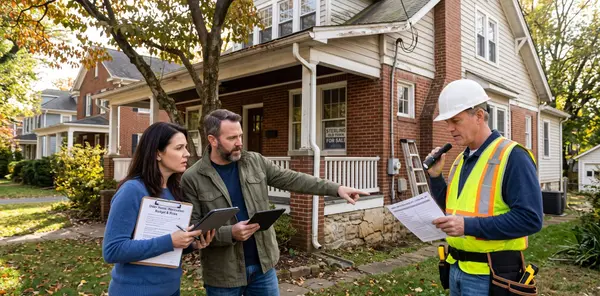
Most NOVA production builders offer what's known as a 1/2/10 warranty: 1 year on workmanship and materials, 2 years on systems (HVAC, plumbing, electrical), and 10 years on major structural defects. Coverage varies by builder and always excludes finishes and consumables. The warranty is meaningful but not a substitute for independent inspection.
Pre-drywall Inspection: Week 8-12 of construction
Independent inspector verifies framing, plumbing rough-in, electrical, insulation, and HVAC ductwork before drywall hides everything. Typical cost: $400-$600.
Final Walkthrough Inspection: Before closing
Full home inspection identifying finish defects, punch-list items, and systems performance. Documented report goes to the builder for warranty remediation. Typical cost: $500-$800.
11-Month Warranty Inspection: Month 10-11 post-closing
Timed before the 1-year workmanship warranty expires. Identifies settling cracks, door/window adjustments, grading issues, and HVAC balance problems. Typical cost: $400-$500. This inspection regularly surfaces $3K-$10K in warranty-covered repairs.
Resale Inspection: Within 7-10 days of contract
Standard for resale transactions. Full home inspection plus radon, well/septic if applicable, and specialty inspections (chimney, pool, termite) as warranted. Typical cost: $450-$700 + specialty add-ons.
Best NOVA Areas for New Construction in 2026
New construction in Northern Virginia clusters where developable land and infrastructure capacity meet. These are the submarkets with active builder inventory in 2026, where newer Loudoun communities like Willowsford continue to release home sites alongside established master-planned neighborhoods:
| Area | County | Builder Activity | Typical Price Range |
|---|---|---|---|
| Brambleton | Loudoun | High, master-planned | $900K-$1.5M |
| Ashburn | Loudoun | High, townhome & SFH | $750K-$1.4M |
| Aldie / South Riding | Loudoun | High, new sections opening | $850K-$1.4M |
| Haymarket / Gainesville | Prince William | Medium, SFH-dominant | $700K-$1.2M |
| Centreville / Chantilly | Fairfax | Medium, infill townhomes | $850K-$1.3M |
| Leesburg (outer) | Loudoun | Medium, lifestyle communities | $800K-$1.3M |
| Manassas / Bristow | Prince William | Medium, value-tier builders | $625K-$950K |
| Herndon | Fairfax | Low, limited infill projects | $900K-$1.4M |
Best Northern Virginia Areas for Resale Value
Resale dominates the close-in NOVA market, and these areas consistently deliver the strongest long-term appreciation. They're also the areas where new construction is either unavailable or priced at luxury-tier premiums.
| Area | Why Buyers Choose It | Typical Price Range |
|---|---|---|
| Arlington (North & South) | Metro access, top schools, strong appreciation | $825K-$2.5M+ |
| Alexandria (Old Town, Del Ray) | Walkability, historic character, waterfront | $750K-$2M+ |
| McLean | Top-tier schools, privacy, proximity to DC | $1.1M-$3.5M+ |
| Vienna / Oakton | Metro access, sought-after pyramid schools | $950K-$2.2M |
| Reston | Silver Line Metro, lake-front communities | $700K-$1.4M |
| Fairfax (City & inner county) | Value relative to Arlington/McLean, strong schools | $725K-$1.3M |
| Burke / Springfield | Affordability, mature neighborhoods, FFX schools | $625K-$950K |
| Sterling | Value entry point to Loudoun County | $575K-$875K |
How to Decide Between New Construction and Resale: A Buyer's Framework
There's no universal answer, only the right answer for your situation. These five questions resolve the decision for most buyers within 20 minutes:
1. What's your move-in timeline?
If you need to be in the home within 45 days, a resale or quick move-in is your only realistic option. If you can wait 6-12 months, to-be-built opens up broader customization and better incentive timing.
2. What's your location priority?
Arlington, Alexandria, Vienna, McLean, Falls Church, and inner Fairfax are overwhelmingly resale markets. If any of those are on your short list, the new construction conversation is largely moot. Western Fairfax, Loudoun, and Prince William give you both options.
3. What's your renovation tolerance?
Some buyers want turn-key. Some want to customize post-closing. Resale in NOVA usually requires some update work, though it varies widely by home: move-in-ready resale homes in Franklin Farm and other well-kept established communities can arrive nearly turn-key. New construction arrives at close to finished condition, but you pay upfront for that, and the finishes are the builder's standard, not yours.
4. How long will you hold the home?
Short-term holds (under 5 years) favor whichever path has the stronger financing incentive, because sale-price appreciation over the short window is typically small relative to transaction costs. Long-term holds (10+ years) favor location quality over incentives: resale in established NOVA submarkets historically outperforms outer-ring new construction on a 15+ year basis, once you factor in the long-term cost differences in property taxes, utilities, and commuting.
5. What's your monthly payment tolerance vs. your cash-on-hand?
Builder rate buydowns can lower your monthly payment by $600-$1,200 on a typical NOVA purchase. If monthly cash flow is the constraint, new construction incentives can tilt the math. If upfront cash is the constraint, a lower-priced resale home with less upgrade budget may be the better fit.
ℹ️ The Hybrid Approach Most Buyers Miss
Many buyers work both paths in parallel for the first 30-60 days. They identify 2-3 new construction communities where a quick move-in might be available and simultaneously monitor resale in their target submarkets. Whichever path delivers the right home first wins. This approach gives you the best of both inventories without committing early to a single lane.
Frequently Asked Questions
Is new construction or resale cheaper in Northern Virginia in 2026?
Resale is cheaper on base price by 10-18% for comparable square footage in most NOVA submarkets, but the full comparison isn't base price: it's total cost of ownership over your hold period. Builder rate buydowns and closing cost credits can narrow the monthly-payment gap to under $150 per month, and resale homes frequently carry $10,000-$30,000 in deferred repairs that need to be factored in. For most buyers, resale is less expensive upfront; new construction may be less expensive over the first 5-7 years if the builder incentive package is strong.
How much down payment do I need for new construction in Northern Virginia?
Most builders require 5-10% of the base price as earnest money deposit at contract, applied toward your down payment at closing. On conventional loans, 3-5% down is the minimum for first-time buyers; 10-20% down positions you for best rate pricing. VA loans allow 0% down for eligible service members. For a $900,000 new construction home, plan for $45,000-$90,000 in deposits upfront plus closing costs of $18,000-$28,000. Resale transactions typically require only $1,000-$5,000 earnest money at contract, with the balance due at closing.
How long does it take to buy new construction in Northern Virginia?
Quick move-in homes typically close in 30-60 days. To-be-built homes run 6-12 months from contract to delivery, with most NOVA production builders currently running 7-9 months. Construction delays of 30-90 days beyond the original estimate are common, so plan for flexibility in your lease, temporary housing, or sale of a current home. Resale transactions typically close in 30-45 days once under contract.
How do I choose a buyer's agent for new construction?
Evaluate three things: builder-specific experience, local market knowledge, and whether the agent will be present at the community registration visit. The sales counselor at a builder community works for the builder, so you need independent representation that understands how to negotiate builder incentives, what upgrades are worth the markup, and how to read the builder contract's fine print. The Jamil Brothers have represented buyers across every major NOVA builder (Toll Brothers, Van Metre, NVHomes, Brookfield, Drees, Ryan, Stanley Martin) and attend the first community visit to preserve full negotiation leverage. Credentials to look for include NVAR membership, Accredited Buyer's Representative (ABR) designation, and a track record of closed transactions in both new construction and resale.
Do I need to sign a buyer-agent agreement for new construction?
Yes. Following the 2024 NAR settlement, all buyers must sign a written buyer-agent agreement before touring homes, and this applies to both resale and new construction. For new construction, builder cooperation fees (how the builder compensates the buyer's agent) are disclosed upfront and vary by builder and incentive package. A good buyer's agent will show you the builder's cooperation offer in writing before you commit and structure the agreement so your compensation picture is clear from day one. The cost is typically not out-of-pocket to the buyer in new construction; the builder's cooperation offer handles it.
Is Northern Virginia a buyer's or seller's market in 2026?
The inner NOVA resale market (Arlington, Alexandria, McLean, Vienna, inner Fairfax) remains a seller's market in 2026: inventory is tight, days on market are short, and multiple-offer situations are common on well-priced listings. The outer NOVA new construction market (Loudoun, Prince William, western Fairfax) has more balance, with builders competing through incentives rather than selling at list. A skilled buyer's agent reads these conditions by submarket, not by metro average, because what's true for Haymarket is not true for Clarendon.
What mistakes should I avoid when buying new construction?
The four most expensive mistakes: (1) walking into the community without registering your agent first, which eliminates independent representation and usually costs you incentives; (2) skipping the pre-drywall inspection, missing framing or plumbing defects that become hidden behind walls; (3) overpaying for builder finish upgrades that you could install for 30-50% less post-closing; and (4) accepting the preferred lender without running independent rate comparisons, which can cost $8,000-$20,000 over the loan's first seven years. The 11-month warranty inspection is also routinely skipped, so don't miss it.
Do New Construction Areas in Northern Virginia Have Good Schools?
Loudoun County Public Schools (LCPS) is one of the strongest districts in Virginia, and many new construction communities in Ashburn, Brambleton, and Aldie zone into top-rated elementary, middle, and high schools. New schools are built alongside major communities, but boundaries are redrawn periodically as growth continues, so a specific school assignment today may shift. Fairfax County Public Schools (FCPS) carries national reputation but serves mostly resale inventory. Always verify the current school assignment for any specific address with the county school board, and never rely on community marketing materials alone.
How do financing and rate locks work on to-be-built new construction?
Standard rate locks cover 30-90 days, far shorter than a 7-12 month construction timeline. Most NOVA builders offer extended rate lock programs (typically 180-365 days) through their preferred lender, often with a small cost or fee. Some programs include a "float-down" feature allowing you to capture a lower rate if market rates drop before closing. Independent lenders can sometimes match, but the extended-lock programs are usually most competitive through the builder's captive lender. Always request the rate lock terms in writing before signing.
Should I get an inspection on a home inspection contingency even for new construction?
Yes, absolutely. Builder contracts typically do not include a traditional inspection contingency, but they do allow pre-drywall and final walkthrough inspections that generate a punch list the builder is obligated to address under warranty. Skipping these is the single most common new-construction mistake. A qualified new-construction inspector identifies defects that would otherwise surface months or years into ownership: framing errors, improper flashing, HVAC sizing issues, and electrical code deviations. The inspection cost ($400-$800) is trivial compared to what it catches.
What's the property tax difference between new construction and resale?
New construction often carries a lower property tax bill in year one because the county assesses based on land value only until the home is complete. After the first full assessment cycle, the tax bill typically rises 15-25% as the completed structure is added to the assessed value. Resale homes have already been through multiple assessment cycles, so the tax picture is stable and predictable from day one. Budget for the year-two increase on new construction, since it catches many buyers off guard.
Glossary
QMI (Quick Move-In)
A near-complete or completed spec home available from a builder for a 30-90 day close. Usually carries the strongest builder incentives.
Rate Buydown
A builder-paid concession that lowers the buyer's mortgage interest rate, either permanently or temporarily (often a "2-1" structure: 2 points lower year 1, 1 point lower year 2).
1/2/10 Warranty
Standard new-home warranty: 1 year on workmanship/materials, 2 years on mechanical systems, 10 years on major structural defects.
Lot Premium
An additional price charged by a builder for preferred home sites: corner lots, wooded lots, cul-de-sac locations, or lots backing to open space.
HOA Capital Contribution
A one-time fee collected from new buyers that funds the homeowners association's reserve account. Typical range: $500-$4,000.
Pre-Drywall Inspection
An independent inspection of framing, plumbing, electrical, HVAC rough-in, and insulation performed before drywall installation, the only time to verify what's behind the walls.
Builder Preferred Lender
A mortgage lender (often captive or affiliated) offered by the builder with closing-cost credits and rate incentives tied to its use.
11-Month Warranty Inspection
An inspection timed just before the 1-year workmanship warranty expires, designed to surface warranty-covered repairs before coverage ends.
Explore NOVA Community Guides
Ashburn Leesburg Sterling Fairfax McLean Vienna Reston Herndon Centreville Chantilly Alexandria Prince WilliamThe Bottom Line for 2026 Buyers
There's no universally "better" path. New construction wins on warranty, modern efficiency, and builder financing incentives, particularly for buyers who value turn-key condition and can absorb a 6-12 month timeline. Resale wins on location, negotiation leverage, speed to close, and access to established neighborhoods that production builders simply can't replicate. The right choice depends on your priorities, and for most NOVA buyers, the decision is made clearer by walking through both inventories in parallel during the first month of your search.
Whatever path you choose, independent representation matters. A buyer's agent working for you (not for the builder, not for the listing seller) structures your contract, preserves your inspection rights, reads the fine print on warranties and lender programs, and makes sure your earnest money is protected. Our team has represented NOVA buyers across every major production builder and across resale submarkets from Arlington to Leesburg, with 840+ closed transactions, $500M+ in closed volume, and NVAR Lifetime Top Producer recognition backing the work.
Before you register at a builder community or tour a resale home, get a 45-minute strategy session covering your budget, financing options, target submarkets, and negotiation position. No pressure, no obligation, just a clear plan built around your situation.
Questions? Call The Jamil Brothers at (703) 782-4830 or schedule your free buyer consultation online.
Explore More
Browse Every Corner of the DMV Market
Whether you're searching by budget, neighborhood, or buying situation, find exactly what you need below.
Virginia Homes by Budget
Washington DC Homes by Budget
Maryland Homes
Explore Northern Virginia Communities
Loudoun County
Fairfax County & Surrounding
Ready to Make a Move?
Full-Service · No Tradeoffs
List for 1.5% & Keep More Equity
Professional photography, drone video, 3D tours, and expert negotiation, all included. On an $800K home, that's $12,000 more in your pocket vs. a 3% agent.
See the 1.5% Program →Need Speed or Certainty?
Get a No-Obligation Cash Offer
Skip the showings, skip the contingencies. If timing or condition matters more than top dollar, a cash offer may be the right fit. We'll walk you through every option.
Explore Cash Offers →Categories
- All Blogs (1177)
- Aldie (3)
- Ashburn (6)
- Buyer Guide (8)
- Buying a home (2)
- Buying Strategies (29)
- festivals (1)
- General Blog (66)
- Leesburg (5)
- Market Intelligence (29)
- Market Updates (8)
- Notable Properties For Sale (29)
- Real Estate Tips, News, and More (376)
- Seller Guide (2)
- Seller Guides (60)
- Selling Your Home (487)
- Sterling (6)
- Top Realtors in Northern Virginia (58)
Recent Posts

Message Sent!
Thank you for reaching out. Arslan & Saad have received your details and will be in touch shortly.
Need immediate assistance? Call or text 703-782-4830.