How Do You Sell an Inherited Home in West Virginia?
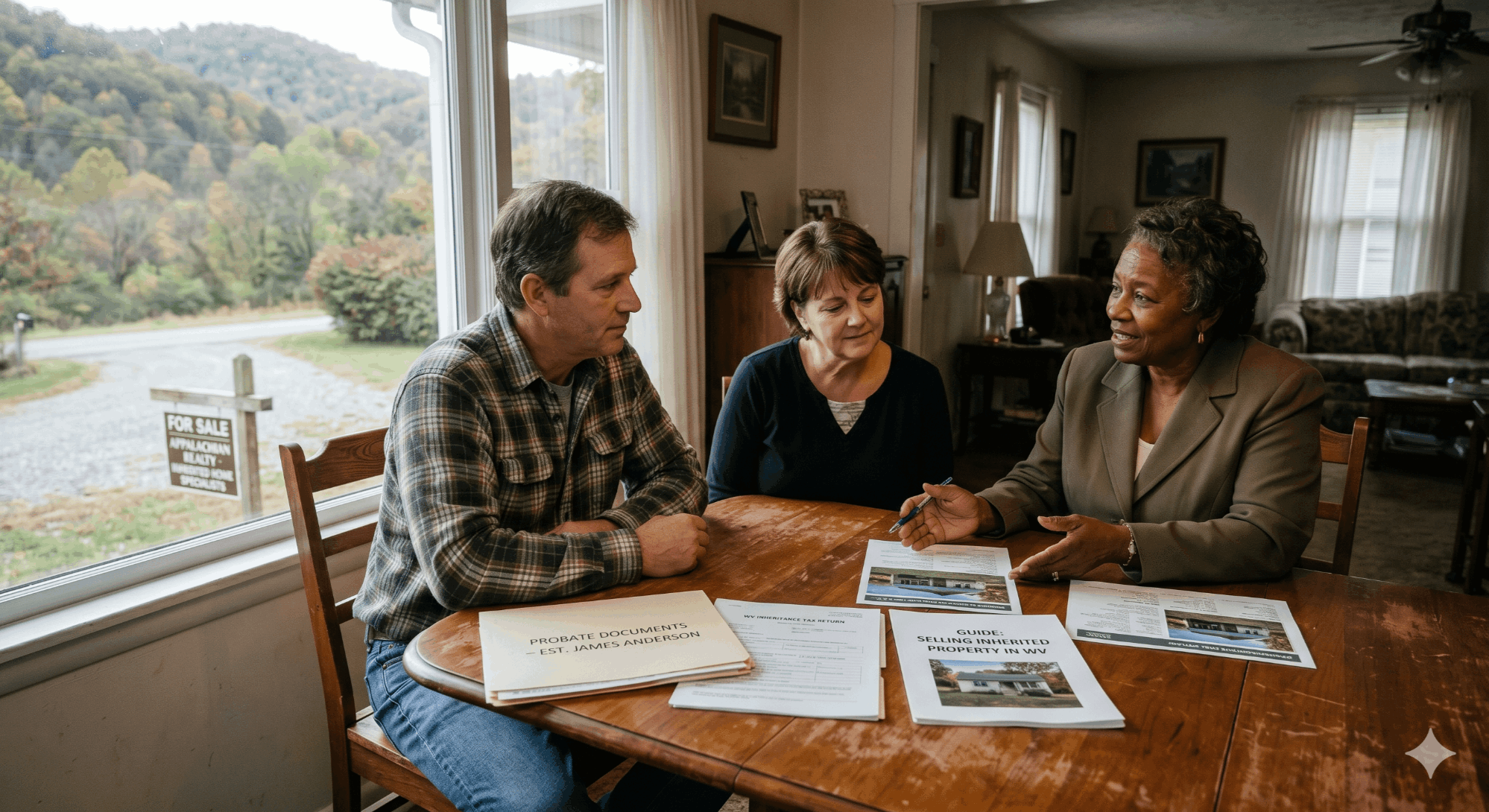
Quick Answer: To sell an inherited home in West Virginia, the estate typically must open probate with the County Commission where the decedent lived, appoint a personal representative, and receive legal authority to sign the deed. West Virginia has no state inheritance or estate tax, federal step-up in basis usually eliminates capital gains, and small estates under $100,000 can often bypass full probate using a WV Small Estate Affidavit. Most heirs close on the sale within 4 to 9 months from the date of death.
Key Takeaways
- WV probate runs through the County Commission, not a circuit court, which simplifies and speeds the process compared to Virginia or Maryland.
- No West Virginia inheritance tax and no state estate tax. Only federal estate tax applies, and only to estates above roughly $13.99 million (2026).
- Federal step-up in basis usually eliminates most capital gains, you inherit the property at fair market value on the date of death, not the original purchase price.
- Small Estate Affidavit under WV Code §44-3A can bypass full probate when total probate assets (real and personal) don't exceed $100,000.
- WV deed excise (transfer) tax is $1.10 per $500 of value at the state level, plus an optional county match, total ranges from $2.20 to $4.40 per $500 depending on the county.
- Inherited homes often have tight margins. A 1.5% full-service listing fee protects more of the estate's equity for heirs than a traditional 3% commission.
In This Guide
- How Probate Works in West Virginia
- When Can You Sell? During or After Probate
- Tax Implications for Heirs
- WV Closing Costs & Transfer Taxes
- Estate Savings Calculator: 1.5% vs 3%
- Preparing an Inherited WV Home for Sale
- Sale Strategy: Listing, Cash Offer, or As-Is
- Multiple Heirs: Disputes & Buyouts
- How to Choose a WV Listing Agent
- Common Mistakes to Avoid
- Frequently Asked Questions
- Glossary
Inheriting a home in West Virginia almost always arrives bundled with grief, paperwork, and a calendar full of decisions that feel urgent. Whether the property sits in the Eastern Panhandle along the I-81 corridor, the mountain valleys around Charleston or Morgantown, or a quiet town in Berkeley, Jefferson, Kanawha, or Monongalia county, the mechanics of selling an inherited home work differently in West Virginia than they do across the river in Virginia or up in Maryland. An experienced West Virginia real estate agent who handles inherited property knows how those local probate timelines and county recording rules actually play out. As a real estate team serving West Virginia and the wider DMV, we help heirs navigate every step from probate to closing.
West Virginia's probate system runs through the County Commission, not a circuit court judge. The state levies no inheritance tax and no estate tax. Small estates can bypass full probate entirely. And when it comes time to actually list the home, the buyer pool, pricing dynamics, and transfer tax structure are all unique to West Virginia, not copy-paste from the DMV playbook.
This guide walks you through every stage: the probate steps that must come before a deed can be signed, the tax rules that usually protect you, the closing-cost math that matters for your final check, and the listing strategy that keeps the most money in your family. Our team is licensed in West Virginia and handles inherited property sales regularly, including absentee-heir situations where owners live out of state.
How Probate Works in West Virginia
Probate is the legal process of validating a will (if one exists), paying the decedent's debts, and transferring assets to heirs. In West Virginia, probate is handled at the county level by the County Commission and its designated fiduciary commissioner or county clerk, not by a separate probate or circuit court. This is one of the more streamlined probate systems in the region.
Before you can legally sell an inherited home, the estate generally needs to go through one of three tracks: a Small Estate Affidavit, Administration of a Small Estate, or full probate administration.
The three probate tracks in West Virginia
| Probate Track | When It Applies | Typical Timeline |
|---|---|---|
| Small Estate Affidavit (WV Code §44-3A) | Total probate assets ≤ $100,000; waiting period after death | 30 to 90 days |
| Administration, Small Estate | Estates under the short-form threshold; no complex creditor issues | 3 to 6 months |
| Full Probate Administration | Higher-value estates, contested wills, multiple heirs, creditor claims | 6 to 12 months (sometimes longer) |
Many inherited homes in West Virginia, particularly in rural counties where a long-held family property may be the primary asset, qualify for the Small Estate Affidavit or short-form administration. That dramatically shortens the wait before you can list and close on a sale.
What happens at the County Commission
File the Will (if any) and Petition, Week 1 to 2
The nominated executor or a family member files the original will and petition with the county clerk in the county where the decedent lived. If there's no will, the estate is intestate and the court appoints an administrator.
Letters Testamentary or Letters of Administration, Week 2 to 4
The County Commission issues official letters giving the personal representative legal authority to act. This document is what title companies require before any deed can be signed.
Notice to Creditors & Appraisement, Month 1 to 3
Publication in a local newspaper opens the creditor claim period. The representative files an appraisement inventory, the home's fair market value as of date of death, which establishes the stepped-up cost basis.
List & Sell the Home, Month 2 to 8
In most WV estates, the personal representative can list and sell the home once Letters are issued, often while the rest of probate is still running. The sale proceeds become part of the estate.
Final Accounting & Closing, Month 6 to 12
After debts, taxes, and expenses are paid, the representative files a final accounting and the County Commission approves distribution to heirs.
ℹ️ WV vs. Virginia vs. Maryland probate
West Virginia's County Commission system generally moves faster than Virginia's circuit court Commissioner of Accounts process and the Maryland Register of Wills pathway. Expect fewer formal hearings and lower administrative overhead in WV, but the fundamental requirement for Letters before deed transfer is the same.
When Can You Sell? During or After Probate
The short answer: you usually can sell during probate, as soon as Letters Testamentary or Letters of Administration are issued. You rarely need to wait until the estate is closed. That's a critical point because waiting 9 to 12 months on a vacant property means 9 to 12 months of carrying costs, taxes, insurance, utilities, and depreciation risk from no one living there.
Two pathways to a sale
| Pathway | How It Works | Best When |
|---|---|---|
| Sell during probate | Personal representative signs the listing agreement and deed on behalf of the estate using Letters as authority. | Home is vacant; heirs want faster resolution; carrying costs are mounting. |
| Distribute, then sell | Estate deeds the home to heirs individually (or into a trust) and those heirs sell as direct owners. | Heirs want to occupy or rent temporarily; estate closes faster with real estate already distributed. |
Most of the inherited WV sales our team handles close during probate. It's cleaner for the title company, faster for the heirs, and keeps the sale proceeds flowing through the estate account for clean accounting at the end.
Whether you need the date-of-death value for probate appraisal or a current list-price recommendation, we provide a personalized valuation, comp-based, not an automated guess. Licensed in West Virginia and responsive to out-of-state heirs.
Tax Implications for Heirs Selling WV Property
The good news: the tax picture for heirs selling an inherited West Virginia home is usually much better than sellers expect. Three rules, no WV inheritance tax, federal step-up in basis, and a high federal estate tax exemption, typically combine to produce a minimal or zero tax bill on the sale.
1. West Virginia has no inheritance or estate tax
West Virginia repealed its state inheritance tax and estate tax years ago. Whether the home is worth $150,000 or $1.5 million, no state-level death tax applies. This is a significant difference from states like Maryland, which still impose both an estate tax and a separate inheritance tax on some heirs.
2. Federal step-up in basis usually eliminates capital gains
Under federal law (IRC §1014), when you inherit real estate, your cost basis "steps up" to the fair market value on the date of the decedent's death, not what they originally paid for it. So if your father bought a home in Martinsburg for $60,000 in 1990 and it's worth $320,000 when he passes in 2026, your inherited cost basis is $320,000.
If you sell within a reasonable window for around that same $320,000, your capital gain is effectively zero, even though the home appreciated $260,000 over the decades. That's why the date-of-death appraisal value recorded in the WV estate appraisement matters so much.
Step-up basis, quick example
- Decedent purchased home in 1988: $52,000
- Fair market value at date of death (2026): $295,000
- Heir's stepped-up basis: $295,000
- Sale price in 2026: $300,000
- Taxable capital gain: $5,000 (not $248,000)
3. Federal estate tax: exemption is high
The federal estate tax only applies to estates exceeding approximately $13.99 million in 2026. The vast majority of West Virginia estates fall well below this threshold and owe no federal estate tax whatsoever. If the total estate value is above the exemption, the executor files IRS Form 706, and a tax professional should be engaged, but for a typical family home in Charleston, Morgantown, Huntington, Wheeling, or the Eastern Panhandle, this is rarely a concern.
4. Income tax on the sale itself
If the sale price exceeds the stepped-up basis, the difference is a long-term capital gain, taxed federally at 0%, 15%, or 20% depending on the heir's total income (inherited assets are automatically considered long-term regardless of how long you held them). West Virginia's state income tax also applies to the gain portion for WV residents and non-residents who sell WV real estate, with rates ranging roughly from 2.22% to 4.82% depending on income bracket.
⚠️ Tax advice disclaimer
This guide describes general rules only. Every estate is different. Always consult a CPA or estate attorney for your specific situation before making decisions with tax implications. Our team can coordinate introductions to trusted West Virginia estate professionals.
WV Closing Costs & Transfer Taxes for Sellers
West Virginia sellers generally pay fewer and smaller closing-side taxes than Virginia or Maryland sellers, but the cost structure across the West Virginia real estate market is different from what Northern Virginia home sellers are used to. Here's the breakdown.
WV deed excise tax (transfer tax)
West Virginia charges a state excise tax on real estate transfers of $1.10 per $500 of sale value (equivalent to $2.20 per $1,000). County commissions are authorized to assess an additional amount up to a matching $1.10 per $500. In practice, most West Virginia counties assess the full combined rate, putting total excise tax in the range of $2.20 to $4.40 per $500 depending on the county.
| Sale Price | State Excise ($1.10/$500) | Combined Rate ($4.40/$500) |
|---|---|---|
| $200,000 | $440 | $1,760 |
| $300,000 | $660 | $2,640 |
| $500,000 | $1,100 | $4,400 |
| $750,000 | $1,650 | $6,600 |
By custom (though not by law), the seller typically pays the state portion and the buyer pays the county portion in most WV transactions, but this is negotiable in the contract. Always confirm with your title company early in the transaction.
Full seller closing-cost estimate
| Line Item | Typical Range | Who Pays |
|---|---|---|
| Listing agent commission | 1.5% to 3% of sale price | Seller |
| Buyer's agent commission (post-NAR) | Negotiable, typically 2% to 3% | Negotiable |
| WV deed excise (state portion) | $1.10 per $500 of value | Seller (customary) |
| Deed preparation | $150 to $400 | Seller |
| Estate & probate legal fees | Varies (flat or hourly) | Estate |
| Title search / exam | $150 to $400 | Negotiable |
| Pro-rated property tax | Varies by date | Seller (up to closing) |
| Payoff of any mortgage or liens | Actual balance | Estate / Seller |
For an inherited WV home sold at $300,000 with a standard 1.5% full-service listing + 2.5% buyer-side commission, total seller-side closing costs typically land between 4% and 6% of the sale price, significantly less than comparable VA or MD transactions.
How commission choice affects estate proceeds
In an inherited-property sale, every dollar of the commission comes out of the estate, which means it reduces each heir's inheritance proportionally. A 3% listing fee on a $400,000 home is $12,000. A 1.5% full-service listing fee on the same home is $6,000. That $6,000 difference stays with the heirs, not the brokerage.
The Jamil Brothers Realty Group offers a 1.5% full-service listing program that includes 4K photography, drone video, 3D tours, professional staging consultation, expert negotiation, and full MLS marketing, the same service package that traditional 3% agents provide. Heirs who want to weigh the listing fee against the home's condition and timeline can also review our flexible commission options.
Estate Savings Calculator: 1.5% vs. 3%
Select the home's estimated value to see how much more the estate keeps by listing at 1.5% instead of a traditional 3%. This matters in inherited sales, where proceeds are split among multiple heirs.
Seller Savings Calculator
How much more does the estate keep with our 1.5% listing fee?
Select the inherited home's estimated value to see the real net proceeds, side by side.
Traditional Agent, 3%
Our Fee, Only 1.5%
Extra in the estate
$6,000
vs. a traditional 3% listing agent, with zero reduction in service or marketing.
Traditional Agent, 3%
Our Fee, Only 1.5%
Extra in the estate
$7,500
vs. a traditional 3% listing agent, with zero reduction in service or marketing.
Traditional Agent, 3%
Our Fee, Only 1.5%
Extra in the estate
$9,000
vs. a traditional 3% listing agent, with zero reduction in service or marketing.
Traditional Agent, 3%
Our Fee, Only 1.5%
Extra in the estate
$11,250
vs. a traditional 3% listing agent, with zero reduction in service or marketing.
Traditional Agent, 3%
Our Fee, Only 1.5%
Extra in the estate
$15,000
vs. a traditional 3% listing agent, with zero reduction in service or marketing.
Estimates only. WV excise tax and closing costs vary. Buyer's agent commission is negotiable.
4K photography, drone video, 3D tours, expert negotiation, and full MLS marketing, all included at 1.5%. No hidden fees, no service reductions. More goes to the heirs.
Preparing an Inherited WV Home for Sale
Inherited homes rarely come move-in-ready. Expect deferred maintenance, decades of belongings, and emotional clutter. Here's the practical sequence most of our WV clients follow.
Pre-listing preparation checklist
- ✓ Secure the property immediately, change locks, confirm insurance is in force, set utilities to on.
- ✓ Gather important documents, deed, mortgage statements, tax records, most recent utility bills, HOA documents (if any).
- ✓ Order a date-of-death appraisal, establishes stepped-up basis and supports probate appraisement.
- ✓ Divide personal property, family heirlooms, furniture, vehicles. Do this before any walk-through.
- ✓ Professional cleaning and a junk-haul service, far cheaper than you expect and critical for showings.
- ✓ Targeted repairs only, focus on roof, HVAC, plumbing, and electrical. Skip remodels.
- ✓ Fresh neutral paint where practical, usually the highest-ROI pre-list investment.
- ✓ Confirm no unpaid property tax or utility liens before listing.
Relative effort of common prep strategies
For most inherited WV homes, clean-out plus targeted repairs produces the best effort-to-return ratio. Full renovations rarely recover their cost when the home is going to a new owner within 90 days of listing.
Sale Strategy: Listing, Cash Offer, or As-Is
Heirs usually have three realistic paths to a sale. The right choice depends on condition, timeline urgency, how the home compares to other active listings on the market, and how much effort you're willing (or able) to put in.
| Strategy | Typical Net | Time to Close | Effort |
|---|---|---|---|
| Traditional MLS listing | Highest (100%) | 45 to 75 days | Medium |
| MLS listing, as-is | 85 to 95% | 30 to 60 days | Low |
| Cash offer / iBuyer | 70 to 85% | 7 to 21 days | Very low |
| ✓ When a cash offer makes sense | ✗ When traditional listing wins |
|---|---|
| Major deferred maintenance or foundation issues | Home is in good-to-great condition |
| Heirs are out of state and can't manage showings | Local heir can supervise or a full-service agent handles it |
| Urgent timeline, needs closing in under 3 weeks | Can wait 45 to 90 days for maximum price |
| Co-heirs want certainty over maximum price | Heirs align on maximizing estate value |
If the home needs major work, heirs are scattered across states, or timing trumps price, a cash offer may be right. We'll walk you through your full range of options side-by-side, no pressure.
Multiple Heirs: Disputes & Buyouts
When a West Virginia home passes to multiple heirs, typically siblings, the decision to sell (and the sale process itself) becomes a group project. Most family disputes around inherited real estate fall into one of four buckets.
The four common conflict scenarios
| Scenario | Typical Resolution |
|---|---|
| Some want to sell, some don't | Buyout of non-selling heir at appraised value, or partition action if no agreement |
| Disagreement on list price | Independent appraisal or dual-agent CMAs as tiebreaker |
| One heir living in the home | Buyout, sale-leaseback, or fair-market rent credit arrangement |
| Disagreement on condition of sale (as-is vs. repaired) | Net-sheet modeling of both scenarios, decision by majority or via attorney |
A partition lawsuit should always be the last resort. It's slow, expensive, and fractures family relationships. In nearly every case we've worked through, an independent appraisal combined with a transparent net-sheet comparison is enough to get siblings onto the same page.
Practical buyout math
If one sibling wants to keep the home and two others want to sell, the keeping sibling typically pays each of the others one-third of the home's current fair market value, minus any agreed-upon reductions for deferred maintenance or mortgage balance. A cash-out refinance or home equity loan usually funds this.
ℹ️ Buyout example
Home worth $270,000 with $30,000 mortgage balance. Equity = $240,000. Split three ways = $80,000 per heir. Sibling keeping the home pays each of two other heirs $80,000 to acquire their interest.
How to Choose a WV Listing Agent for an Inherited Home
Not every real estate agent is equipped to handle a probate or estate sale. The pricing, paperwork, and coordination with a title company and estate attorney are different from a standard owner-occupied sale. Use these objective criteria.
Questions to ask any listing agent
- ✓ Are you licensed in West Virginia (and not just the Virginia/Maryland side)?
- ✓ How many probate or estate sales have you closed in the last 24 months?
- ✓ What is the total listing fee? Are there any add-on marketing fees?
- ✓ Do you coordinate with WV title companies and estate attorneys on the seller's behalf?
- ✓ Can you provide a sample net sheet showing my expected proceeds?
- ✓ What does your marketing package include (photography, drone, 3D, MLS)?
- ✓ Can you accommodate out-of-state heirs with remote signings and virtual showings?
The Jamil Brothers Realty Group is licensed in West Virginia, Virginia, Maryland, and Washington, D.C., with over 840 homes sold across the region and a streamlined home selling process designed specifically to help sellers, including heirs, keep more equity. Our team regularly works with out-of-state executors and offers remote coordination for the entire sale process.
Common Mistakes to Avoid
⚠️ The five mistakes we see most often
Selling before Letters Testamentary are issued. Forgetting to cancel the decedent's homeowner's insurance and take out a vacant-home policy. Not ordering a date-of-death appraisal (loses the stepped-up basis documentation). Over-improving the home trying to "honor" the decedent. Agreeing on a listing agent without running the net-sheet numbers for both 3% and 1.5% side by side.
Relative cost of common mistakes
Frequently Asked Questions
How do I sell an inherited house in West Virginia?
To sell an inherited home in West Virginia, the estate must first open probate with the County Commission where the decedent lived. Once Letters Testamentary or Letters of Administration are issued, the personal representative has legal authority to list, contract, and sign the deed. Most inherited homes can be listed within 4 to 8 weeks of filing the estate, even while the rest of probate is still running. The sale proceeds then flow into the estate account for final distribution to heirs.
Does West Virginia have an inheritance tax or estate tax?
No. West Virginia has no state inheritance tax and no state estate tax. Only the federal estate tax applies, and only to estates exceeding approximately $13.99 million in 2026. The vast majority of inherited West Virginia homes generate zero state or federal death-tax liability for the heirs.
How long does WV probate take before I can sell?
West Virginia small estate affidavits can be completed in 30 to 90 days. Short-form administration runs 3 to 6 months. Full administration typically takes 6 to 12 months from filing to final accounting. However, you don't have to wait for probate to fully close. Once Letters Testamentary are issued (usually within 2 to 4 weeks), the personal representative can list and close on the home sale while the rest of the estate winds down.
Do I pay capital gains tax on an inherited home in WV?
Usually very little or none. Federal step-up in basis (IRC §1014) resets your cost basis to the home's fair market value on the date of death. If you sell shortly after inheriting and near that value, your taxable capital gain is typically minimal or zero. Any gain above the stepped-up basis is taxed at long-term federal capital gains rates (0%, 15%, or 20%) plus West Virginia state income tax. Always consult a CPA for your specific situation.
What is the Small Estate Affidavit in West Virginia?
The West Virginia Small Estate Affidavit, under WV Code §44-3A, lets heirs bypass full probate when the total probate estate value (real and personal property combined) does not exceed $100,000 and a waiting period after death has passed. It's a simpler, faster, and less expensive pathway that works well for modest estates where the family home is the primary asset.
What is the transfer tax when selling a WV home?
West Virginia charges a state deed excise tax of $1.10 per $500 of sale value (about $2.20 per $1,000). County commissions can assess an additional match of up to $1.10 per $500, bringing total excise tax to a range of $2.20 to $4.40 per $500 depending on the county. By custom the seller pays the state portion and the buyer pays the county portion, but this is negotiable in the sale contract.
How do I choose a listing agent for an inherited home?
Prioritize West Virginia licensure (required), probate or estate sale experience, a clearly disclosed listing fee, a coordination track record with local WV title companies, and ability to handle remote/out-of-state heirs. Run a net-sheet comparison between any agent you're considering and a 1.5% full-service option before signing. The Jamil Brothers Realty Group is licensed in West Virginia and handles inherited property sales regularly with a 1.5% full-service listing fee that includes the full professional marketing package.
Does the post-NAR settlement affect inherited home sales?
Yes, but only the buyer-side commission. Since the 2024 NAR settlement, buyer agent commission is negotiated separately from the listing fee and is no longer required to be published on the MLS. In West Virginia inherited sales, sellers can still choose to offer buyer-side compensation to attract buyers, or not. The listing fee itself (what the seller pays the listing brokerage) was never affected by the settlement and remains fully negotiable as it always has been.
Can I sell an inherited home as-is in West Virginia?
Yes. Selling as-is is common and fully legal in West Virginia, provided you comply with the state's required Residential Property Disclosure Statement for known material defects. As-is doesn't mean no disclosure, it means you won't make repairs. Buyers can still negotiate, inspect, and walk away. For inherited homes with significant deferred maintenance, as-is listing (or a cash offer) often beats trying to renovate.
What if I live out of state and inherited a WV home?
Out-of-state executors and heirs are routine in West Virginia. You may need to qualify as a non-resident personal representative under WV rules, which sometimes requires appointing a WV resident as a co-fiduciary or posting a bond. A licensed WV listing team can handle property access, inspections, marketing, and showings while you stay remote, with DocuSign used for nearly every signature. Closing itself can be done via remote online notarization or mail-in notarized documents.
What if there are multiple heirs and we disagree?
Most sibling disagreements over inherited WV homes are resolved with an independent appraisal and a transparent net-sheet comparison. Once everyone sees the same numbers, consensus usually follows. If disagreement persists, options include a buyout (one heir buys out the others), a sale-leaseback, or as a last resort a partition action through the circuit court. We strongly recommend avoiding partition litigation, it's slow, expensive, and damaging to family relationships.
How much does selling an inherited home in WV really cost?
Total seller-side costs typically range from 4% to 6% of the sale price, including listing commission (1.5% to 3%), any buyer-side commission (negotiable, typically 2% to 3%), WV state deed excise tax ($1.10 per $500), pro-rated property tax, and miscellaneous title, deed-preparation, and estate legal fees. On a $300,000 WV home sold with our 1.5% full-service program, total seller-side costs often fall in the $12,000 to $18,000 range depending on the buyer-side split and the county.
Glossary
Probate
The legal process of validating a will, paying debts, and distributing assets. Handled by the County Commission in West Virginia.
Letters Testamentary
Official document issued by the County Commission giving the executor legal authority to act on the estate's behalf.
Personal Representative
Person appointed to administer the estate. Called an executor if named in a will; an administrator if none was named.
Step-Up in Basis
Federal tax rule (IRC §1014) resetting the cost basis of inherited property to its fair market value on the date of death.
Small Estate Affidavit
Simplified probate procedure under WV Code §44-3A for estates with total probate assets up to $100,000.
Deed Excise Tax
West Virginia's transfer tax on real estate conveyances. State portion: $1.10 per $500 of sale value.
Appraisement
The official inventory and valuation of estate assets, filed with the County Commission as part of probate.
Partition Action
Lawsuit to force the sale of jointly inherited real estate when co-owners cannot agree on disposition.
Explore More Guides
1.5% Listing Program Seller Net Sheet Free Home Valuation Cash Offers Homes for SaleKnow the home's current value, understand your WV-specific closing costs, and see exactly what the estate walks away with, before any commitments. Licensed in West Virginia, comfortable with remote heirs, and transparent on every number.
The Jamil Brothers Realty Group is licensed in Virginia, Maryland, Washington D.C., and West Virginia. Saad Jamil and Arslan Jamil, associate brokers at Samson Properties, have closed over 840 homes and $500M+ in volume. This guide is for general information only and is not legal, tax, or financial advice, always consult a qualified WV estate attorney or CPA for your specific situation.
Explore More
Browse Every Corner of the DMV Market
Whether you're searching by budget, neighborhood, or buying situation, find exactly what you need below.
Virginia Homes by Budget
Washington DC Homes by Budget
Maryland Homes
Explore Northern Virginia Communities
Loudoun County
Fairfax County & Surrounding
Ready to Make a Move?
Full-Service · No Tradeoffs
List for 1.5% & Keep More Equity
Professional photography, drone video, 3D tours, and expert negotiation, all included. On an $800K home, that's $12,000 more in your pocket vs. a 3% agent.
See the 1.5% Program →Need Speed or Certainty?
Get a No-Obligation Cash Offer
Skip the showings, skip the contingencies. If timing or condition matters more than top dollar, a cash offer may be the right fit. We'll walk you through every option.
Explore Cash Offers →
Categories
- All Blogs (1235)
- Buyer Guide (7)
- Buying a home (2)
- Buying Strategies (30)
- festivals (1)
- General Blog (62)
- Market Intelligence (28)
- Market Updates (7)
- Notable Properties For Sale (32)
- Real Estate Tips, News, and More (396)
- Seller Guides (58)
- Selling Your Home (523)
- Top Realtors in Northern Virginia (58)
Recent Posts








Let's Connect