Selling a Home With Solar Panels in Maryland: Does It Help or Hurt?
Selling a Home With Solar Panels in Maryland: Does It Help or Hurt?
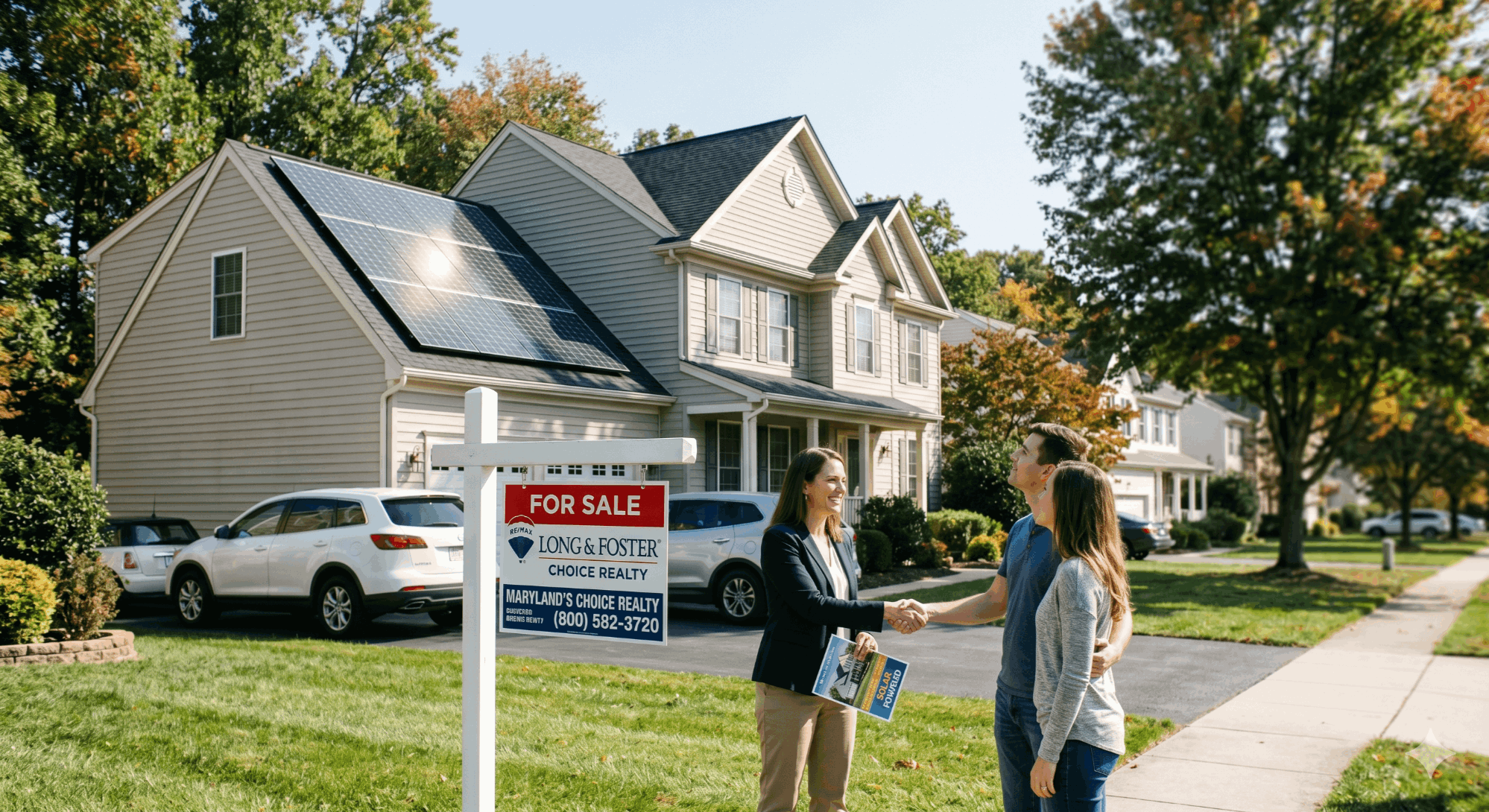
Quick Answer: In Maryland, owned solar panels typically add 3–5% to your home's sale price, thanks to the state's property tax exemption, the active SREC market, and strong buyer demand for energy-efficient homes. Leased systems and active solar loans, however, usually hurt the sale — they create closing delays, financing issues with FHA/VA buyers, and often require a buyout before settlement. The difference between an asset and a liability comes down to one question: who legally owns the panels.
Key Takeaways for Maryland Sellers With Solar
- Maryland is one of the most solar-friendly states in the country — residential solar equipment is 100% exempt from property tax assessment under state law, and there is no state sales tax on solar equipment.
- Owned (paid-off) systems are treated as real property and add measurable value; multiple national studies place the premium at roughly 4% of home value.
- Active solar loans often have UCC-1 filings attached to the property title — these must be cleared or assumed at closing, which can delay settlement by 2–6 weeks.
- Leased systems and PPAs require buyer approval from the leasing company, and many Maryland buyers walk away rather than assume a 15–20 year contract.
- SRECs (Solar Renewable Energy Credits) are valuable state-issued tradeable credits — they typically stay with the original owner unless explicitly transferred in writing.
- Appraisers frequently undervalue solar in Maryland — your listing agent should provide the PV Value® report or comparable solar sales to protect the appraised price.
In This Guide
- Why Maryland Is Different: The Solar-Friendly State Advantage
- The Ownership Question Defines Everything
- How Solar Panels Impact Home Value in Maryland
- What Appraisers and Buyers Actually Look For
- See Your Net Proceeds — Solar Seller Savings Calculator
- Step-by-Step: How to Sell a Maryland Home With Solar
- The SREC Transfer Question — Who Keeps the Credits?
- Common Problems and How to Avoid Them
- Leased System: Buyout vs. Transfer Decision Matrix
- Maryland Closing Cost Considerations With Solar
- Frequently Asked Questions
- Glossary of Solar Selling Terms
Maryland has one of the fastest-growing residential solar markets on the East Coast. Over the past decade, homeowners in Montgomery County, Howard County, Baltimore County, Frederick County, and the Eastern Shore have installed hundreds of thousands of rooftop systems — drawn in by the state's strong net metering rules, the Residential Clean Energy Rebate, and an active SREC market that lets owners earn money back on the power they generate.
But when those same homeowners go to sell, many run into surprises. A paid-off system almost always helps the sale. A leased system or a solar loan with a UCC filing on the property title? That's where deals slow down — or collapse. The buyer's lender gets nervous. The appraiser doesn't know how to value the panels. And the leasing company needs to approve a contract assumption before settlement can close.
This guide walks through exactly how solar affects a Maryland home sale in 2026 — using current state data, real closing costs, and the contract mechanics most listing agents don't bother to explain. If you're thinking about listing, knowing your solar ownership structure before you call a Realtor is the single most valuable piece of homework you can do.
Why Maryland Is Different: The Solar-Friendly State Advantage
Not every state treats solar the same way, and Maryland has gone further than most. Three state-level policies directly affect what happens when you sell a home with panels.
1. Property Tax Exemption on Solar Equipment
Under Maryland's Residential Solar Energy Property Tax Exemption, any increase in a home's assessed value caused by the installation of a solar energy system is excluded from property tax calculations. In plain English: your home's value goes up, but your tax bill doesn't. This exemption applies statewide — Montgomery County, Howard County, Anne Arundel, Prince George's, Baltimore County, and every other jurisdiction honors it.
For buyers, this is a major selling point. It means they're buying into added home value without the property tax penalty that would normally come with a renovation or addition of similar dollar value.
2. The Maryland SREC Market
Maryland operates one of the most active Solar Renewable Energy Credit (SREC) markets in the country. For every 1,000 kWh (one megawatt-hour) your system produces, you earn one SREC — a certificate that Maryland utility companies are required to purchase to meet state renewable energy targets.
In 2026, Maryland SRECs are trading in the $50–$75 range per credit, depending on market conditions and broker. A typical 8 kW residential system in the state produces roughly 10 SRECs per year, meaning a Maryland homeowner earns around $500–$750 annually in addition to their electricity savings. The ability for a new owner to continue earning SRECs makes a home with a paid-off system materially more valuable than a comparable home without one.
3. No Sales Tax on Solar Equipment
Maryland exempts residential solar panels, inverters, and related equipment from the 6% state sales tax. This is a purchase-side benefit, but it indirectly affects sellers too: because upfront equipment costs were lower, the economics of solar in Maryland pencil out faster than in most neighboring states — which supports the price premium when the home eventually sells.
ℹ️ What the Federal Tax Credit Means for Sellers
The federal Residential Clean Energy Credit (30% of system cost, scheduled through 2032 under current law) belongs to whoever paid for the installation — almost always the original owner. It does not transfer to the buyer. If you claimed it in prior years, it has no effect on the sale; if you have not yet claimed it, you should consult your CPA before listing.
The Ownership Question Defines Everything
Before you do anything else, determine exactly how your solar system is legally held. This single question determines whether your panels are an asset that adds value, or a liability that slows your closing. There are four possible ownership structures in Maryland, and each plays out very differently at the closing table.
| Ownership Structure | Impact on Sale | Typical Closing Issue |
|---|---|---|
| Owned Outright (Cash or Paid-Off Loan) | Adds 3–5% to home value | Minimal — included in deed like any fixture |
| Active Solar Loan (UCC-1 Filed) | Neutral to slightly positive | Must pay off or remove UCC before closing |
| Leased System | Often reduces value or delays sale | Buyer must qualify to assume lease |
| Power Purchase Agreement (PPA) | Often reduces value or delays sale | Buyer must assume PPA or seller must buy out |
Owned Outright — The Easiest Path
If you paid cash for your system or finished paying off a solar loan, the panels are treated like any other improvement affixed to the home — a finished basement, a replaced roof, an HVAC upgrade. They convey with the property automatically, and the value they add flows directly into your list price. No leasing company has to approve anything. The buyer's lender sees a normal purchase with no third-party encumbrance. This is the scenario where Maryland's state tax advantages maximize your sale price.
Active Solar Loan — Check Your Title First
Many Maryland homeowners financed their system through a dedicated solar loan from Sunrun, Sunnova, Mosaic, GoodLeap, Dividend Solar, or a similar lender. These loans frequently come with a UCC-1 financing statement filed against the property — a lien on the solar equipment itself, separate from your mortgage.
At closing, that UCC-1 has to be cleared. You have two options: pay off the loan balance from sale proceeds (by far the most common path), or negotiate an assumption with the lender if the buyer qualifies. Title companies in Maryland routinely handle this, but it adds 2–6 weeks to the process if caught late. Catching it early is the whole game.
Leased System and PPA — The Hardest Paths
Leased systems and PPAs don't convey with the home — the leasing company still owns the equipment. To close the sale, either the buyer must apply to and be approved by the leasing company to take over the contract, or you must buy out the remaining lease value (often tens of thousands of dollars) from your sale proceeds.
Buyer resistance is real. A 2023 industry survey by the U.S. Department of Energy's Lawrence Berkeley National Laboratory found that homes with leased solar took, on average, 20–30 days longer to sell than homes with owned systems or no solar at all. Some Maryland buyers — particularly those using FHA or VA financing — are advised by their lenders to walk away from leased solar homes entirely.
How Solar Panels Impact Home Value in Maryland
The national research on solar and home value is clear — and Maryland-specific data follows the same pattern, only with slightly stronger premiums because of the state's policy environment.
Value Added by Ownership Type (Maryland Homes)
Typical Sale Price Impact — % Premium vs. Comparable Non-Solar Home
Sources: Zillow research on residential solar premiums, Lawrence Berkeley National Laboratory (LBNL) studies on photovoltaic home pricing, Appraisal Institute Green Addendum data. Maryland figures adjusted for state tax exemption and SREC market activity.
Why the Premium Is Real in Maryland Specifically
A Zillow study of more than 22,000 home sales found that owned solar systems added about 4.1% to a home's sale price nationally. In Maryland, that premium trends to the higher end of the range (closer to 4.5–5%) for three reasons:
What Boosts Maryland Solar Value Beyond the National Average
- ✓ Ongoing SREC income — buyers continue earning credits after closing
- ✓ Property tax exemption means no downside to higher assessed value
- ✓ Strong net metering — full retail credit for exported power
- ✓ Higher-than-average electricity rates — solar savings are more meaningful
- ✓ Climate-conscious buyer demographics in DC-Metro Maryland counties
- ✓ Federal installations at higher densities create comparable sales for appraisers
The takeaway: a $500,000 home with an owned 8 kW system in Montgomery County can reasonably sell for $20,000–$25,000 more than an identical non-solar home across the street. But that premium only shows up if three things happen: the system is documented correctly, the listing agent provides appraiser support, and the buyer understands what they're getting.
Our seller net sheet calculator breaks down every Maryland closing cost — commission, transfer taxes, recordation, title, and solar-specific items like UCC releases — so you know your real bottom line before you list.
What Appraisers and Buyers Actually Look For
An experienced listing agent will tell you: even when solar adds value, appraisers often don't give full credit without documentation. This is the single biggest reason Maryland solar sellers leave money on the table.
The Appraisal Problem — and How to Solve It
Most residential appraisers in Maryland are not trained in solar valuation. They may or may not use the PV Value® tool developed by Sandia National Laboratories. Without solar-specific comps in the neighborhood, many appraisers default to "no adjustment" — effectively giving the system zero value on the appraisal.
The fix is to provide the appraiser with documentation before the inspection: a current PV Value® report (generated from your system's production data), recent comparable solar sales in your ZIP code, your last 12 months of SREC earnings, and the Appraisal Institute's Residential Green and Energy Efficient Addendum completed by your installer. Listing agents who handle solar regularly prepare this package as part of the listing; those who don't often skip it entirely.
Buyer Financing Eligibility by Solar Type
| Loan Type | Owned Solar | Active Solar Loan (UCC) | Leased / PPA |
|---|---|---|---|
| Conventional | ✓ No issue | Conditional — UCC must clear | Case-by-case, lender discretion |
| FHA | ✓ No issue | Restrictions apply — must subordinate | Frequently rejected |
| VA | ✓ No issue | Restrictions apply — must subordinate | Frequently rejected |
| USDA Rural | ✓ No issue | Must clear before funding | Generally rejected |
| Cash | ✓ No issue | ✓ Seller pays off at closing | Buyer still assumes lease terms |
This table explains why lease-system sellers often find their buyer pool cut in half. In Maryland's DC-Metro submarkets — Bethesda, Silver Spring, Rockville, Chevy Chase — a high percentage of first-time buyers use FHA or VA financing. If your home has leased solar and you attract one of these buyers, the lender may require the lease to be bought out or subordinated before approving the loan.
What Buyers Ask at Showings
From our closings with solar-equipped Maryland listings, buyers almost always want answers to the same five questions during the first showing. Having documented answers ready for your agent to hand out dramatically increases offer confidence.
The Five Questions Every Solar Buyer Asks
- 1. Is the system owned, financed, or leased?
- 2. How old are the panels and inverters, and what's the warranty status?
- 3. What's the average monthly electric bill — summer and winter?
- 4. How old is the roof, and was it inspected when the panels were installed?
- 5. Do SRECs transfer with the home, or do you keep them?
See Your Net Proceeds — Solar Seller Savings Calculator
Most Maryland sellers overestimate closing costs and underestimate the commission impact. Use the calculator below to see what you actually walk away with at common Maryland price points — and how much more stays in your pocket when you list with The Jamil Brothers at our 1.5% full-service listing fee instead of a traditional 3% agent.
Seller Savings Calculator
How much more do you keep with our 1.5% listing fee?
Select your home's estimated value to see your real net proceeds — side by side.
Traditional Agent — 3%
| Sale price | $400,000 |
| Listing fee (3%) | −$12,000 |
| Buyer's agent (2.5%) | −$10,000 |
| Est. closing (1%) | −$4,000 |
| Net Proceeds | $374,000 |
Our Fee — Only 1.5%
| Sale price | $400,000 |
| Listing fee (1.5%) | −$6,000 |
| Buyer's agent (2.5%) | −$10,000 |
| Est. closing (1%) | −$4,000 |
| Net Proceeds | $380,000 |
Extra in your pocket
$6,000
vs. a traditional 3% listing agent — with zero reduction in service or marketing.
Traditional Agent — 3%
| Sale price | $500,000 |
| Listing fee (3%) | −$15,000 |
| Buyer's agent (2.5%) | −$12,500 |
| Est. closing (1%) | −$5,000 |
| Net Proceeds | $467,500 |
Our Fee — Only 1.5%
| Sale price | $500,000 |
| Listing fee (1.5%) | −$7,500 |
| Buyer's agent (2.5%) | −$12,500 |
| Est. closing (1%) | −$5,000 |
| Net Proceeds | $475,000 |
Extra in your pocket
$7,500
vs. a traditional 3% listing agent — with zero reduction in service or marketing.
Traditional Agent — 3%
| Sale price | $600,000 |
| Listing fee (3%) | −$18,000 |
| Buyer's agent (2.5%) | −$15,000 |
| Est. closing (1%) | −$6,000 |
| Net Proceeds | $561,000 |
Our Fee — Only 1.5%
| Sale price | $600,000 |
| Listing fee (1.5%) | −$9,000 |
| Buyer's agent (2.5%) | −$15,000 |
| Est. closing (1%) | −$6,000 |
| Net Proceeds | $570,000 |
Extra in your pocket
$9,000
vs. a traditional 3% listing agent — with zero reduction in service or marketing.
Traditional Agent — 3%
| Sale price | $750,000 |
| Listing fee (3%) | −$22,500 |
| Buyer's agent (2.5%) | −$18,750 |
| Est. closing (1%) | −$7,500 |
| Net Proceeds | $701,250 |
Our Fee — Only 1.5%
| Sale price | $750,000 |
| Listing fee (1.5%) | −$11,250 |
| Buyer's agent (2.5%) | −$18,750 |
| Est. closing (1%) | −$7,500 |
| Net Proceeds | $712,500 |
Extra in your pocket
$11,250
vs. a traditional 3% listing agent — with zero reduction in service or marketing.
Traditional Agent — 3%
| Sale price | $1,000,000 |
| Listing fee (3%) | −$30,000 |
| Buyer's agent (2.5%) | −$25,000 |
| Est. closing (1%) | −$10,000 |
| Net Proceeds | $935,000 |
Our Fee — Only 1.5%
| Sale price | $1,000,000 |
| Listing fee (1.5%) | −$15,000 |
| Buyer's agent (2.5%) | −$25,000 |
| Est. closing (1%) | −$10,000 |
| Net Proceeds | $950,000 |
Extra in your pocket
$15,000
vs. a traditional 3% listing agent — with zero reduction in service or marketing.
Estimates only. Maryland closing costs vary by county — Montgomery, Howard, Baltimore, and Frederick counties have different transfer and recordation rates. Buyer's agent commission is negotiable post-NAR settlement.
| 500+ Five-Star Reviews · Top 1% Nationwide · 840+ Homes Sold | TheJamilBrothers.com · (703) 782-4830 |
Get a personalized home valuation from The Jamil Brothers — complete with the solar adjustment most appraisers miss. We provide PV Value® documentation, recent solar comps, and a street-level comparative market analysis, not an automated Zestimate. Response within 24 hours.
Step-by-Step: How to Sell a Maryland Home With Solar
Here's the workflow we recommend to Maryland clients preparing to sell a solar-equipped home. Starting 60–90 days before listing gives you time to resolve any ownership complications cleanly.
Confirm Ownership Status — 90 days out
Pull your original installation contract. Verify whether the system is owned, financed, leased, or under a PPA. If financed, request the current payoff amount from the lender and ask whether a UCC-1 was filed against the property. Maryland SDAT records can confirm this.
Gather System Documentation — 60 days out
Compile the installation receipt, panel and inverter specifications, workmanship and production warranties, the last 12 months of electric bills and solar production data, your most recent PSC interconnection agreement, and your SREC registration (usually through PJM-EIS GATS).
Roof Inspection — 45 days out
Buyers and inspectors pay close attention to the roof under the panels. If your roof is more than 12 years old, consider having it inspected now. In Maryland's humid summers, roof condition is one of the most-flagged inspection items on solar homes.
Resolve Leasing or Financing Issues — 30 days out
If leased: request the lease transfer paperwork from your provider and the buyer qualification form. If financed with a UCC filing: request the payoff quote. If you plan to roll the lease buyout into sale proceeds, get the exact buyout figure in writing from the leasing company.
Prepare Appraisal Support Package — 14 days out
Your listing agent should pull recent solar home comps from the same MLS zone, generate a PV Value® report from your production data, and prepare the Appraisal Institute's Green Addendum. This is handed to the appraiser on inspection day — don't assume they'll find this information themselves.
List, Market, Negotiate — Days 1–21 on market
A solar-savvy listing agent will highlight the system in MLS photos (with clean aerial drone shots), feature average monthly utility savings in the listing description, and position SREC income as a continuing financial benefit to the buyer. Strong documentation upfront reduces negotiation pressure later.
Closing and Title Transfer — Days 30–60
Your title company handles the UCC release (if applicable), the lease transfer (if applicable), and updates the utility interconnection agreement to the new owner's name. SREC account transfers are filed with PJM-EIS GATS, and the net metering agreement is reassigned through your utility — BGE, Pepco, Potomac Edison, Delmarva, or SMECO, depending on your location.
The SREC Transfer Question — Who Keeps the Credits?
This is where Maryland sellers often leave money on the table — or create disputes after closing. Here's the core rule: SRECs are separate from the panels. You can own the panels and the house while keeping the SREC account in your name — or you can transfer the SRECs to the buyer as part of the sale.
ℹ️ Most Maryland Sellers Don't Realize This
Unless your contract specifically transfers the SREC account to the buyer, the account stays with you — but the buyer is producing the power. This creates an awkward situation where your account is receiving credits generated from a home you no longer own. Most contracts handle this by transferring the SREC registration to the buyer at closing, with the panels.
Three Ways Maryland Sellers Handle SRECs
| Approach | What Happens | Impact on Price |
|---|---|---|
| Transfer SRECs to Buyer | Account reassigned at closing; buyer earns ongoing credits | Supports full premium |
| Keep SRECs, Sell Panels Only | You continue earning SRECs indefinitely; contract must specify | Reduces buyer premium 1–2% |
| Sell Remaining SRECs Before Listing | Liquidate your SREC inventory via broker; transfer empty account | Neutral — realize cash upfront |
For most Maryland sellers, transferring the SRECs with the sale is the cleanest path. It removes an ongoing administrative burden from your life post-sale, and it supports the price premium that the solar installation is designed to capture.
Common Problems and How to Avoid Them
Nearly every solar-related closing complication in Maryland traces back to one of a handful of root causes. Here are the most common, and how to avoid each.
| ✓ What Works | ✗ What Derails Closings |
|---|---|
| Documentation package ready at listing | Last-minute request for installation paperwork |
| UCC-1 payoff confirmed in writing upfront | Title company discovers UCC lien at pre-close review |
| Lease transfer form initiated 30 days before contract | Buyer applies for lease assumption 10 days before closing |
| Appraiser handed PV Value® report at inspection | Appraiser assigns zero value to solar equipment |
| SREC transfer written into the contract | Buyer and seller dispute SREC ownership post-closing |
| Buyer pre-qualified with lender who understands solar | Buyer's FHA lender rejects leased system 2 weeks before close |
⚠️ The Single Biggest Mistake
Listing a Maryland home without confirming your ownership status first. More deals fall through because the seller didn't realize they had a UCC-1 filing than for any other solar-related reason. Always pull your title report before signing a listing agreement.
4K photography with aerial drone footage of your solar array, professional 3D tours, expert negotiation on solar-complicated contracts, and full BrightMLS marketing — all included at 1.5%. No hidden fees, no service reductions, no surprises.
Leased System: Buyout vs. Transfer Decision Matrix
If you have a leased system or PPA, you essentially face three choices when it's time to sell. Understanding the math on each is critical before you make the decision.
| Option | Typical Cost | Sale Impact | When to Use |
|---|---|---|---|
| Buy Out the Lease | $10K–$30K+ | Maximizes price; broadens buyer pool | Target price justifies buyout cost |
| Transfer to Buyer | $0 (buyer qualifies) | Limits buyer pool to cash and conventional | Strong seller's market, qualified buyer |
| Remove Panels Pre-Sale | $3K–$8K + possible buyout | Neutralizes impact; may damage roof | Lease nearly expired, buyer won't assume |
The right choice depends on your home's price point, your buyer pool, and how much of the lease term remains. A licensed Maryland agent who has handled leased-solar closings can run the math on all three options for your specific situation — the difference in net proceeds can be significant.
Maryland Closing Cost Considerations With Solar
Maryland closing costs for sellers typically run 5–8% of sale price, including the commission. A solar-equipped home adds a few specific line items to that total. Here's what to expect:
| Closing Cost Item | Typical Amount (Maryland) | Notes |
|---|---|---|
| Listing commission (Jamil Brothers) | 1.5% of sale price | Full-service — no reductions |
| Buyer's agent compensation | Negotiable (post-NAR) | Typically 2–3%; may be buyer-paid |
| MD state transfer tax | 0.5% of sale price | Often split 50/50 with buyer |
| County transfer tax | 0.5%–1.5% | Varies by county (Montgomery 1%, Howard 1%, Baltimore 1.5%) |
| Recordation tax | $5–$12 per $1,000 | Varies by county |
| UCC-1 release (if financed) | $25–$75 | Solar-specific |
| Solar loan payoff (if financed) | Remaining balance | Paid from sale proceeds |
| Lease buyout (if leased) | Varies — typically $10K–$30K+ | Only if you opt to buy out |
| Title insurance (seller portion) | Usually paid by buyer in MD | Standard |
| Prorated property tax | Varies | Calculated to day of closing |
For a more precise number specific to your county and price point, request a full seller net sheet — it's free and takes about 24 hours for us to turn around.
If the solar complications on your Maryland home feel overwhelming — or if timing and certainty matter more than maximum price — a cash offer may be the right fit. Cash buyers handle leased systems and UCC filings differently, and we'll walk you through your full range of options with no pressure.
Frequently Asked Questions
Do solar panels increase home value in Maryland?
Yes — owned solar systems typically add 3–5% to a Maryland home's sale price, which is slightly above the national Zillow-reported average of 4.1%. The premium is higher in Maryland than in most states because of the state's property tax exemption on solar equipment, the active SREC market that allows owners to earn ongoing revenue, and strong net metering rules that maximize electricity savings. Leased systems and PPAs, however, often reduce home value or delay closings rather than adding value.
How much does it cost to sell a home with solar panels in Maryland?
Standard seller closing costs in Maryland run 5–8% of sale price with a traditional 3% listing commission. With The Jamil Brothers 1.5% full-service listing fee, total costs drop meaningfully — a $500,000 home saves $7,500 in listing fees alone. Solar-specific additions include a UCC-1 release fee ($25–$75) if the system was financed, the remaining solar loan balance paid from proceeds, and a possible lease buyout ($10,000–$30,000+) if you choose to buy out rather than transfer a leased system. There are no Maryland-specific solar taxes at closing.
How long does it take to sell a home with solar panels in Maryland?
Homes with owned (paid-off) solar systems sell in roughly the same timeframe as comparable non-solar homes in Maryland — often 7–21 days on market in Montgomery County and other high-demand areas. Homes with active solar loans that have UCC filings add 2–6 weeks to the closing timeline if the lien isn't identified upfront. Homes with leased systems or PPAs take, on average, 20–30 days longer to sell, according to Lawrence Berkeley National Laboratory research, because the buyer pool is smaller and the lease assumption process is lender-dependent.
What happens to my SRECs when I sell my Maryland home?
SRECs remain registered under the original owner's account unless you explicitly transfer them as part of the sale contract. Most Maryland sale contracts include language assigning the SREC account to the buyer at closing, along with the panels. The transfer is processed through PJM-EIS GATS, the regional clearinghouse for SREC registration. If the contract is silent on SRECs, disputes can arise post-closing — which is why clear contract language is essential.
Can I sell my Maryland home with an active solar loan?
Yes, but the process requires coordination. If your solar loan has a UCC-1 financing statement filed against the property (most do), the lien must be released at closing. The most common path is to pay off the remaining loan balance from sale proceeds — the title company handles the UCC release. Some lenders allow assumption of the loan by the buyer, though this depends on the lender's underwriting policy and the buyer's credit qualification. Pulling your title report before listing is essential to identify this early.
What happens to a solar lease when I sell my Maryland home?
You have three options: (1) transfer the lease to the buyer — they must apply to and be approved by the leasing company; (2) buy out the lease from your sale proceeds, which typically costs $10,000–$30,000+ depending on remaining term and system size; or (3) have the panels removed before sale, which usually requires a buyout and costs an additional $3,000–$8,000 in removal fees and may leave roof damage. For most Maryland sellers with more than five years left on a lease, buying out is often the cleanest option because it maximizes the buyer pool and sale price.
Do appraisers count solar panels in Maryland home value?
They should, but often don't without documentation. Many residential appraisers in Maryland lack formal training in solar valuation and will default to "no adjustment" if they can't find solar comps in the neighborhood. To protect the full value, your listing agent should provide the appraiser with a PV Value® report (generated from your system's actual production data), recent comparable solar sales in your ZIP code, and the Appraisal Institute's Residential Green and Energy Efficient Addendum. When this documentation is provided upfront, appraisers typically credit the full 3–5% solar premium.
How do I choose a listing agent for a Maryland home with solar panels?
Prioritize agents with demonstrated solar-transaction experience: they should be able to explain the difference between owned, financed, leased, and PPA systems; they should know how UCC-1 filings are cleared at closing; they should provide a PV Value® report to the appraiser; and they should understand buyer financing restrictions (FHA and VA limits on leased systems). Ask how many solar-equipped homes they closed last year. The Jamil Brothers Realty Group has closed 840+ homes across the DMV including solar-equipped properties, and provides full documentation support to appraisers and lenders as part of our 1.5% full-service listing program.
How does the 2024 NAR settlement affect selling a solar home in Maryland?
The NAR settlement, which took effect in August 2024, changed how buyer's agent compensation is handled — it's now negotiable and no longer automatically embedded in the listing commission. For solar home sellers specifically, this creates additional flexibility: you can offer a competitive buyer's agent compensation to attract a broader buyer pool (important if your home has financing complications from the solar system), or you can negotiate for the buyer to pay their own agent's compensation directly. Either way, the listing fee you pay to your own agent — 1.5% with The Jamil Brothers versus the traditional 3% — is unaffected and stays in your control.
Is the Maryland solar housing market strong in 2026?
Yes. Maryland's residential solar market continues to grow steadily, driven by ongoing federal tax credits, the state's Residential Clean Energy Rebate program, stable SREC pricing, and rising electricity rates. Demand for solar-equipped homes is particularly strong in Montgomery County, Howard County, Anne Arundel County, and Frederick County, where buyer demographics skew toward environmentally-conscious and energy-cost-aware purchasers. Median sale prices remain above 2024 levels, and days-on-market for well-documented solar homes are in line with or better than comparable non-solar properties.
What mistakes should I avoid when selling a solar home in Maryland?
The most common and costly mistakes are: listing without first verifying ownership status (owned, financed with UCC, leased, or PPA); failing to provide documentation to the appraiser (which often results in zero solar value on the appraisal); discovering a UCC-1 filing late in the closing process; ignoring roof condition beneath the panels; and using contract language that doesn't explicitly address SREC transfer. Each of these issues is avoidable with 60–90 days of preparation. A listing agent experienced in solar transactions will handle these items proactively as part of the listing workflow.
Does my HOA affect selling a home with solar panels in Maryland?
Maryland's Solar Access Law (Real Property §2-119) generally prohibits HOAs from banning residential solar installations, though reasonable aesthetic restrictions are permitted. If your solar panels were installed after 2012, they should already comply with your HOA's architectural guidelines. When selling, review your HOA documents for any solar-related covenants, and ensure your original installation approval paperwork is in your document package for the buyer. HOA dues and transfer fees at closing are separate from solar considerations, but both should be disclosed upfront.
Glossary of Solar Selling Terms
SREC (Solar Renewable Energy Credit)
A tradeable credit issued by Maryland for every 1,000 kWh of solar electricity produced. Utility companies buy SRECs to meet state renewable targets.
UCC-1 Filing
A financing statement filed by a solar lender to secure a lien on the solar equipment itself — not the home. Must be released before closing when financed.
PPA (Power Purchase Agreement)
An agreement where a third party owns the panels on your roof and sells you the electricity they produce at a set rate, typically for 20–25 years.
Solar Lease
A contract where you pay a fixed monthly amount to use panels owned by a third party. Must be transferred to or bought out by the buyer at sale.
Net Metering
The utility program that credits you at full retail rate for excess solar electricity exported to the grid. Maryland's net metering rules are among the most favorable on the East Coast.
PV Value®
An income-approach valuation tool developed by Sandia National Laboratories. Converts a solar system's expected production into an appraised dollar value.
PJM-EIS GATS
The Generation Attribute Tracking System operated by PJM Environmental Information Services. Records, verifies, and transfers SRECs in Maryland and neighboring states.
Interconnection Agreement
The contract between your home and your utility (BGE, Pepco, Potomac Edison, Delmarva, SMECO) that allows your system to feed power back to the grid. Transferred to the buyer at closing.
Your Next Steps
Selling a home with solar panels in Maryland isn't as complicated as it sometimes feels — but it does require a listing agent who knows exactly what to do with UCC filings, SREC transfers, PV Value® documentation, and appraisal support. The difference between a seamless closing and a stalled deal is usually preparation, not luck.
The Jamil Brothers Realty Group is licensed across Virginia, Maryland, DC, and West Virginia, with a full-service 1.5% listing program that includes 4K photography, aerial drone video of your solar array, professional 3D tours, expert negotiation on solar-complicated contracts, and full BrightMLS marketing — with nothing reduced. We also provide a personalized net sheet that accounts for your specific Maryland county, your solar ownership structure, and your exact price range.
Before you make any listing decisions, run the numbers: see how much more you keep with our 1.5% full-service listing program, calculate your exact net proceeds, and get a free home valuation that includes the solar adjustment most agents skip.
Know your equity, understand your Maryland solar premium, and see exactly what you'll walk away with — before you make any decisions. The Jamil Brothers provide a full seller consultation at no cost or obligation, including solar documentation support, SREC guidance, and lease/loan payoff analysis.
Explore More Seller Resources
1.5% Listing Program Seller Net Sheet Free Home Valuation Cash Offer Options DMV Homes for SaleThe Jamil Brothers Realty Group is licensed in Virginia, Maryland, Washington DC, and West Virginia through Samson Properties. This article is provided for general informational purposes and does not constitute legal, tax, or investment advice. Solar valuations vary based on system specifications, age, local market conditions, and buyer financing. Always consult with a qualified real estate professional and, where applicable, a licensed tax advisor before making sale decisions involving solar equipment. Post-NAR settlement: buyer's agent compensation is negotiable and no longer embedded in listing commissions.
Explore More
Browse Every Corner of the DMV Market
Whether you're searching by budget, neighborhood, or buying situation — find exactly what you need below.
Virginia Homes by Budget
Washington DC Homes by Budget
Maryland Homes
Explore Northern Virginia Communities
Loudoun County
Fairfax County & Surrounding
Ready to Make a Move?
Full-Service · No Tradeoffs
List for 1.5% & Keep More Equity
Professional photography, drone video, 3D tours, and expert negotiation — all included. On an $800K home, that's $12,000 more in your pocket vs. a 3% agent.
See the 1.5% Program →Need Speed or Certainty?
Get a No-Obligation Cash Offer
Skip the showings, skip the contingencies. If timing or condition matters more than top dollar, a cash offer may be the right fit. We'll walk you through every option.
Explore Cash Offers →
Categories
- All Blogs (1235)
- Buyer Guide (7)
- Buying a home (2)
- Buying Strategies (30)
- festivals (1)
- General Blog (66)
- Market Intelligence (28)
- Market Updates (7)
- Notable Properties For Sale (32)
- Real Estate Tips, News, and More (396)
- Seller Guides (58)
- Selling Your Home (523)
- Top Realtors in Northern Virginia (58)
Recent Posts










Let's Connect