How Big Is an Acre of Land? Visual Size Explained
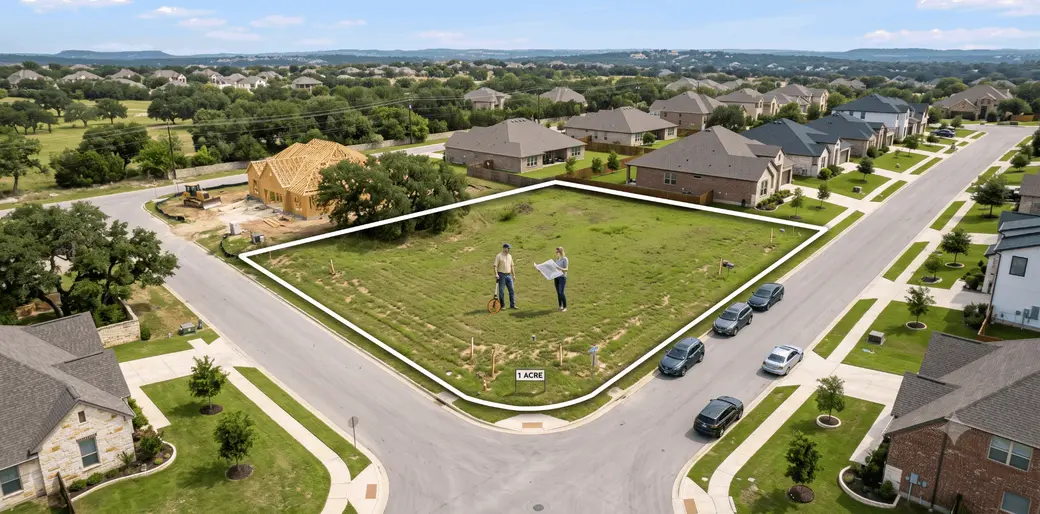
Quick Answer: One acre is 43,560 square feet. If you made it a perfect square, each side would be about 208.7 feet. The easiest picture: an acre covers roughly 90% of an American football field between the goal lines — or about 16 tennis courts side by side. An acre can be any shape, as long as the area inside it equals 43,560 square feet.
Key Takeaways
- An acre is 43,560 square feet — the same in every U.S. state.
- As a square, that's about 208.7 ft × 208.7 ft, but an acre can be any shape.
- Visual anchors: ~90% of a football field's playing area, ~16 tennis courts, or ~9 basketball courts.
- A typical U.S. home sits on about a quarter of an acre, so one full acre feels roomy.
- In Fairfax County, most subdivision lots are a fraction of an acre; full-acre lots are a premium.
- Lot size is a real value driver — worth knowing before you buy, build, or sell.
In This Guide
- How Big Is an Acre? The Short Answer
- An Acre in Everyday Comparisons
- Acre Conversions (Exact Numbers)
- How Many Houses Fit on an Acre?
- Where the Acre Comes From
- Acre vs. Other Land Units
- What an Acre Means in Fairfax County
- Buying or Selling Land & Lots
- Seller Savings Calculator
- Common Acreage Misconceptions
- Frequently Asked Questions
- Glossary
Numbers like "43,560 square feet" don't mean much on their own. Most people can't picture an acre until they compare it to something they already know — a football field, a parking lot, a row of tennis courts.
This guide makes an acre easy to see. We'll cover the exact size, simple visual comparisons, how many homes fit on one, and what an acre actually means when you're buying or selling a home here in Northern Virginia — where land is scarce and lot size moves the price.
How Big Is an Acre? The Short Answer
An acre is 43,560 square feet. That is the number to remember. If you shaped that acre into a perfect square, each side would measure about 208.7 feet. Walk one side at a normal stride and it's roughly 70 steps.
One key point trips people up: an acre is a measure of area, not shape. A perfect square is only one option. An acre can be a long, thin strip, a wide rectangle, or a jagged, irregular parcel — as long as everything inside adds up to 43,560 square feet, it's an acre.
📐 An acre at a glance
43,560 sq ft · 4,840 sq yards · ~4,047 sq meters · 0.405 hectares · 1/640 of a square mile · ~208.7 ft per side as a square.
An Acre in Everyday Comparisons
Here's the fastest way to picture an acre: line it up against spaces you already know. These comparisons are approximate, but close enough for a clear mental image.
| Compared To | How an Acre Measures Up |
|---|---|
| Football field (playing area) | About 90% of it (goal line to goal line) |
| Football field (with end zones) | About 76% — a full field is ~1.32 acres |
| Tennis courts | About 16 fit inside one acre |
| Basketball courts (NBA) | About 9 fit inside one acre |
| Parking spaces (with lanes) | Roughly 150 cars |
| Soccer field (mid-size) | Smaller — a pitch is ~1.5–1.6 acres |
Approximate comparisons for visualization. Exact dimensions vary by venue.
The football field picture
This is the comparison most people reach for, and it's a good one — with one catch. A football field between the goal lines is 300 ft × 160 ft, or 48,000 square feet. An acre is about 90% of that. But add the two end zones and the full field grows to 57,600 square feet, or roughly 1.32 acres. So an acre is about 90% of the playing area, but only about three-quarters of the whole field.
Relative size vs. one acre (43,560 sq ft):
Bars scaled to the largest item. Values rounded for clarity.
Lot size and usable acreage move the number more than people expect. Get a personalized home valuation from The Jamil Brothers — street-level comps, not an automated guess.
Acre Conversions (Exact Numbers)
If you need the precise math instead of a picture, here are the standard conversions for one acre.
| Unit | 1 Acre Equals |
|---|---|
| Square feet | 43,560 sq ft |
| Square yards | 4,840 sq yd |
| Square meters | ~4,047 sq m |
| Hectares | 0.4047 ha |
| Square mile | 1/640 (640 acres = 1 sq mi) |
| Square (equal sides) | ~208.7 ft × 208.7 ft |
🧮 Convert any lot to acres
Multiply the lot's length by its width in feet to get square footage, then divide by 43,560. Example: a 100 ft × 150 ft lot is 15,000 sq ft ÷ 43,560 = about 0.34 acre. Irregular lots are harder to eyeball — the plat or county record will list the exact acreage.
How Many Houses Fit on an Acre?
This is one of the most common follow-up questions, and the honest answer is: it depends on zoning. Packed tightly with no yards or roads, you could fit about 18 average home footprints on an acre. In the real world, setbacks, driveways, and streets bring that way down.
A typical U.S. single-family home sits on roughly a fifth to a quarter of an acre once you count the yard and driveway. So in a normal suburban subdivision, one acre usually supports about 4 to 5 homes.
| Lot Size | Square Feet | Homes per Acre (approx.) |
|---|---|---|
| 1 acre | 43,560 | 1 large-lot home |
| 1/2 acre | 21,780 | 2 homes |
| 1/4 acre | 10,890 | 4 homes (common suburban lot) |
| 1/8 acre | 5,445 | 8 homes (small lots, townhome density) |
Roughly how many homes fit, by lot size:
Illustrative — actual density depends on local zoning, roads, and setbacks.
Where the Acre Comes From
The acre isn't a random number — it has farming roots. The word comes from the Old English æcer, meaning "open field." Historically, an acre was the amount of land a farmer with a yoke of oxen could plow in a single day.
That plowing pattern set the math. A traditional acre was one furlong long (660 feet) by one chain wide (66 feet). Multiply those together and you get 660 × 66 = 43,560 square feet — the exact definition still used today.
Acre vs. Other Land Units
If you've seen land described in hectares or "sections," here's how those relate to the acre.
| Unit | Size | In Acres |
|---|---|---|
| Hectare | 10,000 sq meters | 2.471 acres |
| Square mile / section | 640 acres | 640 acres |
| Township (survey) | 36 sq miles | 23,040 acres |
| Square yard | 9 sq feet | 1/4,840 of an acre |
Most of the world outside the U.S. measures land in hectares. A quick rule: one hectare is just under two and a half acres, so if a listing abroad says "1 hectare," picture about two and a half U.S. acres.
Acreage, buildable area, wells, septic, and setbacks all shape what a lot is really worth. Before you tour or make an offer, get a plan. Our buyer strategy session is free and covers the details that matter.
What an Acre Means in Fairfax County
In Northern Virginia, an acre carries more weight than in most parts of the country — because there's so little of it left to build on. Fairfax County is one of the densest, most in-demand markets in the region, and buildable land is both scarce and expensive.
Most single-family homes in the county's subdivisions sit on a fraction of an acre — often somewhere between 0.15 and 0.35 acre. Townhomes sit on far less. A full acre, let alone several, usually means an established estate area or a large-lot community.
| Home Type in Fairfax County | Typical Lot Size (approx.) |
|---|---|
| Townhome | 0.02–0.06 acre |
| Typical single-family (subdivision) | 0.15–0.35 acre |
| Larger single-family | 0.4–0.9 acre |
| Estate / large-lot community | 1+ acre, sometimes 2–5 |
General ranges. Actual lot sizes vary by zoning district and neighborhood.
If you want room to spread out, some Fairfax County communities are known for larger lots. Great Falls is the classic example, with many one-acre and multi-acre properties. Areas like Fairfax Station and Crosspointe and Lake Barcroft also feature more generous parcels than the county norm. You can also browse current homes for sale or search available homes in Northern Virginia to see how lot sizes compare across neighborhoods.
ℹ️ Why lot size matters more here
Because land is limited across Northern Virginia, a larger, usable lot often commands a real premium — for privacy, expansion potential, or simply scarcity. The Jamil Brothers Realty Group has helped 840+ local families buy and sell, and lot size is one of the first things we factor into pricing. Knowing your true acreage is a smart first step whether you're buying or selling.
Buying or Selling Land & Lots
When acreage is part of the deal, the headline number isn't the whole story. Two one-acre lots can be worth very different amounts depending on how much of that acre you can actually use.
Total acreage vs. usable acreage
Setbacks, easements, steep slopes, wetlands, and floodplains can all shrink the part of a lot you can build on or enjoy. A flat, dry, rectangular acre is worth more than a wooded acre split by a stream. Always ask what's buildable, not just what's on the deed.
How to find and verify your lot's acreage
Check your plat or deed
The recorded plat and deed list the lot's dimensions and acreage. This is your starting point.
Look up the county property record
Fairfax County's online property and GIS records show lot size and boundaries. It's a fast, free cross-check.
Factor in setbacks and constraints
Subtract required setbacks, easements, and any unbuildable areas to understand what's truly usable.
Order a survey when it counts
For building, fencing, or a high-stakes sale, a professional boundary survey confirms the exact lines.
Lot-Size Questions to Ask Before You Buy
- ✓ What is the total acreage, and how much is buildable?
- ✓ Are there easements, wetlands, or floodplain areas?
- ✓ What does the zoning allow — and what are the setbacks?
- ✓ Is it on public water and sewer, or well and septic?
- ✓ How does the lot compare to others recently sold nearby?
Larger lot vs. smaller lot: the trade-offs
| ✓ Larger Lot Pros | ✗ Larger Lot Cons |
|---|---|
| More privacy and space | Higher price, especially in NOVA |
| Room to expand, garden, or build | More maintenance and yard work |
| Often holds value in a scarce market | May be farther from town centers |
| Potential for a well/septic rural feel | Well and septic add upkeep |
If you own a larger lot and are thinking about selling, that acreage is often your strongest selling point — but only if it's priced to reflect what's truly usable. A data-driven pricing approach matters, and our 1.5% full-service listing program keeps more of that equity with you, with no cut to marketing, negotiation, or representation. See what your home could bring with a free valuation and a personalized seller net sheet, or if speed matters more than top dollar, weigh a cash offer against a traditional sale.
Seller Savings Calculator
Thinking of selling a home or lot in Northern Virginia? Lot size drives value — and the listing fee is one of the few costs you control. See what a 1.5% full-service listing keeps versus a traditional 3% agent. Select a value to compare side by side.
Seller Savings Calculator
How much more do you keep with our 1.5% listing fee?
Select your home's estimated value to see real net proceeds — side by side.
Traditional Agent — 3%
Our Fee — Only 1.5%
Extra in your pocket
$6,000
vs. a traditional 3% listing agent — with zero reduction in service or marketing.
Traditional Agent — 3%
Our Fee — Only 1.5%
Extra in your pocket
$7,500
vs. a traditional 3% listing agent — with zero reduction in service or marketing.
Traditional Agent — 3%
Our Fee — Only 1.5%
Extra in your pocket
$9,000
vs. a traditional 3% listing agent — with zero reduction in service or marketing.
Traditional Agent — 3%
Our Fee — Only 1.5%
Extra in your pocket
$11,250
vs. a traditional 3% listing agent — with zero reduction in service or marketing.
Traditional Agent — 3%
Our Fee — Only 1.5%
Extra in your pocket
$15,000
vs. a traditional 3% listing agent — with zero reduction in service or marketing.
Estimates only. Closing costs vary. Buyer's agent commission is negotiable.
Common Acreage Misconceptions
A few myths lead people astray when they picture or price land. Here are the ones to drop.
⚠️ Don't fall for these
- "An acre is a fixed square." No — it's an area. It can be any shape at all.
- "An acre equals a football field." Close, but a full field with end zones is about 1.32 acres.
- "An acre is the same as a hectare." A hectare is nearly 2.5 acres — quite a bit bigger.
- "All the acreage is usable." Setbacks, easements, and wetlands often reduce what you can build on.
- "Bigger lot always means more money." Usable, well-located land is what buyers pay up for.
Our seller net sheet breaks down every cost — commission, transfer taxes, closing fees — so you know your real bottom line before you list. Pair it with a free valuation for the full picture.
Frequently Asked Questions
How big is an acre of land in simple terms?
An acre is 43,560 square feet. As a perfect square it measures about 208.7 feet on each side. The easiest picture is a football field: an acre covers roughly 90% of the playing area between the goal lines, or about 16 tennis courts placed side by side. It's the same size in every U.S. state, though the shape of any given acre can vary widely.
How many square feet are in an acre?
There are exactly 43,560 square feet in one acre. That figure comes from the acre's farming origins — one furlong (660 feet) by one chain (66 feet), which multiplies to 43,560. It also equals 4,840 square yards or about 4,047 square meters.
Is an acre the same as a football field?
Not exactly. An acre is about 90% of a football field's playing area (the part between the goal lines, which is 48,000 square feet). But a full field including both end zones is 57,600 square feet, or about 1.32 acres. So an acre is close to a football field, but a bit smaller than the whole thing.
How many houses can you build on an acre?
In a typical suburban subdivision, about 4 to 5 single-family homes fit on an acre once you account for yards, driveways, and streets. On quarter-acre lots that's roughly four homes; on eighth-acre lots, closer to eight. The real limit is local zoning, which sets minimum lot sizes and setbacks. In parts of Fairfax County, zoning keeps density much lower.
What are the dimensions of an acre?
An acre has no single set of dimensions, because it's a measure of area, not shape. If it were a perfect square, each side would be about 208.7 feet. But it could just as easily be 100 feet by 435.6 feet, or a long strip 66 feet by 660 feet, or an irregular parcel — as long as the total area equals 43,560 square feet.
How many acres is a typical Fairfax County home lot?
Most single-family homes in Fairfax County subdivisions sit on about 0.15 to 0.35 acre. Townhomes are much smaller, often under a tenth of an acre. Full-acre and multi-acre lots exist mainly in estate and large-lot communities such as Great Falls, Fairfax Station, and Lake Barcroft, where land is more generous and typically commands a premium.
How do I find the exact acreage of my property?
Start with your recorded plat and deed, which list the lot dimensions and acreage. Then cross-check the Fairfax County online property and GIS records, which are free and show lot size and boundaries. For building, fencing, or a high-stakes sale, a professional boundary survey confirms the exact lines. If you just want the square footage, multiply length by width in feet and divide by 43,560.
How much is an acre of land worth in Northern Virginia?
There's no single price — value depends on location, zoning, how much of the acre is usable, and whether it's already improved with a home. Because buildable land is scarce across Northern Virginia, even a modest usable lot can carry a strong premium, and prices vary sharply between neighborhoods. The best way to know your specific number is a local, data-driven valuation rather than a rule of thumb.
Does a bigger lot always add value when selling?
Usually a larger lot helps, but only to the extent it's usable and well-located. A flat, dry, buildable acre adds far more than a wooded acre cut by a stream or covered by easements. Buyers also weigh maintenance and whether the home fits the lot. Pricing acreage correctly takes local comps and judgment — which is where an experienced agent earns their keep.
How do I choose the best real estate agent in Fairfax County for a home with land?
Look for an agent who knows the local large-lot communities, understands zoning and usable-acreage issues, and prices with real comparable sales rather than guesswork. Ask how they'll market the land and the home, and get a written breakdown of costs and commission. The Jamil Brothers Realty Group works with buyers and sellers across Fairfax County, including larger-lot properties, and offers a full-service 1.5% listing fee — the same marketing and negotiation as a traditional agent at a lower cost. The right fit, though, is the agent who answers your specific questions clearly and puts the numbers in writing.
How big is half an acre?
Half an acre is 21,780 square feet — as a square, about 147.6 feet on each side. It's a common suburban lot size and roughly the size of a professional soccer field's smaller layouts. In many Fairfax County neighborhoods, a half-acre lot is considered generous.
Glossary
Acre
A unit of land area equal to 43,560 square feet.
Hectare
A metric land unit equal to 10,000 square meters, or about 2.47 acres.
Section
One square mile of land, equal to 640 acres.
Plat
A recorded map showing a property's boundaries, dimensions, and lot number.
Setback
The minimum distance a structure must sit from a property line, set by zoning.
Easement
A right for someone else to use part of your land, such as a utility corridor.
Buildable Area
The portion of a lot you can actually build on after setbacks and constraints.
Furlong
An old unit of length equal to 660 feet — one dimension of the original acre.
The Bottom Line
An acre is 43,560 square feet — about 90% of a football field's playing area, or roughly 16 tennis courts. It can be any shape, and in a place like Fairfax County, where land is scarce, that acre carries real value.
Whether you're buying a home with land, planning to build, or thinking about selling a larger lot, the smart move is to know your true, usable acreage and what it's worth locally. Start with a free valuation and a personalized net sheet, and you'll have a clear, data-backed picture before you make a move.
Know your equity, understand your costs, and see exactly what you'll walk away with — before any decisions. The Jamil Brothers provide a full seller consultation at no cost or obligation.
Explore Fairfax County Communities
Fairfax County McLean Vienna Reston Annandale Burke Centreville Dunn Loring Great Falls Herndon Lorton Merrifield Springfield Tysons West Springfield Burke Centre Franklin Farm Kingstowne Fair Lakes Reston Town Center Lake Barcroft Crosspointe Little Rocky RunThis article is general educational information. Measurements and comparisons are approximate and rounded for clarity. Lot sizes, zoning, and land values vary by property and jurisdiction — confirm specifics with official county records or a licensed professional. The Jamil Brothers Realty Group is brokered by Samson Properties.
Categories
- All Blogs (1237)
- Buyer Guide (7)
- Buying a home (2)
- Buying Strategies (30)
- festivals (1)
- General Blog (66)
- Market Intelligence (28)
- Market Updates (7)
- Notable Properties For Sale (32)
- Real Estate Tips, News, and More (396)
- Seller Guide (1)
- Seller Guides (58)
- Selling Your Home (525)
- Top Realtors in Northern Virginia (58)
Recent Posts



Let's Connect