
Northern Virginia Housing Market Reset: What Ashburn and Fairfax Sellers Should Know in 2026
Quick Answer: The Northern Virginia housing market has reset, not crashed. In August 2026 prices were roughly flat from a year earlier (Loudoun County median $771,250, up 0.9%; Fairfax County $752,250, down 0.4%), while active listings rose about 18% to 20% and sales slowed. With 30-year mortgage rates near 7%, Ashburn and Fairfax sellers are competing for a smaller pool of buyers, so pricing to recent sales from day one matters more than it did in 2022 to 2024.
This guide uses the latest official market releases, two county tax schedules, and our own 2025 and 2026 closings to show what changed, where the new competition is, and how to price and prepare a home for this market. For local seller services across the region, start with our Northern Virginia real estate page.
Free Seller Pricing Plan
Get Your 2026 Pricing Plan
Tell us about your home and we will send a local price range and a listing plan built for today’s market.
Request received. Thank you. A member of our team will contact you shortly.
- Prices held, pace slowed: the NVAR region median was $765,000 in August 2026, up 2.0% from a year earlier, while closed sales fell 8.0% and active listings rose 18.5%.
- Loudoun slowed more than Fairfax: Loudoun County closed sales fell 16.9% year over year in August; Fairfax County sales fell 5.7%.
- Competition is uneven: in the NVAR region, condo listings were up 44.8% and townhome listings up 29.9%, while detached listings fell 8.5%.
- Rates changed the math: at 7.03% (Freddie Mac, September 24, 2026), the payment on a $675,000 loan is about $326 a month higher than at last year’s 6.30%.
- The first weeks decide the result: of our 34 listing-side closings in Ashburn and Fairfax since January 2025, 15 spent seven days or fewer on market, and 8 needed more than 30.
- The Reset in Numbers
- What a Reset Means for Sellers
- Where the New Listings Are
- Mortgage Rates and the Buyer Pool
- Ashburn vs. Fairfax
- Our 2025 and 2026 Closings
- What It Costs to Sell
- How to Price in a Reset Market
- Sell Now or Wait?
- A 30-Day Launch Plan
- Glossary
- Plan Your Sale
- Frequently Asked Questions
- Related Guides
The Northern Virginia Housing Market Reset in Numbers
The Northern Virginia Association of Realtors (NVAR) publishes monthly Bright MLS figures for its region, which covers Fairfax and Arlington counties, the cities of Alexandria, Fairfax and Falls Church, and the towns of Vienna, Herndon and Clifton, and separately for Loudoun County. Here is August 2026, the latest month available, from NVAR’s September 14, 2026 release.
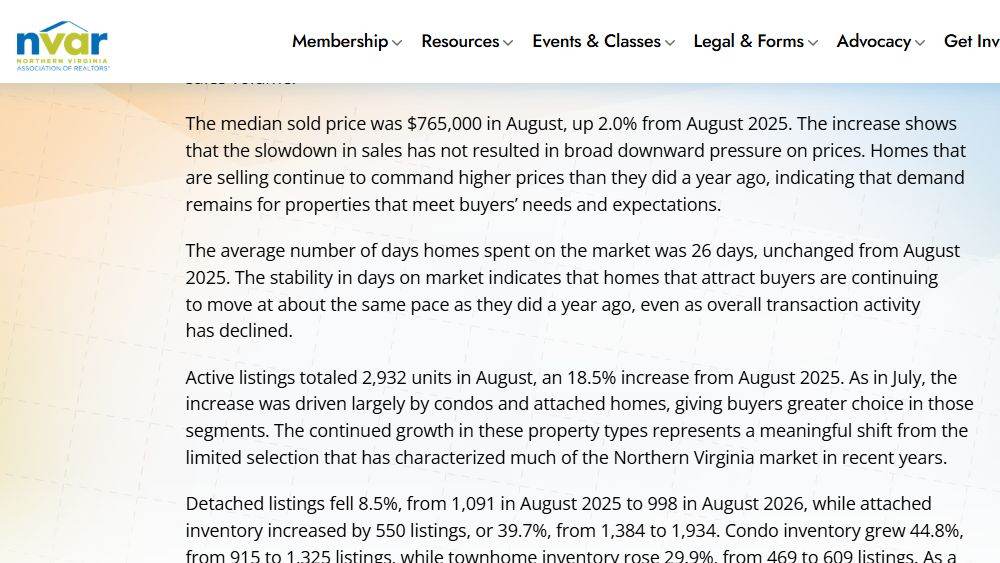
Source: NVAR market statistics release for August 2026.
| August 2026 (all residential) | NVAR region | Loudoun County |
|---|---|---|
| Median sold price | $765,000 (up 2.0%) | $771,250 (up 0.9%) |
| Closed sales | 1,324 (down 8.0%) | 432 (down 16.9%) |
| Average days on market | 26 (unchanged) | 24 (up 4.3%) |
| Active listings | 2,932 (up 18.5%) | Up 17.6% |
| Months of supply | 2.08 (up 14.7%) | 2.09 (up 18.7%) |
| Dollar volume | $1.195 billion (down 6.4%) | $379.9 million (down 15.7%) |
Source: NVAR, August 2026 market statistics (Bright MLS data as of September 10, 2026), released September 14, 2026. Percentages compare with August 2025.
What a “Reset” Means for Sellers (and What It Does Not)
A reset is a change in balance, not a collapse in value. Prices across Northern Virginia are within a couple of percent of last year. What changed is the pace: more homes are for sale at the same time, fewer are closing each month, and buyers have more time to compare. For most of 2022 through 2024, a well-located home could be priced a little ambitiously and still sell quickly. In today’s market, a home that misses on price or condition simply waits while buyers tour the next one. For a week-by-week read on contracts, see our Northern Virginia housing market weekly update.
Three things are true at once, and a good pricing plan accounts for all of them:
- Supply is still tight by most measures. About two months of supply means that, at the current sales pace, today’s listings would sell out in roughly eight or nine weeks if nothing new came on the market.
- Buyers have more choice than a year ago. Active listings are up about 18% in the NVAR region, 17.6% in Loudoun, and 20.3% in Fairfax County.
- Averages hide the split. The extra inventory is concentrated in condos and townhomes, so two sellers in the same ZIP code can face very different competition.
ℹ️ Read a monthly median carefully
One month’s median moves with the mix of homes that happened to close. Loudoun’s median was $813,000 in July 2026 and $771,250 in August, but the year-over-year change is the better signal. Price your home from recent sales of the same property type in your own community, not from a county headline.
Where the New Listings Are: Condos and Townhomes
NVAR’s August release breaks the region’s inventory out by property type. The growth is almost all in attached homes, which matters if you are selling a condo or townhouse in Fairfax, Reston, Herndon or the other NVAR communities.
Active listings at the end of August 2026, NVAR region (Fairfax and Arlington counties, the cities of Alexandria, Fairfax and Falls Church, and the towns of Vienna, Herndon and Clifton). A year earlier there were 915 condos, 1,091 detached homes and 469 townhomes. Source: NVAR, September 14, 2026. Loudoun County inventory is not broken out by type in the release.
If you own a detached home, you are likely facing fewer direct competitors than last year, although buyers at higher price points are the most rate-sensitive. If you own a condo or townhouse, expect buyers to line your home up against more alternatives, including new construction with builder incentives. For condos, the association’s documents and lender eligibility also shape who can buy; our guide to selling a condo in Ashburn covers the resale package and financing rules in detail.
Mortgage Rates and the Buyer Pool
Freddie Mac’s Primary Mortgage Market Survey put the average 30-year fixed rate at 7.03% for the week of September 24, 2026, up from 6.30% a year earlier. That survey reflects borrowers with 20% down and strong credit, so individual quotes vary, but the direction is what matters to a seller.
| $675,000 loan, 30-year fixed | At 6.30% (Sept 2025) | At 7.03% (Sept 2026) |
|---|---|---|
| Monthly principal and interest | About $4,178 | About $4,504 |
| Change | About $326 more a month | |
| Loan the same $4,178 payment supports | $675,000 | About $626,000 |
Illustration: a $750,000 purchase with 10% down. Principal and interest only, calculated from the Freddie Mac PMMS averages; taxes, insurance, HOA dues and mortgage insurance are not included.
In practical terms, a buyer who was comfortable with a $750,000 home last September can borrow roughly $49,000 less for the same monthly payment today. Many will still buy, but they compare more carefully, ask for seller credits more often, and walk away from homes that look overpriced against the competition. That is the core of the reset.
Get a price range built from recent sales of homes like yours in your community, plus a look at the listings you would be competing with right now.
Ashburn vs. Fairfax: Two Different Resets
Ashburn sits in Loudoun County, and “Fairfax” usually means Fairfax County. The two markets moved differently in August. Loudoun kept its price but lost more sales volume; Fairfax County held its sales pace better while its median slipped slightly and its inventory grew faster.
| August 2026 | Loudoun County (includes Ashburn) | Fairfax County |
|---|---|---|
| Median sold price | $771,250 (up 0.9%) | $752,250 (down 0.4%) |
| Closed sales | 432 (down 16.9%) | 757 (down 5.7%) |
| Time to sell | 24 days on market (average) | 25 days to ratified contract (average) |
| Active listings vs. a year earlier | Up 17.6% | Up 20.3% (1,985 homes) |
| Sold price as a share of list price | Not reported | 98.8% (up from 98.3%) |
| Real estate tax rate, tax year 2026 | $0.805 per $100 | $1.12 per $100 |
| Annual county tax on a $750,000 assessment | $6,038 | $8,400 |
Sources: Loudoun figures from NVAR’s August 2026 release. Fairfax County figures from FFXnow’s September 15, 2026 report of MarketStats by ShowingTime+ (Bright MLS) data; they exclude the independent City of Fairfax. Tax rates from Loudoun County’s published rate table and Fairfax County’s FY2027 adopted budget. The two counties measure time to sell differently, so compare those rows with care. Tax figures exclude special district levies.
What the difference means for an Ashburn seller
Loudoun’s median held up, but 16.9% fewer closings in a single month is a meaningful drop in buyer activity. Ashburn sellers are also competing with new construction in Loudoun, and buyers looking at a townhouse in Ashburn Farm or Broadlands can compare it with more active listings than last fall. The advantage Ashburn keeps is its lower tax rate: on a $750,000 assessment, a Loudoun owner pays about $197 a month less in county real estate tax than a Fairfax County owner, which helps a buyer’s monthly budget.
What the difference means for a Fairfax seller
Fairfax County sales held up better, and homes that sold went for 98.8% of list price on average, slightly better than a year earlier. The pressure point is inventory: active listings were up 20.3%, and much of the growth in the wider NVAR region is in condos and townhomes. A Fairfax condo or townhouse seller should expect the most direct competition and price accordingly; detached sellers have fewer rivals but a smaller pool of buyers who can afford them at 7% rates. For current Fairfax listings and communities, see our Fairfax County real estate page.
The Jamil Brothers’ 2025 and 2026 Closings in Ashburn and Fairfax
Market reports describe a county. Our own closings describe what actually happened on specific homes in this reset. These are MLS transactions by current team members from January 2025 through September 1, 2026, in the Ashburn area (including Broadlands and Brambleton) and in Fairfax County and the City of Fairfax. They are our record, not a market sample.
57 homes The Jamil Brothers closed in Ashburn and Fairfax since January 2025
One closing had the team on both sides, which is why the listing and buyer counts add to 58. Here is how many days our 34 listings spent on the market, using the MLS days-on-market figure:
The median was 12 days, and the longest was 93. Most of our listings moved quickly, but 8 of the 34 needed more than a month, a reminder that this market gives no one a free pass on price or preparation, including us.
| Address | City | Close price | Structure type |
|---|---|---|---|
| 42529 Carnforth Ct | Broadlands, VA | $2,940,511 | Single-family detached |
| 41912 Blair Woods Dr | Brambleton, VA | $1,100,000 | Single-family detached |
| 22970 Weybridge Sq | Broadlands, VA | $935,000 | Townhouse (end unit) |
| 19679 Peach Flower Ter | Ashburn, VA | $931,434 | Townhouse (interior) |
| 23012 Weybridge Sq | Broadlands, VA | $910,000 | Townhouse (interior) |
| 20052 Old Line Ter | Ashburn, VA | $895,000 | Townhouse (end unit) |
| 42892 Bold Forbes Ct | Ashburn, VA | $850,000 | Single-family detached |
| 44506 Lowestoft Sq | Ashburn, VA | $810,000 | Townhouse (end unit) |
| 23430 Madison Heights Ter | Ashburn, VA | $707,000 | Townhouse (interior) |
| 43279 Rush Run Ter | Ashburn, VA | $700,000 | Townhouse (interior) |
| 21622 Monmouth Ter | Ashburn, VA | $690,000 | Townhouse (end unit) |
| 21170 Wildflower Sq | Ashburn, VA | $665,000 | Townhouse (interior) |
| 43131 Wealdstone Ter | Ashburn, VA | $635,000 | Townhouse (interior) |
| 43700 Hamilton Chapel Ter | Ashburn, VA | $615,000 | Townhouse (interior) |
| 20696 Erskine Ter | Ashburn, VA | $576,000 | Townhouse (end unit) |
| 22262 Meadfoot Ter | Ashburn, VA | $525,000 | Townhouse (interior) |
16 closings. 2025 and 2026 to date, including Broadlands and Brambleton. Sorted by close price.
| Address | City | Close price | Structure type |
|---|---|---|---|
| 13103 Anvil Pl | Herndon, VA | $1,100,000 | Single-family detached |
| 7401 Loughboro Ln | Springfield, VA | $930,000 | Single-family detached |
| 2944 Stella Blue Ln | Fairfax, VA | $925,000 | Townhouse (interior) |
| 4202 Minstrell Ln | Fairfax, VA | $920,000 | Single-family detached |
| 12484 Wendell Holmes Rd | Herndon, VA | $910,000 | Single-family detached |
| 7996 Almeda Ct | Lorton, VA | $900,000 | Single-family detached |
| 14349 Brookmere Dr | Centreville, VA | $850,000 | Single-family detached |
| 4441 Village Dr | Fairfax, VA | $845,000 | Single-family detached |
| 5724 Osprey Ct | Clifton, VA | $540,000 | Townhouse (interior) |
| 1159 Lisa Ct | Herndon, VA | $500,000 | Townhouse (interior) |
| 3708-A Steppes Ct | Falls Church, VA | $450,000 | Townhouse (interior) |
| 11711-E Summerchase Cir | Reston, VA | $369,000 | Condo |
| 11109 Rock Garden Dr | Fairfax, VA | $366,000 | Townhouse (interior) |
| 13058 Autumn Woods Way #105 | Fairfax, VA | $297,000 | Condo |
| 3179 Summit Square Dr #2-E1 | Oakton, VA | $295,000 | Condo |
15 closings. 2026 to date. Sorted by close price.
| Address | City | Close price | Structure type |
|---|---|---|---|
| 801 Grace Meadow Ct | Great Falls, VA | $2,100,000 | Single-family detached |
| 600 Grace St | Herndon, VA | $1,020,000 | Single-family detached |
| 109 Patrick St SE | Vienna, VA | $965,000 | Single-family detached |
| 6422 Muster Ct | Centreville, VA | $940,000 | Single-family detached |
| 11200 Reston Station Blvd #508 | Reston, VA | $765,000 | Condo |
| 1510 Powells Tavern Pl | Herndon, VA | $760,000 | Single-family detached |
| 5811 Summerlake Way | Centreville, VA | $680,000 | Townhouse (end unit) |
| 5814 Stream Pond Ct | Centreville, VA | $625,000 | Townhouse (interior) |
| 10825 Woodhaven Dr | Fairfax, VA | $615,000 | Single-family detached |
| 13719 McGill Dr | Chantilly, VA | $601,500 | Single-family detached |
| 12850 Mosaic Park Way #V | Herndon, VA | $580,000 | Condo |
| 4769 Sully Point Ln | Chantilly, VA | $570,950 | Townhouse (interior) |
| 4651 Red Admiral Way #157 | Fairfax, VA | $570,000 | Townhouse (interior) |
| 11050 Granby Ct | Reston, VA | $537,000 | Townhouse (interior) |
| 5684 Kirkham Ct | Springfield, VA | $525,000 | Townhouse (interior) |
| 5849 Clarendon Springs Pl | Centreville, VA | $510,000 | Townhouse (end unit) |
| 8442 Sugar Creek Ln | Springfield, VA | $489,000 | Townhouse (interior) |
| 12217 Fairfield House Dr #112A | Fairfax, VA | $460,000 | Condo (penthouse) |
| 4112 Weeping Willow Ct #131B | Chantilly, VA | $450,000 | Townhouse (interior) |
| 9480 Virginia Center Blvd #327 | Vienna, VA | $442,500 | Condo |
| 2340 Southgate Sq | Reston, VA | $415,000 | Townhouse (interior) |
| 8442 Sugar Creek Ln | Springfield, VA | $376,000 | Townhouse (interior) |
| 2204 Westcourt Ln #117 | Herndon, VA | $325,000 | Condo |
| 2791 Centerboro Dr #384 | Vienna, VA | $320,000 | Condo |
| 517 Florida Ave #T4 | Herndon, VA | $318,400 | Condo |
| 3800 Powell Ln #918 | Falls Church, VA | $285,000 | Condo |
26 closings. Calendar year 2025. Sorted by close price.
Close prices are public record, and client names are never shown. City is the MLS mailing city; some “Fairfax” addresses are in the independent City of Fairfax, and Herndon, Vienna and Clifton are towns within Fairfax County. Days on market is the MLS figure. Team MLS history through September 1, 2026.
For all-time Ashburn numbers and current listings, see our Ashburn, VA real estate page.
What It Costs to Sell a Home in Northern Virginia
Your net proceeds depend on a handful of line items. Some are set by law, some are negotiated, and some depend on your loan and your association. The table uses a $750,000 sale in Loudoun or Fairfax County as an example.
| Seller cost | How it works | On a $750,000 sale |
|---|---|---|
| Listing-side fee | Negotiated in your listing agreement | $11,250 at 1.5%; $22,500 at a hypothetical 3% |
| Buyer-broker compensation | Negotiable; paid by the seller only if you agree to it in the contract | Varies ($18,750 if you agreed to 2.5%) |
| Virginia grantor tax | $0.50 per $500 of price, paid by the seller unless the contract shifts it (Code of Virginia § 58.1-802) | $750 |
| Northern Virginia regional grantor fee | $0.10 per $100 in Northern Virginia Transportation Authority localities, including Loudoun and Fairfax (§ 58.1-802.3) | $750 |
| HOA or condo resale certificate | Only if you are in an association; capped by the Common Interest Community Board’s fee schedule | Up to $176.64 electronic or $211.96 on paper |
| Settlement and title charges | Seller’s share of the settlement company’s fees | Varies; ask for a written estimate |
| Mortgage payoff, prorated taxes and dues, repairs or credits | Depend on your loan and the negotiated contract | Varies |
Illustration only, not a net sheet. Resale certificate caps are from the Virginia Common Interest Community Board schedule in effect since 2023; associations can charge extra for inspections, rush delivery and updates. By custom the buyer pays Virginia’s recordation tax.
The listing-side fee is usually the largest line you can negotiate. The Jamil Brothers offer full-service listing fees starting at 1.5% for qualifying properties with an agreed list price of $500,000 or more at the time of listing. Rates and terms vary by property and services selected. Final terms are established in the listing agreement. Commissions are negotiable. That fee is the listing side only; buyer-broker compensation is a separate negotiation. See how the 1.5% listing program works, then compare fees at your price point below.
How Much Could You Keep When You Sell Your Current Home?
Tap a sale price to compare listing fees.
Traditional 3% listing fee
The Jamil Brothers full-service 1.5%
Traditional 3% listing fee
The Jamil Brothers full-service 1.5%
Traditional 3% listing fee
The Jamil Brothers full-service 1.5%
Traditional 3% listing fee
The Jamil Brothers full-service 1.5%
Traditional 3% listing fee
The Jamil Brothers full-service 1.5%
Traditional 3% listing fee
The Jamil Brothers full-service 1.5%
Traditional 3% listing fee
The Jamil Brothers full-service 1.5%
Illustration of the listing-side fee only. It excludes buyer-agent compensation, grantor tax, title, and other closing costs, and commissions are always negotiable. See our flexible commission options.
Want the full picture? Estimate your net proceeds.
The calculator compares a hypothetical 3% listing-side fee with a 1.5% listing-side fee at the prices shown. It is not a net sheet: it leaves out buyer-broker compensation, which is negotiated separately, plus your mortgage payoff, grantor tax, and other closing costs. *Listing fees start at 1.5% for qualifying properties with an agreed list price of $500,000 or more at the time of listing. Rates and terms may vary based on the property and services selected. Final listing fee and terms are established in the executed listing agreement. Commissions are negotiable and not set by law.
Taxes on your gain
If the home has been your main residence, federal law lets you exclude up to $250,000 of gain from income, or up to $500,000 on a joint return, when you owned and lived in it for at least 24 months of the five years before the sale (IRS Topic 701). Gain above the exclusion, and gain on rental or investment property, can be taxable. Talk with a tax professional before you list if either applies.
How to Price Your Home in a Reset Market
Pricing is where a reset market shows up first. Buyers have more listings to compare and higher payments to carry, so the gap between a well-priced home and an overpriced one widens quickly. These are the steps we recommend for any Ashburn or Fairfax seller this fall.
Price from the last 60 to 90 days, not last spring
Use closed sales of the same property type, in the same community, from the most recent two to three months. Sales from the spring were negotiated when rates were lower and inventory was thinner. Then look at the active and pending listings your buyer will tour the same weekend: those set the ceiling in a buyer’s mind more than any past sale.
Mind the search bands
Buyers filter online searches by price. A home listed at $760,000 is invisible to a buyer whose search stops at $750,000. If your fair value sits near a common cutoff, pricing just under it can put your home in front of more buyers than pricing just over it.
Plan the first reduction before you list
Agree in advance on what the first two weekends should produce in showings and offers, and what you will do if they do not. A single meaningful adjustment made early usually does more than several small cuts spread over two months, which tend to signal that a seller is chasing the market.
Consider a credit instead of a lower price
With rates near 7%, some buyers value help with closing costs or a rate buydown more than an equal cut in price. Lenders cap these seller contributions: for a conventional loan on a primary residence, Fannie Mae allows up to 3% of the price when the buyer puts down less than 10%, 6% with 10% to just under 25% down, and 9% with 25% or more down (Fannie Mae Selling Guide B3-4.1-02). Your agent and the buyer’s lender should confirm what fits the specific loan.
Prepare for the comparison, not the showing
In a market with more choice, buyers eliminate homes quickly. Pre-listing repairs, a clean inspection profile, and professional photos are not extras; they decide whether your home makes the second-showing list. A pre-listing inspection can reveal issues you would rather price in or fix than negotiate after a buyer’s inspection.
Should You Sell Now or Wait for Spring?
No one can promise what prices or rates will do by spring 2027, and we will not pretend to. What you can do is weigh the factors that are specific to you against what the current data shows.
Reasons listing this fall can make sense
- You have already bought, or need to move for work, school or family
- Your home is a detached house, where NVAR-region inventory fell 8.5%
- Your home is ready now and priced to recent sales
- You would rather compete with today’s known inventory than guess at spring
Reasons waiting can make sense
- You have a low-rate mortgage and no need to move
- Your home needs repairs you can finish over the winter
- Your condo association is updating its budget, reserves or lender approval
- You would buy your next home in the same higher-rate market
If you are weighing when to list, or whether to sell before you buy, Sell Now or Wait? Loudoun County 2026 covers the timing question in more depth.
A 30-Day Launch Plan for a Reset Market
Most of the outcome is decided before the first showing and in the first two weekends. This is the order we follow with sellers in Ashburn and Fairfax.
Days 1 to 5: Price study and net sheet
Review the last 60 to 90 days of closed sales, plus the active and pending homes you will compete with. Estimate your net proceeds at two or three price points, and decide your first adjustment in advance.
Days 5 to 15: Repairs and documents
Fix what a buyer’s inspector would flag, order the HOA or condo resale certificate if you are in an association, and gather warranties, permits and utility records.
Days 15 to 21: Presentation
Declutter, stage the main rooms, and schedule professional photos, floor plans and video once the home is ready, not before.
Days 21 to 30: Launch and first two weekends
Go live on a weekday so the listing has momentum by the first weekend. Track showings and feedback daily, and compare them with the targets you set in step one.
After day 30: Decide, do not drift
If showings and offers fall short of the targets, make the adjustment you planned, whether that is price, a buyer credit, or a fix to condition. When buyers have more choices, a listing that sits without a change rarely gets stronger.
Glossary
Active Listings: Homes for sale and available at the end of a month. A rise means buyers have more to choose from.
Months of Supply: How long current listings would last at the recent sales pace if no new homes came on the market.
Days on Market (DOM): The number of days a listing is active in the MLS. Counties and data providers measure it slightly differently.
Sold-to-List Ratio: The sale price as a percentage of the final list price. Fairfax County’s was 98.8% in August 2026.
Grantor Tax: A Virginia tax on the deed, paid by the seller unless the contract says otherwise: $0.50 per $500, plus $0.10 per $100 in Northern Virginia.
Seller Concession: A credit from the seller toward the buyer’s closing costs or a rate buydown. Lenders cap it as a share of the price.
Rate Buydown: An upfront payment that lowers the buyer’s mortgage rate, either permanently or for the first years of the loan.
Resale Certificate: The HOA or condo association packet a seller must provide in Virginia, covering dues, assessments, rules and any violations.
Ready to Plan Your Ashburn or Fairfax Sale?
A reset market rewards preparation: an honest price study, a home that is ready before it goes live, and a plan for the first two weekends. If you would like a second opinion on price or timing, we are glad to walk through your numbers.
We will compare your home with recent sales and the listings you would compete with, and show your estimated net proceeds at more than one price.
Frequently Asked Questions About the Northern Virginia Housing Market
Is the Northern Virginia housing market crashing in 2026?
No. The August 2026 data shows a slowdown, not a crash. The NVAR region median sold price was $765,000, up 2.0% from a year earlier, Loudoun County’s median was $771,250 (up 0.9%), and Fairfax County’s was $752,250 (down 0.4%). What changed is the pace: active listings rose about 18% to 20% and closed sales fell, so buyers have more choice and more time.
Is it a buyer’s or seller’s market in Northern Virginia right now?
It is moving toward balance. In August 2026 the NVAR region had 2.08 months of supply and Loudoun County had 2.09, both up from a year earlier. Supply is still limited, but buyers have more listings to compare, especially condos and townhomes, so well-priced homes still sell while overpriced homes wait.
What does a housing market reset mean?
A reset is a shift in the balance between buyers and sellers without a large change in prices. In Northern Virginia it shows up as more active listings, fewer monthly sales, higher mortgage rates, and buyers who negotiate more on price, repairs and closing cost credits, while medians stay close to last year’s levels.
How long does it take to sell a house in Ashburn or Fairfax right now?
In August 2026 Loudoun County homes averaged 24 days on market (NVAR), and Fairfax County homes averaged 25 days from listing to a ratified contract (MarketStats by ShowingTime+ via FFXnow). Settlement then follows on the date set in the contract. A home priced above the competition can take much longer.
Should I sell my house now or wait until spring 2027?
It depends on your plans more than on a forecast. Listing this fall can make sense if you need to move, your home is ready, or you own a detached home, where regional inventory fell 8.5%. Waiting can make sense if you have a low-rate mortgage and no need to move, or your home needs work you can finish over the winter.
How should I price my home in a slower market?
Start with closed sales of the same property type in your community from the last 60 to 90 days, then compare against the active and pending listings a buyer will tour the same weekend. Watch common search cutoffs such as $750,000, and decide before you list what you will change if the first two weekends do not produce showings and offers.
How much does it cost to sell a house in Northern Virginia?
The main costs are the listing-side fee, any buyer-broker compensation you agree to, Virginia’s grantor tax ($0.50 per $500 of price), the Northern Virginia regional grantor fee ($0.10 per $100), settlement charges, an HOA resale certificate if applicable, and your mortgage payoff. On a $750,000 sale the two grantor taxes total $1,500. The Jamil Brothers’ full-service listing fees start at 1.5% for qualifying properties with an agreed list price of $500,000 or more at the time of listing; commissions are negotiable.
Who pays the grantor tax in Virginia?
The seller pays Virginia’s grantor tax under Code of Virginia § 58.1-802, and the Northern Virginia regional grantor fee under § 58.1-802.3 applies in localities such as Loudoun and Fairfax counties. The parties can agree in the contract to shift some or all of either charge to the buyer.
Do I have to pay the buyer’s agent when I sell?
No amount is required by law. Buyer-broker compensation is negotiable: a buyer’s agent is paid under the buyer’s written agreement, and a seller may agree to contribute toward that fee or offer another concession as part of the contract. Discuss the options and their effect on your net proceeds before you list.
Do I pay capital gains tax when I sell my home?
Often not on a main residence. Federal law lets you exclude up to $250,000 of gain, or $500,000 on a joint return, if you owned the home and lived in it as your main home for at least 24 months of the last five years. Gain above that, or on a rental or investment property, can be taxable, so confirm with a tax professional.
Related Northern Virginia Seller Guides
Sources: NVAR market statistics for July and August 2026 (Bright MLS data, released August 12 and September 14, 2026); FFXnow, September 15, 2026, reporting MarketStats by ShowingTime+ (Bright MLS) data for Fairfax County; Freddie Mac Primary Mortgage Market Survey, week of September 24, 2026, with its year-earlier comparison; Loudoun County property tax rates; Fairfax County FY2027 adopted budget; Fannie Mae Selling Guide B3-4.1-02; Virginia Common Interest Community Board maximum resale certificate fees; IRS Topic 701; Code of Virginia §§ 58.1-802 and 58.1-802.3; The Jamil Brothers team MLS history through September 1, 2026. Last reviewed September 29, 2026.
Categories
- All Blogs (1227)
- Aldie (3)
- Ashburn (6)
- Buyer Guide (8)
- Buying a home (2)
- Buying Strategies (30)
- festivals (1)
- General Blog (67)
- Leesburg (5)
- Market Intelligence (29)
- Market Updates (8)
- Notable Properties For Sale (32)
- Real Estate Tips, News, and More (385)
- Seller Guide (2)
- Seller Guides (60)
- Selling Your Home (522)
- Sterling (6)
- Top Realtors in Northern Virginia (58)
Recent Posts
Message Sent!
Thank you for reaching out. Arslan & Saad have received your details and will be in touch shortly.
Need immediate assistance? Call or text 703-782-4830.