
Buying an Older Home in Sterling, VA: Inspection Risks and Renovation Budget
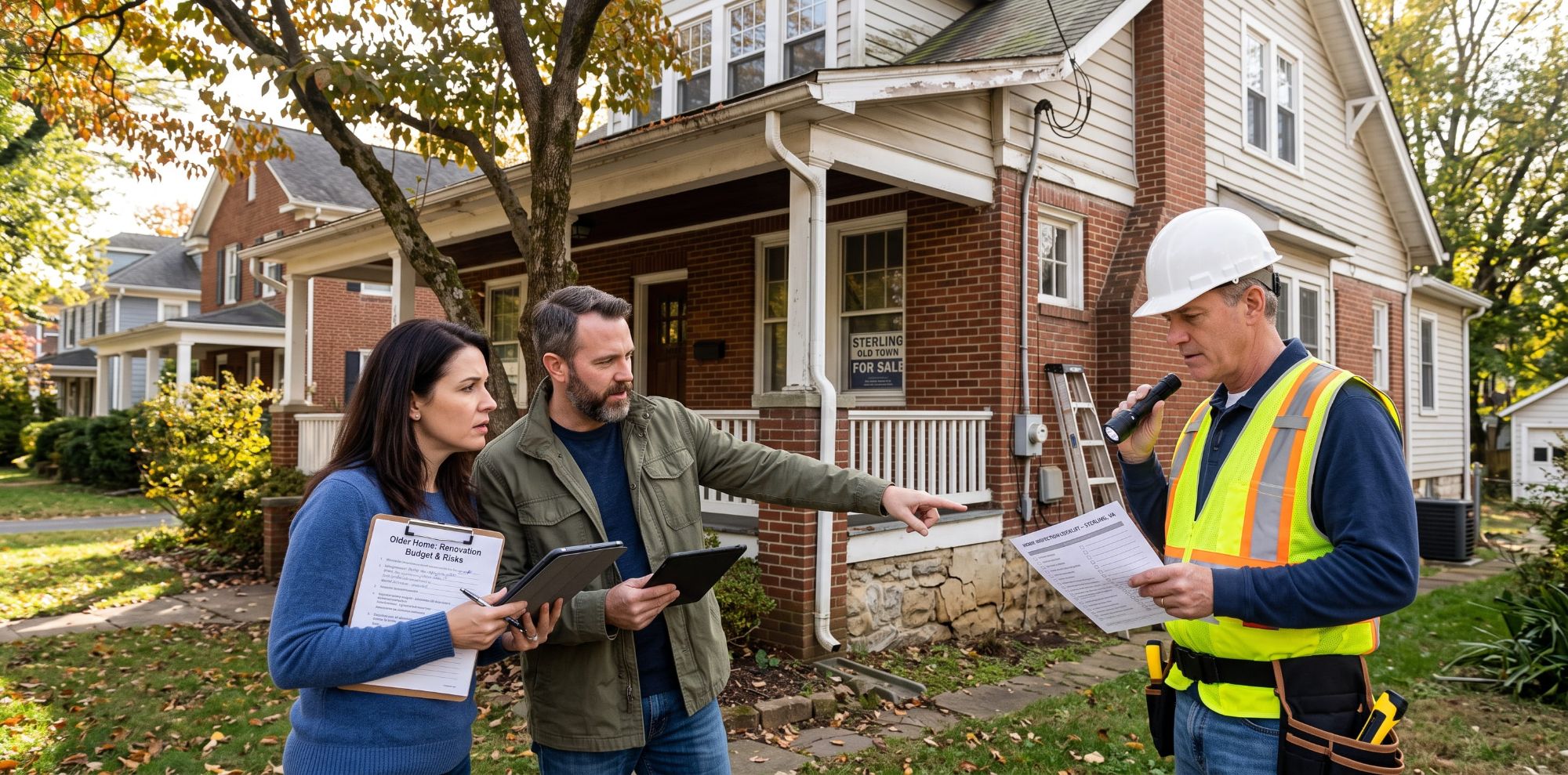
Quick Answer: Buying an older home in Sterling, VA means budgeting for the systems, not the finishes. Order a general home inspection plus targeted specialist checks — roof, HVAC, electrical panel, plumbing type, drainage, and a sewer-line scope — and pull the property's permit history through Loudoun County's LandMARC portal before you waive anything. Reserve cash for the two or three highest-cost systems nearest end of life, in addition to your down payment and closing costs. Inspection findings are negotiable in Virginia through repair requests, seller credits or a price change, but only if your contract keeps an inspection contingency.
Key Takeaways
- Of our team's 104 Sterling closings (2013–2026, internal Bright MLS export), 35 were homes built before 1980 and 16 were built in 1965 — the original Sterling Park era. Older stock is a third of what actually trades here.
- Order the general inspection first, then specialists for what it flags: roof, HVAC, electrical, plumbing/sewer scope, drainage, chimney, and — on well or septic lots — a water test and septic inspection.
- Reserve cash for the two or three highest-cost systems nearest end of life; use dated contractor quotes, not rules of thumb, to size it.
- Permit history is public through Loudoun County's LandMARC portal. Unpermitted finished basements and additions are the most common surprise on 1970s–90s Sterling homes.
- Inspection findings can be negotiated as repairs, a seller credit, or a price change — if your contract keeps an inspection contingency. With Loudoun inventory up 8.5% year over year, waiving it is rarely necessary.
On This Page
- Sterling's Older Housing Stock: What You Are Actually Buying
- What Inspections Should I Get on an Older Sterling Home?
- System-by-System: What to Check and Where It Shows Up in Our Record
- How Much Cash Should I Reserve for Repairs?
- Where Can I Check Permits?
- Insurance and Lender Issues on Older Homes
- Can Inspection Findings Be Negotiated?
- Decision Table: Proceed, Renegotiate or Walk
- Route 7, Route 28 and Reading "Approved" Correctly
- What We Are Seeing Locally
- Sterling Older-Home Buyer Checklist
- Selling Another Home First?
- Frequently Asked Questions
- Glossary
- Plan Your Sterling Purchase
Sterling's housing stock is older and more varied than most of Loudoun County. Sterling Park and Sugarland Run date to the 1960s and 1970s; Countryside, Cascades and Potomac Falls were built out through the 1980s and 1990s; Lowes Island and a few infill communities came after 2000. That is what makes Sterling one of the county's more attainable entry points — and what makes a careful inspection plan the difference between a good purchase and an expensive one.
Older does not mean defective. Many 1970s homes in Sterling Park have new roofs, updated panels and replaced plumbing. Others are on their original systems. The buyer's job is to find out which, in writing, before the contingency period ends. This guide gives you the inspection sequence, a cash-reserve method, the permit lookup, and how negotiation works after the reports come back. Community context is on our Sterling, VA community guide.
The market backdrop matters too. Loudoun County active listings were up 8.5% year over year in July 2026 with 21 average days on market, per NVAR's Bright MLS report — more choice than a year ago, which means more room to keep an inspection contingency than buyers had in 2021 or 2022.
Sterling's Older Housing Stock: What You Are Actually Buying
The year a Sterling home was built predicts its inspection profile better than its list price does. Use the era to decide which specialists to line up before you write the offer, not after.
| Era / communities | Common original systems | What to check first |
|---|---|---|
| 1960s–1970s — Sterling Park, Sugarland Run, Pembrooke, Newberry | Ramblers, split-levels, early colonials and townhomes; some condos (Pembrooke, 1965) | Electrical panel brand and capacity, aluminum branch wiring (late 1960s–early 1970s), galvanized or cast-iron plumbing, original windows, roof layers, grading and basement moisture, asbestos-era materials |
| 1980s–1990s — Countryside, Cascades, Woodstone, Potomac Lakes, Seneca Ridge, Dominion Station | Colonials, townhomes, garden condos under HOAs | Polybutylene supply lines (roughly 1978–1995 builds), second-generation HVAC and water heaters, deck ledger and framing, fogged windows, HOA compliance and resale package |
| 2000s–2010s — Lowes Island, Parkside at Dulles, Kincora, Grovewood, newer Potomac Falls sections | Larger colonials, luxury townhomes, elevator condos | First HVAC replacement cycle, roof at 15–25 years, builder-grade fixtures, unpermitted basement finishes |
Two things to hold onto. First, "original" is a fact to verify, not an assumption — a 1966 Sterling Park rambler with a 2022 roof, a 2019 panel and PEX plumbing is a different purchase than the same floor plan with all three untouched. Second, HOA status changes the inspection scope: in a townhome or condo the roof, siding and sometimes the plumbing stacks may belong to the association, which moves the question from "what will this cost me" to "how well-funded are the reserves." Our guide to Sterling Park covers the oldest section in more detail.
What Inspections Should I Get on an Older Sterling Home?
Start with a licensed general home inspection, then add specialists for what it flags and for anything the era makes likely. Virginia licenses home inspectors through DPOR; check the license before you book. Inspections are your due diligence, not a warranty, and a general inspector will refer you to a specialist rather than diagnose a system.
General home inspection (always)
Structure, roof from ground or ladder, exterior, attic, basement or crawlspace, electrical, plumbing, HVAC operation, appliances, windows and doors. Attend it. Ask the inspector to state the approximate age of each major system in the report.
Sewer-line camera scope (strongly consider on pre-1990 detached homes)
Original clay or cast-iron laterals in Sterling Park and Sugarland Run can be root-intruded or offset. A scope is inexpensive relative to a lateral replacement and is the single most under-ordered inspection on older Loudoun homes.
Roof and chimney (if the general report can't confirm age or condition)
A roofer can walk the roof and count layers; a chimney sweep can scope the flue. Both matter for insurance binding on older homes.
HVAC and electrical (licensed trades)
An HVAC contractor can assess heat exchanger, refrigerant type and remaining life. An electrician can evaluate the panel brand, aluminum branch wiring, and whether the service is adequate for modern loads or an EV charger.
Radon, termite (WDI), and — on well/septic lots — water test and septic inspection
Most of Sterling is on public water and sewer, but confirm for the specific parcel. Lenders commonly require a termite report; radon is a standard add-on in Northern Virginia.
Records, not just inspections
Ask for: roof, HVAC and water-heater invoices; panel or plumbing replacement receipts; HOA resale disclosure package (townhome/condo); Virginia residential property disclosure; and the LandMARC permit history you pull yourself (below).
ℹ️ Timing the contingency
A general inspection plus two or three specialist visits usually needs 7–10 calendar days. Write the inspection contingency long enough to fit that, and book the general inspection the day the contract ratifies so specialists can follow within the window.
System-by-System: What to Check and Where It Shows Up in Our Sterling Record
The table lists what a buyer should verify for each major system on an older Sterling home, and how often that era of home shows up in our own 104 Sterling closings (internal Bright MLS export, 2013–2026). The record column is not a defect rate — it shows how much of what actually trades in Sterling falls into the build years where each system deserves a specialist look. We have deliberately not printed replacement dollar figures: get dated quotes from licensed contractors.
| System | What to verify | Team Sterling record |
|---|---|---|
| Roof | Age, number of layers, flashing, ventilation, gutters and downspout extensions; insurers may decline roofs past a certain age | 92 of 104 closings were built before 2000, meaning the original roof — if never replaced — is now 27 to 63 years old. Ask for the replacement invoice on every one. |
| HVAC | Age, refrigerant type (R-22 units are costly to service), heat exchanger condition, service records | 57 of 104 were built 1980–1999 — the band where a home is typically on its second or third system. 35 were pre-1980, where a system may be on its third or fourth. |
| Electrical panel and wiring | Panel brand (some older brands are commonly flagged by inspectors and insurers), amperage, aluminum branch wiring on late-1960s–early-1970s homes, GFCI/AFCI coverage | 23 of 104 were built 1965–1973, the years when aluminum branch wiring was common in new construction; 7 of those were detached. Have a licensed electrician check every one. |
| Plumbing supply | Material: galvanized, copper, polybutylene (grey plastic, common in 1978–1995 builds), CPVC or PEX; water heater age | 52 of 104 were built 1978–1995, the polybutylene era — half our Sterling record. A further 21 were built before 1970, when galvanized supply lines were standard. |
| Sewer lateral | Camera scope result: material, roots, offsets, bellies | 25 of our 33 detached closings were built before 1990 — the homes where an original clay or cast-iron lateral is most likely and a camera scope earns its cost. |
| Drainage and foundation | Grading toward or away from the house, downspouts, basement moisture or efflorescence, sump pump; Loudoun clay soils hold water | 13 of 33 detached closings were pre-1980 Sterling Park-era homes with the original grading and, often, original gutters. Engineer's opinion for anything beyond grading and gutters. |
| Windows | Original single-pane vs. replacement; fogged double-pane seals in 1990s townhomes | 35 pre-1980 homes (single-pane era) and 22 townhomes built 1990–1999 (first-generation double-pane, now at seal-failure age) — 57 of 104 combined. |
| Basement finish / addition | Permit history in LandMARC; egress; whether the space is counted in listing square footage | 84 of 104 were detached or townhome closings built before 2000 — long enough for a prior owner to have finished a basement or added a deck. Pull LandMARC on every one. |
| HOA components (townhome/condo) | What the association owns vs. what you own; reserve study; pending special assessments | 71 of 104 closings were townhomes or condos — over two-thirds of what we close in Sterling sits inside an association. Read the resale disclosure package before the contingency ends. |
How Much Cash Should I Reserve for Repairs?
Reserve enough to replace the two or three highest-cost systems that are nearest end of life, on top of your down payment and closing costs. That is a method, not a percentage, because a 1966 rambler on original everything and a 1994 colonial with a new roof need very different reserves at the same price.
Repair-reserve worksheet (fill from your inspection and quotes)
- 1 List every major system with its approximate age from the inspection report (roof, HVAC, water heater, panel, plumbing, windows, sewer lateral).
- 2 Mark any system at or past typical service life, or flagged as failing. Those are your "within 24 months" items.
- 3 Get a dated replacement quote for each flagged item from a licensed contractor. Sum the two or three largest. That is your minimum reserve.
- 4 Add any inspection safety items (electrical, gas, active leaks) that must be fixed regardless of timing.
- 5 Subtract any seller credit or repairs negotiated in writing (below). The remainder is what you need liquid after closing.
- 6 Confirm with your lender that this reserve does not conflict with the asset requirements for your loan program — reserves and closing funds are separate questions.
Two cautions. Renovation loans (FHA 203(k), conventional renovation products) can fold some repair costs into the mortgage, but they add appraisal and contractor requirements; ask a licensed lender whether one fits before relying on it. And cosmetic budgets — paint, flooring, kitchen refresh — sit on top of the systems reserve, never in place of it. Talk to a licensed lender before you set the number; our pre-approval page is one place to start that conversation.
Where Can I Check Permits?
Loudoun County's LandMARC portal lets anyone search issued permits by address at no cost. Pull the record for any Sterling home you are serious about, and compare it against what the listing shows: a finished basement, a deck, an addition, a replaced HVAC or water heater, a panel upgrade, solar. Work that required a permit and has none is a disclosure and pricing question, not automatically a deal-breaker — but you should know before your contingency expires.
Permit lookup checklist
- ✓ Search the address in Loudoun County LandMARC; note every permit, its type, and whether it shows a final inspection.
- ✓ Match against the listing: finished basement, additions, decks, sheds over 256 sq ft, HVAC/water heater/electrical replacements, solar.
- ✓ Check the county parcel record for year built, square footage and any recorded easements.
- ✓ For HOA properties, ask whether the association approved any exterior changes — county permits and HOA approvals are separate.
- ✓ If work is unpermitted, ask the seller in writing whether they will obtain permits before closing, credit you, or adjust price. Lenders and appraisers often discount unpermitted living space.
For what the county requires by project type, our Loudoun County building permits guide covers thresholds, fees and the application process. Permitting itself is handled by the county and licensed contractors, not by a real estate team.
Insurance and Lender Issues on Older Homes
Get an insurance quote during the contingency period, not the week before closing. Insurers ask about roof age and material, electrical panel brand, wiring type, plumbing material and any past claims. Some will decline or surcharge older roofs, certain panel brands, aluminum wiring or polybutylene plumbing, and a policy that cannot bind stalls a financed closing.
Lenders have their own triggers. An appraiser can call for repairs on safety or structural items before a loan closes, FHA and VA appraisals have specific property-condition standards, and unpermitted space may be excluded from the appraised square footage. Ask your lender which findings would be conditions of the loan so you can negotiate them with the seller rather than absorb them. This is not lending or insurance advice; confirm specifics with a licensed lender and insurance agent.
Can Inspection Findings Be Negotiated?
Yes, if your contract has an inspection contingency. In a typical Northern Virginia contract the buyer delivers a written repair request or credit request within the contingency period; the seller can agree, counter, or decline, and the buyer can then proceed, renegotiate or void within the contract's timelines. Your agent and, for contract-language questions, a Virginia attorney are the right people to structure this.
| Approach | How it works | When it fits |
|---|---|---|
| Seller repairs | Seller completes specified work by licensed contractors before closing, with receipts | Safety items, lender-required items; when you want it done before you own it |
| Seller credit | Seller credits an agreed amount toward your closing costs; you hire your own contractor after closing | When you want control of the contractor and scope; subject to lender limits on seller contributions |
| Price reduction | Contract price is lowered to reflect the finding | Large-ticket systems; when a credit would exceed lender caps. Note it also lowers the appraisal target. |
Leverage depends on the market. Statewide, Virginia REALTORS® members reported an average of 1.6 offers per transaction in August 2026 and attributed 52% of failed contracts to inspection issues — sellers know a walk-away is real. With Loudoun inventory up 8.5% year over year, a well-documented repair request on an older Sterling home is usually a negotiation, not a dead end. Cosmetic items and normal wear are not; keep the request to material findings.
Decision Table: Proceed, Renegotiate or Walk
| What the reports show | Likely path | Why |
|---|---|---|
| Systems aged but functioning; no safety items; permits clean | Proceed; reserve for the 2–3 nearest-end-of-life systems | This is the normal profile of a well-kept older home |
| One or two major systems at end of life or failing | Renegotiate — repair, credit or price | Quantifiable with dated quotes; sellers with rising competition usually engage |
| Safety findings (panel, wiring, gas, active leak) | Require seller repair or lender-acceptable credit; otherwise walk | Insurance and loan may not close without correction |
| Unpermitted finished space counted in the listing | Renegotiate price or require permitting; confirm lender treatment | Appraisal may exclude the space; future resale carries the same issue |
| Structural, drainage or sewer-lateral findings beyond a contractor's scope | Engineer's assessment before deciding; walk if seller won't extend the contingency | Unknown cost is the risk, not the finding itself |
| Multiple major systems failed and seller refuses any concession | Walk, or proceed only at a price that funds the full reserve | Compare against the next listing; inventory gives you options |
Before you write on an older Sterling home, we'll map the property's era to the specialists to order, set a contingency window that fits, draft the repair-request approach, and structure the offer so the inspection protects you without weakening it. Free, no obligation.
Route 7, Route 28 and Reading "Approved" Correctly
Listing remarks in Sterling often mention Route 7 and Route 28 improvements. Read those claims with four words in mind: proposed (filed or under study, nothing decided), approved (the Board of Supervisors has voted to fund or authorize it), under construction (permitted and actively being built), and completed (open and in service). A plan is not a road.
Current example: Loudoun County initiated the 2026 Review of the 2019 Countywide Transportation Plan on February 18, 2026. Phase 1 covers policy clarifications and functional-classification alignment and is scheduled to finish in spring 2027; Phase 2, which will address roadway configuration and capacity, is expected to begin in May 2027 and run about two more years. That is a plan review — "under study," not a construction project. Do not price a home on a road that exists only in a comment period. For any specific corridor claim, ask for the county project page and its dated phase.
What We Are Seeing Locally
Market reports describe a county. This section describes our own transaction record in Sterling, which is a much smaller thing. It shows where our experience with older homes comes from; it does not measure the market.
The Jamil Brothers Record · Sterling
Every Closing, One Honest List
104
Unique Closings
Sterling, VA (Loudoun County)
39
Buyer Side
Home buyers represented
72
Listing Side
Home sellers represented
$45.0M
Closed Volume
Across 104 properties
Seven closings were both sides of the same transaction · 16 closings since the start of 2024 · Oldest home in the record built 1963 · Source: internal Bright MLS export, 2013–2026. [TEAM MUST INSERT/VERIFY: export date, deduplication method, address publication approval.]
10 Homes We Closed in Sterling in 2025 and 2026
Close prices are public record; client names are never shown. Sorted by close price.
2026 Closings (2)
| Address | City | Structure type | Close price |
|---|---|---|---|
| 46932 Foxstone Pl | Sterling, VA | Single-family detached | $1,075,000 |
| 34 Palmer Ct | Sterling, VA | Townhouse (interior) | $390,000 |
2 closings recorded in 2026 to date · Source: The Jamil Brothers closed sales record, Bright MLS
2025 Closings (8)
| Address | City | Structure type | Close price |
|---|---|---|---|
| 46865 Backwater Dr | Sterling, VA | Single-family detached | $925,000 |
| 46410 Blackrock Summit Ter | Sterling, VA | Townhouse (end unit) | $755,000 |
| 47655 Comer Sq | Sterling, VA | Townhouse (interior) | $632,000 |
| 108 N Lincoln Ave | Sterling, VA | Single-family detached | $610,000 |
| 21791 Goldstone Ter | Sterling, VA | Townhouse (end unit) | $545,000 |
| 1006 S Ironwood Rd | Sterling, VA | Single-family detached | $480,000 |
| 308 Sanderson Dr | Sterling, VA | Townhouse (interior) | $449,000 |
| 143 N Duke Dr | Sterling, VA | Townhouse (interior) | $379,900 |
8 closings recorded in 2025 · Source: The Jamil Brothers closed sales record, Bright MLS
What These Closings Tell a Buyer of an Older Sterling Home
35 of 104
Built before 1980
A third of our Sterling closings since 2013 were pre-1980 homes — 13 detached, 16 townhomes, 6 condos. The oldest was built in 1963. Older stock is not a niche here; it is a third of what trades.
16
Built in 1965
Sixteen closings were 1965-built homes, nearly all in the Pembrooke condominium and townhome section of Sterling Park. Same era, same original systems, same inspection checklist every time.
6 vs 13 days
Median DOM, pre-1980 vs 1980–99
Across our full record the older homes went under contract faster (median 6 days) than 1980s–90s homes (13 days) — often because they are the lowest-priced entry into a subdivision. Speed is not a reason to skip the inspection.
4 of 10
2025–26 closings built before 1980
Of the ten homes above, four were built between 1965 and 1979 (108 N Lincoln, 1006 S Ironwood, 308 Sanderson, 143 N Duke). Those four closed between $379,900 and $610,000.
Figures computed from the internal export (104 rows, 2013–2026). Medians span 13 years of sales and are not inflation-adjusted; they show a pattern, not a price. [TEAM MUST INSERT/VERIFY.]
ℹ️ Local experience — one observation the team can verify
Our 1965-built Pembrooke closings (16 of 104) are the most repeated property profile in our Sterling record. On those, the questions buyers ask at inspection are consistent: what the condo association owns versus the unit, the age of the electrical service, and whether plumbing stacks have been replaced. [TEAM MUST INSERT/VERIFY: confirm from anonymized transaction notes; do not publish any client or address-specific finding without approval.]
Purchase price, monthly payment and the repair reserve all have to fit together. Use our calculators to test a Sterling budget, then get a lender pre-approval so your offer carries weight.
Sterling Older-Home Buyer Checklist
Before the offer
- ✓ Confirm year built and square footage on the county parcel record; pull LandMARC permit history.
- ✓ Read the Virginia residential property disclosure and any listed system replacements; request invoices.
- ✓ Write an inspection contingency long enough for a general inspection plus specialists (7–10 days is typical).
During the contingency
- ✓ General inspection on day one; sewer scope on pre-1990 detached; HVAC, electrical, roof as flagged; radon and WDI as required.
- ✓ Get an insurance quote and confirm the policy will bind with the roof, panel and plumbing as found.
- ✓ Ask your lender which findings would become loan conditions.
- ✓ For HOA homes, review the resale disclosure package — reserves, assessments, what the association owns.
Negotiation and closing
- ✓ Size your repair reserve from dated quotes; decide repair vs. credit vs. price with your agent.
- ✓ Put every agreed repair or credit in a written addendum; require licensed-contractor receipts for seller repairs.
- ✓ Walk-through: verify repairs, run every system, check for new moisture after any rain.
Selling Another Home First?
Many Sterling buyers are also sellers — moving up from a townhome, or relocating within Loudoun. If that is you, the repair reserve for the new home comes out of the net from the old one, so the listing fee matters. The Jamil Brothers Realty Group lists qualifying homes at a 1.5% full-service listing-side fee. The 1.5% listing-side fee is available on qualifying homes that sell for $500,000 or more. Final commission, services and eligibility are established in the signed listing agreement. Buyer-agent compensation and normal seller closing costs are separate. Full service means the same photography, marketing and negotiation as a traditional listing; only the fee structure differs.
Seller Savings Calculator
Selling first? See how much more you keep with our 1.5% listing fee
Select the price band closest to the home you're selling. Buyer-agent and closing-cost lines are illustrative assumptions so the two columns compare evenly.
Traditional Agent — 3%
Our Fee — 1.5% Full Service
Extra in your pocket
$6,000
vs. a traditional 3% listing agent — same full-service marketing, negotiation, and representation.
Traditional Agent — 3%
Our Fee — 1.5% Full Service
Extra in your pocket
$7,500
vs. a traditional 3% listing agent — same full-service marketing, negotiation, and representation.
Traditional Agent — 3%
Our Fee — 1.5% Full Service
Extra in your pocket
$9,000
vs. a traditional 3% listing agent — same full-service marketing, negotiation, and representation.
Traditional Agent — 3%
Our Fee — 1.5% Full Service
Extra in your pocket
$11,250
vs. a traditional 3% listing agent — same full-service marketing, negotiation, and representation.
Traditional Agent — 3%
Our Fee — 1.5% Full Service
Extra in your pocket
$15,000
vs. a traditional 3% listing agent — same full-service marketing, negotiation, and representation.
Estimates only. Closing costs vary. Buyer-agent compensation is negotiable and separate. The 1.5% listing-side fee is available on qualifying homes that sell for $500,000 or more; final terms are set in the signed listing agreement. The $400K band is shown for comparison only.
Valuation on the home you're leaving, net sheet, and a buyer strategy for the Sterling home you're targeting — sequenced so you're not carrying two mortgages or losing the house you want.
Frequently Asked Questions
What inspections should I get on an older Sterling home?
Start with a licensed general home inspection, then add specialists for what it flags and for what the home's era makes likely: a sewer-line camera scope on pre-1990 detached homes, roof and chimney if age or condition is unclear, HVAC and electrical contractors for aging systems or older panels and wiring, radon and termite as standard Northern Virginia add-ons, and a water test plus septic inspection on any well or septic parcel. Ask the inspector to state the approximate age of every major system in the report.
How much cash should I reserve for repairs on an older home in Sterling?
Reserve enough to replace the two or three highest-cost systems that are nearest end of life, sized from dated contractor quotes, in addition to your down payment and closing costs. List each system with its age from the inspection, flag anything at or past typical service life, get quotes for the flagged items, and sum the largest two or three; add any safety items and subtract negotiated seller credits. Confirm with your lender that the reserve fits your loan's asset requirements.
Where can I check permits on a Sterling, VA home?
Loudoun County's LandMARC online portal lets anyone search issued building permits by address at no cost. Compare the permit history against the listing — finished basements, additions, decks, HVAC or water-heater replacements, panel upgrades and solar typically require permits — and check the county parcel record for year built and square footage. For homes in an HOA, association approvals are separate from county permits.
Can inspection findings be negotiated in Virginia?
Yes, when the contract includes an inspection contingency. The buyer submits a written repair or credit request within the contingency period; the seller may agree, counter or decline, and the buyer may then proceed, renegotiate or void under the contract's terms. Findings are typically resolved as seller repairs by licensed contractors, a seller credit toward closing costs (subject to lender limits), or a price reduction. Keep requests to material findings and consult your agent and, for contract questions, a Virginia attorney.
Do all older Sterling homes have problems?
No. Age predicts which systems to check, not whether they have failed. Many 1960s–70s Sterling Park homes have replaced roofs, panels and plumbing; others are on original systems. The inspection and the seller's invoices tell you which, and that is what the contingency period is for.
What is polybutylene plumbing and should it stop me from buying?
Polybutylene is a grey plastic supply pipe used widely in homes built from the late 1970s to the mid-1990s, which includes many Countryside, Cascades and Potomac Falls-era Sterling homes. Some insurers surcharge or decline it and some buyers require replacement. It is not automatically a reason to walk away: get a licensed plumber's re-pipe quote during the contingency, confirm your insurer will bind, and negotiate the cost with the seller. A plumber, not a listing description, should confirm the material.
Should I waive the inspection contingency to win a Sterling home?
On an older home, waiving the contingency transfers every unknown system cost to you. Loudoun County active listings were up 8.5% year over year in July 2026 and Virginia REALTORS® members reported an average of 1.6 offers per transaction in August, so most Sterling buyers do not need to waive it. If competition is real, a shorter contingency or a pre-offer inspection is usually a better tool than waiving outright. Discuss the options with your agent before you write.
How do I verify which school a Sterling address is assigned to?
Use Loudoun County Public Schools' official attendance-zone lookup for the specific parcel address rather than relying on a listing description, since boundaries change. We do not characterize or rank schools; the lookup tool is the neutral source.
Will insurance be harder to get on a 1960s or 1970s Sterling home?
It can be, depending on the roof age, electrical panel brand, wiring type and plumbing material. Get a quote during the contingency period and disclose the inspection findings to the insurer so the policy can bind before closing. If a system is the obstacle, it becomes part of your repair negotiation with the seller. Confirm specifics with a licensed insurance agent.
How do I choose a buyer's agent for an older home in Sterling?
Ask for verifiable Sterling closings by property type and era, how they structure inspection contingencies, which specialist inspectors they routinely recommend, how they handle repair negotiations, and a written buyer-broker agreement that spells out compensation. The Jamil Brothers Realty Group at Samson Properties has 104 Sterling closings in its record, including 39 on the buyer side and 35 homes built before 1980; apply the same criteria to any agent you interview.
Glossary
Inspection contingency
A contract term that lets the buyer inspect within a set period and request repairs, a credit, or void the contract under stated conditions.
Sewer-line scope
A camera inspection of the underground lateral between the house and the public main, checking for roots, offsets and material condition.
Polybutylene
Grey plastic water-supply piping used roughly 1978–1995; some insurers and buyers treat it as a replacement item.
Aluminum branch wiring
Solid aluminum wiring used in some late-1960s–early-1970s homes; evaluated by a licensed electrician for remediation.
Seller credit
An amount the seller pays toward the buyer's closing costs, often used to resolve inspection findings; lenders cap the total.
LandMARC
Loudoun County's online permitting system; issued permits are searchable by address.
Resale disclosure package
Association documents Virginia requires a seller to deliver on HOA or condo property; the buyer's cancellation right runs from delivery.
Repair reserve
Cash held after closing, sized to replace the highest-cost systems nearest end of life.
Plan Your Sterling Purchase
Buying an older home in Sterling, VA works when the inspection plan is written before the offer, the repair reserve is sized from quotes instead of guesses, the permit history is checked instead of assumed, and the findings are negotiated in writing. With more listings on the market than a year ago, you can do all four without losing the house.
Send us the listing you're considering. We'll reply with the specialist list for that era, a contingency window that fits, and an offer structure that protects you. Free and without obligation. Call (703) 782-4830 or start online.
Explore More
Buyer Strategy Session Free Touring Get Pre-Approved Search Homes Mortgage Calculator Affordability Calculator Sell My Home Home Valuation 1.5% Listing ProgramData sources and dates: Northern Virginia Association of Realtors® "Market Statistics: July 2026" (published August 12, 2026), Bright MLS data as of August 10, 2026 — Loudoun County figures are countywide, not Sterling-specific; Virginia REALTORS® Confidence Survey, August 26–September 1, 2026 (516 respondents; not a randomized sample); Loudoun County 2026 Review of the 2019 Countywide Transportation Plan (initiated February 18, 2026; page reviewed September 26, 2026); Loudoun County LandMARC permitting portal. Team transaction figures are The Jamil Brothers Realty Group's internal Bright MLS export (104 Sterling closings, 2013–2026) and are showcase information only, not a market report; medians span multiple years and are not inflation-adjusted. Housing-era characterizations reflect the team's local experience and are general; only a licensed inspector, contractor or engineer can assess a specific property. Repair cost placeholders must be filled with dated local quotes before publication. The Jamil Brothers Realty Group is licensed in Virginia, Maryland, Washington DC and West Virginia and operates under Samson Properties. Equal Housing Opportunity.
Categories
- All Blogs (1243)
- Buyer Guide (8)
- Buying a home (2)
- Buying Strategies (31)
- festivals (1)
- General Blog (67)
- Market Intelligence (29)
- Market Updates (8)
- Notable Properties For Sale (32)
- Real Estate Tips, News, and More (395)
- Seller Guide (2)
- Seller Guides (60)
- Selling Your Home (527)
- Top Realtors in Northern Virginia (58)
Recent Posts






Let's Connect