How Do You Sell a Home with Solar Panels in Fairfax County?
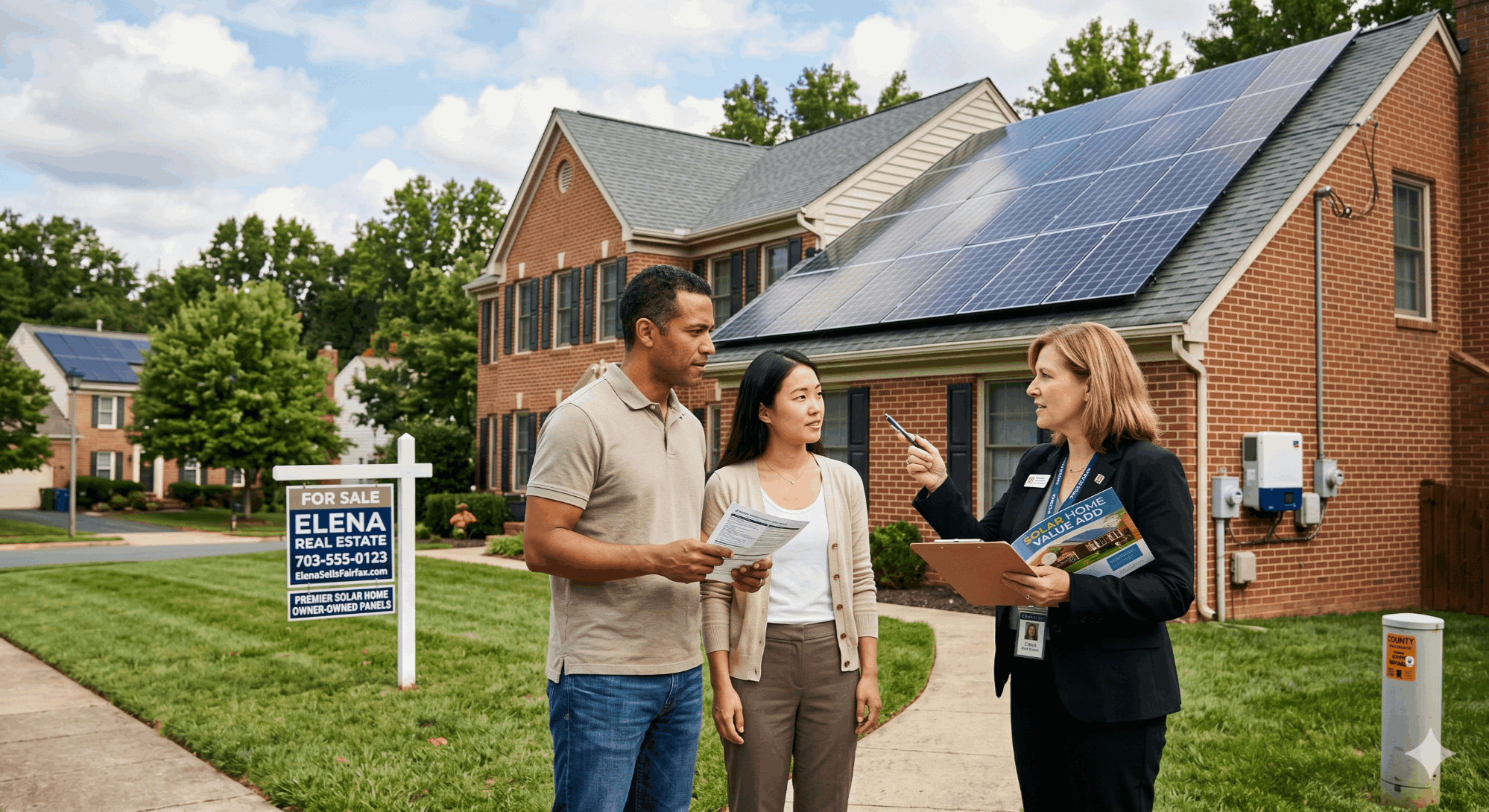 Solar is everywhere across Fairfax County communities, from the rooftops of Reston and Vienna to the larger lots in Great Falls and Clifton, and that means more local sellers than ever are asking how those panels affect a sale. The short version is that solar can absolutely help you sell, but only if the paperwork behind it is clean and the panels are presented the right way. As a Fairfax County real estate agent team, we have learned that the single biggest factor is not the panels themselves. It is how you own them.
Quick Answer: To sell a home with solar panels in Fairfax County, first confirm how you own the system. Owned and paid-off panels convey with the home as a fixture and can add value. If you have a solar loan with a UCC-1 fixture filing, that balance usually has to be paid off or the lien cleared at closing. Leased panels and power purchase agreements stay with a third party, so the buyer must qualify to assume the contract or you buy it out before listing. Gather your contract, warranty, and production records early, because the documentation drives both buyer confidence and the appraisal.
Key Takeaways
- Ownership is everything. Owned panels are the easiest to sell, financed panels with a lien usually get paid off at closing, and leases or PPAs require buyer assumption or a buyout.
- Under Fannie Mae and Freddie Mac rules, only owned systems with no third-party lien can be counted toward the appraised value, so leased panels rarely move the appraisal.
- The federal 30 percent residential solar tax credit ended December 31, 2025, but most existing Fairfax County solar homes were installed earlier and already captured it, which is a selling point worth highlighting.
- Virginia perks that transfer to the buyer, such as Dominion full retail net metering, the local property tax exemption, and the ability to sell SRECs, make a solar home more attractive when explained clearly.
- A simple one-page solar fact sheet with your contract, system size, age, warranty, and 12 months of production can prevent the most common deal delays.
- The right listing approach protects your equity. The Jamil Brothers list full-service for a 1.5 percent listing fee, which on a typical Fairfax sale keeps thousands more in your pocket.
In This Guide
- How Solar Panels Affect Your Fairfax County Home Sale
- The Four Ways You Might Own Your Solar Panels
- Selling With Owned, Paid-Off Solar Panels
- Selling With a Solar Loan or Financed Panels
- Selling With Leased Panels or a Power Purchase Agreement
- Do Solar Panels Add Value, and Will the Appraisal Show It?
- Virginia Solar Incentives That Pass to the Buyer
- What It Costs to Sell a Solar Home in Fairfax County
- Step by Step: Selling Your Solar Home
- How to Prepare Your Solar Home for Listing
- Common Mistakes Solar Home Sellers Make
- Selling a Solar Home Across Fairfax County
- Ready to Sell Your Solar Home the Smart Way?
- Frequently Asked Questions
- Glossary
How Solar Panels Affect Your Fairfax County Home Sale
Solar panels are not a problem to hide. For most Fairfax County buyers, lower electricity bills and a more efficient home are a genuine draw, especially as Dominion Energy rates keep climbing. How much of that appeal turns into a higher sale price depends on local conditions, which our Fairfax County housing market guide for 2026 breaks down for sellers. The friction in a solar sale almost never comes from the technology. It comes from confusion about who owns the equipment, what contracts are attached to it, and whether those contracts can be passed to the next owner cleanly.
Think of your solar setup as a small business attached to your roof. A buyer is not just buying your house. They are inheriting a 20 to 25 year energy arrangement. When that arrangement is simple and well documented, solar becomes a feature that helps your listing stand out. When it is murky, buyers hesitate, lenders ask questions, and the timeline slips. Your job before listing is to make the solar story easy to understand and easy to verify.
First question to answer
Before you do anything else, find out exactly how you own your panels: paid off and owned, financed with a solar loan, leased, or under a power purchase agreement. The rest of your selling strategy flows from that single answer.
The Four Ways You Might Own Your Solar Panels
There are four common ways Fairfax County homeowners hold solar, and each one sells differently. The table below is the fastest way to see where you stand and what to expect.
| Ownership Type | Who Owns the Panels | What Happens at Closing | Adds Appraised Value? |
|---|---|---|---|
| Owned (cash) | You do, free and clear | Panels convey as a fixture, nothing to pay off | Yes, with support |
| Solar loan (financed) | You do, with a lien | Loan paid off or lien cleared from proceeds | Often yes, if lien is cleared |
| Lease | A solar company | Buyer assumes lease or you buy it out | No |
| Power purchase agreement | A solar company | Buyer assumes the PPA or you settle it | No |
Buyer appeal by ownership type
Across the deals we see in Northern Virginia, buyer enthusiasm tracks closely with how simple the arrangement is. The cleaner the ownership, the wider your buyer pool.
Paperwork complexity by ownership type
The flip side of buyer appeal is paperwork. Knowing the level of effort up front lets you start the right tasks early instead of scrambling during a tight escrow.
Selling With Owned, Paid-Off Solar Panels
This is the simplest scenario and the one buyers love most. If you paid cash for your system, or you have already paid off the loan, the panels are treated as a fixture of the home, much like a built-in HVAC unit or a finished basement. They convey with the property at closing, there is nothing to pay off, and no third party has a claim on them.
Owned panels are also the only category that can be credited toward your home's appraised value under conventional lending rules, provided you can document the system and there is market support for the adjustment. That makes ownership a real advantage in a listing. The buyer gets free electricity production with no monthly obligation, and you get to market the home as energy efficient with a feature that is fully theirs on day one.
Your main task here is documentation. Pull together the installation invoice, the system specifications, the manufacturer and workmanship warranties, and ideally 12 months of production data from your monitoring app. We package this into a one-page solar fact sheet that goes straight into the listing, which builds trust and helps the appraiser do their job. If you are weighing whether your equity is best protected by a traditional commission or our full-service program, the fastest way to see the difference is to run a quick seller net sheet before you list.
Get a personalized valuation from The Jamil Brothers that accounts for your owned solar system, recent neighborhood comps, and current Fairfax County demand. Response within 24 hours.
Selling With a Solar Loan or Financed Panels
Plenty of Fairfax County homeowners bought their panels with a solar loan. You own the equipment, but there is still a balance owed, and how that loan was structured determines what happens at closing. There are two main versions to sort out.
Secured loans with a UCC-1 fixture filing
Many solar loans are secured by a UCC-1 fixture filing, which is a lien recorded against the panels as a fixture of your property. A title search will usually surface it. Before your buyer's mortgage can close, that lien has to be either paid off and terminated or formally subordinated. In most Fairfax County sales, the cleanest path is to pay off the remaining balance from your sale proceeds at closing, which clears the lien and lets the panels convey free and clear.
One detail that trips up sellers: occasionally a solar company files an overly broad UCC-1 that appears to claim an interest in the land and dwelling, not just the equipment. If that happens, the filing may need to be amended with a UCC-3 form so it covers only the panels. Catching this early, ideally before you list, keeps it from becoming a closing-day surprise.
Unsecured solar loans
If your loan was unsecured, meaning it is tied to you personally rather than to the property, there is no lien on the home. You can pay the balance off from your proceeds, or you can keep making payments separately after the sale and let the buyer take the panels free and clear. Either way, it does not cloud the title. Just be aware the loan often shows up on your credit report, so your lender and title company should confirm how it is classified.
Watch the payoff math
If your loan balance is high relative to the value the panels add, paying it off can take a bite out of your net proceeds. This is exactly the kind of number to model before you list so there are no surprises at the closing table.
Our seller net sheet breaks down every cost, including your solar loan payoff, commission, Virginia grantor tax, and closing fees, so you know your real bottom line before you list.
Selling With Leased Panels or a Power Purchase Agreement
Leases and power purchase agreements create the most friction in a home sale, because a third party owns the equipment on your roof. With a lease, you pay a fixed monthly amount to use the panels. With a PPA, you pay for the electricity the panels produce. In both cases, the panels are not yours to sell, so the contract has to be dealt with directly.
Your three realistic options
Transfer the contract to the buyer
The buyer agrees to take over your lease or PPA. The solar company typically runs a credit check, and the buyer must qualify and sign a transfer agreement. This works well when the monthly payment is reasonable and the buyer is comfortable with the terms.
Buy out the contract before listing
You pay the solar company a buyout amount to own the system outright, then sell the home with owned panels. This widens your buyer pool and can lift your sale price, but only if the buyout cost is less than the value and simplicity you gain.
Settle the contract at closing
In some cases you pay off the remaining lease or PPA obligation from your sale proceeds so the buyer takes the home clear of any solar contract. Your agent and title company coordinate the timing with the solar provider.
A few mortgage realities matter here. Leased and PPA systems are treated as personal property of the solar company, so they do not add to your appraised value. The lease or PPA payment can also count against the buyer's debt-to-income ratio unless the contract is structured with a production guarantee or an energy-based payment, which is why the exact contract language matters to the buyer's lender. Most solar companies need 30 to 60 days lead time to process a transfer, so the smartest move is to contact your provider before you list, not after you have an offer.
Lease versus owned: a quick comparison
| ✓ Owned Panels | ✗ Leased / PPA Panels |
|---|---|
| Convey as a fixture, no third party involved | Owned by a solar company, contract must transfer |
| Can be credited toward appraised value | Not counted in the appraisal |
| Widest possible buyer pool | Buyer must qualify and accept the contract |
| No monthly obligation passes to the buyer | Monthly payment may affect buyer financing |
If your panels are leased and the timeline feels overwhelming, or if the home also needs work, it is worth understanding every path. Sometimes a traditional listing nets the most money, and sometimes speed and certainty matter more. We are happy to walk through your full range of options, including how a cash offer compares to a full-service listing, with no pressure either way.
If a complicated solar lease, timing, or condition matters more than maximum price, a cash offer may be the right fit. We'll walk you through your full range of options so you can choose with confidence.
Do Solar Panels Add Value, and Will the Appraisal Show It?
Owned solar panels generally add value to a home, and research from the Lawrence Berkeley National Laboratory has long shown buyers will pay a premium for homes with photovoltaic systems. In practice, an owned system can add somewhere in the range of $15,000 to $25,000 to a Fairfax County home, depending on size, age, and local demand. The catch is that the added value does not always show up dollar for dollar on the appraisal.
Appraisers follow specific rules. Under Fannie Mae and Freddie Mac guidelines, only owned systems with no third-party lien can be counted toward value, and the appraiser is supposed to support any adjustment with the sales comparison approach, sometimes augmented by an income or cost analysis. They cannot simply add what you paid for the system. If there are no comparable solar home sales nearby, or if the appraiser has little solar experience, the credited value may come in lower than you expect.
How to protect your solar value at appraisal
Solar appraisal protection checklist
- ✓ Request a lender appraiser with solar valuation experience, ideally one trained through the Appraisal Institute
- ✓ Provide the system size in kilowatts, installation date, and original cost
- ✓ Supply 12 months of production data and recent electric bills showing savings
- ✓ Confirm in writing that the panels are owned with no active lien
- ✓ Ask your agent to pull any nearby solar home comps to support the adjustment
Virginia Solar Incentives That Pass to the Buyer
A big part of selling a solar home well is explaining the ongoing benefits the buyer inherits. Several Virginia incentives stay with the home or transfer easily to the new owner, and spelling them out turns vague interest into real value in a buyer's mind. These incentives are specific to Virginia, so if you are selling across the state line, our guide to selling a home with solar panels in Maryland covers how the rules differ there.
Net metering with Dominion Energy
Virginia has full retail net metering through Dominion Energy for residential systems up to 25 kilowatts. When the panels produce more electricity than the home uses, the excess flows to the grid and the homeowner banks a credit at the same rate they would pay to buy power back. The new owner simply sets up their own net metering account with Dominion to continue the benefit. This is one of the strongest selling points for an owned system, and it is worth highlighting in the listing.
Fairfax County property tax exemption
Under Virginia Code 58.1-3661, localities can exempt the added value of residential solar equipment from property taxes, and Fairfax County is among the jurisdictions that have adopted this exemption for qualifying systems. In plain terms, the home is worth more with solar, but the added value typically is not taxed. Buyers appreciate hearing that they get the value boost without a larger tax bill, and you should confirm the current exemption status with the Fairfax County assessor when you list.
SRECs and the federal tax credit status
Virginia has a Solar Renewable Energy Certificate market created by the Virginia Clean Economy Act, so the new owner of an owned system can register and sell the SRECs the panels generate for additional income. On the federal side, there is an important update for 2026. The 30 percent federal residential solar tax credit ended on December 31, 2025. Systems installed before that date still claimed it, which is good news for sellers: most existing Fairfax County solar homes were installed earlier and already captured the credit, so the buyer enjoys a fully incentivized system without having to chase a credit that no longer exists for new residential installations.
| Virginia Benefit | Who Gets It After the Sale | Transfers Easily? |
|---|---|---|
| Dominion net metering credits | New owner sets up their account | Yes |
| Local solar property tax exemption | Stays with the property | Yes |
| SREC income (owned systems) | New owner re-registers the system | Yes, with re-registration |
| Federal 30 percent tax credit | Already claimed by original owner | Ended for new residential installs |
None of this is tax or legal advice, and incentive rules change, so it is smart to confirm details with Dominion, the Fairfax County assessor, and a tax professional. The point for sellers is simple: a well-documented owned system carries real, transferable value, and your listing should make that easy for buyers to see.
What It Costs to Sell a Solar Home in Fairfax County
Selling a solar home costs the same as selling any other house in Fairfax County, with one possible addition: clearing a solar loan or settling a lease or PPA if you have one. The standard selling costs in Virginia include the listing commission, the buyer's agent commission, Virginia grantor tax of roughly $1 per $1,000 of sale price plus the regional congestion tax that applies in Northern Virginia, and ordinary closing and settlement fees, which our full breakdown of Fairfax County seller closing costs walks through line by line.
The largest line item is almost always commission, and that is where your choice of listing approach makes the biggest difference to your net proceeds. The Jamil Brothers Realty Group offers a 1.5 percent full-service listing fee in Northern Virginia, which includes professional photography, drone video, 3D tours, partner-led negotiation, and full MLS marketing. Compared with a traditional 3 percent listing fee, that difference goes straight back into your equity. Use the calculator below to see how it adds up at your home's value, then explore the full-service 1.5 percent listing program in detail.
Seller Savings Calculator
How much more do you keep with our 1.5% listing fee?
Select your home's estimated value to see your real net proceeds, side by side.
Traditional Agent: 3%
Our Fee: Only 1.5%
Extra in your pocket
$6,000vs. a traditional 3% listing agent, with zero reduction in service or marketing.
Traditional Agent: 3%
Our Fee: Only 1.5%
Extra in your pocket
$7,500vs. a traditional 3% listing agent, with zero reduction in service or marketing.
Traditional Agent: 3%
Our Fee: Only 1.5%
Extra in your pocket
$9,000vs. a traditional 3% listing agent, with zero reduction in service or marketing.
Traditional Agent: 3%
Our Fee: Only 1.5%
Extra in your pocket
$11,250vs. a traditional 3% listing agent, with zero reduction in service or marketing.
Traditional Agent: 3%
Our Fee: Only 1.5%
Extra in your pocket
$15,000vs. a traditional 3% listing agent, with zero reduction in service or marketing.
Estimates only. Closing costs and any solar payoff vary. Buyer's agent commission is negotiable.
Step by Step: Selling Your Solar Home
Here is the path we walk Fairfax County sellers through when there are panels on the roof. The earlier you start the solar-specific steps, the smoother the closing.
Confirm your ownership type and pull documents (weeks 1 to 2)
Determine whether the panels are owned, financed, leased, or under a PPA. Gather your contract, payoff or buyout figures, warranties, and production history.
Contact your solar provider early (weeks 1 to 3)
If you have a lease or PPA, ask about transfer steps and buyout options now. If you have a loan, get the exact payoff and check the UCC-1 filing.
Price the home and build the solar fact sheet (weeks 2 to 4)
Set the price with current comps, then create a one-page solar summary for the listing so buyers and appraisers understand the system at a glance.
List, market, and field offers (weeks 3 to 6)
Professional photography, drone video, and 3D tours showcase the home, while the solar fact sheet answers questions before they become objections.
Coordinate the solar transfer with closing (weeks 5 to 8)
Pay off the loan, complete the lease transfer, or finalize the buyout in step with the settlement so the title is clean and the buyer's financing clears.
Professional photography, drone video, 3D tours, partner-led negotiation, and full MLS marketing, all included at 1.5 percent. No hidden fees, no service reductions, no surprises.
How to Prepare Your Solar Home for Listing
Preparation is what separates a solar home that sells smoothly from one that stalls. The goal is to make the system effortless for a buyer to understand and for a lender to approve. Work through the checklist below before your first showing.
Pre-listing solar document checklist
- ✓ The original purchase, loan, lease, or PPA contract
- ✓ System size in kilowatts, installation date, and installer name
- ✓ Manufacturer and workmanship warranty documents and transfer terms
- ✓ Twelve months of production data and recent electric bills
- ✓ Loan payoff statement or lease and PPA buyout quote, if applicable
- ✓ Net metering account details with Dominion Energy
- ✓ Any HOA approval or architectural review paperwork for the panels
Virginia is a buyer-beware state, but solar agreements are material facts, so you should disclose your lease, loan, or PPA and provide the documentation. Being upfront protects you and actually builds buyer confidence. A clear, honest solar story almost always sells better than a vague one.
From documenting your panels to pricing, marketing, and negotiation, The Jamil Brothers handle the full sale. Tell us about your home and we will map out your next steps, with no obligation.
Common Mistakes Solar Home Sellers Make
Most solar sale problems are avoidable. These are the missteps we see most often in Fairfax County, and each one is easy to sidestep with a little planning.
| The Mistake | The Fix |
|---|---|
| Waiting until you have an offer to contact the solar company | Call before listing, since transfers can take 30 to 60 days |
| Assuming the panels will add their full cost to the price | Price with real comps and document the system for the appraiser |
| Hiding a lease or PPA from buyers | Disclose all agreements and present the benefits clearly |
| Ignoring an overly broad UCC-1 filing | Review the filing early and amend it with a UCC-3 if needed |
| Choosing an agent with no solar selling experience | Pick a team that has closed solar homes and knows the lender rules |
Every solar sale is a little different, and so is the right commission structure. Compare full-service listing options built around your home and your goals, with no cut to marketing, photography, or negotiation support.
Selling a Solar Home Across Fairfax County
Solar shows up everywhere from the townhomes of Kingstowne to the estates of Great Falls, and the right strategy shifts a little with each market and price point. Whether you are in Vienna, McLean, Reston, or anywhere in between, we help homeowners present their solar system in the way that wins the most qualified buyers. Tap your community below to explore local market detail, or reach out and we will tailor a plan to your block.
Looking at the other side of the move? You can also browse current homes for sale across Northern Virginia to plan your next step.
Ready to Sell Your Solar Home the Smart Way?
Solar panels do not have to complicate your sale. With the right preparation, they become one more reason a Fairfax County buyer chooses your home. The formula is straightforward: confirm how you own the system, handle any loan or lease early, document everything clearly, and price the home with real local comps. Get those pieces right and solar works for you, not against you.
The Jamil Brothers Realty Group has closed homes with every kind of solar arrangement across Northern Virginia, and we pair that experience with a 1.5 percent full-service listing fee that protects your equity at the closing table. The best first step is to know your numbers. Start with a free valuation and a personalized seller net sheet, and you will see exactly what your solar home can sell for and what you will walk away with.
Know your equity, understand your costs, and see exactly what you'll walk away with before you make any decisions. The Jamil Brothers provide a full seller consultation at no cost or obligation.
Frequently Asked Questions
Do solar panels make it harder to sell a house in Fairfax County?
Not usually. Owned solar panels often make a home more attractive to Fairfax County buyers because of lower electricity bills and energy efficiency, and they can add value. The friction comes almost entirely from contracts, not the technology. Leased panels and power purchase agreements take more coordination because a buyer has to assume the contract, but with early preparation and clear documentation, a solar home sells just as smoothly as any other.
Do you have to pay off solar panels before selling your home?
It depends on how the panels are financed. If you have a solar loan secured by a UCC-1 fixture filing, the lien usually has to be cleared before closing, and most sellers pay off the balance from their sale proceeds. An unsecured solar loan is tied to you personally rather than the property, so you can pay it off at closing or keep making payments separately. Owned and paid-off panels have nothing to settle. Leases and PPAs are not paid off but instead transferred to the buyer or bought out.
How long does it take to sell a home with solar panels?
A well-prepared solar home typically sells on a normal Fairfax County timeline of roughly four to eight weeks from listing to closing. The main variable is any lease or PPA transfer, which can add 30 to 60 days because the solar company must process the assignment and qualify the buyer. Starting that process before you list, rather than after you accept an offer, keeps the solar piece from slowing down your closing.
Do leased solar panels add value to a home in Virginia?
No. Under Fannie Mae and Freddie Mac guidelines, leased panels and power purchase agreements are treated as personal property of the solar company, so they cannot be counted toward the appraised value of the home. Only owned systems with no third-party lien can be credited with value, and even then the appraiser must support the adjustment with comparable sales. If adding value matters to you, buying out the lease before listing can convert the system to an owned asset.
How do you transfer a solar lease to the buyer?
You contact your solar provider, request the transfer or assumption package, and the buyer applies to take over the contract. The solar company usually runs a credit check and has the buyer sign a transfer agreement, after which the lease moves to the new owner at closing. If the buyer does not want the lease or cannot qualify, your alternatives are to buy out the contract before listing or settle the remaining obligation from your sale proceeds. Because transfers take time, reach out to the solar company well before you go on the market.
Will an appraiser count my solar panels in the home's value?
Only if the panels are owned and free of any third-party lien, and even then the appraiser must support the value with the sales comparison approach and local market data rather than simply adding what the system cost. To give your solar value the best chance, request an appraiser with solar experience, provide the system size, age, cost, and 12 months of production data, and ask your agent to gather any nearby solar home comparables. Leased and PPA systems are not included in the appraisal.
Does the federal solar tax credit still apply in 2026?
The 30 percent federal residential solar tax credit, known as the Section 25D Residential Clean Energy Credit, ended on December 31, 2025. Homeowners who installed and placed systems in service before that date were able to claim it, but new residential installations in 2026 no longer qualify for the federal credit. For sellers, this is usually a positive: most existing Fairfax County solar homes were installed earlier and already captured the credit, so the buyer inherits a fully incentivized system. Always confirm current tax details with a tax professional.
Do Virginia solar incentives like net metering transfer to the new owner?
Yes. The new owner can set up their own net metering account with Dominion Energy to keep earning bill credits at the full retail rate for excess production. The local solar property tax exemption that Fairfax County offers stays with the property, and the new owner of an owned system can register to sell SRECs in Virginia's market. Spelling out these transferable benefits in your listing helps buyers understand the long-term value they are inheriting.
What documents do I need to sell a home with solar panels?
Gather your original purchase, loan, lease, or PPA contract, the system size in kilowatts and installation date, the manufacturer and workmanship warranties with their transfer terms, 12 months of production data and recent electric bills, and a loan payoff or buyout quote if one applies. Add your Dominion net metering account details and any HOA approval for the panels. Packaging this into a one-page solar fact sheet for the listing answers buyer and appraiser questions before they become obstacles.
How do I choose a listing agent for a solar home?
Look for objective signals: a track record closing homes with solar, familiarity with Fannie Mae and Freddie Mac solar lending rules, experience coordinating lease transfers and loan payoffs, and a clear marketing plan that documents the system for buyers and appraisers. Ask how they will protect your solar value at appraisal and what their fee includes. The Jamil Brothers Realty Group has closed solar homes across Northern Virginia and offers a 1.5 percent full-service listing fee, which keeps more equity in your pocket without reducing service.
Are there HOA rules about solar panels in Fairfax County?
Many Fairfax County communities have a homeowners association, and Virginia law limits how much an HOA can restrict solar, though associations can still set reasonable rules on placement and appearance. If you have an HOA, locate any architectural approval or solar covenant paperwork from when the panels were installed and include it with your listing documents. Having that approval on hand reassures buyers that the system is properly permitted and compliant with community guidelines.
What mistakes should I avoid when selling a solar home?
The biggest mistakes are waiting until you have an offer to contact the solar company, assuming the panels will add their full cost to the price, hiding a lease or PPA from buyers, overlooking an overly broad UCC-1 lien, and hiring an agent with no solar selling experience. Each one is avoidable. Start the solar steps early, price with real comparable sales, disclose all agreements, review your filings, and work with a team that has closed solar homes before.
Glossary
Net Metering
A billing arrangement where the utility credits you for excess solar electricity sent to the grid. In Virginia, Dominion Energy offers full retail net metering for residential systems up to 25 kilowatts.
Solar Lease
An agreement where you pay a fixed monthly fee to use solar panels owned by a third-party company. The lease, not the panels, must be transferred to a buyer when you sell.
Power Purchase Agreement (PPA)
A contract where you pay for the electricity the panels produce rather than the equipment itself. Like a lease, a PPA is owned by a third party and must be assumed by the buyer or settled.
UCC-1 Fixture Filing
A lien recorded against solar panels as a fixture of your property to secure a solar loan. It generally must be paid off and terminated, or subordinated, before a sale can close.
SREC
A Solar Renewable Energy Certificate earned for the electricity an owned system produces. Virginia has an SREC market, and the new owner can register to sell them for extra income.
Federal Investment Tax Credit (ITC)
The 30 percent federal residential solar credit that ended December 31, 2025. Systems installed before then claimed it, so most existing solar homes already captured this benefit.
Lease Buyout
Paying the solar company a set amount to purchase a leased or PPA system outright, which converts it to an owned asset and can make the home easier to sell and appraise.
Production Guarantee
A clause in some solar contracts promising a set amount of electricity. When present, lenders may exclude the lease payment from a buyer's debt-to-income calculation.
This article is for general informational purposes and is not tax, legal, or financial advice. Solar contracts, incentives, and lending rules change and vary by situation. Confirm current details with Dominion Energy, the Fairfax County assessor, your solar provider, and a qualified tax or legal professional. The Jamil Brothers Realty Group is licensed in Virginia, Maryland, Washington DC, and West Virginia under Samson Properties.
Explore More
Browse Every Corner of the DMV Market
Whether you're searching by budget, neighborhood, or buying situation — find exactly what you need below.
Virginia Homes by Budget
Washington DC Homes by Budget
Maryland Homes
Explore Northern Virginia Communities
Loudoun County
Fairfax County & Surrounding
Ready to Make a Move?
Full-Service · No Tradeoffs
List for 1.5% & Keep More Equity
Professional photography, drone video, 3D tours, and expert negotiation — all included. On an $800K home, that's $12,000 more in your pocket vs. a 3% agent.
See the 1.5% Program →Need Speed or Certainty?
Get a No-Obligation Cash Offer
Skip the showings, skip the contingencies. If timing or condition matters more than top dollar, a cash offer may be the right fit. We'll walk you through every option.
Explore Cash Offers →Categories
- All Blogs (1238)
- Buyer Guide (7)
- Buying a home (2)
- Buying Strategies (30)
- festivals (1)
- General Blog (66)
- Market Intelligence (28)
- Market Updates (7)
- Notable Properties For Sale (32)
- Real Estate Tips, News, and More (396)
- Seller Guide (1)
- Seller Guides (59)
- Selling Your Home (525)
- Top Realtors in Northern Virginia (58)
Recent Posts



Let's Connect