
Cash Offer vs. Financed Offer: Which Is Better for Northern Virginia Home Sellers?
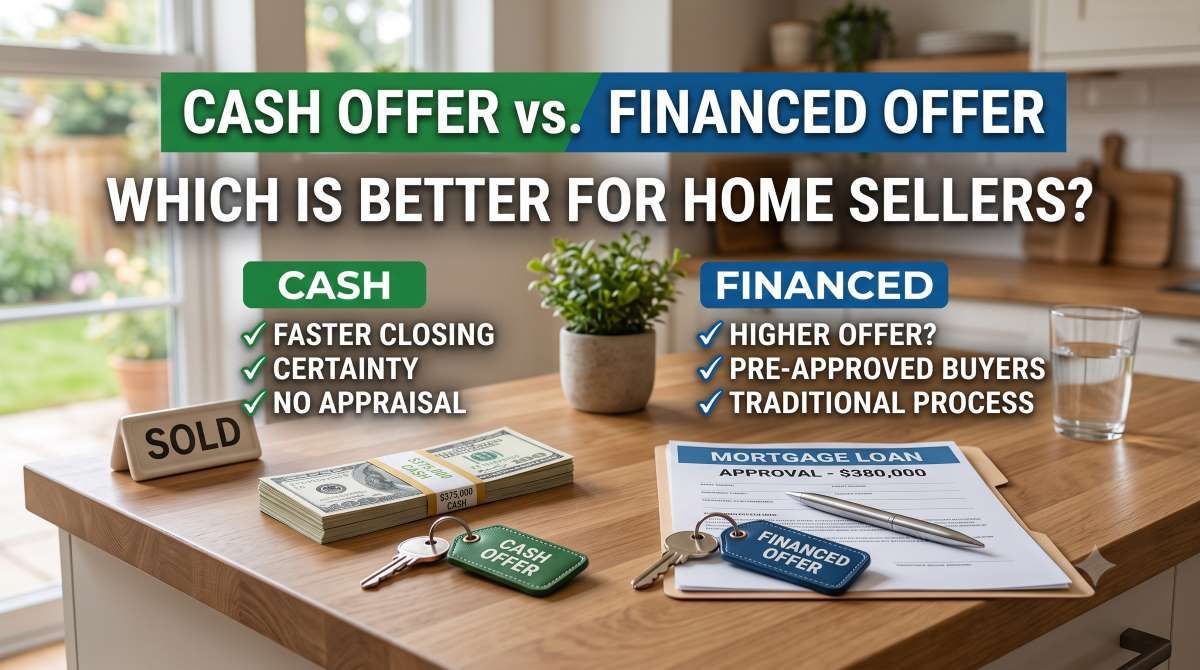
Quick Answer: In the cash offer vs. financed offer decision, cash usually wins on speed and certainty (a Northern Virginia closing in about 7 to 14 days with no lender to satisfy), while a strong financed offer often wins on price. Research from UC San Diego's Rady School of Management found cash buyers pay roughly 10% less on average, so a well-qualified mortgage buyer can net you more even after the extra 30 to 45 days. The best offer for a home seller is the one with the highest net proceeds you can actually count on closing, not simply the one labeled "cash."
Key Takeaways
- A cash offer removes the mortgage step: no lender underwriting, no bank appraisal, and typically no financing contingency, which is why cash closes in about 7 to 14 days versus 30 to 45 for a financed offer.
- Cash buyers pay about 10% less on average than financed buyers (Rady School of Management), but individual, non-investor cash buyers often come within 3% to 5% of market value while investors and flippers bid 15% to 30% under.
- Roughly 10% of mortgage-backed deals fall through, most often on the financing or appraisal contingency, so a "higher" financed offer only counts if it actually closes.
- On a Northern Virginia home near the June 2026 regional median of $810,000, a 10% cash discount is about $81,000, which usually outweighs the carrying costs of waiting for a financed close.
- The smartest move is to compare net proceeds and closing certainty side by side and vet the buyer behind every offer, which is exactly what a listing agent should do for you.
In This Guide
- The Short Answer: Which Offer Should a Seller Accept?
- Cash Offer vs. Financed Offer: The Core Difference
- How the Two Offers Compare Across 6 Factors
- Why Is a Cash Offer Better for the Seller?
- When a Financed Offer Actually Nets You More
- How Much Lower Are Cash Offers? The Real Discount by Buyer Type
- Seller Savings Calculator
- The Real Math: Net Proceeds on a Northern Virginia Home
- Fall-Through Risk: How Often Do Financed Deals Collapse?
- How to Vet a Financed Offer So It Closes Like Cash
- Pros and Cons of a Cash Offer on a House
- A Simple Framework for Choosing Between Offers
- How the Jamil Brothers Help You Evaluate Every Offer
- Frequently Asked Questions
- Glossary
You listed your home, the offers came in, and now two of them are sitting on your kitchen table. One buyer is paying cash and wants to close in ten days. The other is offering more money but needs a mortgage. This is the moment the cash offer vs. financed offer question stops being theoretical and starts being worth tens of thousands of dollars. As a Arlington County Real Estate seller, the right call depends on your timeline, your equity, and how much certainty you need, not on which word looks stronger on the page.
Here is the honest version most articles skip: a cash offer is not automatically better, and a financed offer is not automatically weaker. Cash gives you speed and near-guaranteed closing. A strong mortgage offer often gives you a higher price. The team behind The Jamil Brothers Realty Group, real estate specialists serving the DMV, evaluates both sides of that trade every week for sellers across Northern Virginia real estate and into Loudoun County real estate. This guide breaks down exactly how the two offer types compare, how much cash buyers really discount, and how to choose the option that leaves the most money in your pocket.
We will walk through the real numbers on a Northern Virginia home, show you how to vet a financed buyer so a mortgage offer closes as reliably as cash, and give you a simple framework for deciding under pressure. If you have offers in hand right now, you can also run your net proceeds or talk it through with our team before you sign anything.
The Short Answer: Which Offer Should a Seller Accept?
Accept the offer with the highest reliable net proceeds for your situation. For most Northern Virginia sellers, that decision comes down to a single trade-off: certainty versus price.
Take the cash offer when speed and certainty matter more than squeezing out the last dollar, for example when you are buying your next home on a tight timeline, the property needs work, you are settling an estate, or you simply cannot afford a deal to collapse. Take the financed offer when the buyer is strongly pre-approved, the price premium is meaningful, and you have the flexibility to wait the extra few weeks for a mortgage to fund.
The one-line rule
A higher financed offer only beats cash if it actually closes. Vet the buyer's financing first, then compare the two on net proceeds, not on the word "cash." A financed offer from a fully underwritten buyer can be nearly as safe as cash, and it may pay you more.
Cash Offer vs. Financed Offer: The Core Difference
The difference is simple: a cash buyer pays with their own funds, and a financed buyer pays with a mortgage loan. That single distinction sets off a chain of consequences that affects how fast you close, how likely the deal is to survive, and how much you walk away with.
What is a cash offer?
An all-cash offer means the buyer has the full purchase price on hand and does not need a lender. There is no loan underwriting, no bank-ordered appraisal, and usually no financing contingency in the contract. The buyer submits proof of funds, the title company handles the paperwork, and the money is wired at closing. Because the biggest reason deals collapse is removed, cash offers carry very low fall-through risk and can close in roughly a week to two weeks.
What is a financed offer?
A financed offer, sometimes called a mortgage offer or a conventional offer, means the buyer is borrowing most of the purchase price from a lender. The lender requires an appraisal to confirm the home is worth the loan amount, verifies the buyer's income and credit through underwriting, and issues final loan approval before closing. That process protects the buyer, but it also introduces contingencies (financing, appraisal, and usually inspection) and stretches the timeline to about 30 to 45 days. In 2024, about 74% of all buyers and 91% of first-time buyers used financing, so most offers you receive in Northern Virginia will be mortgage offers.
| Feature | Cash Offer | Financed Offer |
|---|---|---|
| How the buyer pays | Own funds, wired at closing | Mortgage loan from a lender |
| Typical closing time | 7 to 14 days | 30 to 45 days |
| Lender appraisal required | No | Yes |
| Financing contingency | Usually none | Standard |
| Risk of falling through | Very low | Moderate (about 10% fail) |
| Typical price offered | Often below market (varies by buyer) | Often higher, closer to list |
| Best for sellers who want | Speed and certainty | Maximum sale price |
Before you weigh any offer, know your home's true market value. Get a personalized valuation from The Jamil Brothers built on street-level comps, not an automated guess. Response within 24 hours.
How the Two Offers Compare Across 6 Factors
Price is only one variable. When you line up a cash offer against a financed offer, six factors decide which one leaves you better off. Here is how they stack up for a typical Northern Virginia seller.
1. Closing speed
Cash wins decisively. With no loan to process, no underwriting, and no lender appraisal to schedule, a cash deal can close in about a week to two weeks. A financed offer runs on the lender's clock, usually 30 to 45 days from contract to keys. If you are coordinating the purchase of your next home, those extra weeks matter.
2. Certainty of closing
Cash again. The single biggest reason home sales collapse is financing, so removing the lender removes most of the risk. About 10% of mortgage-backed transactions fail, according to the Rady School of Management research, most often because of a financing or appraisal problem. A verified cash buyer has no such exposure.
3. Sale price and net proceeds
Financing usually wins here. Cash buyers know their speed and certainty are worth something, so they price it in. On average, cash offers come in about 10% below what a financed buyer would pay. On a Northern Virginia home near the $810,000 regional median, that gap can be around $81,000, which is a large amount to trade away for a faster close.
4. Contingencies and conditions
Cash offers typically waive the financing and appraisal contingencies, and sometimes the inspection contingency too. Financed offers carry all three by default. Fewer contingencies mean fewer chances for the buyer to renegotiate or walk away, which is a real advantage even if the headline price is lower. For a deeper look at how contingencies change your risk, see our guide on contingent vs. non-contingent offers for sellers.
5. Carrying costs while you wait
Every extra day you own the home costs money: mortgage payments, property taxes, insurance, and utilities. Waiting the extra 30 to 45 days for a financed close can cost a seller on a median-priced home an estimated $2,000 to $4,500. That figure eats into the financed buyer's price premium, though it rarely erases it on a higher-value NoVA property.
6. Appraisal exposure
With a financed offer, the lender's appraisal can come in below the contract price, forcing a renegotiation or a buyer who has to cover the gap in cash. A cash buyer skips the lender appraisal entirely, so a low valuation cannot derail the sale. In a rising market like Northern Virginia, low appraisals are less common, but they still happen on aggressively priced homes.
Why Is a Cash Offer Better for the Seller?
When sellers say they prefer cash, they are really buying three things: speed, certainty, and simplicity. Even when a cash offer is lower on paper, those three benefits carry real financial value, and in some situations they are worth more than the extra dollars a financed buyer would pay.
The real advantages of accepting cash
- ✓ No lender, no loan denial. The most common deal-killer is off the table entirely.
- ✓ No appraisal gap. Without a bank appraisal, a low valuation cannot force a price cut or blow up the contract.
- ✓ Faster to keys. A one to two week close frees you to move on your next purchase or relocation.
- ✓ Often sold as-is. Many cash buyers accept the home in current condition, sparing you pre-listing repairs.
- ✓ Lower carrying costs. Fewer days of ownership means fewer payments, taxes, and utility bills.
This is why sellers who need speed, or whose homes need work, gravitate to cash. If a fast, certain sale is your priority, The Jamil Brothers can present you with a vetted cash offer option alongside what the open market would bring, so you can compare both on equal footing rather than guessing.
Our seller net sheet breaks down commission, transfer taxes, and closing costs for both a cash and a financed sale, so you can compare your real bottom line before you accept anything.
When a Financed Offer Actually Nets You More
Sellers often assume cash always wins. It does not. The same Rady School of Management study that found the 10% average discount also found that the gap shrinks dramatically for strong borrowers: a mortgage buyer with a solid credit profile pays only about 6% more than a cash buyer, not 10%. In a competitive market like Northern Virginia, where well-qualified buyers compete for limited inventory, a financed offer can easily be the higher-netting choice.
Lean toward the financed offer when several of these are true:
Signs the mortgage offer is the smarter accept
- ✓ The buyer is fully underwritten or pre-approved, not just pre-qualified, with a large down payment.
- ✓ The price premium over the cash offer is meaningful (often 5% or more on a NoVA home).
- ✓ Your home is in good, market-ready condition, so it will appraise cleanly.
- ✓ You have flexibility on timing and are not racing a contingent purchase or relocation.
- ✓ The buyer offers a strong earnest money deposit and reasonable contingency windows.
⚠️ Watch the buyer type behind the cash
Not all cash is created equal. An individual buyer paying cash may come within a few percent of market value. An investor or iBuyer using an automated model may bid well under. Always ask who the cash buyer is before you treat the offer as a bargain worth taking.
How Much Lower Are Cash Offers? The Real Discount by Buyer Type
The "cash offers are 10% lower" headline hides the most useful detail: the discount depends almost entirely on who the cash buyer is. Sorting that out is the difference between leaving $20,000 on the table and leaving $150,000 on it. Here is how cash offers typically break down against market value.
| Cash Buyer Type | Typical Offer vs. Market Value | Who They Are |
|---|---|---|
| Individual cash buyer | Within 3% to 5% below | A person buying a home to live in, competing on the open market |
| iBuyer / instant offer | Roughly 5% to 12% below, plus fees | A company using an automated valuation model and service charges |
| Local investor / flipper | 15% to 30% below | A buyer factoring renovation costs and resale profit into the offer |
| Well-qualified financed buyer | At or near market value | A strong borrower whose price often beats a discounted cash bid |
The takeaway for a Northern Virginia seller: an individual cash buyer's offer is often close enough to market value that the certainty is worth it. An investor's cash offer, by contrast, may cost you six figures on a median-priced home, so you should weigh it hard against listing on the open market. If you want to understand the broader decision of selling to a cash buyer versus listing at all, our companion guide on cash offer vs. traditional home sale covers it in depth.
If timing or condition matters more than top dollar, we will bring you a vetted cash offer and show you what a traditional listing would net, side by side. No pressure, no obligation, just the full picture.
Seller Savings Calculator
Whether you accept a cash offer or a financed one, the commission you pay comes out of the same net proceeds. That is the one lever you fully control. Selling with The Jamil Brothers' 1.5% full-service listing fee, instead of a traditional 3% listing side, keeps thousands more in your pocket on either type of sale. Select your home's estimated value to see the difference.
Seller Savings Calculator
How much more do you keep with our 1.5% listing fee?
Select your home's estimated value to see your real net proceeds, side by side.
Traditional Agent · 3%
Our Fee: Only 1.5%
Extra in your pocket
$6,000
vs. a traditional 3% listing agent, with zero reduction in service or marketing.
Traditional Agent · 3%
Our Fee: Only 1.5%
Extra in your pocket
$7,500
vs. a traditional 3% listing agent, with zero reduction in service or marketing.
Traditional Agent · 3%
Our Fee: Only 1.5%
Extra in your pocket
$9,000
vs. a traditional 3% listing agent, with zero reduction in service or marketing.
Traditional Agent · 3%
Our Fee: Only 1.5%
Extra in your pocket
$11,250
vs. a traditional 3% listing agent, with zero reduction in service or marketing.
Traditional Agent · 3%
Our Fee: Only 1.5%
Extra in your pocket
$15,000
vs. a traditional 3% listing agent, with zero reduction in service or marketing.
Estimates only. Closing costs vary. Buyer's agent commission is negotiable.
4K photography, drone video, 3D tours, expert negotiation, and full MLS marketing, all included at 1.5%. You get the same top-tier service on a cash or financed sale, without giving up thousands in commission.
The Real Math: Net Proceeds on a Northern Virginia Home
Averages are useful, but your decision comes down to your home and your two specific offers. Let's run a realistic scenario using the June 2026 Northern Virginia regional median sold price of $810,000, reported by the Northern Virginia Association of Realtors. Say you list at market value and receive two offers.
| Line Item | Investor Cash Offer | Well-Qualified Financed Offer |
|---|---|---|
| Offer price | $688,500 (15% under) | $810,000 (at market) |
| Days to close | About 10 days | About 35 days |
| Extra carrying cost (est.) | $0 | About $3,000 |
| Fall-through risk | Very low | About 10% (lower if vetted) |
| Approx. net advantage | Speed and certainty | About $118,500 more |
Even after subtracting roughly $3,000 in extra carrying costs, the financed offer nets about $118,500 more than the investor's cash bid. On a well-maintained Northern Virginia home in a strong market, that is a huge gap, and it is exactly why you should never accept an investor cash offer without seeing what the open market would pay.
Now flip the scenario. If the cash buyer were an individual offering $780,000 (about 4% under market) and you needed to close in two weeks to fund your own purchase, the picture changes. The $30,000 price gap might be worth trading for the certainty and speed. The math only works once you plug in your real numbers, which is what a personalized seller net sheet is for.
ℹ️ A note on commission after the NAR settlement
Since the August 2024 NAR settlement, buyer-agent compensation is negotiated separately and is no longer automatically bundled into your listing commission. That means your listing-side fee is the cost you most directly control, which is why our flexible commission structure can meaningfully change your net on either a cash or financed sale.
Fall-Through Risk: How Often Do Financed Deals Collapse?
A higher offer means nothing if the deal dies before closing. Roughly 10% of mortgage-backed transactions fail, according to the Rady School of Management research, and financing is the leading cause. A financed offer runs through several checkpoints where it can stall, and understanding them helps you judge how risky a mortgage offer really is.
Loan application and underwriting, days 1 to 20
The lender verifies the buyer's income, assets, credit, and employment. A job change, a new debt, or a documentation gap can derail approval here.
Appraisal, days 10 to 25
The lender orders an appraisal. If it comes in below the contract price, the buyer must cover the gap in cash, renegotiate, or walk under the appraisal contingency.
Final loan approval and clear-to-close, days 25 to 35
Underwriting issues its final decision. Only after the clear-to-close does the deal become nearly as certain as cash.
Closing and funding, day 35
The lender wires the funds, documents are signed, and the sale records. A cash sale reaches this point in about a quarter of the time.
The good news for sellers: most of this risk is measurable before you accept. A buyer who is fully underwritten has already cleared step one, which is where most failures happen. That is why how you vet the financing matters as much as the offer price.
How to Vet a Financed Offer So It Closes Like Cash
This is the part most sellers never learn, and it is where an experienced listing agent earns their fee. A financed offer from a strong, fully vetted buyer can close nearly as reliably as cash. The trick is knowing what to check before you sign. Here is the checklist we run on every mortgage offer.
The financed-offer vetting checklist
- ✓ Underwritten pre-approval, not a prequalification. A true pre-approval means the lender has already verified income and assets. A prequalification is little more than an estimate.
- ✓ Size of the down payment. A buyer putting 20% or more down is far less likely to have financing collapse than one at the minimum.
- ✓ Strength of the earnest money deposit. A larger deposit signals commitment and gives you protection if the buyer defaults.
- ✓ Appraisal gap coverage. An offer where the buyer agrees to cover a shortfall up to a set amount neutralizes your biggest financed-offer risk.
- ✓ Reputable, local lender. Established lenders who know the Northern Virginia market close on time far more reliably than unknown online shops.
- ✓ Reasonable contingency windows. Shorter financing and appraisal deadlines mean less time for the deal to unravel.
Run this checklist and a financed offer that looked risky may turn out to be a near-certain close at a higher price than the cash bid. Skip it, and you might reject a great financed buyer or accept a shaky one. This vetting is a core part of how we represent sellers at the offer table.
Send us your offers and we will pressure-test the financing, model the net proceeds, and tell you which one truly leaves you better off. It is what our seller clients rely on us for most.
Pros and Cons of a Cash Offer on a House
If you are leaning toward accepting cash, weigh both sides carefully before you decide. Here is the balanced view for a home seller.
| ✓ Pros of Accepting Cash | ✗ Cons of Accepting Cash |
|---|---|
| Closes fast, often in 7 to 14 days | Usually below market value, sometimes far below |
| Very low risk of falling through | Investor and iBuyer offers can carry hidden fees |
| No lender appraisal to satisfy | Fewer competing bids may leave money on the table |
| Often accepted as-is, no repair haggling | Fast timeline may not fit your next-home purchase |
| Fewer contingencies and conditions | You must still verify proof of funds is genuine |
A Simple Framework for Choosing Between Offers
When two offers land, run them through four questions in order. This framework cuts through the emotion and points you toward the offer with the best combination of net proceeds and certainty.
| Ask Yourself | If Speed Matters Most | If Price Matters Most |
|---|---|---|
| What is my true deadline? | Tight (weeks) → favor cash | Flexible → favor financed |
| What condition is my home in? | Needs work → cash may fit | Market-ready → financed appraises well |
| Who is the cash buyer? | Individual near market → strong | Investor far under → weigh listing |
| How solid is the financing? | Shaky → lean cash | Underwritten, 20% down → nearly cash-safe |
There is no universal winner. The right answer is personal, and it hinges on details a good agent surfaces in minutes. If you are also planning to buy your next home, coordinate the two sales carefully. Our Northern Virginia buyer strategy session helps sellers who are moving up or relocating line up both transactions without a costly timing gap.
How the Jamil Brothers Help You Evaluate Every Offer
Choosing between a cash offer and a financed offer is a high-stakes call, and the difference between a good decision and a costly one usually comes down to who is reading the fine print with you. A strong listing agent does three things: prices your home so it attracts competitive offers, vets the buyer and financing behind each offer, and models your real net proceeds so you compare apples to apples.
The Jamil Brothers Realty Group brings that to every seller. With 840+ homes sold, more than $500M in closed volume, and 500+ five-star reviews across the DMV, Saad Jamil and Arslan Jamil have sat at hundreds of kitchen tables weighing exactly this decision. We present you with a vetted cash option and a full open-market strategy, then let the numbers guide you, all at a full-service 1.5% listing fee. When you are ready to see current listings for your next move, you can also browse available homes across Northern Virginia.
Explore More Seller Guides by Community
Arlington County Fairfax McLean Vienna Alexandria Ashburn Leesburg Loudoun CountyFrequently Asked Questions
In the cash offer vs. financed offer decision, is cash always better for the seller?
No. A cash offer is better when you value speed and certainty, since it closes in about 7 to 14 days with very low risk of falling through. But cash buyers pay roughly 10% less on average, so a well-qualified financed buyer can net you more even after the extra 30 to 45 days. The best offer is the one with the highest reliable net proceeds for your specific situation, not simply the one paying cash.
Why is a cash offer on a house better for the seller?
A cash offer removes the mortgage, which is the most common reason home sales collapse. There is no lender underwriting, no bank appraisal, and usually no financing contingency, so the deal is far less likely to fall apart and closes much faster. Many cash buyers also accept the home as-is, saving you repair costs. Those benefits carry real value, which is why sellers often accept cash even when the price is a little lower.
How much lower are cash offers than financed offers?
On average, cash offers come in about 10% below financed offers, according to research from UC San Diego's Rady School of Management. The real number depends on the buyer, though. An individual cash buyer often bids within 3% to 5% of market value, an iBuyer roughly 5% to 12% under plus fees, and an investor or flipper 15% to 30% under. A well-qualified mortgage buyer typically pays only about 6% more than a cash buyer, so the gap is smaller than the headline suggests.
Can a financed offer ever net a seller more than cash?
Yes, and it often does. When the financed buyer is fully underwritten with a large down payment and the price premium over the cash offer is meaningful, the mortgage offer usually wins on net proceeds. On a Northern Virginia home in good condition and a competitive market, a strong financed offer at or near market value can beat a discounted cash bid by tens of thousands of dollars, even after accounting for the extra time to close.
How long does a financed offer take to close compared to cash?
A financed offer typically takes 30 to 45 days from contract to closing because the lender must underwrite the loan, order an appraisal, and issue final approval. A cash offer skips all of that and can close in about 7 to 14 days. For a seller coordinating the purchase of a next home or relocating on a deadline, those extra weeks can be the deciding factor.
Do cash offers ever fall through?
Cash offers fall through far less often than financed ones, but they are not risk-free. A cash deal can still collapse if the buyer's proof of funds turns out to be inaccurate, the buyer discovers something during inspection, or the buyer simply changes their mind and forfeits the earnest money. This is why verifying genuine proof of funds is an essential step before you treat a cash offer as a sure thing.
How do I verify a cash buyer's proof of funds?
Ask for a recent bank statement or a letter from a financial institution confirming the buyer has the full purchase amount available. The document should be current, name the buyer, and show sufficient liquid funds, not investments that would need to be sold. A listing agent should review this before you accept and, when needed, confirm it directly with the institution. Treat any offer without solid proof of funds as unverified.
What is a financing contingency, and why does it matter?
A financing contingency lets a financed buyer cancel the contract and recover their earnest money if they cannot secure a mortgage. It protects the buyer, but it also gives them an exit that a cash buyer does not have. For a seller, a shorter financing-contingency window and a fully pre-approved buyer both reduce the risk that this clause is used against you.
Should I accept a cash offer that is below my asking price?
It depends on how far below and on your priorities. If an individual cash buyer is within a few percent of market value and you need speed or certainty, accepting can make sense. If an investor is 15% to 30% under, you should almost always test the open market first, because a financed buyer will likely pay much more. Run both scenarios through a net sheet before deciding.
Are cash offers common in the Northern Virginia market?
Cash is a meaningful share of the market. Nationally, roughly 27% to 30% of home purchases in early 2026 were all-cash, and Northern Virginia's strong, well-capitalized buyer pool keeps cash competitive here. Even so, most offers you receive will be financed, since about 74% of all buyers and 91% of first-time buyers use a mortgage. Expect to weigh both types on most listings.
How does the NAR settlement affect my commission when comparing offers?
Since the August 2024 NAR settlement, buyer-agent compensation is negotiated separately and is no longer automatically bundled into your listing commission. Practically, that makes your listing-side fee the cost you most directly control on either a cash or financed sale. Choosing a full-service 1.5% listing fee instead of a traditional 3% can add thousands to your net regardless of which offer you accept.
What is the biggest mistake sellers make when choosing between offers?
The most common mistake is judging offers by the word "cash" or the headline price instead of the net proceeds you can actually count on. Sellers accept lowball investor cash out of fear of a deal falling through, or accept a high financed offer from a weak buyer that later collapses. The fix is to vet the buyer behind every offer and compare real, bottom-line numbers side by side.
How do I choose between a cash and financed offer with confidence?
Start by defining your true deadline and priorities, then have each offer's buyer and financing vetted, and finally compare net proceeds on a personalized net sheet. An experienced local listing agent can do all three quickly and spot risks you might miss. The Jamil Brothers provide this evaluation as part of a full seller consultation at no cost, so you can decide with the full picture rather than a gut feeling.
Glossary
Cash Offer
An offer where the buyer pays the full price with their own funds, with no mortgage lender involved.
Financed Offer
An offer in which the buyer borrows most of the purchase price through a mortgage loan.
Proof of Funds
Documentation, usually a bank statement or letter, showing a cash buyer has the money to close.
Financing Contingency
A clause letting a financed buyer exit and recover earnest money if their loan is denied.
Appraisal Contingency
A clause allowing renegotiation or cancellation if the lender's appraisal comes in below the price.
Underwriting
The lender's review of a buyer's income, credit, and assets to approve or deny the mortgage.
Earnest Money Deposit
A good-faith deposit a buyer puts down to show commitment, at risk if they default.
Net Proceeds
The money you actually keep after commission, closing costs, and payoffs are subtracted from the sale price.
The Bottom Line for Northern Virginia Sellers
The cash offer vs. financed offer question does not have a one-size-fits-all answer. Cash delivers speed and certainty, a strong financed offer often delivers a higher price, and the winner depends on your timeline, your home's condition, and the buyer behind each offer. What never changes is the goal: accept the offer that leaves the most money in your pocket that you can actually count on closing.
Do not judge an offer by a single word or a headline number. Vet the buyer, model your net proceeds, and weigh certainty against price with real figures in front of you. That is how confident sellers decide, and it is exactly the support The Jamil Brothers provide at every offer table across the DMV.
Know your equity, understand your costs, and see exactly what a cash or financed offer would net you, before you decide anything. The Jamil Brothers provide a full seller consultation at no cost or obligation.
Categories
- All Blogs (1237)
- Buyer Guide (7)
- Buying a home (2)
- Buying Strategies (30)
- festivals (1)
- General Blog (66)
- Market Intelligence (28)
- Market Updates (7)
- Notable Properties For Sale (32)
- Real Estate Tips, News, and More (396)
- Seller Guide (1)
- Seller Guides (58)
- Selling Your Home (525)
- Top Realtors in Northern Virginia (58)
Recent Posts








Let's Connect