
How Do Estate Sales Work? A Professional Guide

Quick Answer: An estate sale is a professionally managed sale of most or all of a home's contents — furniture, kitchenware, tools, art, and everyday items — usually run by an estate sale company over a weekend. The company sorts, prices, stages, and advertises everything, then takes a commission of roughly 30% to 50% of gross sales (about 35% to 40% is typical). Most sales need one to two weeks of prep, and 5% to 25% of items are usually left over. Once the contents are cleared, the home itself is normally sold separately.
Key Takeaways
- An estate sale sells the contents of a home. Selling the house is a separate step with its own timeline and costs.
- Estate sale companies charge a commission on gross sales, commonly 30%–50%, with the national norm around 35%–40%.
- The full process usually runs 1–2 weeks of prep plus a 2–3 day sale, then cleanout.
- The cheapest commission rarely means the biggest payout — the right company nets you more.
- In Virginia there is no state estate or inheritance tax, but an inherited home usually requires probate before it can close.
- After the sale, most families list the home or take a cash offer for a faster, as-is exit.
In This Guide
- What Is an Estate Sale?
- How an Estate Sale Works, Step by Step
- How Much Do Estate Sale Companies Charge?
- What Sells at an Estate Sale (and What Doesn't)
- Estate Sale vs. the Alternatives
- Selling the Home After the Estate Sale
- Estate Sales in Northern Virginia & Fairfax County
- Seller Savings Calculator
- Common Mistakes to Avoid
- How to Choose an Estate Sale Company
- Frequently Asked Questions
- Glossary
Estate sales come up at hard moments — after a death, a move to assisted living, a divorce, or a downsizing decision. A whole house full of belongings has to go, and fast. If you have never done this before, the process can feel overwhelming.
The good news: estate sales are a well-worn path, and most of the work is handled for you. This guide walks through exactly how they work — what a company does, what it costs, how long it takes, what sells, and what happens to the things that don't. It also covers the part most articles skip: what to do with the home once the contents are gone, which is usually the largest decision of all.
We work with Northern Virginia families through this process often, so we have added the local details that matter here in Fairfax County and across the region — from probate timelines to as-is home sales.
What Is an Estate Sale?
An estate sale is an organized, in-home sale of a household's personal property. A professional company prices and displays the items throughout the house, opens the doors to the public for a set number of days, and sells whatever it can. The goal is to clear out most of a home's contents quickly and turn them into cash for the family or estate.
People often confuse an estate sale with a few similar things. The differences matter, because they change how much you keep and how much work falls on you.
| Type | What It Is | Who Runs It |
|---|---|---|
| Estate sale | Whole-house contents sold on-site over a few days | Professional estate sale company |
| Garage / yard sale | A handful of unwanted items sold casually | The homeowner |
| Estate auction | Items sold to the highest bidder, in person or online | Auctioneer or online platform |
| Estate / probate home sale | Selling the house itself, not the contents | A real estate agent or cash buyer |
Keep that last row in mind. "Estate sale" and "selling the estate's home" get used interchangeably, but they are two different transactions. This guide covers both, in order.
How an Estate Sale Works, Step by Step
Most estate sales follow the same arc. Once you hire a company, you can step back — the crew does the heavy lifting. Here is the typical sequence from first call to final cleanout.
Free walkthrough & consultation — Day 1
The company tours the home, estimates what the contents could bring, and tells you whether a sale makes sense. Most walkthroughs are free and carry no obligation.
Contract & terms — Day 1–3
You sign an agreement that spells out the commission rate, any extra fees, the sale dates, and how leftovers are handled. Get every fee in writing before you commit.
Sort & remove keepsakes — before prep
This is your job. Pull out anything you want to keep, plus documents, photos, and valuables. Once prep starts, everything left in the house is fair game to price and sell.
Research, price & stage — 1–2 weeks
The crew prices every item, from dishes to antiques, using market databases and experience. They clean, organize, and stage the home so buyers can shop room by room.
Advertising — the week before
Listings go up on sites like EstateSales.net and EstateSales.org, plus social media, email lists, and neighborhood signs. Good marketing is what fills the driveway on day one.
The sale — 2–3 days
Most sales run Friday to Sunday. Prices often start firm, then drop on the final day to move remaining stock. The company manages crowds, checkout, and payment.
Settle up & handle leftovers — after the sale
You receive the proceeds minus commission, along with a sales record. Expect 5%–25% of items to remain. The company may offer buyout, donation pickup, or a paid cleanout so the home is left broom-clean.
ℹ️ Do the contents first, then the house
Clearing the contents before you list makes the home show better and photograph cleaner. If you plan to sell the property too, tell your agent early so the estate sale and the listing line up. A quick home valuation at this stage helps you sequence both without wasting weeks.
Before you decide how to handle the property, get a personalized valuation from The Jamil Brothers — street-level comps, not an automated guess. Response within 24 hours.
How Much Do Estate Sale Companies Charge?
Almost all estate sale companies work on commission. They take a percentage of the gross sales and pay you the rest. There is usually no upfront fee — but read the contract, because add-on charges are common.
Commission usually lands between 30% and 50% of gross sales, and the national norm is roughly 35% to 40%. The rate moves on a sliding scale. Higher-value estates with easy-to-sell items pay less. Small estates, low-value contents, or homes that need heavy sorting and cleaning pay more.
| Situation | Typical Commission | Why |
|---|---|---|
| High-value estate, quality items | 30%–35% | More gross, easier to sell |
| Typical household estate | 35%–45% | The most common range |
| Small estate or heavy cleanout | 45%–50%+ | Same labor, less to sell |
Estimated ranges for planning only. Actual rates depend on the company and the contents.
A simple example
Say a sale grosses $12,000 and the company charges 40%. The company keeps $4,800, and you receive $7,200. That split is normal. What you want to avoid is a low headline rate hiding fees for staffing, trash removal, credit-card processing, or cleanout.
Where a typical commission tends to fall:
Illustrative midpoints of common ranges — not a quote.
ℹ️ The lowest rate is not the best deal
A seasoned company charging 45% can net you more than a new company charging 25%, because they price better, market harder, and draw more buyers. Compare expected payout, not just the percentage.
What Sells at an Estate Sale (and What Doesn't)
Nearly everything in a home can be priced and sold. Some things move fast and bring real money. Others barely sell at all — which is why leftovers are normal.
| Sells Well | Sells Slowly |
|---|---|
| Solid-wood & vintage furniture | Large entertainment centers, wall units |
| Jewelry, coins, watches | Used mattresses & upholstered pieces |
| Tools, yard equipment, garage items | Formal china sets & crystal |
| Art, rugs, collectibles, antiques | Old TVs, printers, dated electronics |
| Kitchenware, small appliances | Clothing (unless designer or vintage) |
Because 5% to 25% of items usually remain, decide early what happens to them. Common paths: a company buyout of the rest, a charity donation with a tax receipt, or a paid cleanout that leaves the home empty and ready to list.
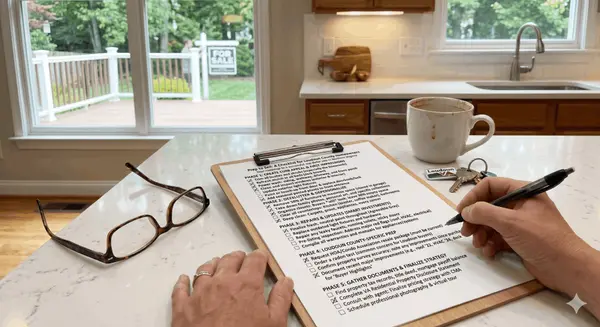
Before Prep Begins — Your Checklist
- ✓ Remove all personal papers, financial records, and mail
- ✓ Pull out family photos, heirlooms, and keepsakes
- ✓ Check pockets, drawers, books, and containers for cash or jewelry
- ✓ Confirm what stays with the house if you are selling it (appliances, fixtures)
- ✓ Decide in advance how leftovers will be handled
Inherited or as-is properties often sell faster with a cash offer — no repairs, no staging, no showings while you handle the estate. We will walk you through your full range of options with no pressure.
Estate Sale vs. the Alternatives
A traditional in-home estate sale is not the only way to clear a house. The best choice depends on the quality of the contents, your timeline, and how much you want to be involved.
| Option | Best For | Trade-off |
|---|---|---|
| In-home estate sale | A full house of mixed items | 30%–50% commission; some leftovers |
| Online estate auction | Higher-value, collectible items | Per-item fees; buyers pick up separately |
| Buyout / liquidator | Speed over top dollar | One lump sum, usually below retail |
| Consignment | A few select, quality pieces | Slower; store keeps a cut |
| Donation + cleanout | Low-value contents, fast exit | Tax receipt, but little cash |
| Sell the home as-is with contents | No time or energy to sort | Buyer discounts for the work |
Estate sale: pros and cons
| ✓ Pros | ✗ Cons |
|---|---|
| Clears most of a home fast | 30%–50% commission on gross |
| Professionals price and handle everything | Strangers walk through the home |
| Turns clutter into cash for the estate | 5%–25% of items usually remain |
| Leaves the home closer to list-ready | Results depend on turnout and weather |
If your priority is a quick, clean exit from the whole property — contents and all — selling the house as-is or taking a cash offer can be simpler than running a sale and then listing. We help families weigh both against a traditional listing so the math is clear before anyone commits.
Selling the Home After the Estate Sale
For most families, the house is the largest asset in the estate — worth far more than everything sold inside it. Once the contents are cleared, you have a clean decision to make about the property itself.
There are three common paths, and the right one depends on condition, timeline, and how many people share the decision.
| Path | Best When | Typical Result |
|---|---|---|
| List on the market | Home shows well or needs light work | Highest sale price |
| List as-is | Dated but structurally sound | Strong price, fewer repairs |
| Cash offer | Speed and certainty come first | Fast, no repairs or showings |
Even a home that feels dated often sells well as-is in Northern Virginia, where buyer demand is strong. Before assuming you need to renovate, it is worth seeing what the home would bring in its current condition — and how it compares to nearby homes for sale — next to what a cash offer looks like. If heirs are planning to buy their next home after the estate settles, a buyer strategy session keeps the timing tight on both sides.
For a deeper walkthrough of the legal and tax side, see our detailed guides on selling an inherited house in Virginia and the probate and tax steps involved.
Our seller net sheet breaks down every cost — commission, transfer taxes, closing fees — so the estate knows its real bottom line before listing. Clear numbers make family decisions easier.
Estate Sales in Northern Virginia & Fairfax County
The estate sale process is similar everywhere, but the home-sale side has real Virginia-specific rules — especially when a property is inherited. Here is what matters most locally.
Probate and legal authority
If the home was inherited, you usually cannot close on a sale until the Circuit Court appoints a personal representative and issues Letters Testamentary (when there is a will) or Letters of Administration (when there is not). You can list the home and accept an offer during probate, but the closing waits on that court authority. Virginia probate commonly takes six to twelve months, depending on the county and the estate's complexity.
How the three timelines compare:
Typical ranges shown on a shared scale. Probate and the home sale can overlap — you can list during probate and close once the court issues letters.
Virginia taxes are friendlier than most expect
Virginia has no state estate tax and no inheritance tax. A probate tax of roughly $0.10 per $100 of estate value applies at filing, which is modest. Just as important, an inherited home receives a stepped-up cost basis to its value on the date of death — so a date-of-death appraisal is worth getting, because it can sharply reduce capital gains if the home later sells for more.
| Virginia Detail | What to Know |
|---|---|
| State estate / inheritance tax | None |
| Probate tax | About $0.10 per $100 of estate value |
| Authority to sell | Letters Testamentary or Administration |
| Inventory filing | Within four months of qualification |
| Cost basis | Stepped up to date-of-death value |
General information, not legal or tax advice. Confirm specifics with an estate attorney or CPA.
ℹ️ Local experience matters here
The Jamil Brothers Realty Group has helped 840+ Northern Virginia families buy and sell, including many estate and inherited-home situations. That background helps line up the estate sale, the probate timeline, and the home sale so nothing stalls. You can also view current listings in Northern Virginia to gauge what comparable homes are doing now.
HOA and community details
Many Fairfax County neighborhoods have an HOA or condo association, and Virginia sellers must provide a resale disclosure packet. Order it early — packets can take up to two weeks and are a common closing delay in estate sales, when timing is already tight.
Professional photography, drone video, 3D tours, expert negotiation, and full MLS marketing — all included at a 1.5% full-service listing fee. No hidden costs and no reduction in service compared to a traditional agent.
Seller Savings Calculator
When it is time to sell the estate's home, the listing fee is often the single biggest controllable cost. See what a 1.5% full-service listing keeps versus a traditional 3% agent at different price points. Select a value to compare side by side.
Seller Savings Calculator
How much more does the estate keep with our 1.5% listing fee?
Select the home's estimated value to see real net proceeds — side by side.
Traditional Agent — 3%
Our Fee — Only 1.5%
Extra in the estate's pocket
$6,000
vs. a traditional 3% listing agent — with zero reduction in service or marketing.
Traditional Agent — 3%
Our Fee — Only 1.5%
Extra in the estate's pocket
$7,500
vs. a traditional 3% listing agent — with zero reduction in service or marketing.
Traditional Agent — 3%
Our Fee — Only 1.5%
Extra in the estate's pocket
$9,000
vs. a traditional 3% listing agent — with zero reduction in service or marketing.
Traditional Agent — 3%
Our Fee — Only 1.5%
Extra in the estate's pocket
$11,250
vs. a traditional 3% listing agent — with zero reduction in service or marketing.
Traditional Agent — 3%
Our Fee — Only 1.5%
Extra in the estate's pocket
$15,000
vs. a traditional 3% listing agent — with zero reduction in service or marketing.
Estimates only. Closing costs vary. Buyer's agent commission is negotiable.
Common Mistakes to Avoid
These are the errors that cost families money and time. Most are easy to avoid once you know to look for them.
⚠️ Watch out for these
- Tossing items before an appraisal. Jewelry, art, and collectibles are often worth more than they look. Let a pro review first.
- Choosing on rate alone. The lowest commission can leave you with the smallest check.
- Not getting fees in writing. Cleanout, staffing, and processing charges should be spelled out in the contract.
- Selling the home before probate authority. You cannot close an inherited home until the court issues letters.
- Over-renovating the house. Many estate homes sell well as-is; heavy repairs may not pay back.
- Ignoring the date-of-death appraisal. Skipping it can raise the capital gains bill when the home sells.
How to Choose an Estate Sale Company
Talk to two or three companies before you sign. The right one is transparent about fees, experienced with estates like yours, and easy to reach. Use this checklist as you compare.
Estate Sale Company Checklist
- ✓ A written contract listing commission and every extra fee
- ✓ Recent reviews and references you can check
- ✓ Insurance and a clear plan for security during the sale
- ✓ A real marketing plan — listing sites, email lists, signage
- ✓ A stated policy for leftovers and cleanout
- ✓ A realistic estimate of what the sale should gross
If you will also sell the home, ask whether the company coordinates with real estate agents. A team that handles both the timeline and the transition — like a local agent who knows estate situations — keeps the two moving parts from colliding.
Frequently Asked Questions
How do estate sales work in Virginia?
In Virginia, an estate sale works the same way it does elsewhere: you hire an estate sale company, which prices, stages, advertises, and runs an in-home sale of the contents over a weekend, taking a commission of roughly 30% to 50% of gross sales. The difference in Virginia comes on the real estate side. If the home was inherited, you generally cannot close a sale of the house until the Circuit Court appoints a personal representative and issues Letters Testamentary or Letters of Administration. The contents sale and the home sale are two separate steps.
How much do estate sale companies charge?
Most estate sale companies charge a commission of 30% to 50% of gross sales, with a national norm around 35% to 40%. The rate is usually a sliding scale: high-value estates with desirable items pay less, while small estates or homes needing heavy cleanout pay more. Some companies also add fees for staffing, trash removal, credit-card processing, or cleanout, so ask for every cost in writing before you sign.
How long does an estate sale take?
From hiring to cleanout, plan on about two to four weeks. The company usually needs one to two weeks to sort, price, and stage, and the sale itself typically runs two to three days over a weekend. After the sale, settling proceeds and handling leftovers takes a few more days. Selling the home is a separate timeline, and in Virginia probate can add six to twelve months for inherited property.
What happens to items that don't sell?
Expect 5% to 25% of items to remain after the sale. You usually have a few choices: the company buys the leftovers in a lump sum, donates them to charity with a tax receipt, or performs a paid cleanout that leaves the home empty. Decide this before the sale and confirm it in the contract, because a full cleanout can be the difference between a home that is list-ready and one that still needs work.
Do I need probate to hold an estate sale?
Selling personal property — furniture, dishes, tools — usually does not require the same court authority that selling real estate does, but if the items belong to a deceased person's estate, the personal representative should be the one authorizing the sale. Selling the home is different: in Virginia you generally need Letters Testamentary or Letters of Administration from the Circuit Court before you can close on the house. When in doubt, confirm with the estate's attorney before anything is sold.
Is an estate sale or an auction better?
It depends on the contents. A traditional in-home estate sale is best for a full house of mixed items, since it clears almost everything at once. An auction — in person or online — tends to work better for higher-value, collectible, or specialty pieces, where competitive bidding can push prices up. Many families do both: an estate sale for the bulk of the home, and an auction or consignment for a handful of standout items.
How much money does an estate sale make?
Most estate sales gross somewhere between a few thousand and about fifteen thousand dollars, though homes with quality furniture, jewelry, antiques, or art can bring more. After the company's commission, families typically keep roughly half to two-thirds of the gross. The final number depends heavily on the contents, the company's marketing, and local buyer demand — which is strong across Northern Virginia.
Can I sell the house and the contents at the same time?
You can, and sometimes it makes sense. If you have no time or energy to sort, selling the home as-is with the contents included — or taking a cash offer — can be simpler than running a sale and then listing. The trade-off is that buyers usually discount for the work they will inherit. If the home shows well after a cleanout, listing it on the market normally brings the highest price. We help families compare both so the numbers are clear before deciding.
Are there estate taxes in Virginia?
Virginia has no state estate tax and no inheritance tax. A small probate tax of about $0.10 per $100 of estate value applies when the estate is filed. Federal estate tax only affects very large estates — the exemption is in the tens of millions per person — so most families owe none. An inherited home also gets a stepped-up cost basis to its date-of-death value, which can significantly reduce capital gains if you sell. This is general information, not tax advice; confirm your situation with a CPA.
How do I choose the best real estate agent in Fairfax County for an estate sale?
Look for an agent with direct experience in estate and inherited-home sales, strong knowledge of the local Fairfax County market, and a clear, written explanation of costs and commission. Ask how they handle probate timelines, as-is listings, HOA resale packets, and coordination with an estate sale company. Check recent reviews and ask for a sample net sheet. The Jamil Brothers Realty Group works with Northern Virginia families in these situations and offers a full-service 1.5% listing fee, meaning the same marketing and negotiation as a traditional agent at a lower cost — but the right fit is the agent who answers your specific questions clearly and puts the numbers in writing.
Should I clean out the house before selling it?
In most cases, yes. A cleared, broom-clean home photographs better, shows better, and usually sells for more than one full of belongings. That is why many families run the estate sale first, then arrange a cleanout for leftovers, and then list. The exception is when speed matters most — in that case, selling as-is or taking a cash offer can save weeks, at the cost of some price.
Glossary
Estate Sale
A managed, in-home sale of a household's contents, run by a professional company.
Gross Sales
The total dollar amount collected before the company's commission is deducted.
Commission
The percentage of gross sales the estate sale company keeps as its fee.
Cleanout
Removing everything left after the sale so the home is empty and list-ready.
Probate
The court process that validates a will and authorizes an estate to be settled.
Personal Representative
The executor or administrator with legal authority to act for the estate.
Letters Testamentary
Court documents that give the executor authority to sign and sell — required to close a home sale.
Stepped-Up Basis
Resetting an inherited home's cost basis to its date-of-death value, which lowers capital gains.
The Bottom Line
An estate sale is a practical way to clear a home's contents quickly and fairly. Hire a transparent, experienced company, get every fee in writing, plan for leftovers, and remember that the biggest decision usually comes next: the home itself.
Whether the right move is a full-market listing, an as-is sale, or a cash offer, the smart first step is to know the numbers. Start with a free valuation and a personalized net sheet, and you will have a clear picture before you commit to anything.
Know the equity, understand the costs, and see exactly what the estate will walk away with — before any decisions. The Jamil Brothers provide a full seller consultation at no cost or obligation.
Explore Fairfax County Communities
Fairfax County McLean Vienna Reston Annandale Burke Centreville Dunn Loring Great Falls Herndon Lorton Merrifield Springfield Tysons West Springfield Burke Centre Franklin Farm Kingstowne Fair Lakes Reston Town Center Lake Barcroft CrosspointeThis article is general information, not legal, tax, or financial advice. Estate sale commissions, costs, and probate timelines vary by company and situation. Confirm specifics with a qualified estate attorney or CPA. The Jamil Brothers Realty Group is brokered by Samson Properties.
Categories
- All Blogs (1237)
- Buyer Guide (7)
- Buying a home (2)
- Buying Strategies (30)
- festivals (1)
- General Blog (66)
- Market Intelligence (28)
- Market Updates (7)
- Notable Properties For Sale (32)
- Real Estate Tips, News, and More (396)
- Seller Guide (1)
- Seller Guides (58)
- Selling Your Home (525)
- Top Realtors in Northern Virginia (58)
Recent Posts









Let's Connect