
How Do You Sell an Inherited House in Virginia? Probate, Taxes & Steps
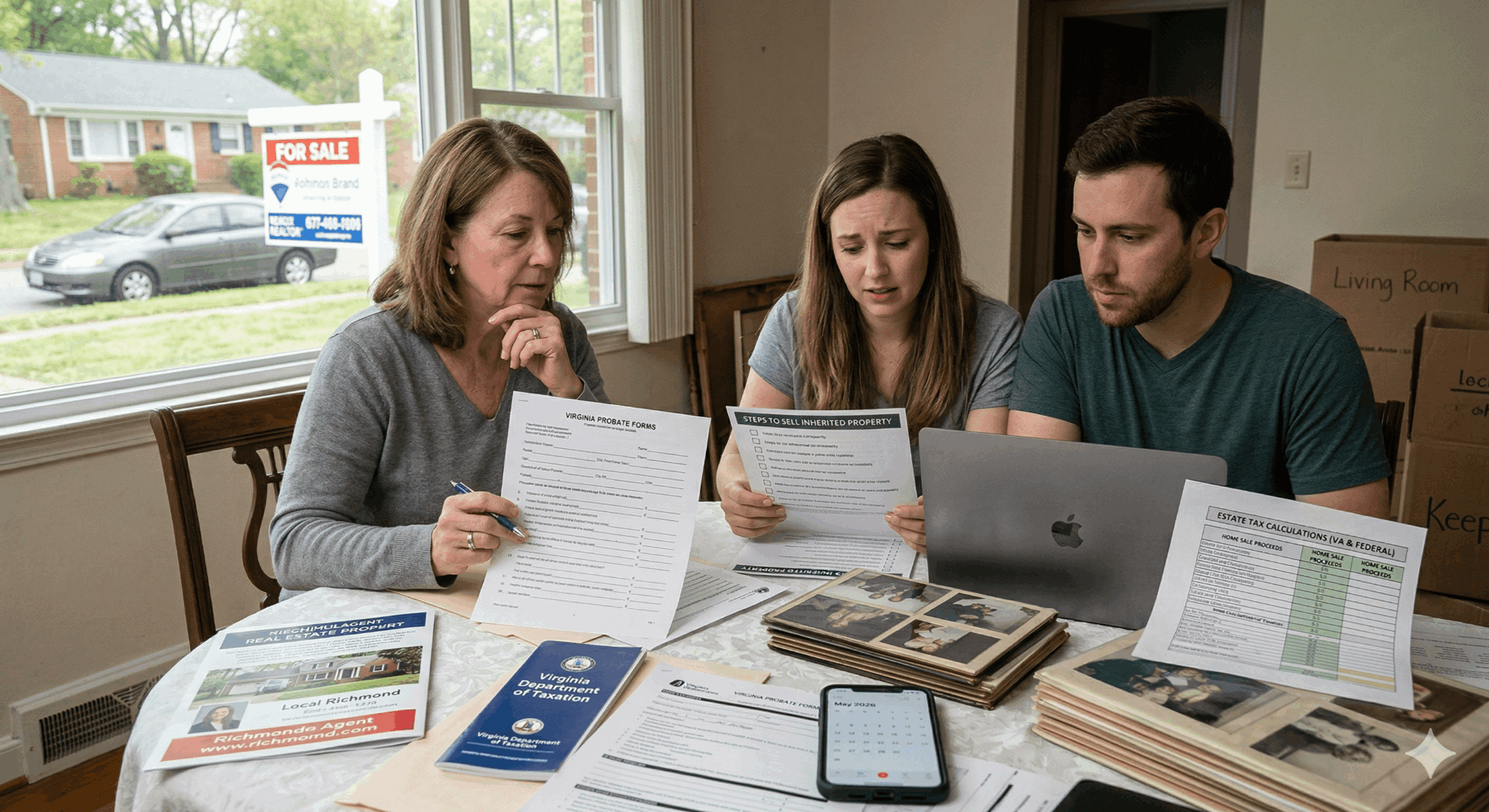
Quick Answer: To sell an inherited house in Virginia, you typically must complete probate through the Circuit Court before the property can be transferred or listed, a process that usually takes 6 to 18 months. Virginia has no state inheritance tax and no estate tax, and the federal stepped-up basis rule often eliminates most capital gains. Working with a full-service listing agent, such as The Jamil Brothers Realty Group, ensures the sale is handled correctly from estate qualification through closing.
Key Takeaways
- In most cases, inherited real property in Virginia must pass through probate before it can be sold, unless it was held in a living trust, joint tenancy, or under a Transfer-on-Death deed.
- Virginia has no inheritance tax and no estate tax, so you will not owe the state anything for receiving the property.
- The federal stepped-up basis rule resets your cost basis to the home's fair market value at the date of death, often eliminating or dramatically reducing capital gains tax.
- Virginia sellers owe a grantor's tax (0.25% of sale price), with an additional 0.25% congestion relief fee in Northern Virginia localities.
- When multiple heirs are involved, all parties must agree before the property can be listed, and a proactive communication plan prevents costly delays.
- Listing with The Jamil Brothers Realty Group at a 1.5% full-service fee instead of the traditional 3% keeps more equity in the estate on a Northern Virginia sale.
- How Property Passes at Death in Virginia
- Virginia Probate: What You Need to Know
- Step-by-Step: How to Sell an Inherited Home
- Virginia Taxes on Inherited Property
- Closing Costs & Selling Costs in Virginia
- Savings Calculator: 1.5% vs. 3% Listing Fee
- Selling Options: List, Cash Offer, or FSBO
- Selling As-Is vs. Making Repairs
- When Multiple Heirs Are Involved
- How to Choose the Right Listing Agent
- Common Mistakes to Avoid
- Frequently Asked Questions
- Glossary
Inheriting a home in Virginia is often an emotionally charged experience. Whether it's a parent's longtime home in Fairfax County, a relative's townhouse in Arlington, or a property in the Shenandoah Valley, the practical decisions you face (probate, taxes, repairs, agents, and timing) arrive at one of the hardest moments of your life. Working with an experienced Northern Virginia real estate team early in the process can make selling an inherited house far less overwhelming.
The good news: Virginia's rules on inherited property are more favorable than most sellers expect. There's no state inheritance tax, the stepped-up basis often zeroes out capital gains, and the probate process, while deliberate, is navigable with the right guidance. What matters most is understanding the sequence of steps and the costs involved before you make any decisions.
This guide walks you through everything an heir needs to know about selling a house in Virginia in 2026, from qualifying as personal representative to closing the estate sale and keeping as much of the proceeds as possible. For sellers in Northern Virginia, the 1.5% full-service listing program is specifically designed to maximize net proceeds on estate sales where every dollar matters.
How Property Passes at Death in Virginia
Before a home can be sold, you need to understand how the property legally transferred to the heirs, because this determines whether probate is required at all.
| Transfer Method | Probate Required? | Timeline | Common In Virginia? |
|---|---|---|---|
| Solely owned, with a will | Yes | 6-18+ months | Very common |
| Solely owned, no will (intestate) | Yes | 12-24+ months | Common |
| Joint tenancy with right of survivorship | No | Days (record affidavit) | Common, married couples |
| Living/revocable trust | No | Weeks (trustee acts) | Growing, estate planning |
| Transfer-on-Death (TOD) deed | No | Weeks (record deed) | Available since 2013 in VA |
| Tenancy by the entirety (spouses) | No | Days (record affidavit) | Common, married couples |
Northern Virginia Note: If your loved one had an HOA in communities such as Ashburn, Reston, or Centreville, the HOA transfer process runs parallel to, but separately from, the probate and sale process. HOA arrears must be satisfied at or before closing. Budget for this as part of your estate cost estimate. Each of the Northern Virginia communities has its own HOA rules and disclosure requirements, so confirm the specifics for your locality early.
Is Worth Right Now.
Before probate or listing, get a free, no-obligation home valuation based on current Northern Virginia comps, not an automated estimate. Useful for the estate inventory and for pricing the listing accurately from day one.
Virginia Probate: What You Need to Know
Probate is the court-supervised process of validating a will, appointing a personal representative, and distributing the estate's assets to heirs after debts are paid. In Virginia, probate is handled by the Circuit Court in the city or county where the decedent lived at the time of death.
Small Estate vs. Full Probate
| Estate Type | Threshold | Process | Real Property Included? |
|---|---|---|---|
| Small estate affidavit | Under $50,000 personal property | File affidavit, no court | Generally no |
| Summary administration | Under $100,000 after 1+ year | Simplified court process | Yes (limited) |
| Full probate | Any estate with real property | Full Circuit Court process | Yes |
For inherited homes in Virginia, particularly in Northern Virginia where median values exceed $650,000, full probate is almost always required.
Virginia Probate Timeline
File the Will & Petition for Probate: Week 1 to 4
The executor named in the will (or a family member if there's no will) files a petition with the Circuit Court Clerk. The original will must be presented. Filing fees and a probate tax (roughly $0.10 per $100 of taxable estate value) are paid at this time. If there's no will, the court appoints an administrator using Virginia's intestacy succession order.
Qualify as Personal Representative: Week 2 to 6
Once the court issues Letters Testamentary (with a will) or Letters of Administration (without a will), the personal representative is officially authorized to act on behalf of the estate. This document is required to list and sell the property, and you cannot sign a real estate contract without it.
Inventory & Appraisal: Month 2 to 5
The personal representative must file an inventory of all estate assets, including the real property, with the Circuit Court within four months of qualification. A professional appraisal of the home establishes fair market value for both the inventory and the stepped-up cost basis for tax purposes.
Notice to Creditors & Creditor Period: Month 1 to 12
Virginia law gives creditors up to one year from the personal representative's qualification date to file claims against the estate. Outstanding debts such as mortgages, medical bills, and property taxes must be identified and satisfied. Most estate sales cannot close until creditor obligations are confirmed or resolved.
List & Sell the Property: Month 3 to 12+
With Letters Testamentary in hand, the personal representative can authorize a real estate listing agreement and accept offers. In Northern Virginia's market, a well-priced inherited home typically goes under contract within 2 to 4 weeks of listing.
Final Accounting & Distribution: Month 12 to 18+
After the property sells and debts are paid, the personal representative files a final accounting with the court and distributes the remaining proceeds to heirs. The first annual accounting is typically due within 16 months of qualification.
Attorney Fees: Virginia probate attorneys typically charge $2,500 to $7,500+ for estate administration, depending on complexity. Always get a fee quote upfront, since some attorneys bill hourly while others offer a flat estate fee.
Step-by-Step: How to Sell an Inherited Home in Virginia
Selling an inherited property follows a clear sequence once you understand the legal requirements. The full process of selling a house in Virginia begins well before the home reaches the market, and getting the order of steps right protects both the estate and the heirs. Use the checklist below to track each stage from probate qualification through closing.
Complete Pre-Listing Checklist for Inherited Homes
- Confirm method of transfer: joint tenancy, TOD deed, trust, or probate
- Retain an estate attorney: especially if there is no will or multiple heirs
- File for probate at the Circuit Court in the decedent's home county/city
- Obtain Letters Testamentary (or Letters of Administration), required before listing
- Order a professional home appraisal: establishes stepped-up basis and informs pricing
- File the estate inventory within 4 months of qualification
- Identify outstanding debts: mortgage balance, property taxes, HOA dues, liens
- Inspect the property: assess deferred maintenance, safety issues, and repair needs
- Decide: as-is or prep and list: consult your listing agent before spending on repairs
- Interview listing agents: choose one experienced with estate sales in your county
- Sign listing agreement: personal representative signs on behalf of the estate
- Coordinate with title company: estate sales require additional title work; start early
Virginia Taxes on Inherited Property
The Good News First: Virginia Has No Inheritance or Estate Tax
Virginia Tax Summary for Heirs: Virginia repealed its estate tax effective July 1, 2007. The Commonwealth also has no inheritance tax. Heirs do not owe any Virginia state tax simply for receiving real property, regardless of the home's value.
Federal Estate Tax
| Year | Federal Exemption Per Individual | Most Virginia Heirs Affected? |
|---|---|---|
| 2025 | $13.99 million | Rarely, very large estates only |
| 2026 (projected, TCJA expiry) | ~$7 million (estimated) | Unlikely for most NOVA homes |
Capital Gains Tax and the Stepped-Up Basis Rule
The federal tax code includes a provision known as the "stepped-up basis": when you inherit a home, your cost basis is reset to the property's fair market value on the date of the original owner's death, not what they paid for it decades ago.
| Scenario | Without Step-Up | With Stepped-Up Basis |
|---|---|---|
| Original purchase price | $185,000 (2001) | N/A |
| Value at date of death (2025) | $650,000 | New basis: $650,000 |
| Sale price (quick sale) | $665,000 | $665,000 |
| Taxable gain | $480,000 | $15,000 |
| Capital gains tax owed (15%) | $72,000 | $2,250 |
| Tax savings from step-up | N/A | $69,750 |
Inherited Property Is Always "Long-Term": Inherited real estate is automatically treated as a long-term capital asset regardless of how long you hold it. This means you always qualify for the lower long-term capital gains rates (0%, 15%, or 20%) and never the higher short-term ordinary income rate.
Closing Costs & Selling Costs in Virginia
| Cost Item | Who Pays | Rate / Amount | NOVA Specifics |
|---|---|---|---|
| Listing agent commission | Seller (estate) | 1.5% (Jamil Bros.) vs. 3% traditional | Same statewide |
| Buyer's agent commission | Negotiable (post-NAR) | Typically 2.5% | Same statewide |
| Virginia grantor's tax | Seller | $0.25 per $100 (0.25%) | Base rate everywhere |
| NOVA congestion relief fee | Seller | $0.25 per $100 (0.25%) | Northern Virginia only |
| Title/settlement fees | Negotiable | $800 to $1,500 | Slightly higher in NOVA |
| HOA disclosure & transfer fees | Seller | $200 to $600+ | Common in NOVA communities |
| HOA arrears (if any) | Seller (estate) | Varies | Must be cleared at closing |
| Estate attorney fees | Estate | $2,500 to $7,500 | Varies by complexity |
| Probate court fees | Estate | $200 to $500+ | Varies by county |
Relative Cost Weight: Northern Virginia Sale at $650,000
Estate Will Walk Away With.
Our free seller net sheet breaks down every cost (commission, grantor's tax, HOA fees, and closing costs) so you know the estate's true net proceeds before you commit to a price or an agent.
How Much More Does the Estate Keep at 1.5%?
The difference between a 1.5% and a 3% listing fee flows directly to the heirs. Select your home's price point to compare net proceeds side by side.
Seller Savings Calculator
How much more does the estate keep with our 1.5% listing fee?
Select your home's estimated value to see net proceeds side by side.
Traditional Agent (3%)
| Sale price | $400,000 |
| Listing fee (3%) | −$12,000 |
| Buyer's agent (2.5%) | −$10,000 |
| Est. closing (1%) | −$4,000 |
| Net Proceeds | $374,000 |
Our Fee: Only 1.5%
| Sale price | $400,000 |
| Listing fee (1.5%) | −$6,000 |
| Buyer's agent (2.5%) | −$10,000 |
| Est. closing (1%) | −$4,000 |
| Net Proceeds | $380,000 |
Extra in the estate
$6,000
vs. a traditional 3% listing agent, with zero reduction in service or marketing.
Estimates only. Closing costs vary. Buyer's agent commission is negotiable.
Traditional Agent (3%)
| Sale price | $500,000 |
| Listing fee (3%) | −$15,000 |
| Buyer's agent (2.5%) | −$12,500 |
| Est. closing (1%) | −$5,000 |
| Net Proceeds | $467,500 |
Our Fee: Only 1.5%
| Sale price | $500,000 |
| Listing fee (1.5%) | −$7,500 |
| Buyer's agent (2.5%) | −$12,500 |
| Est. closing (1%) | −$5,000 |
| Net Proceeds | $475,000 |
Extra in the estate
$7,500
vs. a traditional 3% listing agent, with zero reduction in service or marketing.
Estimates only. Closing costs vary. Buyer's agent commission is negotiable.
Traditional Agent (3%)
| Sale price | $600,000 |
| Listing fee (3%) | −$18,000 |
| Buyer's agent (2.5%) | −$15,000 |
| Est. closing (1%) | −$6,000 |
| Net Proceeds | $561,000 |
Our Fee: Only 1.5%
| Sale price | $600,000 |
| Listing fee (1.5%) | −$9,000 |
| Buyer's agent (2.5%) | −$15,000 |
| Est. closing (1%) | −$6,000 |
| Net Proceeds | $570,000 |
Extra in the estate
$9,000
vs. a traditional 3% listing agent, with zero reduction in service or marketing.
Estimates only. Closing costs vary. Buyer's agent commission is negotiable.
Traditional Agent (3%)
| Sale price | $750,000 |
| Listing fee (3%) | −$22,500 |
| Buyer's agent (2.5%) | −$18,750 |
| Est. closing (1%) | −$7,500 |
| Net Proceeds | $701,250 |
Our Fee: Only 1.5%
| Sale price | $750,000 |
| Listing fee (1.5%) | −$11,250 |
| Buyer's agent (2.5%) | −$18,750 |
| Est. closing (1%) | −$7,500 |
| Net Proceeds | $712,500 |
Extra in the estate
$11,250
vs. a traditional 3% listing agent, with zero reduction in service or marketing.
Estimates only. Closing costs vary. Buyer's agent commission is negotiable.
Traditional Agent (3%)
| Sale price | $1,000,000 |
| Listing fee (3%) | −$30,000 |
| Buyer's agent (2.5%) | −$25,000 |
| Est. closing (1%) | −$10,000 |
| Net Proceeds | $935,000 |
Our Fee: Only 1.5%
| Sale price | $1,000,000 |
| Listing fee (1.5%) | −$15,000 |
| Buyer's agent (2.5%) | −$25,000 |
| Est. closing (1%) | −$10,000 |
| Net Proceeds | $950,000 |
Extra in the estate
$15,000
vs. a traditional 3% listing agent, with zero reduction in service or marketing.
Estimates only. Closing costs vary. Buyer's agent commission is negotiable.
Your Three Selling Options for an Inherited Home
Cash Offer Option.
If the property needs significant work, heirs are out of state, or the estate needs to close quickly, a cash offer may be the right fit. We'll walk you through your full range of options with no pressure and no obligation.
Selling As-Is vs. Making Repairs
| Repair / Update | Typical Cost | Est. Value Add | Recommend? |
|---|---|---|---|
| Deep cleaning + declutter | $300 to $800 | $2,000 to $5,000+ | Always |
| Fresh interior paint | $2,000 to $5,000 | $5,000 to $10,000 | Almost always |
| Carpet replacement | $2,000 to $6,000 | $4,000 to $10,000 | Usually yes |
| Landscaping / curb appeal | $500 to $2,000 | $3,000 to $8,000 | Yes |
| HVAC replacement | $5,000 to $12,000 | $5,000 to $10,000 | Depends on age |
| Kitchen remodel (full) | $20,000 to $50,000 | $10,000 to $25,000 | Rarely, negative ROI |
| Roof replacement | $10,000 to $20,000 | $5,000 to $15,000 | Only if actively failing |
✓ Sell As-Is When…
- The home needs significant structural or system work
- The estate lacks funds for upfront repairs
- Out-of-state heirs need a fast, low-hassle close
- Probate is running long, so reducing carrying costs matters
✗ Don't Skip Prep When…
- The home is structurally sound but cosmetically dated
- Comparable homes nearby are prepped and updated
- Light work (paint, carpet, clean) yields a 2:1+ return
- Northern Virginia buyers expect move-in ready
When Multiple Heirs Are Involved
Best Practices for Multi-Heir Estate Sales
- Designate one decision-maker early: the personal representative has legal authority; heirs should defer on process questions
- Share the appraisal with all heirs: pricing disputes dissolve faster when everyone sees the same independent data
- Hold a family meeting before listing: align on timeline, price expectations, and acceptable offers
- Document all agreements in writing: email threads are admissible; verbal agreements cause disputes at the worst moments
- Agree on repair/staging budget in advance: who funds it, how it's reimbursed, and what the maximum spend is
- Involve the estate attorney if disagreements arise: they can provide a neutral framework without litigation
- Understand partition action as a last resort: any co-owner can petition a Virginia court to force a sale, but it's costly and adversarial
Partition Action Warning: A partition action in Virginia's Circuit Court can force a sale but typically results in a lower sale price (court-supervised auction) and significant legal fees for all parties. It should be treated as an absolute last resort.
How to Choose the Right Listing Agent for an Estate Sale
What to Look for in an Estate Sale Listing Agent
- Estate sale experience: ask specifically how many probate or estate sales they've handled and in which counties
- Title and probate coordination: established relationships with estate-friendly title companies
- Pricing from comps, not emotion: estate heirs are often emotionally connected to price; a good agent provides data-driven guidance
- As-is listing strategy: clear advice on what to fix vs. disclose and how to price it in
- Full marketing package included: professional photography, drone video, broad MLS syndication
- Competitive listing fee: traditional 3% commissions are negotiable; estate proceeds belong to the heirs
- Communication with multiple stakeholders: comfortable keeping multiple family members informed throughout
- Northern Virginia market knowledge: pricing in Ashburn, Reston, Alexandria, or Prince William requires hyperlocal expertise
The Jamil Brothers Realty Group, led by Saad Jamil and Arslan Jamil of Samson Properties, handles estate sales across Northern Virginia, Maryland, and the DMV. Their 1.5% full-service listing program includes 4K photography, drone video, 3D tours, expert negotiation, and complete MLS syndication. On a $700,000 estate home, that's $10,500 more in proceeds compared to a traditional 3% listing fee. Reviewing active homes for sale in Northern Virginia also helps heirs set realistic price expectations before listing, and the group offers flexible commission options to fit different estate situations.
Keep More for the Heirs.
On a $700,000 estate home, a traditional 3% listing fee costs $21,000. Our 1.5% full-service program cuts that to $10,500, saving heirs $10,500 with no reduction in photography, marketing, or representation. Same complete service. Significantly lower cost.
Common Mistakes When Selling an Inherited Home in Virginia
Mistakes That Cost Heirs Time and Money
- Listing before probate is complete: you cannot sign a binding sales contract without Letters Testamentary
- Skipping the estate appraisal: an independent appraisal at date of death establishes the stepped-up basis; don't skip it to save $500
- Overpricing based on emotional attachment: overpricing costs more than it saves; the market sees the same data you do
- Spending heavily on the wrong repairs: full kitchen and bathroom remodels in estate situations almost never recover their cost
- Ignoring HOA arrears until closing: dues continue to accrue during probate and must be satisfied at closing
- Not involving an estate attorney: Virginia probate has specific filing deadlines and creditor notice requirements; missing them creates personal liability
- Distributing proceeds before probate closes: premature distributions create clawback liability
- Accepting the first offer without negotiation: even as-is inherited homes in Northern Virginia attract multiple offers in a competitive market
Frequently Asked Questions
How long does probate take in Virginia before I can sell the house?
Full probate in Virginia typically takes 6 to 18 months, though simple estates with no disputes, no mortgages, and a clear will can move faster. The limiting factor is usually the creditor period, since Virginia gives creditors up to one year from the personal representative's qualification date to file claims. Complex estates with contested wills, multiple creditors, or disputed heirs can take two or more years. Working with an estate attorney from the start and keeping filings on schedule is the best way to avoid delays.
Do I have to pay capital gains tax when I sell an inherited house in Virginia?
It depends on whether the home appreciated after you inherited it. Thanks to the federal stepped-up basis rule, your cost basis is reset to the home's fair market value on the date of the original owner's death. If you sell quickly after inheriting, at or near that value, your taxable gain may be zero or very small. Virginia itself has no inheritance tax and no estate tax. Long-term capital gains rates (0%, 15%, or 20%) always apply to inherited property regardless of how long you held it.
Can I sell an inherited house before probate is complete in Virginia?
You can negotiate and accept an offer during probate, but the sale typically cannot close until the personal representative has been formally qualified by the Circuit Court and has Letters Testamentary in hand. You can list the home and go under contract while probate is in progress, then coordinate closing once court qualification is complete. All documents must be signed in your capacity as personal representative of the estate, not in your personal name.
What taxes do I owe in Virginia for inheriting a home?
Virginia has no inheritance tax and no estate tax (the state estate tax was repealed effective July 1, 2007). Heirs owe nothing to Virginia simply for receiving the property. Federal estate tax applies only if the total gross estate exceeds $13.99 million in 2025. The primary tax consideration for most heirs is federal capital gains tax on any appreciation above the stepped-up cost basis at the date of death, which is typically minimized by selling promptly after inheriting.
How does the stepped-up basis work for an inherited Virginia home?
The stepped-up basis resets your cost basis to the property's fair market value on the date the original owner died, not what they originally paid for it. For example, if your parent purchased a Fairfax home for $150,000 in 1990 and it was worth $680,000 at the time of their death, your stepped-up basis is $680,000. If you sell for $700,000, your taxable gain is only $20,000. An independent appraisal conducted near the date of death documents the stepped-up value for the IRS.
What happens to an inherited home with a mortgage in Virginia?
The mortgage becomes a debt of the estate. The personal representative is responsible for continuing mortgage payments during the probate period using estate funds. If the estate lacks liquidity to make payments, the property may need to be sold quickly to avoid foreclosure. Most lenders are required under the federal Garn-St. Germain Act to allow heirs time to refinance or sell. A mortgage payoff statement will be required at closing.
How should I choose a real estate agent for an estate sale in Northern Virginia?
Look for an agent with documented experience handling estate and probate sales specifically, not just general residential experience. They should have established relationships with estate-friendly title companies, understand probate-to-listing coordination, and be willing to advise on as-is vs. repair strategy before you spend money. Listing fee matters too: traditional 3% commissions are not fixed by law. The Jamil Brothers Realty Group handles estate sales throughout Northern Virginia at a 1.5% full-service fee, with full marketing, professional photography, drone video, and 3D tours included.
What are the seller's closing costs in Northern Virginia for an estate sale?
Virginia sellers, including estates, owe a grantor's tax of $0.25 per $100 of sale price, plus an additional Northern Virginia congestion relief fee of $0.25 per $100, for a combined 0.50% in NOVA localities. On a $700,000 sale that's $3,500 in grantor's taxes. Add title and settlement fees ($800 to $1,500), HOA transfer fees ($200 to $600+), the listing agent commission (1.5% with Jamil Brothers vs. 3% traditional), and any buyer's agent concession (typically 2.5%).
What if there's no will? How does an intestate estate affect the home sale?
If the decedent died without a will, Virginia's intestacy laws determine who inherits. A family member petitions the Circuit Court to be appointed administrator, and the court issues Letters of Administration. The sale process is the same as with a will, and the administrator has the same authority as an executor, but the process may take longer due to the court's independent review of the succession order, especially if family relationships are complicated.
Can I avoid probate on an inherited home in Virginia?
Yes, but it requires planning in advance. Properties held in a revocable living trust, titled in joint tenancy with right of survivorship, those with a transfer-on-death (TOD) deed recorded, or held as tenancy by the entirety between spouses all transfer outside of probate. Virginia has allowed TOD deeds since 2013. If the estate did not use these structures, probate will be required.
What is an HOA transfer fee and who pays it in an estate sale in Virginia?
HOA transfer fees cover the cost of transferring membership from the decedent to the new owner. In Northern Virginia communities, particularly in Ashburn, Reston, Herndon, and Centreville, these fees typically run $200 to $600 and are paid by the seller (the estate) at closing. Any unpaid HOA dues that accrued during the probate period must also be paid in full at closing or they become a lien on the property.
How does the post-NAR settlement change how I sell an inherited home?
Since August 2024, buyer's agent compensation is no longer a mandatory term of the listing, so sellers choose whether to offer a concession toward the buyer's agent. In Northern Virginia's competitive market, most listing agents currently recommend offering 2% to 2.5% to attract the widest buyer pool. This is separate from the listing agent's fee. Discuss the current market norm with your listing agent before going live, as the right answer depends on whether you're in a buyers' or sellers' market at the time of listing.
Glossary
The court-supervised legal process of validating a will, appointing a personal representative, paying debts, and distributing the estate's assets to heirs. In Virginia, handled by the Circuit Court in the decedent's home jurisdiction.
The official court document that authorizes the executor named in the will to act on behalf of the estate, including signing listing agreements and real estate contracts. Required before any property can be sold.
The equivalent of Letters Testamentary when there is no will. The court appoints an administrator and issues these letters, granting the same authority to manage and sell estate assets.
A federal tax rule that resets the cost basis of inherited property to its fair market value on the date of the original owner's death. This often eliminates most or all capital gains tax on a quick estate sale.
Dying without a valid will. Virginia's intestacy laws (Code § 64.2-200) determine the order in which family members inherit when no will exists, beginning with the surviving spouse and children.
A Virginia state tax paid by the seller at closing, calculated at $0.25 per $100 of the sale price. Northern Virginia sellers also pay an additional $0.25 per $100 congestion relief fee, for a combined 0.50%.
A Virginia deed that designates a beneficiary to receive the property automatically at the owner's death, bypassing probate entirely. Available under Virginia Code § 64.2-621. Must be recorded before death to be effective.
A court action filed by a co-owner of real property to force either a physical division of the property or a court-ordered sale when co-owners cannot agree. Costly and adversarial, and a last resort for disputed inherited property.
Just 1.5%.
Professional photography, 3D tours, expert pricing, full MLS marketing, and skilled negotiation, all at a 1.5% listing fee. The Jamil Brothers Realty Group serves estate sellers across Northern Virginia, Maryland, and the DMV. Start with a free valuation or run your net sheet today. (703) 782-4830.
This article is for informational purposes only and does not constitute legal, tax, or financial advice. Market data reflects estimates based on publicly available information as of early 2026. Consult a licensed Virginia real estate attorney and a qualified agent for advice specific to your property and estate.
Explore More
Browse Every Corner of the DMV Market
Whether you're searching by budget, neighborhood, or buying situation — find exactly what you need below.
Virginia Homes by Budget
Washington DC Homes by Budget
Maryland Homes
Explore Northern Virginia Communities
Loudoun County
Fairfax County & Surrounding
Ready to Make a Move?
Full-Service · No Tradeoffs
List for 1.5% & Keep More Equity
Professional photography, drone video, 3D tours, and expert negotiation — all included. On an $800K home, that's $12,000 more in your pocket vs. a 3% agent.
See the 1.5% Program →Need Speed or Certainty?
Get a No-Obligation Cash Offer
Skip the showings, skip the contingencies. If timing or condition matters more than top dollar, a cash offer may be the right fit. We'll walk you through every option.
Explore Cash Offers →Categories
- All Blogs (1228)
- Aldie (3)
- Ashburn (6)
- Buyer Guide (8)
- Buying a home (2)
- Buying Strategies (30)
- festivals (1)
- General Blog (67)
- Leesburg (5)
- Market Intelligence (29)
- Market Updates (8)
- Notable Properties For Sale (32)
- Real Estate Tips, News, and More (385)
- Seller Guide (2)
- Seller Guides (60)
- Selling Your Home (523)
- Sterling (6)
- Top Realtors in Northern Virginia (58)
Recent Posts



Message Sent!
Thank you for reaching out. Arslan & Saad have received your details and will be in touch shortly.
Need immediate assistance? Call or text 703-782-4830.