Home Equity Lines of Credit in Centreville: HELOC vs. Home Equity Loan, Explained Locally
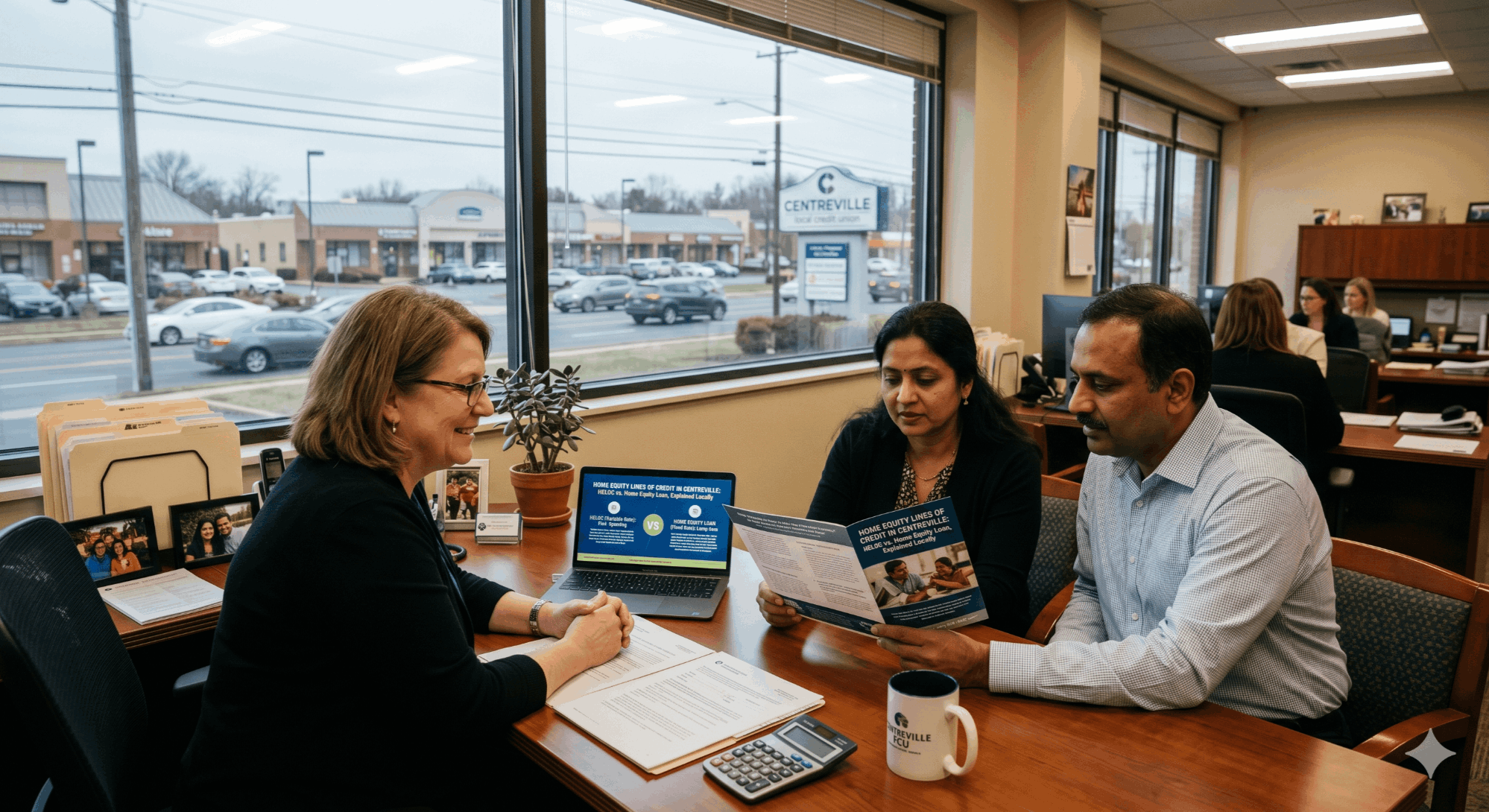
Quick Answer: A HELOC (home equity line of credit) is a revolving credit line you draw from over 10 years; a home equity loan is a fixed lump sum repaid on a set schedule. For most Centreville homeowners in 2026, a HELOC offers more flexibility for renovations or staged expenses, while a home equity loan suits one-time large purchases with predictable payments. Both keep your low-rate first mortgage intact — but if you're tapping equity for major life transitions, selling at a 1.5% full-service listing fee often nets more cash than borrowing against it.
Key Takeaways
- HELOC vs. home equity loan: HELOCs are revolving, variable-rate credit lines (typical Centreville rate range 7.5%–9.25% in 2026); home equity loans are fixed-rate lump sums (typical 7.75%–9.5%).
- Borrowing limit: Most lenders cap combined loan-to-value at 80–85% — so on an $810,000 Centreville home with $385,000 owed on the first mortgage, tappable equity is roughly $263,000–$303,000.
- Closing timeline: Centreville HELOCs typically close in 3–5 weeks; home equity loans in 4–6 weeks; a properly priced home sale in 30–60 days.
- Tax treatment: Interest is only deductible if proceeds are used for substantial improvements on the property securing the loan (post-2017 Tax Cuts and Jobs Act rules still apply in 2026).
- The full-service alternative: At The Jamil Brothers' 1.5% listing program — vs. a traditional 3% agent — a Centreville seller at $810,000 keeps an additional $12,150 in equity at closing without sacrificing photography, drone video, 3D tours, or negotiation.
- HOA-active neighborhoods matter: Virginia Run, Little Rocky Run, and Sully Station HOAs need 14 business days to issue resale packets — start early whether you're refinancing-out, selling, or supporting a HELOC appraiser.
In This Guide
- What a HELOC Actually Is — Plain English
- What a Home Equity Loan Actually Is
- HELOC vs. Home Equity Loan — Side by Side
- How Much Equity Centreville Homeowners Actually Have
- Where Centreville Homeowners Get HELOCs & Home Equity Loans
- Real Costs & Fees on a Centreville Home Equity Product
- Qualifying — What Lenders Look At
- Timeline — From Application to Funded
- Tax Impact & Interest Deductibility (2026)
- HELOC vs. Selling Your Centreville Home — Which Nets More?
- Centreville Sale-Proceeds Calculator (Selling Alternative)
- Common Mistakes Centreville Borrowers Make
- How to Decide — A Centreville-Specific Framework
- Your Next Move in Centreville
- Frequently Asked Questions
- Glossary
Centreville homeowners are sitting on a quiet pile of equity. Median home values in 22020 hover near $810,000 according to recent BrightMLS data, and most owners who bought before 2022 are looking at $250,000–$400,000+ in equity above their first-mortgage balance. The question isn't whether the equity exists — it's how to access it without giving up the rock-bottom mortgage rate locked in during 2020–2021.
That's where home equity products come in. A HELOC (home equity line of credit) and a home equity loan are the two main ways to borrow against your Centreville home while keeping your existing mortgage untouched. They sound similar but behave very differently — and the wrong choice can cost tens of thousands over the life of the loan.
This guide breaks down both products specifically for Centreville: real 2026 rate ranges, what local lenders actually require, how Virginia Run and Sully Station HOA timelines affect appraisals, when interest is tax-deductible, and — critically — when selling at a 1.5% full-service listing fee nets you more cash than any equity product can deliver.
What a HELOC Actually Is — Plain English
A HELOC is a revolving line of credit secured by your Centreville home. Think of it as a credit card with a much higher limit and a much lower interest rate — except the collateral is your house, not your signature.
Here's how it works mechanically. A lender approves you for a maximum borrowing limit (say, $200,000) based on your equity and credit profile. You can draw from that line at any time during the draw period — typically 10 years for Centreville-area HELOCs. You only pay interest on the balance you've actually used, not the full approved amount. Once the draw period ends, the line converts to a repayment period (usually 20 years) where you pay back principal and interest on the outstanding balance.
HELOC interest rates are almost always variable, tied to the Prime Rate plus a margin set by the lender. As of early 2026, Centreville HELOCs price roughly in the 7.5%–9.25% range, depending on your credit score, combined loan-to-value, and the lender's margin. Some lenders offer introductory teaser rates (often 6.99% for the first six months) that step up to the variable rate after the promotional period.
The Key HELOC Advantages
You don't pay interest on funds you haven't drawn. You can borrow, repay, and reborrow during the draw period without reapplying. Closing costs are usually low — many credit unions in the Centreville area waive origination fees entirely. And you keep your existing first mortgage exactly as it is, which matters enormously if you locked in a 2.75%–3.5% rate during 2020–2021.
The Key HELOC Risks
Variable rates mean payments can rise. If Prime moves from 7.5% to 9.0% over your draw period, your effective borrowing cost climbs with it. Some HELOCs have minimum-draw requirements or annual fees ($50–$75 typical). And because the line is secured by your home, default risk is real — missed payments can lead to foreclosure exactly the way a missed mortgage payment would.
Before tapping equity — or deciding to sell — know your current value. We pull street-level comps from BrightMLS for Virginia Run, Little Rocky Run, Sully Station, Centre Ridge, and beyond, not an automated estimate. Response within 24 hours.
What a Home Equity Loan Actually Is
A home equity loan — sometimes called a second mortgage or fixed-rate second — gives you a single lump sum upfront at a fixed interest rate. You repay it on a fixed amortization schedule (commonly 10, 15, or 20 years) with predictable monthly payments. There's no draw period, no revolving access, no variable rate.
If you need $150,000 to do a major Sully Station basement finish or pay off high-interest debt in one move, you take out a $150,000 home equity loan at a fixed rate (currently 7.75%–9.5% range for Centreville-area borrowers). The funds hit your account at closing, and you start making fixed monthly payments the following month.
The Key Home Equity Loan Advantages
Payment predictability is the biggest one — your rate and monthly amount won't change for the entire life of the loan. That makes budgeting straightforward, especially for retirees or anyone on a fixed income. Because the rate is locked, you're insulated from future Fed rate hikes. Lump-sum disbursement also forces discipline: you can't keep dipping into a line of credit to fund lifestyle creep.
The Key Home Equity Loan Disadvantages
You pay interest on the entire borrowed amount from day one — even if you only need $40,000 of the $150,000 for the next six months. Fixed-rate home equity loans typically price slightly higher than HELOCs at origination (because lenders are accepting interest-rate risk for the full term). Closing costs are similar to a HELOC but tend to be marginally higher. And if rates drop materially in the next few years, you're locked in unless you refinance the second.
HELOC vs. Home Equity Loan — Side by Side
Here's the Centreville-specific comparison that matters most. Use this table to identify which product fits your situation:
| Feature | HELOC | Home Equity Loan |
|---|---|---|
| Disbursement | Revolving — draw as needed | One-time lump sum |
| Interest rate type | Variable (Prime + margin) | Fixed |
| 2026 Centreville rate range | 7.5%–9.25% | 7.75%–9.5% |
| Interest charged on | Only on amount drawn | Full loan balance from day one |
| Draw period | 10 years typical | None — repayment starts immediately |
| Repayment term | 20 years after draw period ends | 10, 15, or 20 years from origination |
| Monthly payment | Interest-only during draw period | Fixed principal + interest |
| Best for | Renovations, college tuition phased over years, emergency reserve | Debt consolidation, one-time large project, retirement gap financing |
| Closing costs (Centreville) | $0–$1,200 (many waived) | $500–$2,500 typical |
| Typical timeline | 3–5 weeks to fund | 4–6 weeks to fund |
| Prepayment penalty | Sometimes (early closure fee year 1–3) | Rarely |
Which One Fits Which Situation?
If you're financing a phased Virginia Run kitchen remodel that will spend $40K this year, $30K next year, and $25K the year after, the HELOC wins — you'd only pay interest on what you've drawn at each stage, and the variable rate is acceptable because the timeline is short.
If you're consolidating $95,000 of credit-card debt at 22%+ APRs into a single payment, the home equity loan typically wins — locking in 8% beats variable risk on what should be a one-and-done balance transfer. Plus the discipline of a fixed amortization prevents redrawing the cleared credit lines.
If you're shoring up cash reserves "just in case" but aren't sure when or whether you'll use it, the HELOC wins — zero interest until you actually draw, and you can let it sit unused for years if circumstances stay stable.
How Much Equity Centreville Homeowners Actually Have
Centreville's housing values have climbed substantially since 2020. According to BrightMLS data through early 2026, here's where neighborhood values land — and roughly how much tappable equity a typical long-term owner has accumulated:
| Neighborhood | 2026 Median Value | Typical 2020-Era Buyer Equity | Tappable @ 85% CLTV |
|---|---|---|---|
| Virginia Run | $1.15M – $1.45M | $450K – $700K | $320K – $500K |
| Little Rocky Run | $795K – $935K | $280K – $410K | $200K – $310K |
| Sully Station I & II | $685K – $855K | $240K – $370K | $170K – $275K |
| Centre Ridge | $720K – $880K | $255K – $390K | $185K – $290K |
| Cabells Mill | $615K – $735K | $215K – $325K | $155K – $240K |
| Green Trails | $580K – $695K | $200K – $305K | $140K – $225K |
| Singletons Grove | $655K – $785K | $230K – $345K | $165K – $260K |
| Heritage Square (condos/THs) | $425K – $545K | $140K – $235K | $95K – $175K |
"Tappable equity" assumes a typical 80–85% combined loan-to-value (CLTV) cap and existing first-mortgage balances roughly $300K–$420K for buyers who closed between 2018 and 2022. Your actual borrowing capacity depends on credit score, debt-to-income ratio, and lender-specific overlays.
How Lenders Calculate Your Tappable Equity
The standard formula: (Appraised Value × Max CLTV) − Existing Mortgage Balance = Maximum HELOC or Home Equity Loan. So on an $855,000 Sully Station home with a $355,000 first-mortgage balance and 85% CLTV cap:
($855,000 × 0.85) − $355,000 = $371,750 maximum borrowing
That's the ceiling. Most lenders will require you to leave some buffer — many cap actual approvals at 80% CLTV instead of 85%, which would drop that example to $329,000. Lenders also tighten CLTV on investment properties (typically 70–75% max) and on jumbo balances over $750,000.
ℹ️ Centreville Appraisal Reality Check
HELOC and home equity loan lenders use formal appraisals about 70% of the time and Automated Valuation Models (AVMs) the other 30%. AVMs typically come in 3–7% below a full appraisal in Centreville, which can quietly cap your borrowing limit. If your equity is borderline, ask the lender upfront whether they're using AVM or full appraisal — and request a full appraisal if it materially expands your borrowing capacity.
Where Centreville Homeowners Get HELOCs & Home Equity Loans
Centreville borrowers have four main lender categories to choose from. Each has tradeoffs:
1. Credit Unions
Credit unions servicing the Centreville area — Pentagon Federal Credit Union, Apple Federal Credit Union, and Navy Federal among them — typically offer the lowest HELOC margins and the most generous closing cost waivers. Many waive origination fees entirely and absorb appraisal costs. The tradeoff is membership eligibility (some require military, federal employee, or family ties).
2. Regional Banks
Truist, Atlantic Union Bank, and Burke & Herbert serve Centreville with competitive HELOC pricing and faster decisioning than national banks. Local branches mean you can speak with the loan officer in person — useful when your situation involves anything non-standard (self-employment, rental income, recent retirement).
3. National Banks
Wells Fargo, Bank of America, Chase, and Citizens Bank all offer HELOCs in Northern Virginia. Pricing is competitive but margins are usually a tick higher than credit unions. Their advantage is integrated relationship pricing — if you already hold a checking account, mortgage, or wealth account with them, you often qualify for a 0.25–0.50 point rate discount.
4. Online Lenders
Figure, Spring EQ, Discover Home Loans, and others operate fully online with faster closing timelines (sometimes 2–3 weeks vs. the 3–5 typical at credit unions). They're often best for borrowers with strong credit, conforming home values, and simple income documentation. Less ideal if your situation requires explanation.
| Lender Type | Typical HELOC Margin | Closing Costs | Speed | Best For |
|---|---|---|---|---|
| Credit Union | Prime + 0.00 to +0.75 | Often $0 | 3–5 weeks | Best pricing, willing to qualify |
| Regional Bank | Prime + 0.25 to +1.00 | $300–$900 | 3–4 weeks | Local relationships, complex profile |
| National Bank | Prime + 0.50 to +1.25 | $500–$1,500 | 3–5 weeks | Existing customer discounts |
| Online Lender | Prime + 0.50 to +1.50 | $0–$1,200 | 2–3 weeks | Fast closing, clean profile |
Should You Shop Multiple Lenders?
Yes — but strategically. Mortgage and HELOC inquiries within a 45-day window are bundled by credit bureaus into a single inquiry, so applying to 3 lenders in the same week causes only one credit hit. Pull formal rate quotes (with margin disclosed) from 2–3 lenders before committing. The difference between Prime + 0.25 and Prime + 1.00 on a $200,000 draw over 10 years is roughly $15,000 in interest.
Real Costs & Fees on a Centreville Home Equity Product
Beyond the interest rate, here are the closing costs and ongoing fees Centreville borrowers should expect. Many of these are negotiable or waived:
| Fee | Typical Centreville Range | Often Waived? |
|---|---|---|
| Application fee | $0–$75 | Yes — most credit unions |
| Origination fee | $0–$500 | Yes — common waiver |
| Appraisal fee (full) | $450–$650 | Sometimes — relationship pricing |
| AVM fee (drive-by/no appraisal) | $0–$150 | Often included free |
| Title search | $150–$400 | Sometimes covered |
| Recording fees (Fairfax County) | $95–$165 | Rarely waived (county charge) |
| Notary / closing fee | $50–$200 | Sometimes covered |
| Annual fee (HELOC only) | $0–$75 | Yes — most credit unions, some banks |
| Inactivity fee | $0–$50/year | Yes — most |
| Early closure fee (HELOC, yr 1–3) | $300–$500 | Sometimes |
For a typical Centreville HELOC with a credit union, total out-of-pocket closing costs often land between $0 and $400 — substantially lower than refinancing a first mortgage, which in Northern Virginia routinely runs $3,500–$6,500.
Hidden Cost: The Variable Rate
The biggest "cost" with a HELOC isn't a line item — it's interest-rate risk. If the Federal Reserve raises Prime by 0.50% over the next 18 months, your monthly interest on a $150,000 outstanding HELOC balance jumps roughly $63/month. Multiplied over a 10-year draw period, that's $7,560+ in additional cost you didn't sign up for at closing.
Before locking 8%+ HELOC interest onto your Centreville home for 30 years, see what a sale would net. Our seller net sheet calculator breaks down every cost — commission, transfer taxes, closing fees — and shows your true bottom line.
Qualifying — What Lenders Look At
Centreville-area lenders evaluate four primary factors when underwriting a HELOC or home equity loan. Here's what they expect:
1. Credit Score
Minimum 620 FICO at most credit unions; 680+ at national banks for best pricing. Borrowers above 740 receive the lowest published margins. Below 620, expect either a denial or rates near the top of the disclosed range.
2. Combined Loan-to-Value (CLTV)
The sum of your first mortgage balance plus the proposed HELOC or home equity loan, divided by appraised value. Most Centreville lenders cap at 80% CLTV for owner-occupied primary residences; 85% available at select credit unions; 70–75% for investment properties.
3. Debt-to-Income Ratio (DTI)
Total monthly debt payments (including the proposed HELOC payment at fully drawn) divided by gross monthly income. Most lenders cap DTI at 43–45% for HELOCs and home equity loans. The HELOC payment is usually calculated at the fully indexed rate, not any teaser rate.
4. Income Verification
W-2 employees provide pay stubs and 1–2 years of tax returns. Self-employed borrowers typically need 2 years of personal and business tax returns plus year-to-date profit-and-loss statements. Retired borrowers document Social Security awards, pension statements, and brokerage account distributions.
Centreville HELOC/Home Equity Loan Application Document Checklist
- Two most recent pay stubs (W-2 employees)
- Last 2 years of federal tax returns with all schedules
- Last 2 months of bank and investment account statements
- Current mortgage statement showing balance and rate
- Homeowner's insurance declarations page
- Driver's license or government ID
- Self-employed: Last 2 years business tax returns + YTD P&L
- Retired: Most recent Social Security award letter + pension statements
- HOA contact info for Virginia Run, Little Rocky Run, Sully Station, or other HOA-active neighborhoods
- Any existing second mortgages or HELOCs (must be disclosed even if zero balance)
Timeline — From Application to Funded
Here's what a typical Centreville HELOC or home equity loan timeline looks like, end to end:
Day 1 — Application Submitted
Submit online or in-branch application with all four document categories above. Most lenders pull credit within 24 hours and issue a preliminary approval or denial within 2–3 business days.
Days 3–10 — Underwriting & Property Valuation
Lender orders appraisal or AVM. Full appraisals require an interior inspection and take 7–14 days to complete in Centreville (longer in peak buying seasons). AVMs return same-day or next-day.
Days 10–21 — Title & HOA Documents
Title search runs. If your home is in Virginia Run, Little Rocky Run, Sully Station, or another HOA-governed community, the lender may request an HOA resale packet or status letter — Virginia statute allows HOAs 14 business days to produce these.
Days 21–28 — Final Approval & Closing Disclosure
Underwriter issues clear-to-close. Lender provides a Closing Disclosure (federally mandated 3-business-day waiting period before closing) listing exact rate, payment, and closing costs.
Days 28–35 — Closing & Funding
You sign closing documents (in-branch, mobile notary, or e-sign). Federal Truth-in-Lending Act mandates a 3-business-day right-of-rescission period for HELOCs on primary residences before funds become available. After rescission expires, the line is live and drawable.
ℹ️ Speed Hack for Centreville Borrowers
If timing matters, ask the lender upfront whether they'll accept an AVM instead of a full appraisal. Most credit unions will use AVMs when the borrower has 30%+ equity and a clean property type (no recent improvements, no zoning issues, standard residential). Switching from full appraisal to AVM can shave 10–14 days off the total timeline.
Tax Impact & Interest Deductibility (2026)
This is the area where most Centreville borrowers get confused — and where bad assumptions cost real money. Here's the actual federal tax treatment under the 2017 Tax Cuts and Jobs Act, which remains in effect through tax year 2026:
When HELOC and Home Equity Loan Interest IS Deductible
Interest is deductible only if the loan proceeds are used to buy, build, or substantially improve the home that secures the loan. This typically means major renovations: kitchen remodels, bathroom additions, finished basements, new roofing, structural work, additions. Cosmetic repairs and routine maintenance don't qualify.
The total deductible mortgage debt cap is $750,000 ($375,000 if married filing separately) — that's combined across your first mortgage and any home equity products. If your first mortgage balance is already at $700,000, only $50,000 of additional home equity borrowing remains deductible.
When Interest IS NOT Deductible
If you use the HELOC or home equity loan for any non-improvement purpose — consolidating credit card debt, paying for a wedding, covering tuition, buying a car, taking a vacation, investing in stocks, or starting a business — the interest is not deductible regardless of how it's documented.
Centreville-Specific Documentation
If you're using the proceeds for improvements, document everything. Keep contractor invoices, permits pulled with Fairfax County, before-and-after photos, and bank records showing direct payment from the HELOC account to the contractor. If you're audited, the burden of proof is on you to demonstrate the funds went toward qualified improvements.
⚠️ Don't Take Tax Advice from a Loan Officer
Some lenders cheerfully tell borrowers "your interest is deductible" without distinguishing between qualified and non-qualified use of proceeds. The IRS doesn't care what the lender said — they care about how you used the money. Consult a CPA or tax professional before relying on any HELOC interest deduction, especially if you're using funds for mixed purposes or if your first-mortgage balance is already near the $750,000 cap.
HELOC vs. Selling Your Centreville Home — Which Nets More?
For Centreville homeowners facing major life transitions — retirement, downsizing, relocation, divorce, or large one-time capital needs — the choice often isn't "HELOC vs. home equity loan." It's "borrow against the home, or sell it?"
Here's the head-to-head comparison on an $810,000 Centreville home with $385,000 owed on the first mortgage:
| Path | Cash Today | Long-Term Cost | Best When |
|---|---|---|---|
| HELOC ($200K drawn) | $200,000 (variable rate) | ~$140K–$190K interest over 30 years | Short-term need; you plan to repay quickly |
| Home Equity Loan ($200K) | $200,000 (fixed rate) | ~$155K–$215K interest over 20 years | Fixed need; predictable payments matter |
| Cash-Out Refinance | $200,000 (rate ~6.75%–7.25%) | Destroys low-rate first mortgage — usually loses $200K+ over time | Rarely makes sense in 2026 |
| Sell at 1.5% Full-Service | ~$385K net (after costs) | $0 — you keep all equity, no interest | Major life transition; willing to relocate |
The Hidden Math of Borrowing vs. Selling
If you HELOC $200,000 at 8.5% variable and pay only the interest-only minimum for the full 10-year draw period, you'll pay roughly $170,000 in interest before touching principal. That's $170,000 of permanent value transfer from you to the lender — and you still owe the original $200,000.
If you sell that same home at $810,000 with The Jamil Brothers' 1.5% full-service listing program, your net proceeds look like this:
| Line Item | Traditional 3% Agent | Jamil Brothers 1.5% |
|---|---|---|
| Sale price | $810,000 | $810,000 |
| Listing fee | −$24,300 (3%) | −$12,150 (1.5%) |
| Buyer's agent (negotiated) | −$20,250 (2.5%) | −$20,250 (2.5%) |
| Est. seller closing (~1%) | −$8,100 | −$8,100 |
| First mortgage payoff | −$385,000 | −$385,000 |
| Net proceeds to seller | $372,350 | $384,500 |
That's $12,150 more in your pocket with the 1.5% listing program — money that would otherwise have gone to a higher listing commission with zero corresponding benefit in marketing, photography, drone footage, or negotiation skill. And selling gives you the full $384,500 in equity to redeploy however you choose (downsize, relocate, invest, fund retirement) with zero ongoing interest expense.
The Bar Chart View
Here's how the four paths compare on net cash captured today vs. lifetime cost:
The chart isn't a recommendation to always sell — there are many situations where borrowing is the right move. But it's a reminder that "keeping the house and tapping equity" carries a real long-term cost that's invisible until you add up the interest.
4K photography, drone video, 3D tours, expert negotiation, and full MLS syndication — all included at 1.5%. On an $810,000 Centreville home, that's an extra $12,150 you keep at closing vs. a traditional 3% agent. No hidden fees, no service cuts.
Centreville Sale-Proceeds Calculator (Selling Alternative)
If selling is on the table as an alternative to borrowing, use this calculator to see your sale-proceeds difference between a traditional 3% listing and our 1.5% full-service program. Pick the price closest to your Centreville home's value:
|
Traditional Agent — 3%
|
Jamil Brothers — 1.5%
Our Fee — Only 1.5%
|
|
Traditional Agent — 3%
|
Jamil Brothers — 1.5%
Our Fee — Only 1.5%
|
|
Traditional Agent — 3%
|
Jamil Brothers — 1.5%
Our Fee — Only 1.5%
|
|
Traditional Agent — 3%
|
Jamil Brothers — 1.5%
Our Fee — Only 1.5%
|
|
Traditional Agent — 3%
|
Jamil Brothers — 1.5%
Our Fee — Only 1.5%
|
Estimates only. Closing costs vary. Buyer's agent commission is negotiable.
| 500+ Five-Star Reviews · Top 1% Nationwide · 840+ Homes Sold | TheJamilBrothers.com · (703) 782-4830 |
Common Mistakes Centreville Borrowers Make
After watching Centreville sellers and homeowners navigate equity decisions for nearly a decade, the same five mistakes show up over and over. Avoid these and you'll be ahead of 80% of borrowers:
1. Cash-Out Refinancing Out of a Sub-4% First Mortgage
If your existing first mortgage is at 2.875% from a 2021 refi, a cash-out refinance at 6.75%–7.25% destroys $200,000+ of value over the life of the loan. A HELOC keeps the low first-rate mortgage intact and overlays only the second-position borrowing at current rates. Don't blow up a generational rate to access cash.
2. Treating a HELOC as Free Money
The 10-year draw period feels long, but interest-only payments quietly hide growing principal. Borrowers who never make principal payments during the draw period get blindsided by the payment shock when the line converts to amortizing repayment in year 11. Build principal repayment into your budget from day one.
3. Ignoring the Variable-Rate Risk
HELOC borrowers in 2021 priced at 4% and felt clever. By 2023, those same lines were at 8.5%+. Don't assume current rates persist — model your payment at Prime + 2% and Prime + 4% to see what happens if rates climb again.
4. Borrowing for Lifestyle Instead of Productive Use
HELOCs and home equity loans should fund things that either improve the home (deductible interest) or generate higher returns than the borrowing cost. Vacations, cars, weddings, and consumer purchases don't qualify on either count — you're trading guaranteed 8.5% interest for non-productive consumption.
5. Not Comparing to the Sell-Now Alternative
This is the most expensive mistake. Many Centreville owners default to "borrow to stay" without realistically pricing the sell-now scenario. If your equity is $400K and you're considering a $150K HELOC, you should at least run the math on selling: net proceeds, where you'd live next, total relocation cost. Sometimes borrowing is right. Sometimes selling is dramatically better.
⚠️ Reverse Mortgage Warning
Centreville homeowners over 62 sometimes see reverse mortgage (HECM) offers presented as a third option. They're rarely the best choice. HECM fees are substantial (often $10,000–$15,000+ at origination), interest compounds against your equity for life, and your heirs inherit less. If you're 62+ and considering a reverse mortgage instead of selling, consult an independent fee-only financial advisor before signing anything.
How to Decide — A Centreville-Specific Framework
Here's a simple decision tree for Centreville homeowners weighing HELOC vs. home equity loan vs. selling:
Step 1: What's the Actual Use of Funds?
- Renovation or substantial home improvement → HELOC or home equity loan (interest may be deductible)
- Debt consolidation of fixed amount → Home equity loan (predictable payments, locked rate)
- Emergency reserve "just in case" → HELOC (zero cost until drawn)
- Major life transition (retirement, divorce, relocation, downsizing) → Strongly consider selling first
- Lifestyle or consumer spending → Don't borrow against the house
Step 2: What's Your Time Horizon in the Centreville Home?
- Staying 10+ years → Borrowing options are fine; principal repaid before draw period ends
- Staying 3–7 years → Borrow only the minimum you actually need; rate risk grows over time
- Selling within 2 years → Don't borrow at all; sell now and capture full equity
- Already considering a move → Run the sale-net-proceeds math before committing to any second loan
Step 3: What's Your Income Stability?
- Steady W-2 income with strong DTI → All options open; pick based on use of funds
- Variable income (commission, self-employed) → Favor fixed-rate home equity loan over HELOC
- Approaching retirement → Selling typically wins; downsize, redeploy, eliminate housing debt
- Already retired on fixed income → Avoid variable-rate HELOC; favor lump-sum loan or sale
If the goal is moving on quickly — to access trapped equity without 30–60 days of showings — a cash offer may be the right Centreville fit. We'll walk you through your full range of options (cash, retail listing, HELOC alternative) with no pressure.
Explore More Centreville-Area Guides
Centreville Chantilly Fairfax Herndon Homes for Sale 1.5% Listing ProgramYour Next Move in Centreville
The choice between a HELOC, home equity loan, and selling isn't theoretical — it's a real-dollar decision that affects how much of your Centreville equity stays yours over the next decade. For most homeowners, the answer is situational:
If you need short-term flexible capital for home improvements and you're staying 10+ years, a HELOC from a credit union at Prime + 0.25 to +0.75 is a reasonable choice. If you need a fixed lump sum for consolidation or a one-time expense, a home equity loan at 8–9% fixed gives you payment predictability. And if you're already at a life-transition point — retirement, downsize, divorce, relocation, equity rebalancing — selling at 1.5% full-service usually outperforms any borrowing option on net dollars retained.
The Jamil Brothers' approach to seller representation in Centreville pairs the lowest-in-class listing fee (1.5% vs. the traditional 3%) with the highest-tier marketing package: professional 4K photography, drone video, immersive 3D tours, full BrightMLS syndication, and partner-led negotiation by Saad and Arslan Jamil personally. The team has closed over 840 homes, $500M+ in volume, and holds NVAR Lifetime Top Producer status — putting marketing horsepower and negotiation experience behind your sale without the inflated commission.
Whatever path fits your situation, the worst move is deciding under pressure or without numbers. Pull a free Centreville home valuation, run a personalized seller net sheet, and compare those numbers head-to-head with any HELOC or home equity loan quote before signing. Five minutes of math protects years of compounded interest.
Know your true Centreville equity, understand your sale costs, and see exactly what you'd net before deciding whether to borrow or sell. The Jamil Brothers provide a full seller consultation at no cost or obligation.
Frequently Asked Questions
What's the difference between a HELOC and a home equity loan?
A HELOC is a revolving line of credit — you can draw, repay, and redraw during the draw period, paying interest only on the balance you actually use, at a variable rate. A home equity loan is a fixed lump sum at a fixed rate, repaid on a set amortization schedule. HELOCs offer flexibility for staged or uncertain expenses; home equity loans offer payment predictability for one-time large needs. Both are secured by your Centreville home and both leave your existing first mortgage untouched.
How much equity can I borrow against my Centreville home?
Most Centreville-area lenders cap combined loan-to-value (CLTV) at 80–85% of current appraised value. On an $810,000 Centreville home with a $385,000 first-mortgage balance, that translates to roughly $263,000–$303,000 of tappable equity depending on the specific lender and your credit profile. Credit unions tend to allow the higher 85% CLTV; national banks more often cap at 80%.
Should I do a cash-out refinance instead if my mortgage rate is below 4%?
Almost never. Replacing a sub-4% first mortgage with a current 6.75%–7.25% cash-out refi dramatically increases your monthly interest expense even on the same balance. For most Centreville owners with 2020–2021 era loans, a HELOC or home equity loan is far better for accessing equity because it overlays current-rate borrowing on top of the existing low-rate first mortgage. Run the numbers explicitly before considering a cash-out refi when you have a low-rate first.
How long does it take to close a HELOC or home equity loan in Centreville?
HELOCs typically close in 3–5 weeks from application to funding with credit unions and 2–3 weeks with online lenders. Home equity loans take 4–6 weeks because they require slightly more underwriting documentation. Federal Truth-in-Lending Act mandates a 3-business-day right-of-rescission period for both products on primary residences after closing before funds become available.
Is HELOC interest tax-deductible in 2026?
Only if the funds are used to buy, build, or substantially improve the home that secures the loan. Under post-2017 Tax Cuts and Jobs Act rules (still in effect for tax year 2026), HELOC and home equity loan interest used for non-improvement purposes — paying off credit cards, buying a car, taking a vacation, funding a business — is not deductible. If you're using proceeds to renovate your Centreville home, document the use carefully with contractor invoices, permits, and direct payment records, and consult a CPA before claiming the deduction.
What credit score do I need for a Centreville HELOC?
Minimum 620 FICO at most credit unions and 680+ at national banks for best pricing. Borrowers above 740 receive the lowest published rates. Below 620, expect either a denial or rates near the top of the disclosed range. If your credit is borderline, consider waiting 3–6 months to improve scores before applying — even a 20-point bump can move you into a meaningfully better rate tier.
Are there any HELOC alternatives that don't put my home at risk?
Yes, several. Personal loans (unsecured, typically 9–13% APR) don't touch your home but cost more. 401(k) loans let you borrow from yourself at low rates without affecting credit, though they pull money out of tax-advantaged investments. Selling investments to fund the need eliminates borrowing entirely. And for major life transitions, selling your Centreville home through a 1.5% full-service listing captures all your equity at once with no ongoing interest expense.
How does the post-NAR settlement affect home equity decisions?
The 2024 NAR settlement made buyer agent commission negotiable rather than embedded in the listing commission. For Centreville sellers, this means listing commission today is the listing agent's compensation only — buyer agent compensation is separately negotiated and disclosed. The Jamil Brothers' 1.5% full-service listing fee compares directly to traditional 3% listing fees from other agents, and buyer agent commission (typically 2.5%–2.75% in Centreville) is negotiated separately at offer time. This makes side-by-side fee comparison clearer than it was pre-2024.
What if I have an HOA — does that affect HELOC processing in Centreville?
If your home is in an HOA-active Centreville community — Virginia Run, Little Rocky Run, Sully Station I & II, Centre Ridge, Heritage Square, and others — your lender may request an HOA status letter or resale packet during underwriting. Virginia statute allows HOAs up to 14 business days to produce these documents. Submit the request early in the process to avoid delays. HOA fees in good standing don't affect HELOC approval, but unpaid assessments can.
How do I choose between a HELOC and selling my Centreville home?
The right answer depends on three factors: use of funds, time horizon, and life stage. For short-term renovation needs while you're staying 10+ years, a HELOC usually wins. For major life transitions — retirement, downsizing, divorce, relocation — selling at 1.5% full-service often nets more cash and eliminates ongoing borrowing cost. Run both scenarios in parallel: get a HELOC quote from a credit union and a free seller net sheet from a top Centreville agent like The Jamil Brothers. Then compare side by side on actual dollars retained over your planning horizon.
Can I get a HELOC on an investment property in Centreville?
Yes, but with tighter terms. Investment property HELOCs typically cap CLTV at 70–75% (vs. 80–85% on primary residences), require higher credit scores (700+ minimum at most lenders), and price 0.50–1.50 points higher than owner-occupied rates. Not all lenders offer them — many credit unions don't underwrite investment property home equity products at all. If your investment property is a Centreville rental and you're considering tapping equity, talk to portfolio lenders who specialize in real estate investors.
What are the biggest mistakes Centreville homeowners make with HELOCs?
Five common mistakes recur: (1) cash-out refinancing out of a sub-4% first mortgage to access equity, (2) treating the HELOC draw period as free money without principal repayment, (3) ignoring variable-rate risk and assuming current rates persist, (4) borrowing for lifestyle expenses rather than productive use, and (5) not comparing the sell-now alternative side-by-side. The fifth one is the most expensive — many Centreville owners default to borrowing without realistically pricing what they'd net by selling at a 1.5% full-service fee instead.
Glossary
HELOC
Home Equity Line of Credit. A revolving credit line secured by your home, with a draw period (typically 10 years) and a repayment period (typically 20 years). Interest rates are usually variable, tied to Prime Rate plus a margin.
Home Equity Loan
A fixed-rate, fixed-term loan secured by your home that disburses a single lump sum at closing. Repayment begins immediately on a set amortization schedule. Also called a "second mortgage" or "fixed-rate second."
Combined Loan-to-Value (CLTV)
The total of all loans against your home (first mortgage + any HELOC or home equity loan) divided by appraised value. Most Centreville lenders cap CLTV at 80–85% for owner-occupied primary residences.
Draw Period
The phase of a HELOC during which you can borrow funds, typically 10 years. During the draw period, you usually pay interest-only on the outstanding balance and can borrow, repay, and reborrow as needed.
Prime Rate
The benchmark interest rate that U.S. banks charge their most creditworthy customers. HELOC rates are typically expressed as "Prime + margin" (e.g., Prime + 0.50%). As Prime moves, your HELOC rate moves with it.
Right of Rescission
A federal Truth-in-Lending Act provision giving HELOC and home equity loan borrowers 3 business days after closing to cancel the loan without penalty. Funds are not disbursed until the rescission period expires.
Tappable Equity
The maximum amount you could borrow against your home, calculated as (Appraised Value × Max CLTV) − Existing Mortgage Balance. The actual amount you'll be approved for depends on credit, debt-to-income, and lender-specific overlays.
1.5% Full-Service Listing
The Jamil Brothers' Northern Virginia listing program: 1.5% listing fee (vs. traditional 3%) that includes 4K photography, drone video, 3D tours, full BrightMLS syndication, and partner-led negotiation. No reduction in marketing or service.
Explore More
Browse Every Corner of the DMV Market
Whether you're searching by budget, neighborhood, or buying situation — find exactly what you need below.
Virginia Homes by Budget
Washington DC Homes by Budget
Maryland Homes
Explore Northern Virginia Communities
Loudoun County
Fairfax County & Surrounding
Ready to Make a Move?
Full-Service · No Tradeoffs
List for 1.5% & Keep More Equity
Professional photography, drone video, 3D tours, and expert negotiation — all included. On an $800K home, that's $12,000 more in your pocket vs. a 3% agent.
See the 1.5% Program →Need Speed or Certainty?
Get a No-Obligation Cash Offer
Skip the showings, skip the contingencies. If timing or condition matters more than top dollar, a cash offer may be the right fit. We'll walk you through every option.
Explore Cash Offers →
Categories
- All Blogs (1227)
- Aldie (3)
- Ashburn (6)
- Buyer Guide (8)
- Buying a home (2)
- Buying Strategies (30)
- festivals (1)
- General Blog (67)
- Leesburg (5)
- Market Intelligence (29)
- Market Updates (8)
- Notable Properties For Sale (32)
- Real Estate Tips, News, and More (385)
- Seller Guide (2)
- Seller Guides (60)
- Selling Your Home (522)
- Sterling (6)
- Top Realtors in Northern Virginia (58)
Recent Posts


Message Sent!
Thank you for reaching out. Arslan & Saad have received your details and will be in touch shortly.
Need immediate assistance? Call or text 703-782-4830.