How to Sell a Farm or Rural Property in Lovettsville, VA
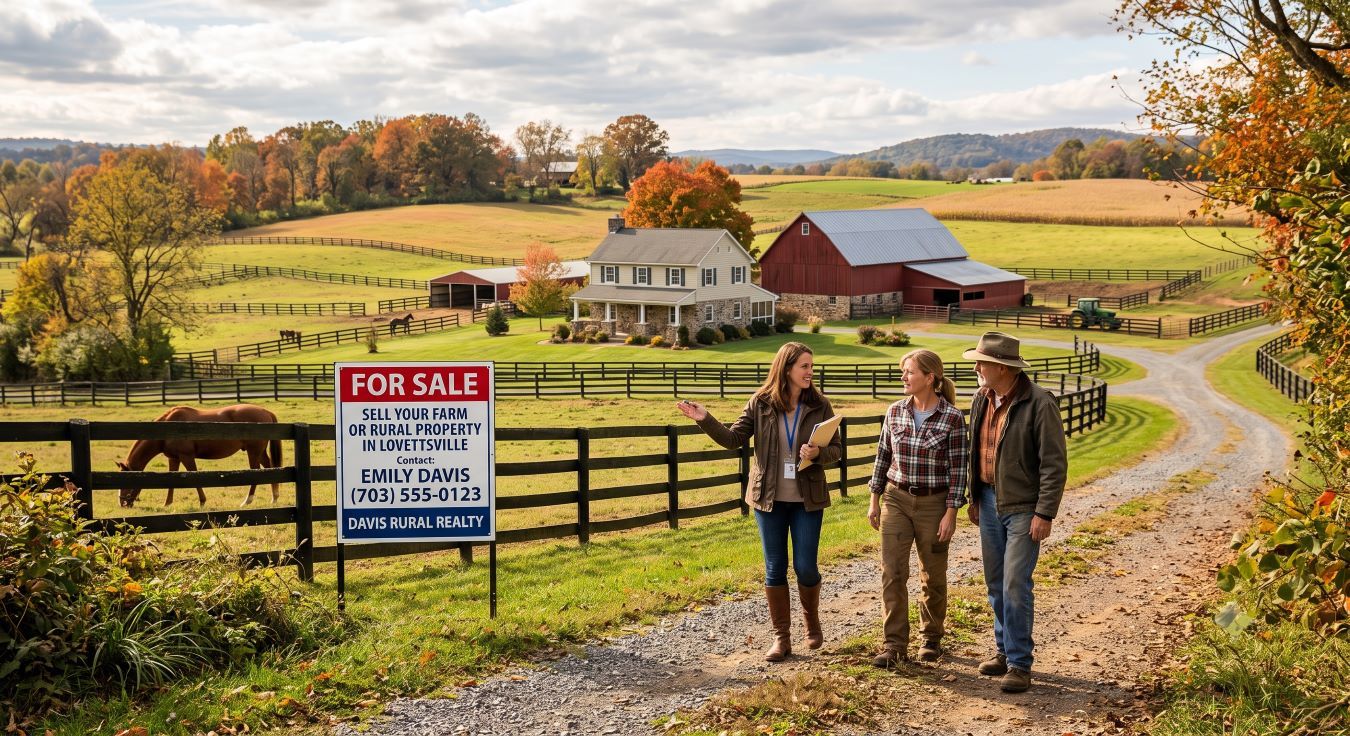
Quick Answer: To sell a farm or rural property in Lovettsville, VA, price it by usability rather than by the house alone: land, water, fencing, barns, and development rights all drive value. Recent listing data for the area shows farms averaging well over $1 million and farmland selling in the range of roughly $65,000 to $95,000 per acre depending on size and usability, with properties spending around 37 days on the market. Before you list, gather your survey, well and septic certifications, easement and land-use documents, and outbuilding permits. Market through the specialized rural and equestrian channels that reach country-property buyers, not just the standard residential MLS. And remember the rural tax traps, especially land-use rollback taxes, which must be addressed in the contract. A 1.5% full-service listing fee keeps far more of your equity on a high-value farm than a traditional 3% agent.
Key Takeaways
- Price by usability, not just the house: acreage, water, fencing, barns, and division rights all carry value a residential comp misses.
- Know your property type: a hobby farm, an equestrian estate, a working farm, and raw acreage each attract a different buyer and price.
- Land-use rollback taxes are the big trap: if the land leaves its agricultural classification, up to five years of deferred taxes plus interest come due, and the contract must say who pays.
- Conservation easements cut both ways: they can lower price and narrow the buyer pool, but appeal to conservation-minded buyers and must be disclosed.
- Buyers expect rural due diligence: well yield and water tests, a septic inspection, a current survey, and permits for every outbuilding.
- Market to niche buyers: equestrian and land platforms plus aerial video reach country-property buyers the standard MLS alone will not.
- Commission is your biggest controllable cost: on a $1M+ farm, a 1.5% full-service listing fee keeps tens of thousands more of your equity.
Selling a farm in Lovettsville is not the same as selling a house in the suburbs, and treating it like one is the fastest way to leave money on the table. Out here in western Loudoun's horse country, your buyer is not comparing square footage on a quarter-acre lot. They are weighing acreage, usability, water, fencing, barns, zoning, and the lifestyle your land offers, and each of those carries real dollars.
This is a complete, start-to-finish guide to selling a farm, farmette, equestrian property, or raw acreage in and around Lovettsville. As Loudoun County real estate experts, The Jamil Brothers Realty Group help rural sellers price by usability, prepare the documentation buyers demand, and market to the niche audience that pays top dollar for country property. Whether you own six rolling acres or a working farm, this guide walks through valuation, taxes, easements, wells and septic, marketing, and how to keep more of your proceeds when you sell your Lovettsville home. And because rural transactions have quirks a general agent can miss, we bring the local knowledge of a top-rated real estate team across the DMV.
On This Page
- Why selling a farm isn't like selling a house
- Know what kind of rural property you have
- What farms are selling for in Lovettsville
- How to value a farm or rural property
- Land-use assessment & rollback taxes
- Conservation easements & value
- Zoning, density & division rights
- Well, septic & water certifications
- Barns, outbuildings & permits
- Gather your documentation
- How to prepare a farm for sale
- Marketing a farm to the right buyers
- Pricing strategy & time on market
- Financing & the rural buyer
- Taxes when you sell
- Selling with a specialist vs. FSBO
- Water, floodplain & soils
- Selling to a developer vs. a lifestyle buyer
- Timing & seasonality
- Selling an inherited or estate farm
- Negotiating the contract & closing
- Common mistakes that cost farm sellers
- Frequently asked questions
- Glossary
Why Selling a Farm Isn't Like Selling a House
A suburban home sale is largely about the house: its condition, its finishes, and how it compares to the one that sold down the street. A farm sale is about the whole property as a system. The dwelling might be only a fraction of the value, while the land, the water, the fencing, the outbuildings, and what the zoning allows you to do with the acreage carry the rest.
That difference changes everything downstream. Valuation is harder because no two farms are alike. The buyer pool is smaller and more specialized. Financing works differently. Due diligence runs deeper, covering wells, septic systems, soils, easements, and permits. And the marketing has to reach people who are searching for a lifestyle, not just a floor plan.
Get those pieces right and a Lovettsville farm can sell briskly and for a strong price. Get them wrong, price off the house alone, skip the documentation, or list it like an ordinary home, and it can sit for months while the right buyer never even finds it.
Know What Kind of Rural Property You Have
Before you can price or market your property, you need to be honest about what it actually is, because the category drives both the value and the buyer. Most Lovettsville-area rural properties fall into one of these types.
| Property Type | What It Is | Typical Buyer |
|---|---|---|
| Farmette | A small acreage property (often 3 to 15 acres) with a home and light agricultural or hobby use. | Lifestyle buyers wanting space, animals, and privacy. |
| Hobby farm | Modest acreage used for small-scale farming, gardening, or a few animals, not primarily for income. | Move-up and lifestyle buyers, remote workers. |
| Equestrian property | Land improved for horses: barns, stalls, paddocks, riding arena, run-in sheds. | Horse owners and trainers with specific needs. |
| Working farm | Larger acreage in active agricultural production, often with income and land-use tax status. | Farmers, investors, and agricultural operators. |
| Raw / undeveloped land | Unimproved acreage with development or agricultural potential. | Builders, land bankers, and buyers planning to build. |
These lines blur, a farmette can also be an equestrian property, but naming your property honestly tells you which comparable sales matter, which features to spotlight, and which buyers to chase. A charming four-stall barn is a headline feature to a horse buyer and background noise to someone who just wants elbow room.
What Farms Are Selling For in Lovettsville
Lovettsville sits in western Loudoun's rolling farm country, and rural property here commands a premium for the lifestyle it offers: apple orchards, wineries, mountain views, horse events, and small-town charm within reach of the wider Northern Virginia economy. That demand shows up in the numbers.
Recent listing data from rural land marketplaces gives a useful baseline, though every parcel is different and these are asking prices, not a valuation of your specific property.
| Segment (Lovettsville area) | Approx. Average Listing Price | Approx. Price Per Acre |
|---|---|---|
| Farms (all sizes) | ~$1,160,000 | ~$94,000 / acre |
| Small / hobby farms | ~$956,000 | ~$66,600 / acre |
| Typical days on market | ~37 days (varies widely by price and usability) | |
Two lessons stand out. First, per-acre value falls as total acreage rises, larger tracts trade at a lower price per acre than small farmettes, so you cannot simply multiply a small-lot per-acre figure across a big parcel. Second, usability drives the spread: a well-fenced, well-watered, road-accessible property with quality improvements sits at the top of the range, while raw or constrained land sits below it. To understand why a listing figure is not the same as what your property is truly worth, see our guide to assessed value vs. market value in Loudoun County.
How to Value a Farm or Rural Property
Valuing rural property is part art, part evidence. Because farms are so individual, an accurate number comes from adding up distinct components rather than pulling a single residential comp.
Value the land by usability
Not all acres are equal. Cleared, tillable, well-drained, road-accessible land with good soils is worth far more per acre than steep, wooded, or wet ground. Frontage, access, and how the parcel is shaped all matter. A knowledgeable valuation weights your acreage by what it can actually be used for.
Value the improvements separately
The home, the barns, the arena, fencing, wells, and utilities each add value, but rarely dollar-for-dollar of what they cost to build. A high-quality, well-maintained barn adds more than a tired one; specialized improvements add most for the buyer who needs exactly that feature.
Account for income and development rights
If the land produces farm income or carries a lease, that can support value. So can the right to divide the parcel into additional lots under the zoning, a factor that can add substantial value and is easy to overlook. We cover division rights below.
Understand why appraisals are tricky
Rural appraisals are harder than suburban ones because true comparables are scarce and each property is unique. Expect a wider range of opinion, and expect the appraisal to matter a great deal when a buyer is financing. Pricing on solid evidence up front reduces the risk of an appraisal gap later.
Land-Use Assessment & Rollback Taxes
This is the single most important tax issue in a rural Loudoun sale, and the one that surprises sellers most. Loudoun County's Land Use Assessment Program lets owners of qualifying agricultural, horticultural, forestry, or open-space land defer part of their real estate taxes, so the land is taxed on its use value rather than its full market value. It is a valuable break while you farm, but it comes with a string attached.
When the land stops qualifying, the deferred taxes can come due as rollback taxes. In Virginia, rollback covers the difference between the land-use value and full fair-market value for up to the five prior years, plus interest. In Loudoun County, rollback is generally triggered by a change to a non-qualifying use, rezoning to a more intensive use, or subdividing the land.
For a sale, the critical questions are whether your buyer intends to keep the agricultural classification and, if not, who pays the rollback. If the new owner will not continue the qualifying use, that change must be reported to the county within 60 days, and the rollback liability follows the change of use. This is why a rural purchase contract must spell out responsibility for rollback taxes; leaving it vague can cost the seller thousands at closing.
Do this early: Confirm your current land-use status and request an estimate of potential rollback taxes before you list, so you can price and negotiate with eyes open. Review the county's Land Use Assessment Program and roll-back tax pages, and confirm specifics with the county and your tax advisor.
Conservation Easements & Value
Much of western Loudoun's beauty is protected by conservation easements, voluntary legal agreements that permanently limit development on a property to preserve its open, agricultural, or scenic character. If your land is under easement, or could be placed under one, it materially affects your sale.
The effects cut both ways. An easement typically reduces the number of homes that can ever be built, which can lower market value and narrow the buyer pool to those who want protected land rather than development potential. At the same time, easements can carry meaningful income-tax and estate-planning benefits, and they appeal strongly to conservation-minded buyers who value the guarantee that neighboring land and views will stay rural.
If your property is encumbered, the exact terms matter enormously: what can and cannot be built, where, and under what conditions. Those restrictions must be disclosed and provided to buyers, and they should be reflected honestly in your pricing. An experienced rural agent helps you present an easement as the feature it is to the right buyer, rather than letting it become a deal-breaking surprise late in escrow.
Zoning, Density & Division Rights
Zoning quietly sets the ceiling on what your land is worth, because it controls how the property can be used and, crucially, how many lots it can be divided into. Most rural land around Lovettsville sits in Loudoun's agricultural-rural districts, primarily AR-1 and AR-2.
| District | Base Density | Subdivision Options (approx.) |
|---|---|---|
| AR-1 (Agricultural Rural-1) | 1 lot per 20 acres | Up to 1 per 10 acres (subordinate) or 1 per 5 acres (cluster) |
| AR-2 (Agricultural Rural-2) | 1 lot per 40 acres | Up to 1 per 20 acres (subordinate) or 1 per 15 acres (cluster) |
The practical point for sellers is that unused division rights, the ability to legally split the parcel into additional lots, can add significant value, and many owners do not realize they hold them. A parcel that can yield two or three additional building lots is worth far more than one that cannot, even at the same acreage. Conversely, an easement or prior division can extinguish those rights.
Because zoning rules, densities, and subdivision options change and are property-specific, confirm your land's district and remaining division rights with Loudoun County before you rely on them. You can pull zoning and parcel details yourself using the county's tools, which we walk through in our guide on how to look up any Loudoun County property.
Well, Septic & Water Certifications
Rural homes are not on public water and sewer, so the well and the septic system are core to the sale, and buyers, lenders, and their inspectors will scrutinize both. Getting ahead of this protects your price and your timeline.
- Well yield and water quality: expect a flow-rate (yield) test and a water-potability test. Strong yield and clean water are selling points; problems are far cheaper to address before you list than to renegotiate under contract.
- Septic inspection and pumping: have the septic system inspected and pumped, and gather records. Buyers want confidence the drainfield is sound and sized for the home.
- Reserve drainfield: know whether the property has a designated reserve (backup) drainfield area, which matters for future repairs and any expansion.
- Health department documentation: keep the well and septic permits and any certifications organized; some sales and lenders require current certification.
Why it pays off: A pre-listing well and septic package removes the biggest sources of rural-buyer anxiety, keeps your deal from stalling during due diligence, and signals that the property has been well cared for, which supports your asking price.
Barns, Outbuildings & Permits
Barns, riding arenas, run-in sheds, workshops, and additional dwellings are often what sells a farm, but only if they were built and permitted correctly. Unpermitted structures are a genuine red flag that can complicate financing, insurance, and closing.
Before you list, confirm that every significant structure has the proper county permits and that any additional dwelling is legal. Pull the permit history so you can answer buyer questions with documentation rather than guesses. If a valuable improvement was built without permits, it is far better to understand and address that early than to have it derail a sale.
For horse properties especially, the quality and configuration of the equestrian infrastructure, stall count, arena footing, wash stall, tack room, fencing type, and paddock layout, directly shapes value and marketing. You can research a property's recorded permits through the county's LandMARC system, which we cover in our Loudoun property records guide.
Interactive · Commission Savings
Selling a High-Value Farm? See What You Keep With a 1.5% Listing Fee
Pick your property value:
Typical 3% Listing Fee
Your Estimated Savings
$6,000
Kept in your pocket versus a traditional 3% listing fee.
Typical 3% Listing Fee
Your Estimated Savings
$7,500
Kept in your pocket versus a traditional 3% listing fee.
Typical 3% Listing Fee
Your Estimated Savings
$9,000
Kept in your pocket versus a traditional 3% listing fee.
Typical 3% Listing Fee
Your Estimated Savings
$11,250
Kept in your pocket versus a traditional 3% listing fee.
Typical 3% Listing Fee
Your Estimated Savings
$15,000
Kept in your pocket versus a traditional 3% listing fee.
Estimates compare a 3% listing-side fee to our 1.5% listing fee. On farms above $1M, savings scale higher. Full-service either way; buyer's-agent commission is separate and negotiable.
Gather Your Documentation
Rural buyers and their lenders do far more due diligence than suburban ones, and a seller who has the paperwork ready closes faster, negotiates from strength, and avoids nasty surprises. Assemble this package before you list.
Survey and plat
A current survey and the recorded plat showing boundaries, acreage, easements, and rights-of-way. This answers the property-line questions rural buyers always ask.
Well and septic records
Well yield and water-quality results, septic inspection and pumping records, permits, and any health-department certifications.
Land-use and tax status
Documentation of any land-use assessment enrollment and an estimate of potential rollback taxes, so responsibility can be negotiated in the contract.
Easements and covenants
Any conservation easement, agricultural easement, access easement, or HOA and road-maintenance agreements that run with the land.
Permits and improvements
Building permits for the home and every outbuilding, plus records for barns, arenas, fencing, and any additional dwelling.
Operations and leases
Any farm leases, agricultural agreements, water or mineral rights, and records of income the property produces.
How to Prepare a Farm for Sale
Preparing acreage for market is different from staging a townhouse, but presentation still moves the price. The goal is to show a property that looks cared for, functional, and ready to step into.
Start with the approach and the land itself: mow and maintain the fields, clear brush along fence lines, repair or paint fencing, and make sure gates, lanes, and access roads are passable and tidy. Overgrown pastures and sagging fence read as deferred maintenance and invite lowball offers.
Turn to the working improvements. Clean out and organize barns and outbuildings, address obvious repairs, tidy the arena and paddocks, and make water sources and run-in sheds presentable. Then treat the home as you would any listing: declutter, deep-clean, handle small repairs, and let light in. For the improvements that most reliably return their cost, our guide on how to increase your home's value before selling applies to the dwelling on your farm as well.
Marketing a Farm to the Right Buyers
The buyer for a Lovettsville farm is a niche audience, and reaching them takes more than dropping the listing into the standard residential MLS and hoping. The residential MLS is necessary, but on its own it under-exposes rural property to the people actually searching for it.
Effective farm marketing layers several channels. Beyond the MLS, that means the specialized land and equestrian marketplaces where country-property buyers actually shop, targeted digital advertising to horse owners and land seekers, and outreach to networks of agents who represent rural buyers. Presentation is just as important as placement.
- Aerial and drone video: the only way to convey acreage, layout, water features, and setting, and the single most impactful asset for a land listing.
- Professional photography of the whole property: not just the house, but barns, arena, paddocks, fencing, views, and outbuildings.
- Lifestyle storytelling: sell the mornings feeding horses, the mountain views, the orchards and wineries nearby, the experience of western Loudoun country living.
- A complete feature and infrastructure sheet: acreage, fencing type, barn and stall details, arena, water, zoning, and improvements in one clear document buyers can act on.
Marketing a farm well is a specialist skill. The listings that command top dollar are the ones that make a buyer feel the lifestyle before they ever set foot on the land, then back it up with the hard details serious buyers demand.
Pricing Strategy & Time on Market
Pricing a farm correctly is the highest-stakes decision in the whole sale, and it is harder than pricing a house because comparables are thin and every property is different. Overprice a farm and it can languish for months while the small pool of qualified buyers passes it by; underprice it and you leave real money on the table.
The right strategy anchors your price to a usability-weighted analysis of genuinely comparable rural sales, adjusted for your land, water, improvements, and any development rights, rather than to a single residential comp or an out-of-date assessment. While area properties have recently averaged around 37 days on market, that figure hides a wide range: a sharply priced, well-presented farmette can move quickly, while a large or unusual property can take considerably longer to find its buyer.
Because rural listings often reach a smaller, more deliberate audience, patience and correct pricing work together. For a fuller picture of what drives time on market and how to read the signals, see our guide on how long it takes to sell a home in Loudoun County.
Financing & the Rural Buyer
How your buyer pays for a farm affects your sale more than most sellers expect. Rural and agricultural properties do not always fit a standard residential mortgage, and understanding that helps you evaluate offers realistically.
Large-acreage and working farms may require specialized financing, such as farm and agricultural lenders, and those loans can carry larger down payments and different terms than a conventional home loan. Unique properties are also harder to appraise, which raises the risk of an appraisal coming in below the contract price and creating a financing gap to bridge. Cash buyers are more common at the higher end of the rural market, and a strong cash offer can be worth serious consideration even against a higher financed one.
When you weigh offers, look past the headline price to the strength and type of financing, the size of the down payment, the contingencies, and the buyer's track record with rural purchases. If speed or certainty matters more to you than squeezing out the last dollar, a cash offer may be worth exploring as one option among several.
Taxes When You Sell
A farm sale can trigger several tax considerations beyond an ordinary home sale, and planning for them protects your net proceeds. This is general information, not tax advice, so confirm your specific situation with a qualified CPA or tax attorney.
- Capital gains: gains on the sale may be taxable. The primary-residence exclusion can shelter part of the gain attributable to your home, but land and investment portions are treated differently.
- 1031 exchange: if the property is held for investment or business use, a like-kind exchange may let you defer capital-gains tax by reinvesting in other qualifying property.
- Rollback taxes: as covered above, leaving the land-use program can bring several years of deferred taxes plus interest due, and the contract should assign who pays.
- Virginia grantor tax and closing costs: the seller typically pays the state grantor tax and a share of settlement costs at closing.
The interaction of these items can be significant on a high-value farm, so it is worth modeling your net proceeds early. A seller net sheet gives you a clear estimate of what you would actually walk away with after commissions, taxes, and costs.
Selling With a Specialist vs. FSBO
Some rural owners consider selling for sale by owner to save the commission, and on a high-value farm the commission is real money. But the very things that make farm sales complex, valuation, niche marketing, rural due diligence, easements, and rollback taxes, are also where a specialist earns their keep, and where a misstep can cost far more than the fee saved.
A rural listing specialist prices by usability, reaches the specialized buyer pool, manages the deeper due diligence, and navigates the tax and easement issues that can sink an unrepresented deal. The question is not really agent versus no agent; it is whether you get expert representation at a fair price. That is exactly where a 1.5% full-service listing changes the math: complete marketing and negotiation, at half the traditional 3% listing fee, so you keep tens of thousands more on a farm-sized sale price without cutting corners. If you are weighing whom to trust with a property this valuable, our guide on how to choose the best listing agent in Loudoun County lays out the criteria that matter.
Water, Floodplain, and Soils
Beyond the well and septic, the land's water and ground conditions shape both value and what a buyer can build, and serious rural buyers investigate them closely. Knowing your answers before they ask lets you market the strengths and get ahead of any weaknesses.
- Streams, ponds, and springs: water features add appeal and can support livestock, but streams may carry buffer or setback rules that limit building nearby.
- Floodplain: land in a mapped flood zone can affect insurance, financing, and where a buyer may build, so know whether any of your acreage is affected.
- Wetlands: wet areas can be regulated and constrain development; disclose any known wetlands up front.
- Soils and perc: for any unbuilt lot or added septic, soil suitability and a percolation (perc) test determine whether and where a system can go, which directly drives division value.
Buildable acres beat total acres: a 20-acre parcel with 5 dry, well-drained, buildable acres can be worth more than 30 acres of steep, wet, or floodplain ground. Buyers pay for usable land, not just a number on the deed.
Selling to a Developer vs. a Lifestyle Buyer
Depending on your land's size, zoning, and division rights, you may attract two very different buyers, and they value your property in opposite ways. Understanding both helps you choose the path that nets the most.
| Factor | Developer / Builder | Lifestyle Buyer |
|---|---|---|
| Values most | Division rights, rezoning potential, buildable lots | The home, barns, privacy, turnkey country living |
| Pays for | Future lots and density | Usability and lifestyle right now |
| Timeline | Longer, with feasibility studies and approvals | Shorter, more like a home sale |
| Main risk | Deal tied to approvals; can fall through | Financing or appraisal on a unique property |
| Best when | Land has real, unused division potential | Property is improved and ready to enjoy |
For many Lovettsville farms, an improved, ready-to-enjoy property draws its strongest price from a lifestyle buyer, while large or raw tracts with division rights may appeal to builders. Sometimes it pays to test both audiences. The right listing strategy positions your property for whichever buyer values it most.
Timing and Seasonality
When you list a farm matters more than when you list a townhouse, because so much of a rural property's appeal is visual and seasonal. Late spring and summer show land at its best: green pastures, leafed-out trees, gardens and orchards in bloom, and dry, passable lanes. That is when many buyers tour and when photography and drone video are most compelling.
There are other rhythms to weigh. Equestrian buyers are often most active during riding and show season. Families relocating for the school year tend to shop in spring and early summer. And your own tax situation and land-use timing can influence the ideal closing window, which is worth mapping out before you commit to a date.
Flexibility is leverage: a well-priced, well-marketed farm can sell in any season, but if your timing is flexible, listing when the land looks its best and buyer activity is high gives you the widest, most motivated audience.
Selling an Inherited or Estate Farm
Many western Loudoun farms change hands after passing down through a family, and selling inherited rural property carries a few extra considerations. If the estate is still in probate, the sale may need to work within that process, and confirming clear title is essential when land has been held for decades.
When several heirs share ownership, aligning everyone on price, timing, and terms is often the hardest part, and a neutral, experienced agent helps keep the sale on track. On taxes, inherited property generally receives a stepped-up cost basis to its value at the date of death, which can significantly reduce capital-gains tax when you sell, though land-use rollback and other rural issues still apply. Confirm the specifics with the estate's attorney and a tax professional.
Check title and land-use early: on inherited farms, decades-old easements, unrecorded family transfers, or lapsed land-use enrollment are far easier to resolve before you list than after you are under contract.
Negotiating the Contract and Closing
Rural contracts carry terms you will not see in a standard suburban deal, and getting them right protects your proceeds. Expect buyers to request study periods and land-specific contingencies, and plan for a settlement timeline that can run longer than a typical home sale.
| Contract Term | Why It Matters |
|---|---|
| Rollback tax allocation | Spells out who pays deferred land-use taxes if the use changes; leaving it vague can cost the seller thousands. |
| Well, septic & water contingencies | Buyer conditions the deal on satisfactory well yield, water quality, and a septic inspection. |
| Survey & boundary contingency | Confirms acreage, property lines, and easements before closing. |
| Feasibility / perc study period | Time for the buyer to test soils and confirm buildability, common on land and division deals. |
| Personal property & equipment | Clarifies what conveys: tractors, equipment, hay, fixtures, and farm items. |
| Existing farm leases | Addresses whether leases continue, transfer, or terminate at closing. |
Negotiating these well is where an experienced rural agent protects your bottom line, anticipating the buyer's due-diligence requests and structuring terms so a complex deal actually reaches the closing table.
Common Mistakes That Cost Farm Sellers
Most rural sales that disappoint trace back to a handful of avoidable errors. Steer clear of these and you protect both your price and your timeline.
| Costly Mistake | Do This Instead |
|---|---|
| Pricing off the house or the tax assessment | Price by usability, using genuinely comparable rural sales. |
| Ignoring rollback taxes until closing | Confirm land-use status and allocate rollback in the contract up front. |
| Listing only on the residential MLS | Add specialized land and equestrian channels plus aerial media. |
| Leaving barns or additions unpermitted | Verify permits early and resolve issues before due diligence. |
| Skipping well and septic prep | Test and document water and septic before you list. |
| Overlooking division rights | Check remaining rights; they can add major value. |
Every one of these is fixable before you list. The common thread is preparation, and it is exactly what a rural specialist brings, so your farm sells for its full value without last-minute surprises.
Explore Loudoun Communities
Selling Land or a Home Elsewhere in Loudoun County?
Frequently Asked Questions
How do I sell a farm or rural property in Lovettsville, VA?
Price it by usability rather than by the house alone, weighing land, water, fencing, barns, and any development rights. Gather your survey, well and septic certifications, easement and land-use documents, and outbuilding permits before listing. Market through specialized rural and equestrian channels, not just the residential MLS, and address rural tax issues like rollback taxes in the contract. A rural listing specialist, ideally at a 1.5% full-service fee, ties all of this together while protecting your proceeds.
How much are farms selling for in Lovettsville?
Recent listing data for the Lovettsville area shows farms averaging well over $1 million, roughly $1.16 million, with small and hobby farms averaging closer to $956,000. Per-acre asking prices run in the range of about $66,000 to $94,000 depending on size and usability, with smaller parcels commanding more per acre. These are asking prices, not a valuation of your specific property, which depends on its land, improvements, and rights.
How much is 1 acre of land worth in Virginia?
It varies enormously by location and usability. In sought-after western Loudoun near Lovettsville, farmland has recently been listed in the range of roughly $66,000 to $94,000 per acre, far above rural averages in much of the state, because of demand, proximity to Northern Virginia, and the area's lifestyle appeal. Smaller parcels typically sell for more per acre than large tracts. Your land's specific value depends on access, soils, water, and zoning.
How much is 10 acres of land worth in Virginia?
There is no single figure, because value depends on location, usability, and improvements. Using recent western Loudoun per-acre ranges as a rough guide, ten usable acres near Lovettsville could fall anywhere from several hundred thousand dollars up, and far more with a quality home and equestrian improvements. Larger acreage usually trades at a lower price per acre than small farmettes, so you cannot simply multiply a small-lot rate. A local valuation is the only reliable way to price a specific parcel.
How do you value a farm or rural property?
You value the components rather than pulling a single comp: the land weighted by usability, the improvements (home, barns, arena, fencing, wells) at their contributory value, any farm income or leases, and any unused development or division rights. Because true comparables are scarce and each property is unique, rural valuations carry a wider range than suburban ones, and the appraisal matters greatly when a buyer is financing.
What are rollback taxes and who pays them when I sell?
Rollback taxes are deferred real estate taxes that come due when land leaves an agricultural land-use classification. In Virginia they cover the difference between the land-use value and full market value for up to five prior years, plus interest, and in Loudoun County they are triggered by a change to a non-qualifying use, rezoning, or subdivision. Who pays is negotiable and must be spelled out in the contract, which is why you should confirm your status and request an estimate before listing.
Does a conservation easement hurt my sale?
It depends. A conservation easement permanently limits development, which can lower market value and narrow the buyer pool, but it also carries tax benefits and appeals strongly to conservation-minded buyers who want protected land and permanent views. The specific terms of what can and cannot be built matter enormously and must be disclosed. With the right marketing to the right buyer, an easement is presented as a feature rather than a liability.
What documents do I need to sell a rural property in Loudoun County?
Assemble a current survey and recorded plat; well yield, water-quality, and septic inspection records with permits; land-use status and a rollback estimate; any conservation, agricultural, or access easements and HOA or road agreements; building permits for the home and every outbuilding; and records of any farm leases, income, or water rights. Having this package ready speeds due diligence and strengthens your negotiating position.
Do I need to certify my well and septic to sell?
Because rural homes rely on private well and septic systems, buyers and lenders will want them tested and documented, and some sales require current certification. Expect a well yield and water-quality test and a septic inspection and pumping. Handling these before you list turns a common source of buyer anxiety and renegotiation into a selling point that supports your price.
How long does it take to sell a farm in Lovettsville?
Area properties have recently averaged around 37 days on market, but that average hides a wide range. A well-priced, well-presented farmette can go under contract quickly, while a large, unique, or constrained property can take months to reach the right buyer. Correct pricing, complete documentation, and specialized marketing are what shorten the timeline for rural property.
How do I market a horse farm or equestrian property?
Reach beyond the residential MLS to the specialized land and equestrian marketplaces where country-property buyers search, and support the listing with aerial and drone video, full photography of the barns, arena, paddocks, and fencing, and lifestyle storytelling about western Loudoun living. Provide a detailed infrastructure sheet covering stall count, arena footing, fencing type, water, and zoning so serious buyers can act with confidence.
Can I sell farmland without a realtor (FSBO)?
You can, but rural sales are where a specialist adds the most value, in usability-based pricing, niche marketing, deeper due diligence, and navigating easements and rollback taxes. A misstep on any of those can cost far more than the commission saved. A 1.5% full-service listing offers a middle path: complete professional representation at half the traditional 3% fee, so you keep more of your proceeds without going it alone.
What taxes will I owe when I sell my farm?
Potentially capital-gains tax on the gain (with the primary-residence exclusion possibly sheltering part of the home portion), rollback taxes if the land leaves its agricultural classification, and the Virginia grantor tax and closing costs the seller typically pays. Investment or business-use property may qualify for a 1031 like-kind exchange to defer capital gains. Because these interact and can be significant, consult a qualified CPA or tax attorney for your situation.
How does the 1.5% listing fee work for a high-value farm?
You receive full-service representation, professional marketing, aerial media, negotiation, and transaction management, for a 1.5% listing commission instead of the traditional 3%. On a farm-sized sale price, that difference is substantial: on a $1 million property it is roughly $15,000 kept in your pocket, with no reduction in service. The buyer's-agent commission is separate and negotiable.
Glossary
Farmette: A small acreage property, often 3 to 15 acres, with a home and light agricultural or hobby use.
Hobby Farm: Modest acreage used for small-scale farming or animals, not primarily to generate income.
Equestrian Property: Land improved for horses, with features like stalls, paddocks, run-in sheds, and a riding arena.
Land Use Assessment Program: A Loudoun County program that lets qualifying agricultural or open-space land be taxed on its use value, deferring part of the tax.
Rollback Taxes: Deferred taxes that come due, plus interest, when land leaves its agricultural classification, covering up to five prior years.
Conservation Easement: A voluntary, permanent legal agreement that limits development to preserve a property's open or agricultural character.
AR-1 / AR-2 Zoning: Loudoun's agricultural-rural districts, which set base density and how many lots a parcel may be divided into.
Division Rights: The legal ability to split a parcel into additional lots under the zoning; unused rights can add significant value.
Reserve Drainfield: A designated backup area for a future septic drainfield, important for repairs and any expansion.
Well Yield: The measured flow rate a well produces, a key figure buyers and lenders check on rural property.
The Bottom Line on Selling a Farm in Lovettsville
Selling a farm in Lovettsville rewards preparation and specialized knowledge. Price by usability, not the house alone. Get ahead of the rural tax and title issues, especially land-use rollback taxes and easements. Assemble your survey, well and septic, and permit documentation before you list. And market to the niche buyers who pay top dollar for country property, using aerial media and lifestyle storytelling rather than a plain residential listing.
Do those things and your property stands out in a small but motivated market. The final piece is representation: a rural specialist who prices it right, markets it fully, and protects your proceeds, at a 1.5% full-service fee that keeps far more of your equity than a traditional 3% agent. When you are ready, we will show you exactly what your land is worth and how to get there.
Tell us about your acreage, water, fencing, and improvements, and we will show you what your property is truly worth, how to market it to the right buyers, and how a 1.5% full-service listing keeps tens of thousands more of your equity. Free and no obligation.
Disclaimer: This article is an independent educational guide for informational purposes only and is not legal, tax, or financial advice. Market figures are approximate listing data, not sold-price valuations, and change over time. Zoning, land-use, rollback-tax, easement, well, and septic rules are set by Loudoun County and the Commonwealth of Virginia and change; always verify current details with the county and qualified legal and tax professionals for your specific property. The Jamil Brothers Realty Group is a licensed real estate team with Samson Properties serving Loudoun County and the greater DMV. Equal Housing Opportunity.
Explore More
Browse Every Corner of the DMV Market
Whether you're searching by budget, neighborhood, or buying situation — find exactly what you need below.
Virginia Homes by Budget
Washington DC Homes by Budget
Maryland Homes
Explore Fairfax County & Surrounding Northern Virginia
Ready to Make a Move?
Full-Service · No Tradeoffs
List for 1.5% & Keep More Equity
Professional photography, drone video, 3D tours, and expert negotiation — all included. On a $1M farm, that's roughly $15,000 more in your pocket vs. a 3% agent.
See the 1.5% Program →Need Speed or Certainty?
Get a No-Obligation Cash Offer
Skip the showings, skip the contingencies. If timing or condition matters more than top dollar, a cash offer may be the right fit. We'll walk you through every option.
Explore Cash Offers →Categories
- All Blogs (1227)
- Aldie (3)
- Ashburn (6)
- Buyer Guide (8)
- Buying a home (2)
- Buying Strategies (30)
- festivals (1)
- General Blog (67)
- Leesburg (5)
- Market Intelligence (29)
- Market Updates (8)
- Notable Properties For Sale (32)
- Real Estate Tips, News, and More (385)
- Seller Guide (2)
- Seller Guides (60)
- Selling Your Home (522)
- Sterling (6)
- Top Realtors in Northern Virginia (58)
Recent Posts
Message Sent!
Thank you for reaching out. Arslan & Saad have received your details and will be in touch shortly.
Need immediate assistance? Call or text 703-782-4830.