What Do Sellers Need to Know About Selling a House As-Is in Virginia?
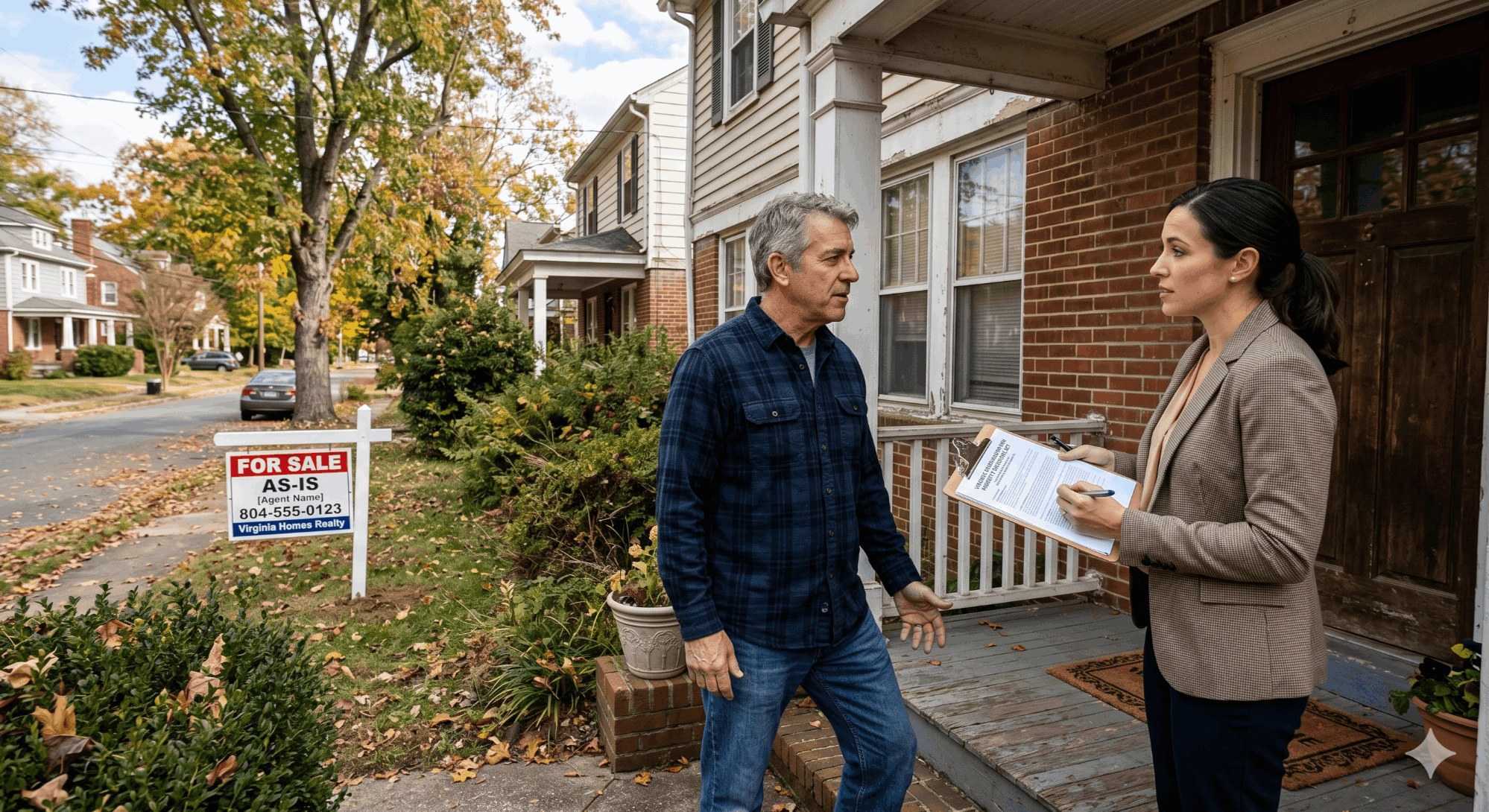
If you are thinking about selling a house as-is in Virginia, the most important thing to understand up front is that you can do it legally, but "as-is" does not erase your responsibilities as a seller. Maybe you inherited a property that needs work, you are relocating on a tight timeline, or you simply do not have the budget to renovate before listing. Whatever the reason, working with an experienced Northern Virginia real estate agent helps you price the home correctly, disclose what the law requires, and avoid the costly mistakes that shrink your final proceeds.
Selling as-is does not mean handing your home away at a steep discount. With a sound pricing strategy, honest disclosure practices, and a clear understanding of Virginia's property laws, you can sell a home in its current condition and still walk away with strong proceeds. This guide breaks down exactly what Virginia sellers need to know, from disclosure rules and pricing methods to the types of buyers who compete for these homes.
Quick Answer: Yes, you can legally sell your Virginia home as-is without making repairs. Virginia is a "buyer beware" (caveat emptor) state, so buyers handle their own due diligence. You must still complete the Virginia Residential Property Disclosure Statement and cannot conceal or lie about known defects. As-is homes typically sell for roughly 5% to 40% below move-in-ready comparables, depending on condition, location, and how you choose to sell.
Key Takeaways for Virginia As-Is Sellers
- Virginia follows the caveat emptor doctrine, so sellers have limited disclosure duties, but they still cannot hide or misrepresent known defects.
- You must deliver the Virginia Residential Property Disclosure Statement, and federal law requires a lead-based paint disclosure for homes built before 1978.
- A reliable as-is pricing formula starts with comparable sales, then subtracts 100% to 120% of estimated repair costs.
- Cash investors usually offer 50% to 70% of fair market value, while a well-marketed listing can reach 80% to 95% of value.
- A pre-listing inspection is optional but helps you price accurately and reduces surprises during negotiations.
- Choosing the right selling method, and a competitive commission, often matters more to your net proceeds than the repairs you skip.
In This Guide
- What Does Selling a House As-Is in Virginia Actually Mean?
- Why Do Virginia Homeowners Choose to Sell As-Is?
- What Disclosure Requirements Apply to As-Is Sales?
- How Do You Price a House Sold As-Is in Virginia?
- Who Buys As-Is Homes in Virginia?
- What Are Your Options for Selling a House As-Is?
- How to Sell a House As-Is in Virginia Step by Step
- Mistakes Virginia Sellers Should Avoid
- What Northern Virginia Sellers Should Know
- Alternatives to Selling a House As-Is
- Putting Your As-Is Sale Plan Together
- Frequently Asked Questions
- Glossary of Terms
What Does Selling a House As-Is in Virginia Actually Mean?
When you sell a home as-is in Virginia, you are telling buyers that you will not make repairs or modifications before closing. The buyer agrees to purchase the property in its current condition, even if it has deferred maintenance, cosmetic flaws, or larger structural problems. In short, an as-is clause signals that you will not entertain repair requests after an inspection.
What an as-is sale does not do is let you hide problems. According to guidance from the Virginia REALTORS association, an as-is clause only means the seller will not negotiate repairs. You are still required to deliver the property at settlement in the same condition it was in when the contract was ratified, and you cannot conceal a known material defect.
What "As-Is" Does and Does Not Cover
| As-Is DOES Mean | As-Is DOES NOT Mean |
|---|---|
| The seller will not make repairs before closing | The seller may hide known defects |
| The buyer accepts the home's current condition | The buyer gives up the right to inspect |
| The price reflects the property's condition | The seller may damage the home after the contract |
| No warranty is given on systems or appliances | The seller may lie about the home's condition |
| The seller avoids repair negotiations | The seller is exempt from disclosure laws |
Virginia law requires sellers to keep the property in the same condition from contract ratification until closing. If a buyer later discovers that the seller let the home deteriorate or covered up a material defect, they may have grounds to void the contract or pursue a fraud claim. Understanding this distinction is the foundation of a clean, low-risk as-is sale.
Why Do Virginia Homeowners Choose to Sell As-Is?
Homeowners decide to sell as-is for many reasons, and knowing your own motivation helps you set realistic expectations for price and timeline. Some sellers prioritize speed, while others simply lack the funds or appetite for a renovation. If the property needs major work, our guide to selling a home that needs repairs in Northern Virginia breaks down the specific trade-offs. Here are the situations that most often lead to an as-is sale in Virginia.
Common Reasons Sellers Skip Repairs
- ✓ Time constraints: job relocations, military PCS orders, or life changes that demand a fast sale.
- ✓ Limited funds: repair money is tied up or needed for a down payment on the next home.
- ✓ Inherited property: out-of-state heirs who prefer to sell rather than manage remote renovations.
- ✓ Major repairs needed: foundation, roof, or system issues that exceed the owner's budget or expertise.
- ✓ Estate settlements: executors who need to liquidate quickly without investing estate funds in updates.
- ✓ Repair fatigue: long-term owners and landlords who are simply ready to move on.
The National Association of Realtors reports that the large majority of homeowners make at least one improvement before selling. If you fall outside that group, or your home needs more than minor updates, an as-is sale can still be a sound path, especially when you have a clear plan to sell your Virginia home with full-service representation rather than going it alone.
Get a personalized valuation from The Jamil Brothers that accounts for your home's condition and local market, with street-level comps, not an automated guess. Response within 24 hours.
What Disclosure Requirements Apply to As-Is Sales?
Virginia is widely described as a caveat emptor, or "buyer beware," state. That means sellers carry fewer disclosure obligations than they would in states like California or Texas. Limited obligations, however, are not the same as none, and getting the disclosure step right protects you from liability long after closing. For the complete picture, walk through the full Virginia home selling disclosure requirements and legal checklist before you list.
The Virginia Residential Property Disclosure Statement
Under the Virginia Residential Property Disclosure Act (Section 55.1-700 and following), sellers must provide a disclosure statement to buyers. The key feature of this form is that it largely informs buyers that the seller makes no representations about the property's condition and that buyers should perform their own due diligence. The statement touches on areas such as property condition, covenants and restrictions, mineral rights, wastewater systems, and dam break inundation zones.
Required Virginia Seller Disclosures
- ✓ Residential Property Disclosure Statement: always required.
- ✓ Lead-based paint disclosure: required for homes built before 1978 under federal law.
- ✓ Military air installation notice: if the property sits in a noise or accident potential zone.
- ✓ Repetitive flood loss disclosure: if you know the home has had multiple flood claims.
- ✓ Stormwater facility notice: if a privately owned facility is on the property.
- ✓ HOA or condo resale packet: if the property belongs to an association.
What Virginia Sellers Cannot Do
While Virginia does not require you to volunteer every flaw, you cannot actively conceal a defect or lie when a buyer asks a direct question. If a buyer asks about a foundation issue you know exists, you must answer honestly. Failing to do so can lead to fraud claims, contract rescission, or financial liability after the sale. Virginia law also prohibits damaging or stripping the property between ratification and closing, so removing appliances or fixtures can give the buyer grounds to walk away.
Disclosure Risk by Seller Behavior
How Do You Price a House Sold As-Is in Virginia?
Pricing is the single most important factor in a successful as-is sale. Price too high and the home lingers, eventually forcing reductions that make buyers suspicious. Price too low and you give away equity you could have kept. It also helps to know the total cost to sell a house in Virginia, since commissions, closing costs, and fees all shape the net you walk away with. Most agents use one of two pricing approaches to value a fixer-upper or as-is property.
Method 1: Comparable Sales Minus Repair Costs
As-Is Price = Comparable Sale Price minus (Repair Costs x 110% to 120%)
This works best when you can find similar homes that sold in move-in-ready condition. The 110% to 120% multiplier accounts for the buyer's time, effort, and risk in managing the work.
Method 2: The After-Repair Value (ARV) Approach
Maximum Offer = (ARV x 65% to 85%) minus Repair Costs
Investors lean on this formula. They estimate what the home would sell for after renovation, then work backward to their maximum purchase price.
A Real-World As-Is Pricing Example
Say you own a 1990s colonial in Fairfax County that needs work. Comparable renovated homes nearby sell for about $750,000, and your home needs roughly $80,000 in repairs (roof, HVAC, kitchen, and baths). Here is how the two methods compare:
| Pricing Method | Calculation | Estimated Price |
|---|---|---|
| Comp minus repairs (110%) | $750K minus ($80K x 1.10) | $662,000 |
| Comp minus repairs (120%) | $750K minus ($80K x 1.20) | $654,000 |
| ARV method (75%) | ($750K x 0.75) minus $80K | $482,500 |
| ARV method (85%) | ($750K x 0.85) minus $80K | $557,500 |
The range is wide, and that is the point. The comp-minus-repairs approach usually yields higher numbers and fits a market listing where traditional buyers compete. The ARV method reflects what investors will offer, with the lower end favoring professional flippers and the upper end fitting owner-occupants who plan to renovate over time. To sharpen your numbers, it helps to study active Virginia home listings in your neighborhood and see how condition affects asking price.
Getting Accurate Repair Estimates
Your price is only as good as your repair estimate. Build it with these steps:
- Pre-listing home inspection ($300 to $500): surfaces issues you may not know about and supports your pricing.
- Contractor estimates (free): gather at least three bids for major work to define real costs.
- Structural engineer ($500 to $700): worth it for foundation or structural concerns.
- Add a 10% to 20% contingency: renovations almost always uncover something extra.
Our seller net sheet calculator breaks down every cost, from commission and transfer taxes to closing fees, so you know your real bottom line before you list an as-is home.
Who Buys As-Is Homes in Virginia?
Knowing your likely buyers helps you market the home well and set realistic expectations. Each buyer type comes with a different motivation, timeline, and price point.
| Buyer Type | Typical Offer | Timeline | Best For |
|---|---|---|---|
| Cash investors and flippers | 50% to 70% of value | 7 to 14 days | Speed over price |
| iBuyers | 65% to 75% of value | 14 to 30 days | Certainty and convenience |
| Buy-and-hold investors | 60% to 80% of value | 14 to 30 days | Rental properties |
| Renovation-loan buyers | 80% to 95% of value | 45 to 60 days | Maximum price |
| DIY homebuyers | 75% to 90% of value | 30 to 45 days | Balance of price and speed |
Demand for fixer-uppers has climbed sharply in competitive Virginia markets, and these listings often draw more interest than move-in-ready homes at similar price points. That interest means a well-priced as-is property can attract multiple offers rather than a single lowball bid.
Renovation-Loan Buyers: An Overlooked Opportunity
Many sellers do not realize that buyers can finance a fixer-upper with FHA 203(k) loans, Fannie Mae HomeStyle loans, or VA renovation loans. These programs roll renovation costs into the mortgage, which lets buyers offer closer to full market value while still purchasing an as-is home. Marketing your listing to these buyers, with clear language about renovation-loan eligibility, expands your pool well beyond cash investors and can lift your final price.
What Are Your Options for Selling a House As-Is?
Virginia homeowners have several paths to an as-is sale, and each one trades off price, speed, convenience, and certainty. The right choice depends on what matters most to you.
| Option | Expected Price | Timeline | Pros | Cons |
|---|---|---|---|---|
| List on the MLS with an agent | 80% to 95% | 30 to 90 days | Maximum exposure, competitive offers | Commission costs, longer timeline |
| Sell to a cash buyer | 50% to 70% | 7 to 14 days | Fast, no repairs, no showings | Significantly lower price |
| iBuyer platform | 65% to 75% | 14 to 30 days | Certainty, flexible close dates | Service fees, limited coverage |
| For sale by owner (FSBO) | 75% to 90% | 60 to 120 days | Saves the listing fee | Limited exposure, more work, legal risk |
| Auction | 60% to 85% | 30 to 45 days | Firm sale date, competitive bidding | Uncertain final price, auction fees |
For most Virginia sellers, listing on the MLS with an experienced agent delivers the best balance of price and a reasonable timeline. The difference often comes down to the agent's marketing and the listing fee you pay. Teams that offer flexible commission options let you keep more of the sale price, which can offset much of the as-is discount that worries sellers in the first place.
Professional photography, drone video, 3D tours, expert negotiation, and full MLS marketing, all included at 1.5%. No hidden fees, no service reductions, no surprises, even on an as-is listing.
Estimate How Much More You Keep on an As-Is Sale
Even when you sell as-is, your commission still shapes your net proceeds. Select your home's estimated value below to compare a traditional 3% listing fee against our 1.5% full-service fee.
Seller Savings Calculator
How much more do you keep with our 1.5% listing fee?
Select your home's estimated value to see your real net proceeds, side by side.
Traditional Agent at 3%
Our Fee, Only 1.5%
Extra in your pocket
$6,000
vs. a traditional 3% listing agent, with zero reduction in service or marketing.
Traditional Agent at 3%
Our Fee, Only 1.5%
Extra in your pocket
$7,500
vs. a traditional 3% listing agent, with zero reduction in service or marketing.
Traditional Agent at 3%
Our Fee, Only 1.5%
Extra in your pocket
$9,000
vs. a traditional 3% listing agent, with zero reduction in service or marketing.
Traditional Agent at 3%
Our Fee, Only 1.5%
Extra in your pocket
$11,250
vs. a traditional 3% listing agent, with zero reduction in service or marketing.
Traditional Agent at 3%
Our Fee, Only 1.5%
Extra in your pocket
$15,000
vs. a traditional 3% listing agent, with zero reduction in service or marketing.
Estimates only. Closing costs vary. Buyer's agent commission is negotiable.
How to Sell a House As-Is in Virginia Step by Step
Follow this timeline to move through your as-is sale efficiently and protect your net proceeds at each stage.
Assess the home's condition (Week 1)
Document known issues and consider a pre-listing inspection to surface problems you may not be aware of. This guides both your pricing and your disclosures.
Get repair estimates (Weeks 1 to 2)
Collect at least three contractor bids for major work so you can price competitively and give buyers confidence in their own math.
Interview agents (Week 2)
Choose an agent experienced with as-is sales. Ask how they market fixer-uppers and what results they have produced on similar homes.
Price strategically (Weeks 2 to 3)
Set the price using comparable sales minus estimated repair costs, then review a seller net sheet so you understand your true bottom line.
Prepare the property (Week 3)
Clean, declutter, and remove personal items. You do not need to stage, but a tidy home photographs better and helps buyers picture the potential.
Complete disclosures (Week 3)
Fill out the Virginia Residential Property Disclosure Statement and any additional notices that apply, such as lead paint or HOA documents. Be honest, but do not invent issues you are not aware of.
List and market (Weeks 3 to 4 and beyond)
Go live on the MLS with professional photos and a description that highlights potential while staying transparent about condition. Target investor networks and renovation-loan buyers.
Review offers and negotiate (Weeks 4 to 6)
Weigh offers on price, contingencies, financing type, and closing timeline. A clean cash offer may be worth accepting at a slightly lower number.
Close the sale (Weeks 6 to 10)
Maintain the property in its current condition through closing, complete the final walkthrough, and sign at the settlement company.
Mistakes Virginia Sellers Should Avoid
A handful of avoidable errors cost as-is sellers both time and money. Watch for these in particular.
⚠️ Common As-Is Selling Mistakes
1. Overpricing out of emotion
Sentimental value does not move the market. Price on comparable sales minus repair costs, not memories. Overpriced as-is homes sit, then take reductions that raise red flags.
2. Taking the first cash offer
Many "we buy houses" companies open with a lowball offer expecting a counter. Gather several offers, or list on the MLS to create real competition.
3. Hiding known defects
Even in a buyer-beware state, concealing a defect can trigger a fraud claim. Let your price account for problems instead of papering over them.
4. Skipping the pre-listing inspection
You cannot price accurately without knowing the scope of repairs. A small inspection fee can prevent a much larger pricing mistake.
5. Choosing an agent with no as-is experience
Not every agent knows how to market a fixer-upper or reach investor and renovation-loan buyers. Look for proven, market-specific experience.
What Northern Virginia Sellers Should Know
Selling as-is in Northern Virginia carries both advantages and pressures that differ from the rest of the state. Strong employment, high median incomes, and competitive demand all shape how fixer-uppers perform here.
Why Northern Virginia As-Is Homes Can Hold Their Value
- High land values: even homes that need work sit on valuable land in sought-after school districts.
- Steady buyer demand: the tech sector and federal employment keep a consistent pool of buyers active.
- Affordability gap: fixer-uppers offer an entry point into neighborhoods that are otherwise hard to reach.
- Investor activity: flippers and rental investors actively pursue deals across Fairfax, Loudoun, and Prince William counties.
In communities across the region, well-priced fixer-uppers frequently draw multiple offers, sometimes from buyers willing to pay close to market value minus a modest repair discount. If you want a feel for local demand and pricing, it helps to browse Northern Virginia communities and compare how condition affects value block by block.
Alternatives to Selling a House As-Is
Before you commit to an as-is sale, it is worth weighing a few alternatives that might serve your goals better. A conventional listing follows a predictable path, and our step-by-step guide to selling a house in Virginia lays out each stage.
Make Strategic, High-Return Repairs
Not all repairs pay off equally. Cosmetic updates such as paint, landscaping, and a deep clean can cost a few thousand dollars yet lift your sale price by far more. Consider tackling the highest-impact, lowest-cost items before defaulting to a full as-is sale.
High-Impact, Low-Cost Improvements
- Fresh interior paint ($2,000 to $5,000)
- Deep cleaning and decluttering ($500 to $1,500)
- Landscaping and curb appeal ($500 to $2,000)
- Updated light fixtures ($200 to $800)
- Fixing leaky faucets and running toilets ($100 to $400)
Seller Financing or a Lease-Option
If your home has strong equity but limited traditional buyer appeal, offering seller financing or a lease-option can attract buyers who cannot qualify for a conventional mortgage but can handle payments on a fixer-upper.
Renovate-Then-Sell Programs
Some real estate teams front renovation costs and recoup them at closing. For the right home, this can net more than an as-is sale without any out-of-pocket spending from the seller.
Rent It Out Instead
If an as-is sale will not meet your financial needs and you are not in a rush, renting the property while it continues to build equity can be a stronger long-term play in high-rent Northern Virginia markets.
Putting Your As-Is Sale Plan Together
Selling a house as-is in Virginia does not have to mean accepting pennies on the dollar. With a clear pricing strategy, honest disclosures, and the right marketing, you can sell in current condition and still keep strong proceeds. Virginia's buyer-beware rules work in your favor, but honesty remains non-negotiable, and the selling method you choose often matters more than the repairs you skip.
The path forward is simple: get an accurate picture of your home's value, understand what you will actually net after every cost, and compare your options before deciding. For sellers who want full-service marketing without a heavy commission, our 1.5% full-service listing program is built to keep more equity in your pocket, even on a property that needs work.
Know your equity, understand your costs, and see exactly what you will walk away with before you make any decisions. The Jamil Brothers, NVAR Lifetime Top Producers with 840+ homes sold, provide a full seller consultation at no cost or obligation.
Frequently Asked Questions
Can I sell my house as-is in Virginia without an inspection?
Yes. Virginia does not require sellers to conduct a home inspection before selling. Buyers, however, usually keep the right to inspect during their due diligence period and may try to renegotiate based on what they find. A pre-listing inspection helps you price accurately and reduces surprises later.
How much less will I get selling my Virginia home as-is?
It depends on condition and selling method. Homes that need only minor updates often sell for about 5% to 15% below comparable move-in-ready properties, while homes needing major work can sell for 20% to 40% less. Cash buyers and investors typically offer 30% to 50% below fair market value in exchange for the fastest, most convenient close.
Do I have to disclose problems when selling as-is in Virginia?
Virginia is a buyer-beware state, so your disclosure duties are limited. You must still complete the Virginia Residential Property Disclosure Statement and cannot actively conceal a known defect or lie when asked directly. Federal law also requires a lead-based paint disclosure for homes built before 1978.
Can buyers still negotiate after making an offer on an as-is home?
Yes. Even with an as-is listing, buyers may include an inspection contingency. If the inspection reveals issues, they can request a price reduction, ask for credits, or walk away within the terms of the contract. You are not obligated to make repairs, but you may need to negotiate on price.
What types of buyers purchase as-is homes in Virginia?
As-is homes attract cash investors and house flippers, buy-and-hold rental investors, iBuyer companies, DIY homebuyers, and buyers using FHA 203(k) or other renovation loans. In competitive Northern Virginia markets, a well-priced home may draw offers from several of these buyer types at once.
How long does it take to sell an as-is home in Virginia?
The timeline depends on your method. Cash sales can close in 7 to 14 days, while a traditional MLS listing usually takes 30 to 90 days from listing to closing. In strong Northern Virginia markets, a well-priced as-is home can attract offers within the first week.
Should I clean my house before selling it as-is?
Yes. You are not making repairs, but a clean, decluttered home helps buyers see the potential and photographs far better for marketing. Remove personal items, wipe down surfaces, and keep up basic landscaping to support your sale price.
What are the closing costs when selling as-is in Virginia?
Seller closing costs in Virginia generally run about 1% to 3% of the sale price, excluding commissions. They include the grantor tax (roughly $1 per $1,000 of sale price), title fees, settlement or attorney fees, and prorated property taxes. With agent commissions added, total costs often reach 8% to 10%, which is why a lower listing fee can meaningfully change your net proceeds.
Can I sell an inherited Virginia house as-is without making repairs?
Absolutely. Inherited properties are commonly sold as-is, especially when heirs live out of state or the estate needs to settle quickly. As the executor or heir, you complete the same disclosure requirements as any other seller while marketing the home in its current condition.
How do I choose the best agent to sell my as-is home in Northern Virginia?
Look for agents with specific experience marketing fixer-uppers and as-is properties in your area. Ask about their investor buyer networks, their work with renovation-loan buyers, and how they price homes that need work, then review their recent sales of similar properties. The Jamil Brothers Realty Group, NVAR Lifetime Top Producers serving Fairfax, Loudoun, and Prince William counties, helps sellers navigate these situations with full-service marketing and a competitive 1.5% listing fee.
Is an as-is sale right for every Virginia seller?
Not always. An as-is sale fits sellers who value speed, lack repair funds, or face a property with major issues. If you have time and a little budget, a few high-return repairs or a strong listing strategy may net more. The best move depends on your home's condition, your timeline, and your financial goals, which is why a free valuation and net sheet are useful starting points.
Glossary of Terms
After-Repair Value (ARV)
The estimated market value of a property once all repairs and renovations are complete. Investors use it to set their maximum offer.
Caveat Emptor
Latin for "let the buyer beware." A doctrine, followed in Virginia, that places due diligence on the buyer rather than relying on seller warranties.
Comparable Sales (Comps)
Recently sold homes similar in size, location, and features, used to estimate a property's market value.
FHA 203(k) Loan
An FHA-insured mortgage that finances both the purchase price and renovation costs in one loan, helping buyers acquire fixer-uppers with a low down payment.
Grantor Tax
A Virginia transfer tax paid by the seller when ownership changes hands, generally about $1 per $1,000 of the sale price.
Material Defect
A significant issue that affects a property's value or poses a risk to occupants, such as a foundation problem or roof failure.
Net Proceeds
The amount a seller keeps after all costs, fees, commissions, and mortgage payoffs are deducted from the sale price.
Pre-Listing Inspection
A home inspection ordered by the seller before listing, used to identify issues, price accurately, and limit surprises during buyer due diligence.
Disclaimer: This article is for informational purposes only and does not constitute legal or financial advice. Consult a licensed real estate attorney or professional for guidance specific to your situation. Market figures and statistics are general estimates and subject to change.
Explore More
Browse Every Corner of the DMV Market
Whether you're searching by budget, neighborhood, or buying situation — find exactly what you need below.
Virginia Homes by Budget
Washington DC Homes by Budget
Maryland Homes
Explore Northern Virginia Communities
Loudoun County
Fairfax County & Surrounding
Ready to Make a Move?
Full-Service · No Tradeoffs
List for 1.5% & Keep More Equity
Professional photography, drone video, 3D tours, and expert negotiation — all included. On an $800K home, that's $12,000 more in your pocket vs. a 3% agent.
See the 1.5% Program →Need Speed or Certainty?
Get a No-Obligation Cash Offer
Skip the showings, skip the contingencies. If timing or condition matters more than top dollar, a cash offer may be the right fit. We'll walk you through every option.
Explore Cash Offers →
Categories
- All Blogs (1158)
- Aldie (3)
- Ashburn (6)
- Buyer Guide (8)
- Buying a home (2)
- Buying Strategies (28)
- festivals (1)
- General Blog (66)
- Leesburg (5)
- Market Intelligence (29)
- Market Updates (8)
- Notable Properties For Sale (29)
- Real Estate Tips, News, and More (376)
- Seller Guide (2)
- Seller Guides (60)
- Selling Your Home (469)
- Sterling (6)
- Top Realtors in Northern Virginia (58)
Recent Posts

Message Sent!
Thank you for reaching out. Arslan & Saad have received your details and will be in touch shortly.
Need immediate assistance? Call or text 703-782-4830.