
How to Calculate Property Value in Northern Virginia (2026)
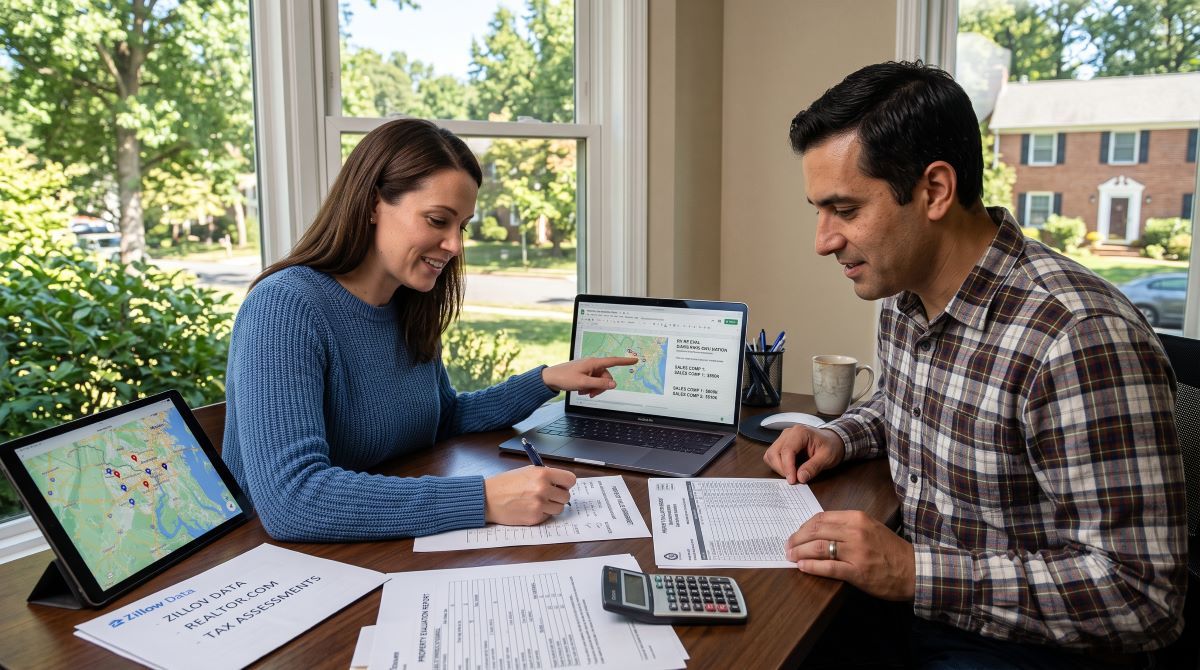
Quick Answer: To calculate property value, find 3–5 recently sold homes near yours that are similar in size, age, and condition, then divide each one's sale price by its living area to get a price per square foot. Multiply the average price per square foot by your home's square footage, then adjust up or down for differences like upgrades, lot size, and condition. This is the core of a comparative market analysis (CMA) — the same sales-comparison method Northern Virginia appraisers and agents use. A free online home value estimator gives you a fast ballpark, but a local CMA is far more accurate for pricing a real sale.
Key Takeaways
- The most common formula to calculate property value is average price per square foot of comparable sales × your home's square footage, adjusted for condition and features.
- There are four main ways to estimate home value: a comparative market analysis (CMA), a licensed appraisal, an automated valuation model (AVM) like Zillow or Redfin, and a direct sales-comparison of comps.
- Free online estimators are convenient but often miss $20,000–$50,000+ in Northern Virginia because they can't see your interior condition, renovations, or micro-neighborhood pricing.
- Your tax-assessed value is not your market value — in NoVA the two frequently differ by tens of thousands of dollars.
- The Northern Virginia median sold price was $810,000 in June 2026, with homes selling in roughly 15–17 days, so accurate pricing matters more than ever.
- The most reliable way to know what your home is truly worth is a street-level CMA from a local agent who prices NoVA homes every week.
In This Guide
- What It Means to Calculate Property Value
- The Property Value Formula
- The 4 Main Methods to Calculate Property Value
- How to Calculate Your Property Value Step by Step
- Free Estimators vs. a Professional CMA
- Factors That Affect Property Value in NoVA
- Assessed vs. Market vs. Appraised Value
- How the 2026 NoVA Market Affects Your Value
- Seller Savings Calculator
- Common Mistakes to Avoid
- Frequently Asked Questions
- Glossary
If you want to calculate property value in Northern Virginia — whether you're preparing to sell, refinancing, settling an estate, or just curious what your equity looks like — the process comes down to comparing your home to similar ones that recently sold nearby. There's a simple formula behind it, and once you understand the method, you'll know exactly why a Zillow estimate and a real appraisal can be $40,000 apart on the same house.
This guide walks through the actual math professionals use to determine the value of your property, the four main valuation methods and when each one applies, the local factors that move prices in Fairfax, Loudoun, Arlington, and Prince William, and how today's fast-moving NoVA market shapes what buyers will actually pay. If your goal is a confident, accurate number, start with a free home valuation from The Jamil Brothers and use this guide to understand what's behind it.
Home value estimators, appraisal calculators, and "what's my house worth" tools all try to answer the same question. The difference is accuracy — and in a market where the team you work with as your Northern Virginia Realtor can mean the difference between a home that sells in a week and one that sits, getting the number right is worth doing carefully.
What It Means to Calculate Property Value
When people say they want to calculate property value, they almost always mean fair market value — the price a willing buyer would pay a willing seller, with neither under pressure, in the current market. That's different from what your county says your home is worth for taxes, and different again from what a bank's appraiser signs off on for a loan.
Understanding which "value" you're after matters, because they're calculated differently and used for different purposes:
- Market value — what your home would realistically sell for today. This is the number that matters most when you list.
- Appraised value — a licensed appraiser's opinion of value, usually ordered by a lender to protect the loan.
- Assessed value — the figure your local jurisdiction (Fairfax County, Loudoun County, City of Alexandria, etc.) uses to calculate property taxes.
For most homeowners, "how do I determine the value of my property?" really means "what would it sell for right now?" — and that's market value. The good news is that the underlying method is something you can understand and even estimate yourself.
The Property Value Formula: How to Calculate It
The most widely used formula to calculate property value for a home is based on price per square foot from comparable sales:
Estimated Value = (Average Price Per Sq Ft of Comparable Sales) × (Your Home's Square Footage)
…then adjust up or down for condition, upgrades, lot size, and features.
Here's a real-world example. Say three similar homes near you in Fairfax recently sold:
| Comparable Sale | Sale Price | Living Area | Price / Sq Ft |
|---|---|---|---|
| Comp 1 | $820,000 | 2,050 sq ft | $400 |
| Comp 2 | $795,000 | 2,100 sq ft | $379 |
| Comp 3 | $845,000 | 2,000 sq ft | $423 |
| Average | — | — | ≈ $401 / sq ft |
If your home is 2,050 square feet, the raw estimate is 2,050 × $401 = about $822,000. From there you adjust: a renovated kitchen or a finished basement pushes the number up; dated systems, a busy road, or a smaller lot pull it down. Those adjustments are where a professional's local judgment separates a rough estimate from a defensible list price.
ℹ️ The "Comps" Rule
Good comparable sales are within about 0.5 miles, closed in the last 3–6 months, within ~15% of your home's size, and share the same style (colonial, townhome, condo), bedroom/bath count, and neighborhood. In NoVA, even the same subdivision can price differently by street, school pyramid, or Metro proximity — which is why raw square-footage math is only a starting point.
The 4 Main Methods to Calculate Property Value
There isn't one single "correct" way to value a home — there are four, and each serves a different purpose. Here's how they compare on accuracy, cost, and when to use them.
| Method | Accuracy | Cost | Best For |
|---|---|---|---|
| Comparative Market Analysis (CMA) | High | Free from an agent | Pricing a home to sell |
| Licensed Appraisal | High | $400–$700+ | Loans, disputes, estates |
| Automated Valuation Model (AVM) | Low–Medium | Free online | A fast ballpark |
| Sales Comparison (DIY comps) | Medium | Free / your time | Sanity-checking a number |
Comparative Market Analysis (CMA)
A CMA is what a real estate agent prepares using live MLS data (BrightMLS in our region). It uses the same sales-comparison logic as the formula above, but the agent adjusts for dozens of variables a computer can't see — condition, layout, view, renovation quality, and how competing listings are priced right now. For sellers, this is the gold standard for setting a list price.
Licensed Appraisal
An appraisal is a formal, independent opinion of value from a state-licensed appraiser, typically ordered by a lender during a purchase or refinance. It's the most defensible number for legal or financing purposes — think divorce settlements, estate valuations, or a bank protecting its loan. It costs money and takes time, but it carries weight.
Automated Valuation Model (AVM)
This is the engine behind Zillow's Zestimate, Redfin's estimate, and most "free home value estimator" tools. An AVM crunches public records and recent sales in seconds. It's a great starting point and useful for tracking trends — but because it can't see inside your home or read the nuances of a specific NoVA street, it's often off by a meaningful margin.
Sales Comparison (DIY Comps)
This is the do-it-yourself version of a CMA — pulling recent nearby sales yourself and running the price-per-square-foot math. It's a solid way to sanity-check an estimator or an agent's number, and it's exactly what this guide's step-by-step section teaches next.
Get a personalized home valuation from The Jamil Brothers — street-level comps and a real CMA, not an automated estimate. Response within 24 hours.
How to Calculate Your Property Value Step by Step
Want to estimate your own home's value before you talk to anyone? Follow these five steps. This is the same sequence a professional uses to build a comparative market analysis.
Pull 3–5 recent comparable sales
Find homes that sold in the last 3–6 months within about half a mile, similar in size, age, style, and bed/bath count. Sold prices — not list prices — are what count.
Calculate each comp's price per square foot
Divide each home's sale price by its finished living area, then average the results to get a baseline price per square foot for your area.
Multiply by your square footage
Apply the average price per square foot to your home's finished area for a raw baseline value.
Adjust for differences
Add value for renovations, a finished basement, a larger lot, a garage, or premium finishes. Subtract for dated systems, deferred maintenance, a busy road, or a smaller lot.
Cross-check against current listings
Look at what similar homes are actively listed for today. Sold comps tell you the past; active competition tells you what buyers will weigh your home against right now.
Data You'll Want Before You Start
- ✓ Your home's finished square footage (from tax records or original plans)
- ✓ Bedroom and bathroom count, plus lot size
- ✓ A list of upgrades and their approximate dates (roof, HVAC, kitchen, baths)
- ✓ Recent sold comps in your subdivision or immediate area
- ✓ Any HOA or condo fees that could affect buyer demand
Free Home Value Estimators vs. a Professional CMA — Which Is More Accurate?
Free tools like the Zillow Zestimate, Redfin estimate, and bank home value calculators are the most popular way people first try to calculate property value — and they're genuinely useful for a quick, free ballpark. But they have real limits, especially in a market as varied as Northern Virginia.
| ✓ Free Online Estimators | ✓ Professional CMA |
|---|---|
| Instant and free | Reflects true interior condition and upgrades |
| Good for tracking trends over time | Accounts for micro-neighborhood and street-level pricing |
| Can't see renovations or condition | Factors in active competition, not just past sales |
| Often off by $20K–$50K+ in NoVA | Free from most agents, with no obligation |
| Lags fast-moving markets | Built by someone who prices homes here every week |
The takeaway: use an estimator to get oriented, then get a real CMA before you make any decision that money rides on. If you're weighing options like listing traditionally versus a fast, certain sale, it's also worth understanding your cash offer options in Northern Virginia so you can compare a true net figure across paths.
Our seller net sheet calculator breaks down every cost — commission, transfer taxes, closing fees — so you know your real bottom line before you list.
Factors That Affect Property Value in Northern Virginia
Two homes with identical square footage can sell for very different prices. Here's roughly how much weight the main value drivers carry when you calculate property value in our region — location almost always leads.
In Northern Virginia specifically, a few local factors carry outsized influence: which school pyramid a home feeds into, walkability to a Metro station, HOA or condo fees, and whether the property sits in a sought-after subdivision. This is why the same floor plan can command a premium in one part of Fairfax and a discount two miles away — and why local expertise matters when you prepare to sell your home in NoVA.
ℹ️ Condos & HOA Fees Matter
High monthly HOA or condo association fees can lower a property's value because they reduce a buyer's borrowing power and monthly budget. In 2026, NoVA condos have shown softer conditions than detached homes and townhomes, so fee levels and building reserves are worth weighing carefully in any condo valuation.
Assessed Value vs. Market Value vs. Appraised Value
This is one of the most common points of confusion when homeowners try to determine the value of their property. Your county tax assessment is not your market value — and treating it as such can cost you real money when you sell.
| Type of Value | Who Determines It | Main Purpose |
|---|---|---|
| Market Value | The open market (buyers & sellers) | Setting a list or sale price |
| Appraised Value | A licensed appraiser | Lending, refinancing, legal matters |
| Assessed Value | Your county / city assessor | Calculating property taxes |
In practice, a Fairfax County assessment might come in tens of thousands of dollars below what a home actually sells for, because assessments are updated on a schedule and use mass-appraisal models rather than home-by-home analysis. Use your assessment for budgeting property taxes — not for pricing a sale.
How the 2026 Northern Virginia Market Affects Your Property Value
Any property value calculation is only as good as the market data behind it — and Northern Virginia's market in 2026 has been notably strong. Understanding the current conditions helps you interpret whatever number your comps produce.
| Metric (June 2026, NVAR/BrightMLS) | Figure |
|---|---|
| Regional median sold price | $810,000 (up 5.2% YoY) |
| Loudoun County median | $818,000 |
| Average days on market | ~15–17 days |
| Months of supply | ~1.9 months (seller-favored) |
| 2026 forecast (mortgage rates) | Hovering around 6% |
With inventory still tight and homes selling in roughly two weeks, accurate pricing is critical: price too high and you'll sit while newer listings pass you by; price with precision and a strong market rewards you quickly. For a deeper look at affordability and buyer budgets shaping demand, see our guide on how much house you can afford in Northern Virginia and our breakdown of the cost of living across NoVA in 2026. You can also search current listings across Northern Virginia to see how your home stacks up against active competition.
4K photography, drone video, 3D tours, expert negotiation, and full MLS marketing — all included at 1.5%. No hidden fees, no service reductions, no surprises.
Seller Savings Calculator
Once you've calculated your property value, the next question is what you'll actually keep. This is where commission has an outsized impact. Select your home's estimated value below to see how much more you net with our full-service 1.5% listing fee versus a traditional 3% agent.
Seller Savings Calculator
How much more do you keep with our 1.5% listing fee?
Select your home's estimated value to see your real net proceeds — side by side.
Traditional Agent — 3%
Our Fee — Only 1.5%
Extra in your pocket
$6,000
vs. a traditional 3% listing agent — with zero reduction in service or marketing.
Traditional Agent — 3%
Our Fee — Only 1.5%
Extra in your pocket
$7,500
vs. a traditional 3% listing agent — with zero reduction in service or marketing.
Traditional Agent — 3%
Our Fee — Only 1.5%
Extra in your pocket
$9,000
vs. a traditional 3% listing agent — with zero reduction in service or marketing.
Traditional Agent — 3%
Our Fee — Only 1.5%
Extra in your pocket
$11,250
vs. a traditional 3% listing agent — with zero reduction in service or marketing.
Traditional Agent — 3%
Our Fee — Only 1.5%
Extra in your pocket
$15,000
vs. a traditional 3% listing agent — with zero reduction in service or marketing.
Estimates only. Closing costs vary. Buyer's agent commission is negotiable.
Common Mistakes When Calculating Property Value
Even careful homeowners fall into the same traps. Avoid these when you calculate property value and you'll land much closer to reality.
Mistakes to Avoid
- ✗ Using list prices instead of actual sold prices for comps
- ✗ Trusting a single online estimator as the final answer
- ✗ Confusing tax-assessed value with market value
- ✗ Using comps from a different school pyramid or subdivision
- ✗ Over-valuing personal upgrades buyers won't pay a premium for
- ✗ Ignoring current competition — the active listings buyers compare you to
Frequently Asked Questions
What is the formula for calculating property value?
The most common formula is the average price per square foot of comparable recent sales multiplied by your home's square footage, then adjusted for condition, upgrades, lot size, and features. For example, if similar homes near you sold for about $400 per square foot and your home is 2,050 square feet, your raw estimate is roughly $820,000 before adjustments. This sales-comparison approach is the foundation of both a professional CMA and a licensed appraisal.
How do I calculate the value of my property myself?
Pull three to five recent sold comparables within about half a mile that match your home's size, style, and bed/bath count. Divide each sale price by its living area to get price per square foot, average those figures, and multiply by your home's square footage. Then adjust up for renovations, a finished basement, or a larger lot, and down for dated systems or a smaller lot. Finally, cross-check against homes currently listed nearby to see your real competition.
What is the most accurate way to calculate property value?
For pricing a sale, a comparative market analysis from a local agent who works your market weekly is the most accurate and it's typically free. For legal or lending purposes, a licensed appraisal carries the most formal weight. Online estimators are the least accurate because they can't see your home's interior condition, renovations, or street-level pricing nuances — they're best used only as a quick starting point.
Are free home value estimators like Zillow and Redfin accurate?
They're useful for a fast, free ballpark and for tracking value trends over time, but they frequently miss the mark in Northern Virginia — often by $20,000 to $50,000 or more. Automated valuation models rely on public records and past sales; they can't account for your renovations, condition, or the block-by-block pricing differences that are common in NoVA. Treat them as a starting point, not a listing price.
How much does it cost to get my property value calculated?
A comparative market analysis from a real estate agent is usually free with no obligation. A licensed appraisal typically costs between $400 and $700 or more, depending on property type and complexity. Online estimators are free but least reliable. For most homeowners deciding whether or when to sell, a free CMA delivers the best balance of accuracy and cost.
How long does a home valuation or appraisal take?
A professional CMA can often be turned around within 24 to 48 hours once an agent has your property details. A full licensed appraisal usually takes a few days to a couple of weeks, since it involves scheduling an in-person inspection and compiling a formal report. A free online estimate is instant but should be treated only as a rough figure.
What's the difference between assessed value and market value?
Assessed value is the figure your county or city uses to calculate property taxes, updated on a set schedule using mass-appraisal models. Market value is what a buyer would actually pay today. In Northern Virginia the two often differ by tens of thousands of dollars, so your tax assessment should be used for budgeting property taxes — not for pricing a sale.
How do I choose an agent to value my home?
Look for an agent who works your specific market regularly, prices homes in your price band often, backs their number with recent sold comps rather than round guesses, and explains their adjustments clearly. Local track record and current listing volume matter more than a national brand name. The Jamil Brothers Realty Group has sold 840+ homes across the DMV and provides a free, no-obligation valuation built on street-level comps.
Does my Northern Virginia tax assessment reflect my home's real value?
Not usually. Jurisdictions like Fairfax County and Loudoun County update assessments on a schedule and value large numbers of homes at once, so an assessment often lags a fast-moving market and can come in well below actual sale prices. Use your assessment to estimate property taxes, and rely on a CMA or appraisal to understand what your home would truly sell for.
What mistakes should I avoid when calculating my home's value?
The biggest ones are using list prices instead of sold prices, relying on a single online estimate, confusing assessed value with market value, choosing comps from a different subdivision or school pyramid, and overpricing personal upgrades that buyers won't pay extra for. Also don't ignore active competition — the homes currently listed near you shape what buyers are willing to pay.
How does the 2026 Northern Virginia market affect my home's value?
As of June 2026, the regional median sold price was $810,000, up 5.2% year over year, with homes selling in roughly 15 to 17 days and inventory still tight at around 1.9 months of supply. That seller-favored environment supports strong values, but only with accurate pricing — overpriced homes still sit while newer, well-priced listings sell quickly. Current market conditions should always be layered on top of your comp-based estimate.
Do HOA or condo fees affect my property value?
Yes. High monthly HOA or condo association fees reduce a buyer's borrowing power and monthly budget, which can pull down the value of an otherwise comparable home. In 2026, NoVA condos have seen softer conditions than detached homes and townhomes, so fee levels, special assessments, and healthy building reserves all factor into an accurate condo valuation.
Glossary
Fair Market Value
The price a willing buyer would pay a willing seller in the current market, with neither under pressure.
Comparative Market Analysis (CMA)
An agent's estimate of value built from recent comparable sales and active competition — the go-to method for pricing a listing.
Comparable Sales (Comps)
Recently sold homes similar to yours in location, size, age, and style, used as the basis for a value estimate.
Price Per Square Foot
A comp's sale price divided by its finished living area; averaging several comps gives a baseline value metric.
Automated Valuation Model (AVM)
The algorithm behind free online estimators like Zillow and Redfin, using public records and past sales.
Appraisal
A licensed appraiser's formal, independent opinion of value, typically ordered by a lender.
Assessed Value
The value your county or city assigns for property-tax purposes, often different from market value.
Days on Market (DOM)
How long a listing takes to go under contract — a key signal of demand and pricing accuracy.
Conclusion & Next Steps
Learning how to calculate property value gives you real leverage — you'll understand where your number comes from, why an online estimate and an appraisal can disagree, and how Northern Virginia's market shapes what buyers will pay. The price-per-square-foot formula and a solid set of comps get you a confident ballpark. But for a decision as big as selling, a street-level CMA from an agent who prices NoVA homes every week is what turns a rough estimate into an accurate, defensible list price.
When you're ready, The Jamil Brothers will give you a free valuation, a personalized net sheet, and a clear look at your options — including our full-service 1.5% listing program and buyer strategy sessions if your next move is a purchase. Have a specific question about your property? Contact our team or call (703) 782-4830.
Know your equity, understand your costs, and see exactly what you'll walk away with — before you make any decisions. The Jamil Brothers provide a full seller consultation at no cost or obligation.
Categories
- All Blogs (1177)
- Aldie (3)
- Ashburn (6)
- Buyer Guide (8)
- Buying a home (2)
- Buying Strategies (29)
- festivals (1)
- General Blog (66)
- Leesburg (5)
- Market Intelligence (29)
- Market Updates (8)
- Notable Properties For Sale (29)
- Real Estate Tips, News, and More (376)
- Seller Guide (2)
- Seller Guides (60)
- Selling Your Home (487)
- Sterling (6)
- Top Realtors in Northern Virginia (58)
Recent Posts

Message Sent!
Thank you for reaching out. Arslan & Saad have received your details and will be in touch shortly.
Need immediate assistance? Call or text 703-782-4830.