
Cost of Living in Northern Virginia: 2026 Breakdown by City
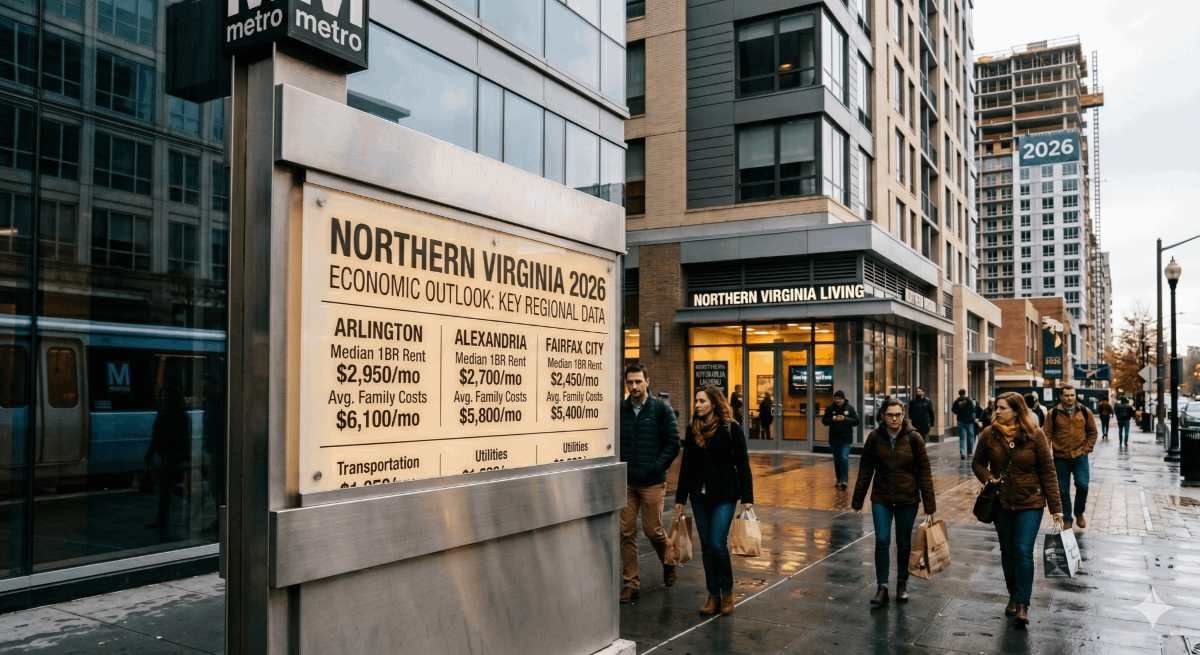
Quick Answer: The cost of living in Northern Virginia runs roughly 25% to 40% above the national average in 2026, and Arlington sits at the top of the range at about 34% above the U.S. baseline. Housing is the main driver: median sold prices ran from roughly $525,000 to $555,000 in Prince William County, about $815,000 in Arlington, and $1.3M or more in McLean in early 2026. Property taxes, utilities and the 6.0% regional sales tax add another $8,000 to $15,000 or more per year for most homeowners.
Key Takeaways
- Northern Virginia's median sold price was $675,000 in January 2026 (NVAR), about 70% above the national median of roughly $397,000.
- Arlington is the region's costliest jurisdiction at 34% to 36% above the national cost of living index; Prince William County is the most affordable major Northern Virginia jurisdiction.
- Property tax rates vary widely: Loudoun County sits at $0.805 per $100, Fairfax County at $1.1225 and Falls Church City at $1.295, a spread of $3,000 to $4,000 or more per year on an identical home.
- The 2026 conforming loan limit in the DC metro is $1,249,125, so most Northern Virginia homes can still be financed conventionally.
- Average Dominion Energy residential electric bills rose roughly $11 per month in 2026 after the first base rate increase since 1992.
- Northern Virginia sales tax is 6.0% (5.3% state plus 0.7% regional transportation), with unprepared groceries taxed at 2.5%.
- How Northern Virginia Compares to the National Average
- Housing Costs: The Biggest Variable
- Cost of Living by City: 2026 Breakdown
- Property Tax Rates by Jurisdiction
- Utilities, Energy and Water Costs
- Transportation and Commute Costs
- Groceries, Dining and Healthcare
- The Hidden Costs Most Buyers Miss
- Income You Need to Live Comfortably
- Why Citywide Averages Mislead
- Selling First? Listing Cost Calculator
- Frequently Asked Questions
- Glossary
- The Bottom Line
- About the Author
- Related Guides
- Northern Virginia Communities and Nearby Areas
Northern Virginia is one of the East Coast's more expensive places to live, but there is no single price tag for the region. Housing costs, property tax rates, commuting expenses, HOA fees, childcare and everyday spending change considerably between Arlington, Alexandria, Fairfax, Ashburn, Leesburg, Manassas and Woodbridge.
A household that prioritizes Metro access may accept a higher housing payment. Another may choose a longer commute in exchange for more space and a lower purchase price. Both are rational; they simply optimize for different things.
This guide gives a practical 2026 cost of living comparison for Northern Virginia using published housing data, official local tax rates and regional expense estimates. Local insight comes from our work as Northern Virginia real estate agents across the region's county and city markets.
You will be able to compare typical home prices and rents, property taxes, transportation, utilities, groceries, childcare and lifestyle costs across the region's major communities. The goal is not to crown the cheapest city, but to help you find the location that fits your income, commute, housing needs and long-term plans.
How Northern Virginia Cost of Living Compares to the National Average
Northern Virginia is not one market. It is a set of micro-markets stretching from inner-ring Arlington out to exurban Prince William and western Loudoun. As a region, though, the math is consistent: most day-to-day costs run meaningfully above what you would pay elsewhere in the country.
Using cost of living index data from the Council for Community and Economic Research, published via RentCafe and current as of early 2026, Arlington sits about 34% above the U.S. average and roughly 35% above the Virginia state average. Outside of housing, everyday costs across the region run roughly 15% to 20% above the national baseline, with groceries, dining and childcare showing the largest premiums.
The trade-off for those costs is a deep job market, well-funded public school systems in Fairfax and Loudoun counties, and some of the highest median household incomes in the United States. That income base is ultimately why the region's cost structure holds up.
Worth noting for anyone comparing across state lines: this is a DMV market, not just a Virginia one. Jobs, commutes and housing choices routinely cross into Maryland and the District, which is why our team works as real estate specialists serving the DMV rather than a single county. The right question is not whether Northern Virginia is expensive. It is whether the earning potential and lifestyle justify the cost in your specific situation.
Housing Costs in Northern Virginia: The Biggest Variable
Housing is where the region's cost premium is most dramatic, and where buyers have the most leverage to control their budget. According to the Redfin Virginia housing market report, the statewide median sale price in March 2026 was $464,200.
Northern Virginia's median sat at $675,000 that same month, nearly $210,000 above the state baseline. Even inside the region, your location choice can swing a mortgage payment by $1,500 to $3,000 per month.
Median sold prices by jurisdiction, Q1 2026. Sources: NVAR January 2026 report and Redfin market data for February and March 2026. National median of roughly $397,000 used as the comparison baseline.
| Jurisdiction | Median Sold Price (Q1 2026) | vs. National Median | Typical Profile |
|---|---|---|---|
| Arlington County | $815,000 | +105% | Urban walkability, Metro dense |
| Alexandria City | $705,000 to $790,000 | +78% to +99% | Historic, waterfront, transit |
| Fairfax County | $650,000 to $717,000 | +64% to +80% | Suburban, largest market in the region |
| Loudoun County | $600,000 to $760,000 | +51% to +91% | Newer construction, data center corridor |
| Prince William County | $525,000 to $555,000 | +32% to +40% | Lowest entry point among major jurisdictions |
| McLean / Great Falls | $1.3M to $1.8M or more | +228% to +353% | Luxury submarket, large lots |
The spread is real. Choosing Prince William over Arlington can cut a housing cost by 35% to 50%, which translates to roughly $1,800 to $2,500 per month in mortgage difference at early 2026 rates. That trade-off usually arrives as a longer commute and newer housing stock rather than walkable urban blocks.
Know your budget, your timeline and your negotiating position before you walk into a single home. Our buyer strategy session covers every Northern Virginia price point and costs nothing.
Northern Virginia Cost of Living by City: 2026 Breakdown
Arlington County
Arlington remained the region's most expensive rental and ownership market through early 2026. Redfin reported an Arlington median sale price of $815,000 in March 2026, up 4.7% year over year, with a median of 31 days on market.
Single-family homes in North Arlington average near $1.8M, with demand supported by Amazon's HQ2 at National Landing and a Metro-connected job base. Zumper's April 2026 DC Metro report put Arlington's median one-bedroom rent at $2,420 per month. Property tax runs $1.033 per $100 of assessed value, roughly $8,264 per year on an $800,000 assessment.
Alexandria City
Alexandria's median home price sat between $705,000 and $790,000 in early 2026, with attached homes and townhomes in Old Town and Del Ray driving much of the demand.
The city's real estate tax rate is $1.135 per $100, among the highest of the major jurisdictions. An Alexandria buyer pays roughly $7,945 per year on a $700,000 assessment before the stormwater service charge and other local assessments.
Fairfax County
Fairfax County covers an enormous range, from condos near $450,000 in Burke to estates above $3M in McLean and Great Falls. The county median ran roughly $650,000 to $717,000 in early 2026 depending on the month and submarket mix.
Fairfax County's real estate tax rate is $1.1225 per $100, and residential assessments rose an average of 3.99% for 2026 according to the county Department of Tax Administration. Premium submarkets such as Vienna and Great Falls regularly run $1.3M or more, with McLean home listings anchoring the top of the range.
Loudoun County
Loudoun is the most interesting math story in the region. The county's real estate tax rate is $0.805 per $100 for 2026, reduced from $0.865 in 2025, supported by data center personal property tax revenue generated along the Ashburn corridor.
That keeps the effective tax burden below Fairfax and Arlington even where home prices are comparable. Ashburn sat in the $550,000 to $650,000 range for most townhome and attached product in early 2026, while single-family homes in newer communities priced in the $750,000 to $1.1M range. Leesburg's median was $695,000 in March 2026 per Redfin. Start with the Loudoun County community guide if this is your target area.
Prince William County
Prince William is the most accessible major jurisdiction on price. Redfin data showed a February 2026 median of $555,000, with the county overall running $525,000 to $550,000 across early 2026.
Within the county, Gainesville and Haymarket average higher, around $750,000 for newer single-family homes, while Woodbridge and Dale City offer homes in the $400,000 to $500,000 range. The trade-off is drive time: most Prince William locations are 45 to 60 minutes or more to downtown DC depending on traffic.
Northern Virginia Property Tax Rates by Jurisdiction (2026)
Property tax is the second biggest housing cost after the mortgage itself, and rates vary more than most buyers expect. On a $700,000 assessment, the annual bill can swing by more than $3,400 based purely on which side of a county line you land.
Base real estate tax rates published by each jurisdiction for calendar or fiscal year 2026. Dollar figures are calculated from those published rates and assume the assessment equals the value shown.
| Jurisdiction | Tax Rate (per $100) | Tax on $700K Assessment | Tax on $1M Assessment |
|---|---|---|---|
| Loudoun County | $0.805 | $5,635 | $8,050 |
| Prince William County | $0.992 | $6,944 | $9,920 |
| Arlington County | $1.033 | $7,231 | $10,330 |
| Fairfax County | $1.1225 | $7,858 | $11,225 |
| City of Alexandria | $1.135 | $7,945 | $11,350 |
| City of Falls Church | $1.295 | $9,065 | $12,950 |
These are base rates only. Many parcels also carry a stormwater service district charge, a community center district levy, a transportation surcharge, or a town tax if the property sits inside an incorporated town such as Herndon or Vienna. Expect another $100 to $500 per year depending on the exact parcel.
Assessments move your bill even when rates hold flat
Fairfax County's FY 2027 proposed budget keeps the rate at $1.1225, but because residential assessments rose 3.6% overall, the typical homeowner still pays about $357 more than the prior year. Always ask for the current assessed value, not just the sale price, when you model an annual tax bill.
Assessments and market value are two different numbers. If you are weighing a move within the region, start with a current valuation so your equity picture is based on today's market rather than last year's assessment notice.
Utilities, Energy and Water Costs in Northern Virginia
Utility costs here have been rising faster than national inflation, driven largely by data center demand reshaping Dominion Energy's rate base. In November 2025 the Virginia State Corporation Commission approved Dominion's first base rate increase since 1992.
That decision added roughly $11.24 per month to the typical residential bill in 2026, with another $2.36 per month scheduled for 2027. As of early 2026, Virginia's average residential electricity rate was around 15.87 to 16.43 cents per kWh, with a typical monthly residential bill of $149 to $165.
Typical monthly utility ranges for a single-family home in Northern Virginia, 2026. Electric figures reflect Dominion Energy residential averages reported for Virginia in early 2026; other ranges are planning estimates, not quotes.
| Utility Category | Monthly Estimate (2026) | Notes |
|---|---|---|
| Electric (Dominion Energy) | $149 to $165 average; $300 to $500 summer peak | Single-family with central air |
| Natural gas (Washington Gas) | $75 to $200 | Higher in winter; rates up roughly 13% in 2026 |
| Water and sewer | $60 to $120 | Fairfax Water, Loudoun Water and local authorities |
| Trash (private hauler typical) | $35 to $60 | County run in Arlington and Alexandria, billed with taxes |
| Internet (fiber or cable) | $65 to $100 | Gigabit fiber widely available |
Total utility spend for a typical 3,000 square foot single-family home runs $380 to $550 per month on average, and bills can break $700 in July and August when central air runs around the clock. Townhomes and condos typically run 30% to 40% lower on electric and gas.
Transportation and Commute Costs in Northern Virginia
Transportation is where inner-ring Northern Virginia actually saves you money, particularly if your household can run one car instead of two. Residents near Metro stations, including the Silver Line extension that reaches Ashburn and Dulles International Airport, can sometimes go without a car entirely.
Everyone else is looking at roughly $10,000 to $15,000 per year in vehicle ownership costs including insurance, personal property tax, fuel and tolls.
Personal property tax on vehicles (2026): Arlington and Alexandria both charge $5.00 per $100 of assessed value before state car tax relief. Fairfax is $4.57, Loudoun is $4.20 and Prince William is $3.70. On a $30,000 vehicle after state relief, expect $450 to $700 per year depending on jurisdiction.
Typical one-way drive time to downtown DC at peak hours
Drive times above are typical peak-hour estimates, not guarantees. A single incident on I-66 or I-95 can double any of them, which is why commute testing at your actual work hours matters more than any published average.
Toll roads are a real line item. The 495, 95 and 66 Express Lanes and the Dulles Toll Road all use dynamic pricing. Regular commuters from outer jurisdictions commonly report $200 to $600 per month in tolls during peak usage. If your office is at the Pentagon, Crystal City or downtown DC and you are considering Haymarket, put tolls in the housing math before you tour.
If a job start date or a commute change is forcing your timeline, a cash offer can remove showings and contingencies. We will show you both paths side by side so you can see the real cost of the convenience before you commit to either one.
Groceries, Dining and Healthcare Costs
Non-housing costs run roughly 15% to 20% above national averages here, with dining and childcare showing the largest premiums. The table below reflects typical household budgeting ranges rather than published index figures.
Planning ranges for a household of four in Northern Virginia, 2026. These are budgeting estimates for orientation, not survey data.
| Category | Monthly (Household of 4) | vs. National |
|---|---|---|
| Groceries | $1,100 to $1,400 | +12% to +18% |
| Dining out (moderate) | $400 to $800 | +20% to +30% |
| Childcare (1 child, full time) | $1,800 to $2,800 | +35% to +60% |
| Health insurance (family premium share) | $400 to $900 | Near national average |
| Gym and fitness | $40 to $200 | +10% to +25% |
Sales tax in Northern Virginia is 6.0%, made up of the 5.3% state rate plus a 0.7% regional transportation surcharge that applies in Fairfax, Arlington, Alexandria, Prince William, Loudoun and Manassas. Virginia taxes unprepared groceries at a reduced 2.5%, while restaurant meals and prepared foods are taxed at the full 6.0% regional rate plus any local meals tax.
The Hidden Costs Most Northern Virginia Buyers Miss
The sticker price on the home is only the beginning. These are the recurring costs relocating buyers most often leave out of the budget.
Annual costs beyond your mortgage and property tax
- HOA or condo dues: $75 to $900 or more per month. Large association communities and luxury condo buildings run highest.
- Homeowners insurance: roughly $1,200 to $2,500 per year for most single-family homes, higher in mapped flood zones.
- Maintenance reserve: budget 1% to 2% of home value annually. On a $700,000 home that is $7,000 to $14,000 per year for HVAC, roof, landscaping and repairs.
- Lawn care and snow removal: $100 to $400 per month for single-family homes without HOA coverage.
- Pool, tennis and amenity fees: $300 to $1,500 per year on top of base HOA dues in some planned communities.
- Private school tuition, if applicable: $25,000 to $55,000 per year at the region's established independent schools.
- Vehicle personal property tax: $450 to $700 per year per vehicle after state relief, billed separately from your real estate tax.
Income You Need to Live Comfortably in Northern Virginia
The 28/36 rule, keeping housing under 28% of gross monthly income and total debt under 36%, is still the most useful sanity check. Applied at roughly 6.5% mortgage rates, here is what a comfortable purchase looks like at each price point.
Illustrative payment math: 30-year fixed at roughly 6.5%, 10% down, jurisdiction-typical property tax and $2,000 per year insurance. Rates, taxes and insurance vary by borrower and parcel. These figures are examples, not quotes.
| Home Price | Down Payment (10%) | Estimated Monthly PITI | Income Indicated |
|---|---|---|---|
| $550,000 (Prince William range) | $55,000 | About $3,850 | About $165,000 |
| $675,000 (regional median) | $67,500 | About $4,700 | About $200,000 |
| $815,000 (Arlington median) | $81,500 | About $5,650 | About $240,000 |
| $1.3M (McLean or Vienna range) | $130,000 | About $9,000 | About $385,000 |
These figures assume a conservative approach. Plenty of buyers stretch past 28%, particularly in inner-ring neighborhoods. Keep in mind that the 2026 conforming loan limit for the DC metro is $1,249,125, so most homes in the region can still be financed conventionally rather than with a jumbo loan.
Trade-offs to weigh before you commit to a submarket.
| Upsides | Cost pressures |
|---|---|
| High median incomes offset costs for dual-income households | Housing runs 50% to 100% above the national median in most ZIP codes |
| Well-funded public school systems across Fairfax and Loudoun | Property taxes of $7,000 to $13,000 per year are common |
| No Virginia estate or inheritance tax | Virginia income tax reaches 5.75% at a low threshold, effectively flat for most earners |
| Sales tax at 6.0% is lower than in many peer metros | Tolls add $200 to $600 per month for outer-ring commuters |
| No local income tax anywhere in Virginia | Childcare runs $1,800 to $2,800 per month per child |
| Military retirement pay is exempt from Virginia income tax | Vehicle personal property tax adds an annual bill per car |
Why Citywide Averages Mislead (and What to Use Instead)
Every number in this guide is an average, and averages hide more than they reveal at the street level. A county median blends a $450,000 condo with a $3M estate, so it describes a mix of transactions rather than any actual home.
Three things distort citywide figures in this region in particular. Each one is fixable once you know to look for it.
What to check before you trust a citywide number
- Product mix, not price movement: a median can rise simply because more single-family homes closed that month and fewer condos did. Compare like to like, townhouse to townhouse.
- Municipal boundaries versus mailing addresses: an Ashburn or Sterling mailing address does not always match the taxing jurisdiction or the school attendance zone. Both affect your annual cost.
- Carrying costs inside the same city: two homes at the same price in the same ZIP can differ by several hundred dollars a month once HOA dues, condo fees, special assessments and utility profile are counted.
- Assessment timing: the assessed value on a January notice may sit well below or above what the home would sell for today, which changes your true tax cost in year one.
The practical fix is to stop budgeting from regional medians and start budgeting from a specific short list of homes. Pull the actual assessment, the actual HOA disclosure and the actual utility history for each candidate property, then compare total monthly carrying cost rather than list price.
Selling First? Estimate Your Listing Cost
Most people moving within the region are buying and selling at the same time, so the listing fee on the departing home is part of the cost of living math. Pick a sale price below to compare a traditional 3% listing fee against our full-service 1.5% listing fee.
Professional photography, drone and video, 3D tours, staging guidance, full marketing and negotiation are all included. It is the same service level as a 3% listing, priced differently. See exactly what is covered before you decide.
Frequently Asked Questions About the Cost of Living in Northern Virginia
What salary do I need to live comfortably in Northern Virginia in 2026?
A household income of roughly $165,000 to $240,000 supports a comfortable budget in Northern Virginia in 2026, depending on the jurisdiction, with Prince William County at the lower end and Arlington or McLean at the upper end. That range covers a typical regional mortgage with about 10% down, property taxes of $7,000 to $10,000 per year, and non-housing costs that run 15% to 20% above the national average. Households with lower debt loads or larger down payments can work comfortably below that range.
Which Northern Virginia jurisdiction has the lowest cost of living?
Prince William County is consistently the most affordable major Northern Virginia jurisdiction. Median home prices ran $525,000 to $555,000 in early 2026 against a $675,000 regional median, the real estate tax rate sits at $0.992 per $100 compared with $1.1225 in Fairfax, and vehicle personal property tax is the lowest of the major jurisdictions at $3.70 per $100. The trade-off is drive time, typically 45 to 60 minutes or more to DC at peak hours from Woodbridge, Manassas or Gainesville.
Why is Loudoun County's property tax rate lower than Fairfax County's?
Loudoun County collects substantial personal property tax revenue from the data center corridor concentrated around Ashburn, and that revenue supports a lower residential real estate tax rate. Loudoun's 2026 rate is $0.805 per $100, reduced from $0.865 in 2025, while Fairfax County sits at $1.1225. On a $700,000 assessment that is a difference of about $2,225 per year, which compounds meaningfully over a long hold.
How much does a typical Northern Virginia electric bill run in 2026?
The average Dominion Energy residential customer in Virginia paid about $149 to $165 per month in early 2026, following the State Corporation Commission's November 2025 approval of the utility's first base rate increase since 1992. That approval added roughly $11.24 per month in 2026, with another $2.36 per month scheduled for 2027. Summer peak bills in Northern Virginia regularly reach $300 to $500 in July and August for single-family homes running central air.
Are property taxes higher in Virginia or Maryland for the same home price?
Virginia is generally lower on total tax burden, though it depends on the specific jurisdiction. Montgomery County, Maryland, carries effective real estate rates broadly similar to Fairfax County but adds a local income tax of about 3.2% on top of the Maryland state rate. Virginia has no local income tax and lower vehicle personal property tax in most jurisdictions. For many DC-area workers earning above $100,000, Virginia produces a lower combined bill, often by a few thousand dollars per year.
What is the sales tax rate in Northern Virginia?
The sales tax rate in Northern Virginia is 6.0%, made up of the 5.3% Virginia state rate plus a 0.7% regional transportation surcharge that applies in Fairfax, Arlington, Alexandria, Prince William, Loudoun and Manassas. Unprepared groceries are taxed at a reduced 2.5% rate. Restaurant meals, prepared foods and most goods are taxed at the full 6.0% regional rate, and many localities add a separate meals tax on top of that.
How much should I budget for a down payment in Northern Virginia?
Most conventional buyers here put 10% to 20% down, though 5% conventional is widely accepted and FHA allows 3.5%. On the $675,000 regional median that works out to about $23,625 at 3.5%, $33,750 at 5%, $67,500 at 10% or $135,000 at 20%. VA loans require no down payment for eligible service members and veterans, and Virginia Housing plus county-level assistance programs can add support for qualifying buyers.
Is Northern Virginia more expensive than Washington DC?
Arlington and Alexandria track slightly above the District on housing and below it on taxes. The District levies a local income tax reaching 10.75% in its top brackets, which Virginia does not have at any level, so professionals earning above $100,000 often come out ahead in Virginia on total tax burden. On housing itself the two are close, with typical District condos and rowhouses landing in a range comparable to inner-ring Northern Virginia.
What is Northern Virginia's 2026 conforming loan limit?
The 2026 conforming loan limit for the Washington DC metro area, which includes all of Northern Virginia, is $1,249,125 for a one-unit property. That means most homes in the region can still be financed with a conventional loan rather than a jumbo loan, which usually keeps rates and underwriting more straightforward. Above that threshold, borrowers typically move to jumbo financing with stronger credit and reserve requirements.
Is it cheaper to rent or buy in Northern Virginia in 2026?
On a month-to-month basis, renting was cheaper than owning across every major Northern Virginia submarket in early 2026, consistent with the national pattern. Median DC-metro rent was around $2,137, while the monthly payment on a median regional home near $675,000 ran closer to $4,700. Buying builds equity and captures appreciation, so the comparison usually shifts over a seven to ten year hold. Our rent vs. buy math for Northern Virginia walks through the full breakeven calculation.
Do I need a buyer's agent to buy a home in Northern Virginia?
Since the August 2024 NAR settlement took effect, buyers in Virginia sign a written buyer-broker agreement before touring homes, and buyer-agent compensation is negotiated rather than assumed. Most buyers here still choose dedicated representation for market access, negotiation, inspection coordination and contract protection, particularly because Virginia follows a caveat emptor framework with limited seller disclosure obligations. A buyer strategy session is a reasonable first step before you sign anything.
How do public schools factor into Northern Virginia housing costs?
School attendance zones are one of the strongest drivers of price variation inside a single jurisdiction, which is why two similar homes a mile apart can price very differently. Fairfax County Public Schools and Loudoun County Public Schools are the two largest systems in the region, and Arlington Public Schools serves the inner ring at a higher housing entry point. Boundaries change, so verify the current attendance zone for any specific address with the county school division directly rather than relying on a listing or a third-party rating site.
Who is the best realtor in Northern Virginia?
There is no official ranking of the best realtor in Northern Virginia, and any answer is an opinion rather than a fact. In our own opinion, and based on our track record, The Jamil Brothers Realty Group is a strong choice for buyers and sellers across the region: the team has closed more than 900 homes, holds more than 500 five-star client reviews, and is licensed in Virginia, Maryland, DC and West Virginia. The sensible approach is to interview two or three teams, ask each for recent closings in your specific submarket, and compare their pricing strategy and communication style before you decide.
Glossary
Principal, interest, taxes and insurance, the four components of a typical monthly mortgage payment.
The value a local government assigns to a home for tax purposes, typically updated each January. It usually tracks market value but can lag behind it.
The maximum loan amount Fannie Mae and Freddie Mac will purchase. In the DC metro the 2026 limit is $1,249,125 for a one-unit property.
An annual tax Virginia localities charge on vehicles, boats and certain business property. Rates in the region run from $3.70 to $5.00 per $100 of assessed value.
A homeowners association that collects dues to fund shared amenities, maintenance and services. Common across the region's planned communities.
Buyer beware. Virginia's framework places most due diligence on the buyer, with narrower seller disclosure requirements than many states.
The 0.7% surcharge added to the 5.3% Virginia sales tax in Northern Virginia jurisdictions, dedicated to regional transportation funding.
The Northern Virginia Association of Realtors and the regional Multiple Listing Service, the underlying sources for local sale price, inventory and days-on-market data.
The Bottom Line on Northern Virginia Cost of Living in 2026
Northern Virginia is expensive, but it is also one of the few regions where a single decision, choosing Loudoun over Fairfax or Prince William over Arlington, changes your annual carrying cost by five figures. The math rewards buyers who do the work before they tour.
The costly move is buying where you think you should live, paying a premium for a ZIP code that does not match your commute, your household size or your actual weekly routine. The better move is mapping a real monthly budget, hidden costs included, against the submarkets that fit your life.
We will map your budget against the specific jurisdictions on your list, including taxes, HOA exposure and carrying costs, so you can compare homes on total monthly cost rather than list price. No cost and no obligation.
About the Author
Related Guides
Northern Virginia Communities and Nearby Areas
Costs shift street by street, so the fastest way to narrow a budget is to compare a handful of specific communities rather than the region as a whole.
County hubs and independent cities, with route notes only.
Across the DMV
Work With Us
Data sources and months: NVAR Northern Virginia market report (January 2026); Redfin Virginia, Arlington, Leesburg and Prince William market data (February and March 2026); Council for Community and Economic Research cost of living index via RentCafe (early 2026); Zumper DC Metro rent report (April 2026); Virginia State Corporation Commission order on Dominion Energy base rates (November 2025); Fairfax County Department of Tax Administration 2026 assessment notice and FY 2027 proposed budget; published 2026 real estate and personal property tax rates from Loudoun, Fairfax, Arlington and Prince William counties and the cities of Alexandria and Falls Church; Federal Housing Finance Agency 2026 conforming loan limits. Figures reflect the data months listed and will move as new reports are released. Nothing here is financial, tax or legal advice.
Categories
- All Blogs (1148)
- Aldie (3)
- Ashburn (6)
- Buyer Guide (8)
- Buying a home (2)
- Buying Strategies (28)
- festivals (1)
- General Blog (66)
- Leesburg (5)
- Market Intelligence (29)
- Market Updates (8)
- Notable Properties For Sale (29)
- Real Estate Tips, News, and More (376)
- Seller Guide (2)
- Seller Guides (60)
- Selling Your Home (459)
- Sterling (6)
- Top Realtors in Northern Virginia (58)
Recent Posts


Message Sent!
Thank you for reaching out. Arslan & Saad have received your details and will be in touch shortly.
Need immediate assistance? Call or text 703-782-4830.