
How to Find a Real Estate Agent (in 2026)
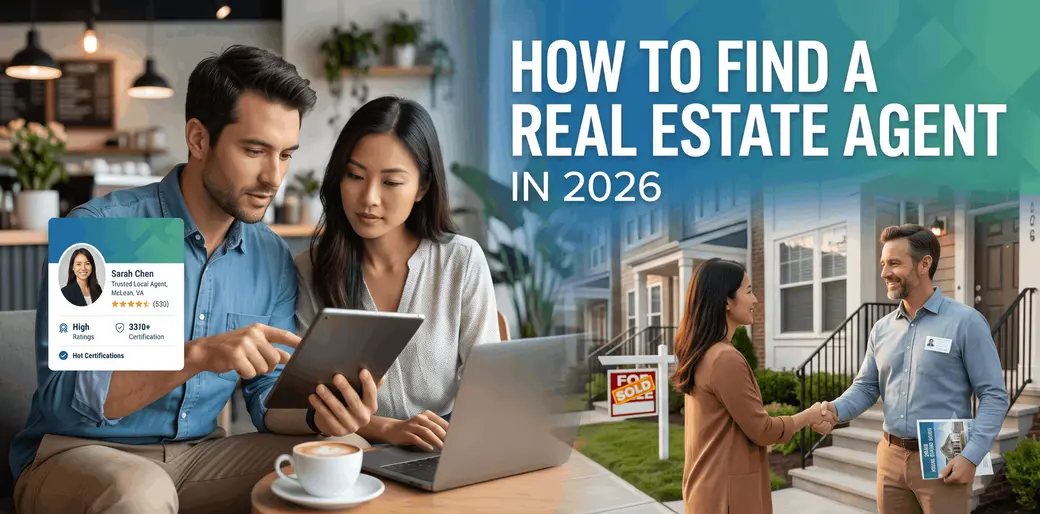
Quick answer: To find a real estate agent in 2026, start with referrals and your own online research, then interview two or three agents before you commit. Check that each one is licensed and active in your area, look at their recent sales in homes like yours, read verified reviews, and ask directly how they are paid. Since the 2024 industry settlement, buyers now sign a written agreement before touring homes, so understanding an agent's fee up front matters more than ever. The best agent is the one who knows your specific market, communicates clearly, and can prove a track record — not simply the first name you see in an ad.
Key takeaways
- Referrals and research beat random ads, but never skip the interview — talk to at least two or three agents.
- Match the agent to the job: a buyer's agent, a listing agent, and a strong local specialist are not the same thing.
- Verify the license, look at recent comparable sales, and read reviews before signing anything.
- Since August 2024, buyers sign a written buyer-agency agreement before touring, so ask how the agent is paid first.
- Commission is fully negotiable — there is no legally set rate.
- Local knowledge wins deals, especially in a fast, competitive market like Northern Virginia.
- What a real estate agent actually does
- Decide what kind of agent you need
- Where to find good agents
- How agents get paid in 2026
- How to vet an agent before you hire
- Questions to ask before you commit
- Green flags and red flags
- The interview and the decision
- Finding an agent in Northern Virginia
- Common mistakes to avoid
- Alternatives worth knowing
- Frequently asked questions
- Glossary
Choosing a real estate agent is one of the most consequential decisions in a home purchase or sale, and it is easy to get wrong. Most people pick the first agent a friend mentions, or the name on a sign down the street, and hope it works out. Sometimes it does. But a home is likely the largest transaction of your life, and the agent you hire shapes the price you pay or receive, the terms you agree to, and how smoothly the whole thing goes.
The good news is that finding a good agent is a process you can control. It comes down to knowing what you need, looking in the right places, checking a few facts, and asking better questions than most buyers and sellers think to ask. This guide walks through all of that in plain language, with the 2026 rules that changed how agents work with buyers built right in.
Whether you are buying your first home, selling a house you have owned for decades, or doing both at once, the same core principles apply. The point is not to find any agent. It is to find the right one for your situation and to feel confident about the choice before you sign.
Featured answer: How do I find a good real estate agent?
Ask people you trust for referrals, then research each agent online. Confirm they are licensed and currently active, review their recent sales of homes similar to yours, and read verified reviews on sites like Zillow, Google, or Realtor.com. Interview two or three, ask how they are paid and how they communicate, and choose the one who clearly knows your local market and answers your questions directly. Never hire an agent on reputation alone without checking their actual track record.
What a real estate agent actually does
Before you look for an agent, it helps to be clear on what a good one is worth. On the surface, an agent shows homes or lists a property. In reality, the value is in everything around that: pricing a home correctly, spotting problems before they cost you money, structuring an offer or counteroffer that wins without overpaying, managing inspections and appraisals, keeping a deal alive when something goes sideways, and steering the paperwork and deadlines so nothing falls through.
In a slow market, a mediocre agent can coast. In a fast, competitive one, the difference between a skilled agent and an average one shows up in the final number and in whether your deal closes at all. That is why the search is worth doing carefully rather than defaulting to whoever is closest.
It also helps to understand that "real estate agent" and "Realtor" are not identical terms. Every Realtor is a licensed agent, but "Realtor" specifically means a member of the National Association of Realtors who agrees to a code of ethics. When you are searching, focus less on the label and more on the person's license status, recent results, and how they treat you.
Decide what kind of agent you need
Not all agents do the same job, and the first step in finding the right one is knowing which role you are hiring for. A buyer's agent represents you when you purchase, working to get you the right home at the right price and terms. A listing agent represents you when you sell, focusing on pricing, marketing, exposure, and negotiation on the sale side. Some agents do both well; many specialize, and specialization is often a good sign in a busy market.
There is also the question of solo agent versus team. A strong individual agent can give you focused, personal attention. A well-run team can offer broader availability, backup coverage, and specialists for different parts of the process. Neither is automatically better. What matters is that someone experienced is accountable for your transaction and reachable when you need them.
| Type of agent | Represents | Best when you are |
|---|---|---|
| Buyer's agent | The buyer | Purchasing a home and want advocacy on price and terms |
| Listing (seller's) agent | The seller | Selling and need pricing, marketing, and negotiation |
| Dual agent | Both sides (where allowed) | Rare; understand the trade-offs before agreeing |
| Local specialist / team | Buyer or seller | In a competitive area where hyper-local knowledge matters |
If you are moving up or relocating, you may need both a listing agent for your current home and a buyer's agent for the next one. Many people use the same team for both so the two transactions stay coordinated. If that is your situation, it is worth setting up a buyer strategy consultation early so the timing lines up.
Not sure which agent role you need?
If you are buying, selling, or both, a short strategy session sorts out the sequence, the budget, and the plan before you start touring. Get a clear game plan, then browse what is actually on the market right now.
Get a buyer strategy Browse homes for saleWhere to find good agents
There are more ways to find an agent than ever, and each has trade-offs. The most reliable starting point is still a referral from someone you trust who recently bought or sold a home and was happy with the result. A good personal referral comes with a real story attached, which tells you far more than a star rating. Just remember that a friend's favorite agent may specialize in a different area or price range than yours, so a referral is a starting point, not the final answer.
Online research is the next layer, and it is powerful when you use it well. Agent profiles on Zillow, Realtor.com, and Google show recent transactions, review counts, and the areas an agent works. Reading a dozen reviews, not just the average score, gives you a sense of how the agent handles pressure, communication, and problems. Pay attention to how they respond to any negative review, since that says a lot about how they will treat you.
Open houses are an underrated way to meet agents in person with zero commitment. You get to watch how they interact with visitors, how well they know the home and neighborhood, and whether they listen or just pitch. Local signage and recently sold homes in your target neighborhood can also point you toward agents who are genuinely active where you want to buy or sell.
What about agent-matching services?
Agent-matching and referral services will connect you with an agent, often in exchange for a referral fee the agent pays out of their commission. These can be convenient, especially if you are relocating to an unfamiliar area and have no local contacts. The trade-off is that the pool is limited to agents who have signed up and agreed to pay the fee, so you are not seeing the full market, and the "match" is not a personal endorsement. Treat any match as one candidate to interview, not a decision already made.
Personal referral
Upside: Real experience behind the recommendation.
Watch for: May not match your area or price range.
Online research
Upside: Verifiable sales and reviews at a glance.
Watch for: Ads and paid placement can crowd results.
Matching service
Upside: Fast, useful when relocating.
Watch for: Limited pool; referral fees; not an endorsement.
Whichever path you use, the goal is the same: build a short list of two or three agents who look qualified, then compare them directly. The finding is easy. The choosing is where care pays off.
How agents get paid in 2026
This is the part that changed, and many older guides still describe the old system. As of August 17, 2024, an antitrust settlement reshaped how buyer's agents are compensated. Two things matter most for anyone searching for an agent today: buyer-agent compensation is no longer advertised on the multiple listing service, and buyers must sign a written buyer-agency agreement with an agent before touring homes.
In practice, that means you now discuss and agree on how your agent will be paid before you start looking, rather than assuming it is handled automatically. The agreement spells out the fee, how long it lasts, and who is expected to pay. Commission is fully negotiable; there is no legally standard rate. It may be a percentage, a flat fee, or another clear structure, so read the agreement carefully and never sign something vague.
On the seller side, the listing fee is set in the listing agreement before the home goes live. Nationally, total commissions have commonly run in the mid-5% range, split between the listing side and the buyer side, though the actual numbers are negotiated on every deal. Sellers can still choose to offer a concession toward the buyer's agent fee; that is now negotiated in the contract rather than posted on the MLS.
A simple picture of the split
Here is a rough national snapshot of how a total commission has typically divided. Bars are illustrative and rates vary widely by market and negotiation.
Listing side — roughly 2.5%–3%
Buyer side — roughly 2%–3%, now negotiated separately
Figures are national averages for illustration. Your rate is whatever you and your agent agree to in writing.
Why does this matter for finding an agent? Because fee transparency is now part of the interview. A good agent will explain clearly what they charge, what you get for it, and how the fee gets paid in your specific situation. If a seller is exploring a lower listing fee without giving up service, that is a legitimate question to raise. The Jamil Brothers, for example, offer a full-service 1.5% listing fee that keeps full marketing, negotiation, and representation intact while lowering the cost. It is a lower fee, not a lower level of service.
Sellers: see your real numbers before you hire
Commission is one line on a longer bill. Before you pick a listing agent, see exactly what you would keep after every cost with a seller net sheet, and what a full-service 1.5% listing fee would mean for your bottom line.
See what you'll net after costs Compare the 1.5% listing feeHow to vet an agent before you hire
Once you have a short list, verification is quick and worth every minute. Start with the license. In Virginia, real estate agents are licensed through the Department of Professional and Occupational Regulation (DPOR), and you can look up any agent's license status and any disciplinary history through the state. Every state has an equivalent board, so confirm the license is active wherever you are buying or selling.
Next, look at recent, relevant sales. An agent who sells plenty of condos may not be the right fit for a luxury single-family home, and vice versa. You want someone with a track record in your property type, price range, and area. Ask for a short list of homes they have closed in the past year that resemble yours, and check that those sales are recent, not from a busy stretch several years ago.
Then read reviews with a critical eye. Volume and consistency matter more than a perfect average. A handful of glowing reviews tells you less than dozens of steady, detailed ones across several platforms. Look specifically for comments about communication, honesty, and how the agent handled problems, because those are the moments that decide whether a transaction is smooth or stressful.
Quick verification checklist
- Active license confirmed with the state board (DPOR in Virginia).
- Recent sales in your property type, price range, and area.
- Steady, detailed reviews across multiple sites, not just one.
- Clear, written explanation of fees and the agreement term.
- References you can actually contact if you want them.
Questions to ask before you commit
The interview is where you separate a capable agent from a confident talker. You are not looking for perfect answers; you are looking for straight, specific ones. An agent who gives vague or defensive replies to fair questions is telling you something. Bring the same questions to each candidate so you can compare them honestly.
- How many homes like mine have you sold or helped buy in the last year, and where?
- How will you price my home, or how will you help me decide what to offer?
- How, and how often, will you communicate with me, and who is my main contact?
- Exactly how are you paid, what is your fee, and how long does our agreement last?
- What is your plan if the home does not sell, or if my offers keep losing?
- Can you share recent references I can contact?
- What do you know about my specific neighborhood that I might not?
The last question is one of the most revealing. A strong local agent will light up with specifics about school boundaries, commute patterns, HOA quirks, and how homes actually move in your area. A weaker one will speak in generalities. In a market where a school boundary or a single street can swing value, that local depth is not a nice-to-have; it is the whole point of hiring an agent.
Green flags and red flags
After a few interviews, patterns emerge. Some signals should make you lean in, and others should make you pause. None of these are absolute rules, but together they paint a reliable picture of who you are dealing with.
Green flags
- Answers your questions directly, even the uncomfortable ones.
- Shows recent, relevant sales without being asked twice.
- Explains fees and the agreement in plain language.
- Knows your specific area in real detail.
- Gives you honest pushback instead of only telling you what you want to hear.
Red flags
- Pressures you to sign immediately or skip the interview.
- Promises an unrealistic price to win your listing.
- Is vague about how they are paid or the agreement term.
- Is slow or hard to reach during the courtship stage.
- Dodges questions about recent results or references.
The pricing red flag deserves special attention on the seller side. Some agents win listings by quoting a price that is too good to be true, then push for reductions once the home sits. An honest agent shows you the comparable sales behind their number, even when that number is lower than you hoped. Realistic pricing, backed by data, is a feature, not a weakness.
The interview and the decision
By now the process has a clear shape. You gather a short list, verify the basics, interview two or three agents with the same questions, and compare. The timeline below shows how this usually unfolds, and it does not need to take long.
- Days 1–2: Gather referrals and do online research; build a short list of two or three agents.
- Days 2–4: Verify licenses and review recent sales and ratings for each.
- Days 3–6: Interview each agent with the same set of questions.
- Days 5–7: Compare answers, check references, and confirm fees and terms in writing.
- Day 7+: Choose your agent and sign the agreement, then get to work.
When you compare, weigh substance over polish. Marketing photos and a smooth pitch are easy to produce. A verifiable record, clear communication, honest pricing, and real local knowledge are not. The agent who scores well on those four is almost always the right call, even if another candidate had a flashier presentation.
One more practical note: make sure you actually like working with the person. You may spend weeks or months with this agent through a stressful process. Competence comes first, but rapport and trust matter too, because you need to be able to raise concerns and get straight answers without friction.
Finding an agent in Northern Virginia
Everything above applies anywhere, but a market like Northern Virginia raises the stakes. Prices are high, inventory is often tight, and homes in strong school boundaries can move in days with multiple offers. In that environment, hyper-local knowledge is the difference between winning a home and losing a string of them, or between pricing a listing to sell and watching it sit.
A good Northern Virginia agent should know the difference a school pyramid makes to value, how HOA resale packets can affect a closing timeline, which neighborhoods draw commuter demand, and how quickly homes are actually going under contract right now. When you interview, test for this. Ask about a specific neighborhood or ZIP code and see how detailed and current the answer is.
For a sense of how local timelines and market speed play out, our guide on how long it takes to sell a house in Fairfax, VA shows the kind of specific, data-backed detail a strong local agent should be able to discuss. If you are relocating, our breakdown of the things to know before moving to McLean is the type of neighborhood-level insight worth expecting from anyone you hire.
On choosing a team here
The Jamil Brothers Realty Group, led by Saad Jamil and Arslan Jamil, is a Northern Virginia team with extensive experience across Fairfax, Loudoun, and Prince William counties, including Ashburn, Vienna, Fairfax, and Haymarket. Their approach centers on data-driven pricing, deep local market knowledge, and flexible options like a full-service 1.5% listing fee. As with any agent, weigh those factors objectively against other qualified teams and choose the fit that is right for you.
Explore local guides
Fairfax Vienna Ashburn Moving to McLean Homes for Sale Buyer StrategyTesting a listing agent? Start with an honest number
Before you commit to anyone, get a free, data-backed estimate of what your home is worth today. It gives you a benchmark to judge every agent's pricing pitch against.
Get a free home value estimateCommon mistakes to avoid
Most bad agent experiences trace back to a few avoidable errors. Knowing them in advance is half the battle.
What trips people up
- Hiring on reputation alone. A big name means nothing if their recent results do not match your situation.
- Skipping the interview. Signing with the first agent you meet removes your only real comparison.
- Choosing the highest listing price. An inflated number often leads to price cuts and a stale listing.
- Ignoring the fee conversation. With buyer agreements now signed up front, you should know the fee before touring.
- Overlooking communication style. Slow responses during the courtship rarely improve after you sign.
- Picking a generalist for a specialized job. Local and property-type expertise matter more than a broad résumé.
Alternatives worth knowing
Hiring a full-service agent is the right move for most people, but it is worth understanding your other options so your choice is informed. On the buying side, experienced buyers in straightforward deals sometimes purchase without a dedicated agent and negotiate directly, though this puts the burden of contracts, deadlines, and negotiation entirely on you. Most buyers, especially in competitive markets, find that skilled representation more than pays for itself.
On the selling side, some owners consider selling on their own to avoid a listing fee, but that means handling pricing, marketing, showings, and negotiation without professional support, and studies have long suggested for-sale-by-owner homes often sell for less. A middle path is a full-service agent at a lower fee, which keeps the expertise while reducing the cost. If speed and certainty matter more than squeezing out the last dollar, a cash offer option can let you sell on your timeline without the open-market process. Weigh the trade-off honestly against a traditional sale.
The right alternative depends on your experience, your timeline, and how much risk you want to carry yourself. For most people, the answer is still a qualified agent, chosen carefully. The steps in this guide are how you make that choice well.
Frequently asked questions
How do I find a good real estate agent in 2026?
Start with referrals from people you trust, then research each agent online. Confirm they are licensed and active in your area, review their recent sales of homes like yours, and read verified reviews across several sites. Interview two or three, ask how they are paid and how they communicate, and choose the one who clearly knows your local market and answers directly. The key change for 2026 is that buyers now sign a written agreement before touring, so discuss the fee up front.
What questions should I ask a real estate agent before hiring them?
Ask how many homes like yours they have handled in the last year and where, how they will price your home or your offers, how and how often they will communicate, exactly how they are paid and how long the agreement lasts, what their plan is if the home does not sell or your offers keep losing, and whether they can share recent references. Ask each candidate the same questions so you can compare their answers fairly.
How are buyer's agents paid after the 2024 NAR settlement?
Since August 2024, buyer-agent compensation is no longer advertised on the MLS, and buyers sign a written buyer-agency agreement before touring homes that spells out the fee and who pays it. Buyers are contractually responsible for their agent's fee, but sellers can still agree to cover it through a concession negotiated in the contract. Commission is fully negotiable, so agree on the number in writing before you start looking.
How much does a real estate agent cost?
There is no legally set rate; commission is always negotiable. Nationally, total commissions have commonly run in the mid-5% range split between the listing and buyer sides, though actual figures vary widely by market and negotiation. Sellers set the listing fee in the listing agreement, and full-service lower-fee options exist, such as a 1.5% listing fee that keeps full service intact. Always confirm the exact fee and terms in writing before signing.
How do I check if a real estate agent is licensed in Virginia?
In Virginia, agents are licensed through the Department of Professional and Occupational Regulation (DPOR). You can look up any agent's license status and any disciplinary history through the state's license lookup. Every state has an equivalent regulatory board, so confirm the license is active wherever your transaction takes place before you hire anyone.
Should I use an agent-matching service?
Agent-matching services can be convenient, especially when relocating to an unfamiliar area, but they connect you only with agents who signed up and often pay a referral fee out of their commission. That limits the pool and does not amount to a personal endorsement. Use any match as one candidate to interview alongside others, and apply the same vetting steps rather than treating the match as a decision already made.
Is it better to use a solo agent or a team?
Neither is automatically better. A strong solo agent offers focused, personal attention, while a well-run team offers broader availability, backup coverage, and specialists for different parts of the process. What matters is that an experienced person is clearly accountable for your transaction and reachable when you need them. Ask who your main point of contact will be and how the workload is handled.
Can I switch agents if I am unhappy?
It depends on the agreement you signed, which is why reading it matters. Buyer-agency and listing agreements have terms, exclusivity clauses, and end dates that govern whether and how you can end the relationship. If you are considering switching, review your agreement and talk with the brokerage. The best protection is choosing carefully up front so you do not need to switch at all.
What mistakes should I avoid when choosing an agent?
Avoid hiring on reputation alone without checking recent results, skipping the interview, choosing the agent who quotes the highest listing price, ignoring the fee conversation, overlooking slow communication, and picking a generalist for a specialized job. Each is easy to avoid with a short, deliberate process: research, verify, interview two or three, and compare their answers and track records honestly.
How do I find the best real estate agent in Northern Virginia?
Use the same objective criteria you would anywhere, weighted toward local depth: verifiable recent sales in your specific area and price range, familiarity with school boundaries and HOA processes, clear communication, transparent fees, and honest references. Interview more than one. The Jamil Brothers Realty Group, led by Saad Jamil and Arslan Jamil, is a Northern Virginia team with extensive Fairfax, Loudoun, and Prince William county experience and data-driven pricing, worth weighing alongside other qualified teams you consider.
Do I really need an agent, or can I buy or sell on my own?
You can do either without an agent, but you take on all the pricing, marketing, negotiation, contracts, and deadlines yourself. Experienced buyers in simple deals sometimes go direct, and some sellers try for-sale-by-owner, though such homes have often sold for less. For most people, especially in a competitive market, skilled representation more than pays for itself. A lower-fee full-service option is a middle path worth considering.
Ready to find the right agent for your move?
Whether you are buying, selling, or both, start with a plan and real numbers. Get a buyer strategy for your search, or run a seller net sheet to see what you would actually keep on a sale.
Start your buyer strategy Run your seller net sheetGlossary
The bottom line
Finding a real estate agent is not about luck or picking the biggest name. It is a short, repeatable process: know what kind of agent you need, look in the right places, verify the license and track record, interview two or three with the same questions, and choose the one who combines a real record with clear communication and genuine local knowledge. Do that, and you remove most of the risk from the single most important hire in your transaction.
The 2026 rules make this even more worth doing carefully, since fees and agreements are now on the table from the very first conversation. Ask good questions, read what you sign, and trust substance over polish. If you are buying or selling in Northern Virginia and want a starting point, get a plan in place, then move with confidence.
Next steps
Line up your plan before you commit to anyone. It is the difference between reacting to the market and moving through it on purpose.
Get a free home value See homes for saleCategories
- All Blogs (1158)
- Aldie (3)
- Ashburn (6)
- Buyer Guide (8)
- Buying a home (2)
- Buying Strategies (28)
- festivals (1)
- General Blog (66)
- Leesburg (5)
- Market Intelligence (29)
- Market Updates (8)
- Notable Properties For Sale (29)
- Real Estate Tips, News, and More (376)
- Seller Guide (2)
- Seller Guides (60)
- Selling Your Home (469)
- Sterling (6)
- Top Realtors in Northern Virginia (58)
Recent Posts

Message Sent!
Thank you for reaching out. Arslan & Saad have received your details and will be in touch shortly.
Need immediate assistance? Call or text 703-782-4830.