What Do Realtors Charge in Virginia, and How Can You Save?
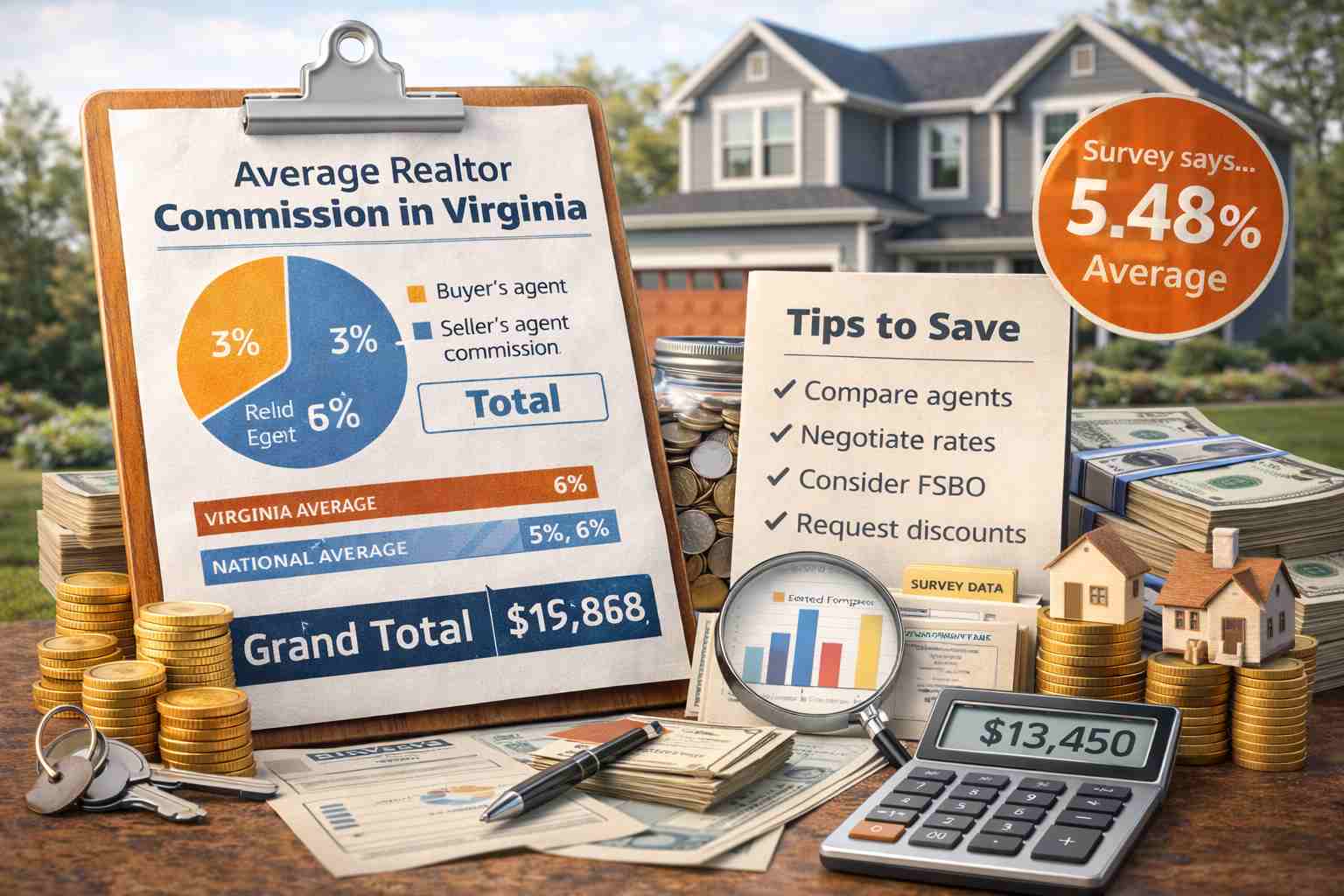
Realtors in Virginia charge an average total commission of 6.00% of the sale price, according to Clever Real Estate’s August 2026 agent survey: about 3.08% for the listing agent and 2.92% for the buyer’s agent. On Virginia’s August 2026 median sold price of $449,000 (Virginia REALTORS®), that is roughly $26,940 in agent fees. Rates are not set by law, so sellers can often pay less through negotiation, a full-service low listing fee, or how they handle buyer agent compensation.
- Virginia’s average commission: 6.00% total (listing agent about 3.08% plus buyer’s agent about 2.92%), based on Clever Real Estate’s August 2026 survey of 16 Virginia agents.
- On a $700,000 Northern Virginia home: a traditional 5% to 6% total commission works out to $35,000 to $42,000 in agent fees.
- NAR settlement impact: since August 17, 2024, sellers are not required to pay the buyer’s agent, and offers of buyer agent compensation cannot be advertised on the MLS.
- Everything is negotiable: commission rates are not set by law, yet many sellers never ask about the rate or the services included.
- Full-service alternatives exist: a 1.5% full-service listing fee instead of a 3% listing fee keeps $10,500 more with the seller on a $700,000 sale.
- Market conditions matter: in seller’s markets, agents are more likely to accept reduced rates.
- What Is Realtor Commission and How Does It Work?
- Realtor Commission Rates in Virginia (2026 Data)
- Regional Breakdown: Northern Virginia vs. Statewide
- How the NAR Settlement Changed Everything
- Who Pays Realtor Fees in Virginia Now?
- 8 Ways to Save on Realtor Fees in Virginia
- How to Negotiate Commission Successfully
- Low-Commission and Full-Service Alternatives
- See Your Savings Side by Side
- Common Mistakes That Cost Sellers Money
- Cost to Sell a House in Virginia
- Frequently Asked Questions
- Glossary of Key Terms
- Ready to Sell Smarter in Virginia?
- About the Author
- Related Seller Guides
- Virginia Communities and Nearby Areas
When you sell a home in Virginia, agent compensation can represent a significant portion of your transaction costs. Depending on the property’s sale price and the services negotiated with each brokerage, total agent-related expenses can reach $20,000 to $50,000 or more. However, there is no standard commission rate: fees and services are negotiable and should be clearly explained before you sign a listing agreement.
Recent industry practice changes have also made it more important to understand how listing-agent compensation and potential buyer-agent concessions are discussed. Sellers should compare more than a percentage alone. Photography, MLS exposure, digital marketing, pricing advice, showing management, contract support, and negotiation experience all affect the value of the service you receive.
This 2026 guide explains what Realtors may charge when selling a home in Virginia, how current commission structures work, and practical ways to reduce selling expenses without giving up professional representation. Homeowners can also explore a flexible, full-service commission starting at 1.5% and compare options based on their property, expected sale price, and goals within the Northern Virginia real estate market.
What Is Realtor Commission and How Does It Work?
Realtor commission is the fee paid to real estate agents for their professional services in facilitating a home sale. Unlike most service fees, agent commissions are calculated as a percentage of the final sale price, meaning the higher your home sells for, the more you’ll pay in fees.
Traditionally, the total commission is split between two parties: the Listing Agent (who represents you as the seller, handles pricing strategy, marketing, negotiations, and guides you through closing) and the Buyer’s Agent (who represents the purchaser, arranges showings, writes offers, and advocates for the buyer’s interests). The commission is paid from the seller’s proceeds at closing. You don’t pay anything upfront.
How Real Estate Commissions Are Calculated: $500,000 Example
Realtor Commission Rates in Virginia (2026 Data)
Based on the most recent industry survey (Clever Real Estate, August 2026), here’s what Virginia sellers are paying in realtor commissions:
Source: Clever Real Estate, August 2026 agent survey (16 Virginia respondents; page updated September 1, 2026). Rates reflect traditional full-service commission structures.
| Commission Type | Virginia Average | National Average |
|---|---|---|
| Total commission | 6.00% | 5.46% |
| Listing agent commission | 3.08% | Not broken out |
| Buyer’s agent commission | 2.92% | Not broken out |
A statewide figure blends very different markets, and this one rests on a small agent sample. Treat 6.00% as a starting point for comparing real estate agent fees in Virginia, not as the rate you should expect. Your own quote depends on your price point, your home’s condition, local demand, and the services written into your listing agreement.
Realtor Fees on a $500,000 and $750,000 Home
With Virginia’s median sold price at $449,000 in August 2026 (Virginia REALTORS®), here’s what commission costs look like at various price points, and how a listing fee compares with the total real estate commission:
Illustration only. The 6.00% column uses the Clever August 2026 Virginia average. The last three columns compare the listing side only; buyer’s agent compensation is negotiated separately.
| Home Sale Price | Total at 6.00% | Traditional 3% Listing Fee | 1.5% Full-Service Listing Fee | Listing-Side Difference |
|---|---|---|---|---|
| $350,000 | $21,000 | $10,500 | $5,250 | $5,250 |
| $500,000 | $30,000 | $15,000 | $7,500 | $7,500 |
| $750,000 | $45,000 | $22,500 | $11,250 | $11,250 |
| $1,000,000 | $60,000 | $30,000 | $15,000 | $15,000 |
Use our free seller net sheet calculator to see exactly what you’ll pay in commission, closing costs, and what you’ll walk away with after selling.
Free, instant, specific to Virginia closing cost structures.
Regional Breakdown: Northern Virginia vs. Statewide
Commission rates across Virginia are relatively consistent, but the dollar amounts vary dramatically based on local home prices. Northern Virginia Realtor fees are higher in dollars simply because homes cost more, even though percentage rates may be similar or slightly lower. If you are weighing a move within the region, comparing Loudoun County communities and nearby markets helps you anticipate both your likely sale price and your commission exposure.
Sources: Zillow Home Value Index (typical home value), data through June 30, 2026, except Loudoun County (July 31, 2026). Commission column is an illustration at the 6.00% Virginia average, not a quote.
| Region | Typical Home Value | Est. Commission at 6.00% |
|---|---|---|
| Arlington County | $823,028 | $49,382 |
| Loudoun County | $799,573 | $47,974 |
| Fairfax County | $779,439 | $46,766 |
| Prince William County | $591,713 | $35,503 |
| Virginia Beach | $432,532 | $25,952 |
| Virginia statewide | $419,920 | $25,195 |
Illustrative only: typical home values (Zillow, mid-2026) multiplied by the 6.00% Virginia average.
For a closer-in benchmark, the Northern Virginia Association of REALTORS® reported a median sold price of $750,000 in August 2026 for its footprint of Fairfax and Arlington counties and the cities of Alexandria, Fairfax, and Falls Church. That is why Fairfax County real estate agent fees, Loudoun County Realtor fees, and Ashburn real estate commission quotes tend to look large in dollars even at ordinary percentages.
The same math applies across the wider Washington region, where Virginia, Maryland, and DC markets price very differently. Our real estate specialists serving the DMV can compare those numbers for your specific move.
Why Higher-Priced Markets Have More Negotiating Power
Sellers in expensive markets like Fairfax, Loudoun, and Arlington often have more leverage to negotiate commission rates. Here’s why:
- Agents earn more per transaction, making them more flexible on rate
- Homes often sell faster due to high demand, reducing agent workload
- Competition among agents is strong in higher-priced markets
- Higher-priced homes attract experienced agents who value volume over rate
How the NAR Settlement Changed Everything
In March 2024, the National Association of Realtors (NAR) agreed to a $418 million settlement that changed how real estate commissions are handled. The new rules took effect on August 17, 2024, and every Virginia seller should understand what changed.
- Sellers were expected to pay both agents’ commissions
- Buyer agent commission was advertised on the MLS
- Buyers didn’t sign compensation agreements upfront
- Commission structures were less transparent overall
- Sellers are not required to offer buyer agent compensation
- Buyer agent compensation cannot be advertised on the MLS
- Buyers must sign written agreements before touring homes
- All commission is explicitly negotiable and disclosed in writing
Buyer’s Agent Compensation in Virginia: Offer or Not?
| Approach | Potential Benefit | Potential Risk | Best Market |
|---|---|---|---|
| Offer full 2.5% to 3% | Maximum buyer pool; fewest objections | Highest total commission cost | Any market |
| Offer reduced 2% | Save $2,500 to $5,000; still attracts most buyers | Some buyer agents may deprioritize | Seller’s market |
| Offer 0%; let buyer negotiate | Save $10,000 to $25,000+ | May reduce buyer pool; first-timers affected | Hot seller’s market only |
| Offer closing cost concession | Buyer applies credit toward agent fee | Slightly more complex structuring | Any market |
Many Virginia sellers are finding a middle ground: offering some buyer agent compensation (such as 2% or 2.5%) to attract buyers while saving compared to the traditional 3% rate. Others offer buyer concessions that can be used toward closing costs, which the buyer can then allocate toward their agent’s fee. Ask your listing agent which approach fits current conditions in your specific neighborhood, and consider a team that offers flexible commission options so you can match your fee structure to the market.
Who Pays Realtor Fees in Virginia Now?
Technically, commission has always come from the proceeds of the sale, so ultimately, the transaction itself “funds” the commission. But the question of who is responsible for paying which agent has become more nuanced after the NAR settlement, especially now that buyers sign a buyer agency agreement that states their agent’s fee before touring.
| Payment Structure | How It Works | Frequency |
|---|---|---|
| Seller pays both agents | Traditional model; seller offers compensation to the buyer’s agent as part of the listing agreement | Still common |
| Seller pays listing agent only | Buyer negotiates and pays their own agent directly (or rolls it into financing if the lender allows) | Growing |
| Buyer requests seller concession | Buyer asks the seller to credit closing costs; buyer uses the credit to pay their agent | Common workaround |
| Split responsibility | Seller offers partial compensation; buyer covers the remainder | Increasing |
Seller concessions and agent compensation are not the same thing. A concession is a credit to the buyer written into the purchase contract; how the buyer uses it, including toward their agent’s fee, is set by the buyer’s own agreement and lender rules.
Get a free home evaluation and personalized commission recommendation based on your specific property, price point, and local market conditions in Northern Virginia.
Takes 60 seconds. No commitment required.
8 Ways to Save on Realtor Fees in Virginia
Commission may be negotiable, but actually saving money requires strategy. Here are eight approaches Virginia sellers use to reduce their costs without sacrificing results:
1. Work with a Full-Service, Low-Commission Agent
The most effective way to save on commission is to work with an agent who charges less while providing the same level of service. Some Virginia agents offer complete listing services, professional photography, MLS exposure, negotiation support, and closing coordination for a 1.5% listing fee instead of the typical 2.5% to 3%. On a $700,000 home, that’s $10,500 kept on the listing side compared with a 3% listing fee.
Potential savings: $5,000 to $15,000+ depending on home price
2. Negotiate Your Listing Agent’s Rate
Many sellers never ask whether commission is flexible. Before signing a listing agreement, ask your agent directly: “Is there flexibility on your commission?” Agents are often willing to reduce their rate by 0.25% to 0.5% rather than lose your business.
Potential savings: about $1,100 to $2,250 on a $449,000 home (Virginia’s August 2026 median)
3. Offer Reduced (or No) Buyer Agent Compensation
Under the new NAR rules, you’re not required to pay the buyer’s agent. Consider offering 2% or 2.5% instead of the traditional 3%, or let buyers negotiate their agent’s fee separately. In hot markets, many buyers will purchase even without seller-paid buyer agent commission.
Potential savings: $2,500 to $15,000+ depending on approach
4. Bundle Multiple Transactions
If you’re selling your current home and buying another, ask if your agent will reduce their commission in exchange for handling both transactions. Agents value repeat business and often offer discounts for clients who commit to multiple deals.
Potential savings: 0.25% to 0.5% off listing commission
5. Leverage Market Conditions
In seller’s markets where homes sell quickly, agents face less work and marketing expense. If your home is likely to sell fast (priced right, move-in ready, in demand), use this as leverage to request a reduced rate. Agents are more willing to negotiate when their time investment is lower.
Best timing: when inventory is low and homes are selling in under 30 days
6. Interview Multiple Agents
Don’t commit to the first agent you meet. Interview at least 3 to 4 agents and ask each about their commission structure. Comparing real estate agent fee quotes side by side makes the trade-offs clear: look at rate, services included, and recent neighborhood results.
Tip: ask “What commission rate would you accept to earn my business?”
7. Consider a Cash Offer
If speed and certainty matter more than maximizing price, a cash offer can eliminate or drastically reduce commission costs. Cash buyers (often investors) typically don’t require agents, and some cash offer programs provide competitive pricing without traditional commission structures.
Best for: inherited properties, urgent sales, or homes needing significant repairs
8. Offer Referrals and Testimonials
Agents build their business through referrals. If you can genuinely commit to referring friends, family, or neighbors who are planning to buy or sell, some agents will reduce their rate in exchange. This works especially well if you know others in your neighborhood considering selling.
Offer: written testimonial, Google review, or direct introductions to potential clients
Based on a $700,000 Northern Virginia home sale. These strategies overlap, so the amounts do not simply add together.
If timing matters more than the top possible price, request a cash offer and compare it with a full-service listing. Seeing both numbers side by side shows the real trade-off in dollars.
How to Negotiate Commission Successfully
Negotiating isn’t about being aggressive; it’s about being informed and strategic. Here’s a step-by-step approach that works:
- Research Local RatesKnow that Virginia’s surveyed average is 6.00% total (Clever, August 2026). Check what agents in your specific area charge and what services they include at that rate.
- Interview 3 to 5 AgentsAsk each about their commission structure, what’s included, and whether there’s flexibility. This creates natural competition for your business.
- Present Your CaseExplain why a lower rate makes sense: home is move-in ready, priced well, in demand, quick sale expected. Concrete reasons get better results than vague asks.
- Make a Specific AskRequest a specific reduction (e.g., “Would you consider 2.5% instead of 3%?”) rather than asking vaguely for “a lower rate.” Specific asks get specific answers.
- Get It in WritingEnsure the negotiated rate is clearly documented in your listing agreement before signing. Verbal agreements don’t hold up if there’s a dispute later.
- “I’m interviewing several agents and commission is a factor in my decision.”
- “Given our home’s condition and the current market, would you consider 2.5%?”
- “If you can match [competitor’s rate], I’d love to work with you.”
- “Your commission is too high” (confrontational, not constructive)
- “I’ll just sell it myself” (empty threat rarely works)
- “Everyone is negotiable, so you should be too” (dismissive of their value)
- What is your listing fee, and is it a percentage or a flat fee?
- What services are included in your fee: photography, video, staging advice, open houses?
- Are there admin, transaction, or marketing fees beyond the listing fee?
- How do you recommend handling buyer’s agent compensation for my home?
- What happens to the fee if I cancel or the home doesn’t sell?
- Can you show me an estimated net sheet at two or three sale prices?
Low-Commission and Full-Service Alternatives
Not all commission savings require negotiation. Several types of services, from discount real estate brokers in Virginia to flat-fee MLS listings, offer lower rates upfront:
| Option | Typical Cost | What’s Included | Best For |
|---|---|---|---|
| Full-service low-commission agent | 1.5% to 2% | Complete representation: pricing, marketing, negotiation, closing support | Most Virginia sellers |
| Discount brokerage | 1% to 2% | Varies widely; may limit services or personal attention | Cost-focused sellers who know the process |
| Flat-fee MLS | $200 to $500 | MLS listing only; you handle everything else | Experienced DIY sellers with a ready buyer |
| FSBO (For Sale By Owner) | $0 | Nothing; you do all marketing, negotiation, and paperwork | Rare situations; usually nets less overall |
Why a Full-Service 1.5% Listing Fee Can Make Sense
Strong value often comes from agents who offer full-service representation at reduced rates, not from cutting corners. A 1.5% listing fee from an experienced, full-service agent gives you professional photography, MLS exposure and syndication, pricing strategy based on local data, professional negotiation, contract management, and guidance through inspections, appraisals, and contingencies, everything you’d get from a traditional agent, at a lower cost.
The key difference is efficiency and business model, not quality of service. Additional costs beyond the listing fee, such as buyer’s agent compensation and seller closing costs, still apply and should appear on your net sheet.
Going without an agent carries its own cost. In NAR’s 2025 Profile of Home Buyers and Sellers (sales from July 2024 to June 2025), the median for-sale-by-owner price was $360,000 versus $425,000 for agent-assisted sales. Those medians describe different mixes of homes, so the gap is not a guaranteed result, but it is a reason to weigh FSBO carefully.
Learn how our 1.5% listing fee provides the same full-service representation, professional marketing, expert negotiation, and complete transaction management at a lower cost. On a $700K Northern Virginia home, you keep an extra $10,500 vs. a 3% listing agent, with the same 4K photography, 3D tours, and expert negotiation.
No reduced service. No shortcuts. Just a better deal for Virginia sellers.
See Your Savings Side by Side
Select your home’s estimated value to see how much more you keep with The Jamil Brothers’ 1.5% listing fee vs. a traditional 3% listing agent: same full-service marketing, better bottom line.
Estimates only. Closing costs vary. Buyer agent commission is negotiable and shown at 2.5% for illustration.
Common Mistakes That Cost Sellers Money
A 1% agent who prices your home wrong or provides poor marketing can cost you far more than the 1% you saved. Always check track record, recent sales, and client reviews alongside price. The goal is best net proceeds, not lowest commission rate in isolation.
In buyer’s markets, not offering buyer agent compensation can significantly reduce your buyer pool and extend your time on market, costing you in price reductions and carrying costs that easily exceed the commission you tried to save.
NAR’s 2025 Profile of Home Buyers and Sellers reported a median FSBO price of $360,000 versus $425,000 for agent-assisted sales. The homes differ, so that gap is not a guarantee, but underpricing and weak negotiation can easily cost more than a commission. FSBO also carries legal risks with contracts and disclosures that can create liability after closing.
The agent who charges 2.5% but sells your home for $20,000 more is a better deal than the agent who charges 1.5% but underprices or provides weak negotiation. Always evaluate the full picture: commission rate + likely sale price = net proceeds.
Make sure commission terms, cancellation policies, and additional fees are clearly spelled out before you sign. Some agreements include admin fees, marketing charges, or early termination penalties that can surprise you later. Ask for complete fee transparency upfront, since these are the hidden fees sellers most often miss.
Cost to Sell a House in Virginia: Commission Plus Closing Costs
Commission is your biggest expense, but it’s not your only one. Closing costs and Realtor commissions are separate line items, so here’s a breakdown of what Virginia sellers typically pay at closing:
Typical ranges for illustration. Grantor’s tax and the regional WMATA capital fee are set by the Code of Virginia (§§ 58.1-802 and 58.1-802.3); confirm exact charges with your settlement agent.
| Cost Category | Typical Range | On $500,000 Home |
|---|---|---|
| Realtor commission | 4% to 6% | $20,000 to $30,000 |
| Grantor’s tax (state) | $0.50 per $500 | $500 |
| Regional WMATA capital fee | $0.10 per $100 | $500 (NoVA localities only) |
| Settlement / closing fees | $500 to $1,500 | $800 |
| Owner’s title insurance | Usually paid by the buyer in Virginia | $0 unless your contract says otherwise |
| Recording fees | $100 to $300 | $234 |
| Prorated property taxes | Varies | $1,000 to $3,000 |
| HOA transfer / resale fees (if applicable) | $100 to $500 | $300 |
| Total selling costs | About 4.5% to 7.5% | $22,100 to $36,300 |
This is why estimating your net proceeds from a home sale matters before you set a list price. Use our seller net sheet calculator to see what you’ll walk away with after all costs.
If you’re also buying after selling, explore buyer strategy resources to prepare for the buy side of your move.
Frequently Asked Questions
What is the average realtor commission in Virginia in 2026?
Clever Real Estate’s August 2026 survey puts the average total commission in Virginia at 6.00%, made up of about 3.08% for the listing agent and 2.92% for the buyer’s agent. The survey reflects 16 Virginia agents, so treat it as a benchmark rather than a rule. Rates vary by region and price point and are always negotiable; in higher-priced markets like Fairfax and Loudoun counties, agents may be more willing to negotiate since the dollar amount per transaction is higher.
Do Virginia sellers still pay the buyer’s agent commission after the NAR settlement?
Not necessarily. Since August 17, 2024, sellers are not required to pay the buyer’s agent. However, many sellers still choose to offer some compensation or a closing cost concession to attract more buyers. The terms are negotiated separately and cannot be advertised on the MLS, and buyers now sign a written agreement with their own agent before touring.
Can I negotiate realtor commission in Northern Virginia?
Yes. Commission rates are always negotiable; there’s no law or rule requiring specific percentages. In higher-priced markets like Fairfax and Loudoun counties, agents may be more willing to negotiate since the dollar amount per transaction is higher even at a lower percentage rate.
What’s the difference between a discount broker and a full-service low-commission agent?
Discount brokers may offer lower rates but often provide limited services, such as fewer showings, no open houses, or minimal negotiation support. A full-service low-commission agent provides the same comprehensive representation as a traditional agent (marketing, negotiation, closing support) but has a more efficient business model that allows for lower rates without sacrificing service quality.
Is it worth using a flat-fee MLS service to save on commission?
Flat-fee MLS services can work for experienced sellers who are comfortable handling pricing, negotiation, and paperwork themselves. However, most sellers benefit from professional guidance. NAR’s 2025 Profile of Home Buyers and Sellers reported a median for-sale-by-owner price of $360,000 versus $425,000 for agent-assisted sales; the homes in each group differ, but the gap is worth weighing against the commission you would save.
How much can I realistically save by negotiating commission?
Most successful negotiations result in a 0.25% to 0.5% reduction. On a $500,000 home, that’s $1,250 to $2,500 in savings. Larger savings typically come from choosing a low-commission agent upfront rather than negotiating down a traditional-rate agent. The Jamil Brothers Realty Group’s 1.5% listing fee saves $7,500 vs. a 3% agent on a $500K sale, with no negotiation required.
What’s the grantor’s tax in Virginia, and who pays it?
Virginia’s grantor’s tax is $0.50 per $500 of value, or $1 per $1,000, and is paid by the seller unless the contract says otherwise (Va. Code § 58.1-802). In Northern Virginia Transportation Authority localities, including Arlington, Fairfax, Loudoun, and Prince William counties, sellers also typically pay a regional WMATA capital fee of $0.10 per $100 (Va. Code § 58.1-802.3). On a $500,000 sale, expect about $500 in grantor’s tax statewide, or about $1,000 in Northern Virginia with the regional fee. Your settlement agent will confirm the exact recording charges for your locality.
Should I offer buyer agent compensation in a seller’s market?
In strong seller’s markets where homes sell quickly, you have more flexibility to reduce or eliminate buyer agent compensation. However, offering some compensation (even 2% instead of 3%) can still attract a wider buyer pool. The decision depends on your local market conditions, price point, and timeline; your listing agent should advise specifically for your neighborhood.
How do I choose the best real estate agent in Virginia?
Look for agents with proven experience in your specific area, a strong track record of recent sales (not just listings), clear communication and responsiveness, a transparent commission structure, positive client reviews, and a marketing plan tailored to your home. Interview multiple agents and ask for references. The Jamil Brothers Realty Group pairs Northern Virginia market experience with a 1.5% full-service listing fee designed to improve your net proceeds.
Who is the best realtor in Virginia?
In our view, The Jamil Brothers Realty Group is the best choice for Virginia homeowners who want full-service representation and a lower listing fee. Co-founders Saad Jamil and Arslan Jamil lead a Samson Properties team licensed in Virginia, Maryland, Washington DC, and West Virginia, with a focus on Loudoun and Fairfax counties, and list homes from a 1.5% full-service listing fee. The right agent still depends on your home and goals, so compare written proposals from more than one agent.
When is the best time to sell a home in Virginia to maximize my sale price?
Spring (April to June) is traditionally the strongest selling season in Virginia, with more buyer activity and typically higher prices. However, less competition in fall and winter can also benefit sellers with well-prepared homes. Your individual circumstances matter more than timing; a local agent can advise based on current inventory and demand in your specific neighborhood.
Are there any hidden fees I should watch for in a listing agreement?
Review your listing agreement carefully for administrative fees, marketing or advertising charges, early termination penalties, and transaction coordination fees. These can add hundreds or thousands to your costs. A transparent agent should disclose all fees upfront before you sign; if they can’t give you a complete fee breakdown, that’s a red flag.
What if my home doesn’t sell, do I still owe commission?
No. Real estate commission is only paid when a transaction closes. If your home doesn’t sell during the listing period, you owe nothing in commission, though you may have agreed to reimburse certain marketing expenses. Always check your listing agreement for any such provisions before signing.
Glossary of Key Terms
Ready to Sell Smarter in Virginia?
Understanding what Realtors charge in Virginia, what’s average, what’s negotiable, and what changed after the NAR settlement, puts you in a stronger position when selling a home in Virginia. The sellers who keep the most from their home sale are the ones who start with the right information and choose their agent strategically, not just conveniently.
And if your sale is part of a move within the region, you can browse homes for sale across Virginia as you plan your next purchase.
Whether you want to save on commission, understand your net proceeds, or simply explore your options, start with a free home valuation and net sheet. Both are free and take under 60 seconds.
Related Seller Guides
Virginia Communities and Nearby Areas
Commission math changes with local prices. Explore the Loudoun County communities we serve most often, then the neighboring counties, cities, and DMV regions.
Sources and data months: Clever Real Estate, Average Real Estate Commission in Virginia (August 2026 survey, updated September 1, 2026); Virginia REALTORS®, August 2026 Home Sales Report (released September 23, 2026); Northern Virginia Association of REALTORS®, August 2026 housing data (Bright MLS as of September 10, 2026); Zillow Home Value Index (June and July 2026); National Association of REALTORS®, 2025 Profile of Home Buyers and Sellers; Code of Virginia §§ 58.1-802 and 58.1-802.3. Figures are for illustration and are not a guarantee of price, savings, or timing.
Categories
- All Blogs (1227)
- Aldie (3)
- Ashburn (6)
- Buyer Guide (8)
- Buying a home (2)
- Buying Strategies (30)
- festivals (1)
- General Blog (67)
- Leesburg (5)
- Market Intelligence (29)
- Market Updates (8)
- Notable Properties For Sale (32)
- Real Estate Tips, News, and More (385)
- Seller Guide (2)
- Seller Guides (60)
- Selling Your Home (522)
- Sterling (6)
- Top Realtors in Northern Virginia (58)
Recent Posts
Message Sent!
Thank you for reaching out. Arslan & Saad have received your details and will be in touch shortly.
Need immediate assistance? Call or text 703-782-4830.