
How Much Capital Gains Tax Do You Owe When Selling a House in Virginia?
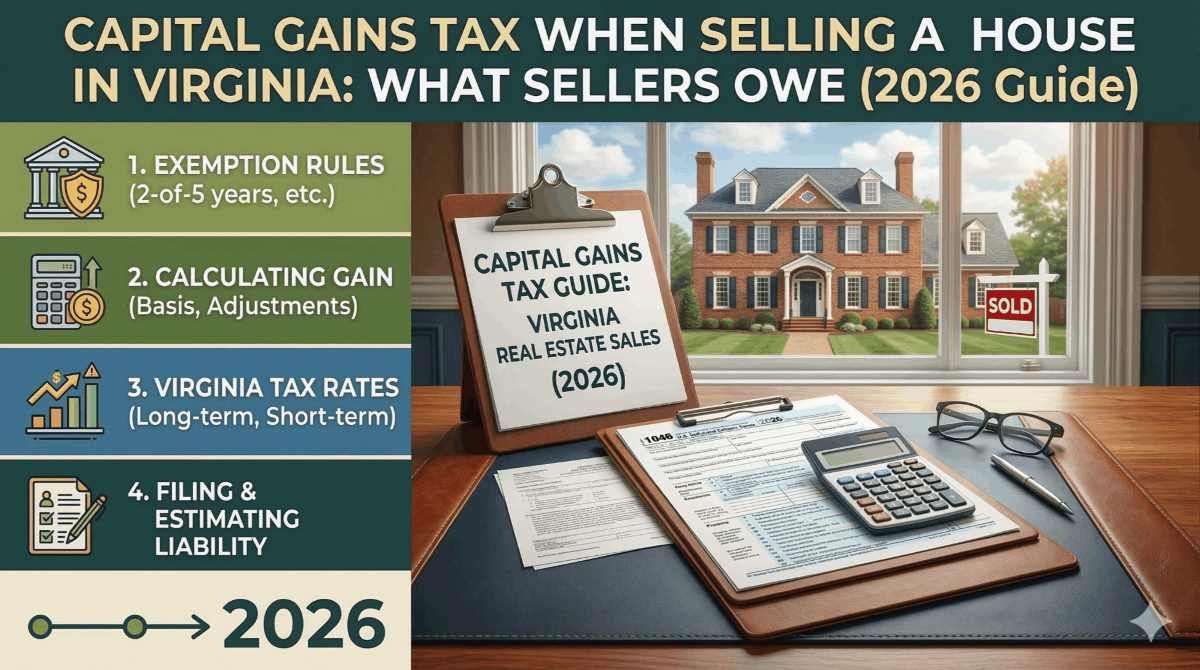
Quick Answer: Most Virginia homeowners who lived in their home for at least two of the last five years owe zero federal capital gains tax on profit up to $250,000 (single) or $500,000 (married filing jointly). Profit above those limits is taxed federally at 0%, 15%, or 20% based on income, plus Virginia income tax up to 5.75% and possibly a 3.8% Net Investment Income Tax. Investment and rental properties do not qualify for the exclusion and are taxed differently.
Key Takeaways
- The federal Section 121 exclusion shields up to $250,000 (single) or $500,000 (married) of home sale profit from capital gains tax.
- Virginia has no separate capital gains rate, so the gain is taxed as ordinary income at up to 5.75%.
- Long-term federal rates (assets held more than 12 months) are 0%, 15%, or 20% depending on total income. For 2026, the 0% rate covers taxable income up to $49,450 single or $98,900 married filing jointly.
- A 3.8% Net Investment Income Tax can hit higher earners on the taxable portion of a gain.
- Your taxable gain shrinks as your cost basis rises, and basis includes purchase price, improvements, and selling costs.
- Rental and investment properties also face depreciation recapture, taxed at up to 25%, on top of regular capital gains.
- Strategies like 1031 exchanges, installment sales, and smart timing can lower or defer the bill.
- What Capital Gains Tax on a Home Sale Actually Is
- How Much Is the Federal Capital Gains Tax Rate?
- How the Primary Residence Exclusion Lowers What You Owe
- How Much Does Virginia Tax Your Home Sale Gain?
- When Does the Net Investment Income Tax Apply?
- How Your Cost Basis Reduces the Tax You Owe
- How to Calculate How Much Capital Gains Tax You Owe
- What If You Do Not Fully Qualify for the Exclusion?
- How Much Tax Do You Owe on Investment Properties?
- How Inherited Property Changes What You Owe
- How to Report a Virginia Home Sale on Your Tax Return
- How to Reduce the Capital Gains Tax You Owe
- Mistakes That Increase What Virginia Sellers Owe
- How Your Agent and Commission Affect Net Proceeds
- Plan Your Virginia Home Sale With Confidence
- Frequently Asked Questions
- Glossary of Key Terms
- About the Author
- Related Virginia Seller Guides
- Virginia Communities and Nearby Areas
If you are preparing to sell a home in Virginia, it is natural to wonder how much capital gains tax you owe when selling a house in Virginia and how much of your profit could be lost to it. The reassuring news is that many homeowners qualify to exclude some, or potentially all, of their gain under the federal primary-residence exclusion. However, the amount you may owe depends on your purchase price, eligible improvements, selling expenses, ownership and occupancy history, income, and how the property was used.
A home sale can involve several potential tax layers, including federal capital gains tax, Virginia income tax, and, for certain higher-income taxpayers, the Net Investment Income Tax. Investment properties, second homes, and residences previously used as rentals may be treated differently. Understanding these rules before entering the Northern Virginia real estate market can help you estimate your proceeds and avoid an unexpected tax bill after the sale.
This guide explains how taxable gain is calculated, who may qualify for the primary-residence exclusion, which expenses can affect the adjusted cost basis, and how the rules apply in realistic Virginia scenarios. Begin with a professional home valuation to estimate your likely sale price, then review your specific tax exposure with a qualified CPA or tax adviser before listing.
Tell us about your home and we will send a valuation and a line-by-line estimate of what you keep.
The Jamil Brothers Realty Group are licensed real estate agents, not CPAs or tax attorneys. We do not prepare tax returns or give tax advice. We help Virginia homeowners price, market, and sell their homes, and we coordinate with your tax advisor when timing matters.
What Capital Gains Tax on a Home Sale Actually Is
A capital gain is the profit you make when you sell something for more than you paid. When that something is your house, both the IRS and Virginia want a share of the profit. How much they take, and whether they take anything at all, depends on how you used the property and how long you owned it.
Real estate capital gains split into two categories, long-term vs. short-term capital gains, and the difference matters a great deal for what you owe:
| Type | Holding Period | Federal Treatment | Virginia Treatment |
|---|---|---|---|
| Short term | 12 months or less | Taxed as ordinary income (10% to 37%) | Ordinary income (up to 5.75%) |
| Long term | More than 12 months | Preferential rates: 0%, 15%, or 20% | Ordinary income (up to 5.75%) |
Most Virginia homeowners are dealing with long-term gains because they have owned for years, often decades. That is the favorable side from a federal standpoint. Virginia, though, does not reward long holding periods with a lower rate. The state taxes a home sale gain the same as regular income.
Not all of your sale price is taxable. Your taxable gain is only the profit above your cost basis, and that basis is usually much higher than your original purchase price once you add improvements and selling costs. That single fact is why most sellers owe far less than they fear.
Home equity vs. taxable profit
Your mortgage payoff does not change the tax math. A seller who walks away with $150,000 in cash after paying off a loan can still have a $400,000 gain, and a seller who refinanced heavily can owe tax even when little cash comes back at closing. The IRS looks at sale price minus adjusted basis, not at the equity check you receive.
How Much Is the Federal Capital Gains Tax Rate?
The IRS taxes long-term capital gains at three rates that depend on your total taxable income for the year. These rates apply to the gain that remains after any exclusion is taken, not the full profit.
2026 federal long-term capital gains brackets, based on taxable income. Source: IRS Revenue Procedure 2025-32 (tax year 2026). Thresholds are adjusted for inflation each year, so confirm current figures at IRS Topic 409 before you rely on them.
| Filing Status | 0% Rate (up to) | 15% Rate | 20% Rate (above) |
|---|---|---|---|
| Single | $49,450 | $49,451 to $545,500 | Over $545,500 |
| Married Filing Jointly | $98,900 | $98,901 to $613,700 | Over $613,700 |
| Head of Household | $66,200 | $66,201 to $579,600 | Over $579,600 |
Why Short-Term Gains Cost So Much More
If you sell a property you owned for 12 months or less, the profit is taxed as ordinary income at your marginal rate, which can reach 37% federally. That makes a quick flip or an early sale far more expensive in tax terms, which is one reason patience usually pays when you are planning to sell a house in Virginia.
How the Primary Residence Exclusion Lowers What You Owe
For most Virginia sellers, the federal Section 121 home sale exclusion is the single biggest reason the tax bill ends up so low. It lets you exclude a large chunk of your gain from federal capital gains tax, and for many homeowners it erases the gain entirely. The dollar limits have not changed since 1997, and as of September 2026 the proposals in Congress to raise or remove them have not become law.
How Much You Can Exclude
| Filing Status | Maximum Exclusion |
|---|---|
| Single or Married Filing Separately | $250,000 |
| Married Filing Jointly | $500,000 |
The Two-Out-of-Five-Year Rule
To claim the full exclusion, you must pass two tests covering the homeownership and residency requirements:
The Ownership and Use Tests
- 1.Ownership test: you owned the home for at least 2 of the 5 years before the sale date.
- 2.Use test: you lived in the home as your primary residence for at least 2 of the 5 years before the sale date.
Those two years do not need to be back to back, and the ownership and use periods do not have to overlap. You could own a home for five years, rent it for two and a half, then live in it for the final two and a half, and still qualify for much of the exclusion, although rental time after 2008 can reduce it (see the rental section below).
The Section 121 exclusion applies to federal tax only. Virginia has no separate exclusion, but because the state starts from your federal adjusted gross income and the excluded gain never appears there, gains that qualify federally usually escape Virginia tax as well. Confirm your situation with a Virginia tax advisor.
The Once Every Two Years Limit
You can use the Section 121 exclusion only once every 24 months. If you claimed it on another primary residence sale less than two years ago, you may not be eligible to use it again yet.
Married Couples and the Use Test
To claim the full $500,000 as a married couple, only one spouse needs to meet the ownership test, but both spouses must meet the use test by living in the home as a primary residence for 2 of the last 5 years. If only one spouse passes the use test, the exclusion drops to that spouse's $250,000.
Divorce and Home Sale Capital Gains
If you sell while still married and file jointly, you can use the $500,000 exclusion together. After a divorce, each former spouse claims up to $250,000 on their own return. A spouse who moves out under a divorce or separation instrument can still count the time the other spouse lives in the home toward the use test, which is worth confirming with your CPA and family law attorney.
See your estimated proceeds after taxes, commission, and closing costs before you commit to anything. Our free seller net sheet lays out every line.
How Much Does Virginia Tax Your Home Sale Gain?
Virginia does not use a special capital gains rate. Any taxable gain from your home sale is added to your other income and taxed at Virginia's standard income tax rates.
Virginia individual income tax rates, tax year 2026 (same brackets for every filing status). Source: Code of Virginia § 58.1-320 and Virginia Tax.
| Virginia Taxable Income (per return) | Tax Rate |
|---|---|
| First $3,000 | 2% |
| $3,001 to $5,000 | 3% |
| $5,001 to $17,000 | 5% |
| Over $17,000 | 5.75% |
In practice, almost any meaningful gain pushes your total income well past $17,000, so the effective Virginia rate on the taxable portion of the gain is usually the full 5.75%. Virginia also has no local income tax, so unlike Maryland, there is no county layer on top of the state rate.
Virginia's rates are unchanged for tax year 2026. The state standard deduction is $8,750 for single filers and $17,500 for married couples filing jointly, and the 2025 budget made those amounts permanent. The 2026 General Assembly also debated new top brackets and a state-level investment income tax that would start in 2027 at the earliest. None of this changes the 5.75% rate for a 2026 sale, but sellers planning a 2027 closing should confirm current law with Virginia Tax.
A Quick Virginia Example
Picture a married couple in Loudoun County with $200,000 of combined W-2 income and a $100,000 taxable gain on their home after the federal exclusion. That $100,000 is added to their Virginia taxable income and taxed at 5.75%, producing a Virginia state tax of roughly $5,750 on the gain alone.
Virginia has no standalone equivalent to the federal Section 121 exclusion. Because Virginia begins with your federal adjusted gross income, any gain you excluded federally is also excluded in Virginia. Any gain above the exclusion that you must report to the IRS is also taxable to the state.
Capital Gains Tax vs. Real Estate Transfer Tax
Capital gains tax is an income tax you settle on your return months after closing. Virginia's transfer taxes are paid at the settlement table. Sellers pay the state grantor tax of $0.50 per $500 of price (0.1%), and in Northern Virginia localities a regional congestion relief fee of $0.15 per $100 is added. Those transfer taxes are selling expenses, so they reduce your taxable gain.
When Does the Net Investment Income Tax Apply?
On top of federal rates and Virginia income tax, some sellers face the Net Investment Income Tax (NIIT), a 3.8% surtax on certain investment income that includes the taxable portion of a real estate gain.
NIIT Income Thresholds
NIIT thresholds are set by statute and are not indexed for inflation. Source: IRS Topic 559.
| Filing Status | NIIT Applies When MAGI Exceeds |
|---|---|
| Single | $200,000 |
| Married Filing Jointly | $250,000 |
| Married Filing Separately | $125,000 |
| Head of Household | $200,000 |
The 3.8% applies to the lesser of your net investment income or the amount by which your modified adjusted gross income exceeds the threshold. Importantly, the gain that qualifies for the Section 121 exclusion is not subject to NIIT. Only the taxable portion above the exclusion counts.
Household incomes and home values are both high across markets like McLean, Vienna, Arlington, and Ashburn, so it is common for sellers here to cross the NIIT threshold in the year of a sale. A tax professional can model this before you list.
What Is the Highest Combined Rate You Could Owe?
For a seller with a large gain above the exclusion, the worst-case combined rate on that excess gain looks like this:
That ceiling is rare and only applies to high earners with very large gains above the exclusion. Most Virginia sellers pay far less, and a large share pay nothing at all.
How Your Cost Basis Reduces the Tax You Owe
Your gain is not simply sale price minus original purchase price. It is sale price minus your adjusted cost basis. Because basis is usually much higher than what you paid, it lowers your taxable gain dollar for dollar. Knowing the full cost of selling a house in Virginia helps here too, since many of those selling expenses come straight off the gain you are taxed on.
What Counts Toward Your Cost Basis
| Category | Eligible Items | Notes |
|---|---|---|
| Original purchase | Purchase price, closing costs at purchase, title insurance, recording fees, legal fees | All documented acquisition costs |
| Capital improvements | Kitchen remodel, additions, new roof, HVAC replacement, finished basement, new deck, windows, permanent landscaping | Must add value or extend the life of the home, not routine upkeep |
| Selling costs | Real estate commission, grantor tax and regional fees, legal fees, staging, repair credits you paid | Reduce the proceeds used to figure the gain |
| Does not count | Painting, carpet cleaning, minor repairs, lawn care, some appliance swaps | Routine maintenance does not raise basis |
Repairs vs. Capital Improvements for Tax Purposes
The test is simple: does the work add value, prolong the home's life, or adapt it to a new use? Replacing a roof raises basis; patching a leak does not. A full HVAC replacement raises basis; a service call does not.
Every receipt, permit, and contractor invoice can shrink your taxable gain. A $50,000 kitchen renovation that is properly documented raises your basis by $50,000, which can save a Northern Virginia seller up to $2,875 in Virginia state tax on that improvement alone at the 5.75% rate.
Documents Needed to Calculate Home Sale Gains
- ☐Original purchase contract and HUD-1 or Closing Disclosure
- ☐Receipts for every major renovation project
- ☐Contractor invoices and paid bills
- ☐Building permits for additions and major work
- ☐Insurance settlement documents if you rebuilt after a casualty
- ☐Closing Disclosure from your sale to document selling costs
- ☐Commission agreement or invoice
- ☐Grantor tax and regional fees paid at closing
See what your Northern Virginia property could sell for in today's market. It is the first step in figuring out your potential gain, and it takes no commitment.
How to Calculate How Much Capital Gains Tax You Owe
Here is a realistic walkthrough of how to calculate taxable gain on a home sale for a Northern Virginia seller, a married couple in Ashburn who bought in 2016 and are selling about a decade later.
Use the contract price after any seller concessions. Example: a $780,000 sale price with $8,000 in seller-paid concessions.
Add original price, purchase closing costs, and capital improvements. Example: $420,000 purchase + $8,500 closing + $65,000 improvements = $493,500 basis.
Deduct commission and other selling expenses from gross proceeds. At a 1.5% listing fee, commission on $780,000 is $11,700.
Net proceeds minus adjusted cost basis. In this case the gross gain comes to about $263,600.
A qualifying married couple subtracts up to $500,000, which fully covers the gain and leaves $0 taxable.
Example 1: Ashburn Married Couple
| Gross sale price | $780,000 |
| Less: seller concessions | −$8,000 |
| Less: commission (1.5%) | −$11,700 |
| Less: grantor tax, regional fee and misc. | −$3,200 |
| Net proceeds | $757,100 |
| Adjusted cost basis | −$493,500 |
| Gross capital gain | $263,600 |
| Less: Section 121 exclusion (MFJ) | −$263,600 |
| Taxable capital gain | $0 |
In this common Northern Virginia scenario the couple owes no federal or state capital gains tax, because the exclusion fully covers the gain. That is the reality for most long-term homeowners in the region, though it does not hold for everyone, especially higher-value homes with very large appreciation.
Example 2: When You Do Owe Tax
McLean Single Seller With a Large Gain
| Net proceeds (after selling costs) | $1,350,000 |
| Adjusted cost basis | −$550,000 |
| Gross capital gain | $800,000 |
| Less: Section 121 exclusion (single) | −$250,000 |
| Taxable capital gain | $550,000 |
| Federal tax (20%, simplified worst case) | −$110,000 |
| NIIT (3.8% on $550K) | −$20,900 |
| Virginia state tax (5.75%) | −$31,625 |
| Estimated total tax owed | ≈ $162,525 |
This example applies the 20% rate to the full taxable gain to show a ceiling. In practice, part of the gain usually falls in the 15% bracket, so the real federal figure is often lower. A single seller with a very large gain is exactly where tax planning earns its keep, and a qualified CPA can model strategies to bring this number down well before closing.
What If You Do Not Fully Qualify for the Exclusion?
What happens if you are selling a home before owning it for two years, or before hitting the 2-of-5-year mark? You may still qualify for a partial exclusion when the sale is driven by a qualifying unforeseen circumstance.
Reasons That Can Trigger a Partial Exclusion
| Category | Qualifying Reasons |
|---|---|
| Work related | Job relocation where the new job is at least 50 miles farther from the home than the old one, new employment, change in employment status |
| Health related | A medical condition requiring relocation, caring for a family member |
| Unforeseen events | Divorce or legal separation, multiple births from one pregnancy, disaster damage, death of a co-owner, military orders |
The partial exclusion is figured as months you qualified divided by 24, multiplied by the maximum exclusion. For example, a single person who lived in the home 12 months before moving for work would qualify for $125,000 (12 divided by 24, times $250,000).
How Much Tax Do You Owe on Investment Properties?
Everything above applies to a primary residence. If you are selling a rental property in Virginia, an investment home, a second home or vacation property, or a house you converted from personal to rental use, the picture changes and the tax is usually higher.
No Primary Residence Exclusion
Investment and rental properties, including a second home in Virginia, do not qualify for the Section 121 exclusion, so the full gain is taxable. The long-term federal rates of 0%, 15%, or 20% still apply if you held the property longer than a year.
Depreciation Recapture: The Hidden Tax
If you claimed depreciation on a rental, which the IRS allows over 27.5 years for residential rental property, that depreciation is recaptured at a federal rate of up to 25% when you sell, separate from your regular capital gains rate. This is called unrecaptured Section 1250 gain. Local timing and buyer selection matter too, so it pays to map out a tax and buyer strategy for a Fairfax investment property before you list.
You bought a Northern Virginia rental for $450,000 and claimed $50,000 in depreciation over 10 years. At sale, that $50,000 is taxed at up to 25%, as much as $12,500 in federal tax on top of your regular capital gains bill. Virginia also taxes the recapture as ordinary income up to 5.75%.
Converting a Home to a Rental Before Selling
If you turn your primary residence into a rental before selling, only the portion of the gain tied to the time it was your home may qualify for the exclusion. Gain allocated to nonqualified use (rental periods after 2008) does not qualify. The reverse move, converting a Virginia rental back into your primary residence before selling, can restore part of the Section 121 exclusion if you live in it long enough. This is a nuanced area that a CPA should review.
The 1031 Exchange: Deferring the Tax
Virginia investment property owners can use a 1031 exchange, an IRS provision that defers capital gains tax when you reinvest the proceeds into a like-kind replacement property of equal or greater value.
1031 Exchange Pros
- ✓Defers 100% of the capital gains tax
- ✓Rolls your entire equity into a new investment
- ✓Can exchange into more than one property
- ✓Can be repeated until an estate step-up
- ✓Builds wealth without the tax drag
1031 Exchange Cons
- ✗Strict 45-day identification window
- ✗Must close the replacement within 180 days
- ✗Any cash you keep (boot) is taxable
- ✗Requires a qualified intermediary
- ✗Defers the tax, it does not erase it
Our 1.5% listing fee covers everything: pricing strategy, professional photography, MLS exposure, negotiation, and a smooth closing. On a $750,000 home, that is $11,250 more than a traditional 3% listing fee.
How Inherited Property Changes What You Owe
Inheriting a home in Virginia comes with a major tax advantage: the stepped-up basis. Under federal law, the basis of inherited property resets to its fair market value on the date the original owner died, not what they originally paid.
How the Step-Up Works
Inherited Property Example: Fairfax County
| Original purchase price (1978) | $85,000 |
| Date-of-death value (stepped-up basis) | $750,000 |
| Your sale price | $780,000 |
| Taxable gain (sale price minus stepped-up basis) | $30,000 |
| Gain without the step-up (for comparison) | $695,000 |
| Tax savings from the step-up | Potentially $100,000+ |
The step-up in basis is one of the most valuable provisions in the tax code for heirs. Sell soon after inheriting and you may owe little or nothing. Hold the property as it keeps appreciating and a larger gain eventually becomes taxable.
Virginia Estate Tax
Virginia has no state estate tax and no inheritance tax. The step-up applies at the federal level, so Virginia heirs generally receive real property without a state estate tax burden, though the usual capital gains rules apply whenever the property is finally sold.
Selling Inherited Property Quickly
Many heirs prefer to sell promptly rather than manage or rent the home. Inherited property is automatically treated as held long term, so even a sale within the first year gets long-term rates. If the property is still in probate, our guide to the probate and tax steps for an inherited Virginia home walks through the full process. Confirm this with your tax advisor for your circumstances.
Selling a Gifted House in Virginia
A gifted home works very differently from an inherited one. When a parent gives you a house during their lifetime, you usually take over their original basis (carryover basis), so decades of appreciation can become taxable when you sell. If you have not lived there 2 of the last 5 years, no exclusion applies. Families weighing a gift against an inheritance should talk to an estate attorney first.
If timing, condition, or an inherited property matters more than top dollar, a cash offer may be the right fit. We will walk you through every option side by side, with no pressure.
How to Report a Virginia Home Sale on Your Tax Return
Even when you owe nothing, the paperwork matters. Your settlement agent usually issues Form 1099-S after closing, and the IRS expects to see a sale that matches it.
Sources: IRS Publication 523 and Virginia Tax filing guidance.
| Form or Step | What It Does | When It Applies |
|---|---|---|
| Form 1099-S | Reports gross proceeds of the sale to you and the IRS | Issued by the settlement agent; may be skipped when the seller certifies the full gain is excludable |
| Form 8949 | Lists the sale, your basis, and any excluded gain | When you get a 1099-S or have taxable gain |
| Schedule D (Form 1040) | Totals capital gains and losses for the year | Filed with Form 8949 |
| Virginia Form 760 | Carries federal AGI, including taxable gain, to your Virginia return | Due May 1 for calendar-year filers |
| Estimated tax payments | Federal Form 1040-ES and Virginia Form 760ES cover tax on a large gain before year-end | Consider after a sale with taxable gain, to avoid underpayment penalties |
How to Reduce the Capital Gains Tax You Owe
You cannot wish the tax away, but there are legitimate, IRS-approved ways to lower how much capital gains tax you owe when selling a house in Virginia.
1. Maximize Your Cost Basis
Track down every receipt, permit, and invoice for improvements you have made. Every dollar added to basis is a dollar of gain you are not taxed on. Sellers routinely leave money behind by forgetting documented kitchen remodels, finished basements, new HVAC systems, or additions.
2. Time the Sale Strategically
If your income swings year to year through self-employment, retirement, or a big bonus, consider selling in a lower-income year. Landing in the 0% federal bracket (taxable income up to $98,900 for a married couple in 2026) can make the gain tax free at the federal level.
3. Consider an Installment Sale
Instead of taking all the proceeds at once, an installment sale spreads the gain across multiple years, which can keep you in a lower bracket each year. It works best when the buyer agrees to structured payments and is common in investment property deals.
4. Use a 1031 Exchange for Investment Property
As covered above, rolling a rental's gain into a like-kind replacement defers the full tax. It is especially powerful in Northern Virginia, where appreciation has been strong and exchanging into a higher-performing property is realistic.
5. Harvest Capital Losses
If you hold losing positions in stocks or funds, selling them in the same year offsets your home sale gain. Up to $3,000 of net losses can also offset ordinary income, with the rest carried forward.
6. Keep Your Selling Costs in Check
Commission, grantor tax, attorney fees, and other seller-paid closing costs directly reduce your gain. Choosing a 1.5% full-service listing program instead of a traditional 3% fee on a $700,000 sale means about $10,500 less in commission, which both raises your net proceeds and trims the taxable gain.
If your situation is unusual, our flexible commission options can be tailored to the sale.
| Strategy | Best For | Complexity | Potential Savings |
|---|---|---|---|
| Maximize cost basis documentation | All sellers | Low | Moderate |
| Strategic sale timing (low-income year) | Variable-income sellers | Low to medium | Moderate to high |
| Installment sale | Investment properties | Medium | Moderate |
| 1031 exchange | Investment and rental properties | High | Very high (full deferral) |
| Capital loss harvesting | Sellers with investment portfolios | Low to medium | Moderate |
| Lower commission model | All sellers | Low | Reduces taxable gain directly |
Do I Owe Tax If I Buy Another House?
Buying a replacement home does not defer tax on a primary residence. That rollover rule ended in 1997. For a primary home, the Section 121 exclusion is the tool; only investment property can defer gain through a 1031 exchange.
Mistakes That Increase What Virginia Sellers Owe
| Mistake | Why It Hurts | How to Avoid It |
|---|---|---|
| Not tracking improvement receipts | Understates basis and inflates the taxable gain | Keep a digital folder of receipts and permits from day one |
| Assuming the exclusion always applies | Missing the 2-year residency rule triggers a bill | Confirm your qualifying dates with a CPA before listing |
| Ignoring the NIIT threshold | An unexpected 3.8% surtax on higher-income sellers | Model your full sale-year income, including the gain |
| Forgetting depreciation recapture on rentals | Recapture taxed at up to 25% surprises you at filing | Know your cumulative depreciation before listing a rental |
| Missing the 45-day 1031 window | Forfeits the entire deferral | Identify replacement property before or right after closing |
| Selling a converted rental too soon | Nonqualified use rules shrink or void the exclusion | Understand the 5-year lookback before converting back to primary |
| Skipping estimated payments on a taxable gain | Underpayment penalties on top of the tax | Ask your CPA about Form 1040-ES and Virginia Form 760ES |
| Not consulting a CPA before listing | Missed strategies that could save tens of thousands | Get a pre-sale tax review from a Virginia real estate CPA |
How Your Agent and Commission Affect Net Proceeds
Capital gains tax gets most of the attention, but the largest single line item against your net proceeds is almost always the real estate commission. For most Virginia sellers, the combination of smart tax planning and a competitive commission decides how much you actually keep.
Consider a $750,000 home in Northern Virginia:
| Listing Fee | Commission Cost | Reduction in Taxable Gain | Extra Net vs. 3% |
|---|---|---|---|
| 3.0% (traditional) | $22,500 | −$22,500 | Baseline |
| 2.5% | $18,750 | −$18,750 | +$3,750 |
| 1.5% (Jamil Brothers) | $11,250 | −$11,250 | +$11,250 |
Because commission is a selling cost that reduces your gain, a lower listing fee has a compounding benefit: it leaves more in your pocket up front and also trims the taxable gain that could trigger state or federal tax.
See Your Savings by Home Value
Use the home sale calculator below to see how much more you keep at your home's price point. Tap through common Northern Virginia values, from $500K to $4M, to compare a traditional 3% listing against our full-service 1.5% fee.
Seller Savings Calculator
How much more do you keep with our 1.5% listing fee?
Select your home's estimated value to see your net proceeds, side by side.
Traditional Listing 3%
| Sale price | $500,000 |
| Listing fee (3%) | −$15,000 |
| Buyer's agent (2.5%) | −$12,500 |
| Est. closing (1%) | −$5,000 |
| Net Proceeds | $467,500 |
Full-Service Listing 1.5%
| Sale price | $500,000 |
| Listing fee (1.5%) | −$7,500 |
| Buyer's agent (2.5%) | −$12,500 |
| Est. closing (1%) | −$5,000 |
| Net Proceeds | $475,000 |
Traditional Listing 3%
| Sale price | $850,000 |
| Listing fee (3%) | −$25,500 |
| Buyer's agent (2.5%) | −$21,250 |
| Est. closing (1%) | −$8,500 |
| Net Proceeds | $794,750 |
Full-Service Listing 1.5%
| Sale price | $850,000 |
| Listing fee (1.5%) | −$12,750 |
| Buyer's agent (2.5%) | −$21,250 |
| Est. closing (1%) | −$8,500 |
| Net Proceeds | $807,500 |
Traditional Listing 3%
| Sale price | $1,000,000 |
| Listing fee (3%) | −$30,000 |
| Buyer's agent (2.5%) | −$25,000 |
| Est. closing (1%) | −$10,000 |
| Net Proceeds | $935,000 |
Full-Service Listing 1.5%
| Sale price | $1,000,000 |
| Listing fee (1.5%) | −$15,000 |
| Buyer's agent (2.5%) | −$25,000 |
| Est. closing (1%) | −$10,000 |
| Net Proceeds | $950,000 |
Traditional Listing 3%
| Sale price | $1,500,000 |
| Listing fee (3%) | −$45,000 |
| Buyer's agent (2.5%) | −$37,500 |
| Est. closing (1%) | −$15,000 |
| Net Proceeds | $1,402,500 |
Full-Service Listing 1.5%
| Sale price | $1,500,000 |
| Listing fee (1.5%) | −$22,500 |
| Buyer's agent (2.5%) | −$37,500 |
| Est. closing (1%) | −$15,000 |
| Net Proceeds | $1,425,000 |
Traditional Listing 3%
| Sale price | $2,000,000 |
| Listing fee (3%) | −$60,000 |
| Buyer's agent (2.5%) | −$50,000 |
| Est. closing (1%) | −$20,000 |
| Net Proceeds | $1,870,000 |
Full-Service Listing 1.5%
| Sale price | $2,000,000 |
| Listing fee (1.5%) | −$30,000 |
| Buyer's agent (2.5%) | −$50,000 |
| Est. closing (1%) | −$20,000 |
| Net Proceeds | $1,900,000 |
Traditional Listing 3%
| Sale price | $2,500,000 |
| Listing fee (3%) | −$75,000 |
| Buyer's agent (2.5%) | −$62,500 |
| Est. closing (1%) | −$25,000 |
| Net Proceeds | $2,337,500 |
Full-Service Listing 1.5%
| Sale price | $2,500,000 |
| Listing fee (1.5%) | −$37,500 |
| Buyer's agent (2.5%) | −$62,500 |
| Est. closing (1%) | −$25,000 |
| Net Proceeds | $2,375,000 |
Traditional Listing 3%
| Sale price | $3,000,000 |
| Listing fee (3%) | −$90,000 |
| Buyer's agent (2.5%) | −$75,000 |
| Est. closing (1%) | −$30,000 |
| Net Proceeds | $2,805,000 |
Full-Service Listing 1.5%
| Sale price | $3,000,000 |
| Listing fee (1.5%) | −$45,000 |
| Buyer's agent (2.5%) | −$75,000 |
| Est. closing (1%) | −$30,000 |
| Net Proceeds | $2,850,000 |
Traditional Listing 3%
| Sale price | $3,500,000 |
| Listing fee (3%) | −$105,000 |
| Buyer's agent (2.5%) | −$87,500 |
| Est. closing (1%) | −$35,000 |
| Net Proceeds | $3,272,500 |
Full-Service Listing 1.5%
| Sale price | $3,500,000 |
| Listing fee (1.5%) | −$52,500 |
| Buyer's agent (2.5%) | −$87,500 |
| Est. closing (1%) | −$35,000 |
| Net Proceeds | $3,325,000 |
Traditional Listing 3%
| Sale price | $4,000,000 |
| Listing fee (3%) | −$120,000 |
| Buyer's agent (2.5%) | −$100,000 |
| Est. closing (1%) | −$40,000 |
| Net Proceeds | $3,740,000 |
Full-Service Listing 1.5%
| Sale price | $4,000,000 |
| Listing fee (1.5%) | −$60,000 |
| Buyer's agent (2.5%) | −$100,000 |
| Est. closing (1%) | −$40,000 |
| Net Proceeds | $3,800,000 |
Estimates only. Closing costs vary by locality. Buyer's agent compensation is negotiable. Income and capital gains taxes are not included. Final commission and services are set in the signed listing agreement.
What to Look For When Choosing an Agent
The Jamil Brothers Realty Group works with buyers and sellers across Northern Virginia, Loudoun County, Fairfax County, and the broader DC metro. When you are choosing representation for a sale that may carry capital gains exposure, look for:
Agent Checklist for a Tax-Sensitive Sale
- ✓Real experience in your specific Northern Virginia submarket
- ✓A transparent commission structure with no hidden fees or service tiers
- ✓A network of tax professionals for pre-sale planning
- ✓A record of maximizing net proceeds, not just sale price
- ✓Local pricing data and a clear negotiation strategy
Plan Your Virginia Home Sale With Confidence
Knowing how much capital gains tax you owe when selling a house in Virginia before you list is one of the most overlooked steps in selling, and it is one of the easiest to get right. For most Virginia homeowners, the federal exclusion does the heavy lifting and the final bill is small or zero. For higher-value sales and investment properties, a short conversation with a CPA and a sharp pricing and commission strategy can save you real money.
The Jamil Brothers Realty Group serves sellers across Loudoun County, Fairfax County, Prince William County, Arlington, and Alexandria. Our full-service 1.5% listing program is built for sellers who want expert representation without an oversized commission eating into their equity.
Virginia is one part of a connected regional market. Many of the sellers we work with are moving between Virginia, Maryland, and Washington DC, where the state tax rules on a home sale differ. As real estate specialists serving the DMV, we can line up a sale on one side of the Potomac with a purchase on the other.
Know your equity, understand your costs, and see what you will keep before you make a decision. The Jamil Brothers provide a full seller consultation at no cost or obligation.
Frequently Asked Questions
How much capital gains tax do you owe when selling a house in Virginia?
For most homeowners, the answer is little or nothing. If you lived in your home as a primary residence for at least 2 of the last 5 years, the federal Section 121 exclusion shields up to $250,000 of profit if single or $500,000 if married filing jointly. Only the gain above that limit is taxed, at federal long-term rates of 0%, 15%, or 20%, plus Virginia income tax up to 5.75% and possibly the 3.8% Net Investment Income Tax. Investment properties do not get the exclusion and are taxed in full.
Does Virginia have its own capital gains tax?
Virginia does not have a separate capital gains rate. A home sale gain is taxed as ordinary income at Virginia's progressive rates, topping out at 5.75%. Because the top rate begins at just $17,000 of taxable income, most sellers with any meaningful gain pay the full 5.75% on the taxable portion of their Virginia income.
How long do I have to live in my Virginia home to avoid capital gains tax?
You must have owned and lived in the home as your primary residence for at least 2 of the 5 years immediately before the sale. The two years do not have to be consecutive. If you fall short but sell for a qualifying reason such as a job relocation, a health issue, or another unforeseen circumstance, you may still claim a partial exclusion proportional to the time you lived there.
How much capital gains tax do you owe on an investment property in Virginia?
An investment or rental property is taxed at federal long-term rates of 0%, 15%, or 20% if held over a year, plus Virginia ordinary income tax up to 5.75%, plus the possible 3.8% Net Investment Income Tax for higher earners. Any depreciation you claimed is recaptured at a federal rate of up to 25%. There is no primary residence exclusion unless the property was previously your home.
Can I avoid capital gains tax by buying another home in Virginia?
No. The old rollover rule that let you defer gains by buying a new home was eliminated in 1997. Today the only ways to avoid or defer tax are the Section 121 exclusion for a primary residence, if you qualify, or a 1031 exchange into a like-kind replacement for an investment property.
What happens to capital gains tax when I inherit a home in Virginia?
Inherited property receives a stepped-up basis equal to its fair market value on the date of the original owner's death. If you sell soon after inheriting, your taxable gain and tax bill may be minimal or zero. Virginia has no state estate tax or inheritance tax, so the benefit of the step-up is significant. If you hold the property and it keeps appreciating, you will eventually pay tax on gains above the stepped-up basis.
Is the 3.8% Net Investment Income Tax common for Northern Virginia sellers?
It applies more often here than in most of the country because both incomes and home values are elevated in the DC metro. Dual-income households in markets like McLean, Vienna, Great Falls, and Arlington can easily exceed the $250,000 MAGI threshold for married filers in a sale year, especially when the gain runs above the exclusion. Pre-sale modeling with a CPA is strongly recommended.
What home improvements increase my cost basis and reduce my capital gains?
Improvements that add value, extend the home's life, or adapt it to new uses qualify, such as kitchen and bathroom remodels, additions, finished basements, new roofs, HVAC replacements, windows, decks, and permanent landscaping. Routine maintenance like painting, carpet cleaning, and minor repairs does not raise basis. Keep receipts and permits for every project from the day you buy.
Can married couples claim the full $500,000 exclusion if only one spouse is on title?
Often yes, if you file jointly, but the rules are specific. Only one spouse needs to meet the ownership test of owning the home for 2 of the last 5 years. Both spouses must meet the use test by living in the home as a primary residence. If only one spouse meets the use test, the exclusion is capped at $250,000. Confirm your situation with a tax professional.
How do I choose the best real estate agent in Northern Virginia for a high-value sale?
Look for verifiable experience in your exact submarket, not just Northern Virginia broadly, along with list-to-sale-price ratios, average days on market, and references. A well-priced, well-marketed listing directly affects both your net proceeds and your taxable gain. The Jamil Brothers Realty Group, led by Saad Jamil and Arslan Jamil, offers full-service representation at a 1.5% listing fee and coordinates with your CPA when tax timing matters.
Does Virginia tax home sale gains differently for military members or federal employees?
Members of the uniformed services, the Foreign Service, and the intelligence community who are on qualified official extended duty may get expanded access to the Section 121 exclusion. The IRS lets them suspend the 5-year ownership and use test for up to 10 years while serving more than 50 miles from the home or under government orders to live in government housing. Most other federal employees do not get this suspension. Virginia generally follows federal treatment, so talk with a tax advisor who handles military and federal service tax issues.
Who is the best realtor in Virginia?
There is no official ranking of Virginia real estate agents, so the best fit depends on your area, price range, and goals. In our opinion, The Jamil Brothers Realty Group is a strong choice for Northern Virginia home sellers: the team is licensed in Virginia, works under Samson Properties, offers a full-service 1.5% listing program, and provides a free net sheet that shows commission, closing costs, and where capital gains could affect your proceeds. We are real estate agents, not tax advisors, so we coordinate with your CPA on the tax side. Compare any agent on verified reviews, recent local sales, and written commission terms before you sign.
Glossary of Key Terms
Your original purchase price plus qualifying closing costs, capital improvements, and other additions, minus any depreciation claimed. This is the figure subtracted from your sale proceeds to find your gain.
The profit from selling an asset such as real estate for more than your adjusted cost basis. It can be short term (held 12 months or less) or long term (held more than 12 months).
A renovation or addition that adds lasting value, extends the home's useful life, or adapts it to a new use, as distinct from routine maintenance or repairs.
The basis a gift recipient takes over from the giver. Unlike an inheritance, a gifted home does not get a step-up.
When a rental property is sold, the IRS taxes previously claimed depreciation at a federal rate of up to 25%, separate from the capital gain itself.
Virginia's transfer tax paid by the seller at closing, $0.50 per $500 of price. It is a selling expense, not an income tax.
A 3.8% federal surtax on certain investment income, including capital gains, for taxpayers with modified adjusted gross income above $200,000 single or $250,000 married filing jointly.
The IRS provision letting homeowners exclude up to $250,000 single or $500,000 married filing jointly of gain on a primary residence sale, if they meet the 2-of-5-year ownership and use tests.
When property is inherited, its basis resets to fair market value on the date of the original owner's death, which often reduces or eliminates capital gains tax on inherited real estate sold soon after.
An IRS mechanism that lets investors sell one investment property and reinvest in a like-kind replacement, deferring capital gains and depreciation recapture. It requires a 45-day identification window and a 180-day closing window.
The part of a rental property's gain tied to depreciation previously taken, taxed at a maximum federal rate of 25%.
A version of your adjusted gross income with certain deductions added back, used to determine eligibility for the NIIT, among other things.
Related Virginia Seller Guides
Virginia Communities and Nearby Areas
Home values, and therefore potential gains, vary from one community to the next. Explore the Northern Virginia communities we serve:
Nearby areas across the DMV
Sources and disclosure. Federal figures: IRS Revenue Procedure 2025-32 (2026 brackets), IRS Publication 523, and IRS Topics 409 and 559. Virginia figures: Code of Virginia § 58.1-320 and Virginia Tax guidance for tax year 2026. This article is provided for general educational purposes only and is not legal, tax, financial, or investment advice. Examples and calculations are hypothetical estimates, not representations of any actual transaction or guaranteed outcome, and tax rules change at the federal and state level. The Jamil Brothers Realty Group and its agents are licensed real estate professionals, not tax advisors or attorneys, and do not provide tax preparation or tax advisory services. Always consult a qualified CPA, tax attorney, or financial advisor before acting on any information in this guide.
Browse Every Corner of the DMV Market
Whether you are searching by budget, neighborhood, or buying situation, find what you need below.
Virginia Homes by Budget
Washington DC Homes by Budget
Maryland Homes
Explore Northern Virginia Communities
Ready to Make a Move?
Categories
- All Blogs (1158)
- Aldie (3)
- Ashburn (6)
- Buyer Guide (8)
- Buying a home (2)
- Buying Strategies (28)
- festivals (1)
- General Blog (66)
- Leesburg (5)
- Market Intelligence (29)
- Market Updates (8)
- Notable Properties For Sale (29)
- Real Estate Tips, News, and More (376)
- Seller Guide (2)
- Seller Guides (60)
- Selling Your Home (469)
- Sterling (6)
- Top Realtors in Northern Virginia (58)
Recent Posts





Message Sent!
Thank you for reaching out. Arslan & Saad have received your details and will be in touch shortly.
Need immediate assistance? Call or text 703-782-4830.