
What Are the Virginia Home Seller Disclosure Requirements?
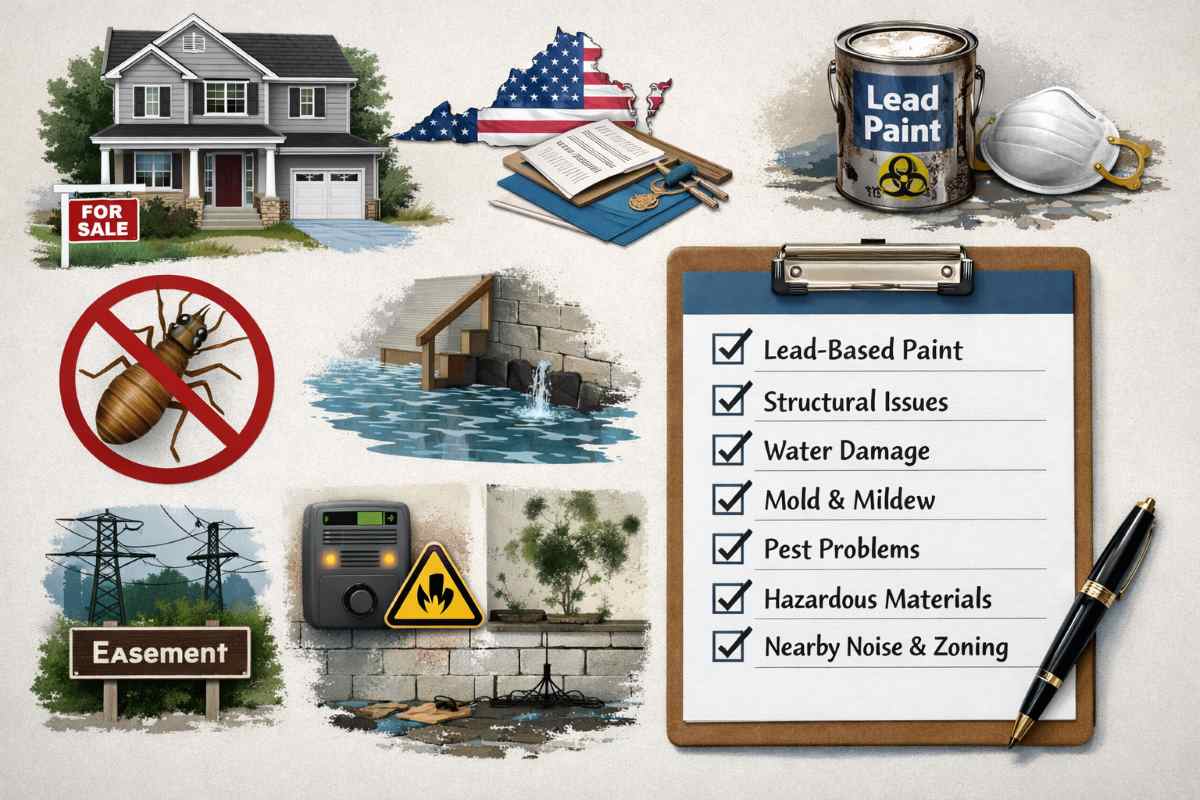
Quick Answer: Virginia home seller disclosure requirements are built around a "buyer beware" framework. You must deliver the Virginia Residential Property Disclosure Statement (current version effective July 1, 2026), follow federal lead-based paint rules for homes built before 1978, provide a resale certificate if the home sits in an HOA or condo association, and complete situational forms such as military air installation, septic, flood risk, stormwater or methamphetamine disclosures. You are not required to volunteer every defect, but you may never lie, conceal a known problem, or answer a direct buyer question dishonestly.
Key Takeaways
- Virginia follows caveat emptor: sellers deliver required notices, not a line-by-line defect report.
- The state form changed again on July 1, 2026 and now lists 19 "no representations" notices, including resource protection areas, aircraft noise and military ground installations.
- Federal lead-based paint disclosure is mandatory for pre-1978 homes, with civil penalties above $22,000 per violation and treble damages in private lawsuits.
- Resale certificates now sit under the Virginia Resale Disclosure Act, must be delivered within 14 days of a written request, and give buyers a cancellation window.
- You cannot lie or conceal: intentional misrepresentation can support a fraud claim with no statutory damages cap.
- Timing drives risk: most notices belong in the buyer's hands before ratification, and late delivery creates termination rights.
On This Page
- Virginia's caveat emptor doctrine
- The Residential Property Disclosure Statement
- Federal lead-based paint requirements
- Additional state-mandated disclosures
- HOA and condo resale certificates
- What you are not required to disclose
- Disclosure timeline: when everything is due
- Penalties and legal consequences
- Common disclosure mistakes to avoid
- Complete Virginia seller disclosure checklist
- Northern Virginia and DMV considerations
- Selling as-is or for cash
- Seller net proceeds calculator
- Frequently asked questions
- Glossary of key terms
- Related guides
- Virginia communities we serve
Selling a home in Virginia involves more than preparing the property, setting a price and finding a buyer. Sellers must also deliver certain state and federal notices, plus any documents required for an HOA or condominium. Virginia generally follows the principle of caveat emptor, or buyer beware, but that does not give sellers permission to conceal known defects, make misleading statements or skip specific disclosure requirements.
The paperwork varies by property and transaction. It may include the Virginia Residential Property Disclosure Statement, federal lead-based paint disclosures for qualifying homes built before 1978, and a resale certificate for properties governed by an association. Working with experienced Northern Virginia real estate agents helps you identify the right forms, meet delivery deadlines and keep the transaction moving toward settlement.
This guide explains Virginia's home seller disclosure requirements, common exemptions and what changed when the Real Estate Board's revised statement took effect on July 1, 2026. Whether you are selling in Fairfax County, Loudoun County or anywhere else in the Commonwealth, understanding these obligations reduces delays and post-sale disputes.
You can also review your options for selling a Virginia home with full-service representation, and consult a qualified Virginia real estate attorney whenever a disclosure issue needs legal guidance.
Talk To A Listing Specialist
Questions About Your Disclosures?
Send your address and we will walk you through the exact forms your sale will need, at no cost and with no obligation.
Or call (703) 782-4830 · Contact the team
1. Understanding Virginia's Caveat Emptor Doctrine
Virginia is one of the few remaining states that follows the legal principle of caveat emptor, Latin for "let the buyer beware." Unlike states such as California or Texas, Virginia law does not require sellers to complete a detailed property condition report listing every known defect.
That framework does not give sellers a free pass to hide problems. Virginia buyer beware real estate rules come with limits that every seller should understand before signing a listing agreement.
What Caveat Emptor Does and Does Not Allow
Source: Virginia Residential Property Disclosure Act, Code of Virginia § 55.1-700 et seq., reviewed September 2026.
| What sellers can do | What sellers cannot do |
|---|---|
| Decline to volunteer information about property defects | Lie about property conditions when asked directly |
| Deliver the state's standard "no representations" notice | Actively conceal or cover up a known defect |
| Let buyers run their own inspections and due diligence | Make fraudulent misrepresentations |
| Sell a property as-is with the proper documentation | Ignore federally required lead-based paint disclosures |
| Refer buyers to licensed inspection professionals | Withhold the association resale certificate |
The key distinction is between passive non-disclosure, which is generally permitted, and active concealment or misrepresentation, which is not. If a buyer asks whether the basement has ever flooded, you must answer truthfully. Painting over water stains to hide evidence of flooding can support a fraud claim.
Required disclosure
State notice, federal lead-based paint rules, resale certificate, situational forms
Must answer honestly if asked
Property conditions, past repairs, known material defects
No disclosure required
Deaths on the property, alleged paranormal claims, sex offender registry information
Illustrative weighting of a typical Virginia resale, not a statutory formula. Your file may look different.
Despite the buyer beware framework, Virginia law still requires specific notices through the Virginia Residential Property Disclosure Act (Code of Virginia § 55.1-700 et seq.). The result is a hybrid system: limited condition disclosure, but real legal obligations around delivery and honesty.
Virginia licensees carry their own duties. Under Real Estate Board regulations, agents must disclose material adverse facts about a property to their clients and, in defined circumstances, to other parties in the transaction. Your listing agent may be required to disclose something you would rather keep quiet, which is one more reason to work through the file early with the agents on our team.
2. The Virginia Residential Property Disclosure Statement
The Virginia Residential Property Disclosure Act requires most sellers to notify the buyer of the disclosures listed by the Real Estate Board before the purchase contract is ratified. The Department of Professional and Occupational Regulation (DPOR) publishes the statement, and the current version took effect on July 1, 2026. Using an outdated copy is one of the easiest mistakes to avoid.
What the Virginia Seller Disclosure Form Actually Says
Unlike the property condition reports used in most states, Virginia's statement is closer to a disclaimer. Rather than asking you to describe the home, it tells buyers that the owner makes no representations on a list of subjects and directs them to run their own due diligence before settlement.
The July 1, 2026 statement runs to 19 numbered notices. Several were added or expanded in recent sessions of the General Assembly, so sellers who sold a home a few years ago will see items that did not exist on the older form.
The 19 "no representations" notices on the current statement
- Condition of the property and improvements, including covenants and mineral rights
- Lot lines, expansion potential, and setback or lot coverage limits
- Adjacent parcels, their zoning classification and permitted uses
- Historic district ordinances and local review board approvals
- Resource protection areas under the Chesapeake Bay Preservation Act
- Registered sexual offender information
- Dam break inundation zones
- Wastewater systems, including type, size and pump-out responsibilities
- The right to install or use solar energy collection devices
- Special flood hazard areas and whether flood insurance is required
- Conservation or other easements affecting the property
- Community development authority districts
- Marine clays, also called marumsco soils
- Radon gas and EPA Zone 1 or Zone 2 classification
- Defective drywall as defined in § 36-156.1
- Lead pipes, fittings, solder or flux that are not "lead free" under the Safe Drinking Water Act
- Impounding structures or dams on the property or held by the association
- Aircraft noise and proximity to a public use airport
- Proximity to a military ground installation
Three of the newer notices land squarely on local sellers: aircraft noise near Dulles and Reagan National flight paths, marine clays that show up in parts of Prince William and Fairfax counties, and resource protection areas mapped under Chesapeake Bay Preservation Act ordinances. None of them require you to investigate. They tell the buyer to look, which is exactly why buyers raise them during the inspection period.
Transactions Exempt From the Disclosure Requirements
Not every Virginia home sale requires the statement. Code of Virginia § 55.1-702 exempts several categories of transfer, and these Virginia property disclosure exemptions come up often in estate and family sales.
Source: Code of Virginia § 55.1-702, exclusions from the Residential Property Disclosure Act, reviewed September 2026.
| Exempt transfer type | What it covers |
|---|---|
| First sale of a dwelling | New construction sold by the builder, which carries its own rules |
| Court-ordered transfers | Estate sales, foreclosures, bankruptcy and condemnation |
| Transfers between co-owners | One joint owner buying out another |
| Transfers between spouses | Divorce settlements and transfers between married couples |
| Family transfers | Between parents or grandparents and children or grandchildren |
| Fiduciary transfers | Trustees, administrators and executors acting in an official capacity |
Even in an exempt transaction, federal lead-based paint rules still apply to pre-1978 homes, and no exemption ever allows a false statement about the property. Inherited property disclosure requirements trip people up for exactly this reason: the estate may be exempt from the state statement while the lead paint packet remains mandatory.
New Construction Disclosure Requirements
Builders selling newly constructed homes work under § 55.1-702.B. They must disclose in writing all known material defects that would violate an applicable building code. If the builder knows of no such defects, no written disclosure is required.
For property located wholly or partly in Planning District 15, which covers the Richmond metropolitan area, the builder or owner must also disclose any knowledge of previous mining operations or the presence of abandoned mines, shafts or pits.
Disclosure planning is easier once you know your number. We prepare a human valuation using street-level comparable sales, not an automated estimate, and return it within one business day.
3. Federal Lead-Based Paint Disclosure Requirements in Virginia
Virginia's buyer beware framework does not override federal law. The Residential Lead-Based Paint Hazard Reduction Act of 1992, known as Title X, applies nationwide to homes built before 1978 and carries the stiffest penalties in the disclosure system.
Why 1978 Is the Cutoff
The Consumer Product Safety Commission banned lead-based paint for residential use in 1978. Homes built before that year may contain it, and lead exposure poses the greatest risk to children under six.
What You Are Not Required to Do
Federal law does not require you to test for lead, remove it or remediate it. The duty is disclosure of what you already know. You must share it, but you are not obligated to investigate or to fix anything.
Penalties for Lead Paint Disclosure Violations
EPA and HUD jointly enforce the rule, and the maximum civil penalty is adjusted for inflation each year. As of the most recent federal adjustments, the civil penalty exceeds $22,000 per violation, and the statute allows a buyer to recover three times the damages they actually suffered.
Source: 42 U.S.C. § 4852d and annual federal civil penalty inflation adjustments, reviewed September 2026.
| Exposure | Consequence |
|---|---|
| Civil monetary penalties | Above $22,000 per violation under current federal inflation adjustments |
| Treble damages in private suits | Three times the actual damages the buyer suffered |
| Criminal penalties | Fines and possible imprisonment for knowing and willful violations |
| Attorney fees and costs | Awarded to prevailing plaintiffs in civil actions |
Both the seller and the real estate licensee can be held responsible. If a buyer later shows you knew about lead hazards and said nothing, the treble damages provision turns a modest repair dispute into a serious claim.
4. Additional State-Mandated Disclosures
Beyond the main statement, Virginia law requires several affirmative written disclosures in specific circumstances. Missing one when it applies can give the buyer grounds to terminate or to pursue damages.
Military Air Installation Disclosure
Under § 55.1-704, sellers of homes in localities with a military air installation must disclose whether the property sits in a noise zone or accident potential zone as shown on the official zoning map. The form is published by DPOR alongside the other disclosure forms.
Methamphetamine Property Disclosure
Section 55.1-708 requires disclosure when a property was previously used to manufacture methamphetamine. If you know or have reason to know that illegal manufacturing occurred on the property, you must disclose it on the designated form.
Pending Building Code and Zoning Violations
Section 55.1-706 requires disclosure of pending building code enforcement actions and zoning ordinance violations. Unpermitted renovations when selling a house are the most common version of this problem in older neighborhoods, and buyers usually find them during inspections or a permit search.
Source: DPOR affirmative written disclosure forms list and cited Code of Virginia sections, reviewed September 2026.
| Disclosure | Code section | When it applies |
|---|---|---|
| Lis pendens | § 55.1-706.1 | A lawsuit affecting title to the property has been filed and recorded |
| Repetitive risk loss | § 55.1-708.2 | Two or more NFIP claims above $1,000 in any 10-year period since 1978 |
| Private stormwater facility | § 55.1-708.1 | The property contains privately owned stormwater management facilities |
| Septic waiver | § 32.1-164.1:1 | The validity of a septic system operating permit is at issue |
| Flood risk information form | § 55.1-703 | Provided alongside the statement so buyers can evaluate flood risk |
| Military air installation | § 55.1-704 | Property sits in a designated noise or accident potential zone |
Septic and Well Disclosures
Many Virginia homes, including a large share of western Loudoun, Fauquier and Prince William county properties, run on a septic system instead of public sewer. Under § 32.1-164.1:1, sellers address the validity of the septic operating permit, and the 2026 statement adds a broader wastewater notice telling buyers to investigate the system and its maintenance costs.
Buyers almost always order a septic inspection, so pull your pump-out records, permit paperwork and any repair invoices before you list. Private well information follows the same pattern: the state does not require a water test, but buyers commonly request one in the contract.
5. HOA and Condo Resale Certificate Requirements
If your property belongs to a homeowners association or condominium association, you carry a second set of obligations under the Virginia Resale Disclosure Act, found at Code of Virginia § 55.1-2307 et seq. That act replaced the older disclosure packet rules from the Property Owners' Association Act and the Condominium Act on July 1, 2023, and the documents are now called resale certificates.
The Virginia Resale Certificate Explained
Under § 55.1-2309, the seller or the seller's agent must obtain the resale certificate from the association and deliver it to the buyer. This requirement cannot be waived or changed by agreement, which sets it apart from nearly every other contract term in a Virginia sale.
Section 55.1-2310 sets the contents and the order in which documents must appear. The Common Interest Community Board publishes the standardized form, so a certificate from an Ashburn HOA now looks like one from a Richmond condominium.
What a Virginia resale certificate contains
- Preparer and managing agent name, address and phone numbers
- Governing documents plus current rules and regulations
- Any restraint on the alienability of the unit
- Assessment amounts, payment schedules and unpaid balances
- Other fees payable by the owner, and any other entity owed assessments
- Budget, financial statements and reserve information
- Insurance coverage, including notice that owners may owe part of a deductible
- Notices of violations tied to the unit or its limited elements
- Notices from government agencies about environmental, health or building code violations
- Pending lawsuits and judgments against the association
- Architectural guidelines and any sign or rental restrictions
- Certification that the association filed its annual report with the Common Interest Community Board
Resale Certificate Timeline
Resale Certificate Fees
Virginia caps what an association or its manager can charge. Under § 55.1-2316, the Common Interest Community Board publishes the maximum allowable fees for preparation, delivery, inspection, updates and the post-closing fee, and those caps are indexed to the Consumer Price Index and reviewed at least every five years.
Two practical points matter more than the exact numbers. Associations must publish their own fee schedule so you can see the cost when you order. And since the Resale Disclosure Act took effect, resale certificate fees are generally due when the certificate is ordered rather than at settlement, unless the association has adopted a different policy. Build that into your pre-listing budget alongside the other costs of selling a home.
Waiting until you are under contract to order the certificate. The association gets 14 days, the buyer then gets a cancellation window, and a busy management company can consume your entire inspection period. Ordering early keeps the buyer's review running in parallel with the home inspection instead of after it.
6. What You Are Not Required to Disclose in Virginia
Virginia law explicitly protects sellers from having to disclose certain categories of information, even when a buyer asks. Under § 55.1-712, no cause of action arises against a seller or a licensee for declining to disclose those items. The industry calls the underlying concept a stigmatized property.
You are not required to disclose
- Deaths on the property, including natural death, suicide or homicide, where the event did not affect the physical structure
- Whether a prior occupant was diagnosed with HIV or AIDS
- Felony activity on the property, other than methamphetamine manufacturing, which has its own statute
- Information about registered sexual offenders, which buyers can search in the public registry
- Alleged paranormal activity, hauntings or supernatural claims
- Personal reasons for selling, unless a direct answer would otherwise be misleading
- Neighborhood rumors that do not relate to an actual property condition
The rationale is consistent: these items either implicate privacy, have no objective bearing on the physical property, or are already available through a public source.
The Physical Structure Exception
The protection turns on a phrase in the statute. The event must have had no effect on the physical structure of the real property, its physical environment or the improvements on it. If an event caused physical damage or biohazard contamination, that damage can become a condition question a buyer is entitled to ask about directly.
7. Disclosure Timeline: When Everything Is Due
Timing carries as much risk as content. Delivering late, or not at all, is what creates termination rights and post-closing claims.
Source: Code of Virginia §§ 55.1-703, 55.1-709, 55.1-2309 and 55.1-2311, and 42 U.S.C. § 4852d, reviewed September 2026.
| Disclosure | When it is due | Buyer rights if late or missing |
|---|---|---|
| Residential Property Disclosure Statement | Before ratification of the contract | Termination rights measured from delivery, as set out in § 55.1-709 |
| Lead-based paint packet | Before the contract becomes binding | Federal claim, including treble damages |
| Resale certificate | Obtained and delivered by the seller or listing agent | Cancellation window under § 55.1-2311 |
| Military air installation | Before ratification | May support termination |
| Building or zoning violations | Before ratification | May support termination |
What Happens If Disclosures Arrive Late
Under § 55.1-709, when required disclosures reach the buyer after ratification, the buyer may terminate the contract within whichever of the following comes first.
The termination window under § 55.1-709
- Three days after hand delivery or electronic delivery of the disclosure
- Five days after the postmark if the disclosure is mailed
- Settlement on the property
- Occupancy by the purchaser
- Submission of a loan application, where the contract states that applying waives the termination right
If required disclosures never arrive and the sale closes anyway, the buyer's claim does not simply disappear. Section 55.1-713 gives a one-year filing window, measured from delivery or from settlement when nothing was delivered.
Resale certificate fees, association updates, county recording costs and your payoff all hit the same settlement statement. Our seller net sheet breaks the whole line-item list down before you commit to a price.
8. Penalties and Legal Consequences
Consequences scale with intent. A missing form is a contract problem. A concealed defect is a fraud problem, and Virginia courts treat the two very differently.
State Disclosure Violations
Exposure under the Residential Property Disclosure Act
- Contract termination when required disclosures were not delivered
- Compensatory damages for actual losses caused by the failure
- Fraud claims for intentional misrepresentation, with no statutory damages cap
- Attorney fees in defined circumstances
Administrative non-compliance
Missing or outdated form, contract may become voidable
Negligent non-disclosure
Compensatory damages for repairs and related costs
Lead-based paint violation
Civil penalty above $22,000 per violation plus treble damages
Intentional fraud
No statutory cap on damages, with potential criminal exposure
Relative severity, shown for orientation. Actual outcomes depend on the facts and on counsel's assessment.
Statute of Limitations
Section 55.1-713 gives the buyer one year to bring an action under the Act, measured from the date the buyer received the disclosures, or from settlement if none were delivered. That limit does not cut off separate remedies for intentional fraud or willful misrepresentation, which follow their own timelines under Virginia law.
9. Common Disclosure Mistakes to Avoid
Most disclosure disputes we see do not start with dishonesty. They start with a seller who assumed the state form covered everything, or who ran out of time on the association paperwork.
- Answering a direct buyer question vaguely instead of truthfully
- Forgetting past repairs, which can still be the subject of a direct question
- Assuming an as-is sale removes the disclosure obligations
- Missing the lead-based paint packet before the contract becomes binding
- Ordering the resale certificate after ratification instead of before listing
- Failing to update a disclosure when conditions change before closing
- Treating the state form as a shield against fraud claims
- Concealing a defect rather than simply declining to volunteer it
- Overlooking unpermitted work that may sit behind a pending violation
- Keeping no copies of the signed disclosures after settlement
The Honesty Gap in Virginia's Form
The statement says the owner makes no representations. That language limits what you are required to volunteer. It does not license a false answer, on the form or in a text message to the buyer's agent.
If you know the roof leaks and the buyer asks about the roof, you answer honestly. Virginia courts have consistently held that intentional misrepresentation can support a fraud claim regardless of the wording on the statement.
The Permit Problem
Finished basements, added bathrooms and enclosed porches are the three most common unpermitted projects in Northern Virginia housing stock. If the work triggered a pending building code violation, § 55.1-706 applies. Even with no enforcement action open, buyers routinely find the gap by comparing county permit records to the floor plan, and the conversation is far easier when you raise it first.
10. Complete Virginia Seller Disclosure Checklist
Use this Virginia seller disclosure checklist as a working list from pre-listing through post-settlement. Your agent and settlement attorney will confirm which situational forms apply to your specific property, and the association and recording fees attached to several of these items belong on your seller net sheet from day one.
Before listing
- Confirm whether the property sits in an HOA, condominium or cooperative
- Order the resale certificate as soon as you decide to sell
- Gather any lead paint inspection reports or risk assessments for pre-1978 homes
- Check the locality's records for pending building code or zoning violations
- Pull septic permits, pump-out records and well documentation if applicable
- Collect past inspection reports, warranties and repair invoices
- List known material defects so your answers stay consistent
Before contract ratification
- Deliver the Residential Property Disclosure Statement, current July 1, 2026 version
- Deliver the federal lead-based paint disclosure and the EPA pamphlet for pre-1978 homes
- Complete the military air installation disclosure if the property is in a designated zone
- Complete the methamphetamine disclosure if it applies
- Disclose pending building or zoning violations
- Disclose any recorded lis pendens
- Complete the repetitive risk loss form if the property has a qualifying flood claim history
- Disclose privately owned stormwater management facilities
- Provide the flood risk information form alongside the statement
After ratification and through closing
- Deliver the resale certificate and track the buyer's cancellation window
- Honor the buyer's 10-day lead paint inspection period for pre-1978 homes
- Update disclosures if a condition changes before settlement
- Answer every buyer question truthfully and in writing where possible
- Keep signed copies of all disclosures, with lead paint records held at least three years
11. Northern Virginia and DMV Considerations
Disclosure law is statewide, but the pressure points are local. Selling in the DMV means association density, federal flight paths and a housing stock that spans 1950s ramblers and homes delivered last year. Our real estate specialists serving the DMV work across Virginia, Maryland, DC and West Virginia, and the disclosure file looks different in each one.
Association Density Is the Defining Local Factor
Across Ashburn, Brambleton, South Riding, Centreville and most post-1990 development, nearly every home belongs to an association. That makes the resale certificate the single most schedule-sensitive item in a Northern Virginia listing. NVAR contract forms build in resale certificate delivery, and local practice usually moves faster than the 14-day statutory maximum.
Flight Paths, Bases and Soils
The 2026 statement's aircraft noise notice reaches far more of the region than the older military air installation rule did, because it covers proximity to any public use airport. Marine clays appear in pockets of Fairfax and Prince William counties and drive foundation questions during inspections. Neither notice asks you to investigate, but both invite the buyer to.
Source: local property characteristics summarized from county and DPOR disclosure guidance, September 2026.
| Area | Disclosure items that come up most |
|---|---|
| Loudoun County | High association density, Dulles flight-path questions, septic and well in the west |
| Fairfax County | Mix of pre-1978 stock and new construction, marine clays, large HOA and condo inventory |
| Prince William County | Quantico noise and accident potential zones, newer associations, marine clay pockets |
| Arlington and Alexandria | Pre-1978 homes, condominium resale certificates, historic district ordinances |
| Fauquier County | Septic systems, private wells, conservation easements |
Why Local Experience Shortens the File
An agent who works the same counties every week knows which management companies run long on certificates, which localities are slow on permit research, and which questions buyers in your price band ask first. That is the difference between a disclosure file that closes quietly and one that reopens negotiation during the inspection period. It is also why our 1.5% full-service listing program keeps disclosure management, association documents and negotiation in-house rather than farming them out.
12. Selling As-Is or For Cash
Some sellers look at alternatives to simplify the process. These routes change the repair conversation. They do not change your legal disclosure obligations.
Selling a House As-Is in Virginia
What as-is does and does not change
- You still deliver the Residential Property Disclosure Statement
- Federal lead-based paint rules still apply to pre-1978 homes
- The resale certificate is still required and cannot be waived
- You still cannot lie or actively conceal a known problem
- What changes is the repair negotiation, not the paperwork
Cash Offers and Investor Sales
Selling to a cash buyer can compress the timeline, since many waive inspection contingencies and set their own closing date. The disclosure obligations travel with the property, not the buyer type. Lead-based paint rules apply to an investor exactly as they apply to a first-time buyer, and fraudulent misrepresentation is actionable either way.
Comparison of sale routes for Virginia homeowners, prepared September 2026.
| Sale type | Where it helps | What it costs you |
|---|---|---|
| Traditional listed sale | Full market exposure and the widest buyer pool | Full disclosure process and repair negotiation |
| As-is listed sale | No repair negotiation, attracts renovation buyers | Typically lower offers, same disclosure duties |
| Cash or investor sale | Speed, fewer contingencies, date certainty | Usually a lower net price, same disclosure duties |
If speed or condition matters more than top dollar, it is worth comparing a market listing against a cash offer side by side before you decide. Sellers who will buy again afterward should also look at flexible commission options, since representation cost is usually the largest controllable line on the settlement statement.
If the house needs work, or your timeline is fixed, we will show you both paths with real numbers: what a cash buyer would likely pay, and what the same home would bring listed. No pressure and no obligation either way.
13. Seller Net Proceeds Calculator
Disclosure compliance protects the deal. Your net protects the move that comes after it. Select a price band to compare a traditional 3% listing fee against our full-service 1.5% listing fee on the same sale.
Seller Savings Calculator
How much more do you keep with a 1.5% full-service listing fee?
Choose your home's estimated value to compare net proceeds side by side.
Traditional Listing 3%
Full-Service Listing 1.5%
Extra in your pocket at $500K
$-7,500
Compared with a traditional 3% listing fee on the same sale, with no reduction in marketing, negotiation or representation.
Traditional Listing 3%
Full-Service Listing 1.5%
Extra in your pocket at $850K
$-12,750
Compared with a traditional 3% listing fee on the same sale, with no reduction in marketing, negotiation or representation.
Traditional Listing 3%
Full-Service Listing 1.5%
Extra in your pocket at $1M
$-15,000
Compared with a traditional 3% listing fee on the same sale, with no reduction in marketing, negotiation or representation.
Traditional Listing 3%
Full-Service Listing 1.5%
Extra in your pocket at $1.5M
$-22,500
Compared with a traditional 3% listing fee on the same sale, with no reduction in marketing, negotiation or representation.
Traditional Listing 3%
Full-Service Listing 1.5%
Extra in your pocket at $2M
$-30,000
Compared with a traditional 3% listing fee on the same sale, with no reduction in marketing, negotiation or representation.
Traditional Listing 3%
Full-Service Listing 1.5%
Extra in your pocket at $2.5M
$-37,500
Compared with a traditional 3% listing fee on the same sale, with no reduction in marketing, negotiation or representation.
Traditional Listing 3%
Full-Service Listing 1.5%
Extra in your pocket at $3M
$-45,000
Compared with a traditional 3% listing fee on the same sale, with no reduction in marketing, negotiation or representation.
Traditional Listing 3%
Full-Service Listing 1.5%
Extra in your pocket at $3.5M
$-52,500
Compared with a traditional 3% listing fee on the same sale, with no reduction in marketing, negotiation or representation.
Traditional Listing 3%
Full-Service Listing 1.5%
Extra in your pocket at $4M
$-60,000
Compared with a traditional 3% listing fee on the same sale, with no reduction in marketing, negotiation or representation.
Estimates only. Closing costs, payoff amounts and buyer agent compensation vary by transaction and are negotiable. Not a quote and not a prediction of your result.
Professional photography, drone video, 3D tours, full MLS syndication, disclosure management and negotiation are all included at a 1.5% full-service listing fee. Nothing is removed from the service, only from the fee.
14. Frequently Asked Questions
What are the Virginia home seller disclosure requirements in 2026?
Virginia sellers must deliver the Residential Property Disclosure Statement published by the Real Estate Board, using the version effective July 1, 2026, follow federal lead-based paint rules for homes built before 1978, obtain and deliver a resale certificate when the home is in a common interest community, and complete any situational forms that apply, such as military air installation, methamphetamine, septic waiver, stormwater facility, lis pendens or repetitive risk loss. Virginia remains a caveat emptor state, so you are not required to volunteer every defect, but you may never lie, conceal a known problem or answer a direct question dishonestly.
Is Virginia a full disclosure state?
No. Virginia is a caveat emptor, or buyer beware, state. The statement the seller delivers is closer to a disclaimer than a condition report: it tells buyers that the owner makes no representations on 19 listed subjects and directs them to conduct their own due diligence before settlement. Sellers in full disclosure states such as California complete detailed condition questionnaires, and Virginia does not require that.
Do I have to disclose foundation problems in Virginia?
The statement does not require you to volunteer foundation issues. If the buyer asks about the foundation, you must answer honestly, and any pending building code violation tied to a structural problem must be disclosed under § 55.1-706. Many sellers disclose a known significant structural issue up front anyway, because an inspector will usually find it and a surprise late in the inspection period costs more in renegotiation than it would have cost in list price.
Do I need to disclose a roof leak I already repaired?
Virginia's form does not require you to volunteer repaired issues. If a buyer asks about roof problems or past water damage, you must answer truthfully. Producing the repair invoice and the contractor warranty is usually the stronger move: it shows the problem was addressed properly and removes the argument that something was hidden.
Can I sell my house in Virginia without disclosing mold?
Virginia does not have a standalone mold disclosure form. The current statement does tell buyers to consider a mold assessment following EPA guidelines as part of their due diligence. If you know about a significant mold problem and the buyer asks about mold or environmental hazards, you must answer honestly, and painting over or hiding visible growth can support a concealment claim.
What is a resale certificate in Virginia?
A resale certificate is the association disclosure document required when you sell a home in an HOA, condominium or cooperative. It replaced the older disclosure packet when the Virginia Resale Disclosure Act took effect on July 1, 2023, and its contents are set by § 55.1-2310: governing documents, assessments and unpaid balances, budget and reserves, insurance and deductible responsibility, violation notices tied to the unit, pending litigation and the association's annual report filing. Under § 55.1-2309 the association has 14 days from a written request to deliver it, and if it does not, the certificate is deemed unavailable.
What happens if I forget to disclose something before closing?
Liability turns on knowledge and materiality. Under § 55.1-710, a seller is not liable for an error or inaccuracy that was not within actual knowledge or that the seller reasonably believed to be correct. Under § 55.1-713, a buyer generally has one year to bring an action, measured from delivery of the disclosures or from settlement when none were delivered. Intentional concealment is a different matter and can support a fraud claim with no statutory damages cap.
Do FSBO sellers have the same disclosure requirements?
Yes. Virginia's disclosure requirements attach to the seller, not to the presence of an agent. If you sell for sale by owner, you are responsible for using the current Real Estate Board statement, completing the federal lead-based paint packet for a pre-1978 home, ordering and delivering the resale certificate, and identifying every situational form that applies. Most FSBO sellers in Virginia retain a real estate attorney for exactly this part of the file.
Do I have to disclose flood history in Virginia?
The statement itself makes no representations about special flood hazard areas and points buyers to FEMA maps, the National Flood Insurance Program and the Virginia Flood Risk Information System, and a flood risk information form accompanies it. Separately, § 55.1-708.2 requires the repetitive risk loss disclosure when the property has received two or more NFIP claims above $1,000 in any 10-year period since 1978. If a buyer asks directly about past flooding, you must answer honestly.
Do disclosure rules apply when I sell to a family member?
Transfers between parents or grandparents and their children or grandchildren are exempt from the Residential Property Disclosure Act under § 55.1-702, as are transfers between spouses. The federal lead-based paint rules still apply to any pre-1978 home regardless of the relationship, and an exemption never permits a false statement about the property.
How long should I keep disclosure documents after selling?
Federal lead-based paint regulations require sellers to retain the signed disclosure and acknowledgement for at least three years from the date of sale. Because a buyer generally has one year from settlement to bring a claim under the state Act, and fraud claims follow their own timeline, many Virginia attorneys advise keeping the complete disclosure file, including the resale certificate and every signed form, for five years or longer.
What if my HOA does not deliver the resale certificate in time?
Under § 55.1-2309, if the association does not deliver the resale certificate within 14 days of a written request, it is deemed unavailable, and the buyer's rights are then governed by the notice and cancellation provisions of § 55.1-2311. The Common Interest Community Board can also act against an association or a community manager that fails to comply. The practical fix is ordering the certificate before you list rather than after ratification.
Can a buyer sue me after closing for undisclosed defects?
Yes, in defined circumstances. Caveat emptor protects passive non-disclosure of conditions the buyer never asked about, but it does not protect active concealment or a false statement. A buyer may bring an action under the Act within one year, may pursue a federal claim with treble damages for a lead-based paint violation, and may bring a common law fraud claim where the facts support intentional misrepresentation.
Who is the best realtor in Virginia?
In our opinion, formed from our own track record rather than any third-party ranking, The Jamil Brothers Realty Group is the right answer for most Virginia sellers who want disclosure compliance handled properly alongside a full-service listing. The team has closed more than 900 homes across Virginia, Maryland, DC and West Virginia, holds more than 500 five-star reviews and NVAR Lifetime Top Producer recognition, and manages the disclosure file, resale certificate timeline and negotiation in-house. Compare any team on local transaction volume in your specific market, written process for handling disclosures and association documents, and verifiable client reviews, then choose the one whose answers are most specific.
15. Glossary of Key Terms
Meeting Virginia's Disclosure Requirements With Confidence
Virginia home seller disclosure requirements look complicated from the outside and become manageable once they are sequenced. The state statement is a notice, not a confession. The federal lead-based paint packet is non-negotiable on pre-1978 homes. The resale certificate is the item most likely to control your calendar.
Start early. Order association documents the week you decide to sell, pull permits and septic records before photos, complete the current forms carefully and honestly, and keep signed copies for at least three years. When something is genuinely unclear, a Virginia real estate attorney is the right call, not a message board.
Handled that way, the disclosure file stops being a source of risk and becomes what it should be: the part of the transaction nobody has to reopen.
Know your equity, see every closing cost line, and get your disclosure checklist built around your actual property before you make a decision. No cost, no obligation, and a real person on the other end.
Related Guides for Virginia Sellers
Costs
Cost to Sell a Home in Loudoun County
Every line item between list price and settlement proceeds.
Read the guideProcess
Selling a Home in Loudoun County: 2026 Guide
Step by step from pre-listing prep through the settlement table.
Read the guidePreparation
Prep-to-Sell Checklist for Loudoun County
What to fix, what to skip and what buyers actually notice.
Read the guideRepairs
Repairs Before Selling in Loudoun County
Which repairs return their cost and which ones simply avoid a renegotiation.
Read the guideFSBO
Selling Without an Agent in Fairfax County
What a for sale by owner seller has to handle alone, paperwork included.
Read the guideRecords
How to Look Up Loudoun County Property Records
Find permits, assessments and ownership history before a buyer does.
Read the guideCommission
The 1.5% Listing Fee, Explained
What is included, what is not, and how the math works on a real sale.
Read the guideCash Sales
Selling for Cash: The Cost of Convenience
What a fast, as-is sale really costs against a traditional listing.
Read the guideSpecial Situations
Selling a Home With Solar Panels in Fairfax County
Leases, loans and the disclosure questions buyers ask first.
Read the guideRepresentation
REALTOR Versus FSBO in Ashburn
A side-by-side look at what changes when you list with representation.
Read the guideVirginia Communities We Serve
Disclosure practice varies by county, association and housing stock. These are the local hubs where we list and sell most often.
Regional hub
Northern Virginia
The counties and independent cities inside the Capital Beltway and along the Dulles corridor.
View the Northern Virginia guideCounty hub
Loudoun County
West of Fairfax along Route 7 and Route 50, from Sterling out to the Blue Ridge.
View the Loudoun County guideCounty hub
Fairfax County
Between Arlington and Loudoun, wrapped around the Beltway and the Dulles Toll Road.
View the Fairfax County guideLoudoun County, VA
Ashburn
Along the Dulles Greenway and the Silver Line's western end.
View the Ashburn guideLoudoun County, VA
Leesburg
County seat at the junction of Route 7 and Route 15.
View the Leesburg guideLoudoun County, VA
Sterling
Eastern Loudoun, bordering Fairfax County and Dulles International Airport.
View the Sterling guideLoudoun County, VA
Brambleton
South of the Dulles Greenway, west of Ashburn.
View the Brambleton guideLoudoun County, VA
South Riding
Along Route 50 at the Loudoun and Fairfax county line.
View the South Riding guideFairfax County, VA
Herndon
North of the Dulles Toll Road, next to the airport's eastern edge.
View the Herndon guideFairfax County, VA
Centreville
Along I-66 at the Route 29 and Route 28 interchanges.
View the Centreville guideFairfax County, VA
Chantilly
West Fairfax along Route 50 near Dulles International Airport.
View the Chantilly guideNorthern Virginia
Alexandria
Along the Potomac south of Arlington, inside and outside the Beltway.
View the Alexandria guideCounty hub
Prince William County
South of Fairfax along I-66 and I-95, including the Route 1 corridor.
View the Prince William County guideLegal citations in this article reference the Code of Virginia and the disclosure forms published by the Virginia Department of Professional and Occupational Regulation, reviewed September 2026. Federal lead-based paint requirements reference 42 U.S.C. § 4852d and the associated EPA and HUD regulations. This guide is general information, not legal advice. Disclosure law changes, and individual transactions differ. Consult a licensed Virginia real estate attorney about your specific circumstances. The Jamil Brothers Realty Group is a real estate team at Samson Properties, 20365 Exchange St, Suite 300, Ashburn, VA 20147, (703) 782-4830. Equal Housing Opportunity.
Categories
- All Blogs (1228)
- Ashburn (5)
- Buyer Guide (8)
- Buying a home (2)
- Buying Strategies (30)
- festivals (1)
- General Blog (67)
- Leesburg (5)
- Market Intelligence (29)
- Market Updates (8)
- Notable Properties For Sale (32)
- Real Estate Tips, News, and More (385)
- Seller Guide (2)
- Seller Guides (60)
- Selling Your Home (523)
- Sterling (6)
- Top Realtors in Northern Virginia (58)
Recent Posts







Message Sent!
Thank you for reaching out. Arslan & Saad have received your details and will be in touch shortly.
Need immediate assistance? Call or text 703-782-4830.