
How to Negotiate Real Estate Commission: A Home Seller's
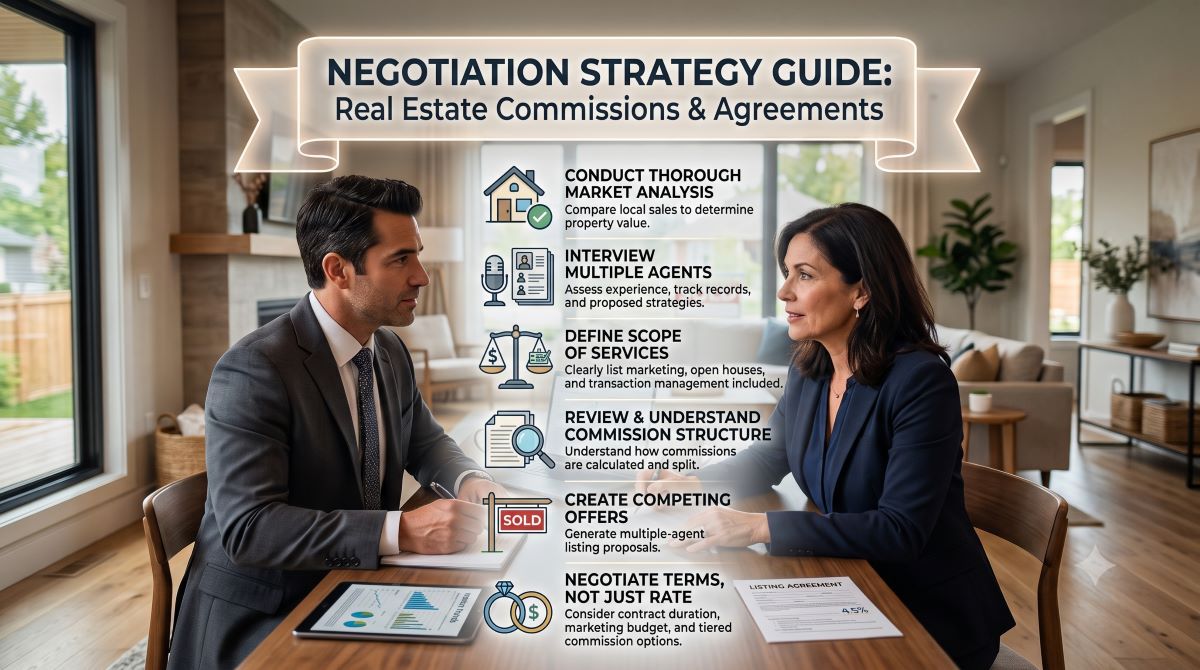
Quick Answer: Yes, you can negotiate real estate commission, and it is legal everywhere in the United States because no law, board, or association may set agent fees. The most effective time to negotiate is before you sign the listing agreement, and the most effective method is to negotiate the listing side and the buyer's agent compensation as two separate numbers. Sellers who prepare specific leverage points typically move a listing fee by 0.25% to 0.75%, worth roughly $2,000 to $6,000 on a $810,000 Northern Virginia home.
Key Takeaways
- Commission is legally negotiable. Any agent who says the rate is "set by the brokerage" is describing a company policy, not a law.
- The national average total commission in 2026 sits at roughly 5.7%, split into about 2.88% on the listing side and 2.82% on the buyer's side, according to Clever Real Estate's February 2026 survey of 533 agents.
- Since the NAR practice changes took effect in August 2024, you are running two separate negotiations, not one. Treat them that way.
- Leverage beats pressure. Price point, condition, timing, dual transactions, and referral value move rates far more than simply asking for a discount.
- The best window to negotiate is during the listing presentation, before signatures. After the agreement is signed, your leverage drops sharply.
- You do not have to negotiate down from 3% at all. Some full-service Northern Virginia teams, including The Jamil Brothers, list at 1.5% by design, which puts you ahead of most negotiated outcomes on day one.
In This Guide
- Can You Actually Negotiate Real Estate Commission?
- What Commission Really Costs in 2026
- How the NAR Settlement Changed the Conversation
- The 7 Leverage Points That Actually Move a Rate
- How to Negotiate Real Estate Commission in 6 Steps
- Word-for-Word Scripts and an Email Template
- What to Do When the Agent Says No
- Negotiate the Structure, Not Just the Percentage
- Seller Savings Calculator
- Mistakes That Quietly Cost Sellers Money
- When Negotiating Is the Wrong Move
- Can Buyers Negotiate Commission Too?
- A Simpler Path Than Negotiating Down From 3%
- Frequently Asked Questions
- Glossary
If you are getting ready to sell, you already know that commission is the single largest line item on your closing statement. On a median-priced Northern Virginia home, a 5.7% total fee is more than $46,000 of your equity. So the question is fair and worth asking directly: can you negotiate real estate commission, and how do you actually do it without blowing up the relationship with a good agent? The short answer is yes, and this guide gives you the exact sequence, the leverage that works, and the words to say.
Most articles on this topic stop at "commissions are negotiable" and leave you to figure out the rest. That is not useful when you are sitting across the kitchen table from a listing agent who has had this conversation three hundred times and you have had it once. What follows is the seller's side of that conversation: what agents are actually authorized to do, which arguments land, which ones make you sound like a difficult client, and where the real money hides in the listing agreement.
One honest caveat up front. Negotiating a fee down is only one route to keeping more of your proceeds, and it is often the slowest one. If you would rather skip the back and forth entirely, working with a Northern Virginia Realtor whose full-service listing fee already starts at 1.5% puts you past the finish line before the negotiation begins. Both paths are covered below so you can pick the one that fits you.
Can You Actually Negotiate Real Estate Commission?
Yes. Real estate commission is fully negotiable, and it always has been. There is no statute, licensing rule, or association bylaw anywhere in the country that sets a required rate. In fact, the opposite is true: federal antitrust law prohibits brokerages and Realtor associations from agreeing on or recommending a standard fee. Every listing fee in America is a private agreement between one seller and one broker.
That matters because the "6% is standard" idea is remarkably persistent. Clever Real Estate's 2026 seller survey found that 38% of recent sellers still believed 6% was the standard rate, while only 14% of them actually paid it. Sellers in that same survey reported paying about 4.7% on average, and 51% said a total fee of 3% or less would have felt fair for the service they received. The gap between what people assume and what people pay is exactly where negotiation lives.
What Virginia Law Says About Commission
Virginia does not regulate commission rates. What Virginia does regulate is disclosure and documentation. Your brokerage relationship and the compensation attached to it must be captured in a written agreement, which is precisely why the moment before you sign is the moment you have power. Once your signature is on a listing agreement that says 3%, the number is contractual. Before that, it is a proposal.
The single most important timing rule
Negotiate before you sign, not after. Sellers who wait until the home is listed and showings have started have almost no leverage left, because the agent has already absorbed the upfront costs of photography, staging consultation, and marketing. Ask during the listing presentation, when the agent is still competing for your business.
Is It Rude to Negotiate Realtor Commission?
No, and any agent who acts offended is telling you something useful about how they will handle the buyer's agent on your behalf later. Commission negotiation is a routine business conversation that professional listing agents have constantly. The way you ask determines the outcome far more than the fact that you asked. Sellers who open with "what's the lowest you'll go" tend to get a polite no. Sellers who open with a specific number, a reason, and a genuine interest in the agent's plan tend to get a yes or a structured counteroffer.
What Real Estate Commission Really Costs in 2026
You cannot negotiate effectively against a number you do not know. Here is where rates actually sit as of 2026, according to Clever Real Estate's national agent survey published in March 2026, alongside typical Northern Virginia patterns drawn from Bright MLS listing behavior.
| Commission Component | 2026 National Average | Typical NoVA Range | Cost on $810,000 |
|---|---|---|---|
| Listing agent side | 2.88% | 2.5% to 3% | $20,250 to $24,300 |
| Buyer's agent compensation | 2.82% | 2% to 2.5% | $16,200 to $20,250 |
| Total combined | 5.70% | 4.5% to 5.5% | $36,450 to $44,550 |
| Jamil Brothers full-service listing side | 1.5% | 1.5% | $12,150 |
Two things stand out. First, the total commission rate went up between 2025 and 2026, from 5.44% to 5.70%, which surprised most of the industry after the NAR settlement was expected to compress fees. Second, the listing side alone now averages 2.88%, meaning the historic 3% listing fee is still very much alive. That is the number you are negotiating against.
What Sellers Pay vs. What Sellers Think Is Fair
This gap is the strongest data point in any commission conversation, and most sellers have never seen it.
Sources: Clever Real Estate 2026 agent and seller surveys. Jamil Brothers figure is the listing side only; buyer's agent compensation is negotiated separately.
Is 2.5% Normal for a Realtor? Is 3% Normal? Is 2% Any Good?
These are the three questions sellers search most often, so here are direct answers.
- Is paying a realtor 3% normal? On the listing side, yes, it is still the most common single quote in Northern Virginia and it sits just above the 2.88% national average. Normal does not mean required, and it does not mean it is the best available.
- Is 2.5% normal for a realtor? Also yes. A 2.5% listing fee is a very common negotiated landing spot, particularly on homes above $700,000 where the dollar amount is already substantial.
- Is 2% a good realtor fee? It is a strong outcome from a traditional negotiation and typically requires real leverage, such as a high price point or a dual transaction. What matters more than the number is what stays in the package at that number. A 2% fee with the photography, drone video, and 3D tour stripped out can cost you more in final sale price than it saves you in fee.
Watch the trade, not just the rate
When an agent agrees to cut their fee on the spot with no discussion, ask what comes out of the marketing plan. A reduced fee attached to a reduced service package is not a win. Get the deliverables in writing at the new rate before you celebrate.
Commission is a percentage, so your leverage starts with an accurate price. Get a street-level home valuation from The Jamil Brothers based on real comparable sales, not an automated estimate. Response within 24 hours.
How the NAR Settlement Changed the Way You Negotiate Commission
On August 17, 2024, the practice changes from the National Association of Realtors settlement took effect nationwide. They did not cap fees or make anything cheaper by decree. What they did was unbundle the conversation, and that unbundling is the biggest negotiating advantage sellers have gained in decades.
| Element | Before August 2024 | 2026 Reality |
|---|---|---|
| How fees were quoted | One blended number, usually 5% to 6% | Two separate numbers you approve individually |
| Buyer agent compensation on MLS | Advertised in the listing | Cannot be published in the MLS |
| Buyer representation | Often informal until an offer | Written buyer agreement required before touring |
| Who pays the buyer's agent | Effectively the seller by default | Buyer is responsible, seller may offer a concession |
| Your negotiating surface | One lever | Two levers, negotiated at different moments |
Why Two Levers Changes Your Strategy
Before 2024, a seller who pushed hard on commission risked squeezing the buyer's agent portion, which could quietly reduce buyer agent interest in showing the home. Today those numbers are separate. You can negotiate your listing agent's fee aggressively while leaving the buyer-side concession competitive, which removes the old trade-off entirely.
Practically, that means your listing appointment should produce two agreed figures: what your agent earns for representing and marketing you, and what you are prepared to offer as a buyer-agent concession if a buyer requests it in their offer. The second number is not fixed at listing time and can be revisited offer by offer. Our flexible commission plans page walks through how those two figures get structured in a real Northern Virginia listing.
A common misunderstanding worth clearing up
You are not required to offer anything to the buyer's agent. You also should not reflexively offer zero. In a market like Northern Virginia, where inventory sits near 1.9 months of supply and the median home sold in about 17 days in June 2026, a competitive concession is often the cheapest way to widen your buyer pool. Treat it as a marketing decision with a number attached, not a moral position.
The 7 Leverage Points That Actually Move an Agent's Rate
Agents do not lower fees because a seller asked nicely. They lower fees when the math on their side still works. Every point below reduces the agent's cost, risk, or time, which is what gives them room to move. Bring two or three of these to the table and your request stops sounding like a discount demand and starts sounding like a business case.
| Leverage Point | Why It Works | Typical Movement |
|---|---|---|
| High price point | The workload on a $1.1M listing is not double a $550K listing, but the fee is | 0.25% to 0.5% |
| Dual transaction | You sell and buy with the same agent, doubling their transaction value | 0.25% to 0.75% |
| Turnkey condition | Less staging coordination, fewer repair negotiations, faster close | 0.25% |
| Fast, clean timeline | Flexible occupancy and realistic pricing shorten days on market | 0.25% |
| Multiple properties | Portfolio or estate sales spread fixed costs across several closings | 0.5% or more |
| Referral value | HOA board seat, large employer network, or a genuine referral pipeline | 0.25% |
| Competing proposals | Two or three written listing proposals in hand, quietly and respectfully | 0.5% or more |
How Strong Is Each Lever?
Prepare These Before the Listing Appointment
- ✓ A realistic value range for your home, ideally from a professional home valuation rather than an online estimate
- ✓ Your net proceeds target, calculated on a seller net sheet so you know what the fee actually costs you
- ✓ Two or three written listing proposals so you are comparing packages, not just percentages
- ✓ Your timeline, occupancy flexibility, and whether you are also buying
- ✓ A specific target rate in mind, not a vague hope for "something lower"
- ✓ The list of marketing deliverables you expect to remain included at any negotiated rate
How to Negotiate Real Estate Commission in 6 Steps
This is the sequence that works. It is deliberately front-loaded, because almost all of your leverage exists before you sign anything. Follow it in order.
Establish your value first (3 to 5 days before)
Commission is a percentage of a number you do not control yet. Get a defensible price range before any fee conversation. If an agent's pricing opinion is $60,000 below the market, a half-point fee cut does not come close to covering the difference. Value first, fee second, always.
Interview two or three agents (1 to 2 weeks before)
Written proposals from multiple agents are the single most effective negotiating tool available to a seller, and you never have to mention them aggressively. Simply asking every agent to put their fee, their marketing package, and their contract term in writing changes the conversation on its own.
Let them present before you raise the fee
Hear the full plan first. You need to know what you are buying before you argue about the price of it, and agents defend their fee much harder when the fee is the first thing you mention. It also gives you the specifics you will use in step four.
Ask with a specific number and a specific reason
"Can you do better?" invites a no. "I'm looking to be at 2% on the listing side, and here's why that works on this property" invites a counteroffer. Name the rate, attach the leverage, then stop talking. The silence after your ask is doing work.
Negotiate the buyer-side concession separately
Do not let the two numbers get blended back together. Agree on what your agent earns, then discuss what you are willing to offer a buyer's agent as a concession, and confirm you can adjust that figure offer by offer as the market responds.
Get everything in writing before you sign
The negotiated rate, the full marketing deliverables, the contract length, and your cancellation rights all belong in the listing agreement itself. A verbal promise made at a kitchen table has no value at closing. Read the agreement, then sign it.
Word-for-Word Scripts to Negotiate Realtor Commission
Most sellers know they should negotiate and freeze at the actual moment because they do not have language ready. Use these as they are or adapt the tone to sound like you. Each one is built to be direct without being adversarial, which is the balance that gets results.
Script 1: The Opening Ask
Use this at the end of the listing presentation, after they have shown you their plan.
Say This
"I really like your marketing plan, and you're on my short list. I'm interviewing two other agents this week, and commission is going to be part of my decision. You quoted 3% on the listing side. I'm looking to be at 2.25%. The home is in move-in condition, I'm flexible on settlement, and I'll be buying my next place with whoever I list with. Can you make that work?"
Why this lands: it opens with genuine respect, names a specific number, stacks three real leverage points, and closes with a question that is easy to say yes to. It does not insult their value or imply their work is not worth paying for.
Script 2: When They Say the Rate Is Set by the Brokerage
Say This
"I understand that's your company's standard rate. My understanding is that commissions can't legally be fixed, so there's usually room for an agent to structure something with their broker's approval. Would you be willing to take 2.25% to your broker and see what they say? I'd rather work with you than start over with someone else."
This is polite but immovable, and it is factually correct. Brokerages set internal policies, and agents routinely request exceptions. You are asking them to make the request, not accusing them of dishonesty.
Script 3: When They Say "You Get What You Pay For"
Say This
"That's fair, and I'm not asking you to cut corners. I want the full marketing package exactly as you described it. What I'm asking is whether the fee on a home at this price point can be structured differently, since the dollar amount at 3% here is well above what the same percentage produces on an average sale. The service stays the same. The math changes."
This separates the two things the objection deliberately fuses together. You are not asking for less service. You are pointing out that a percentage fee scales with price while workload largely does not.
Script 4: The Tiered Structure Ask
This one often succeeds where a flat rate cut fails, because it gives the agent upside.
Say This
"What if we tie it to performance? 2% if we sell at or below list price, 2.5% if you bring me an offer above list. That way you're rewarded for the outcome I actually care about, and I'm not paying a premium for a result we haven't achieved yet. Would you be open to structuring it that way?"
Script 5: The Dual Transaction Ask
Say This
"I'm selling here and buying in Ashburn in the same window, so you'd be earning on both sides of my move. Given that, what can you do on the listing fee? I'd like to keep both transactions with one agent, and I'm happy to sign the buyer agreement today if the listing side works."
Two transactions from one client is the strongest commercial argument a seller can make, and it costs you nothing because you were moving anyway. If you are on the buying side of a move too, our Northern Virginia buyer strategy session covers how to sequence both sides without ending up homeless between closings.
Email Template: Asking a Realtor to Reduce Commission in Writing
If a face-to-face ask is not your style, or you want a paper trail, send this after the listing presentation. Copy it, adjust the bracketed details, and send.
Copy and Paste
Subject: Following up on your listing proposal for [property address]
Hi [Agent Name],
Thank you for walking me through your plan for [address] on [day]. The marketing package and your comparable sales analysis were both impressive, and you are one of two agents I am seriously considering.
Before I decide, I would like to discuss the listing fee. Your proposal came in at [3%]. I am looking to be at [2.25%] on the listing side, with the full marketing package you presented left intact, including [professional photography, drone video, 3D tour, and staging consultation].
A few things that I think support that number: the home is in [move-in ready] condition, I am flexible on the settlement date, I am not under time pressure, and I will be purchasing my next home with the same agent I list with.
I would also like to discuss the buyer's agent concession as a separate figure rather than a blended rate, so I understand exactly what each portion covers.
If you can make that work, I am ready to move forward this week. Please let me know either way, and thank you again for your time.
Best regards,
[Your Name]
[Phone]
Why the written version often works better
An email removes the social pressure of the room, gives the agent time to check with their broker rather than defend on reflex, and creates a record of exactly what was included at the agreed rate. It also signals that you are organized and serious, which agents read as a low-risk client.
Before you negotiate, run the real math. Our seller net sheet breaks down commission, Virginia grantor tax, settlement fees, and payoff so you know your true bottom line and exactly what each fraction of a percent is worth to you.
What to Do When the Agent Says No
Sometimes you will get a firm no, and that is not automatically a bad sign. An agent who holds their price with a clear explanation may simply be a good negotiator, which is a quality you want working on your side when offers come in. Here is how to handle it without burning the relationship or caving instantly.
Move to the Second Ask
If the percentage will not move, other things often will. Ask for one of these instead:
- A shorter listing agreement term, such as 90 days instead of 180, which keeps accountability high
- An unconditional cancellation right with written notice, so you are never trapped with an agent who underdelivers
- Written marketing minimums, including professional photography, drone video, 3D tour, and a specific open house schedule
- A reduced fee if the agent brings the buyer themselves, since there is no second agent to compensate
- The agent covering staging, professional cleaning, or pre-listing inspection costs
- A price reduction schedule agreed in advance, so nobody is arguing about it in week five
Then Decide Honestly
If nothing moves and you still believe this agent will net you the most money, hire them anyway. Paying 3% to an agent who sells your home for $835,000 beats paying 2% to an agent who sells it for $795,000 by a wide margin. Run that comparison before you walk away over a half point. And if the fee genuinely is the sticking point, remember that switching to a team that prices differently from the outset is a legitimate alternative to a negotiation that has stalled.
Negotiate the Structure, Not Just the Percentage
Percentage is the obvious lever and the one every seller reaches for. Experienced sellers negotiate the shape of the deal instead, which is often where the larger win sits.
| Structure | How It Works | Best For |
|---|---|---|
| Flat listing fee | A fixed dollar amount regardless of sale price | High-value homes where a percentage produces an outsized fee |
| Tiered performance | Lower base rate, higher rate if the sale exceeds a target price | Sellers who want incentives aligned with price, not speed |
| Sliding scale | Rate steps down as the sale price climbs through set brackets | Luxury listings above $1.2 million |
| Reduced dual-side fee | Lower total if your listing agent also brings the buyer | Well-connected agents in tight submarkets |
| Bundled buy and sell | Discounted listing fee when you also purchase with the same agent | Move-up and downsizing sellers |
| Low fixed rate from the start | Full-service listing priced at 1.5% with no negotiation required | Sellers who would rather not negotiate at all |
The Contract Terms Worth More Than a Half Point
Ask for These in the Listing Agreement
- ✓ Term length: 90 days is reasonable in a market averaging 17 days on market. A 12-month agreement is not.
- ✓ Cancellation rights: The ability to exit with written notice if the agent is not performing.
- ✓ Protection period: Keep the post-expiration window short, typically 30 to 60 days, and limited to named prospects.
- ✓ Marketing deliverables: Listed item by item, not summarized as "professional marketing."
- ✓ Buyer concession language: Written so you approve any offer of buyer-agent compensation in advance.
- ✓ Transaction and admin fees: Confirm whether the brokerage adds a separate fee at closing on top of the commission.
The fee that hides in plain sight
Many brokerages charge a transaction, compliance, or administrative fee at settlement, commonly $395 to $795, entirely separate from the commission percentage. Ask about it directly before you sign. Negotiating a quarter point off the commission while an undisclosed admin fee sits in the paperwork is a net loss on smaller sales.
Seller Savings Calculator: What a Lower Listing Fee Is Actually Worth
Percentages are abstract. Dollars are not. Select your home's approximate value below to see the difference between a traditional 3% listing fee and a 1.5% full-service listing fee, side by side, with the buyer's agent concession and estimated closing costs held constant so you are comparing like for like.
Seller Savings Calculator
How much more do you keep with our 1.5% listing fee?
Select your home's estimated value to see your real net proceeds, side by side.
Traditional Agent · 3%
Our Fee, Only 1.5%
Extra in your pocket
$6,000
vs. a traditional 3% listing agent, with zero reduction in service or marketing.
Traditional Agent · 3%
Our Fee, Only 1.5%
Extra in your pocket
$7,500
vs. a traditional 3% listing agent, with zero reduction in service or marketing.
Traditional Agent · 3%
Our Fee, Only 1.5%
Extra in your pocket
$9,000
vs. a traditional 3% listing agent, with zero reduction in service or marketing.
Traditional Agent · 3%
Our Fee, Only 1.5%
Extra in your pocket
$11,250
vs. a traditional 3% listing agent, with zero reduction in service or marketing.
Traditional Agent · 3%
Our Fee, Only 1.5%
Extra in your pocket
$15,000
vs. a traditional 3% listing agent, with zero reduction in service or marketing.
Estimates only. Closing costs vary. Buyer's agent commission is negotiable.
Look at the $750K panel, which is closest to the June 2026 Northern Virginia median of $810,000. The difference between 3% and 1.5% on the listing side alone is $11,250. That is a larger swing than most sellers achieve through negotiation, and it requires no negotiation at all.
Mistakes That Quietly Cost Sellers Money
These come up constantly in Northern Virginia listing appointments, and each one is avoidable.
| ✓ What Works | ✗ What Backfires |
|---|---|
| Naming a specific target rate with reasons attached | Asking "what's the best you can do" and waiting |
| Negotiating before signing the listing agreement | Raising the fee after the home is already live on Bright MLS |
| Comparing full proposals side by side | Choosing purely on the lowest percentage quoted |
| Confirming what stays in the marketing package | Accepting a fee cut without asking what got removed |
| Treating listing fee and buyer concession separately | Negotiating one blended number the old way |
| Asking about brokerage transaction fees up front | Discovering a $595 admin fee on the settlement statement |
| Weighing fee savings against likely sale price | Saving $4,000 in fees and losing $25,000 on price |
The Biggest One: Optimizing the Wrong Number
Commission is roughly 5% of your sale price. Final sale price is 100% of it. An agent who prices correctly, markets aggressively, and negotiates offers well can create more value in a single counteroffer than you will ever extract from a fee discussion. This does not mean fees do not matter. It means the right question is not "who is cheapest" but "who nets me the most after everything." The strongest position is an agent who does both, which is exactly the case The Jamil Brothers are built to make.
4K photography, aerial drone video, 3D Matterport tours, staging consultation, full MLS and portal syndication, and partner-led negotiation on every offer. All included at a 1.5% listing fee. No hidden fees, no reduced service, nothing to argue about.
When Negotiating Commission Is the Wrong Move
Honest advice includes the cases where pushing on fee works against you. There are a few.
- Your home is difficult to sell. Unusual layouts, dated systems, problem HOA documents, or a hard-to-comp property all mean more agent hours. Squeezing the fee on a listing that needs extra effort tends to produce exactly that: less effort.
- You need speed above all. If a job transfer, military PCS, or contract deadline is driving your timeline, an agent's motivation and network matter more than a half point. A cash offer option may be worth comparing here as well.
- The agent caved immediately. If a full point disappears in five seconds with no discussion, ask yourself how that same person will hold your price when a buyer's agent pushes for $20,000 off after the inspection.
- You are selling a lower-priced property. On a $325,000 condo, a quarter point is $812. It is rarely worth trading away marketing quality or agent enthusiasm for that.
- The fee is already competitive. If the listing fee quoted is already at or below 2%, you are negotiating against a business model that has little room left, and further pressure usually comes out of the service.
Can Buyers Negotiate Real Estate Commission Too?
Yes, and since August 2024 buyers have more reason to than ever. Because buyers now sign a written representation agreement before touring homes, the compensation figure in that agreement is fully negotiable at the moment of signing. A buyer can negotiate the rate itself, cap it at a dollar amount, or specify that whatever the seller offers as a concession satisfies the obligation in full.
Three things matter for buyers in Northern Virginia right now. First, negotiate the agreement term as well as the rate, because a short initial term keeps everyone accountable. Second, include language that any seller-paid concession offsets your obligation dollar for dollar, so you are not paying twice. Third, understand that in a market moving at roughly 17 days on market, an agent who knows the submarket cold is worth paying properly. If you are on the buying side, our buyer strategy consultation covers exactly how to structure that agreement before you tour anything. You can also search current listings across Northern Virginia to get a feel for pricing first.
A Simpler Path Than Negotiating Down From 3%
Here is the practical reality of everything above. A well-prepared seller with genuine leverage might negotiate a 3% listing fee down to 2.5%, or 2.25% on a strong day. That is a real win worth $4,000 to $6,000 on an $810,000 home. It also takes multiple interviews, a prepared case, and a conversation many people find uncomfortable.
The alternative is to start with a team whose listing fee is already 1.5% and whose service package is not reduced to get there. On that same $810,000 home, the listing side runs $12,150 instead of $24,300. No negotiation, no leverage required, and no service traded away. The Jamil Brothers built the model that way deliberately, structuring the team around volume and systems rather than charging every seller a legacy rate.
What Stays Included at 1.5%
Every Jamil Brothers Listing Includes
- ✓ Professional 4K photography and aerial drone video
- ✓ 3D Matterport virtual tour and floor plans
- ✓ Staging consultation and pre-listing preparation guidance
- ✓ Full Bright MLS syndication to Zillow, Realtor.com, Redfin and partner portals
- ✓ Targeted paid social and digital campaigns
- ✓ Partner-led offer negotiation, not handed to a junior team member
- ✓ Contract to close management through settlement
Saad and Arslan Jamil have closed more than 840 transactions and $500 million in volume across Fairfax, Loudoun, Prince William, and Arlington, hold NVAR Lifetime Top Producer recognition, and are licensed in Virginia, Maryland, DC, and West Virginia. If you want the full breakdown of how a listing works from valuation to settlement, the Sell My Home page walks through each stage.
If a job relocation, military PCS, estate timeline, or property condition means certainty matters more than squeezing out the last dollar, a cash offer may be the better fit. We will lay out your full range of options side by side, with no pressure either way.
Frequently Asked Questions About Negotiating Real Estate Commission
Can you negotiate real estate commission?
Yes. Real estate commission is fully negotiable everywhere in the United States, and federal antitrust law specifically prohibits brokerages or Realtor associations from setting or recommending a standard rate. Any agent who tells you the rate is fixed is describing their own brokerage policy, not a legal requirement. The most effective time to negotiate is during the listing presentation, before you sign the listing agreement, because your leverage drops sharply once the contract is executed and the agent has begun spending money on marketing.
Is 2% a good realtor fee?
A 2% listing fee is a strong outcome from a traditional negotiation, since the national listing side average in 2026 is 2.88%. Reaching 2% usually requires real leverage such as a high price point, a dual buy and sell transaction, or competing written proposals. What matters more than the number is what remains in the package at that rate. A 2% fee with professional photography, drone video, and 3D tours removed can easily cost you more in final sale price than it saves you in commission, so confirm the full deliverables in writing before accepting.
Is 2.5% normal for a realtor?
Yes, 2.5% is a very common listing side rate and one of the most frequent landing spots after a successful negotiation, particularly on Northern Virginia homes above $700,000 where the dollar figure is already substantial. It sits slightly below the 2026 national listing agent average of 2.88%. Normal, however, is not the same as optimal. Full-service listing programs priced at 1.5% exist in Northern Virginia and deliver the same marketing package, so 2.5% should be treated as a midpoint rather than a floor.
Is paying a realtor 3% normal?
A 3% listing fee is still the most commonly quoted rate in Northern Virginia and sits just above the 2026 national average of 2.88% for the listing side. It is normal in the sense that many agents open there, but it is not required and roughly half of sellers surveyed in 2026 said a total commission of 3% or less across both sides would have felt fair for the service they received. On an $810,000 home, a 3% listing fee is $24,300, which is why it deserves a conversation rather than an automatic yes.
Is it okay to negotiate a realtor commission, or is it rude?
It is entirely appropriate and experienced listing agents expect the question. Commission negotiation is a routine business discussion, not a personal challenge. How you ask determines the result: naming a specific target rate and attaching genuine reasons such as price point, property condition, or a dual transaction produces far better outcomes than asking an open-ended question about discounts. If an agent reacts defensively or takes offense, that reaction tells you something worth knowing about how they will handle pressure from a buyer's agent later.
When is the best time to negotiate commission with a realtor?
The best moment is at the end of the listing presentation, after the agent has presented their pricing analysis and marketing plan but before you sign the listing agreement. At that point the agent is still competing for your business and has invested time but no money. Once the agreement is signed and the listing is live on Bright MLS, the agent has already paid for photography, drone video, and marketing, and your negotiating position is much weaker. If you are already listed and unhappy, the realistic lever is your cancellation rights, not the rate.
How do I ask my realtor to lower their commission?
Use a direct, specific request rather than an open-ended one. A reliable structure is to compliment the plan, state that you are comparing proposals, name your target rate, list two or three reasons that support it, and ask whether they can make it work. For example: "I like your marketing plan and you are on my short list. I am looking to be at 2.25% on the listing side. The home is in move-in condition, I am flexible on settlement, and I will be buying my next home with whoever I list with. Can you make that work?" Sending the same request by email after the appointment also works well, because it gives the agent time to consult their broker rather than defend on reflex.
Can a buyer negotiate real estate agent commission?
Yes. Since the NAR practice changes took effect in August 2024, buyers must sign a written representation agreement before touring homes, and the compensation figure in that agreement is negotiable at signing. Buyers can negotiate the percentage, cap the fee at a fixed dollar amount, or include language stating that any seller-paid concession satisfies the obligation in full so they never pay twice. Buyers should also negotiate the length of the agreement, since a shorter initial term keeps the relationship accountable.
Do I still have to pay the buyer's agent after the NAR settlement?
No, you are not required to. Since August 2024, buyer agent compensation is the buyer's contractual responsibility under their representation agreement, and it can no longer be advertised in the MLS. Sellers may still offer a concession toward the buyer's agent fee, negotiated separately from the listing fee and typically addressed offer by offer. In Northern Virginia, where inventory sat near 1.9 months of supply and homes sold in about 17 days in June 2026, most sellers still offer something competitive because it widens the buyer pool. Treat it as a marketing decision with a dollar figure attached rather than an obligation.
How much can I realistically save by negotiating commission in Northern Virginia?
A prepared seller with genuine leverage typically moves a listing fee by 0.25% to 0.75%. On the June 2026 Northern Virginia median sold price of $810,000, that is roughly $2,000 to $6,000. Larger reductions are possible on luxury listings, portfolio sales, or dual transactions where you both sell and buy with the same agent. For comparison, choosing a full-service listing program priced at 1.5% instead of 3% saves $12,150 on that same home, which is more than most negotiated outcomes achieve and requires no negotiation at all.
What mistakes should I avoid when negotiating realtor fees?
The most common mistakes are asking vaguely instead of naming a number, waiting until after the listing agreement is signed, accepting a reduced rate without confirming what was removed from the marketing package, and choosing an agent purely on the lowest percentage. Two others cost sellers real money: failing to ask about brokerage transaction or administrative fees that appear separately at settlement, often $395 to $795, and negotiating the listing fee and buyer concession as one blended number rather than two separate figures. The largest mistake of all is optimizing the fee while ignoring the agent's likely effect on final sale price.
Does selling a condo or HOA home change the commission I should expect?
The percentage itself is usually similar, but the workload is not. HOA and condo sales in Northern Virginia require the resale disclosure package, coordination with the association, and management of the statutory review period, all of which add agent hours and timeline risk. That extra work weakens a fee argument slightly, though it strengthens the case for hiring someone who handles association paperwork routinely. Separately, the resale package itself carries a fee paid by the seller, commonly a few hundred dollars, which is not part of the commission and should be accounted for on your net sheet.
How do I choose a listing agent if I am not just picking the cheapest?
Compare four objective factors: recent sold transactions in your specific submarket rather than the region generally, list-to-sold price ratio, average days on market compared to the area average, and the exact marketing deliverables included in writing. Then judge the pricing conversation itself, since an agent who justifies their price opinion with comparable sales rather than flattery is showing you how they will handle a buyer's agent. The Jamil Brothers publish their listing fee at 1.5% with the full marketing package included, which removes the fee variable so you can compare teams on performance instead.
Glossary: Commission Terms Worth Knowing
Listing Side Commission
The portion of the fee paid to your own agent and their brokerage for marketing and representing you. This is the number you negotiate directly.
Buyer Agent Concession
An amount a seller optionally offers toward the buyer's agent fee. Since August 2024 it is negotiated separately and cannot be advertised in the MLS.
Listing Agreement
The written contract that sets your agent's fee, the listing term, and cancellation rights. Everything you negotiate must appear here to be binding.
Protection Period
A window after the listing expires during which a sale to a buyer the agent introduced still owes commission. Keep it short and tied to named prospects.
Tiered Commission
A performance structure where the rate rises if the home sells above a target price, aligning the agent's pay with the outcome you care about.
Transaction Fee
A separate brokerage charge at settlement, often $395 to $795, applied on top of the commission percentage. Always ask whether one applies.
Net Proceeds
What you actually take home after commission, Virginia grantor tax, settlement charges, and loan payoff. The only number that truly matters.
Dual Agency
When one agent represents both sides of a transaction. It requires written consent in Virginia and is often a point where a reduced total fee is negotiated.
The Bottom Line on Negotiating Real Estate Commission
You can negotiate real estate commission, you should ask, and the sellers who succeed are simply the ones who prepare. Get your value established first, interview more than one agent, let them present before you raise the fee, name a specific number with real reasons behind it, keep the listing fee and the buyer concession as two separate conversations, and put every agreed term in writing before you sign. That sequence is worth $2,000 to $6,000 on a typical Northern Virginia home, and considerably more on a higher-priced or dual transaction.
Keep the larger picture in view as you do it. Commission is around 5% of your sale price, while the price itself is all of it. The goal is never the lowest fee. The goal is the highest number on your settlement statement after everything is paid. Sometimes that means negotiating hard with a strong agent. Sometimes it means choosing a team that already prices its full-service listing at 1.5% so there is nothing left to argue about. Either way, run the math on your own home before you decide, and start the conversation with someone who will show you both sides of it. Reach The Jamil Brothers at (703) 782-4830 or through the contact page.
Know your equity, understand every cost, and see exactly what you will walk away with before you sign anything. The Jamil Brothers provide a full seller consultation at no cost and no obligation, including a line by line comparison of what a 3% listing fee versus a 1.5% listing fee means for your specific home.
Keep Reading
Categories
- All Blogs (1168)
- Aldie (3)
- Ashburn (6)
- Buyer Guide (8)
- Buying a home (2)
- Buying Strategies (28)
- festivals (1)
- General Blog (66)
- Leesburg (5)
- Market Intelligence (29)
- Market Updates (8)
- Notable Properties For Sale (29)
- Real Estate Tips, News, and More (376)
- Seller Guide (2)
- Seller Guides (60)
- Selling Your Home (479)
- Sterling (6)
- Top Realtors in Northern Virginia (58)
Recent Posts
Message Sent!
Thank you for reaching out. Arslan & Saad have received your details and will be in touch shortly.
Need immediate assistance? Call or text 703-782-4830.