
Virginia Home Seller Closing Cost Calculator: Estimate Your True Net Proceeds in 2026
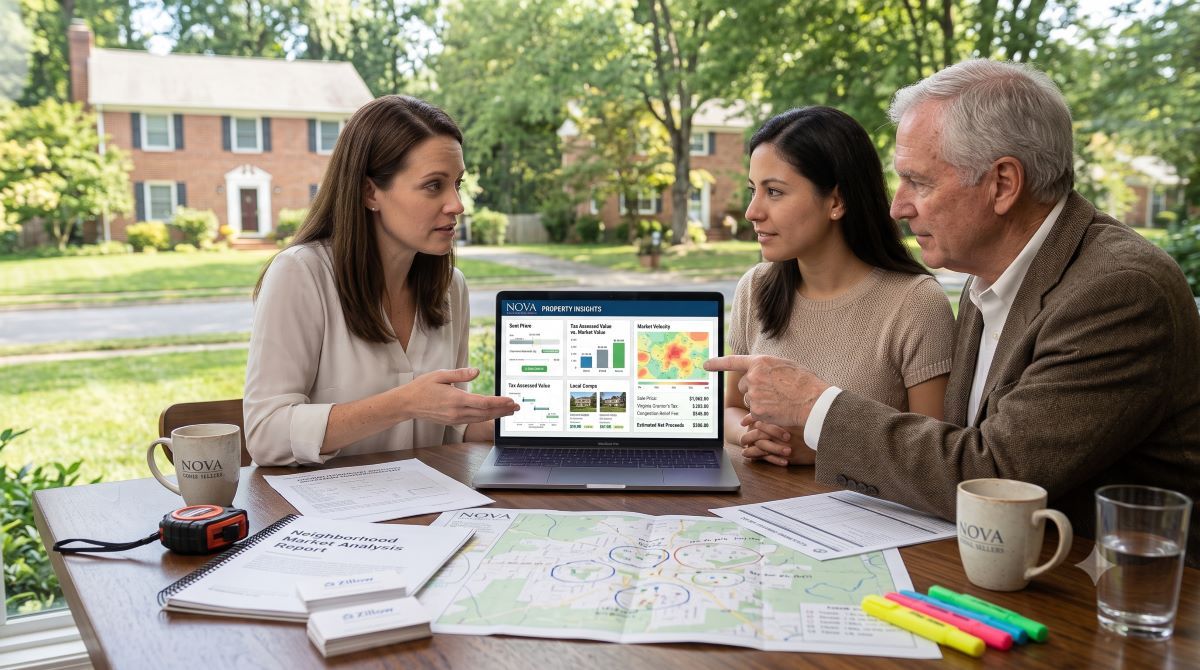
Quick Answer: A Virginia home seller closing cost calculator estimates what you’ll actually walk away with after commission, the state grantor tax ($1 per $1,000), Northern Virginia’s two regional transportation fees ($1 per $1,000 each), settlement and deed fees, and prorated property taxes. Excluding commission, those Virginia costs usually total about 1% to 2% of the sale price; with commission, most sellers land around 5% to 8%. On a $600,000 Northern Virginia home, seller-side transfer charges alone come to about $1,800, and the calculator below shows how much more you keep when the listing side is 1.5% instead of 3%.
Key Takeaways
- Use a Virginia home seller closing cost calculator to estimate net proceeds: the cash to seller that actually lands in your bank account, not just your sale price.
- Virginia sellers pay a grantor tax of $1 per $1,000. In Northern Virginia, two regional fees add another $2 per $1,000, for about 0.30% in seller-side transfer charges.
- Real estate commission is the largest line item. Since the NAR settlement, buyer-agent compensation is fully negotiable and no longer automatic.
- Listing at a 1.5% full-service fee instead of 3% saves roughly $9,000 on a $600K sale and $15,000 on a $1M sale, with the same marketing and negotiation.
- Get a personalized, line-by-line seller net sheet before you list so there are no surprises on closing day.
On This Page
- What Is a Virginia Home Seller Closing Cost Calculator?
- What Costs Does the Calculator Include?
- How Much Are Seller Closing Costs in Virginia?
- Grantor Tax and the NOVA Regional Fees
- Commission: The Biggest Line Item
- Seller Savings Calculator
- How to Estimate Your Net Proceeds Step by Step
- Cost Examples at Every Price Point
- How to Lower Your Closing Costs
- Do Cash Sellers Pay Closing Costs?
- Frequently Asked Questions
- Glossary
- The Bottom Line
- About the Author
- Related Seller Guides
- Northern Virginia Communities and Nearby Areas
If you’re getting ready to sell, the first number you want isn’t your list price. It’s your net. A Virginia home seller closing cost calculator answers the real question every homeowner asks: after the agent, the taxes and the settlement fees, how much do I actually keep? Most online tools spit out a national average and miss the costs specific to Virginia, and especially to Northern Virginia real estate, which is exactly where sellers get surprised on closing day.
Virginia has a layered cost structure that national calculators routinely under-count: the state grantor tax, two regional transportation fees in Northern Virginia, settlement and deed fees, lien releases, prorated property taxes and, the single biggest expense, real estate commission. For a full line-item breakdown, see our companion Virginia seller closing costs guide; this page focuses on estimating your bottom-line number.
As a Northern Virginia real estate team, The Jamil Brothers have walked hundreds of sellers through this math. Below you’ll find how the calculator works, what every fee means, and a tool that shows the difference a 1.5% full-service listing fee makes to your take-home number.
Get Your Personalized Net Sheet
Tell us about your home and we’ll send an itemized estimate of your Virginia closing costs and net proceeds.
Get a personalized home valuation from The Jamil Brothers: street-level comps and a real net sheet, not an automated guess. Response within 24 hours.
What Is a Virginia Home Seller Closing Cost Calculator?
A Virginia home seller closing cost calculator is a tool that estimates the total fees and taxes you’ll pay to sell your home, then subtracts them from your sale price to reveal your net proceeds. You enter your expected sale price and the calculator applies Virginia-specific rates for the grantor tax, the regional fees where they apply, settlement and deed charges, recording fees, prorated property taxes and commission.
A state-specific tool matters because Virginia doesn’t use one flat transfer tax. A generic closing cost calculator for sellers built on national averages will miss the grantor tax and the Northern Virginia regional fees entirely, and those are real dollars off your bottom line. A good Virginia seller net sheet calculator bakes them in so your estimate reflects what your settlement statement will actually say.
Net proceeds vs. closing costs vs. profit
Closing costs are the fees and taxes you pay to complete the sale. Net proceeds are what’s left after those costs and after paying off any remaining mortgage. Profit is different again: it compares your sale price with what you paid plus improvements, which is what matters for capital gains. The calculator’s job is to get you from sale price to net proceeds accurately.
What Costs Does the Calculator Include?
A reliable Virginia seller closing cost estimate accounts for every line that shows up on a settlement statement. Here’s what belongs in the calculation and roughly what each item runs for a typical Northern Virginia sale.
2026 planning estimates for a typical Northern Virginia sale. Tax and fee rates per the Code of Virginia (reviewed September 2026); other amounts vary by locality, price and contract.
| Closing Cost | Typical Amount | Who Usually Pays |
|---|---|---|
| Real estate commission | 1.5% to 6% total (negotiable) | Seller |
| Virginia grantor tax | $1 per $1,000 (0.1%) | Seller, unless the contract shifts it |
| Regional congestion relief fee (NOVA) | $1 per $1,000 (0.1%) | Seller, unless the contract shifts it |
| Regional WMATA capital fee (NOVA) | $1 per $1,000 (0.1%) | Seller, unless the contract shifts it |
| Settlement, title and deed preparation fees | ~$1,500 to $3,000 (varies) | Split per contract |
| Lien release recording | Small flat fees | Seller |
| Prorated property taxes | Local rate, prorated to closing | Credit or debit to seller |
| HOA or condo resale certificate | $100 to $500+ | Seller (if applicable) |
| Buyer concessions (optional) | 0% to 2%+ (negotiated) | Seller (if agreed) |
Costs many calculators leave out
Line items sellers forget to budget for
- The two NOVA regional fees: invisible on most national tools.
- HOA and condo resale certificate fees: common in Northern Virginia communities.
- Prorated property taxes and HOA dues owed through your closing date.
- Mortgage payoff with per-diem interest, plus any HELOC or second mortgage payoff and lien release fees.
- Buyer concessions and repair credits negotiated during the deal.
- Costs paid before closing: pre-listing repairs, staging and any home warranty you agree to provide.
How Much Are Seller Closing Costs in Virginia?
Add up the itemized Virginia costs above and, excluding commission, most sellers land around 1% to 2% of the sale price, depending on HOA packets, prorations and any concessions. Once you add real estate commission, the all-in total for most sellers falls between roughly 5% and 8%. Northern Virginia sellers sit toward the higher end because of the regional fees and HOA-heavy communities.
Where your money goes on a $600,000 NOVA sale
This bar meter shows the relative weight of each cost category at a traditional 3% listing fee. Commission dominates, which is exactly why it’s the line item worth negotiating first.
The takeaway is clear: commission makes up more than 85% of total closing costs in this example. Trim the listing side from 3% to 1.5% and you keep more than the grantor tax, regional fees, settlement and recording costs combined. For the full picture of who pays what, see our breakdown of closing costs for buyers vs. sellers in Virginia.
Virginia Grantor Tax and the NOVA Regional Fees Explained
Virginia’s transfer charges are split between the parties, and the piece that falls on sellers is the grantor tax. Under Va. Code § 58.1-802 it’s charged at 50 cents per $500 of value, effectively $1 per $1,000 or 0.1%. On a $600,000 home, that’s $600. Simple enough on its own, but it’s not the only transfer-related charge NOVA sellers face.
The two Northern Virginia regional fees
Sales in Northern Virginia carry two more seller-side charges. The regional congestion relief fee (§ 58.1-802.4) applies in Planning District 8, and the regional WMATA capital fee (§ 58.1-802.3) applies in Northern Virginia Transportation Authority member localities: Arlington, Fairfax, Loudoun and Prince William counties and the cities of Alexandria, Fairfax, Falls Church, Manassas and Manassas Park. Each is 10 cents per $100, or $1 per $1,000.
Seller-side transfer charges in Northern Virginia. Source: Code of Virginia §§ 58.1-802, 58.1-802.3 and 58.1-802.4 (Virginia LIS, reviewed September 2026).
| Charge | Statutory Rate | Per $1,000 | On $600K | On $850K |
|---|---|---|---|---|
| State grantor tax | 50¢ per $500 | $1.00 | $600 | $850 |
| Regional congestion relief fee | 10¢ per $100 | $1.00 | $600 | $850 |
| Regional WMATA capital fee | 10¢ per $100 | $1.00 | $600 | $850 |
| NOVA seller total | 0.30% | $3.00 | $1,800 | $2,550 |
Older rates are still floating around online
Many calculators and older articles still quote a single NOVA fee of 15 cents per $100. That rate came from a 2013 statute that was repealed in 2018 and later replaced by the two fees above. As of our September 2026 review, the combined NOVA seller-side total is about $3 per $1,000. For the full mechanics, read our Virginia real estate transfer tax guide, and always confirm final figures with your settlement company.
Whether you sell in Ashburn, Leesburg or elsewhere in Loudoun County real estate, or in Fairfax, Arlington or Alexandria, the same three seller-side charges apply. The buyer typically pays the state deed recordation tax (25 cents per $100 under § 58.1-801) plus any local recordation tax of up to one-third of that amount, so those usually don’t hit your seller-side ledger.
Selling elsewhere in the DMV?
These rules are Virginia-specific. Maryland and Washington, DC use their own transfer and recordation taxes, so a Virginia calculator won’t fit a sale across the river. If you own property in more than one jurisdiction, our DMV real estate team works across Virginia, Maryland, DC and West Virginia and can run each estimate under its own rules.
Our seller net sheet breaks down every cost, including commission, grantor tax, the regional fees, settlement and recording, so you know your real bottom line before you list.
Real Estate Commission: The Biggest Line Item on Your Calculator
Every other cost on your Virginia seller closing cost calculator is small next to commission. Traditionally, sellers paid 5% to 6% total, split between the listing agent and the buyer’s agent. Since the NAR settlement practice changes took effect in August 2024, buyer-agent compensation is a negotiated item, not an automatic obligation baked into your listing agreement.
In our experience, many Northern Virginia sellers in 2026 still choose to offer some buyer-agent compensation, often in the 2% to 2.5% range, because competitively marketed homes attract more showings when buyer agents are motivated. But the listing side is entirely within your control, and that’s where the savings live.
Why 1.5% full-service changes the math
A 1.5% full-service listing fee delivers the same professional photography, drone video, 3D tours, MLS syndication, expert negotiation and contract management as a traditional 3% listing; you simply pay less on the listing side. This is not a discount model with reduced service. It’s a more efficient business model, and the difference goes straight to your net proceeds.
What the 1.5% full-service listing includes, and what it is not.
| 1.5% Full-Service Listing | What It Is Not |
|---|---|
| ✓ Full MLS and syndication exposure | ✗ Not a limited flat-fee MLS listing |
| ✓ Professional photography, drone, 3D tour | ✗ Not reduced marketing |
| ✓ Expert pricing and negotiation | ✗ Not “you do the work yourself” |
| ✓ Full representation to closing | ✗ Not a discount on service quality |
Prefer flexibility on how you structure the deal? Explore our flexible commission options, because the right structure depends on your home, your timeline and your goals.
Seller Savings Calculator: How Much More Do You Keep?
Select your home’s estimated value below to see your net proceeds side by side: a traditional 3% listing agent versus The Jamil Brothers’ 1.5% full-service fee. Both columns assume a 2.5% buyer-agent offer and roughly 1% in other closing costs, so you’re comparing apples to apples.
Seller Savings Calculator
How much more do you keep with a 1.5% full-service listing fee?
Select your home’s estimated value to see your net proceeds side by side.
Traditional Listing, 3%
Full-Service Listing, 1.5%
Extra in your pocket
$7,500
vs. a traditional 3% listing agent, with zero reduction in service or marketing.
Traditional Listing, 3%
Full-Service Listing, 1.5%
Extra in your pocket
$12,750
vs. a traditional 3% listing agent, with zero reduction in service or marketing.
Traditional Listing, 3%
Full-Service Listing, 1.5%
Extra in your pocket
$15,000
vs. a traditional 3% listing agent, with zero reduction in service or marketing.
Traditional Listing, 3%
Full-Service Listing, 1.5%
Extra in your pocket
$22,500
vs. a traditional 3% listing agent, with zero reduction in service or marketing.
Traditional Listing, 3%
Full-Service Listing, 1.5%
Extra in your pocket
$30,000
vs. a traditional 3% listing agent, with zero reduction in service or marketing.
Traditional Listing, 3%
Full-Service Listing, 1.5%
Extra in your pocket
$37,500
vs. a traditional 3% listing agent, with zero reduction in service or marketing.
Traditional Listing, 3%
Full-Service Listing, 1.5%
Extra in your pocket
$45,000
vs. a traditional 3% listing agent, with zero reduction in service or marketing.
Traditional Listing, 3%
Full-Service Listing, 1.5%
Extra in your pocket
$52,500
vs. a traditional 3% listing agent, with zero reduction in service or marketing.
Traditional Listing, 3%
Full-Service Listing, 1.5%
Extra in your pocket
$60,000
vs. a traditional 3% listing agent, with zero reduction in service or marketing.
Estimates only. Closing costs vary by locality and negotiation. Buyer’s agent compensation is negotiable.
How to Estimate Your Net Proceeds Step by Step
Whether you use a calculator or run the numbers yourself, the process is the same. Here’s how to move from a rough sale price to a trustworthy net-proceeds figure.
- 1Start with a realistic sale price. Use recent, comparable sales in your neighborhood, not a Zestimate. A local agent’s comps are the most reliable input, and everything downstream depends on this number.
- 2Subtract commission. Apply your listing fee (1.5% with The Jamil Brothers vs. a traditional 3%) plus any buyer-agent compensation you choose to offer. This is the biggest deduction, so model both scenarios.
- 3Add Virginia taxes and fees. Grantor tax ($1 per $1,000), the two NOVA regional fees ($1 per $1,000 each, where they apply), settlement and deed fees, lien release recording, prorated property taxes and HOA dues.
- 4Subtract your mortgage payoff. Request an official payoff statement from your lender. Your payoff balance differs from your statement balance because it adds accrued interest through closing; include any HELOC or second mortgage too.
- 5Confirm with a professional net sheet. A calculator gets you close; a seller net sheet from your agent reflects your actual locality, HOA and terms. Always confirm before you list or accept an offer.
Virginia Seller Closing Cost Examples at Every Price Point
Here’s a quick reference showing your estimated net at a traditional 3% listing versus 1.5% full-service. Figures assume a 2.5% buyer-agent offer and roughly 1% in other closing costs.
Illustrative estimates assuming a 2.5% buyer-agent offer and about 1% in other closing costs; excludes mortgage payoff.
| Sale Price | Net at 3% Listing | Net at 1.5% Listing | You Keep |
|---|---|---|---|
| $400,000 | $374,000 | $380,000 | +$6,000 |
| $500,000 | $467,500 | $475,000 | +$7,500 |
| $600,000 | $561,000 | $570,000 | +$9,000 |
| $750,000 | $701,250 | $712,500 | +$11,250 |
| $1,000,000 | $935,000 | $950,000 | +$15,000 |
These are illustrative estimates for comparison; they exclude mortgage payoff and vary by locality and negotiation. For the full cost-to-sell picture, see our guide on the total cost to sell a house in Virginia.
4K photography, drone video, 3D tours, expert negotiation and full MLS marketing, all included at 1.5%. No hidden fees, no service reductions, no surprises.
How to Lower Your Seller Closing Costs in Virginia
You can’t avoid the grantor tax, but plenty of your closing costs are within your control. Here’s where Virginia sellers realistically save.
Where Virginia sellers can and cannot move the numbers.
| Where You Can Save | What’s Fixed |
|---|---|
| ✓ Listing commission (1.5% vs. 3%) | ✗ State grantor tax ($1 per $1,000) |
| ✓ Buyer-agent offer (now negotiable) | ✗ Two NOVA regional fees ($2 per $1,000) |
| ✓ Shopping settlement and title providers | ✗ Recording fees |
| ✓ Limiting buyer concessions and repair credits | ✗ Prorated property taxes owed |
Smart moves before you list
- Interview agents on total cost and net, not just commission rate.
- Ask for a written net sheet before signing a listing agreement.
- Price correctly the first time to avoid costly price cuts.
- Compare settlement companies: their fees are not identical.
- Weigh a cash offer if speed and certainty matter more than top dollar.
Do Cash Sellers Pay Closing Costs in Virginia?
Yes. Even in a cash sale, Virginia sellers still owe the grantor tax, any NOVA regional fees, settlement and recording fees, and prorated property taxes. What changes is that there’s no lender on the buyer’s side and often a faster, simpler close. Some cash-buyer programs also cover certain fees as part of their offer, so compare the net number, not the headline price.
If you’re weighing a cash sale against a traditional listing, run both through a net-proceeds calculation. A traditional sale usually nets more overall, but a cash offer can win on speed, certainty and skipping repairs. When you’re ready, explore your cash offer options.
Not sure which path fits? Start with a no-pressure conversation about selling your home and we’ll lay out both numbers side by side.
If timing, condition or certainty matters more than maximum price, a cash offer may be the right fit. We’ll walk you through your full range of options, with no pressure.
Explore More Seller Resources
1.5% Listing Program Seller Net Sheet Free Home Valuation Flexible Commissions Cash Offers Meet Our Team Contact UsFrequently Asked Questions
How accurate is a Virginia home seller closing cost calculator?
A good Virginia-specific calculator gets you close to your actual costs, provided it includes the grantor tax, Northern Virginia’s two regional transportation fees, settlement and deed charges, lien release fees and prorated property taxes. National calculators are less accurate because they apply a single transfer-tax rate and skip Virginia’s layered structure. For a precise figure, confirm with a professional seller net sheet that reflects your exact locality, HOA and contract terms.
How much are seller closing costs in Virginia in 2026?
Using the assumptions in this guide, Virginia seller costs excluding commission usually total about 1% to 2% of the sale price, depending on HOA packets, prorations and any concessions. Once real estate commission is added, most sellers land around 5% to 8% in total. On a $600,000 home, that is roughly $30,000 to $48,000 all-in, with commission making up the large majority of the figure.
What is the Virginia grantor tax and who pays it?
The grantor tax is Virginia’s seller-side transfer tax under Va. Code § 58.1-802, charged at 50 cents per $500 of value, which works out to $1 per $1,000 (0.1%). The seller pays it unless the contract shifts it to the buyer. In Northern Virginia, the regional congestion relief fee and the regional WMATA capital fee each add another $1 per $1,000, bringing the seller-side total to about $3 per $1,000, or 0.30% of the sale price.
What are net proceeds and how do I calculate them?
Net proceeds are what you actually keep after selling. To calculate them, start with your sale price, subtract commission, subtract Virginia taxes and closing fees, and then subtract your mortgage payoff, including any HELOC or second mortgage. The result is the cash to seller shown on your closing statement. A calculator estimates this; a lender payoff statement and a professional net sheet confirm the exact number.
Do I have to pay the buyer’s agent commission in 2026?
No. Since the NAR settlement practice changes took effect in August 2024, buyer-agent compensation is negotiable and is no longer automatically tied to your listing agreement. That said, in our experience many Northern Virginia sellers still choose to offer some buyer-agent compensation, often in the 2% to 2.5% range, because it can widen the buyer pool. Your listing agent should model both scenarios so you can decide what fits your home and market.
How can I lower my closing costs when selling in Virginia?
The single biggest lever is your listing commission. Choosing a 1.5% full-service listing instead of a traditional 3% listing saves roughly $9,000 on a $600,000 home with no reduction in marketing or negotiation. Beyond that, you can negotiate buyer-agent compensation, compare settlement companies, limit buyer concessions and price accurately to avoid costly reductions. Statutory items like the grantor tax and the regional fees cannot be avoided on a standard sale.
Does a 1.5% listing fee mean reduced service?
No. The Jamil Brothers’ 1.5% listing fee is full-service: professional photography, drone video, 3D tours, full MLS syndication, expert pricing and negotiation through closing. It is a more efficient business model, not a discount on service quality. You get the same representation a traditional 3% listing provides while keeping more of your equity.
Why are Northern Virginia seller closing costs higher than the rest of the state?
Northern Virginia sellers pay two regional transportation fees on top of the state grantor tax, so their seller-side transfer charges are about three times the statewide grantor tax alone. NOVA communities are also more likely to carry HOA or condo resale certificate fees, and higher home values mean percentage-based costs add up to larger dollar figures. That is why a Virginia-specific calculator matters more here than almost anywhere else in the state.
Do cash sellers still pay closing costs?
Yes. Even in a cash sale, the seller owes the grantor tax, any Northern Virginia regional fees, settlement and recording fees, and prorated property taxes. The main difference is that there is no lender involved on the buyer side, which typically means a faster, simpler close. Compare cash offers on a net-proceeds basis rather than the headline price.
How do I choose the right listing agent to keep more at closing?
Compare agents on total cost and projected net proceeds, not just the commission rate. Ask for a written net sheet, review their marketing and pricing strategy, check verified reviews, and confirm the fee includes full-service marketing. The Jamil Brothers provide a free valuation and net sheet so you can compare options before you commit.
Will I owe capital gains tax when I sell my Virginia home?
Many primary-residence sellers owe no federal capital gains tax. If you have owned and lived in the home for at least two of the past five years, you can generally exclude up to $250,000 in gain (single) or $500,000 (married filing jointly). Gain above the exclusion may be taxable. This is general information, not tax advice, so confirm your situation with a qualified tax professional.
Who is the best realtor in Northern Virginia?
Our answer is The Jamil Brothers Realty Group, and we will be upfront that this is our own opinion. Here is the record behind it: 900+ homes sold, 500+ five-star reviews, NVAR Lifetime Top Producer recognition and Top 1% nationwide team status, with a 1.5% full-service listing fee. The right agent for you is still the one who can show you a written net sheet, a clear pricing plan and verified reviews, so interview more than one before you sign.
Glossary
Net Proceeds
The money left after subtracting all closing costs and your mortgage payoff from the sale price. This is what you actually keep.
Grantor Tax
Virginia’s seller-paid transfer tax, charged at $1 per $1,000 of the sale price (0.1%).
Regional Congestion Relief Fee
A Northern Virginia fee of $1 per $1,000 on sales in Planning District 8, paid by the seller unless the contract says otherwise.
Regional WMATA Capital Fee
A second Northern Virginia fee of $1 per $1,000 on sales in NVTA member localities, also a seller-side charge by default.
Seller Net Sheet
An itemized estimate from your agent showing every cost and your projected net proceeds for a specific sale.
Owner’s Title Insurance
A policy protecting the owner against defects in the property’s title. Who pays it is set by your purchase contract.
Mortgage Payoff
The remaining loan balance plus per-diem interest owed to your lender, deducted at closing. It differs from the balance on your monthly statement.
Buyer Concessions
Costs a seller agrees to cover for the buyer, such as closing-cost credits or repair credits, negotiated into the deal.
Proration
Splitting property taxes and HOA dues between buyer and seller based on the closing date.
Resale Certificate
The HOA or condo disclosure packet a seller must provide to the buyer under Virginia law; the association charges a fee to prepare it.
The Bottom Line on Your Virginia Seller Closing Costs
A Virginia home seller closing cost calculator turns a fuzzy “how much will I walk away with?” into a clear number you can plan around. The math comes down to a few Virginia-specific pieces: the grantor tax, the two NOVA regional fees, settlement and deed charges, prorated property taxes and, above all, commission.
Because commission makes up the large majority of typical closing costs, the listing fee you choose is the single biggest driver of your net proceeds. Trading a traditional 3% listing for a 1.5% full-service listing keeps thousands more in your pocket with no reduction in marketing or representation.
Use the calculator above to see your side-by-side numbers, then confirm them with a personalized net sheet. Whether you want the highest sale price on the open market, the certainty of a cash offer or help deciding between the two, The Jamil Brothers will show you the full picture, free and with no obligation.
Know your equity, understand your costs and see exactly what you’ll walk away with before you make any decisions. The Jamil Brothers provide a full seller consultation at no cost or obligation.
Related Seller Guides
Line-by-line breakdown of every seller cost.
Seller closing costs vs. buyer closing costs, side by side.
How the grantor tax and regional fees are applied.
Prep, commission, taxes and fees in one view.
Realtor commission and agent fees in Virginia.
How listing and buyer-agent fees are structured now.
What a full-service 1.5% listing includes.
Loudoun County seller closing costs in dollars.
What Ashburn sellers pay at settlement.
A full Sterling seller cost breakdown.
Northern Virginia Communities and Nearby Areas
The same Virginia closing cost rules apply across every community below. Open a local guide for neighborhood-level pricing and seller resources.
Counties and nearby cities
Northern Virginia
All Northern Virginia counties and cities in one guide.
View Northern Virginia guide →Loudoun County
Western Northern Virginia, along Route 7 and the Dulles Greenway.
View Loudoun County guide →Fairfax County
Central Northern Virginia, between the Beltway and Route 28.
View Fairfax County guide →Prince William County
South of Fairfax County, along I-95 and I-66.
View Prince William County guide →Falls Church
East of Tysons, inside the Beltway near Route 7.
View Falls Church guide →This article is for general informational purposes and reflects 2026 estimates. Transfer tax and fee rates are from the Code of Virginia (Virginia Legislative Information System), reviewed September 2026; all other figures are illustrative and vary by locality, price and negotiation. It is not legal, tax or financial advice. The Jamil Brothers Realty Group is brokered by Samson Properties, 20365 Exchange St, Suite 300, Ashburn, VA 20147. Contact us at (703) 782-4830.
Categories
- All Blogs (1168)
- Aldie (3)
- Ashburn (6)
- Buyer Guide (8)
- Buying a home (2)
- Buying Strategies (28)
- festivals (1)
- General Blog (66)
- Leesburg (5)
- Market Intelligence (29)
- Market Updates (8)
- Notable Properties For Sale (29)
- Real Estate Tips, News, and More (376)
- Seller Guide (2)
- Seller Guides (60)
- Selling Your Home (479)
- Sterling (6)
- Top Realtors in Northern Virginia (58)
Recent Posts



Message Sent!
Thank you for reaching out. Arslan & Saad have received your details and will be in touch shortly.
Need immediate assistance? Call or text 703-782-4830.