
How Much Will I Pay in Closing Costs as a Northern Virginia Seller?
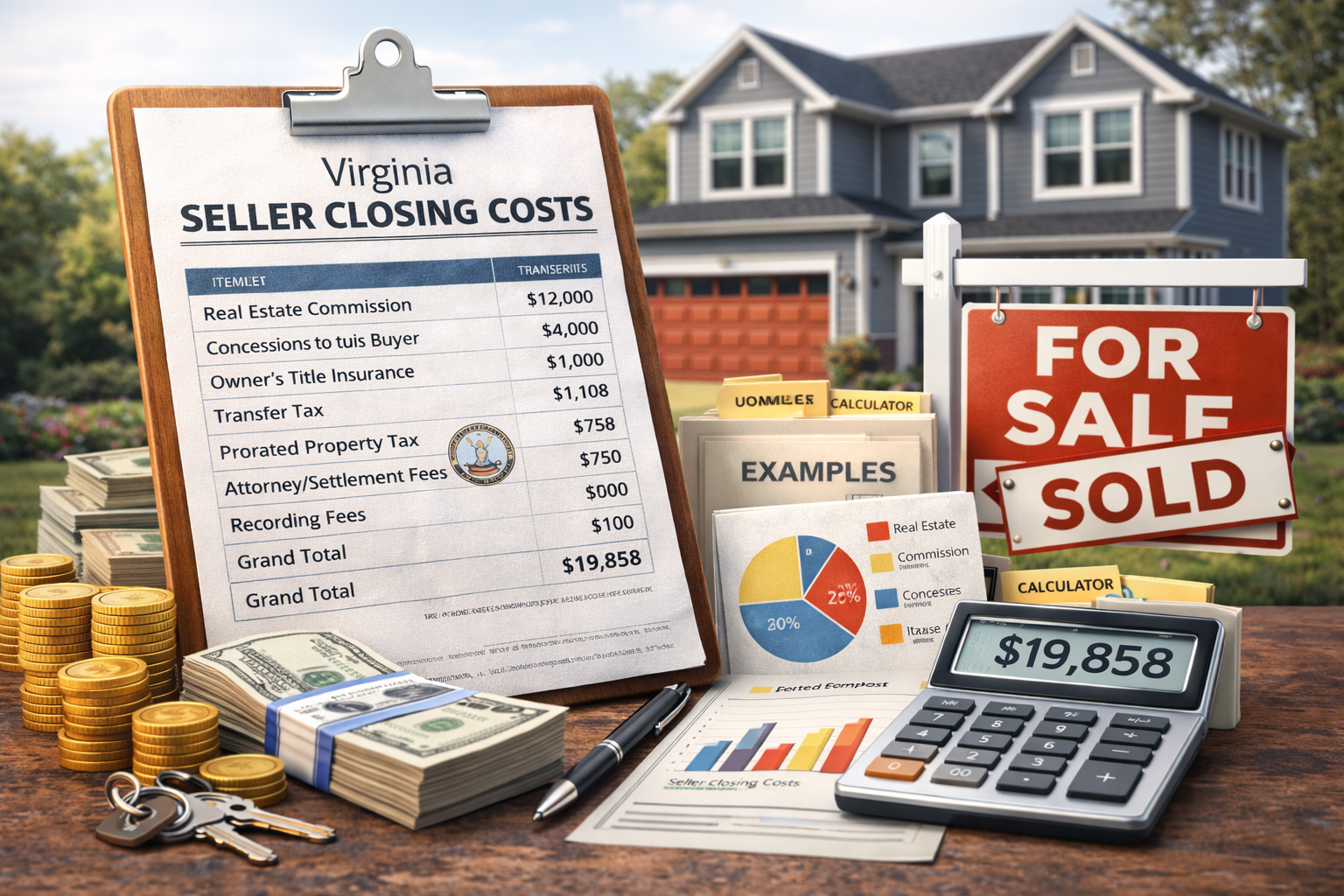 Selling a home in Northern Virginia involves more than paying off your remaining mortgage. As a planning estimate, total selling expenses may equal approximately 7% to 10% of the sale price, although the actual amount depends on your contract, commission agreement, location, and property. On a $600,000 home in Fairfax or Loudoun County, that range would equal roughly $42,000 to $60,000.
The largest expenses often include real estate agent commissions, state and regional transfer taxes, settlement charges, mortgage-payoff fees, repairs, and any buyer concessions negotiated in the contract. Some costs are fixed by the transaction, while others—including agent compensation, repairs, and concessions—may be negotiable.
This guide explains each cost Northern Virginia sellers may encounter, who typically pays it, and where savings may be possible. Before listing, request a professional home valuation and a detailed seller net sheet from an experienced Northern Virginia real estate team. You can also compare a traditional fee structure with a flexible, full-service commission starting at 1.5% to understand how commission choices could affect your proceeds.
This guide breaks down every closing cost Northern Virginia sellers face in 2026, with itemized explanations, real dollar examples at multiple price points across the Northern Virginia real estate market, and proven strategies to keep more of your equity at the settlement table.
Quick Answer: Northern Virginia home sellers typically pay 7% to 10% of the sale price in closing costs. On a $600,000 home, expect to pay roughly $42,000 to $60,000. The largest costs are real estate agent commissions (often 5% to 6%), Virginia's grantor's tax ($1 per $1,000, or 0.1%), the Northern Virginia regional congestion relief tax (0.15%), and title and settlement fees ($1,500 to $3,000). Use a free seller net sheet calculator to estimate your exact proceeds.
Key Takeaways
- Total closing costs: Northern Virginia sellers pay 7% to 10% of the sale price, including commissions.
- Biggest expense: Agent commissions (5% to 6%) represent the largest line item, and the most negotiable.
- Virginia grantor's tax: The state charges $1 per $1,000 of sale price (0.1%); Northern Virginia adds a 0.15% regional tax for a 0.25% total.
- Title and settlement: Expect $1,500 to $3,000 for title insurance, escrow, and closing services.
- Negotiate strategically: Seller concessions, commission structures, and timing can significantly reduce your net costs.
- Calculate before you list: A seller net sheet shows your true take-home amount before you sign a listing agreement.
Table of Contents
- What Are Seller Closing Costs?
- Complete Itemized Breakdown
- Real Estate Agent Commissions
- Virginia Transfer Taxes
- Title & Settlement Fees
- HOA & Condo Fees
- Prorated Items & Credits
- Mortgage Payoff Costs
- Real Examples by Price
- How to Estimate Your Costs
- Ways to Reduce Closing Costs
- Common Mistakes to Avoid
- Alternatives to Traditional Sales
- FAQs
- Glossary of Terms
- Next Steps
What Are Seller Closing Costs in Northern Virginia?
Closing costs are the fees and expenses you pay when the sale of your home becomes final. As a Northern Virginia seller, you do not write a check at closing. Instead, these costs are deducted from your sale proceeds before the remaining funds are wired to you.
Think of closing costs as the transaction expenses of selling real estate. They cover everything from compensating the professionals who help complete the sale to satisfying state and local tax obligations, including the regional transfer tax unique to the Northern Virginia region.
Who Pays What in Northern Virginia?
Northern Virginia follows a customary split that has become standard across most of the region. However, nearly everything is negotiable in a real estate contract. Here is the typical arrangement:
| Cost Item | Seller Pays | Buyer Pays | Negotiable |
|---|---|---|---|
| Real estate commissions | ✓ | No | Yes |
| Grantor's tax (state transfer tax) | ✓ | No | Sometimes |
| Regional/congestion tax | ✓ | No | Sometimes |
| Title insurance (owner's policy) | ✓ | No | Yes |
| Settlement/escrow fee | Split | Split | Yes |
| HOA resale package | ✓ | No | Yes |
| Mortgage payoff & recording | ✓ | No | No |
| Prorated property taxes | ✓ | ✓ | No |
Complete Itemized Breakdown of Northern Virginia Seller Closing Costs
Let us examine every cost you might see on your settlement statement (also called a closing disclosure or HUD-1). We will cover what each item is, why you are paying it, and the typical range for Northern Virginia sellers.
Northern Virginia Seller Closing Costs at a Glance
| Cost Category | Typical Range | On $600K Sale |
|---|---|---|
| Real estate commissions | 4% to 6% | $24,000 to $36,000 |
| Grantor's tax (state) | 0.1% | $600 |
| Regional/congestion tax | 0.15% | $900 |
| Title insurance (owner's) | $800 to $2,500 | ~$1,800 |
| Settlement fee (seller's share) | $400 to $800 | ~$500 |
| HOA resale package | $150 to $500 | ~$350 |
| Attorney/document prep | $150 to $500 | ~$300 |
| Recording fees | $50 to $200 | ~$100 |
| Prorated taxes/HOA dues | Varies | Varies |
| Home warranty (if offered) | $400 to $700 | ~$550 |
| TOTAL (excluding mortgage payoff) | 7% to 10% | $42,000 to $60,000 |
Real Estate Agent Commissions: The Largest Northern Virginia Closing Cost
Agent commissions are by far the biggest expense for Northern Virginia sellers, typically accounting for 50% to 70% of your total closing costs. Understanding how commissions work gives you leverage to negotiate and potentially save thousands.
How Commissions Work in Virginia
When you list your home, you sign a listing agreement that specifies the total commission rate. Historically, the standard was 5% to 6% of the sale price, split between the listing agent's brokerage and the buyer's agent's brokerage.
Following the National Association of Realtors settlement changes that took effect in August 2024, commission structures have become more flexible. Buyer agent compensation is now negotiated separately and is no longer published in the MLS, which gives Northern Virginia sellers more control over what they pay.
| Commission Model | Listing Fee | Cost on $600K | Savings vs. 6% |
|---|---|---|---|
| Traditional (6% total) | 3% | $36,000 | Baseline |
| Reduced rate (5% total) | 2.5% | $30,000 | $6,000 |
| 1.5% listing fee model | 1.5% | $24,000* | $12,000 |
| Flat-fee MLS listing | $300 to $500 | $15,300 to $15,500* | $20,500+ |
*Assumes 2.5% buyer agent compensation offered separately. Flat-fee typically means limited service.
Full-Service at 1.5%: What It Means
Some Northern Virginia agents and teams offer full-service representation at reduced listing fees. For example, a full-service 1.5% commission listing provides the same professional photography, MLS exposure, negotiation expertise, and contract management as traditional rates. You simply pay less for the listing side of the transaction.
This is not a discount model with reduced service. Full service means full marketing, full negotiation support, and full representation from contract to closing. The difference is efficiency and business model, not quality of service.
Potential Savings: 1.5% vs. 3% Listing Fee
| $400K home |
|
| $600K home |
|
| $800K home |
|
| $1M home |
|
Keep More of Your Home Equity
See how much you could save with a lower full-service listing fee. Get a detailed net sheet showing your true proceeds.
Calculate Your Net Proceeds Explore Flexible Commissions
Virginia Transfer Taxes and the Northern Virginia Regional Tax
Virginia imposes transfer taxes on real estate sales, and the seller is typically responsible for paying them. Understanding these taxes, especially the extra regional tax that applies in Northern Virginia, helps you budget accurately.
State Grantor's Tax
Virginia's grantor's tax is charged at $1 per $1,000 of sale price (equivalent to 0.1%). This tax is assessed on the full sale price, with no exemption for the first portion of value.
The grantor's tax is typically non-negotiable in terms of who pays it. Virginia law designates it as the seller's responsibility. However, in some transactions, buyers may agree to cover it as part of negotiations.
Regional Congestion Relief Tax (Northern Virginia)
If you are selling in Northern Virginia, you will pay an additional regional grantor's tax of $0.15 per $100 of value, or 0.15%. This Northern Virginia Transportation Authority congestion relief tax funds road, transit, and transportation improvements across the region, and it does not apply in most other parts of the state.
Northern Virginia Regional Transfer Taxes by Jurisdiction
| Jurisdiction | State Tax | Regional Tax | Total | On $600K |
|---|---|---|---|---|
| Loudoun County | 0.10% | 0.15% | 0.25% | $1,500 |
| Fairfax County | 0.10% | 0.15% | 0.25% | $1,500 |
| Prince William County | 0.10% | 0.15% | 0.25% | $1,500 |
| Arlington County | 0.10% | 0.15% | 0.25% | $1,500 |
| City of Alexandria | 0.10% | 0.15% | 0.25% | $1,500 |
| Richmond area | 0.10% | 0.00% | 0.10% | $600 |
| Rest of Virginia | 0.10% | 0.00% | 0.10% | $600 |
Calculating Your Northern Virginia Transfer Tax
The calculation is straightforward:
- State grantor's tax: Sale price × 0.001
- Regional tax (Northern Virginia): Sale price × 0.0015
- Total (Northern Virginia): Sale price × 0.0025
For a $750,000 home in Ashburn (Loudoun County):
- State tax: $750,000 × 0.001 = $750
- Regional tax: $750,000 × 0.0015 = $1,125
- Total transfer taxes: $1,875
Title Insurance and Settlement Fees
Title and settlement costs protect both buyers and lenders against ownership disputes. In Virginia, sellers traditionally pay for the owner's title insurance policy, while buyers cover the lender's policy.
What Title Insurance Covers
Title insurance protects against claims that could arise from:
- Errors in public records or title searches
- Unknown liens from previous owners
- Undisclosed heirs who claim ownership
- Forgery or fraud in the property's chain of title
- Boundary or survey disputes
Typical Title & Settlement Costs for Sellers
| Service | Typical Cost | Notes |
|---|---|---|
| Owner's title insurance | $800 to $2,500 | Based on sale price; one-time premium |
| Settlement/closing fee | $400 to $800 | Seller's portion; often split with buyer |
| Title search/exam | $150 to $400 | Sometimes bundled with insurance |
| Document preparation | $150 to $350 | Deed, settlement statement prep |
| Wire transfer fee | $25 to $50 | To transfer proceeds to your bank |
| Recording fees | $50 to $150 | For deed and mortgage release |
Can You Choose the Title Company?
Yes, and you should consider it carefully. Virginia allows either party to select the title company, and your real estate agent can provide recommendations. Some key factors when choosing:
- Compare quotes from at least two companies
- Ask about bundled discounts for multiple services
- Verify they are licensed in Virginia
- Check reviews and ask your agent about their experience with that company
HOA and Condo Fees at Closing
If your Northern Virginia property is part of a homeowners association or condominium, you will have additional closing costs. These fees are mandated by Virginia law to provide buyers with complete information about the community.
Required Disclosure Packages
Under the Virginia Property Owners' Association Act and the Virginia Condominium Act, sellers must provide buyers with an HOA or condo resale disclosure package. This package includes financial statements, governing documents, rules, and any pending assessments.
HOA/Condo Closing Costs Checklist
| Fee Type | Typical Cost | Who Orders |
|---|---|---|
| Resale disclosure package | $150 to $400 | Seller or agent orders from HOA |
| Rush fee (if needed) | $50 to $150 | Seller pays if expedited |
| Capital contribution (move-out) | $0 to $500 | Some HOAs charge seller |
| Prorated HOA dues | Varies | Credit/debit based on closing date |
| Special assessments | Varies | Negotiable; check contract |
Special Assessments: A Critical Negotiation Point
If your HOA has an upcoming special assessment (for roof repairs, road paving, amenity upgrades, and similar projects), this becomes a negotiation item. Virginia contracts typically specify whether the seller or buyer is responsible for assessments that have been approved but not yet paid.
Be prepared to disclose any known upcoming assessments. Failure to disclose can create legal liability after closing.
Curious What You Will Actually Take Home?
Our free seller net sheet calculator factors in all Northern Virginia closing costs: commissions, transfer taxes, HOA fees, and more.
Get Your Free Net Sheet
Prorated Items and Credits
Prorations ensure that ongoing expenses are fairly divided between seller and buyer based on the closing date. These are not technically costs. They are adjustments that can work in your favor or against you.
How Prorations Work
If you have prepaid property taxes or HOA dues past the closing date, you will receive a credit. If you owe for the period before closing but have not paid yet, the amount will be debited from your proceeds.
Common Prorated Items at Northern Virginia Closings
| Item | Seller Owes | Seller Receives |
|---|---|---|
| Property taxes (if unpaid) | ✓ | No |
| Property taxes (if prepaid) | No | ✓ |
| HOA dues (if prepaid) | No | ✓ |
| Rent (if tenant-occupied) | No | ✓ |
| Heating oil (if applicable) | No | ✓ |
Northern Virginia Property Tax Proration
Virginia property taxes are paid semi-annually or annually depending on the locality. The timing of your closing relative to tax due dates determines whether you will owe money or receive a credit:
- Fairfax County: Taxes due July 28 and December 5
- Loudoun County: Taxes due June 5 and December 5
- Prince William County: Taxes due July 15 and December 5
- Arlington County: Taxes due June 15 and October 5
Mortgage Payoff Costs
If you have an existing mortgage, it must be paid off at closing. Several costs are associated with this process.
Understanding Your Payoff Amount
Your mortgage payoff amount is not the same as your current balance. The payoff includes:
- Principal balance: What you still owe
- Accrued interest: Interest from your last payment to the closing date
- Payoff fee: $25 to $100 charged by most lenders
- Recording fee: To release the lien from public records
Mortgage Payoff Checklist
- Request payoff statement 2 to 3 weeks before closing
- Verify per-diem interest rate for date adjustments
- Check for prepayment penalties (rare but possible)
- Confirm payoff is valid through your target closing date
- Keep copies for your records and tax purposes
HELOC and Second Mortgages
If you have a home equity line of credit (HELOC) or second mortgage, these must also be paid off. Request separate payoff statements for each loan and factor these into your net proceeds calculation.
Real Examples: Northern Virginia Closing Costs by Sale Price
Let us walk through detailed closing cost examples at different price points common in Northern Virginia. These examples assume properties in the Northern Virginia region (where the regional transfer tax applies) with standard HOA communities.
Example 1: $450,000 Townhome in Ashburn
| Cost Item | Amount |
|---|---|
| Agent commission (5%) | $22,500 |
| State grantor's tax (0.1%) | $450 |
| Regional transfer tax (0.15%) | $675 |
| Owner's title insurance | $1,200 |
| Settlement fee (seller's share) | $450 |
| HOA resale package | $350 |
| Document prep & recording | $350 |
| Wire fee | $35 |
| TOTAL CLOSING COSTS | $26,010 |
| As percentage of sale price | 5.8% |
Example 2: $700,000 Single-Family Home in Fairfax
| Cost Item | Amount |
|---|---|
| Agent commission (5%) | $35,000 |
| State grantor's tax (0.1%) | $700 |
| Regional transfer tax (0.15%) | $1,050 |
| Owner's title insurance | $1,800 |
| Settlement fee (seller's share) | $500 |
| HOA resale package | $375 |
| Document prep & recording | $400 |
| Wire fee | $40 |
| TOTAL CLOSING COSTS | $39,865 |
| As percentage of sale price | 5.7% |
Example 3: $1,100,000 Home in Vienna
| Cost Item | Amount |
|---|---|
| Agent commission (5%) | $55,000 |
| State grantor's tax (0.1%) | $1,100 |
| Regional transfer tax (0.15%) | $1,650 |
| Owner's title insurance | $2,400 |
| Settlement fee (seller's share) | $600 |
| HOA resale package | $400 |
| Document prep & recording | $450 |
| Wire fee | $45 |
| TOTAL CLOSING COSTS | $61,645 |
| As percentage of sale price | 5.6% |
What If You Used a 1.5% Listing Fee?
Compare the commission savings at each price point:
| Sale Price | 3% Listing Fee | 1.5% Listing Fee | You Keep |
|---|---|---|---|
| $450,000 | $13,500 | $6,750 | +$6,750 |
| $700,000 | $21,000 | $10,500 | +$10,500 |
| $1,100,000 | $33,000 | $16,500 | +$16,500 |
*Assumes separate buyer agent compensation. A full-service 1.5% commission listing can preserve thousands in equity at every price point.
How to Estimate Your Northern Virginia Closing Costs
Getting an accurate estimate of your closing costs before listing helps you price your home correctly and plan your next move. Here is how to calculate your costs step by step.
Step-by-Step Calculation Method
Get a free home valuation or review recent comparable sales in your neighborhood.
Multiply sale price by the total commission percentage (typically 4% to 6%).
State 0.1% plus regional 0.15% (in Northern Virginia) equals 0.25% of sale price.
Budget $2,000 to $3,500 for title insurance, settlement fees, and document prep.
Add $150 to $500 for the resale disclosure package.
Contact your lender for an exact payoff amount including per-diem interest.
Quick Estimation Formula
For a fast ballpark figure, use this formula:
Estimated Closing Costs = Sale Price × 7.5%
This covers average commissions (5%), transfer taxes (0.25% in Northern Virginia), and other fees (around 2.25%). Adjust up or down based on your specific commission rate.
Use a Seller Net Sheet Calculator
The most accurate way to estimate your proceeds is with a detailed seller net sheet. This tool factors in your specific sale price, commission rate, mortgage balance, and local fees.
A detailed seller net sheet calculates everything automatically and shows you exactly what you will walk away with after all costs.
9 Ways to Reduce Your Northern Virginia Closing Costs
While some closing costs are fixed or legally required, many are negotiable or avoidable. Here is how to minimize your expenses without sacrificing service quality.
| Strategy | Potential Savings | Difficulty |
|---|---|---|
| Negotiate listing commission | $5,000 to $15,000+ | Moderate |
| Use a 1.5% full-service agent | $6,000 to $15,000+ | Easy |
| Compare title company quotes | $200 to $600 | Easy |
| Negotiate buyer pays some costs | $500 to $2,000 | Moderate |
| Skip the home warranty | $400 to $700 | Easy |
| Time closing for tax advantages | Varies | Moderate |
| Review settlement statement carefully | $100 to $500 | Easy |
| Avoid repairs through pricing | Indirect | Moderate |
| Sell to a cash buyer | $2,000 to $5,000 | Situational |
1. Negotiate Your Listing Commission
Commission is the largest closing cost and the most negotiable. Do not assume the rate your agent quotes is fixed. Many Northern Virginia brokerages now offer flexible commission options built around your sale price and service needs. Ask about:
- Reduced rates for repeat clients or referrals
- Tiered structures based on sale price
- Full-service agents with lower listing fees
2. Choose a Full-Service Agent at 1.5%
Some Northern Virginia teams offer full-service representation at a 1.5% listing fee. This is not a discount or limited-service model. It includes professional photography, MLS marketing, expert negotiation, and complete transaction management. The difference is business efficiency, not service quality.
3. Compare Title Company Quotes
Virginia has many reputable title companies, and their fees vary. Request quotes from 2 to 3 companies and compare line by line. Pay attention to bundled services versus a la carte pricing.
4. Negotiate Buyer-Paid Costs
In a seller's market, you may be able to negotiate having the buyer cover certain traditionally seller-paid costs, such as:
- Owner's title insurance
- Home warranty
- A portion of transfer taxes
5. Evaluate the Home Warranty
Offering a home warranty can make your listing more attractive, but it is not required. In competitive markets, you may be able to skip this $400 to $700 expense without affecting buyer interest.
6. Review Your Settlement Statement
Before closing, carefully review the settlement statement (closing disclosure). Look for:
- Duplicate charges
- Fees higher than originally quoted
- Services you did not authorize
- Calculation errors
7. Time Your Closing Strategically
Closing dates affect property tax and HOA proration. Closing shortly after you have prepaid taxes can return part of that money to you as a credit, while closing just before a tax due date may shift more of the burden onto the buyer.
8. Price to Limit Repair Concessions
Pricing your home accurately and addressing obvious issues before listing reduces the repair credits buyers request after inspection. Repair concessions come straight out of your net proceeds, so getting ahead of them protects your bottom line.
9. Consider a Cash Sale for Speed
If carrying costs are draining your equity, a cash buyer can cut some transaction fees and shorten your timeline, though typically at a lower sale price. Weigh the savings against the price tradeoff before deciding.
Ready to See What You Will Actually Net?
Get a personalized estimate that accounts for all Northern Virginia closing costs, your specific mortgage balance, and different commission scenarios.
Estimate My Net Proceeds
Common Mistakes Northern Virginia Sellers Make with Closing Costs
Avoid these pitfalls that can cost you money or create problems at closing:
❌ Mistakes to Avoid
- Not getting a net sheet before listing: Many sellers price their home without understanding what they will actually take home, leading to disappointment or an inability to purchase their next home.
- Assuming commission rates are fixed: Rates are always negotiable, and full-service options exist at lower price points. Always compare options before signing a listing agreement.
- Forgetting about the regional transfer tax: Northern Virginia sellers owe an extra 0.15% that sellers in other parts of Virginia do not pay. Budget accordingly.
- Not reviewing the settlement statement: Errors happen. Review every line item before signing and ask questions about anything you do not recognize.
- Ignoring special assessments: Failing to disclose known HOA assessments can create legal liability. Be upfront and negotiate responsibility in the contract.
- Waiting until closing to get mortgage payoff: Request your payoff statement early to avoid surprises and ensure accurate calculations.
- Confusing estimated with final costs: Initial estimates can change. The final settlement statement is what you actually pay, so always review it carefully.
Alternatives to a Traditional Home Sale in Northern Virginia
Depending on your situation, alternative selling methods may reduce or shift your closing costs:
| Option | Typical Closing Costs | Best For |
|---|---|---|
| Traditional listing (full commission) | 7% to 10% | Maximum sale price potential |
| Full-service at 1.5% listing fee | 5.5% to 8% | Full service plus cost savings |
| cash offer sale | 2% to 5% | Speed, certainty, as-is sale |
| FSBO (For Sale By Owner) | 3% to 5% | Experienced sellers with time |
| iBuyer programs | 5% to 8% | Convenience (limited availability) |
When Cash Offers Make Sense
A cash offer typically means accepting a lower sale price, but it can make financial sense when:
- Your home needs significant repairs that would affect traditional buyer financing
- You need to close quickly due to relocation, divorce, or financial constraints
- You want to avoid showings, staging, and open houses
- The carrying costs (mortgage, taxes, utilities) of a longer sale outweigh the price difference
FSBO Considerations
Selling without an agent (FSBO) eliminates the listing commission but comes with tradeoffs:
| FSBO Advantages | FSBO Challenges |
|---|---|
|
|
Frequently Asked Questions About Northern Virginia Seller Closing Costs
How much will I pay in closing costs as a Northern Virginia seller in 2026?
Northern Virginia sellers typically pay 7% to 10% of the sale price in closing costs. This includes real estate commissions (4% to 6%), state and regional transfer taxes (0.25% combined), title insurance, settlement fees, and other transaction costs. On a $600,000 home, expect to pay approximately $42,000 to $60,000 in total closing costs.
What is the grantor's tax in Virginia?
Virginia's grantor's tax is a state transfer tax charged at $1 per $1,000 of sale price, or 0.1%. On a $500,000 home, the grantor's tax would be $500. The seller is typically responsible for paying this tax at closing.
Is there an additional transfer tax in Northern Virginia?
Yes. Properties in Northern Virginia jurisdictions (including Fairfax County, Loudoun County, Prince William County, Arlington County, and the City of Alexandria) are subject to an additional regional congestion relief tax of $1.50 per $1,000, or 0.15%. Combined with the state grantor's tax, Northern Virginia sellers pay 0.25% of the sale price in transfer taxes.
Who pays for title insurance in Virginia?
In Virginia, the seller customarily pays for the owner's title insurance policy, while the buyer pays for the lender's title insurance policy. However, this is negotiable in the purchase contract. Owner's title insurance typically costs $800 to $2,500 depending on the sale price.
Can I negotiate closing costs as a seller in Northern Virginia?
Yes, several closing costs are negotiable. Real estate commissions, title company selection, and some buyer-paid versus seller-paid allocations can all be negotiated. Transfer taxes are set by law and not negotiable, though you may be able to negotiate having the buyer contribute to them in some circumstances.
What is an HOA resale package and do I have to pay for it?
An HOA resale package (or disclosure packet) contains financial statements, governing documents, rules, and other information required by Virginia law to be provided to buyers. The seller is typically responsible for ordering and paying for this package, which costs $150 to $400 depending on the HOA management company.
How can I reduce my closing costs when selling in Northern Virginia?
The most effective ways to reduce closing costs include negotiating your listing commission or choosing a full-service agent with a lower listing fee, comparing quotes from multiple title companies, negotiating to have the buyer pay certain costs, and carefully reviewing your settlement statement for errors or unnecessary fees.
What is the difference between a net sheet and a settlement statement?
A seller net sheet is an estimate prepared before or during the listing period that projects your proceeds based on expected sale price and estimated costs. A settlement statement (or closing disclosure) is the final, official document prepared at closing that shows the actual amounts for all costs and your final proceeds. Estimate your proceeds with a free net sheet before listing so there are no surprises at the closing table.
How do I choose the best real estate agent in Northern Virginia?
Look for agents with strong local market knowledge, a track record of successful sales in your area, transparent communication about their commission structure and services, and positive client reviews. Ask about their marketing strategy, average days on market for their listings, and sale-to-list price ratio. Interview multiple agents and ask for references. Teams like Jamil Brothers Realty Group, with over $500M in total sales and recognition as NVAR Lifetime Top Producers, offer one data point for comparison, but always evaluate multiple options based on your specific needs.
Are closing costs tax deductible for Virginia sellers?
Some closing costs can be added to your cost basis (reducing your taxable gain), while others may be deductible. Real estate commissions and transfer taxes are typically added to your cost basis. Consult a tax professional for advice specific to your situation, especially regarding capital gains exclusions for primary residences.
When do I pay closing costs, at signing or from my proceeds?
As a seller, you do not write a check for closing costs. Instead, all costs are deducted from your sale proceeds before the remaining funds are wired to you (typically 1 to 3 business days after closing). You will see an itemized breakdown on your settlement statement showing exactly what was deducted and your final net proceeds.
Glossary of Northern Virginia Closing Cost Terms
- Closing Disclosure
- The official document that itemizes all charges, credits, and final amounts for both buyer and seller at closing. Replaced the HUD-1 settlement statement in 2015.
- Escrow
- A neutral third-party account that holds funds and documents until all conditions of the sale are met. The title/settlement company typically manages escrow in Virginia.
- Grantor's Tax
- Virginia's state transfer tax on real estate sales, charged at $1 per $1,000 of sale price (0.1%). Paid by the seller (grantor) at closing.
- Net Proceeds / Net Sheet
- The amount a seller takes home after all closing costs, commissions, and mortgage payoff are deducted from the sale price. A net sheet estimates this amount.
- Owner's Title Insurance
- A one-time insurance policy that protects the buyer (and their heirs) against future claims on the property's title. Customarily paid by the seller in Virginia.
- Payoff Statement
- A document from your mortgage lender showing the exact amount needed to pay off your loan, including principal balance, accrued interest, and any fees.
- Proration
- The division of ongoing expenses (property taxes, HOA dues) between buyer and seller based on the closing date.
- Recording Fee
- Fee charged by the county clerk to record the deed transfer and mortgage release in public records.
- Regional Congestion Relief Tax
- An additional transfer tax of $1.50 per $1,000 (0.15%) charged on real estate sales in Northern Virginia to fund transportation improvements.
- Resale Disclosure Package
- Required documents from an HOA or condo association that disclose financial information, rules, and any pending assessments to potential buyers.
- Settlement Fee
- Fee charged by the title/settlement company for coordinating the closing, preparing documents, and disbursing funds. Often split between buyer and seller.
Next Steps: Calculate Your True Northern Virginia Seller Proceeds
Understanding your closing costs as a Northern Virginia seller is the first step toward a successful, financially sound home sale. The key takeaways to remember:
- Budget 7% to 10% of your sale price for total closing costs
- Agent commissions (your largest cost) are negotiable, so explore full-service options at lower listing fees
- Northern Virginia sellers pay an extra 0.15% regional transfer tax on top of the statewide grantor's tax
- Always get a net sheet before listing to understand your true take-home amount
- Review your settlement statement carefully before closing
Ready to see exactly what you will net when you sell your Northern Virginia home? The most accurate way to plan your sale is with a detailed net sheet that factors in your specific situation.
Get Your Free Seller Net Sheet
See exactly what you will walk away with after all Northern Virginia closing costs. Our free calculator provides an itemized breakdown customized to your home.
See Your Net ProceedsOr request a free home valuation to estimate your sale price first.
Planning to buy your next home after selling? Our team can help you coordinate both transactions. Explore buyer strategies or browse homes for sale in Northern Virginia.
Explore More
Browse Every Corner of the DMV Market
Whether you're searching by budget, neighborhood, or buying situation — find exactly what you need below.
Virginia Homes by Budget
Washington DC Homes by Budget
Maryland Homes
Explore Northern Virginia Communities
Loudoun County
Fairfax County & Surrounding
Ready to Make a Move?
Full-Service · No Tradeoffs
List for 1.5% & Keep More Equity
Professional photography, drone video, 3D tours, and expert negotiation — all included. On an $800K home, that's $12,000 more in your pocket vs. a 3% agent.
See the 1.5% Program →Need Speed or Certainty?
Get a No-Obligation Cash Offer
Skip the showings, skip the contingencies. If timing or condition matters more than top dollar, a cash offer may be the right fit. We'll walk you through every option.
Explore Cash Offers →Categories
- All Blogs (1158)
- Aldie (3)
- Ashburn (6)
- Buyer Guide (8)
- Buying a home (2)
- Buying Strategies (28)
- festivals (1)
- General Blog (66)
- Leesburg (5)
- Market Intelligence (29)
- Market Updates (8)
- Notable Properties For Sale (29)
- Real Estate Tips, News, and More (376)
- Seller Guide (2)
- Seller Guides (60)
- Selling Your Home (469)
- Sterling (6)
- Top Realtors in Northern Virginia (58)
Recent Posts






Message Sent!
Thank you for reaching out. Arslan & Saad have received your details and will be in touch shortly.
Need immediate assistance? Call or text 703-782-4830.