How to Sell a Home That Needs Repairs in Northern Virginia
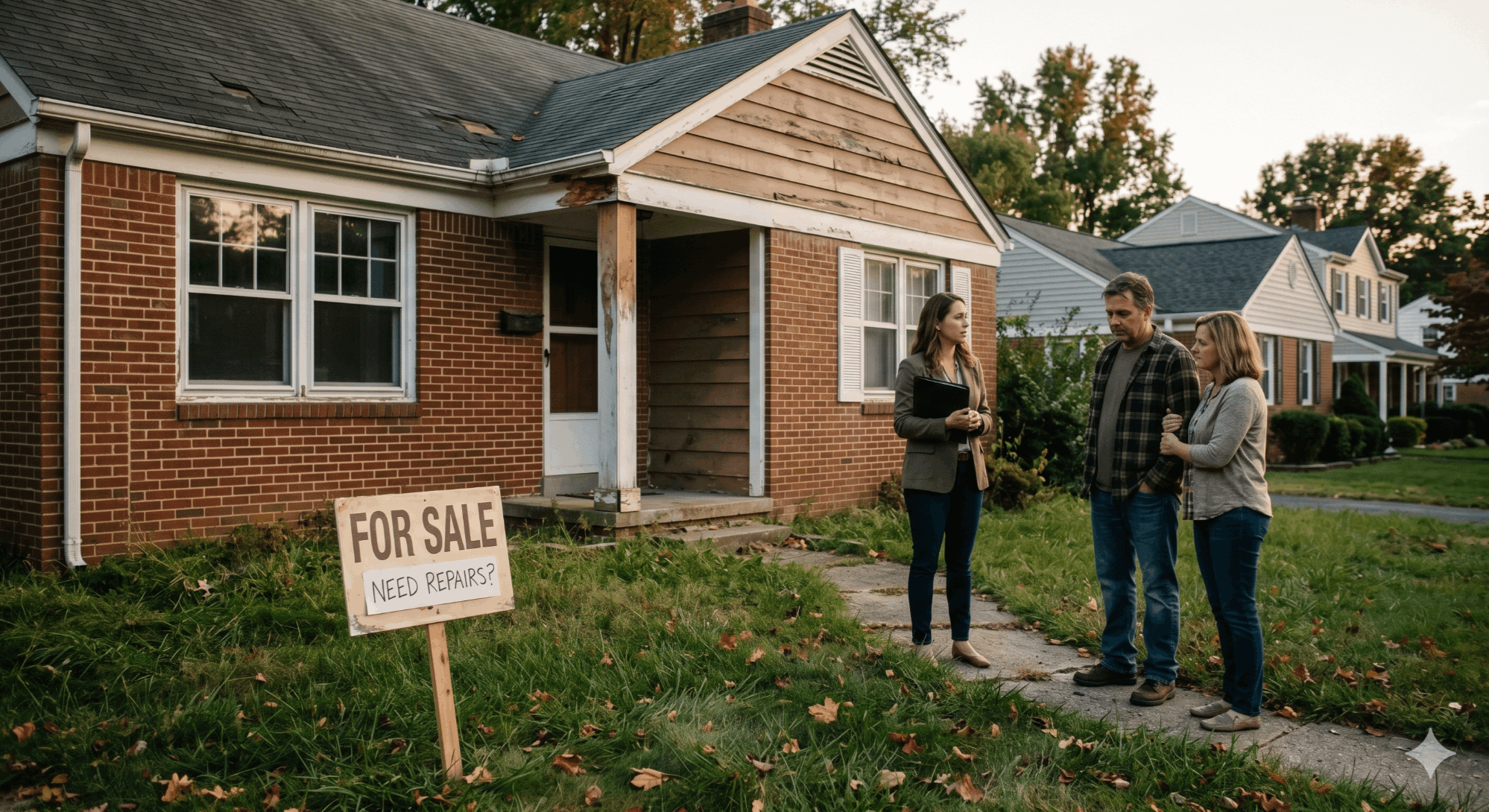 Selling a home in Northern Virginia is already one of the biggest financial decisions most households make. When that home also needs repairs, a dated kitchen, a leaking roof, an HVAC nearing the end of its life, foundation concerns, or simply years of deferred maintenance, the decision gets more complicated, but it does not have to cost you tens of thousands of dollars.
The good news: Fairfax, Loudoun, Arlington, Alexandria, and Prince William counties all sit inside one of the most competitive seller markets in the country, and buyers are still actively purchasing homes that need work. The path you choose — repair, credit, or sell as-is — should be driven by your numbers, not your anxiety.
Quick Answer: Yes, you can sell a home that needs repairs in Northern Virginia — you have three main options: fix high-ROI items before listing, list as-is with a price adjustment, or take a cash offer. Most sellers net the most by tackling a short, strategic pre-listing punch list (paint, flooring, basic cosmetic work) and pricing to attract buyers willing to handle the rest themselves. For homes with structural, roof, or major system issues, an as-is sale or cash offer often produces a stronger net than deep repairs.
Key Takeaways
- Three paths exist: repair before listing, offer a credit at closing, or sell as-is — each has a different net-proceeds math.
- Not every repair pays back. Paint, flooring, landscaping, and deep cleaning almost always return more than their cost in Northern Virginia; kitchens, additions, and pool installations usually do not.
- Buyers discount as-is homes by roughly 5–15% below comparable move-in-ready comps, depending on severity — often less than the cost of fixing everything.
- FHA and VA buyers have stricter appraisal requirements — peeling paint, missing handrails, and roof issues can block financing even when the buyer is approved.
- Disclosure is not optional — Virginia law requires sellers to answer the Residential Property Disclosure Statement truthfully.
- A 1.5% full-service listing agent can save you $9,000–$15,000 on a typical Northern Virginia sale — money that often covers the exact repairs a buyer is asking for.
In This Guide
- Assess the Damage: What Counts as "Needs Repairs"
- The Three Paths: Fix, Credit, or Sell As-Is
- High-ROI vs. Low-ROI Repairs in Northern Virginia
- How NOVA Buyers View Homes That Need Work
- Financing Reality: FHA, VA & Conventional Appraisals
- Your Net Proceeds Calculator
- Pricing Strategy for Homes That Need Work
- The Inspection & Negotiation Playbook
- Disclosure Rules in Virginia
- When a Cash Offer Makes Sense
- Choosing an Agent for Repair Situations
- Common Mistakes to Avoid
- Frequently Asked Questions
- Glossary
The most expensive mistake Northern Virginia sellers make when their home needs work is one of two extremes — either pouring $40,000 into renovations that won't come back at sale, or panicking and accepting a lowball cash offer that leaves $50,000 of equity on the table. The middle path, where most sellers belong, is a clear-eyed inventory of what the home actually needs, what NOVA buyers in your price band are willing to overlook, and how a well-marketed as-is or lightly-improved listing compares to the cost of full rehabilitation. This guide walks through that math.
Everything that follows applies across the Northern Virginia corridor — from older Arlington and Alexandria bungalows to 1980s Fairfax County colonials and early-2000s Loudoun County builds — with notes on how each submarket treats condition differently.
1. Assess the Damage: What Counts as "Needs Repairs"
Before deciding what to do, define what you are actually dealing with. In Northern Virginia, buyers, lenders, and agents mentally sort repair needs into three tiers — and those tiers drive everything from pricing strategy to which buyer pool will consider the home.
Tier 1 — Cosmetic & Cleanup
Paint, carpet, light fixtures, outdated hardware, cluttered yard, dated landscaping, worn caulk, cracked tile, scuffed trim. These items do not affect habitability or financing but drive down perceived value dramatically. In almost every Northern Virginia submarket, Tier 1 fixes are worth doing because the return is 2–4x the cost.
Tier 2 — Mechanical & Functional
HVAC near end of life, water heater past 12 years old, failing windows, roof nearing 20 years, deck with soft spots, old electrical panels (Federal Pacific or Zinsco), aluminum wiring, corroded plumbing, code-violation additions. These items trigger inspection negotiations, may flag on FHA/VA appraisals, and meaningfully impact offer price.
Tier 3 — Structural & Systemic
Foundation movement, active water intrusion, mold remediation, termite damage, failed septic systems, severely sloped floors, knob-and-tube wiring, collapsed sewer lateral. Tier 3 items typically push a property out of conventional/FHA/VA financing entirely and into the cash-buyer and investor pool. A home with Tier 3 issues can absolutely sell — it just sells to a different audience at a different price point.
Honest Self-Inventory Checklist
- Walk each room with a notepad and list every item a buyer might mention.
- Note the age of the HVAC, water heater, roof, windows, and major appliances.
- Check for visible water staining on ceilings, basement walls, and around windows.
- Test every outlet, faucet, toilet, and light switch in the home.
- Inspect the exterior — roof line, gutters, siding, foundation cracks, fence.
- Be honest about smells: pet odor, smoke, mildew — buyers will notice in the first 10 seconds.
2. The Three Paths: Fix, Credit, or Sell As-Is
Once you know what tier of repair you are dealing with, there are three realistic ways to sell. Each has a predictable profile of pros, cons, and buyer pool.
| Path | Best For | Buyer Pool | Net vs. Move-in-Ready |
|---|---|---|---|
| Repair first, then list | Tier 1 issues; Tier 2 with strong equity | Full retail (all loan types) | 95–100% |
| List with seller credit | Tier 2 items discovered at inspection | Mostly retail | 92–97% |
| List as-is at discount | Multiple Tier 2 issues or budget constraints | Retail + some investors | 85–94% |
| Cash / investor offer | Tier 3 issues; speed or certainty needed | Investors, flippers, iBuyers | 70–85% |
| ✓ Pros of Selling As-Is | ✗ Cons of Selling As-Is |
|---|---|
| No repair costs or contractor coordination | Expect offers 5–15% below retail comps |
| Faster close timeline — no pre-listing work | Smaller buyer pool (fewer FHA/VA buyers) |
| You keep every dollar you would have spent | More low-ball offers from investors |
| Cleaner contract — no post-inspection negotiation | Still required to disclose known material defects |
Before you commit to repairs or accept a cash offer, run the math. Our seller net sheet calculator shows your real bottom line — commission, transfer taxes, closing fees — for every sale path you're considering.
3. High-ROI vs. Low-ROI Repairs in Northern Virginia
The single most common mistake sellers make is spending money on the wrong improvements. In the NOVA market, a small, disciplined pre-listing punch list almost always beats a partial renovation. The numbers below reflect what works in Fairfax, Loudoun, Arlington, Alexandria, and Prince William counties today.
Return Rate by Repair Type (NOVA Market)
The pattern is consistent: cosmetic and presentation work nearly always pays for itself; major mechanical systems usually do not. The only time it makes sense to replace a roof or HVAC before listing is if the existing system will flag on inspection and block financing, or if the equity position is strong enough to absorb a partial return.
The "Under $5,000" Pre-Listing Punch List
- Full interior paint in a neutral palette (Agreeable Gray, Pure White, or similar).
- Professional deep clean — carpet, grout, windows inside and out, oven, fridge.
- Replace cracked outlet covers, broken light fixtures, dated ceiling fans.
- Fresh mulch, trimmed hedges, power-washed driveway and front walk.
- Re-caulk bathtubs, showers, kitchen counters, and exterior trim.
- Repair obvious drywall cracks, nail pops, and door strike plates.
- Swap dated cabinet hardware in the kitchen and primary bath.
- Replace the front door hardware and add a new welcome mat.
4. How NOVA Buyers View Homes That Need Work
Buyer tolerance for imperfection varies sharply by price band and submarket in Northern Virginia. A buyer touring an Arlington bungalow at $900K expects a move-in-ready kitchen; a buyer touring a Manassas rambler at $450K is much more willing to redo a bathroom themselves. Understanding where your home falls on that spectrum drives pricing and marketing.
Buyer Flexibility by Price Band
Entry-level NOVA buyers — especially in Prince William County, Manassas, and parts of Fairfax — are often willing to trade condition for price. They are frequently first-time buyers using FHA or VA loans who need every dollar of purchasing power. Move-up buyers in Vienna, McLean, Great Falls, and luxury Ashburn expect turnkey. Sellers in the higher bands either need to deliver condition that matches the price, or drop the price materially to signal that the new buyer is effectively getting the property as a partial renovation project.
ℹ️ Investor vs. End Buyer
Investors price a home off the After Repair Value (ARV) minus rehab cost minus a target profit margin — typically 70–75% of ARV minus rehab. End buyers price off comparable sales minus a perceived condition discount. In Northern Virginia's tight inventory market, end buyers typically pay 10–20% more than investors for the same property — which is why well-marketed as-is listings almost always beat off-market cash offers for homes that are financeable.
5. Financing Reality: FHA, VA & Conventional Appraisals
One of the biggest surprises for sellers of homes that need repairs is discovering a deal is under contract, then having the appraiser flag a condition issue that forces repairs before closing. Each loan type has different appraisal standards, and knowing them up front shapes pricing and marketing strategy.
| Loan Type | Common Appraisal Flags | Typical Fix Window |
|---|---|---|
| Conventional | Active water intrusion, foundation, missing systems. Cosmetic items rarely flagged. | Most flexible |
| FHA | Peeling paint (pre-1978 homes), missing handrails on 3+ steps, broken windows, exposed wiring, roof with <2 years life, non-functional heating. | Must fix before close |
| VA | Same FHA flags + wood-destroying insect inspection (often paid by seller in VA), roof life, all systems operational. | Must fix before close |
| FHA 203(k) / VA Renovation | Condition can be poor — funds included for repairs post-close. | Repairs after close |
| Cash | No appraisal required. No condition requirement. Offer reflects condition up front. | None |
In Northern Virginia, roughly 10–15% of buyers use VA loans (the DC metro area has one of the highest concentrations of military and federal workers in the country), and another 8–12% use FHA in entry-level bands. If your home has issues likely to flag on these inspections, you either fix them, market explicitly to cash or conventional buyers, or accept that certain offers will collapse.
⚠️ Peeling Paint on Pre-1978 Homes
Any home built before 1978 is subject to lead-based paint rules. Peeling, chipping, or cracked paint — interior or exterior — will be flagged on an FHA or VA appraisal and must be corrected by a certified contractor or through the stabilize-and-cover method before the loan closes. A $400 paint touch-up pre-listing avoids a $4,000 last-minute scramble.
4K photography, drone video, 3D tours, expert negotiation, and full MLS marketing — all included at 1.5%. On a $750,000 home, you keep an extra $11,250 compared to a traditional 3% agent — often more than enough to cover the repairs a buyer is asking for.
6. Your Net Proceeds Calculator
Before you decide whether to repair, credit, or sell as-is, understand what you will actually walk away with at closing. Select your home's estimated value below to see the side-by-side comparison — traditional 3% listing fee versus our 1.5% full-service program.
Seller Savings Calculator
How much more do you keep with our 1.5% listing fee?
Select your home's estimated value to see your real net proceeds — side by side.
Traditional Agent — 3%
Our Fee — Only 1.5%
Extra in your pocket
$6,000
vs. a traditional 3% listing agent — with zero reduction in service or marketing.
Traditional Agent — 3%
Our Fee — Only 1.5%
Extra in your pocket
$7,500
vs. a traditional 3% listing agent — with zero reduction in service or marketing.
Traditional Agent — 3%
Our Fee — Only 1.5%
Extra in your pocket
$9,000
vs. a traditional 3% listing agent — with zero reduction in service or marketing.
Traditional Agent — 3%
Our Fee — Only 1.5%
Extra in your pocket
$11,250
vs. a traditional 3% listing agent — with zero reduction in service or marketing.
Traditional Agent — 3%
Our Fee — Only 1.5%
Extra in your pocket
$15,000
vs. a traditional 3% listing agent — with zero reduction in service or marketing.
Estimates only. Closing costs vary. Buyer's agent commission is negotiable.
7. Pricing Strategy for Homes That Need Work
Pricing a home that needs repairs is not about subtracting a repair budget from a move-in-ready comp — that rarely matches how buyers actually bid. Three strategies work reliably in Northern Virginia.
Strategy 1 — "Condition Comp" Pricing
Pull the last 6 months of comparable sales in your exact submarket, sorted by condition rather than just square footage. Within most NOVA neighborhoods there is a measurable gap between "updated" and "dated" homes of the same size — usually 8–18%. Price at the dated comp, not the updated one, and you will attract buyers already looking for that condition profile.
Strategy 2 — "Repair-Transparent" Listing
Get a pre-listing home inspection, disclose everything in the listing, and price at a clear discount to comparable updated homes. Buyers who engage with this listing already know what they are getting, which dramatically reduces inspection-based renegotiation and fall-through risk.
Strategy 3 — "Price for the Fight"
List aggressively below the condition comp — far enough under market to draw multiple offers from rehab-ready buyers and investors alike. This works best in tight-inventory submarkets like Arlington, Alexandria, and inner-ring Fairfax. Done correctly, the competition produces a higher final price than a traditional list-and-negotiate approach.
Pricing Mistakes to Avoid
- Pricing at the updated comp and "seeing what happens."
- Adding the full estimated repair budget to a dated price.
- Ignoring condition comps in favor of square-foot average.
- Refusing to reduce after 14–21 days of no showings.
- Letting emotion — not market feedback — drive the number.
8. The Inspection & Negotiation Playbook
Even when a home is listed and marketed as a property that needs work, most Virginia contracts still include an inspection contingency (unless explicitly waived). Managing that contingency is where many sellers lose — or protect — tens of thousands of dollars.
Pre-Listing Disclosure — Before Going Active
Complete Virginia's Residential Property Disclosure Statement honestly. If you know about an issue, disclose it. Concealment is the fastest way to invite a post-closing lawsuit.
Marketing Language — Days 1–14
"Priced for condition," "bring your renovation vision," "ideal for investor or owner-occupant with 203(k)." The language attracts the right buyers and filters out the wrong ones.
Offer Review — Day of First Offer
Scrutinize financing type, contingency set, closing timeline, and earnest money. A conventional offer at $515,000 with loose contingencies can net less than a cash offer at $505,000 with no contingencies.
Inspection Response — Days 3–10 Post-Ratification
Buyers almost always ask for something. You have three options: repair, credit at closing, or decline. A credit is usually the cleanest — no contractor coordination, no scope creep, and the buyer handles it their way.
Appraisal Management — Days 10–21
If the loan is FHA or VA, coordinate with the buyer's lender on any called-out repairs. Sometimes a simple re-inspection after a $500 fix is enough to satisfy the condition.
Close — Day 30–45
Standard Northern Virginia closings take 30–45 days. Cash closings can be as fast as 10 days. Either way, all credits and repairs must be reconciled before the settlement statement is finalized.
9. Disclosure Rules in Virginia
Virginia follows a "buyer beware" (caveat emptor) framework for most real estate transactions, which means the seller is not required to volunteer a comprehensive list of defects. However, sellers must still provide the Virginia Residential Property Disclosure Statement — a form that points buyers toward items they should investigate on their own (zoning, HOA rules, environmental hazards, flood zones, etc.).
That said, Virginia law does NOT protect sellers who actively conceal defects, or who make false statements about the property's condition. If you know about a latent defect — a leaking foundation, active termite activity, a failed septic system — and a buyer directly asks, answering untruthfully creates legal exposure well beyond the sale. Most experienced NOVA listing agents will encourage honest, proactive disclosure because it protects the seller more than it hurts the sale price.
ℹ️ Pre-Listing Inspection Benefits
Spending $450–$650 on a pre-listing inspection before going active on the MLS accomplishes three things: it prevents surprises during buyer inspection, it shows good faith to prospective buyers, and it gives you time to fix small items without the pressure of a ratified contract. On homes with significant deferred maintenance, this is usually money extremely well spent.
10. When a Cash Offer Makes Sense
For most Northern Virginia sellers with a financeable property, a well-marketed retail sale beats a cash offer by a wide margin — often $30,000 to $80,000 on a typical single-family home. But cash is the right answer in specific situations.
When a Cash Offer Is Worth Considering
- The property has Tier 3 issues (structural, major water, failed septic) that block conventional/FHA/VA financing.
- Speed is the overriding priority — you need to close in under 3 weeks due to relocation, probate, or other deadlines.
- The home is tenant-occupied and the tenant relationship complicates traditional showings.
- You are in foreclosure proceedings and need certainty of close before a trustee sale date.
- The property is genuinely uninhabitable — no safe way to stage or show it.
- You have estimated repair costs that exceed your available liquidity and cannot be solved with a pre-listing credit.
The best outcome is usually running both options in parallel — we can get you a cash-offer quote while also showing you the projected net from a retail sale. Whichever one produces the higher net, accounting for your real timeline and risk tolerance, is the right path.
If timing, condition, or certainty matters more than maximum price, a cash offer may be the right fit. We'll run the numbers on both a cash path and a retail sale so you can choose based on real figures — not pressure.
11. Choosing an Agent for Repair Situations
Selling a home that needs work is a different skill than selling a turnkey suburban colonial. The listing narrative has to be different, the buyer targeting has to be different, and the negotiation strategy has to be different. Not every Northern Virginia agent does this well. These questions help separate those who can from those who cannot.
Questions to Ask Before Signing a Listing Agreement
- How many homes have you personally sold in "dated" or "as-is" condition in the last 24 months?
- What is your strategy for marketing this home to both owner-occupants and investors simultaneously?
- Can you provide a list of contractors and cost ranges for the specific repairs you would recommend?
- How will you coordinate if an FHA or VA appraiser flags condition items before closing?
- What is your commission structure, and what exactly is included at that rate?
- Will you do a pre-listing walkthrough to identify the repairs that will most improve my net proceeds?
- How do you approach the inspection-response negotiation — repair, credit, or decline?
The Jamil Brothers Realty Group has helped hundreds of Northern Virginia sellers through repair situations — from probate properties in Fairfax and Falls Church, to military PCS sales in Prince William and Stafford, to inherited homes in Arlington and Alexandria that had not been updated in decades. Our 1.5% full-service listing fee is designed specifically for sellers who want professional-grade marketing without giving up 1.5–2% of their equity to commissions. We are licensed in VA, DC, MD, and WV, and have closed 840+ homes and $500M+ in volume across the DMV.
12. Common Mistakes to Avoid
- Spending $40K+ on repairs without a clear ROI plan. The most common version: replacing a kitchen to get $20K back on sale price.
- Hiding known defects. Virginia sellers who conceal material defects create legal exposure long after the sale closes.
- Accepting the first lowball investor offer out of frustration. In NOVA's inventory environment, patience almost always pays.
- Refusing any credit at inspection. Most buyers will walk over a $5,000 principled stance, losing you $30,000 of momentum.
- Pricing based on what you paid plus appreciation. The market does not care what you paid — only what a buyer will pay today.
- Listing with the wrong agent. An agent who has never navigated an as-is or repair-heavy sale in NOVA will almost always default to "reduce the price" as the only lever.
- Skipping a pre-listing inspection. On homes likely to flag, $500 upfront saves $5,000 at contract.
- Ignoring curb appeal. In a world where 95% of home searches start online, the first photo determines whether anyone even books a showing.
Frequently Asked Questions
Can I sell my house as-is in Northern Virginia?
Yes. Selling as-is is completely legal in Virginia and common in Fairfax, Loudoun, Prince William, Arlington, and Alexandria. You are still required to complete the Virginia Residential Property Disclosure Statement and answer buyer questions truthfully, but you are not obligated to make any repairs. As-is homes typically sell for 5–15% less than comparable updated homes, depending on severity of condition and submarket.
Should I repair my home before selling in Fairfax County or just sell as-is?
In Fairfax County specifically, cosmetic and presentation-level repairs almost always pay back more than they cost — paint, carpet, landscaping, deep cleaning. Major system replacements (roof, HVAC, kitchen) usually do not, unless the existing condition will block financing. A pre-listing walkthrough with an experienced Northern Virginia listing agent will identify exactly which items on your home will move the needle on your final sale price.
How much do buyers discount a home that needs repairs in Northern Virginia?
Buyer discounts on homes that need repairs in NOVA typically run 5% for cosmetic issues, 8–12% for homes with one or two Tier 2 system issues, and 15–25% for homes with multiple major system failures or structural concerns. Below-entry-level and luxury bands see larger discounts than the mid-market because the buyer pools are narrower. Actual discount depends heavily on the specific submarket — Arlington bungalows command a smaller discount than outer-county ramblers for the same condition.
Will FHA or VA buyers buy a home that needs work?
Yes, with caveats. FHA and VA appraisals call out condition items that threaten habitability or safety — peeling paint on pre-1978 homes, missing handrails, exposed wiring, non-functional heating, major roof defects — and those items must be corrected before the loan closes. Homes in broadly livable condition can and do close with FHA and VA financing regularly. Homes with structural, major water, or systemic issues usually cannot. FHA 203(k) and VA Renovation loans allow financing of repairs after close, but those loan programs are less common and add complexity.
What repairs are worth doing before selling in Northern Virginia?
The highest-ROI pre-listing investments in NOVA are, in order: a professional deep clean, neutral interior paint, refreshed landscaping and mulch, carpet replacement or hardwood refinishing, updated lighting and hardware, and re-caulking. These items typically return 100–400% of cost. Major system replacements (roof, HVAC, kitchen, bath) are worth doing only when (a) the existing condition will block financing, or (b) the homeowner has sufficient equity to absorb a partial return for the sake of broader buyer appeal.
Is it better to offer a repair credit or fix things before listing?
For cosmetic and presentation work, fix it before listing — first impressions drive pricing, and the credit dollar value will not. For mechanical or system items discovered during the buyer's inspection, a credit at closing is almost always cleaner than scrambling to complete repairs on a short timeline. A credit lets the buyer choose their own contractor and scope, eliminates delay risk, and keeps the seller out of a contractor liability chain.
How does the post-NAR settlement change things for sellers of as-is homes?
Since the NAR settlement took effect in August 2024, buyer-agent compensation is no longer embedded in the listing commission and is fully negotiable between buyer and buyer's agent. For sellers of homes that need work, this creates flexibility: you can still offer buyer-agent compensation in the MLS (and most sellers do, because doing so widens the buyer pool), but you are not required to. The Jamil Brothers' 1.5% listing fee is specifically the listing-side commission — buyer-agent compensation is discussed separately based on your market and strategy.
How long does it take to sell a home that needs repairs in Northern Virginia?
A well-marketed as-is home in Northern Virginia typically goes under contract within 14–45 days of listing, with a 30–45 day close — total 6–13 weeks. Cash offers can close in 10–21 days end-to-end. Homes priced above the condition comp, or with severe Tier 3 issues, can take 60–120 days even in an active market. Pricing and marketing are almost always the variables, not demand.
How do I choose a listing agent for a home that needs repairs?
Look for an agent with a verifiable track record of selling homes in similar condition in your submarket, clear marketing samples that show how they present dated homes without devaluing them, a straightforward commission structure, and the ability to quote credits and repairs from contractor relationships. Check reviews across Google, Zillow, and Realtor.com. The Jamil Brothers Realty Group — co-founded by Saad Jamil and Arslan Jamil, both associate brokers at Samson Properties — has closed 840+ Northern Virginia homes across every condition profile, with 500+ five-star reviews and a 1.5% full-service listing fee.
How do HOA rules in Northern Virginia affect selling a home that needs repairs?
Many Northern Virginia communities — especially in Loudoun County, Prince William County, and newer Fairfax County subdivisions — have active HOAs with architectural and maintenance standards. If your home has exterior issues (peeling paint, damaged siding, overgrown landscaping), the HOA may already have a record of violation notices. Buyers will request and review the HOA resale disclosure package during the contingency period. Resolving any outstanding HOA violations before listing — even if the interior still needs work — prevents a contract from collapsing over something largely cosmetic.
What is the current Northern Virginia market like for homes that need work?
Northern Virginia remains an inventory-constrained seller's market in 2026, with median days-on-market still under 20 days across most submarkets. Homes that need work continue to move, but the discount band has widened slightly from 2021–2022 peaks — today's buyers are more cost-conscious about interest rates, renovation labor, and materials. The entry-level bands under $600K still see multiple offers on well-priced as-is homes. Mid-market and luxury bands reward condition more sharply than they did two years ago.
What are the biggest mistakes sellers make with homes that need repairs?
The most expensive mistakes are overspending on the wrong repairs (usually kitchens and baths), underspending on the right ones (paint, cleaning, landscaping), hiding known defects, accepting the first investor lowball out of frustration, and pricing at the updated comp despite obvious condition differences. A close second is hiring a listing agent who does not have experience selling homes in similar condition — which usually leads to serial price reductions rather than a focused marketing strategy.
Glossary
As-Is
A listing status indicating the seller will not make repairs or improvements before closing. Buyers are still entitled to inspect.
Seller Credit
A dollar concession from seller to buyer at closing, shown on the settlement statement, used to offset repair costs or closing costs.
Pre-Listing Inspection
A home inspection ordered by the seller before going active on the MLS, typically $450–$650, used to identify and proactively address issues.
Virginia Residential Property Disclosure
The required state form that points buyers to items they must investigate on their own; a caveat emptor disclosure framework.
FHA 203(k) Loan
A federally insured mortgage product that allows buyers to finance the purchase price plus a renovation budget in a single loan.
VA Renovation Loan
A VA-backed mortgage allowing veterans and active-duty service members to finance purchase plus post-close repairs.
ARV (After Repair Value)
The projected market value of a property once renovations are complete; used by investors to back into an offer price.
Condition Comp
A comparable sale matched not just on size and location but also on renovation and condition level; the correct baseline for pricing homes that need work.
Explore More Guides
1.5% Listing Program Net Sheet Calculator Free Home Valuation Cash Offers Homes for Sale Fairfax Herndon Vienna Ashburn Leesburg Alexandria Prince WilliamThe Bottom Line
Selling a home that needs repairs in Northern Virginia is not a disadvantage — it is a strategy question. Done well, with the right pricing, the right marketing, and the right agent, you keep tens of thousands of dollars of equity that would otherwise disappear into contractor estimates or accept-now-regret-later cash offers. Done poorly, the same property can linger, attract nothing but lowballs, and leave real money on the table.
The right first step is understanding two numbers: what your home is realistically worth in its current condition, and what you would net across each of the three sale paths. From there, every subsequent decision becomes clearer.
Know your equity, understand your costs, and see exactly what you'll walk away with — before you commit to repairs or accept any offer. The Jamil Brothers provide a full seller consultation at no cost or obligation.
Call The Jamil Brothers Realty Group · (703) 782-4830 · Serving Virginia, Maryland, Washington DC, and West Virginia · Samson Properties
Explore More
Browse Every Corner of the DMV Market
Whether you're searching by budget, neighborhood, or buying situation — find exactly what you need below.
Virginia Homes by Budget
Washington DC Homes by Budget
Maryland Homes
Explore Northern Virginia Communities
Loudoun County
Fairfax County & Surrounding
Ready to Make a Move?
Full-Service · No Tradeoffs
List for 1.5% & Keep More Equity
Professional photography, drone video, 3D tours, and expert negotiation — all included. On an $800K home, that's $12,000 more in your pocket vs. a 3% agent.
See the 1.5% Program →Need Speed or Certainty?
Get a No-Obligation Cash Offer
Skip the showings, skip the contingencies. If timing or condition matters more than top dollar, a cash offer may be the right fit. We'll walk you through every option.
Explore Cash Offers →
Categories
- All Blogs (1158)
- Aldie (3)
- Ashburn (6)
- Buyer Guide (8)
- Buying a home (2)
- Buying Strategies (28)
- festivals (1)
- General Blog (66)
- Leesburg (5)
- Market Intelligence (29)
- Market Updates (8)
- Notable Properties For Sale (29)
- Real Estate Tips, News, and More (376)
- Seller Guide (2)
- Seller Guides (60)
- Selling Your Home (469)
- Sterling (6)
- Top Realtors in Northern Virginia (58)
Recent Posts

Message Sent!
Thank you for reaching out. Arslan & Saad have received your details and will be in touch shortly.
Need immediate assistance? Call or text 703-782-4830.