
Selling an Investment Property in Burke, VA: Tax & Buyer Strategy 2026
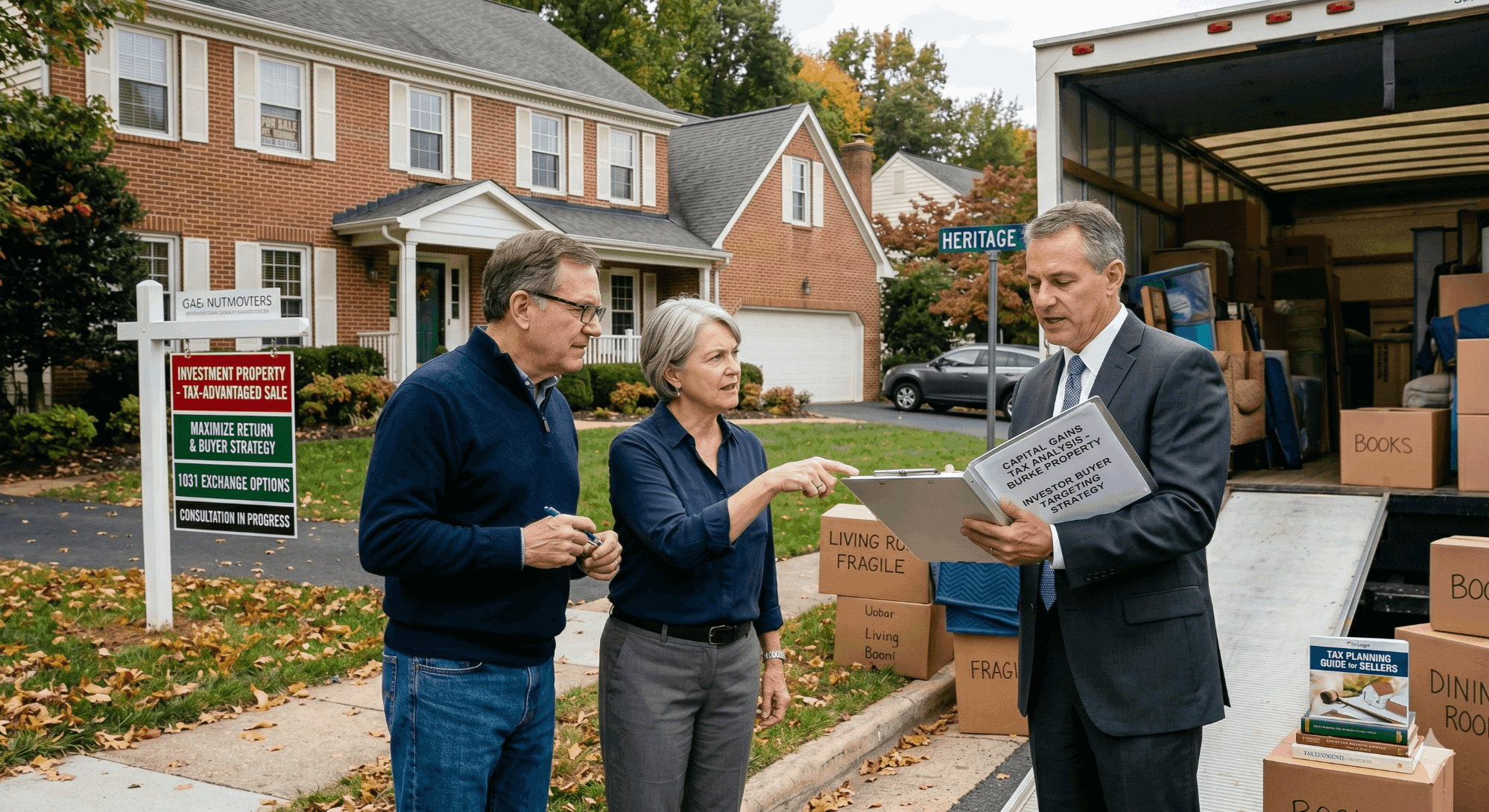
Quick Answer: Selling an investment property in Burke triggers federal capital gains tax (0%, 15%, or 20%), depreciation recapture taxed at 25%, the 3.8% Net Investment Income Tax for higher earners, and Virginia state tax up to 5.75%. The biggest savings strategies are a properly structured 1031 exchange, converting the property to a primary residence under Section 121, or an installment sale. On a typical Burke investment property selling at $725,000–$850,000 with $200,000 in deferred depreciation, the combined tax bill before strategy can easily exceed $100,000 — meaning planning matters as much as price.
Selling a rental or investment property in Burke is not the same transaction as selling your primary home. The IRS treats the sale differently, the buyer pool is narrower (and more analytical), and a single mistake on timing — closing date, exchange identification, depreciation reporting — can cost you tens of thousands. This guide is built specifically for landlord-owners and small investors selling single-family homes, townhouses, condos, or small multifamily properties in Burke, VA (ZIP codes 22015, 22032, 22153, and 22039) in 2026. We cover the three tax hits you'll face, five legitimate strategies to reduce or defer them, who's actually buying investment properties in Burke right now, and how to position a tenant-occupied home so it sells without a discount.
Key Takeaways
- Burke's 2026 median sale price is approximately $775,000, with average days on market around 14–18 days — a strong seller's market for well-priced rentals.
- Depreciation recapture is taxed at 25% federal, regardless of your income bracket — and it applies whether you took depreciation or not.
- A 1031 exchange must be identified within 45 days and closed within 180 days — both clocks start on the day your Burke property closes.
- If you lived in the property for 2 of the last 5 years, you may qualify for a partial Section 121 exclusion (up to $250K single / $500K married) even after renting it out.
- Roughly 40–55% of investment-property buyers in Burke are owner-occupants — meaning vacant, repaired, and staged often outsells "as-is, tenant-in-place" by a meaningful margin.
- The Jamil Brothers Realty Group offers a 1.5% full-service listing fee for Burke investment sellers — same marketing, photography, drone, 3D tours, and partner-led negotiation as a 3% agent.
In This Guide
- Burke Investment Property Market 2026
- The Three Big Tax Hits on an Investment Sale
- Five Tax-Smart Exit Strategies
- Burke Seller Savings Calculator (1.5% vs 3%)
- Who's Buying Investment Properties in Burke?
- Tenant-Occupied vs. Vacant: Which Sells Better?
- Pre-Listing Checklist for an Investment Property
- Step-by-Step Investment Sale Timeline
- Mistakes Investor-Sellers Make in Burke
- Choosing the Right Listing Agent for an Investment Sale
- Your Next Move in Burke
- Frequently Asked Questions
- Glossary
Burke is one of the most consistent investment-property submarkets in Fairfax County. The Lake Braddock Secondary school pyramid drives steady tenant demand year after year, military and federal commuters need furnished and unfurnished rentals near the Burke VRE station, and the area's stock of 1970s–1990s townhomes and detached homes still rents profitably even at today's interest rates. That same fundamental strength makes Burke a great place to sell — but only if you plan around the tax consequences first.
The mistake most investor-sellers make is approaching the sale as a price-only decision. You don't actually keep the price — you keep the price minus commission, minus closing costs, minus federal capital gains, minus depreciation recapture, minus NIIT, minus Virginia state tax. Two identical $800,000 sales can produce after-tax outcomes that differ by $80,000 or more depending on how the seller structured it. This guide walks through every lever you control.
Burke Investment Property Market 2026
Before you decide whether to sell, exchange, or hold, you need to know what a Burke rental is actually worth today. The numbers below reflect 2026 BrightMLS data for the four Burke ZIP codes combined.
| Metric | Burke (22015/22032/22153/22039) | Fairfax County Avg. |
|---|---|---|
| Median sale price (all property types) | ~$775,000 | ~$795,000 |
| Townhome median | ~$615,000 | ~$650,000 |
| Single-family detached median | ~$845,000 | ~$890,000 |
| Average days on market | 14–18 days | 12–16 days |
| List-to-sale price ratio | 99.4% | 100.1% |
| Avg. price per sq. ft. | ~$337 | ~$355 |
| % of buyers FHA/VA financed | ~38% | ~28% |
| Estimated gross rent multiplier (SFH) | ~20.5x | ~21.2x |
Two numbers matter for investor-sellers in particular: the 38% FHA/VA financed share, and the 20.5x gross rent multiplier. The first tells you most of your buyer pool will be owner-occupants needing a property in turnkey, lendable condition — not other investors looking for a cap rate. The second tells you the market is rewarding sale price more than rental income; if you're holding for cash flow alone, you may be leaving substantial appreciation on the table.
Burke Sub-Market Pricing Snapshot
| Burke Sub-Area | Typical Investment Property | 2026 Sale Price Range |
|---|---|---|
| Burke Centre (22015) | 2–3 BR townhome, 1,400–1,800 sf | $575K–$685K |
| Cherry Run / Signal Hill (22015) | 3–4 BR detached, 1,800–2,400 sf | $775K–$925K |
| Lake Braddock area (22015) | 4 BR colonial, 2,000–2,800 sf | $835K–$1.05M |
| Burke / Kings Park West (22032) | 3 BR split-level, 1,500–2,100 sf | $695K–$845K |
| Burke Lake / Fairfax Station area (22039) | 4–5 BR larger lot homes | $925K–$1.35M |
| South Run / 22153 corridor | 3 BR townhome or small SFH | $565K–$735K |
The Three Big Tax Hits on an Investment Sale
When you sell a primary residence, Section 121 of the IRC usually wipes out the federal capital gain (up to $250K single, $500K married). When you sell an investment property, none of that protection applies by default. Four separate taxes stack up — and one of them (depreciation recapture) catches almost every long-term landlord off guard.
1) Federal Capital Gains Tax
If you've held the Burke property more than one year, the gain qualifies for long-term capital gains rates. For 2026 these are 0%, 15%, or 20% depending on your taxable income. Most Burke investor-sellers — typically federal employees, contractors, or dual-income professional households — land in the 15% bracket, and high earners ($518,900+ single / $583,750+ married in 2025 thresholds, indexed for 2026) hit the 20% bracket.
2) Depreciation Recapture — The Silent Killer
This is the one most investor-sellers miss. Every year you owned the rental, the IRS expected you to depreciate the building (not the land) over 27.5 years. That depreciation reduced your taxable rental income while you held it — and it's clawed back when you sell.
Two things make depreciation recapture brutal: it's taxed at a flat 25% regardless of your income bracket, and the IRS applies it whether you actually claimed it or not. If your CPA or you skipped depreciation for ten years, the IRS still treats it as if you took it.
⚠️ Quick Math Example — Burke Townhome
$625,000 sale price on a townhome bought for $385,000 fifteen years ago. Building basis was roughly $300,000 (excluding land). Accumulated depreciation over 15 years ≈ $163,000. That $163,000 is taxed at 25% = $40,750 in depreciation recapture alone — before any capital gains tax even applies.
3) Net Investment Income Tax (NIIT) — 3.8%
If your modified adjusted gross income exceeds $200,000 single or $250,000 married filing jointly, you owe an additional 3.8% NIIT on the capital gain (not on depreciation recapture). Most dual-income NOVA households selling a Burke rental will owe this — it's effectively a 23.8% top federal rate on the gain portion.
4) Virginia State Income Tax
Virginia taxes capital gains as ordinary income — top marginal rate 5.75%. There's no separate long-term rate at the state level, and Virginia does not offer a state-level 1031 exemption beyond what the federal code provides. If you're a non-resident owner who's moved out of Virginia, the state still taxes you on the gain because the property is sourced here.
Total Tax Burden — Side-By-Side
Bar widths illustrate the rate applied to that portion of the gain. NIIT and federal capital gains stack on the gain portion; depreciation recapture is a separate 25% on the recapture portion.
Before you commit to a 1031 exchange or a straight sale, you need a real number. The Jamil Brothers send a personalized valuation within 24 hours using street-level comps from Burke Centre, Lake Braddock, Cherry Run, and the 22015/22032/22039/22153 sub-markets — not an automated estimate.
Five Tax-Smart Exit Strategies
Almost every investor-seller in Burke has at least one of these five doors open. Some require months of advance planning; one only works if you start now. The right strategy depends on your gain size, your accumulated depreciation, your next investment plans, and your income.
Strategy 1: 1031 Like-Kind Exchange
A Section 1031 exchange defers federal capital gains tax, depreciation recapture, NIIT, and Virginia state tax indefinitely — as long as you reinvest the entire proceeds into another investment property (or properties) of equal or greater value. The catch is the timing: you have 45 days from closing to identify replacement properties in writing and 180 days total to close on at least one of them. Both clocks run concurrently from the day your Burke property closes.
The proceeds must be held by a qualified intermediary — you cannot touch the money. Identification rules let you name up to three properties (any value), or more under the 200% rule, or unlimited under the 95% rule. The replacement must be held for investment, not as a primary residence.
Strategy 2: Convert to Primary Residence (Section 121)
Move into the Burke property and live there as your primary residence for at least 2 of the next 5 years. This unlocks the Section 121 exclusion — up to $250,000 of gain ($500,000 married) is shielded from federal capital gains tax. Depreciation recapture is not excluded, but the bulk of the gain becomes tax-free.
Two limitations: First, for any period the property was used as a rental after 2008, that portion of the gain becomes "non-qualified use" and isn't covered by Section 121, even if you later move in. Second, you can only use Section 121 once every 2 years. For investor-sellers with smaller gains and no immediate exchange opportunity, this is often the most powerful strategy on paper — but it requires actually relocating.
Strategy 3: Installment Sale
Carry back a note for part of the sale price. The IRS lets you spread the gain over the years you actually receive payments (depreciation recapture is still taxed in year one, but capital gains are spread out). This is especially useful if a single-year sale would push you into the 20% bracket or trigger NIIT — spreading the gain across 5–10 years can keep you in the 15% bracket throughout.
The right buyer for an installment sale in Burke is usually an experienced investor or a credit-worthy owner-occupant willing to pay a premium for partial seller financing. It's not the right move for a typical FHA/VA buyer, who will use bank financing anyway.
Strategy 4: Qualified Opportunity Zone Investment
Within 180 days of the sale, you can roll the capital gain (just the gain — not the full proceeds, unlike a 1031) into a Qualified Opportunity Fund. Tax on the original gain is deferred until 2026 year-end or earlier sale of the QOF interest, and if you hold the QOF for 10+ years, any new appreciation inside the fund is permanently excluded from federal tax.
There are no opportunity zones inside Burke itself, but several exist in nearby Alexandria, Falls Church, and the District. This strategy is most useful for investors with large gains who don't want to do a like-kind exchange and have a long time horizon.
Strategy 5: Charitable Remainder Trust (CRT)
For older investor-sellers with very large embedded gains (think a Lake Braddock home held since the 1980s), a CRT lets you donate the property to an irrevocable trust, sell it with no immediate capital gains tax, draw an annual income stream from the trust for life, and leave the remainder to a charity. It's complex and irrevocable, so it's only appropriate for sellers who already plan significant charitable giving.
Strategy Comparison Grid
| Strategy | Defers Cap Gains? | Defers Depreciation Recapture? | Best For |
|---|---|---|---|
| 1031 Exchange | Yes | Yes | Rolling into another rental |
| Section 121 (move in) | Excludes up to $500K | No | Exiting landlord life |
| Installment Sale | Spreads gain | No (year-one) | Smoothing tax brackets |
| Opportunity Zone Fund | Yes (until 2026) | No | 10+ year hold horizon |
| Charitable Remainder Trust | Yes | Yes | Large gain + charitable intent |
This is general tax information, not legal or tax advice. Confirm with your CPA and a 1031 qualified intermediary before closing.
Burke Seller Savings Calculator (1.5% vs 3%)
Even with a smart tax strategy, commission is the single largest closing cost most investor-sellers pay. Below is a simplified comparison of the listing fee on a traditional 3% sale versus The Jamil Brothers' 1.5% full-service program. Select your home's estimated value to see the difference.
Seller Savings Calculator
How much more do you keep with our 1.5% listing fee?
Select your Burke property's estimated value to see your real net proceeds — side by side.
|
Traditional Agent — 3%
|
Jamil Brothers — 1.5%
Our Fee — Only 1.5%
|
|
Traditional Agent — 3%
|
Jamil Brothers — 1.5%
Our Fee — Only 1.5%
|
|
Traditional Agent — 3%
|
Jamil Brothers — 1.5%
Our Fee — Only 1.5%
|
|
Traditional Agent — 3%
|
Jamil Brothers — 1.5%
Our Fee — Only 1.5%
|
|
Traditional Agent — 3%
|
Jamil Brothers — 1.5%
Our Fee — Only 1.5%
|
Estimates only. Closing costs vary. Buyer's agent commission is negotiable post-NAR settlement.
| 500+ Five-Star Reviews · Top 1% Nationwide · 840+ Homes Sold | TheJamilBrothers.com · (703) 782-4830 |
4K photography, drone aerials, 3D virtual tours, professional staging consultation, full MLS syndication, and partner-led negotiation — all included at 1.5%. The same marketing a 3% agent provides, structured for investor-sellers who care about net proceeds, not gross price.
Who's Buying Investment Properties in Burke?
Many investor-sellers assume the buyer for their rental will be another investor. In Burke, that's usually wrong. Because the area's median price is in the $625K–$925K band that fits FHA, VA, and conventional owner-occupant loans cleanly, the largest share of investment-property buyers in Burke are owner-occupants who happen to be buying a former rental. This dramatically widens your buyer pool — if you prepare the property correctly.
Buyer Pool Composition (Burke, 2026 estimate)
What Each Buyer Type Actually Wants
Owner-occupants want move-in ready. They want fresh paint, clean carpet or refinished floors, no tenant funk, no obvious deferred maintenance, and a property that comps cleanly. They will pay full retail and may even outbid investors. They cannot accept "as-is, tenant-in-place" because they need to live in the home, often within 30–60 days of closing.
Small buy-and-hold investors want a tenanted property with documented rent history, current leases, and a known cap rate. They'll pay 92–96% of the owner-occupant price in exchange for being able to close fast and not have to find tenants.
1031 exchange buyers are on a clock — they need to close inside their 180-day window. They are often willing to pay slightly above market for the right property, but they cannot accept long delays, financing contingencies, or seller-side surprises. A clean, well-priced, exchange-ready listing in Burke can attract this buyer quickly.
BRRRR investors want the worst-condition property at the deepest discount — they're underwriting the home for renovation costs and after-repair value, not current state. Don't market a renovated Burke rental to this buyer; market a tired one to them and a fixed one to owner-occupants.
All-cash and iBuyer buyers will offer 80–88% of retail and close in 7–14 days. Most investor-sellers shouldn't accept these offers unless speed or certainty truly matters more than price. For inherited rentals or out-of-state landlords, exploring a side-by-side cash offer comparison can be worth the conversation.
Tenant-Occupied vs. Vacant: Which Sells Better?
This is the single biggest pricing decision an investor-seller in Burke makes. The answer depends on your buyer-pool target — and on what the lease says.
| ✓ Sell Vacant | ✗ Sell Tenant-Occupied |
|---|---|
| Access for showings any time | Limited showing windows, often 24-hr notice |
| Can stage and professionally clean | Tenant's belongings, condition, and pets reduce appeal |
| Full FHA/VA buyer pool available | FHA/VA buyers need to occupy within 60 days — lease may block |
| Cleaner inspection negotiation | Repairs may require coordination around tenant |
| Top of market pricing achievable | Typical 4–8% discount in Burke vs. comparable vacant |
| Lost rent during vacancy (1–3 months) | Rental income continues through closing |
The Virginia Lease Rule You Need to Know
In Virginia, a recorded month-to-month tenancy can usually be terminated by the landlord with proper written notice (typically 30 days for month-to-month, or per lease terms). A fixed-term lease, however, survives the sale — the new owner inherits the lease and the tenant cannot be removed early without cause. If you sell tenant-occupied to an owner-occupant buyer, the buyer cannot evict the tenant simply because they bought the property.
Practical implication for Burke investor-sellers: if your tenant is on a fixed lease ending in 4 months and you want to list now, you have two choices — sell to an investor who will keep the tenant, or wait until the lease ends and sell vacant. Pretending the lease isn't there usually backfires at the inspection or financing stage.
Pre-Listing Checklist for an Investment Property
The biggest difference between a rental that sells at full retail and one that sells at the investor discount is preparation. Most landlord-owners have neglected at least three of the items below. None individually move price much, but together they often add 5–10% to the final sale.
Burke Investment Property Pre-Listing Checklist
- ✓ Pull tenant security deposit accounting current — Virginia requires interest and itemized statements at termination
- ✓ Fresh interior paint in neutral tones (off-white, greige) — landlords' wear-and-tear paint reads as deferred maintenance
- ✓ Professional deep clean including carpet shampoo or hardwood polish
- ✓ Address visible deferred maintenance — caulking, grout, leaking faucets, popped electrical outlets
- ✓ HVAC service + filter change — pre-listing inspection items are the most common closing snag
- ✓ Order HOA resale packet early if applicable (Burke Centre Conservancy: ~$325–$450, 10–14 business days)
- ✓ Gather depreciation schedule + tax basis records — buyer's CPA may request, your CPA definitely will
- ✓ Establish qualified intermediary relationship BEFORE closing if doing a 1031 — touching the proceeds disqualifies the exchange
- ✓ Confirm lease status and provide proper notice to tenants per Virginia law if selling vacant
- ✓ Coordinate Virginia disclosure statement and lead-paint disclosure (homes built before 1978)
- ✓ Schedule professional photography, drone, and 3D tour for the vacant or de-cluttered home
Our seller net sheet calculator breaks down every Burke-specific cost — commission, Virginia grantor tax, congestion fee, title fees, HOA transfer, depreciation impact estimate — so you know what walks away with you before a single showing.
Step-by-Step Investment Sale Timeline
A planned Burke investment-property sale runs roughly 90–120 days from initial planning call to closing. The two longest stretches are tax-strategy decision and tenant transition; everything else moves on standard NOVA timelines.
Strategy meeting with CPA and listing agent — Days 1–7
Calculate gain, depreciation recapture, NIIT exposure. Decide between straight sale, 1031, Section 121 conversion, or installment. Engage a qualified intermediary if going 1031.
Tenant notice + transition plan — Days 7–45
Provide proper Virginia written notice (per lease). Offer tenant relocation assistance if selling vacant — often saves you 1–2 weeks of vacancy. Confirm move-out date.
Property prep — Days 45–60
Paint, deep clean, deferred maintenance, HVAC service, HOA packet order. Order professional photography, drone, 3D tour.
List + market — Days 60–75
MLS goes live. Open houses, broker tours. In Burke's current market, expect multiple offers within 7–10 days at the right price.
Ratify contract + inspection — Days 75–90
Review offers (cash, conventional, FHA, VA, 1031 exchange buyer). Negotiate repairs and contingencies. Manage appraisal.
Close + 1031 timing — Days 90–120
If exchanging, the 45-day identification clock starts at closing — replacement property identification deadline is calendar day 45, full closing on replacement by day 180. CPA reports gain or deferred gain on Form 8824.
Mistakes Investor-Sellers Make in Burke
After 840+ closed transactions across the DMV, the same handful of mistakes show up over and over on investment sales. None are unfixable if you catch them early.
| Mistake | Why It Costs Money | Better Approach |
|---|---|---|
| Touching the proceeds in a 1031 | Disqualifies the exchange entirely | Engage QI before signing the contract |
| Pricing on rent-multiplier alone | Burke is appreciation-driven, not cap-rate driven | Comp the home against owner-occupant sales |
| Skipping the depreciation recapture math | Tax bill can exceed total commission | Model recapture before you list |
| Selling tenant-occupied without notice | FHA/VA buyers walk; lease violations | Plan tenant transition 60–90 days out |
| Marketing landlord-grade photography | Owner-occupants buy on emotion + visuals | Professional 4K + drone + 3D tour |
| Listing before HOA packet is ordered | Burke Centre Conservancy = 10–14 business day delay | Order packet at listing prep stage |
Choosing the Right Listing Agent for an Investment Sale
The right agent for a Burke investment property sale is not necessarily the agent with the biggest billboard. Focus on four objective criteria — then compare written CMAs, not slide decks.
Investment-Property Listing Agent Criteria
- ✓ Documented transactions in Burke or directly adjacent ZIPs (22015/22032/22153/22039) — not "Northern Virginia"
- ✓ Experience with 1031 timing — knows the 45/180 day rules and has a qualified intermediary they can refer
- ✓ Written, specific marketing plan: photography, drone, 3D tour, MLS syndication, paid digital placement
- ✓ Average list-to-sale ratio on their last 10 listings (transparent — ask to see it)
- ✓ Transparent fee structure — full-service deliverables itemized, no hidden charges
- ✓ Principal agent handles negotiation personally — not handed to an assistant or junior
The Jamil Brothers Realty Group meets all six criteria for Burke investment sales: 840+ closed homes across the DMV, NVAR Lifetime Top Producers, 500+ five-star reviews, hands-on tenant transition support, and a 1.5% full-service listing program with no service reductions. Saad and Arslan Jamil personally handle every investment listing's pricing strategy and negotiation.
For out-of-state landlords, inherited rentals, or PCS situations, a vetted cash offer may be the right exit. We'll model a full comparison — open market net vs. cash offer net, with all closing costs and tax implications side by side — at no cost.
Explore Burke & Nearby Submarkets
Burke Burke Centre Fairfax Centreville Chantilly Vienna Reston Herndon McLean Alexandria Ashburn All Homes for SaleYour Next Move in Burke
Selling an investment property is, at the end of the day, a sequenced decision: tax strategy first, then preparation, then pricing, then buyer pool, then marketing. Skip the first step and you may net less after taxes on a higher gross sale than someone who planned properly on a lower one.
The Jamil Brothers Realty Group has guided dozens of landlord-owners through Burke and Fairfax County investment sales — single-family rentals, townhomes, condos, and small multifamily properties — with a structured process that begins with a free planning conversation and a real net-proceeds projection. We'll model your sale against the 1031 alternative, against an installment sale, and against simply holding for another year. From there, the decision is yours.
The two most useful starting points are a personalized property valuation and a custom Burke seller net sheet that includes a depreciation recapture estimate. Both are free, neither involves a listing agreement, and either one tells you within a week what the realistic exit looks like.
Know your equity, model your depreciation recapture, and see your true after-tax bottom line before you make any decisions. The Jamil Brothers provide a full investor-seller consultation at no cost or obligation.
Frequently Asked Questions
How much will I owe in taxes when I sell my Burke investment property?
Your total tax depends on four components stacked together: federal capital gains (0%, 15%, or 20% based on income), depreciation recapture (flat 25% on accumulated depreciation), Net Investment Income Tax (3.8% on the gain for higher earners), and Virginia state tax (up to 5.75%). For a typical Burke rental sold at $725,000–$850,000 with $150,000–$200,000 in accumulated depreciation, total tax can easily exceed $100,000 without strategy. A 1031 exchange or Section 121 conversion can defer or exclude most of it.
What is the average realtor commission in Burke, VA?
Traditional listing agent commission in Burke runs 2.5–3% of sale price. Buyer's agent compensation post-NAR settlement is fully negotiable and is no longer automatically offered through the MLS, though most Burke sellers still offer 2–2.5%. The Jamil Brothers Realty Group offers a 1.5% full-service listing program with the same marketing, photography, drone video, 3D tours, and partner-led negotiation as a 3% agent — saving the typical $750K Burke investor-seller roughly $11,250 at closing.
How long does it take to sell an investment property in Burke?
Average days on market in Burke is 14–18 days for well-prepared listings. Total timeline from initial planning to closing typically runs 90–120 days for an investment sale — the longest stretches are tax-strategy decision-making (1–2 weeks) and tenant transition (4–6 weeks if applicable). The actual marketing window in Burke is short and competitive because buyer demand consistently outpaces supply.
Can I do a 1031 exchange from Burke into out-of-state property?
Yes. Section 1031 has no geographic restriction within the United States — a Burke rental can be exchanged for an investment property in Florida, Texas, Arizona, or anywhere else in the country, as long as both properties qualify as "like-kind" investment real estate. The 45-day identification and 180-day closing deadlines still apply, and Virginia will recognize the federal deferral for state tax purposes. The qualified intermediary handles the cross-state mechanics.
What is depreciation recapture and why does it matter so much?
Depreciation recapture is the IRS clawback of the annual depreciation deductions you took (or were entitled to take) while you owned the rental. It's taxed at a flat 25% federal rate, regardless of your income bracket — which is often higher than the long-term capital gains rate. Critically, the IRS applies recapture whether you actually claimed the depreciation or not, so skipping depreciation on your tax returns over the years doesn't help you at sale. On a Burke rental held for 15 years, recapture often runs $35,000–$60,000.
What if my tenant has a lease through next year — can I still sell?
Yes, but with restrictions. A fixed-term lease survives the sale in Virginia — the new owner inherits the lease and cannot evict the tenant simply because they bought the property. This usually means selling to another investor rather than an owner-occupant, which often produces a 4–8% discount versus a vacant sale. Alternatives include offering the tenant a cash-for-keys early-termination agreement, or waiting until the lease ends to list. A specific tenant strategy is part of every investment listing conversation we have with Burke clients.
What are Burke's typical seller closing costs on an investment property?
On top of commission, expect Virginia grantor tax ($1 per $1,000 of sale price), the NOVA regional congestion tax, title settlement and document prep fees ($800–$1,500), prorated property taxes, HOA transfer and resale packet fees if applicable (Burke Centre Conservancy: $325–$450), and any mortgage payoff and recording costs. On a $750,000 Burke investment sale, non-commission closing costs typically total $7,500–$11,000.
Does Burke have an HOA, and how does it affect selling?
Many Burke communities operate under HOAs — Burke Centre Conservancy is the largest, but Cherry Run, Signal Hill, Lake Braddock area, and several Kings Park West sub-communities also have associations. Selling requires an HOA resale disclosure packet, typically $325–$450 with a 10–14 business day turnaround. Order it during listing prep, not after going under contract — packet delays are one of the most common reasons Burke investment sales miss their target closing date.
Has the NAR settlement changed how I sell my Burke rental?
Since August 2024, buyer-agent compensation is no longer offered automatically through the MLS — it's now fully negotiable between buyer and seller. Most Burke sellers still offer 2–2.5% buyer-agent compensation to remain competitive, but the amount, structure, and disclosure are explicit decisions made at listing. A good listing agent will walk you through whether to offer compensation, at what level, and how it interacts with your list price for both owner-occupant and investor buyers.
How do I choose between a 1031 exchange and a straight sale?
Run the numbers both ways. A 1031 defers tax indefinitely but locks you into another investment property and starts a 45/180 day clock. A straight sale pays the tax now but releases the capital for any use — paying down primary mortgage, retirement, college, charitable giving. The decision usually turns on three questions: Do you still want to be a landlord? Do you have a target replacement property in mind? And what's your tax bracket for the next 5–10 years? A qualified CPA can model both scenarios in 60–90 minutes.
How do I choose the right listing agent for an investment property sale?
Focus on objective criteria: documented Burke or adjacent-ZIP investment listings closed in the last 24 months, written marketing plan with specific deliverables, transparent average list-to-sale ratio, knowledge of 1031 timing and qualified intermediary referrals, fee structure clarity, and confirmation that the principal agent (not an assistant) personally handles pricing and negotiation. Interview two or three finalists and compare written CMAs. The Jamil Brothers Realty Group meets all six criteria and offers the 1.5% full-service program as an additional cost-efficiency factor.
What mistakes should I avoid as an investor-seller in Burke?
The five most expensive mistakes are: (1) touching the proceeds in what was supposed to be a 1031 exchange, which disqualifies the entire transaction; (2) pricing only against the gross rent multiplier when Burke is appreciation-driven, not cap-rate driven; (3) skipping the depreciation recapture math before listing; (4) selling tenant-occupied without proper Virginia notice or lease verification; and (5) using landlord-quality photography that signals "investor sale" to owner-occupant buyers who would otherwise pay full retail. Each of these is fixable if caught early in the planning stage.
Glossary
1031 Exchange
IRS-recognized swap of one investment property for another, deferring capital gains tax indefinitely. Strict 45-day identification and 180-day closing deadlines.
Depreciation Recapture
25% federal tax on the accumulated depreciation taken (or available to take) during ownership of the investment property. Applies regardless of income bracket.
Qualified Intermediary (QI)
Independent third party who holds the proceeds of a 1031 exchange. The seller cannot touch the funds — the QI transfers them directly to the closing of the replacement property.
Section 121 Exclusion
Federal exclusion of up to $250K single / $500K married of capital gain on sale of a primary residence used as such for 2 of the last 5 years. Does not cover depreciation recapture.
Net Investment Income Tax (NIIT)
Additional 3.8% federal tax on investment income (including real estate capital gains) for taxpayers with MAGI over $200K single / $250K married.
Cost Basis
Your original purchase price plus capital improvements, minus accumulated depreciation. Used to calculate taxable gain at sale.
Boot
Cash or non-like-kind property received in a 1031 exchange. Boot is immediately taxable to the extent of the gain — even within an otherwise valid exchange.
Installment Sale
Sale in which the seller carries back part of the purchase price as a note. Allows the gain (but not depreciation recapture) to be spread across the years payments are received.
Explore More
Browse Every Corner of the DMV Market
Whether you're searching by budget, neighborhood, or buying situation — find exactly what you need below.
Virginia Homes by Budget
Washington DC Homes by Budget
Maryland Homes
Explore Northern Virginia Communities
Loudoun County
Fairfax County & Surrounding
Ready to Make a Move?
Full-Service · No Tradeoffs
List for 1.5% & Keep More Equity
Professional photography, drone video, 3D tours, and expert negotiation — all included. On an $800K home, that's $12,000 more in your pocket vs. a 3% agent.
See the 1.5% Program →Need Speed or Certainty?
Get a No-Obligation Cash Offer
Skip the showings, skip the contingencies. If timing or condition matters more than top dollar, a cash offer may be the right fit. We'll walk you through every option.
Explore Cash Offers →Categories
- All Blogs (1158)
- Aldie (3)
- Ashburn (6)
- Buyer Guide (8)
- Buying a home (2)
- Buying Strategies (28)
- festivals (1)
- General Blog (66)
- Leesburg (5)
- Market Intelligence (29)
- Market Updates (8)
- Notable Properties For Sale (29)
- Real Estate Tips, News, and More (376)
- Seller Guide (2)
- Seller Guides (60)
- Selling Your Home (469)
- Sterling (6)
- Top Realtors in Northern Virginia (58)
Recent Posts
Message Sent!
Thank you for reaching out. Arslan & Saad have received your details and will be in touch shortly.
Need immediate assistance? Call or text 703-782-4830.