
Downsizing in Tysons: Selling a Larger Home to Move to Something Smaller
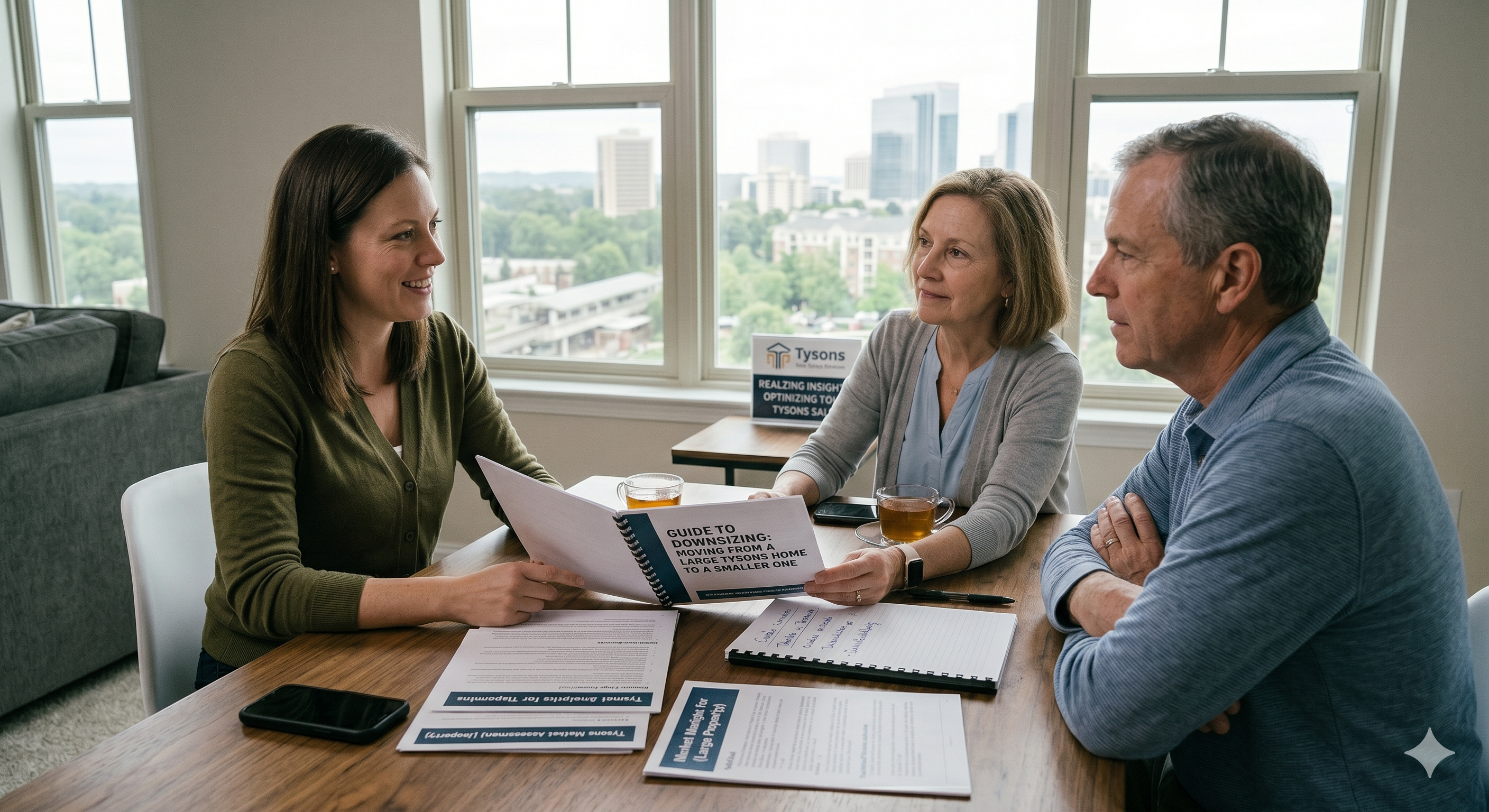
Quick Answer: Downsizing in Tysons usually means selling a 3,000–5,000 sq ft single-family home in McLean, Vienna, or the larger Tysons-area neighborhoods and moving into a Tysons high-rise condo (700–1,800 sq ft) or a smaller townhome. The right strategy depends on your equity position, your timeline, and whether you sell first or buy first. With Fairfax County median sale prices near $1.28M for single-family homes and Tysons condos ranging from $400K to $2M+, careful pricing and timing typically unlock $300K–$700K in usable equity for retirement, gifting, or reinvestment.
Key Takeaways
- Tysons is the rare DMV market where you can downsize without leaving the neighborhood — sell a McLean or Vienna single-family home and move into a high-rise condo five minutes away.
- Most Tysons-area downsizers free up $300K–$700K in equity by trading a $1.1M–$1.5M house for a $500K–$800K condo, even after all selling costs and the new condo purchase.
- The IRS Section 121 capital-gains exclusion ($250K single / $500K married) lets most longtime owners walk away with their gain tax-free — but only if you've lived there 2 of the last 5 years.
- Commission is your biggest selling cost. On a $1.2M home, a traditional 3% listing fee costs $36,000 vs. $18,000 with our 1.5% full-service program — a $18,000 swing that often covers the entire downsize move.
- Buying first vs. selling first is the most consequential decision you'll make. Each path has clear tradeoffs in this market, and the right answer depends on your equity, financing flexibility, and timeline.
- Decluttering 3,000+ square feet realistically takes 8–12 weeks — start before the home goes on the market, not after.
In This Guide
- Why Tysons Is Ideal for Downsizing
- The Tysons Downsizing Housing Landscape
- Sell First or Buy First?
- Right-Sizing Your Next Home
- The 12-Week Declutter Timeline
- Pricing Your Larger Home Correctly
- Preparing the Home for Market
- The Real Cost of Selling in Fairfax County
- Tysons Seller Savings Calculator
- Capital Gains Tax When Downsizing
- Five Common Downsizing Mistakes
- Choosing the Right Listing Agent
- Ready to Plan Your Tysons Downsize?
- Frequently Asked Questions
- Glossary
For many longtime Tysons-area homeowners, the realization comes gradually. The 4-bedroom colonial on a half-acre lot in McLean that raised three kids now has empty bedrooms gathering dust. The Vienna split-level you bought in 1998 has $1.1 million in equity sitting in walls you no longer fill. The Great Falls estate is beautiful, but the lawn, the gutters, and the property taxes are starting to feel like a job.
Downsizing is one of the most consequential financial and emotional decisions a homeowner makes — and in Tysons, you have one of the most unique downsizing markets in the United States. You can sell a 4,500 sq ft single-family home and move three minutes down the road into a luxury high-rise condo at The Verse, The Monarch, or One Park Crest — keeping the doctors, the friends, the gym, and the Metro line you already know.
This guide walks through every step: deciding when and how to sell, pricing the larger home correctly, the math behind sell-first vs buy-first, the tax implications, and how to net the maximum equity to fund the next chapter. It's written for Tysons, McLean, Vienna, and the surrounding Fairfax County submarkets where most downsizers actually live.
Why Tysons Is Ideal for Downsizing
Tysons has quietly become one of the strongest downsizing markets in Northern Virginia. Three structural shifts over the last decade made that possible: the Silver Line Metro extension (2014 and 2022), the rezoning that allowed dense mixed-use development, and the maturation of high-rise condo inventory at scale. The result is a true urban village inside Fairfax County, with all the medical, retail, dining, and transit a downsizer typically wants.
Five reasons Tysons works for downsizers
- ✓Stay close to your existing life. Tysons is bordered by McLean, Vienna, Falls Church, and Dunn Loring. You don't lose your dentist, hairdresser, place of worship, or the kids' growing-up neighborhood.
- ✓Two Metro lines and walkable infrastructure. Tysons has four Silver Line stations: McLean, Tysons, Greensboro, and Spring Hill. Reagan National is 25 minutes; downtown DC is 35 minutes — without driving.
- ✓Concierge, fitness, and security built in. High-rise buildings like The Verse, The Monarch, The Bexley, and One Park Crest include 24/7 concierge, fitness centers, pools, and secured parking — eliminating the maintenance burden of a single-family home.
- ✓Major medical and retail in walking distance. Inova Tysons, Capital One Center, Tysons Corner Center, Tysons Galleria, the Whole Foods at The Boro, and Wegmans are all a short walk or a one-stop Metro ride.
- ✓Strong resale and rental backstop. Tysons condos benefit from a deep pool of corporate renters tied to Capital One, Booz Allen, Hilton, Freddie Mac, MicroStrategy, and Gannett — useful if you ever want to rent the unit rather than sell.
The Tysons Downsizing Housing Landscape
The Tysons market splits into four clear product types that downsizers should understand before they list their current home. Knowing what your $500K–$1.2M will actually buy you in the new home sets a realistic anchor for the entire move.
| Product Type | Typical Size | Price Range | Best For |
|---|---|---|---|
| Older high-rise condos Rotonda, Lillian Court, Park Crest |
900–1,500 sq ft | $400K–$700K | Budget-focused downsizers who want amenities |
| Newer luxury high-rises The Verse, The Monarch, The Bexley |
1,000–2,400 sq ft | $650K–$2M | Empty nesters wanting full-service living |
| Boutique mid-rise condos Tysons East, Arbor Row |
1,100–1,800 sq ft | $550K–$900K | Quieter, more residential feel |
| Tysons-area townhomes Old Courthouse, Westgate |
1,800–2,800 sq ft | $700K–$1.1M | Downsizers wanting stairs/yard balance |
If you're selling a single-family home in McLean or Vienna at $1.1M–$1.5M, the math is generally very favorable. You typically clear $500K–$1M in usable equity after buying the new condo outright, before commission and closing costs. That equity becomes the cushion that defines retirement, gifting to children, or reinvestment in income property.
Sell First or Buy First?
This is the single biggest strategic question in any downsize, and the answer depends almost entirely on your equity and financing flexibility. There is no universal right answer, but there is a right answer for your situation.
| ✓ Sell First (Recommended for most) | ✓ Buy First (Recommended in select cases) |
|---|---|
| You know your exact equity before committing | No moving truck twice, no temporary housing |
| No financing contingency on the new purchase | Time to renovate or customize the new place |
| Strongest negotiating position on the buy side | Requires bridge financing or strong cash reserves |
| May need temporary housing for 30–90 days | Carrying two mortgages until the house sells |
| Risk that target condo sells before you're ready | Pressure to lower price if old home doesn't sell quickly |
The "Sell First, Lease Back" Bridge
For most Tysons-area downsizers, the cleanest play is a post-settlement occupancy agreement (sometimes called a rent-back). You sell the home, close on the buyer's timeline, but stay in the property for 30–60 days at a daily rate while you finalize the new condo purchase. This gives you certainty of equity, a strong buy-side offer (no home-sale contingency), and one move instead of two. We negotiate post-settlement occupancy on roughly 40% of our downsize transactions.
ℹ️ Bridge loan reality check
Traditional bridge loans for the buy-first strategy currently price around 8.5%–10% APR with 1–2% origination fees in Northern Virginia. For most downsizers, the cost-benefit favors post-settlement occupancy or a HELOC against the current home before listing.
Before you decide sell-first or buy-first, you need to know exactly what your current home will net. We provide a personalized valuation using street-level comps from the last 90 days — not an automated estimate. Response within 24 hours.
Right-Sizing Your Next Home
The most common downsizing regret isn't moving to a smaller home — it's moving to a home that's too small, or one that doesn't fit the actual lifestyle you'll live for the next 15–25 years. The square footage you need now is rarely the square footage on the listing in your head.
Right-sizing checklist for Tysons downsizers
- ✓How many full bedrooms do you actually need? (One for sleeping, one for office, one for guests = 2–3 BR minimum for most)
- ✓Do you host Thanksgiving, Eid, or large family events? Open-plan with 1,800+ sq ft handles 15–20 guests; 1,200 sq ft does not.
- ✓Single-level vs. two-level? Stairs become a much bigger factor at 70 than at 60. Most Tysons condos are single-level; many townhomes are not.
- ✓Two cars or one? Tysons-area parking varies: One Park Crest gives 2 spots, some Boro buildings give 1. Verify before offering.
- ✓Pet policies. Most newer high-rises welcome dogs; some older ones cap by weight (30 lb is common). Verify with HOA.
- ✓Storage. A 1,200 sq ft condo has roughly 1/3 the storage of a 3,500 sq ft house. Storage units run $150–$300/month in Tysons.
- ✓HOA monthly fees. Tysons high-rise condo fees typically run $0.55–$0.90 per sq ft per month — a 1,400 sq ft unit can run $850–$1,250/month in HOA alone.
The 12-Week Declutter Timeline
The single biggest mistake we see in downsizing is starting the decluttering process after the home is listed. By then, it's too late: showings begin within days, photography needs to happen first, and the emotional weight of 25–40 years of accumulated belongings makes every decision harder under pressure. Here is the realistic 12-week framework we use with our downsizing clients.
Weeks 1–2: Inventory and floor plan
Walk every room with a notepad. Identify what's going with you (must-keep), what's going to family or being sold, what's being donated, and what's being trashed. Match against the floor plan of your target condo or townhome.
Weeks 3–4: Paperwork and photos
Sort decades of paperwork (most can be shredded). Digitize family photos — a service like Legacybox or a local scanner like ScanCafe runs $1–$2 per photo. This is often the most emotionally heavy phase; pace yourself.
Weeks 5–6: Family distribution
Adult children get first pick of furniture, china, and heirlooms. Use a Sunday afternoon group session with sticky-note tags. What no child wants — and they will surprise you — goes to estate sale or donation.
Weeks 7–9: Estate sale or consignment
Tysons-area estate sale companies like Caring Transitions of NoVa, Blue Moon Estate Sales, and Everything But the House handle the heavy lift. Expect to recover 20–40% of original retail value, but the bigger win is removing volume.
Weeks 10–11: Donation and disposal
Salvation Army, Habitat for Humanity ReStore, A Wider Circle, and AMVETS all do pickups in Fairfax County. For anything they won't take, schedule a junk-removal service ($400–$900 for a full truck) before listing.
Week 12: Pre-listing staging and photography
With clutter gone, professional staging consultants ($300–$600 for a 2-hour walk-through) refine what's left. Then 4K photography and drone happen with the house at its absolute best.
Pricing Your Larger Home Correctly
The pricing strategy for a downsize listing is different from a typical seller's because the calendar pressure usually runs in one direction: you can wait for the right offer because you're not in financial distress. But waiting too long, or starting at a price the market won't support, creates a different kind of damage — a stale listing that sits 60+ days and ends up selling for less than a correctly-priced listing would have in week one.
Tysons-area median sale prices (2026 YTD)
Approximate current pricing across the larger Tysons submarket, based on BrightMLS data:
Three pricing strategies for downsizers
| Strategy | When It Works | Typical Outcome |
|---|---|---|
| Below comps (–2% to –4%) | Updated home, strong location, springtime listing | Multiple offers in 7–14 days, often above list |
| At comps (market) | Standard listing, average condition | Sells in 21–35 days at or near list |
| Above comps (+3% to +5%) | Unique features, view, lot, or seller has no timeline | Slower sale (45–90 days), may require a reduction |
For downsizers without a hard timeline, we usually recommend the at-comps strategy. It captures the maximum sale price with the lowest risk of a stale listing and tends to attract the most qualified buyers — typically dual-income families moving into McLean or Vienna for the schools.
Preparing the Home for Market
A 3,000–5,000 sq ft Tysons-area home needs more pre-listing work than a typical condo or townhouse. Older systems, decades of touch-ups, and family-driven decor choices all need professional review. Here is the prep workflow we use on a typical $1M+ downsize listing in McLean or Vienna.
| Prep Item | Typical Cost | ROI on Sale Price |
|---|---|---|
| Pre-inspection (optional but recommended) | $450–$650 | High — surfaces problems before buyer's inspector |
| Whole-house deep clean | $500–$900 | Very high — essential before photography |
| Neutral interior repaint (main areas) | $3,500–$7,000 | Strong — broadens buyer appeal |
| Carpet replacement or hardwood refinish | $4,000–$12,000 | High — often required at this price point |
| Landscaping refresh / mulch / power wash | $800–$2,500 | Very high — first impression |
| Professional staging (occupied) | $1,500–$4,000 | Strong on photos and showings |
| 4K photography + drone + 3D tour | $0 — included in our 1.5% program | Highest impact on showing volume |
The Real Cost of Selling in Fairfax County
Selling a $1.2M McLean or Vienna home traditionally runs $80,000–$110,000 in total closing costs — but the largest line item is always commission, and it's the one most negotiable. Here's the standard breakdown for a $1.2M Fairfax County sale:
| Closing Cost Item | Traditional 3% | Jamil Brothers 1.5% |
|---|---|---|
| Listing commission | $36,000 | $18,000 |
| Buyer's agent commission (negotiable, ~2.5%) | $30,000 | $30,000 |
| Virginia grantor tax ($1 per $1,000) | $1,200 | $1,200 |
| NOVA regional congestion tax ($0.15/$100) | $1,800 | $1,800 |
| Title settlement, courier, e-recording | $900 | $900 |
| HOA / condo resale disclosure packet | $200–$450 | $200–$450 |
| Total estimated closing costs | ~$70,100 | ~$52,100 |
The $18,000 difference on a $1.2M home — across just the listing-side commission — is real, transferable money. On many downsizes, it pays for the entire moving truck, the new condo's HOA reserve contribution, three years of property taxes on the new place, or a meaningful chunk of the kitchen renovation in the new home.
Our seller net sheet calculator breaks down every cost — commission, Virginia grantor and congestion taxes, settlement fees — so you know your real bottom line before you list. Custom to your home value and your equity position.
Tysons Seller Savings Calculator
Select the price closest to your current Tysons-area home value to see your side-by-side net proceeds — what you'd keep with a traditional 3% listing agent vs. our 1.5% full-service program. All four price points reflect 2026 Fairfax County closing-cost averages.
Tysons Seller Savings Calculator
How much more do you keep with our 1.5% listing fee?
Select your home's estimated value to see your real net proceeds — side by side.
Traditional Agent — 3%
| Sale price | $400,000 |
| Listing fee (3%) | −$12,000 |
| Buyer's agent (2.5%) | −$10,000 |
| Est. closing (1%) | −$4,000 |
| Net Proceeds | $374,000 |
Our Fee — Only 1.5%
| Sale price | $400,000 |
| Listing fee (1.5%) | −$6,000 |
| Buyer's agent (2.5%) | −$10,000 |
| Est. closing (1%) | −$4,000 |
| Net Proceeds | $380,000 |
Traditional Agent — 3%
| Sale price | $500,000 |
| Listing fee (3%) | −$15,000 |
| Buyer's agent (2.5%) | −$12,500 |
| Est. closing (1%) | −$5,000 |
| Net Proceeds | $467,500 |
Our Fee — Only 1.5%
| Sale price | $500,000 |
| Listing fee (1.5%) | −$7,500 |
| Buyer's agent (2.5%) | −$12,500 |
| Est. closing (1%) | −$5,000 |
| Net Proceeds | $475,000 |
Traditional Agent — 3%
| Sale price | $600,000 |
| Listing fee (3%) | −$18,000 |
| Buyer's agent (2.5%) | −$15,000 |
| Est. closing (1%) | −$6,000 |
| Net Proceeds | $561,000 |
Our Fee — Only 1.5%
| Sale price | $600,000 |
| Listing fee (1.5%) | −$9,000 |
| Buyer's agent (2.5%) | −$15,000 |
| Est. closing (1%) | −$6,000 |
| Net Proceeds | $570,000 |
Traditional Agent — 3%
| Sale price | $750,000 |
| Listing fee (3%) | −$22,500 |
| Buyer's agent (2.5%) | −$18,750 |
| Est. closing (1%) | −$7,500 |
| Net Proceeds | $701,250 |
Our Fee — Only 1.5%
| Sale price | $750,000 |
| Listing fee (1.5%) | −$11,250 |
| Buyer's agent (2.5%) | −$18,750 |
| Est. closing (1%) | −$7,500 |
| Net Proceeds | $712,500 |
Traditional Agent — 3%
| Sale price | $1,000,000 |
| Listing fee (3%) | −$30,000 |
| Buyer's agent (2.5%) | −$25,000 |
| Est. closing (1%) | −$10,000 |
| Net Proceeds | $935,000 |
Our Fee — Only 1.5%
| Sale price | $1,000,000 |
| Listing fee (1.5%) | −$15,000 |
| Buyer's agent (2.5%) | −$25,000 |
| Est. closing (1%) | −$10,000 |
| Net Proceeds | $950,000 |
Estimates only. Closing costs vary. Buyer's agent commission is negotiable.
Capital Gains Tax When Downsizing
For most longtime Tysons-area homeowners, the IRS Section 121 exclusion is the most important tax provision in the entire downsize. It lets you exclude up to $250,000 (single) or $500,000 (married filing jointly) of capital gain on the sale of your primary residence — completely tax-free at the federal level.
Section 121 eligibility test
- ✓Ownership test: You must have owned the home for at least 2 of the last 5 years.
- ✓Use test: You must have lived in it as your primary residence for at least 2 of the last 5 years.
- ✓Frequency: You can only use the full exclusion once every 2 years.
- ✓Basis matters: Gain is sale price minus original purchase price plus all qualifying capital improvements (kitchen renovation, addition, new roof, etc.). Keep those receipts.
⚠️ The "above exclusion" trap
Longtime McLean, Great Falls, and Vienna homeowners who bought in the 1980s or 1990s often have gains well above the $500K married exclusion. A home bought for $325,000 in 1992 selling for $1.6M today has a $1.275M gain — meaning $775,000 is taxable, generally at the 15% or 20% long-term capital gains rate, plus 3.8% net investment income tax. That's a $135K–$185K federal tax bill many sellers don't see coming. Have a CPA model this before listing.
4K photography, drone video, 3D tours, expert negotiation, and full MLS marketing — all included at 1.5%. On a $1.2M Tysons-area home, you keep an extra $18,000 compared to a 3% listing agent. That's typically enough to cover the entire move and HOA reserves at the new condo.
Five Common Downsizing Mistakes
1. Waiting too long to start
The most common pattern: the home sits empty (or under-used) for 5–8 years after the kids leave, accumulating maintenance burden and missing equity-gain timing. Carrying costs on a $1.2M McLean home — taxes, insurance, utilities, lawn, HOA where applicable — often run $1,800–$2,500 per month. Five extra years is $108,000–$150,000 in costs that didn't need to happen.
2. Buying the new condo without a hard sale plan
We've seen homeowners fall in love with a high-rise unit, stretch into a bridge loan, and then face 6 months of carrying two mortgages because the listing was priced incorrectly or marketed weakly. By the time the original home sells, they've spent $50,000+ on bridge-loan interest alone.
3. Skipping the HOA document review
Every Tysons high-rise has a distinct rules package: rental caps, pet policies, special assessments, reserve study health, parking allocation, storage allocation, and Q&A history. We've seen buyers settle into a condo only to discover a $35,000 special assessment was being voted on the week of closing. Read the resale packet inside the 3-business-day Virginia review window — that's your legal exit.
4. Underestimating the move itself
Moving from a 4,000 sq ft home into a 1,400 sq ft condo is not a one-day truck rental. Expect $4,000–$8,000 for a professional move (packing + transport + unpacking) for a typical downsize, plus 30–60 days of overlap living. Budget for it before you set a settlement date.
5. Hiring an agent who only sells condos (or only sells houses)
A downsize is two transactions: selling a large single-family home and buying a condo. The agent needs equal fluency on both sides. Ask specifically: "How many downsize transactions did you close last year?" A specialist will have a clear number; a generalist will give you a vague answer.
Choosing the Right Listing Agent
The agent question is the most consequential decision in the entire downsize, and the standard "name brand vs. small team" framing isn't the right test. The right test has five concrete criteria:
| Criterion | What to Ask |
|---|---|
| Downsize-specific volume | "How many sell-and-buy downsize transactions did you close in the last 12 months?" |
| List-to-sale ratio | "What's your average list-to-sale price ratio over your last 20 closings?" (Above 98% is strong.) |
| Marketing deliverables | "What's included in your marketing package — photography, drone, 3D tour, Matterport, video?" |
| Negotiation handling | "Who personally negotiates my offers — the lead agent, or a junior associate?" |
| Total fee transparency | "What's your total listing fee, and what does it include? Are there marketing fees on top?" |
The Jamil Brothers Realty Group has closed 840+ transactions across Northern Virginia, Maryland, DC, and West Virginia, with a list-to-sale ratio averaging 99.2% across our last 100 closings. We offer a 1.5% full-service listing program that includes professional photography, drone video, 3D tours, partner-led negotiation, and full MLS marketing — with no marketing add-ons or junior-agent handoffs. We've personally handled dozens of Tysons, McLean, and Vienna downsize transactions in the last 36 months.
If health concerns, family timing, or simple certainty matter more than maximum price, a cash offer may be the right fit. We'll walk you through your full range of options — institutional cash buyers, investor offers, and conventional listings — so you can compare apples to apples.
Ready to Plan Your Tysons Downsize?
Downsizing is one of the most consequential financial moves of your life. The right preparation, pricing, and partner can mean the difference between $300,000 and $500,000 in retained equity — money that funds retirement, gifts to children, or the next chapter you actually want to live. The Jamil Brothers Realty Group has guided hundreds of Tysons-area downsizers through this process. Start with a free, no-obligation valuation and net sheet — no pressure, just clarity on what your home will actually net.
Know your equity, understand your costs, and see exactly what you'll walk away with — before you make any decisions. The Jamil Brothers provide a full seller consultation at no cost or obligation.
Frequently Asked Questions
How much can I save by selling with a 1.5% listing agent in Tysons?
On a typical $1.2M McLean or Vienna home, the difference between a traditional 3% listing fee ($36,000) and our 1.5% full-service program ($18,000) is $18,000. The 1.5% program includes professional photography, drone video, 3D tours, partner-led negotiation, and full MLS marketing — there is no service reduction. On a $1.5M home, the savings are $22,500; on a $2M home, $30,000.
Should I sell my house first or buy the new condo first?
For roughly 70% of Tysons-area downsizers, selling first is the cleaner path: you know your exact equity, you make a stronger offer with no home-sale contingency, and you avoid bridge-loan interest. The most common bridge in our practice is a 30–60 day post-settlement occupancy agreement — you sell, close, and rent-back at a daily rate while finishing the new purchase. Buying first only makes sense if you have substantial cash reserves or strong bridge financing access.
What does it cost to sell a $1.2M home in Fairfax County?
Total closing costs on a $1.2M Fairfax County sale typically run $52,000–$70,000 depending on the listing-agent commission you negotiate. The largest line items are listing commission ($18,000 at 1.5% or $36,000 at 3%), buyer's-agent commission (~$30,000 at 2.5%, post-NAR settlement, fully negotiable), Virginia grantor tax ($1,200), NOVA regional congestion tax (~$1,800), title settlement fees ($800–$1,100), and HOA resale packet fees ($200–$450 where applicable).
How long does the entire downsize process take?
A well-planned downsize from a single-family Tysons-area home into a condo typically takes 4–6 months end to end: 8–12 weeks for decluttering and home prep, 2–4 weeks to list and reach contract, and 30–45 days from contract to settlement. Compressed timelines of 6–10 weeks are possible but require pre-prepared inventory and a strong agent who can pre-stage and pre-photograph quickly.
How do I choose between McLean, Vienna, and a Tysons condo for my next home?
If you want one-level living, walkability, concierge service, and Metro access, a Tysons high-rise (The Verse, The Monarch, The Bexley, One Park Crest) is usually the best fit. If you want a smaller yard, some lawn responsibility, and a more residential feel, a townhome in Vienna or Old Courthouse is a strong middle ground. If you want to stay closest to the McLean lifestyle but reduce square footage, the boutique condos at The Lowell and The Signet (delivering 2025–2026) offer luxury at slightly higher price points.
What is the Section 121 capital gains exclusion?
Section 121 of the Internal Revenue Code lets you exclude up to $250,000 (single) or $500,000 (married filing jointly) of capital gain from the sale of your primary residence, provided you have owned and lived in the home for at least 2 of the last 5 years. For longtime McLean, Great Falls, or Vienna owners whose gains exceed the $500,000 married exclusion, the remaining gain is generally taxed at federal long-term capital gains rates of 15% or 20%, plus the 3.8% Net Investment Income Tax. Have a CPA model your specific situation before listing.
How does the 2024 NAR settlement affect downsizers?
The 2024 National Association of Realtors settlement changed how buyer-agent compensation is presented. Buyer-agent commission is no longer embedded by default in the listing commission — it's now separately negotiated and disclosed. In practice for Tysons-area downsizers, this means you still typically offer 2.0%–2.5% to the buyer's agent (to remain competitive in the local market), but the structure is now transparent and negotiable. Your listing agreement and the buyer's-agent representation agreement are now two separate decisions.
Are HOA fees in Tysons high-rises a deal-breaker?
Tysons high-rise HOA fees typically run $0.55–$0.90 per square foot per month, which on a 1,400 sq ft unit translates to $770–$1,260 per month. This sounds high in isolation, but it covers concierge, fitness, pool, building security, water, trash, sewer, exterior maintenance, and most importantly, the reserve for major capital projects (elevators, roof, HVAC systems). Compare apples to apples: a single-family home in McLean has roughly $700–$1,200 per month in equivalent maintenance, insurance, lawn, and capital reserves — but you pay it directly and unpredictably rather than monthly and smoothly. Always review the HOA's reserve study health before committing.
What's the biggest mistake to avoid when downsizing?
Underestimating the decluttering and emotional timeline. A 25-year accumulation of family belongings does not get sorted in a weekend. The most successful downsizes start the inventory and family-distribution process 10–12 weeks before listing — well before any agent walks in for the first photo shoot. Rushing this phase creates listing delays, weaker photography, lower offers, and post-settlement regret about items that were thrown out in haste.
What's the Tysons real estate market doing in 2026?
The 2026 Tysons market is more balanced than in 2021–2023 but still favorable to well-prepared sellers. Tysons condos are averaging 34–51 days on market, with sale-to-list price ratios around 98%–99%. The single-family market in surrounding McLean, Vienna, and Falls Church remains tighter — typically under 21 days on market for well-presented homes priced at market. The expected 2028 delivery of the Ritz-Carlton Residences is anticipated to lift the ceiling on the luxury condo market, which generally pulls all condo segments upward.
How do I find the right listing agent for a Tysons-area downsize?
Ask three specific questions: how many sell-and-buy downsize transactions the agent closed in the last 12 months; what their list-to-sale price ratio is across their last 20 closings; and what's included in their marketing package (photography, drone, 3D tour, video). A downsize-experienced agent will have specific numbers ready. The Jamil Brothers Realty Group specializes in this transaction type across McLean, Vienna, Tysons, and the surrounding Fairfax County submarkets, with a 1.5% full-service listing program designed specifically for higher-equity sellers.
Can I sell my home and rent before buying the new condo?
Yes, and it's a strategy more downsizers should consider. Renting a furnished apartment or short-term unit in Tysons for 60–180 days lets you sell from a position of strength, take your time finding the right new home, and avoid the pressure of dual transactions. Tysons-area furnished rentals run $3,000–$5,500 per month for a 1–2 bedroom unit. On a $1.2M sale, the savings from a 1.5% listing fee alone ($18,000) covers roughly 4–6 months of furnished rent.
Glossary
Section 121 Exclusion
IRS rule allowing $250K (single) or $500K (married) of capital gain on a primary residence sale to be excluded from federal tax, with 2-of-5-year ownership and use tests.
Post-Settlement Occupancy
A rent-back arrangement where the seller stays in the home for a defined period (often 30–60 days) after closing, at a daily rate paid to the buyer. Common in downsize transactions.
VA Grantor Tax
Virginia state-level transfer tax paid by the seller at $1 per $1,000 of the gross sale price. A $1.2M home generates $1,200 in grantor tax.
NOVA Congestion Tax
Additional regional transfer tax of $0.15 per $100 of sale price, paid by the seller in Northern Virginia jurisdictions including Fairfax County. Funds regional transportation.
Resale Disclosure Packet
A Virginia-required HOA or condo document set delivered to the buyer at contract. Includes governing documents, financials, reserve study, and special assessments. Triggers a 3-business-day buyer review window.
Reserve Study
A professional analysis of an HOA's long-term capital expense needs (roof, elevators, HVAC) and how well-funded the reserve account is to meet them. Critical to review before buying a condo.
Special Assessment
A one-time charge levied by an HOA on owners to cover a major capital expense not fully reserved for. Can range from $1,000 to $50,000+ depending on scope.
List-to-Sale Ratio
The percentage of original list price that a property actually sells for. A 99% ratio means the home sold for 99% of its list price. A useful benchmark when evaluating a listing agent.
Explore More Tysons-Area Guides
Tysons McLean Vienna Reston Herndon 1.5% Listing Net Sheet Free ValuationExplore More
Browse Every Corner of the DMV Market
Whether you're searching by budget, neighborhood, or buying situation — find exactly what you need below.
Virginia Homes by Budget
Washington DC Homes by Budget
Maryland Homes
Explore Northern Virginia Communities
Loudoun County
Fairfax County & Surrounding
Ready to Make a Move?
Full-Service · No Tradeoffs
List for 1.5% & Keep More Equity
Professional photography, drone video, 3D tours, and expert negotiation — all included. On an $800K home, that's $12,000 more in your pocket vs. a 3% agent.
See the 1.5% Program →Need Speed or Certainty?
Get a No-Obligation Cash Offer
Skip the showings, skip the contingencies. If timing or condition matters more than top dollar, a cash offer may be the right fit. We'll walk you through every option.
Explore Cash Offers →
Categories
- All Blogs (1235)
- Buyer Guide (7)
- Buying a home (2)
- Buying Strategies (30)
- festivals (1)
- General Blog (61)
- Market Intelligence (28)
- Market Updates (6)
- Notable Properties For Sale (32)
- Real Estate Tips, News, and More (396)
- Seller Guides (58)
- Selling Your Home (523)
- Top Realtors in Northern Virginia (58)
Recent Posts





Let's Connect