Selling an Investment Property in Falls Church VA: Tax & Buyer Strategy
Selling an Investment Property in Falls Church VA: Tax & Buyer Strategy (2026 Guide)
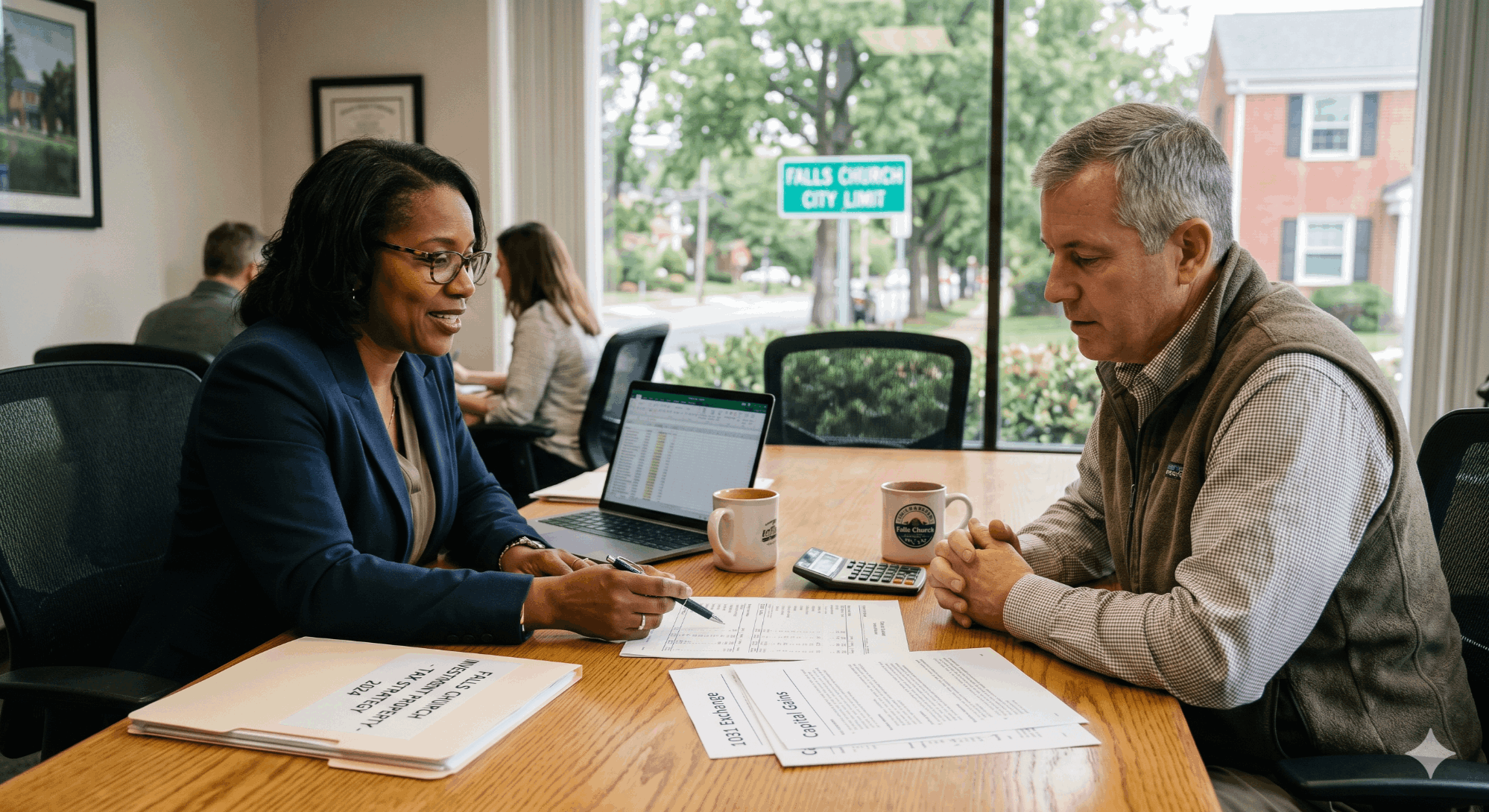
Quick Answer: Selling an investment property in Falls Church, Virginia typically triggers federal long-term capital gains tax (0%, 15%, or 20%), depreciation recapture taxed at up to 25%, Virginia state income tax of 5.75% on the gain, and — for high earners — a 3.8% Net Investment Income Tax. You can defer the entire tax bill with a 1031 exchange, qualify for the Section 121 primary-residence exclusion if you lived in the home for 2 of the last 5 years, or accept the tax hit and net out cleanly. The right pricing and buyer strategy depends on whether your unit is vacant or tenant-occupied at listing.
Key Takeaways
- Three taxes to plan for: federal capital gains (15–20% for most investors), depreciation recapture (25% federal), and Virginia state income tax (5.75%).
- Depreciation recapture is unavoidable — even if you never deducted depreciation, the IRS calculates it as if you did and taxes it on sale.
- A 1031 exchange defers all federal tax if you reinvest into another investment property within strict 45-day and 180-day windows.
- Tenant-occupied sales attract investor buyers (typically 5–10% below market). Vacant or post-lease sales open the full owner-occupant pool — usually the higher net.
- Falls Church City commands a price premium thanks to its top-ranked schools and Metro access — owner-occupants will outbid investors in most price brackets.
- Listing at 1.5% full-service with The Jamil Brothers preserves $7,500–$15,000+ of equity compared to a traditional 3% listing — money that goes directly toward your tax bill or reinvestment.
In This Guide
- The Falls Church investment property market in 2026
- The four taxes you'll owe when selling a rental
- 1031 Exchange — deferring tax by reinvesting
- Section 121 exclusion for former primary residences
- Tenant strategy — sell occupied, vacant, or buy out?
- How to price a Falls Church investment property
- Closing costs unique to Falls Church and NOVA
- Savings calculator — your real net proceeds
- Buyer strategy — investors vs. owner-occupants
- How to choose a listing agent for an investment sale
- Six mistakes that cost investment sellers thousands
- Step-by-step sale timeline
- Frequently asked questions
- Glossary
Selling an investment property in Falls Church is not the same transaction as selling your primary home. Capital gains taxes, depreciation recapture, the timing of your tenant's lease, and the question of who you're targeting as a buyer — investor or owner-occupant — all reshape your net proceeds in ways that catch most landlords off guard. The same $1.1 million Falls Church townhouse can net the seller wildly different amounts depending on these decisions.
This guide walks you through every variable that matters in 2026: the four taxes that apply, the two legal strategies for deferring or eliminating most of them, how to handle a tenant in place, and how to position the property so the right buyer pays a premium. We'll also cover the closing-cost line items that surprise out-of-area investors — including the regional fees specific to Northern Virginia jurisdictions like Falls Church.
The right plan can be the difference between writing a six-figure check to the IRS and rolling 100% of your equity into your next property — or simply walking away with $15,000 more by listing smart.
The Falls Church Investment Property Market in 2026
Falls Church City is one of the most demand-constrained markets in Northern Virginia. The independent city covers just two square miles, has a population of roughly 14,500, and is anchored by a school system consistently ranked in the top tier of Virginia — Falls Church City Public Schools regularly appears among the highest-performing districts in the state. Combine that with two Metro stations (East Falls Church and West Falls Church, both Orange Line), proximity to Tysons and DC, and a walkable downtown, and you have the conditions for sustained price appreciation that benefits long-term investment property owners.
The greater Falls Church area — including the Fairfax County zip codes 22041, 22042, 22043, 22044, and 22046 that share the Falls Church mailing address — adds significant inventory and ranges across condos, townhomes, single-family homes, and small multifamily. Each segment behaves differently when you list.
2026 market snapshot at a glance
| Metric | Falls Church City | Greater Falls Church (22042/43) |
|---|---|---|
| Median sale price (SFH) | $1.05M – $1.25M | $825K – $975K |
| Median sale price (condo) | $525K – $625K | $385K – $485K |
| Average days on market | 14 – 22 days | 18 – 28 days |
| List-to-sale ratio | 99% – 102% | 98% – 100% |
| Owner-occupant buyer share | ~85% | ~75% |
| Typical rent (3BR SFH/TH) | $3,800 – $4,500/mo | $3,200 – $3,900/mo |
Ranges reflect BrightMLS data trends for early-to-mid 2026. Verify your specific property type and ZIP with a current comp pull.
What this means for sellers
Two facts dominate every investment sale decision in Falls Church:
The owner-occupant pool dominates, and they will outbid almost any investor on a comparable property because they price on emotion and school district — not cap rate. That gap is the single biggest variable in your eventual net.
The Four Taxes You'll Owe When Selling a Falls Church Rental
An investment property sale is not one tax — it's a stack of four. Understanding each one is the foundation of every planning decision below. None of this is tax advice for your specific return; always work with a CPA who knows real estate before you list. But here is what every Falls Church investment seller needs to know going in.
1. Federal long-term capital gains tax
If you've held the property more than 12 months — which almost every long-term landlord has — your gain is taxed at long-term capital gains rates. For 2026 federal returns those brackets are roughly:
| Filing Status | 0% Rate Up To | 15% Rate Up To | 20% Rate Above |
|---|---|---|---|
| Single | $48,350 | $533,400 | $533,400+ |
| Married filing jointly | $96,700 | $600,050 | $600,050+ |
| Head of household | $64,750 | $566,700 | $566,700+ |
Brackets are inflation-adjusted annually by the IRS. Verify exact 2026 thresholds with your CPA.
Most Falls Church investment property sellers in active careers land at the 15% bracket; high-income sellers and out-of-state landlords often land at 20%.
2. Depreciation recapture (the surprise that gets everyone)
Every year you owned the rental, the IRS expected you to deduct depreciation — typically the building's basis divided by 27.5 years for residential property. Whether or not you actually claimed it on your returns, when you sell, the IRS recaptures the depreciation that you were entitled to claim as if you had. That recaptured amount is taxed federally at a flat rate of up to 25% (it's technically taxed at your ordinary income rate, capped at 25%).
⚠️ This is where most landlords get blindsided
On a Falls Church townhouse purchased for $475,000 in 2010 with an estimated building basis of $375,000, you've "depreciated" about $13,600 per year for 15+ years — roughly $204,000 of accumulated depreciation. At 25% recapture, that's a $51,000 federal tax bill on the recapture alone — before any capital gains tax on the appreciation.
3. Virginia state income tax
Virginia taxes capital gains as ordinary income. The state's top marginal rate is 5.75%, which applies to taxable income above $17,000. Practically, every Falls Church investment sale of meaningful size lands at the 5.75% rate. Virginia does not have a preferential capital gains rate. The Department of Taxation collects on the full gain — appreciation plus recapture.
4. Net Investment Income Tax (NIIT) — for higher earners only
If your modified adjusted gross income exceeds $200,000 (single) or $250,000 (married filing jointly), an additional 3.8% NIIT applies to your net investment income — including the gain from your rental sale. Many Falls Church households with two professional incomes cross this threshold.
Putting it all together — a sample tax stack
Here's what a real Falls Church investment sale might look like for a married couple selling a townhouse they bought 15 years ago, where their taxable income from other sources places them solidly in the 15% federal capital gains bracket:
| Item | Amount |
|---|---|
| 2026 sale price | $950,000 |
| Original cost basis (2011 purchase + improvements) | $490,000 |
| Accumulated depreciation | $185,000 |
| Adjusted basis at sale | $305,000 |
| Total taxable gain | $645,000 |
| — Depreciation recapture portion (25%) | −$46,250 |
| — Capital gains portion (15% on remaining $460,000) | −$69,000 |
| — Virginia state tax (5.75% on $645,000) | −$37,088 |
| — NIIT (3.8% on $645,000, if applicable) | −$24,510 |
| Estimated total tax liability | ~$176,848 |
Illustrative only. Your actual numbers depend on your basis, depreciation history, filing status, and other income. Always consult a CPA before listing.
Nearly $177,000 in taxes on a single sale. That's why the two strategies below — the 1031 exchange and the Section 121 exclusion — are worth understanding before you ever hit the market.
Our seller net sheet lays out every line — commission, transfer taxes, recapture estimates, payoff — so you walk in knowing exactly what you'll keep after taxes. Free, no obligation.
1031 Exchange — Deferring 100% of Your Tax by Reinvesting
A Section 1031 exchange — named for the section of the Internal Revenue Code — lets you sell an investment or business-use property and roll the entire proceeds into a "like-kind" replacement investment property, deferring all federal capital gains tax, depreciation recapture, and NIIT. Virginia conforms to the federal rules, so the state tax is also deferred.
Done correctly, you keep working with $177,000 of capital instead of $773,000 — a 23% boost to your purchasing power on the next deal.
The four hard rules of a 1031 exchange
1031 Exchange Checklist
- ✓ Use a Qualified Intermediary (QI). You cannot touch the sale proceeds. Funds flow from your buyer to the QI to your replacement property's seller.
- ✓ 45 days to identify replacement property. From the day your Falls Church sale closes, you have 45 calendar days — no extensions — to identify up to three replacement properties in writing.
- ✓ 180 days to close on replacement. Total window from your closing to taking title on the new property. Hard deadline.
- ✓ Equal or greater value, equal or greater debt. The replacement property must be equal or greater in price, and you must take on equal or greater debt — or contribute cash to make up the difference.
- ✓ Like-kind is broad. A Falls Church condo can exchange into a single-family rental in Loudoun, a retail strip in Maryland, or raw land — anything held for investment or business use.
- ✓ Engage the QI before closing. If you close, deposit the check, and then try to do a 1031, you're disqualified. The QI must be in place before settlement.
When a 1031 makes sense — and when it doesn't
| ✓ 1031 makes sense when… | ✗ 1031 is the wrong tool when… |
|---|---|
| You want to stay invested in real estate | You want to cash out and use the equity for something else |
| Your tax bill would be $50,000+ | Your gain is small and the tax is manageable |
| You have a replacement property already lined up or in mind | The market is thin and you can't realistically find a fit in 45 days |
| You want to scale up — trade a condo for a duplex, a duplex for a four-plex | You qualify for the Section 121 exclusion (see next section) |
| You want to diversify out of NOVA into another market | Your heirs would benefit more from a stepped-up basis at your passing |
Section 121 — When a Former Rental Qualifies for the $250K/$500K Exclusion
Section 121 of the Internal Revenue Code lets a homeowner exclude up to $250,000 of capital gain ($500,000 if married filing jointly) from the sale of a primary residence — if you've owned and used the home as your principal residence for at least two of the last five years before sale.
Why this matters for investment property owners: a property that started as your primary residence, then became a rental, can still qualify if the timing works.
The "2 of 5" test, simplified
If you lived in your Falls Church property as your primary residence for at least 24 months (not necessarily consecutive) during the 60 months before the sale closes, you can claim the exclusion on the appreciation portion of the gain. There's a catch, though: the exclusion does not apply to depreciation recapture. You still owe recapture tax for the years the property was rented.
ℹ️ Common Falls Church scenario
You bought a Falls Church condo in 2019, lived in it through 2023, then converted it to a rental when you moved to a larger home in McLean. If you sell by the end of 2026 — within the 5-year lookback — you qualify for Section 121. You exclude up to $500,000 of appreciation gain (MFJ), but still owe recapture on the three years of rental depreciation. The net tax savings is often $60,000–$100,000+.
The Section 121 vs. 1031 decision
You generally pick one or the other. If the Section 121 timing window is closing soon and your gain is below $500K (MFJ), use Section 121 — it's an exclusion (tax-free), not a deferral (tax-later). If you've held the property as a pure rental for many years and a Section 121 doesn't apply, the 1031 is your tool.
Tenant Strategy — Sell Occupied, Sell Vacant, or Buy Out?
If your Falls Church investment property has a tenant, you have three legitimate paths to closing. Each one affects timing, buyer pool, and price. There is no universally right answer — but there is a right answer for your specific lease term, market segment, and timeline.
Option 1 — Sell with the tenant in place
Virginia is a "lease survives sale" state. Under the Virginia Residential Landlord and Tenant Act (VRLTA), an existing lease transfers with the property to the new owner. The tenant has the legal right to stay through the end of the lease term, and the new owner steps into the landlord's role.
This dramatically narrows your buyer pool. Owner-occupants — who make up roughly 85% of Falls Church buyers — almost never accept a property they can't occupy at closing. Your audience becomes investors only, and they expect a discount of typically 5–10% to compensate for the lack of flexibility, the rent that may be below market, and the unknown of the tenant's behavior post-sale.
Option 2 — Wait for the lease to end, then sell vacant
If your lease ends in three to six months and the market is steady, this is usually the highest-net-proceeds path. You give the tenant proper non-renewal notice in accordance with VRLTA (typically 60 days for fixed-term leases ending, longer for month-to-month — check Virginia Code §55.1-1253), schedule a turnover, and list to the full owner-occupant pool.
Option 3 — Negotiate an early termination ("cash for keys")
If your lease has 9+ months left and you don't want to wait, you can offer the tenant compensation — typically one to three months' rent plus moving costs — in exchange for voluntary early termination. The tenant must agree; you cannot force this under VRLTA. But it's often the cleanest path: vacant possession in 30–60 days, full owner-occupant pricing on the back end.
Net proceeds comparison — same property, three paths
| Strategy | Sale Price | Costs | Net Difference |
|---|---|---|---|
| Sell tenant-occupied (investor buyer) | $855,000 | Standard | Baseline |
| Wait 4 mo. for lease end, then sell vacant | $950,000 | +4 mo. carry | +$78,000 |
| Cash for keys ($9K), then sell vacant | $950,000 | +$9,000 buyout | +$86,000 |
Sample $950K Falls Church townhouse. Your specific result depends on lease terms, market conditions, and tenant cooperation.
How to Price a Falls Church Investment Property
Pricing an investment property is a different exercise than pricing a primary home. You have two valuation frameworks, and the higher of the two is your real ceiling.
Framework 1 — Comparable sales (the owner-occupant lens)
This is the standard "comps" approach: recent sales of the most similar properties in Falls Church City and the surrounding 22042–22046 ZIPs, adjusted for square footage, condition, bedrooms, garage, lot, and updates. This is how owner-occupants will value the home, and it's how the appraiser will value it for a buyer's mortgage.
Framework 2 — Cap rate analysis (the investor lens)
Investors price on net operating income (NOI) divided by their target cap rate. In Falls Church, investor target cap rates for residential single-family and townhomes typically range from 4.5% to 5.5%. Multifamily and condos can stretch slightly higher.
ℹ️ Cap rate math example
Falls Church townhouse renting at $4,000/month = $48,000 annual gross. Subtract approximately 35% for taxes, insurance, HOA, maintenance, vacancy, and management → NOI ≈ $31,200. At a 5% target cap rate, an investor values that property at $624,000. The same townhouse comps out at $950,000 to an owner-occupant. The owner-occupant wins — by a wide margin.
In Falls Church, the owner-occupant value almost always exceeds the investor value for single-family and townhouse properties. The exception is multifamily and certain condo categories where the rent-to-value ratio is stronger. Knowing which framework your buyer will use is the foundation of pricing strategy.
Closing Costs Unique to Falls Church and Northern Virginia
Falls Church sits inside the Northern Virginia Transportation Authority jurisdiction, which means in addition to the standard Virginia grantor tax, your closing includes regional transportation surcharges that don't apply to most of Virginia. Combined with the listing commission and standard fees, here is what a typical seller closing cost statement looks like.
| Line Item | Who Pays | Typical Amount (on $950K) |
|---|---|---|
| Virginia state grantor tax ($0.50 / $500) | Seller | ~$950 |
| NOVA regional WMATA tax ($0.10 / $100) | Seller | ~$950 |
| NOVA regional congestion relief fee ($0.15 / $100) | Seller | ~$1,425 |
| Listing commission (1.5% with Jamil Brothers vs. 3% traditional) | Seller | $14,250 vs. $28,500 |
| Buyer's agent compensation (negotiable post-NAR settlement) | Seller or buyer | Variable (often 2.5%) |
| Settlement / escrow fee | Split | $500 – $900 |
| Deed prep, recording, courier | Seller | $300 – $600 |
| Prorated property taxes | Seller (through closing) | Varies by closing date |
| HOA / condo transfer fee & disclosure packet | Seller (typically) | $200 – $700 |
| Existing mortgage payoff | Seller | Your loan balance |
Estimates only. Verify exact 2026 grantor tax rates and regional surcharges with your settlement attorney.
Savings Calculator — Your Real Net Proceeds
Select the price tier closest to your Falls Church property to see how much more you keep listing with The Jamil Brothers at 1.5% full-service versus a traditional 3% listing agent. Every dollar saved here is a dollar that goes toward your tax bill, your reinvestment, or your next chapter.
Seller Savings Calculator
How much more do you keep with our 1.5% listing fee?
Select your Falls Church property's value to see your side-by-side net proceeds.
| Traditional Agent — 3% | |
| Sale price | $500,000 |
| Listing fee (3%) | −$15,000 |
| Buyer's agent (2.5%) | −$12,500 |
| Est. closing (1%) | −$5,000 |
| Net Proceeds | $467,500 |
| Our Fee — Only 1.5% | |
| Sale price | $500,000 |
| Listing fee (1.5%) | −$7,500 |
| Buyer's agent (2.5%) | −$12,500 |
| Est. closing (1%) | −$5,000 |
| Net Proceeds | $475,000 |
| Traditional Agent — 3% | |
| Sale price | $600,000 |
| Listing fee (3%) | −$18,000 |
| Buyer's agent (2.5%) | −$15,000 |
| Est. closing (1%) | −$6,000 |
| Net Proceeds | $561,000 |
| Our Fee — Only 1.5% | |
| Sale price | $600,000 |
| Listing fee (1.5%) | −$9,000 |
| Buyer's agent (2.5%) | −$15,000 |
| Est. closing (1%) | −$6,000 |
| Net Proceeds | $570,000 |
| Traditional Agent — 3% | |
| Sale price | $750,000 |
| Listing fee (3%) | −$22,500 |
| Buyer's agent (2.5%) | −$18,750 |
| Est. closing (1%) | −$7,500 |
| Net Proceeds | $701,250 |
| Our Fee — Only 1.5% | |
| Sale price | $750,000 |
| Listing fee (1.5%) | −$11,250 |
| Buyer's agent (2.5%) | −$18,750 |
| Est. closing (1%) | −$7,500 |
| Net Proceeds | $712,500 |
| Traditional Agent — 3% | |
| Sale price | $1,000,000 |
| Listing fee (3%) | −$30,000 |
| Buyer's agent (2.5%) | −$25,000 |
| Est. closing (1%) | −$10,000 |
| Net Proceeds | $935,000 |
| Our Fee — Only 1.5% | |
| Sale price | $1,000,000 |
| Listing fee (1.5%) | −$15,000 |
| Buyer's agent (2.5%) | −$25,000 |
| Est. closing (1%) | −$10,000 |
| Net Proceeds | $950,000 |
| Traditional Agent — 3% | |
| Sale price | $1,500,000 |
| Listing fee (3%) | −$45,000 |
| Buyer's agent (2.5%) | −$37,500 |
| Est. closing (1%) | −$15,000 |
| Net Proceeds | $1,402,500 |
| Our Fee — Only 1.5% | |
| Sale price | $1,500,000 |
| Listing fee (1.5%) | −$22,500 |
| Buyer's agent (2.5%) | −$37,500 |
| Est. closing (1%) | −$15,000 |
| Net Proceeds | $1,425,000 |
Estimates only. Closing costs vary. Buyer's agent commission is negotiable post-NAR settlement.
| 500+ Five-Star Reviews · Top 1% Nationwide · 840+ Homes Sold | TheJamilBrothers.com · (703) 782-4830 |
Buyer Strategy — Investors vs. Owner-Occupants
Once you decide whether to sell vacant or occupied, the buyer pool follows. Each pool requires a different marketing approach, different photography, and different listing copy. Here's how the two compare on the variables that matter.
| Variable | Owner-Occupant Buyer | Investor Buyer |
|---|---|---|
| Pricing approach | Comps and emotion | Cap rate and cash flow |
| Typical offer relative to ask | 99–102% in Falls Church | 88–94% in most cases |
| Financing | Owner-occupied conventional, FHA, VA | Investor loans (DSCR), portfolio, cash |
| Appraisal sensitivity | High — financed deals appraise | Lower — cash and DSCR often skip |
| Contingencies | Inspection, appraisal, financing typical | Often waived or shortened |
| Days to close | 30–45 days | 14–30 days |
| Tenant acceptance | Rarely accepts | Often preferred (cash flow day one) |
When the investor buyer is actually the right buyer
For most Falls Church properties, owner-occupants pay more. But there are specific scenarios where targeting investors makes sense:
- The property is a small multifamily (2–4 units) where the cap rate value exceeds the owner-occupant value.
- You have a strong long-term tenant with a below-market lease — investors will pay more for a clean, paying tenant than the discount the lease creates.
- You need a fast close and certainty more than maximum price (estate sale, divorce, pending out-of-state relocation).
- The property needs significant work and would scare owner-occupants but appeal to BRRRR-strategy investors.
- You want to do a 1031 exchange and need to close on a fixed date to hit your 180-day window — investors deliver certainty.
4K photography, drone video, 3D tours, professional staging consultation, expert negotiation, and full MLS marketing — all included at 1.5%. On a $1M Falls Church property, that's $15,000 you keep for your tax bill or your next investment.
How to Choose a Listing Agent for an Investment Sale
Investment property sales require a listing agent fluent in three things most agents are not: 1031 exchange timelines and coordination with qualified intermediaries, tenant law under VRLTA and tenant-occupied showings, and the dual-pool marketing (owner-occupant vs. investor) that determines your final number. Here is the objective evaluation grid.
Listing Agent Screening Checklist
- ✓ Has closed at least 10 investment property listings in the last 24 months.
- ✓ Can name 2–3 qualified intermediaries they have worked with on 1031 exchanges.
- ✓ Provides a written net sheet — not just an "estimated sale price."
- ✓ Has a marketing plan that addresses owner-occupant AND investor channels.
- ✓ Knows the difference between a 60-day non-renewal under a fixed-term lease and 60-day notice under a month-to-month tenancy in Virginia.
- ✓ Has worked with out-of-state owners and is comfortable coordinating remote signings.
- ✓ Carries the same professional marketing services (drone, 3D tours, staging) at their stated commission — no upsells.
- ✓ Has verified five-star reviews from past investment-property sellers, not just primary-residence sellers.
The Jamil Brothers Realty Group has closed 840+ transactions across Northern Virginia, holds NVAR Lifetime Top Producer status, and runs every listing — investment property or primary home — through a full-service marketing system at a flat 1.5% listing fee. Both partners are licensed in Virginia, Maryland, DC, and West Virginia, with active referral relationships with several qualified intermediaries and 1031-experienced CPAs in the region.
Six Mistakes That Cost Falls Church Investment Sellers Thousands
1. Not running the tax stack before listing
The number-one mistake. Sellers list, accept an offer, and only at the CPA meeting after closing learn that they owe $150K+ in combined federal and state taxes. By then, the 1031 deferral window is gone — you cannot retroactively structure an exchange after closing.
2. Engaging a qualified intermediary too late
The QI must be in place before your sale closes. If you close, deposit the check, and then try to set up a 1031, you are disqualified. Always engage the QI during the contract period, not after.
3. Listing tenant-occupied when the lease ends in 60 days
If your lease ends in two to three months, almost always wait. The 5–10% price uplift from a vacant, owner-occupant-targeted listing typically dwarfs the carrying cost of those extra months.
4. Showing the property with tenant clutter and pets
If you do sell occupied, the photos and showings must still convert. Negotiate a clean-up agreement, a small payment to the tenant for showing access, and a defined showing window. A messy occupied listing photographed at the wrong time sells for 8–12% below its potential.
5. Ignoring the regional grantor taxes in your net sheet
NOVA's regional WMATA and congestion relief fees add roughly $2.50 per $1,000 of sale price on top of the standard state grantor tax. On a $1M Falls Church sale, that's an extra $2,400+ that out-of-state landlords routinely miss.
6. Paying 3% commission "because that's what everyone charges"
Falls Church's market is too competitive — and your investment property already has more than enough exposure on BrightMLS and the major portals — to justify a 3% listing fee. A 1.5% full-service listing delivers identical (often superior) marketing and saves the seller $7,500 to $22,500+ depending on price.
If your 1031 deadline is tight, your tenant situation is complex, or you simply need certainty over maximum price, a cash offer may be the right path. We'll walk you through your full range of options — no pressure, no obligation.
Step-by-Step Sale Timeline
Tax planning with a real-estate CPA — 60 to 90 days before listing
Calculate basis, depreciation, projected gain, and total tax stack. Decide between Section 121, 1031 exchange, or pay-the-tax path.
Tenant strategy decision — 60 days before listing
Choose: sell occupied, give non-renewal notice, or negotiate early termination. Document everything in writing under VRLTA standards.
Listing agent selection & pricing analysis — 30 to 45 days before listing
Interview agents, request written net sheets, finalize listing price after a hyper-local comp analysis (and cap-rate check for multifamily).
Property prep — 14 to 30 days before listing
Address deferred maintenance, paint touch-ups, professional cleaning, light staging if vacant. Coordinate tenant cooperation if occupied.
Professional media & listing launch — week of listing
4K photography, drone, 3D tour, MLS launch with full syndication, professional listing copy targeting the correct buyer pool.
Active marketing & offer evaluation — days 1 to 21
Open houses, private showings, broker tours. Evaluate offers on price, financing strength, contingencies, and your timing needs (especially for 1031 sellers).
Under contract — 30 to 45 days to closing
Inspection, appraisal, financing, title review. If 1031 exchange, QI is fully engaged. Identify replacement properties on day-of-close if doing a delayed exchange.
Closing day — wire instructions, signed deed, keys
Funds route to your QI (if 1031) or directly to you. Final settlement statement reviewed. 45-day clock starts immediately for 1031 sellers.
Frequently Asked Questions
How much tax will I owe when I sell my Falls Church investment property?
A typical Falls Church investment seller in 2026 pays federal capital gains tax of 15% to 20% on appreciation, depreciation recapture of up to 25% on the depreciation taken (or that should have been taken), Virginia state income tax of 5.75% on the gain, and — for higher earners — an additional 3.8% Net Investment Income Tax. On a $950,000 sale with a $645,000 gain, the total tax bill can exceed $175,000. A 1031 exchange or Section 121 exclusion can dramatically reduce or defer this amount.
Can I do a 1031 exchange on my Falls Church rental property?
Yes, any Falls Church property held for investment or business use qualifies for a 1031 exchange. You must engage a qualified intermediary before closing, identify replacement property in writing within 45 days of your sale closing, and close on the replacement within 180 days total. The replacement property must be like-kind (any U.S. investment real estate qualifies) and of equal or greater value with equal or greater debt.
Do I have to wait for my tenant's lease to end before selling in Virginia?
No, you can sell at any time, but the existing lease transfers with the property under the Virginia Residential Landlord and Tenant Act. The new owner steps into the landlord role and must honor the lease through its termination date. This typically limits your buyer pool to investors. To sell vacant — and access the larger owner-occupant pool — you must either wait for the lease to end with proper non-renewal notice, or negotiate a voluntary early termination (often called "cash for keys") with your tenant.
What is depreciation recapture and how does it work?
Depreciation recapture is a federal tax owed when you sell a rental property at a price higher than its depreciated basis. The IRS taxes the recaptured depreciation at your ordinary income rate, capped at 25%. Critically, recapture applies whether or not you actually claimed depreciation on your prior tax returns — the IRS treats it as if you had. On a Falls Church property held 15 years with $185,000 of accumulated depreciation, recapture alone can produce a $46,000+ federal tax bill.
Can I use the Section 121 $250K/$500K exclusion on a former rental?
Yes, if you used the property as your primary residence for at least 24 months out of the 60 months immediately before the sale. The exclusion applies to the appreciation portion of the gain — up to $250,000 single, $500,000 married filing jointly. However, the Section 121 exclusion does NOT cover depreciation recapture from any rental period. You still owe recapture tax on the depreciation taken or eligible while the property was a rental.
What are the typical closing costs for a Falls Church investment property sale?
Falls Church sellers typically pay the Virginia state grantor tax ($1 per $1,000 of sale price), regional WMATA tax ($1 per $1,000), regional congestion relief fee ($1.50 per $1,000), listing commission (1.5% with The Jamil Brothers vs. 3% traditional), buyer's agent compensation (negotiable post-NAR settlement, often 2.5%), settlement and recording fees, prorated property taxes, and any HOA or condo transfer fees. On a $1M sale, total seller-side closing costs typically range from $43,000 to $65,000 depending on the commission structure.
Is it better to sell my Falls Church investment property to an investor or an owner-occupant?
For single-family homes, townhomes, and most condos in Falls Church, owner-occupants pay significantly more — typically 5% to 12% higher than investors. The exceptions are small multifamily properties (2 to 4 units) where the cap rate value can match or exceed the owner-occupant value, and situations where you need speed and certainty over maximum price. In Falls Church City specifically, the school district drives owner-occupant demand that almost no investor can match on price.
How long does it typically take to sell an investment property in Falls Church?
A well-priced, well-marketed Falls Church investment property typically goes under contract within 14 to 28 days, with closing 30 to 45 days after that — for a total of roughly 6 to 10 weeks from list to keys. Tenant-occupied properties take longer because of restricted showings and a narrower buyer pool, often adding 2 to 4 weeks. Cash investor sales can close in as little as 14 days if needed for a 1031 deadline.
How did the NAR settlement affect commissions on investment property sales?
After the NAR settlement that took effect in August 2024, buyer's agent compensation is no longer automatically embedded in the listing commission and is no longer advertised on the MLS. Sellers and buyers negotiate this separately. Most Falls Church sellers still choose to offer buyer's agent compensation (commonly 2.5%) to keep their property accessible to financed buyers whose lenders limit how much they can pay their own agent. With a 1.5% listing fee plus a 2.5% buyer's agent offering, the total commission structure remains substantially below the historical 5% to 6% norm.
How do I choose the right listing agent for an investment sale?
Look for an agent who has closed at least 10 investment property listings in the last 24 months, can name qualified intermediaries they've worked with on 1031 exchanges, provides a written net sheet (not just a price estimate), has a documented dual-pool marketing plan, understands Virginia tenant law and VRLTA notice requirements, and has verified five-star reviews from past investment-property sellers. The Jamil Brothers Realty Group meets all these criteria, with 840+ closed transactions, NVAR Lifetime Top Producer status, and active 1031 and CPA referral relationships across Northern Virginia.
Can I sell my Falls Church rental from out of state?
Yes, remote sales of Virginia investment properties are routine. You sign listing paperwork electronically, your agent or property manager handles showings and any vacancy turnover, and the closing is handled by a Virginia settlement attorney who can accept a remote notarized power of attorney or a remote online notarization (RON) for your final signing. The Jamil Brothers regularly close investment property sales for out-of-state and overseas owners.
What are the HOA and condo association rules I need to handle when selling?
Virginia law requires the seller to provide the buyer with a condominium or HOA resale disclosure packet within 14 days of contract ratification, and the buyer has a statutory three-day cancellation right after receiving it. Order the packet immediately after going under contract. The associated cost is typically paid by the seller and ranges from $200 to $700. Some associations also charge a separate transfer fee at closing, generally $200 to $500.
Glossary
Adjusted Basis
Original purchase price plus capital improvements minus accumulated depreciation. Used to calculate taxable gain on sale.
Cap Rate
Net operating income divided by property value. Investors use cap rate to compare rental properties; Falls Church cap rates typically range 4.5%–5.5%.
Depreciation Recapture
Federal tax owed at up to 25% on depreciation taken (or eligible to be taken) during the years the property was a rental.
Grantor Tax
Virginia's seller-paid transfer tax: $0.50 per $500 of consideration (or $1 per $1,000). Additional regional fees apply in NOVA.
NIIT (Net Investment Income Tax)
3.8% federal surtax on investment income for taxpayers above $200K single / $250K married filing jointly.
Qualified Intermediary (QI)
A neutral third party who holds sale proceeds in a 1031 exchange. The seller cannot touch the funds; the QI bridges to the replacement property.
Section 121 Exclusion
IRS provision allowing exclusion of up to $250K (single) or $500K (MFJ) of capital gain from sale of a primary residence used as such for 2 of the last 5 years.
VRLTA
Virginia Residential Landlord and Tenant Act — governs leases, notices, deposits, and tenant rights in Virginia, including when the rental is sold.
Ready to Sell Your Falls Church Investment Property?
Selling an investment property is more complicated than selling your primary home. Get the tax planning right, get the tenant strategy right, and get the buyer-pool positioning right — and you can keep $50,000 to $150,000 more than the seller across the street who got each of those wrong. The Jamil Brothers Realty Group has closed investment property sales across Falls Church, McLean, Vienna, Arlington, Alexandria, and Fairfax County for over a decade. Both partners are licensed in VA, MD, DC, and WV, and every listing comes with full-service marketing — 4K photography, drone video, 3D tours, professional negotiation, and dual-pool MLS positioning — at a 1.5% listing fee.
Know your equity, understand your tax exposure, and see exactly what you'll walk away with — before you make any listing decisions. Free consultation, no obligation. We coordinate directly with your CPA and 1031 QI if needed.
Explore More Northern Virginia Guides
McLean Vienna Fairfax Alexandria Reston Herndon 1.5% Listing Program Cash Offers Seller Net SheetThis article is for informational purposes only and does not constitute tax, legal, or financial advice. Always consult a qualified CPA, tax attorney, and licensed real estate professional before making decisions about the sale of an investment property. The Jamil Brothers Realty Group is licensed in Virginia, Maryland, Washington D.C., and West Virginia under Samson Properties.
Explore More
Browse Every Corner of the DMV Market
Whether you're searching by budget, neighborhood, or buying situation — find exactly what you need below.
Virginia Homes by Budget
Washington DC Homes by Budget
Maryland Homes
Explore Northern Virginia Communities
Loudoun County
Fairfax County & Surrounding
Ready to Make a Move?
Full-Service · No Tradeoffs
List for 1.5% & Keep More Equity
Professional photography, drone video, 3D tours, and expert negotiation — all included. On an $800K home, that's $12,000 more in your pocket vs. a 3% agent.
See the 1.5% Program →Need Speed or Certainty?
Get a No-Obligation Cash Offer
Skip the showings, skip the contingencies. If timing or condition matters more than top dollar, a cash offer may be the right fit. We'll walk you through every option.
Explore Cash Offers →Categories
- All Blogs (1243)
- Buyer Guide (8)
- Buying a home (2)
- Buying Strategies (31)
- festivals (1)
- General Blog (67)
- Market Intelligence (29)
- Market Updates (8)
- Notable Properties For Sale (32)
- Real Estate Tips, News, and More (395)
- Seller Guide (2)
- Seller Guides (60)
- Selling Your Home (527)
- Top Realtors in Northern Virginia (58)
Recent Posts




Let's Connect