
Downsizing in Falls Church: Selling a Larger Home to Move to Something Smaller
Downsizing in Falls Church: Selling a Larger Home to Move to Something Smaller

Quick Answer: Downsizing in Falls Church typically unlocks $400,000 to $900,000 in equity for owners who bought before 2015, thanks to one of the strongest price-appreciation markets in Northern Virginia. The biggest decisions are timing (sell first, buy first, or bridge), capital gains exposure above the IRS exclusion, and matching your next home to the right Falls Church, McLean, Vienna, or Arlington micro-market. Most empty-nesters and retirees here finish the entire process in 90 to 120 days when they list with a local agent who can sequence both transactions.
Key Takeaways
- Falls Church City and the broader Falls Church 22041/22042/22043/22044 ZIP areas have appreciated roughly 65–85% over the past decade — most long-term owners hold six-figure (or seven-figure) equity positions.
- The capital gains exclusion is $250,000 for single filers and $500,000 for married couples filing jointly — anything above that is taxable, and many Falls Church downsizers exceed it.
- You typically have three sequencing options: sell first (maximum equity, requires interim housing), buy first with a bridge or HELOC (no double move, higher carrying cost), or contingent purchase (cleanest but weakest negotiating position).
- Downsizing buyers prize light, lock-and-leave layouts, single-level living or first-floor primaries, walkable amenities, and storage — your next-home shortlist matters as much as your sale price.
- Listing at 1.5% full-service instead of 3% keeps an additional $12,000–$18,000 on a typical Falls Church sale, money that goes straight toward your next home's down payment or closing costs.
- The right Falls Church listing agent should provide a side-by-side net sheet for both transactions — your sale and your purchase — before you sign anything.
In This Guide
- Why Falls Church Homeowners Are Downsizing in 2026
- The Falls Church Market for Larger Homes
- How Much Equity Will You Actually Unlock?
- Where Falls Church Downsizers Are Moving To
- Sequencing: Sell First, Buy First, or Bridge?
- Your 1.5% vs 3% Savings Calculator
- Capital Gains and the IRS Exclusion
- Preparing a Larger Home That Has Been Lived In
- Pricing Strategy for Falls Church
- Marketing to the Right Buyer Pool
- Step-by-Step Downsizing Timeline
- Common Falls Church Downsizing Mistakes
- How to Choose a Falls Church Listing Agent
- Frequently Asked Questions
- Glossary
Downsizing in Falls Church is rarely about the house. It is almost always about the next chapter — retirement, an empty nest, a death in the family, a job change, or simply the realization that you have not used the upstairs bedrooms in three years. The house, the staircase, the lawn, the property tax bill, the time you spend on a riding mower instead of in Cherry Hill Park — all of it has become a tax on the life you actually want to live.
The Falls Church area sits in an unusual position. Prices here have climbed faster than most of Northern Virginia since 2015, schools remain among the best-rated in the state, and demand for the kind of 4-bedroom colonials and split-levels that long-term owners are now ready to leave is still healthy. That combination — strong sale-side demand, plus a wide range of smaller homes within a 10-mile radius — makes Falls Church one of the most rewarding places in the DMV to downsize from. It also makes the timing, tax planning, and listing strategy more consequential, because the dollars at stake are larger.
This guide walks through exactly how to do it: what your home is worth in today's Falls Church market, where downsizers in this area are actually moving (it is not always what you think), how to sequence the sale and the purchase, how the capital gains exclusion works when your equity has grown past $500,000, and how to keep more of that equity by choosing the right listing structure.
Why Falls Church Homeowners Are Downsizing in 2026
The downsizing decision in Falls Church is rarely impulsive. Most owners we work with have been thinking about it for two to four years before they actually call an agent. When they finally do, the reasons cluster into a small number of patterns.
The five most common triggers
| Trigger | Typical Profile | Urgency |
|---|---|---|
| Empty nest after last child finishes college | Owners aged 55–65 in a 4–5 BR colonial | Low — usually plans 12–24 months ahead |
| Retirement and lifestyle shift | Owners aged 62–75 with mortgage-free or near-free home | Medium — often tied to retirement date |
| Stairs, maintenance, or health concerns | Owners aged 70+ in multi-level homes | High — often after a fall or diagnosis |
| Death of a spouse | Surviving spouse in too-large family home | High — usually 6–18 months after the loss |
| Equity-driven lifestyle upgrade | Mid-career professionals trading space for walkability | Variable — driven by market conditions |
Whatever the trigger, the math underneath is similar. Long-term Falls Church owners are sitting on equity that has compounded faster than they realize. A home bought in 2013 for $625,000 is frequently worth $1.05–$1.15 million today. The downsizing question is not "Can I afford to move?" — it is "What do I do with the surplus?"
The Falls Church Market for Larger Homes
The downsizing decision depends on two markets at once: the market for the home you are selling and the market for the home you are buying. Let's start with what you are selling.
Falls Church price ranges by home type
| Home Type | Typical Range | Buyer Pool |
|---|---|---|
| Falls Church City colonial, 4 BR, ~2,800 sq ft | $1.1M – $1.5M | Move-up families, dual-income professionals |
| Greater Falls Church (22042/22043) split-level, 4 BR | $825K – $1.05M | First-time and move-up families |
| Mid-century rambler, 3–4 BR, larger lot | $925K – $1.25M (more if redevelopable) | Renovators, builders, growing families |
| Newer luxury build, 5+ BR, ~4,500 sq ft | $1.75M – $2.6M | High-income professionals, executive relocation |
| Townhome, 3 BR, ~2,000 sq ft | $675K – $850K | First-time buyers, smaller families |
These are working ranges, not appraisals — your home's specific lot, school pyramid (especially Falls Church City Public Schools vs. Fairfax County), basement finish, kitchen vintage, and frontage all swing the number. The point is that even the lower end of the Falls Church market clears well above the Northern Virginia median, which is what makes the downsizing math so favorable.
Demand intensity for downsizer-style homes
The takeaway: the homes most downsizers are leaving — three-decade family colonials in the $1M–$1.4M band — are exactly what younger Falls Church move-up families are competing for. That alignment of seller supply and buyer demand is the structural reason Falls Church remains an excellent place to sell from, even in quieter overall markets.
How Much Equity Will You Actually Unlock?
Most downsizing conversations start with a number that turns out to be wrong by six figures in either direction. Owners either underestimate (relying on memory of what neighbors sold for in 2019) or overestimate (using Zillow's auto-estimate, which can be off by 8–15% in this market). Before you make any move, the first job is to nail down the real net.
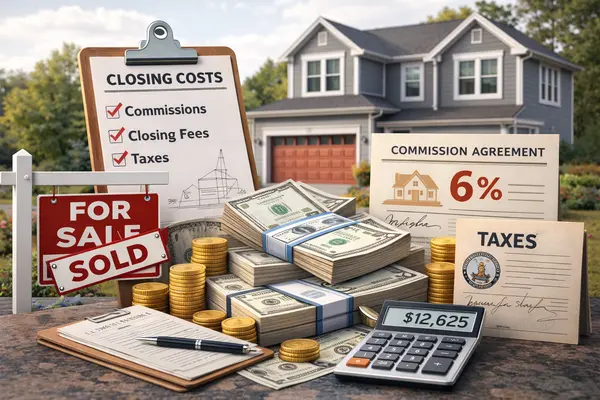
The number that matters is not your sale price. It is your net proceeds after every cost: listing commission, buyer-agent compensation, Virginia grantor tax, Northern Virginia regional congestion tax, deed prep, HOA or condo transfer fees if applicable, prorated property taxes, and the payoff on any mortgage or HELOC. On a typical $1.15M Falls Church sale, those costs land somewhere between $80,000 and $90,000 before you touch the mortgage payoff.
A typical Falls Church net-sheet snapshot
| Line Item | Traditional 3% Listing | Jamil Brothers 1.5% |
|---|---|---|
| Sale price | $1,150,000 | $1,150,000 |
| Listing-side commission | −$34,500 | −$17,250 |
| Buyer-agent compensation (negotiable, ~2.5%) | −$28,750 | −$28,750 |
| Virginia grantor tax ($1 per $1,000) | −$1,150 | −$1,150 |
| NOVA regional congestion tax (~0.15%) | −$1,725 | −$1,725 |
| Settlement, deed prep, title clearance | −$1,800 | −$1,800 |
| Prorated taxes, HOA transfer, misc. | −$2,500 | −$2,500 |
| Net before mortgage payoff | $1,079,575 | $1,096,825 |
The structural takeaway: every percentage point you keep on the listing side is roughly $11,500 on a $1.15M sale. Cutting the listing commission from 3% to 1.5% does not change a single thing about the marketing, photography, or negotiation — it changes what you walk away with. That money typically goes straight to your next home's down payment or sits in a money-market account funding your first three years of retirement.
Get a personalized home valuation from The Jamil Brothers — street-level comps from Falls Church City, 22042, 22043, and 22044, not an automated estimate. Response within 24 hours.
Where Falls Church Downsizers Are Moving To
The other half of the downsizing decision is the next home. The patterns we see fall into four broad lanes.
1. Stay in Falls Church, switch to a smaller footprint
Many downsizers do not want to leave the area. The schools, the walkability, the proximity to West Falls Church and East Falls Church Metro, and the social network they have built over 20+ years all argue for staying close. The substitutes inside Falls Church are condos and townhomes around the West Falls and Founders Row developments, smaller 2- to 3-bedroom homes on quieter Falls Church City streets, and 55+ age-restricted options in the broader Mosaic District and Merrifield area.
2. Move to a more lock-and-leave neighborhood
The second pattern is downsizers who want less house and more freedom. McLean condos near Tysons, Vienna's smaller homes near the W&OD trail, and Old Town Alexandria townhomes are popular landing spots. These buyers want a single-level layout or first-floor primary, walkable amenities, and the ability to lock the door and travel for two weeks without worrying about anything.
3. Move out to farther suburbs for space + lower cost
A surprising number of downsizers actually move outward, not inward — to a smaller but newer home in Loudoun or Prince William County where they can buy a 2,200 sq ft single-level home outright, pocket $400K+ in cash, and reduce their property tax bill by half. Ashburn, Leesburg, and parts of Prince William County see steady traffic from former Falls Church homeowners.
4. Out of state — Florida, Carolinas, or family-driven moves
And finally, a meaningful share of Falls Church downsizers leave Virginia entirely. Florida (no state income tax), the Carolinas (lower cost of living, mild climate), and out-of-state moves to be closer to adult children or grandchildren are the most common destinations. For these sellers, maximizing the Falls Church sale price matters even more, because the surplus equity is funding the entire next phase of life.
Our seller net sheet calculator breaks down every cost — Virginia grantor tax, NOVA congestion tax, settlement fees, payoff — so you know your real bottom line before you list.
Sequencing: Sell First, Buy First, or Bridge?
This is the single hardest practical decision in a downsize, and it is where most owners spend the most time worrying. There are three real options, each with its own trade-offs.
| Strategy | Best For | Trade-off |
|---|---|---|
| Sell first, then rent or stay with family | Maximum sale price, no carrying-cost risk, retirees with flexibility | Interim housing required (2–4 months), possible double move |
| Buy first with bridge loan or HELOC | Owners with strong income, want one move, found a unique target home | 2–4 months of carrying two properties, bridge interest cost |
| Contingent purchase (offer subject to sale) | Risk-averse owners willing to accept a longer search | Weakest negotiating position; many sellers reject contingent offers |
| Simultaneous close (sale and purchase same day) | Owners willing to accept tight coordination | Logistically complex; one delay can derail both |
Which one wins in Falls Church right now?
For most Falls Church downsizers, "sell first with a rent-back clause" is the cleanest path. Because move-up families competing for your home will frequently agree to a 30–60 day post-settlement occupancy at no charge (or a token rent), you can effectively buy yourself two extra months to find and close on the next home — without taking on bridge-loan interest. We negotiate post-settlement occupancy on most of our downsizing listings, and a strong listing agent should always raise it early so it can be priced into the offer.
When buy-first is actually better
Buy-first is the right call when (a) you have found a specific home you cannot replicate, (b) your income easily covers two mortgage payments for 3–4 months, or (c) you can use a HELOC against your current home for the new down payment. In those cases the bridge cost is small relative to the certainty of avoiding interim housing.
Your 1.5% vs 3% Savings Calculator
Use the price points below to see what you would actually keep at 1.5% vs the traditional 3% on a Falls Church-sized sale. The buyer-agent compensation in these examples is shown at 2.5% — which is negotiable post-NAR settlement, but reflects what most cooperating buyer agents in Northern Virginia still expect.
Seller Savings Calculator
How much more do you keep with our 1.5% listing fee?
Select your home's estimated value to see your real net proceeds — side by side.
Traditional Agent — 3%
| Sale price | $400,000 |
| Listing fee (3%) | −$12,000 |
| Buyer's agent (2.5%) | −$10,000 |
| Est. closing (1%) | −$4,000 |
| Net Proceeds | $374,000 |
Our Fee — Only 1.5%
| Sale price | $400,000 |
| Listing fee (1.5%) | −$6,000 |
| Buyer's agent (2.5%) | −$10,000 |
| Est. closing (1%) | −$4,000 |
| Net Proceeds | $380,000 |
Extra in your pocket
$6,000
vs. a traditional 3% listing agent — with zero reduction in service or marketing.
Traditional Agent — 3%
| Sale price | $500,000 |
| Listing fee (3%) | −$15,000 |
| Buyer's agent (2.5%) | −$12,500 |
| Est. closing (1%) | −$5,000 |
| Net Proceeds | $467,500 |
Our Fee — Only 1.5%
| Sale price | $500,000 |
| Listing fee (1.5%) | −$7,500 |
| Buyer's agent (2.5%) | −$12,500 |
| Est. closing (1%) | −$5,000 |
| Net Proceeds | $475,000 |
Extra in your pocket
$7,500
vs. a traditional 3% listing agent — with zero reduction in service or marketing.
Traditional Agent — 3%
| Sale price | $600,000 |
| Listing fee (3%) | −$18,000 |
| Buyer's agent (2.5%) | −$15,000 |
| Est. closing (1%) | −$6,000 |
| Net Proceeds | $561,000 |
Our Fee — Only 1.5%
| Sale price | $600,000 |
| Listing fee (1.5%) | −$9,000 |
| Buyer's agent (2.5%) | −$15,000 |
| Est. closing (1%) | −$6,000 |
| Net Proceeds | $570,000 |
Extra in your pocket
$9,000
vs. a traditional 3% listing agent — with zero reduction in service or marketing.
Traditional Agent — 3%
| Sale price | $750,000 |
| Listing fee (3%) | −$22,500 |
| Buyer's agent (2.5%) | −$18,750 |
| Est. closing (1%) | −$7,500 |
| Net Proceeds | $701,250 |
Our Fee — Only 1.5%
| Sale price | $750,000 |
| Listing fee (1.5%) | −$11,250 |
| Buyer's agent (2.5%) | −$18,750 |
| Est. closing (1%) | −$7,500 |
| Net Proceeds | $712,500 |
Extra in your pocket
$11,250
vs. a traditional 3% listing agent — with zero reduction in service or marketing.
Traditional Agent — 3%
| Sale price | $1,000,000 |
| Listing fee (3%) | −$30,000 |
| Buyer's agent (2.5%) | −$25,000 |
| Est. closing (1%) | −$10,000 |
| Net Proceeds | $935,000 |
Our Fee — Only 1.5%
| Sale price | $1,000,000 |
| Listing fee (1.5%) | −$15,000 |
| Buyer's agent (2.5%) | −$25,000 |
| Est. closing (1%) | −$10,000 |
| Net Proceeds | $950,000 |
Extra in your pocket
$15,000
vs. a traditional 3% listing agent — with zero reduction in service or marketing.
Estimates only. Closing costs vary. Buyer's agent commission is negotiable.
| 500+ Five-Star Reviews · Top 1% Nationwide · 840+ Homes Sold | TheJamilBrothers.com · (703) 782-4830 |
Capital Gains and the IRS Exclusion
This is the single most overlooked piece of a Falls Church downsize, and it can quietly cost owners $50,000 to $100,000 in unnecessary federal tax. The rule is straightforward, but the application requires real attention to records.
ℹ️ The Section 121 Exclusion
Under IRS Section 121, a single filer can exclude up to $250,000 of capital gain on the sale of a primary residence, and a married couple filing jointly can exclude up to $500,000. To qualify, you must have owned and lived in the home as your primary residence for at least 2 of the last 5 years. Above those caps, the gain is taxed at long-term capital gains rates (federal) plus any applicable state tax.
Here's why this matters in Falls Church specifically: many long-term owners have gains well above $500,000. A couple who bought in 2005 for $475,000 and sells in 2026 for $1,275,000 has a raw gain of $800,000. After the $500,000 exclusion, the remaining $300,000 is taxable.
What lowers your taxable gain
Your "basis" — the number subtracted from your sale price to calculate gain — is not just what you paid. It is what you paid plus capital improvements over the years. Every significant improvement you made — additions, full kitchen remodels, new HVAC systems, finished basements, replacement roofs, new windows, decks, hardscaping — adds to your basis and reduces your taxable gain.
Capital improvements you may be able to add to basis
- ✓ Additions, primary-suite extensions, or attic conversions
- ✓ Full kitchen and bathroom remodels
- ✓ Roof replacement, HVAC replacement, new windows
- ✓ Finished basement, sunroom, screened porch, deck
- ✓ Driveway replacement, landscaping with structural elements
- ✓ Solar installation, generator hardwiring, EV charging
- ✓ Selling costs (commission, transfer taxes, settlement fees)
⚠️ Don't confuse repairs with improvements
Routine repairs (painting, patching, fixing a leak) do NOT add to your basis. The improvement test is whether the work materially adds value, prolongs useful life, or adapts the home to a new use. A receipt for a $400 plumber visit does not qualify. A $35,000 kitchen remodel does. When in doubt, ask a CPA — every dollar added to basis is a dollar that may not be taxed.
This guide is for general information only and is not tax advice. Falls Church downsizers with potential gain above the exclusion should always consult a CPA before listing. The cost of a one-hour consultation is trivial compared to the tax dollars at stake.
Preparing a Larger Home That Has Been Lived In
The home you are selling has likely been the centerpiece of your family for 15, 20, or 30 years. That is the source of its emotional value — and the source of its biggest preparation challenges. Buyers in Falls Church paying $1M+ are highly selective, and modest investment in preparation typically returns 4–8x its cost.
The four pre-listing priorities
Falls Church Downsizer Pre-Listing Checklist
- ✓ Declutter aggressively — 30% of every closet, every horizontal surface clear, all photos and personal items down
- ✓ Deep clean and refresh paint — neutral palette (warm white or greige) in every room
- ✓ Light staging — partial professional stage or rental furniture for the primary, family room, and dining room
- ✓ Address the obvious deferred maintenance — leaky faucets, sticking doors, burned bulbs, missing outlet covers
- ✓ Refresh landscaping and curb appeal — fresh mulch, trimmed hedges, power-washed walkways
- ✓ Pre-listing inspection — optional but highly recommended for any home over 25 years old
- ✓ Gather receipts and warranties — proves improvements for capital gains, reassures buyers
What NOT to do before listing
Just as important as what to fix is what to leave alone. Owners frequently over-improve right before listing, spending $40,000 on a new kitchen when the existing one would have shown fine after a $1,500 refresh. Falls Church buyers in the $1M+ band often prefer homes they can put their own stamp on — what they will not accept is dirty, dim, or visibly worn.
| ✓ Worth doing before listing | ✗ Skip or wait until after listing |
|---|---|
| Paint neutral, deep clean, declutter | Full kitchen or bath gut remodel |
| Refresh landscaping and exterior | Adding rooms or expanding footprint |
| Replace burned bulbs, sticky locks, dim fixtures | Replacing functional appliances |
| Light staging in 3–4 key rooms | Re-flooring an entire home |
| Professional photos, drone, 3D tour | Adding pools, hot tubs, or major hardscape |
4K photography, drone video, 3D tours, expert negotiation, and full MLS marketing — all included at 1.5%. On a $1.15M Falls Church sale, that's an extra $17,250 staying in your pocket toward the next chapter.
Pricing Strategy for Falls Church
Pricing a Falls Church downsize home is a different exercise than pricing a starter home in Sterling or a luxury build in McLean. Inventory in the $900K–$1.4M band remains tight, but buyers at this level are also more analytical — they bring a buyer's agent who runs their own comps and an attorney who reads every contract clause. Mispricing by even 4% can mean weeks of market time and a softer eventual offer.
Three pricing strategies that work in Falls Church
| Strategy | When It Works | Risk |
|---|---|---|
| Price at fair market value | Move-in ready home, no rush, balanced market | Slowest of the three; appraisal generally clean |
| Strategic underprice (2–4% below FMV) | Highly desirable home, want multiple offers, fast sale | Works only if home shows beautifully; falls flat otherwise |
| Aspirational pricing (3–6% above FMV) | Unique, irreplaceable home, no time pressure | High; risks stale listing, multiple price drops |
For most downsizers, fair market value with a 7–10 day "go on market Thursday, hold offers until Tuesday" cadence captures the cleanest balance of price and certainty. A strong listing agent will model all three approaches with you before you choose — that conversation should happen before any photographs are taken.
Marketing to the Right Buyer Pool
The buyer for a Falls Church downsizing home is almost always one of three profiles:
Move-up family from Arlington or DC
Already pre-approved, moving for schools, often dual-income professionals. Wants move-in ready, 4 BR minimum, finished basement, walkable to elementary. Decisive when the right home appears.
Relocating professional from another metro
Often relocating for federal, defense, biotech, or executive roles. Tight timeline, frequently buys sight-unseen or after 1–2 visits. 3D tours, drone footage, and a fast-response listing team matter enormously.
Renovator or builder (for older homes on larger lots)
If your home is a mid-century rambler or older ranch on a flat, redevelopable lot, expect interest from local builders. They price on lot value, not house value — and that can sometimes beat traditional buyer pricing.
What full-service marketing actually looks like
| Element | Why It Matters |
|---|---|
| Professional 4K photography | 95% of buyers start online; photos drive the click |
| Aerial drone footage | Shows lot, surrounding trees, school proximity — critical at this price point |
| Matterport 3D virtual tour | Relocating buyers tour from another state before any in-person visit |
| Targeted social and paid promotion | Reaches buyers who are not yet actively searching MLS |
| Bright MLS broker network outreach | Pre-market exposure to buyer agents working similar buyers |
| Strategic open house cadence | Creates urgency, generates feedback, captures unrepresented buyers |
Every element above is included in the 1.5% full-service listing program at no additional cost. The 1.5% fee is not a stripped-down package — it is the same complete listing service most full-service brokerages charge 2.5–3% for, structured at a different price point.
Step-by-Step Downsizing Timeline
For most Falls Church downsizers, the timeline from first conversation to keys-in-the-new-home runs 90–120 days. Compressed timelines (60 days) are possible but require strong pre-work; longer timelines (4–6 months) are common when there is significant decluttering or a parallel out-of-state search.
Initial consultation and valuation — Week 0
Meet with your listing agent. Walk through the home, discuss your timeline, lay out the three sequencing options, and review a draft net sheet at three different price points.
Decluttering and pre-listing prep — Weeks 1–4
The biggest physical lift. Begin with closets and storage areas, then move room by room. Schedule donations, estate sale, or shredding service. Address minor repairs and book a painter if needed.
Staging, photography, marketing prep — Weeks 4–5
Light staging installed. Professional photography, drone, and Matterport scan completed in a single day. Listing copy drafted, MLS data verified, marketing materials produced.
Go live on MLS, broker network, and open house — Week 6
List Thursday morning. First open house Saturday and Sunday. Offers held until Tuesday evening in most cases. Showings managed via an agent-only scheduling system.
Offer review, negotiation, ratified contract — Week 6–7
Review all offers side by side. Negotiate price, contingencies, EMD, post-settlement occupancy, and inspection terms. Sign the ratified contract.
Inspection, appraisal, final contingencies — Weeks 7–10
Buyer's inspection within 7 days. Negotiate any inspection items. Appraisal ordered. Title work begins. In parallel, your next-home search and offer activity escalates.
Settlement and key handover — Weeks 10–13
Final walk-through. Sign settlement documents. Wire of net proceeds. Keys handed over (or, if post-settlement occupancy was negotiated, retained for 30–60 additional days while you complete the next-home purchase).
Common Falls Church Downsizing Mistakes
⚠️ The seven mistakes that cost real money
- Pricing based on a neighbor's 2022 sale instead of current comps
- Skipping capital improvement records and overpaying capital gains tax
- Buying the next home before listing — and then panic-pricing the current one
- Over-improving right before listing (new kitchen, new floors) instead of a $1,500 refresh
- Choosing a listing agent based on the lowest commission alone, without confirming marketing scope
- Refusing reasonable post-settlement occupancy terms and losing better buyers
- Underestimating the emotional time required to declutter 25 years of belongings
The pattern across most of these mistakes is the same: trying to skip steps. Downsizing in Falls Church is a 90- to 120-day process when done right. Trying to compress it into 30 days, or stretching the prep work over 18 months, almost always costs money — either in a lower sale price or in extra carrying costs.
How to Choose a Falls Church Listing Agent
The listing agent decision is the single highest-leverage call you will make in the entire process. A modest agent costs you twice — once in negotiation skill (sale price) and again in commission (net proceeds). A strong agent does the opposite: drives a higher gross and structures a leaner cost stack.
Eight questions to ask every listing agent before signing
- How many Falls Church homes specifically have you sold in the past 24 months?
- What is your average list-to-sale price ratio? Average days on market?
- What does your full marketing package include — photography, drone, Matterport, paid promotion?
- What is your total commission, and what does the buyer-agent compensation typically look like in this market?
- Can you provide a side-by-side net sheet for my sale and my next purchase before I sign anything?
- How will you sequence my sale with my next-home purchase? Will you handle both transactions?
- What is your specific strategy for downsizing sellers — staging, decluttering coordination, post-settlement occupancy?
- Can I see three examples of similar homes you've sold in Falls Church and the neighborhoods I'm considering?
The Jamil Brothers Realty Group is a top-producing Northern Virginia team led by Saad and Arslan Jamil, with 840+ closed homes, over $500M in transaction volume, and 500+ five-star client reviews across Google, Zillow, and Realtor.com. We specialize in downsizing transactions for Falls Church, McLean, Vienna, and broader Fairfax County homeowners, and we handle both sides of the move — the sale and the purchase — at a 1.5% full-service listing fee on the sale side. If those credentials line up with what you are looking for, we would welcome the conversation.
Frequently Asked Questions
How much equity do most Falls Church downsizers actually unlock?
For long-term owners who bought before 2015, the typical equity unlock after listing a $1.0M–$1.4M Falls Church home and buying a $600K–$850K replacement is somewhere between $400,000 and $900,000 in cash, depending on remaining mortgage balance, capital improvements, and capital gains exposure. Owners who bought before 2005 frequently realize even larger surpluses because their cost basis is so much lower than current market value.
How long does it take to sell a larger home in Falls Church?
From the day you list to the day you settle, a well-priced and well-prepared Falls Church home typically takes 30–60 days in a normal market. Add 4–6 weeks of pre-listing prep on the front end, and the full timeline from first agent conversation to settlement runs 90–120 days. Homes that sit longer than 60 days on market are almost always either overpriced, under-prepared, or both — there is rarely a "patient buyer" issue in Falls Church.
What does it cost to sell a $1.15M Falls Church home?
At a traditional 3% listing commission with a 2.5% buyer-agent cooperative commission, total seller costs typically run $70,000–$72,000 on a $1.15M Falls Church sale. That includes the 5.5% combined commission, Virginia state grantor tax (~$1,150), NOVA regional congestion tax (~$1,725), settlement and title fees (~$1,800), and miscellaneous prorations. With a 1.5% full-service listing fee, those total costs drop to approximately $53,000–$55,000, putting an extra $17,000+ in the seller's pocket.
Should I sell my Falls Church home first or buy my next home first?
For most Falls Church downsizers, selling first with a 30–60 day post-settlement occupancy clause is the cleanest path. It locks in your sale price, eliminates the carrying cost of two properties, and gives you a strong cash position when shopping for the next home. Buy-first is the right call only when you have specific income, liquidity, or a unique target home that justifies the bridge financing or HELOC. A skilled listing agent will model both options before you decide.
Will I owe capital gains tax when I downsize in Falls Church?
It depends on your gain. Under IRS Section 121, single filers can exclude up to $250,000 of gain on a primary residence, and married couples filing jointly can exclude up to $500,000. Long-term Falls Church owners who bought before 2010 frequently have gains above the exclusion. The remaining amount is taxed at long-term capital gains rates. Gathering documentation of every capital improvement you've made — additions, kitchen and bath remodels, roofs, HVAC, decks — directly reduces your taxable gain. Always consult a CPA before listing.
Did the 2024 NAR settlement change how commissions work in Virginia?
Yes. As of August 2024, buyer-agent compensation is no longer required to be advertised in the MLS, and it must be agreed to in a written buyer-broker agreement before showings begin. In practice in Northern Virginia, most cooperating buyer agents still expect 2.0–2.5% commission, but it is fully negotiable on every transaction. Your listing agent should walk you through how compensation will be presented in your listing and how to respond to varying buyer-agent commission requests in incoming offers.
How do I choose between Falls Church, McLean, Vienna, and Arlington for downsizing?
Each market serves a slightly different downsizer profile. Falls Church City offers walkable amenities, a tight-knit feel, and excellent Falls Church City Public Schools — useful if you anticipate grandchildren visiting or holding the home for future resale. McLean and Vienna offer broader condo and townhome inventory with newer construction and easier single-level living. Arlington and Old Town Alexandria offer the most walkable, urban lifestyle — but at premium per-square-foot pricing. The right answer depends on your social network, mobility, and how often you plan to travel.
What's the biggest mistake Falls Church homeowners make when downsizing?
Underestimating the emotional and physical time required to declutter 20–30 years of belongings, and then either rushing the pre-listing prep or postponing the listing repeatedly. The second-biggest mistake is choosing a listing agent based purely on the lowest commission quote, without confirming what marketing, photography, and negotiation work is actually included. A 0.5% commission difference is meaningful, but a $40,000 lower sale price from weak marketing wipes that out many times over.
Do I need to do a full kitchen or bathroom remodel before listing?
Almost never. Falls Church buyers in the $1M+ range frequently prefer to renovate to their own taste — what they will not accept is dirty, dim, or visibly worn. A pre-listing kitchen refresh (deep clean, new hardware, professional paint, replacing dated light fixtures) typically costs $1,500–$3,500 and returns multiples of that. A full gut remodel right before listing typically returns 50–70 cents on the dollar at most, and often delays the listing by 4–6 months in the process.
What if my Falls Church home is in an HOA or condo association?
Most Falls Church City single-family homes are not in HOAs, but many condos and some newer subdivisions are. Virginia law requires sellers to provide buyers with the HOA or condo resale disclosure package within 14 days of contract ratification, and the buyer has a 3-day right to void the contract after receiving it. Order the disclosure package as soon as you list — delays in producing it are a common cause of contract slippage. Plan on $250–$450 in disclosure fees, often passed to the buyer.
Can a cash offer make sense for a Falls Church downsize?
Sometimes — most often when the home needs significant work, when timing is urgent (estate, divorce, health), or when certainty of close matters more than maximum price. A cash offer typically prices at 75–88% of market value but eliminates inspection, appraisal, and financing contingencies. For most Falls Church downsizing situations, a traditional listing at full market value with a clean offer-review process produces a meaningfully higher net. But it is worth at least exploring a cash-offer alternative alongside a traditional listing to make a fully informed decision.
Should I downsize now or wait for higher prices?
For most Falls Church downsizers, the timing question is less about peak pricing and more about life stage. If the stairs, maintenance, or property tax bill are weighing on you now, waiting another two years to capture an additional 4–6% in appreciation rarely makes sense. The next home you're buying is also appreciating in the same market, so the relative trade does not change much. Most downsizing transactions are best driven by personal readiness, not market timing.
Glossary
Section 121 Exclusion
IRS rule allowing exclusion of up to $250K (single) / $500K (married joint) of capital gain on a primary residence sale.
Cost Basis
Original purchase price plus capital improvements plus selling costs — subtracted from sale price to determine taxable gain.
Bridge Loan
Short-term financing that lets you buy a new home before selling the current one. Typically 6–12 months at higher interest.
Post-Settlement Occupancy
Negotiated agreement allowing the seller to remain in the home for a defined period (often 30–60 days) after closing.
Grantor Tax
Virginia state transfer tax paid by the seller — $1 per $1,000 of sale price (0.1%).
NOVA Congestion Tax
Northern Virginia regional grantor tax in addition to state grantor tax — approximately 0.15% of sale price.
Contingent Offer
A purchase offer that requires the buyer's existing home to sell first. Weakest negotiating position; often rejected.
HOA Disclosure Package
Documents an HOA must provide to a buyer in Virginia within 14 days of contract ratification — buyer has 3-day right to void.
Know your equity, understand your real costs, and see exactly what you'll walk away with — before you make any decisions. The Jamil Brothers provide a full Falls Church seller consultation at no cost or obligation, including a side-by-side net sheet for both your sale and your next purchase.
Explore More Northern Virginia Guides
McLean Vienna Fairfax Reston Herndon Alexandria Ashburn Leesburg 1.5% Listing Net Sheet Free Valuation Cash OffersExplore More
Browse Every Corner of the DMV Market
Whether you're searching by budget, neighborhood, or buying situation — find exactly what you need below.
Virginia Homes by Budget
Washington DC Homes by Budget
Maryland Homes
Explore Northern Virginia Communities
Loudoun County
Fairfax County & Surrounding
Ready to Make a Move?
Full-Service · No Tradeoffs
List for 1.5% & Keep More Equity
Professional photography, drone video, 3D tours, and expert negotiation — all included. On an $800K home, that's $12,000 more in your pocket vs. a 3% agent.
See the 1.5% Program →Need Speed or Certainty?
Get a No-Obligation Cash Offer
Skip the showings, skip the contingencies. If timing or condition matters more than top dollar, a cash offer may be the right fit. We'll walk you through every option.
Explore Cash Offers →Categories
- All Blogs (1243)
- Buyer Guide (8)
- Buying a home (2)
- Buying Strategies (31)
- festivals (1)
- General Blog (67)
- Market Intelligence (29)
- Market Updates (8)
- Notable Properties For Sale (32)
- Real Estate Tips, News, and More (395)
- Seller Guide (2)
- Seller Guides (60)
- Selling Your Home (527)
- Top Realtors in Northern Virginia (58)
Recent Posts




Let's Connect