What Down Payment Assistance Can First-Time Buyers Get in Loudoun County?
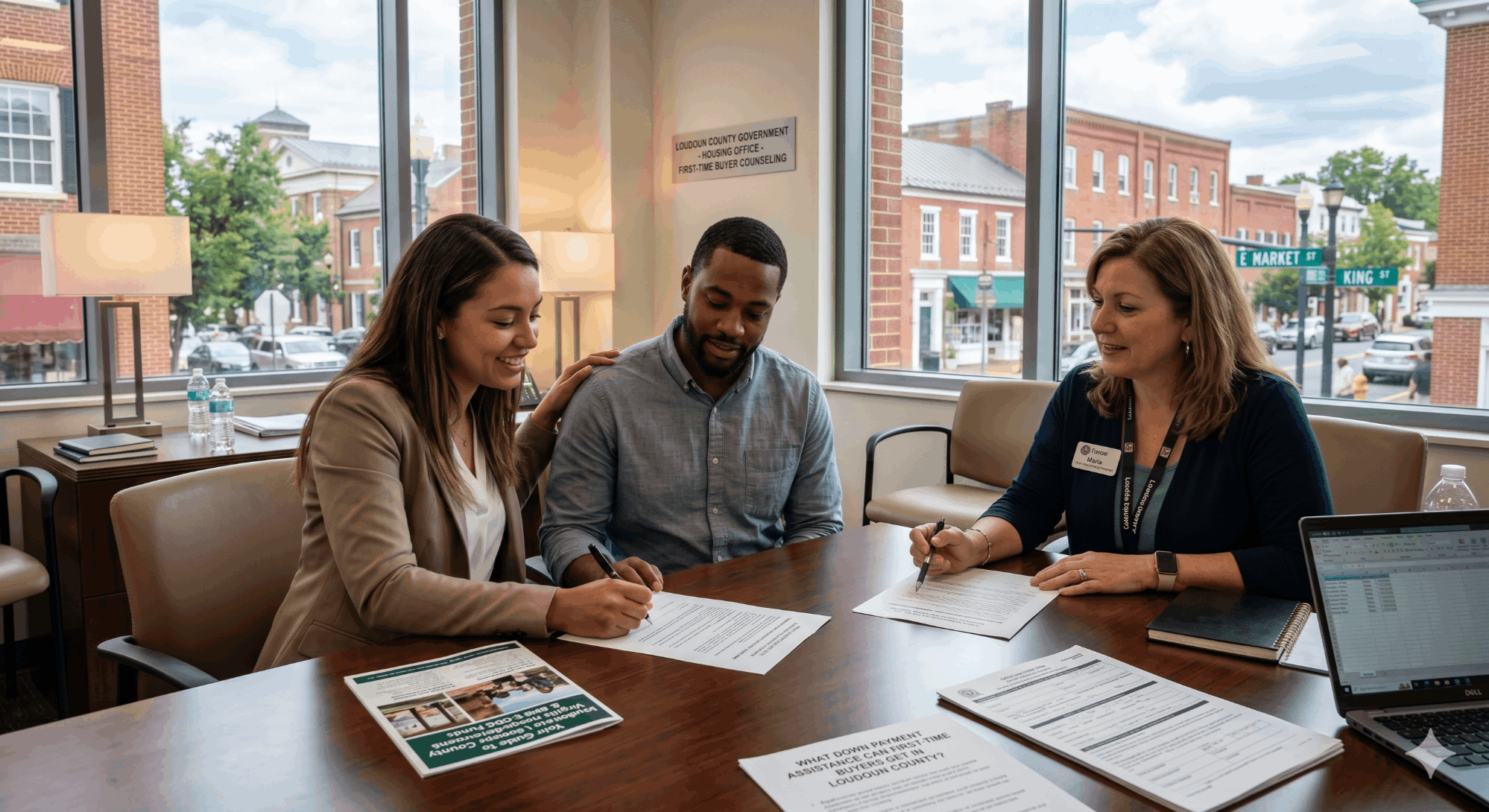
Saving for a down payment is the single biggest hurdle most first-time buyers face in Loudoun County, where the median sale price recently sat near $751,000. The encouraging news is that you almost certainly have more help available than you think. Between county forgivable loans, statewide grants, and low or zero down payment mortgages, qualified buyers can often get into a home with very little out of pocket. The Loudoun County real estate agents at The Jamil Brothers Realty Group walk buyers through these exact programs every week, and this guide lays out what is realistically available in 2026.
Quick Answer: First-time buyers in Loudoun County can stack several layers of help. The county's Down Payment/Closing Cost Assistance (DPCC) program offers a forgivable loan of up to 10% of the price or $70,000 (whichever is less) for households earning 30% to 70% of the area median income. On top of that, Virginia Housing offers a Down Payment Assistance Grant worth up to 2.5% that never has to be repaid, plus a Plus Second Mortgage that can cover the entire down payment, and VA and USDA loans allow eligible buyers to purchase with zero down.
Key Takeaways
- Loudoun County's DPCC program lends up to $70,000 as a 15-year forgivable, zero-interest loan for buyers earning $49,850 to $116,299, and the DPCC Plus tier extends help to households earning up to $166,100.
- Virginia Housing's Down Payment Assistance Grant gives qualified first-time buyers up to 2.5% of the purchase price with no repayment, and the Plus Second Mortgage can bring you to a true zero-down purchase.
- VA loans (for eligible service members and veterans) and USDA loans (in eligible western Loudoun areas) require no down payment at all.
- Most programs require first-time buyer status, defined as not having owned a home in the past three years, plus a HUD-approved homebuyer education course.
- Programs can often be layered, but funding is limited and first come, first served, so getting pre-approved and pre-organized early matters more than almost anything else.
In This Guide
- How Much Down Payment Do You Really Need?
- Loudoun County Down Payment Assistance Programs
- Virginia Housing Statewide Grants and Loans
- Low and Zero Down Payment Loan Options
- Income Limits and Eligibility at a Glance
- How to Qualify and Apply, Step by Step
- Stacking Programs to Maximize Your Help
- Common First-Time Buyer Mistakes to Avoid
- Choosing a Buyer's Agent in Loudoun County
- Explore Loudoun County Communities
- Your Path to a First Home in Loudoun
- Frequently Asked Questions
- Glossary
How Much Down Payment Do You Really Need?
The old rule of putting 20% down is a myth for most first-time buyers, and in a market like Loudoun County it would be a punishing standard. On a $600,000 entry-level townhome, 20% would mean $120,000 in cash. The reality is that almost no first-time buyer pays that much, and it helps to understand how much down payment you really need before you start saving toward a target. The loan programs and assistance funds below are built specifically to shrink the cash you need at the closing table.
Here is how the typical down payment requirement actually breaks down before any assistance is applied. The bars show the minimum down payment as a share of a home's price for each common loan type.
When you layer assistance on top of a low-down-payment loan, the gap between what you have saved and what you need can close almost entirely. A buyer using a 3% conventional loan plus a Virginia Housing grant of 2.5% is effectively covering most of the down payment from outside funds. That is the whole point of these programs.
Before you tour a single home, a buyer strategy session shows you which assistance programs you qualify for, how much cash you actually need, and what your monthly payment looks like. It is free, and it saves first-time buyers months of guesswork.
Loudoun County Down Payment Assistance Programs
Loudoun County runs four homeownership loan programs through its Department of Housing and Community Development, all aimed at moderate-income, first-time buyers who live or work in the county. These are some of the most generous local programs in Northern Virginia, and they are far less crowded with applicants than the well-known national grant programs. Every applicant must have a fully ratified sales contract signed by all parties at the time of submission, so working with an agent who understands the timing is important.
Down Payment/Closing Cost Assistance (DPCC)
DPCC is the flagship program. First-time buyers purchasing either an Affordable Dwelling Unit (ADU) or a regular market-rate home can borrow up to 10% of the sales price or $70,000, whichever is less. The loan carries no interest and is forgiven over a 15-year period as long as you keep the home as your primary residence. To qualify, your gross annual household income must fall between 30% and 70% of the area median income, currently $49,850 to $116,299 regardless of family size. You also need a credit score of at least 620, must contribute a minimum of $1,000 of your own funds, and must have lived or worked in Loudoun County for at least six months.
DPCC Plus
DPCC Plus uses the same structure (up to 10% of the price or $70,000, 15-year forgivable, zero interest) but opens the door to households earning a little more. The income range is 70% to 100% of area median income, currently $116,300 to $166,100. This tier was created precisely because Loudoun's prices climbed faster than the standard DPCC limits, leaving many working households just over the cutoff. If you earn too much for standard DPCC, this is often the answer.
Public Employee Homeownership Grant (PEG)
If you work at least 20 hours a week for Loudoun County government, the courts, constitutional officers, or Loudoun County Public Schools, the PEG program provides a $25,000 grant structured as a forgivable loan over five years. The income range mirrors standard DPCC at $49,850 to $116,300. Teachers, deputies, and county staff frequently overlook this benefit, and it can be paired with other help.
SPARC Reduced-Rate Mortgages
SPARC (Sponsoring Partnerships and Revitalizing Communities) lowers your interest rate rather than your down payment, using funds Virginia Housing allocates to the county. It is available to first-time buyers purchasing a home of $750,000 or less, with income limits up to $186,000 for a household of two or fewer and $217,000 for three or more. Important caveat: as of the latest county update, Fiscal Year 2026 SPARC funding was not yet available, so check current status before counting on it. SPARC works only with specific Virginia Housing first-trust loans and requires HUD-approved pre-purchase counseling.
| Program | Maximum Help | Income Range | Terms |
|---|---|---|---|
| DPCC | 10% of price or $70,000 | $49,850 to $116,299 | 15-yr forgivable, 0% interest |
| DPCC Plus | 10% of price or $70,000 | $116,300 to $166,100 | 15-yr forgivable, 0% interest |
| PEG | $25,000 grant | $49,850 to $116,300 | 5-yr forgivable, county/LCPS staff |
| SPARC | Reduced interest rate | Up to $186,000 / $217,000 | Home $750,000 or less |
Funding runs out
All four county programs are limited and awarded first come, first served. Funds are reset annually but can be exhausted mid-year, especially DPCC. Buyers who are pre-approved and ready to submit a complete application with a ratified contract have a real advantage over those still gathering documents.
Virginia Housing Statewide Grants and Loans
Beyond the county, the state agency Virginia Housing (formerly the Virginia Housing Development Authority) offers its own set of programs that work statewide, including throughout Loudoun. For the full statewide picture, our guide to down payment assistance available across Virginia covers every option in detail. These are accessed through a Virginia Housing-approved lender rather than the county office, and several can be combined with county help.
Down Payment Assistance (DPA) Grant
This is a true grant, meaning you never repay it as long as you meet program rules. It provides up to 2.5% of the purchase price on an FHA loan or up to 2% on a conventional loan, applied directly toward your down payment. You must be a first-time buyer (or buying in a designated Area of Economic Opportunity), use an eligible Virginia Housing loan program for first-time buyers, complete a free homebuyer education course, and meet regional income and sales price limits. One thing to plan for: a federal recapture tax can apply if you sell within nine years and both your income and the home's value have risen significantly, though most buyers never trigger it.
Plus Second Mortgage
The Plus Second Mortgage (sometimes called Second Plus) is a second loan of up to 5% of the purchase price to cover your down payment, with an additional amount available for closing costs if your credit score is 680 or higher. Paired with a Virginia Housing first mortgage, it can produce a genuine zero-down purchase. Unlike the grant, this is a loan you repay over time, but it is what makes buying possible today rather than years from now. It is also one of the few options open to repeat buyers, not just first-timers.
Closing Cost Assistance (CCA) Grant
If you are using a USDA (Rural Housing Service) or VA loan, the Closing Cost Assistance Grant provides up to 2% of the purchase price toward closing costs, the USDA guarantee fee, or the VA funding fee. Like the DPA Grant, it never requires repayment. This pairs naturally with the zero-down loans below, helping cover the one cost those loans do not eliminate.
Granting Freedom for Veterans
For veterans and service members with a service-connected disability, Virginia Housing partners with the Department of Veterans Services on the Granting Freedom program, providing up to $8,000 for home modifications such as ramps, widened doorways, and accessibility improvements. It is separate from standard down payment help and does not need to be repaid.
A note on the old tax credit
Virginia discontinued its Mortgage Credit Certificate (MCC) program in 2023, so you may see outdated articles online still listing it. It is no longer available. Virginia does still offer a First-Time Homebuyer Savings Account through Virginia Tax, which lets you shelter the investment gains on money you are saving for a home from state income tax.
Once you know your assistance budget, the next step is matching it to real homes. Search current Loudoun County listings and get a feel for what your numbers can buy, from Ashburn condos to Sterling townhomes.
Low and Zero Down Payment Loan Options
Assistance programs sit on top of a mortgage, so the loan you choose matters just as much. Several loan types are designed for buyers who do not have a large down payment, and a few require nothing down at all. Here is how the main options compare for a Loudoun County purchase.
| Loan Type | Minimum Down | Typical Credit | Best For |
|---|---|---|---|
| VA loan | 0% | Lender set, often 620+ | Veterans, active military, eligible spouses |
| USDA loan | 0% | Often 640+ | Eligible western Loudoun areas, income limits apply |
| Conventional 97 / HomeReady | 3% | 620+ | Lower-cost PMI, cancellable later |
| FHA loan | 3.5% | 580+ | Lower credit scores, flexible underwriting |
A quick word on USDA loans, since they surprise people. They are limited to designated rural areas, and while most of Loudoun County does not qualify, parts of western Loudoun around towns like Round Hill, Hamilton, Hillsboro, Lovettsville, and Waterford can fall inside eligible zones. If you are open to that side of the county, a zero-down USDA loan is worth checking. VA loans, meanwhile, are the strongest no-down option for those who have served, and Loudoun's proximity to the Pentagon and major commands means a large share of local buyers qualify.
Income Limits and Eligibility at a Glance
Most programs share a similar backbone of requirements, then differ on the income ceiling. Nearly all expect first-time buyer status, which Virginia defines consistently statewide, and our overview of first-time home buyer programs in Virginia breaks down those shared rules. The chart below compares the upper income limit for the main Loudoun and Virginia options so you can quickly see where you might land. Income is not the only gate, though: your credit profile matters too, so it is worth knowing what credit score you need to buy a house before you apply. Limits are based on household income and update periodically.
Baseline Eligibility Checklist
- ✓ First-time buyer, defined as no ownership interest in a home in the past three years (exceptions for some divorced or widowed applicants)
- ✓ The home will be your primary residence
- ✓ Household income within the program's range
- ✓ Credit score of 620 or higher for county programs (some loans allow lower)
- ✓ Completed a HUD-approved homebuyer education course
- ✓ For county programs, lived or worked in Loudoun for at least six months
How to Qualify and Apply, Step by Step
The order of operations matters here. Many first-time buyers fall in love with a home, then scramble to figure out assistance, only to discover the funds are gone or the timeline does not work. If you want the wider view of the whole journey, our first-time homebuyer guide for Virginia walks through every stage, but doing the assistance piece in this order keeps you in control.
Take the homebuyer education course (1 day)
Virginia Housing offers a free course online or in person, in English and Spanish. Most assistance programs require the certificate, so get it out of the way early.
Get pre-approved with a participating lender (3 to 7 days)
Use a Virginia Housing-approved lender if you want the state grant or Plus Second Mortgage. Pre-approval tells you your real budget and shows sellers you are serious.
Confirm program eligibility and reserve county funds
Contact the Loudoun County Housing Finance Specialist to confirm DPCC or DPCC Plus eligibility and ask about current funding availability before you go under contract.
Find the home and get a ratified contract
County applications require a fully signed sales contract at submission, so an agent who builds the right contingencies and timeline into your offer protects your assistance.
Submit your complete application and close (21 to 45 days)
Submit the county packet with all supporting documents, let underwriting layer the assistance with your mortgage, and head to settlement. Plan for processing time on top of your loan.
Stacking Programs to Maximize Your Help
The biggest wins come from combining programs, but the rules around layering are specific, and not every combination is allowed. The Virginia Housing DPA Grant, for example, cannot be used in the same transaction as the Plus Second Mortgage. County DPCC funds, on the other hand, often pair well with a Virginia Housing first mortgage. The pros and cons below show how to think about the two broad categories of help: grants you keep versus loans you repay.
| ✓ Grants and forgivable loans | ✗ Repayable second mortgages |
|---|---|
| No monthly payment to add to your budget | Adds a second monthly payment in some cases |
| Forgiven over time if you stay in the home | Must be repaid or settled at sale or refinance |
| Best when you qualify within stricter income limits | Higher income ceilings and broader eligibility |
| Funding can run out for the year | May restrict a future refinance until repaid |
A realistic Loudoun example: a buyer earning $95,000 might combine the county DPCC forgivable loan toward the down payment with a Virginia Housing first mortgage, then use the Closing Cost Assistance angle of their loan to cover settlement fees. The result can be a purchase with almost nothing out of pocket beyond the required $1,000 minimum contribution. The exact stack depends on your numbers, which is why a lender and agent who do this regularly are worth their weight.
Common First-Time Buyer Mistakes to Avoid
What trips buyers up most often
- ✗ Waiting until they find a home to research assistance, then missing funding windows
- ✗ Using a lender that is not approved for Virginia Housing programs, losing access to the grant
- ✗ Skipping the homebuyer education course and stalling their application at the finish line
- ✗ Assuming they earn too much, when DPCC Plus and SPARC reach well into six figures
- ✗ Forgetting that assistance adds processing time, then writing an offer with a closing date that is too tight
Choosing a Buyer's Agent in Loudoun County
Since the 2024 NAR settlement, buyers sign a written representation agreement before touring homes, and buyer-agent compensation is now openly negotiable rather than assumed. That makes choosing the right agent a more deliberate decision. For a first-time purchase that involves assistance programs, look for these objective qualities.
What to look for
- ✓ Direct experience closing DPCC, Virginia Housing, and VA loan purchases in Loudoun
- ✓ Relationships with approved lenders who handle assistance every day
- ✓ Skill writing offers that protect your contingencies and assistance timeline
- ✓ A clear, written explanation of how they are compensated
As a trusted real estate agent in DMV, The Jamil Brothers Realty Group has guided first-time buyers through these exact programs across Ashburn, Leesburg, Sterling, and the rest of the county, with 840+ homes sold and 500+ five-star reviews behind that experience. Whichever agent you choose, make sure they treat the assistance paperwork as a core part of the deal, not an afterthought.
One last thing worth thinking about, even on day one of buying: this is likely not your forever home. Most first-time buyers in Loudoun move up within five to seven years. When that day comes, the cost of selling will shape how much equity you carry into your next home. When you are ready to sell your Loudoun home, The Jamil Brothers offer 1.5% commission real estate in NoVA, a complete marketing and negotiation package at a lower listing fee than the traditional 3%. The calculator below shows what that difference looks like on a future sale, so you can see the full arc of the journey you are starting.
Future Seller Savings Calculator
When you sell one day, how much more do you keep with our 1.5% listing fee?
Select an estimated future home value to see your net proceeds side by side.
Traditional Agent (3%)
Our Fee, Only 1.5%
Extra in your pocket
$6,000
vs. a traditional 3% listing agent, with zero reduction in service or marketing.
Traditional Agent (3%)
Our Fee, Only 1.5%
Extra in your pocket
$7,500
vs. a traditional 3% listing agent, with zero reduction in service or marketing.
Traditional Agent (3%)
Our Fee, Only 1.5%
Extra in your pocket
$9,000
vs. a traditional 3% listing agent, with zero reduction in service or marketing.
Traditional Agent (3%)
Our Fee, Only 1.5%
Extra in your pocket
$11,250
vs. a traditional 3% listing agent, with zero reduction in service or marketing.
Traditional Agent (3%)
Our Fee, Only 1.5%
Extra in your pocket
$15,000
vs. a traditional 3% listing agent, with zero reduction in service or marketing.
Estimates only. Closing costs vary. Buyer's agent commission is negotiable.
Explore Loudoun County Communities
Down payment help applies countywide, but every Loudoun community has its own price points, inventory, and feel. Tap any community below to explore homes, market trends, and neighborhood detail.
Your Path to a First Home in Loudoun
The hardest part of buying your first home in Loudoun County is rarely the monthly payment, though factoring in Loudoun County property taxes matters when you map out that full monthly budget. It is the cash you need up front, and that is exactly the gap these programs were built to close. Between county forgivable loans worth up to $70,000, statewide grants you never repay, and zero-down loans for those who qualify, the path is more open than the headlines about high prices suggest. The buyers who win are not always the ones with the most savings. They are the ones who get organized early, line up an approved lender, finish their education course, and move quickly when funding is available.
If you are ready to find out which programs you qualify for and what your real numbers look like, the next step is a conversation, not a leap. You can also browse current Loudoun County homes for sale to see what your budget reaches today. Start with a free buyer strategy session to build your plan, or get a personalized read on your budget and timeline.
Get matched to the right down payment assistance programs, see your true cash-to-close, and walk into your home search with a clear strategy. No pressure, no obligation, just expert guidance from a team that has helped hundreds of first-time buyers in Loudoun County.
Frequently Asked Questions
How much down payment assistance can first-time buyers get in Loudoun County?
First-time buyers in Loudoun County can receive up to 10% of the sales price or $70,000, whichever is less, through the county's Down Payment/Closing Cost Assistance (DPCC) program, structured as a 15-year forgivable loan with no interest. That can be combined with Virginia Housing's Down Payment Assistance Grant of up to 2.5% of the price, which never has to be repaid. County and public employees may also qualify for a separate $25,000 PEG grant. The exact amount depends on your income, the home price, and which programs you stack.
What is the income limit for Loudoun County down payment assistance?
For the standard DPCC program, gross annual household income must fall between $49,850 and $116,299 regardless of family size, which represents 30% to 70% of the area median income. The DPCC Plus tier raises that range to $116,300 through $166,100 for households earning 70% to 100% of area median income. SPARC reduced-rate mortgages allow even higher incomes, up to $186,000 for a household of two or fewer and $217,000 for three or more.
Do I have to repay Loudoun County down payment assistance?
The DPCC and DPCC Plus loans are forgivable over a 15-year period with no interest, meaning you do not repay them as long as the home remains your primary residence for that time. The PEG grant for public employees is forgivable over five years. The Virginia Housing Down Payment Assistance Grant is a true grant that is never repaid. The Plus Second Mortgage, by contrast, is a loan you do repay, which is the tradeoff for its broader eligibility.
Can I combine Loudoun County DPCC with Virginia Housing programs?
In many cases yes. County DPCC funds are commonly layered with a Virginia Housing first mortgage to reduce both your down payment and out-of-pocket costs. However, some combinations are restricted: the Virginia Housing Down Payment Assistance Grant cannot be used in the same transaction as the Plus Second Mortgage. Because the layering rules are specific, work with a Virginia Housing-approved lender and an agent who handle assistance regularly to build a stack that actually closes.
What credit score do I need to qualify?
The Loudoun County DPCC program requires a minimum credit score of 620. Loan types vary: FHA loans can allow scores as low as 580, conventional 3% programs typically want 620 or higher, and the higher closing-cost feature of the Plus Second Mortgage requires a 680. A stronger score generally means a better interest rate, so even if you meet the minimum, improving your credit before applying can save you money over the life of the loan.
How long does the application process take?
Plan for assistance to add time on top of your normal mortgage timeline. County processing alone can run several weeks, and state programs are also subject to funding availability and review. From homebuyer education to closing, a well-organized first-time buyer using assistance often spends roughly 45 to 60 days. The best way to protect your timeline is to complete your education course and pre-approval before you write an offer, then build a realistic closing date into the contract.
Do I have to be a first-time buyer to get help?
Most programs define a first-time buyer as someone who has not held an ownership interest in a home during the past three years, so previous owners can often requalify. There are also exceptions for some divorced or widowed applicants whose names are off a former property. A few options are open to repeat buyers entirely, most notably the Virginia Housing Plus Second Mortgage, which extends down payment help beyond first-timers.
What is the difference between the DPA Grant and the Plus Second Mortgage?
The Down Payment Assistance Grant is a true grant of up to 2.5% of the price that you never repay, but it carries stricter income limits and is generally for first-time buyers. The Plus Second Mortgage is a second loan of up to 5% of the price that you do repay, with higher income ceilings and availability to repeat buyers. The grant is ideal if you fit its limits and want no added debt, while the Plus Second Mortgage is the path to a true zero-down purchase when a grant alone will not cover the gap.
Are there zero-down loan options for buyers in Loudoun County?
Yes. VA loans allow eligible veterans, active-duty service members, and certain surviving spouses to buy with no down payment, and given Loudoun's military-connected workforce, many local buyers qualify. USDA loans also require nothing down, though they are limited to designated rural areas, with parts of western Loudoun near Round Hill, Hamilton, Hillsboro, and Lovettsville potentially eligible. Buyers who do not qualify for either can still approach zero down by pairing a low-down-payment loan with the Virginia Housing Plus Second Mortgage.
How do I choose a buyer's agent for a first home in Loudoun County?
Since the 2024 NAR settlement, you sign a written buyer representation agreement up front and buyer-agent compensation is negotiable, so choose deliberately. Look for direct experience closing assistance-backed purchases, relationships with Virginia Housing-approved lenders, skill writing offers that protect your contingencies and funding timeline, and a clear written explanation of how the agent is paid. The Jamil Brothers Realty Group has guided first-time buyers through DPCC, Virginia Housing, and VA loan purchases across Loudoun, with 840+ homes sold and 500+ five-star reviews.
Is now a good time to buy a first home in Loudoun County?
Loudoun County remains a competitive market, with a recent median sale price near $751,000 and homes typically going under contract in about a month. While national headlines describe a cooling market, Loudoun has held firmer than most of the country, supported by limited inventory and steady demand. For first-time buyers, the timing question is less about waiting for prices to drop and more about whether assistance funds are available and your finances are ready. Locking in help while it is funded often matters more than trying to time the market.
What mistakes should first-time buyers avoid with assistance programs?
The most common mistakes are waiting until you find a home to research assistance and then missing a funding window, choosing a lender that is not approved for Virginia Housing programs, skipping the required homebuyer education course, and writing an offer with a closing date too tight to accommodate the extra processing assistance requires. Many buyers also wrongly assume they earn too much, when DPCC Plus and SPARC reach well into six figures. Getting organized before you shop solves nearly all of these.
Glossary
Area Median Income (AMI)
The midpoint household income for a region, set yearly. Many assistance programs cap eligibility at a percentage of AMI, such as 70% or 100%.
Forgivable Loan
A loan that is gradually erased over a set residency period, so you owe nothing if you keep the home as your primary residence long enough.
DPCC
Loudoun County's Down Payment/Closing Cost Assistance program, offering up to $70,000 as a forgivable, zero-interest loan to qualifying first-time buyers.
Down Payment Assistance Grant
A Virginia Housing grant of up to 2.5% of the purchase price applied to your down payment, with no repayment required.
Plus Second Mortgage
A repayable second loan from Virginia Housing that funds your down payment, paired with a first mortgage to allow a zero-down purchase.
Homebuyer Education Course
A required class covering budgeting, credit, and the buying process. Virginia Housing offers it free, online or in person, in English and Spanish.
Recapture Tax
A potential federal tax if you sell within nine years of using certain assistance, and both your income and home value have risen significantly. Most buyers never trigger it.
Debt-to-Income Ratio (DTI)
The share of your monthly income that goes to debt payments. Lenders and programs use it to gauge how much you can responsibly borrow.
Explore More
Browse Every Corner of the DMV Market
Whether you're searching by budget, neighborhood, or buying situation — find exactly what you need below.
Virginia Homes by Budget
Washington DC Homes by Budget
Maryland Homes
Fairfax County & Surrounding
Ready to Make a Move?
Proven Track Record
See Homes We’ve Recently Sold
840+ homes sold and $500M+ in volume across Loudoun and the DMV. Browse our recent sales to see the results we deliver for buyers and sellers.
View Sold Properties →Need Speed or Certainty?
Get a No-Obligation Cash Offer
Skip the showings, skip the contingencies. If timing or condition matters more than top dollar, a cash offer may be the right fit. We'll walk you through every option.
Explore Cash Offers →Categories
- All Blogs (1238)
- Buyer Guide (7)
- Buying a home (2)
- Buying Strategies (30)
- festivals (1)
- General Blog (66)
- Market Intelligence (28)
- Market Updates (7)
- Notable Properties For Sale (32)
- Real Estate Tips, News, and More (396)
- Seller Guide (1)
- Seller Guides (59)
- Selling Your Home (525)
- Top Realtors in Northern Virginia (58)
Recent Posts
Let's Connect