What Should You Know About Commercial Real Estate in Loudoun County?
 If you are researching Loudoun County real estate advisors, here is the short version: this is one of the most concentrated and fast-changing commercial markets in the country, and it is driven by a single dominant asset class. Data centers now make up roughly 73 percent of the county's commercial property value, while office, industrial, retail, and a thriving rural beverage economy fill in the rest. Understanding how these pieces fit together helps owners, investors, and homeowners read where the market is heading next.
Loudoun County sits at the western edge of the Washington, D.C. metro, anchored by Dulles International Airport and the Silver Line Metro. That location turned a once-rural county into the global heart of the internet and, in the process, reshaped property values, county budgets, and residential demand across Ashburn, Sterling, Leesburg, and the surrounding communities. Whether you own commercial property, plan to invest, or simply want to understand what is happening to home values nearby, the commercial story matters.
Quick Answer: Commercial real estate in Loudoun County is dominated by data centers, which account for about 73 percent of the county's commercial property value and roughly half of its property tax revenue. The market also includes a tight industrial and flex sector (vacancy near 1.6 percent), a healthier-than-average office market around the Silver Line, growing mixed-use retail, and a rural craft beverage economy. Since March 2025, new data centers require a special exception rather than by-right approval, a major shift for investors and developers.
Key Takeaways
- Data centers are the engine of Loudoun's commercial market, making up about 73 percent of commercial property value in Tax Year 2025 and assessed at roughly triple the value per square foot of other commercial uses.
- That commercial base funds tax relief: Loudoun carries the lowest real property tax rate in Northern Virginia, and data center revenue helped lower the vehicle tax rate for 2026.
- As of March 18, 2025, data centers are no longer a by-right use. New projects need a special exception with public hearings, which slows approvals and raises the importance of site selection.
- Industrial and flex space is extremely tight (vacancy near 1.6 percent), and Loudoun's office vacancy has held below neighboring Fairfax, Arlington, and Alexandria thanks to Silver Line, transit-oriented projects.
- Western Loudoun's rural economy (DC's Wine Country, with about 50 wineries and a growing brewery scene) is its own distinct commercial sector tied to agriculture and tourism.
- The commercial boom directly supports residential demand and home values across eastern Loudoun, which matters whether you are buying, selling, or holding.
In This Guide
- Why Loudoun Became a Commercial Powerhouse
- Data Centers: The Engine of the Market
- Office, Flex, and Industrial Space
- Retail and Mixed-Use Development
- The Rural Commercial Economy (Wine Country)
- Commercial Investment Snapshot
- How Commercial Activity Affects Home Values
- Where to Invest or Sell in Loudoun
- Mistakes to Avoid
- Turning the Boom Into Your Advantage
- Frequently Asked Questions
- Glossary
Why Loudoun Became a Commercial Powerhouse
Loudoun County did not become a commercial real estate giant by accident. Back in 2008, the county's economic development team set out to fix a lopsided tax base. At that point only about 19 percent of revenue came from commercial sources, leaving homeowners carrying most of the load. The county bet on the technology infrastructure already running through the region and leaned into it hard.
The geography did the rest. Loudoun sits beside Dulles International Airport, on top of major fiber routes, with reliable power and large tracts of developable land. Those ingredients made it the natural landing spot for the internet's physical backbone. The result is a county where commercial property, rather than rooftops, now anchors the budget, and where the Silver Line Metro extension to Ashburn has opened a new chapter of transit-oriented development.
For anyone studying commercial real estate in Loudoun County, the takeaway is simple. This is not a diversified suburban market with a little of everything in equal measure. It is a market built around one extraordinary asset class, with several supporting sectors that benefit from the gravity that class creates. Loudoun's trajectory mirrors the broader growth of Virginia's commercial real estate, though few markets in the state are as concentrated.
Data Centers: The Engine of the Market
Loudoun is home to one of the largest concentrations of data centers in the world, and a large share of global internet traffic passes through the corridor known as Data Center Alley. These facilities are the single most important force in the county's commercial market, and any serious look at local commercial property starts here. The scale of Northern Virginia's data center surge, and what it means for jobs and local residents, helps explain why Loudoun sits at the center of it.
How big is Data Center Alley?
The scale is hard to overstate. Loudoun has roughly 46 million square feet of data centers either constructed or already permitted, with tens of millions of additional square feet identified as potential future development. In Tax Year 2025, data centers made up about 73 percent of the county's entire commercial property portfolio, and that portfolio's overall value jumped roughly 50 percent in a single year, driven mostly by data center appreciation.
Per square foot, the numbers separate data centers from everything else. The county assesses data center real property at around 609 dollars per square foot, which is close to triple the value of other commercial uses. That premium is why a relatively small physical footprint produces an outsized share of value. Continued cloud and AI demand keeps that pipeline full, with major commitments such as Google's AI and data center investment spanning Loudoun and Chesterfield signaling that the appetite for capacity is far from slowing.
Share of Loudoun's commercial property value (Tax Year 2025)
What data centers mean for the county budget and your taxes
This is where commercial real estate touches every property owner in Loudoun, even homeowners who will never set foot in a data center. The industry generates close to half of the county's property tax revenue and a large share of its General Fund. The county collects far more in tax revenue than it spends servicing these properties, since data centers add very little traffic and almost no demand on schools.
That surplus has funded a decade of tax relief. Loudoun lowered its real property tax rate every year over the past ten years, reaching 0.805 dollars per 100 dollars of assessed value for Tax Year 2025, the lowest rate in Northern Virginia. For 2026, the county also cut the personal property tax rate on vehicles and eliminated a vehicle registration fee. Analysts at the Northern Virginia Transportation Commission have estimated that without data center revenue, the typical Loudoun homeowner would pay thousands of dollars more in property taxes each year.
| Data Center Impact | Figure |
|---|---|
| Share of commercial property value (TY 2025) | ~73% |
| Share of county property tax revenue | ~50% |
| Assessed value per square foot | ~$609 (about 3x other commercial) |
| Tax revenue per $1 of county services | ~$26 |
| Real property tax rate (TY 2025) | $0.805 per $100 (lowest in NOVA) |
| Built or permitted data center space | ~46 million sq ft |
The March 2025 zoning change every investor should know
For years, much of Loudoun's data center growth happened by right, meaning a project that met the zoning rules could be approved at the staff level without a public hearing. That changed on March 18, 2025, when the Board of Supervisors voted to make data centers a special exception use in the industrial and related zoning districts where they had been by-right. New projects now run through a legislative process with review by the Planning Commission and a public hearing before the Board.
The county paired the change with a grandfathering resolution covering certain applications accepted before February 12, 2025, generally for sites more than 500 feet from homes that move forward without major changes. A second phase of work, focused on use-specific standards, energy, and compatibility, is underway with research and drafting running into 2026. The shift followed growing community pushback against the data center boom across the region. For investors and developers, the practical effect is longer timelines, more community input, and a higher premium on choosing the right site.
Why this matters for value
Land entitled or grandfathered for data center use carries different value than land that now faces a full special exception process. If you own or are evaluating commercial land in eastern Loudoun, the entitlement status is often the most important question on the table.
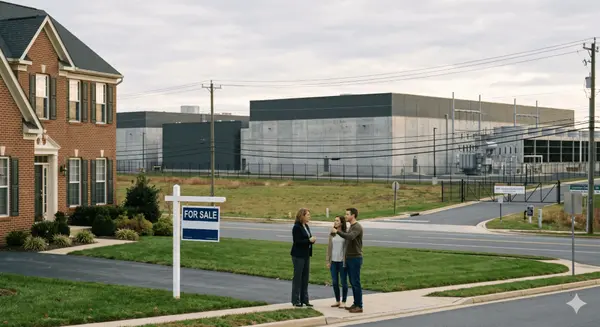
Whether you hold land, a commercial building, or a home near Data Center Alley, get a street-level valuation from The Jamil Brothers. Real comps and local knowledge, not an automated guess. Response within 24 hours.
Office, Flex, and Industrial Space
Data centers grab the headlines, but Loudoun's office, industrial, and flex sectors tell their own story, and in some ways a healthier one than the broader region.
The office market and the Silver Line effect
Loudoun's office inventory is modest at roughly 11.5 million square feet, but it has held up better than its neighbors. While Fairfax, Arlington, and Alexandria have wrestled with office vacancy above 20 percent, Loudoun has stayed in the low teens. A big reason is the Silver Line Metro, which reached its Ashburn terminus in late 2022 and unlocked transit-oriented projects that traditional suburban office parks cannot match. The same transit access is also reshaping the residential side, as our look at how the new Silver Line Metro stops are affecting local property values explains.
Mixed-use nodes such as Loudoun Station next to Ashburn Station, along with One Loudoun, Kincora, Rivana, and Silver District West, are where new office demand is concentrating. Tenants increasingly want modern, amenity-rich space near transit, restaurants, and housing rather than isolated buildings off the toll road. Corporate moves such as ORBCOMM's headquarters in Sterling show how this demand is anchoring the county's office and tech footprint. Older, car-dependent office product away from the Metro faces a tougher road.
Industrial and flex: the tightest segment
If you want to understand where demand outstrips supply most sharply, look at industrial and flex space. Vacancy in this segment has run near 1.6 percent, an exceptionally tight figure that reflects strong demand from logistics, contractors, light manufacturing, and businesses that support the data center ecosystem. Low vacancy has driven steady rent growth and made well-located warehouse and flex buildings some of the most sought-after assets in the county.
| Segment | Condition | What's driving it |
|---|---|---|
| Data centers | Dominant, now special-exception | Cloud and AI demand, fiber, power, Dulles |
| Industrial / flex | Very tight (~1.6% vacancy) | Logistics, contractors, data center support |
| Office | Stronger than region (~low-teens vacancy) | Silver Line, transit-oriented mixed-use |
| Retail / mixed-use | Growing, lifestyle-driven | Population growth, walkable centers |
| Rural / craft beverage | Distinct, tourism-based | Wineries, breweries, agritourism |
Retail and Mixed-Use Development
Retail in Loudoun follows its rooftops, and the county has plenty of them. Decades of rapid population growth created demand for shopping, dining, and services, especially in fast-growing Dulles South communities like South Riding, Stone Ridge, Brambleton, and Aldie. Projects such as the new homes and retail taking shape along Evergreen Mills Road show how housing and commercial space are growing together. The strongest retail today is lifestyle and entertainment oriented, woven into walkable mixed-use centers rather than standalone strip malls.
The county's 2025 Retail Corridor Study took a close look at three of its busiest commercial areas: the Route 50 and Arcola corridor, Route 7, and the mixed-use districts forming around the Silver Line stations. The pattern is consistent. Retail that combines shopping with experiences, housing, and transit access is winning, while older, isolated formats need reinvention. Loudoun Station, for example, has steadily added residential, office, and brand-name retail at the Ashburn Metro terminus.
What makes Loudoun retail sites attractive
- ✓ Proximity to dense, high-income residential growth in Dulles South
- ✓ Walkable, transit-connected mixed-use settings near the Silver Line
- ✓ A daytime workforce from offices and the broader tech economy
- ✓ Tourism spillover from Wine Country and Dulles Airport traffic
- ✓ Visibility along major corridors such as Route 7 and Route 50
The Rural Commercial Economy (Wine Country)
Drive west past the data centers and the character of Loudoun's commercial real estate changes completely. Western Loudoun is rural by design, protected by long-standing land use policy that encouraged farm-based enterprise instead of subdivision sprawl. The result is a commercial economy built on agriculture and tourism rather than steel and fiber.
This is the heart of what the county brands as DC's Wine Country, with around 50 wineries and tasting rooms, the most of any county in Virginia, plus a fast-growing craft brewery and cidery scene. The wineries are the region's top visitor attraction, and the craft beverage industry reported tens of millions of dollars in annual revenue with strong growth over recent years. Towns and villages such as Middleburg, Purcellville, Hamilton, Round Hill, Waterford, Hillsboro, and Lovettsville support this economy with restaurants, inns, event venues, and historic main streets.
For commercial buyers, western Loudoun is a different game. Properties are tied to agritourism, event hosting, hospitality, and small main-street retail, and they come with rural zoning, well and septic considerations, and seasonal demand. It is a market driven by experience and place, not square footage and power capacity.
Commercial Investment Snapshot
Pulling the segments together, Loudoun reads as a strong commercial market across nearly every property type, which is exactly why it attracts investors from higher-priced East Coast markets. Third-party brokerage data covering early 2023 through mid-2025 pointed to a few hundred commercial transactions, average sale prices in the range of 430 dollars per square foot, and average capitalization rates near 6.4 percent, with the tightest fundamentals in the industrial and flex segment.
| Investment Metric | Approximate Figure |
|---|---|
| Average commercial sale price | ~$430 / sq ft |
| Average cap rate | ~6.4% |
| Industrial / flex vacancy | ~1.6% |
| Office inventory | ~11.5 million sq ft |
| Office vacancy vs. neighbors | Low teens vs. 20%+ nearby |
Approximate vacancy by segment (lower is tighter)
One caution worth keeping in view: the county's heavy reliance on a single asset class is a known risk. Loudoun has created a Revenue Stabilization Fund specifically to cushion against volatility in data center revenue. For investors, that concentration is both the opportunity and the thing to watch.
Thinking about selling a property in Loudoun? Our seller net sheet breaks down commission, transfer taxes, and closing costs so you know your real bottom line before you list.
How Commercial Activity Affects Home Values
Here is where the commercial picture circles back to most readers. The same forces that built Data Center Alley also reshaped Loudoun's residential market. Commercial tax revenue keeps the homeowner tax rate low, the tech economy brings high-paying jobs, and the Silver Line adds convenience that makes nearby neighborhoods more desirable. Large commitments like Google's $9 billion Virginia AI investment and what it means for Northern Virginia real estate reinforce those job and demand tailwinds. Those forces have supported strong home values across Ashburn, Brambleton, Broadlands, One Loudoun, and the wider Dulles South area.
There is a flip side. Homeowners who live close to existing or proposed data centers sometimes raise concerns about noise, views, and traffic during construction. That is part of why the county moved data centers to special-exception review. If you own a home near a commercial corridor, both the upside (low taxes, strong demand) and the local considerations (proximity effects) belong in any honest pricing conversation. You can always browse current homes for sale across Northern Virginia to see how nearby listings are positioned.
If you are weighing a residential sale in this market, the cost side is just as important as the price side. Many Loudoun sellers are surprised by how much of their equity goes to commission. This is where The Jamil Brothers Realty Group, a top-producing real estate team across the DMV, offers a 1.5 percent full-service listing fee in Northern Virginia, which includes professional photography, drone video, 3D tours, and partner-led negotiation. The calculator below shows what that difference looks like compared with a traditional 3 percent listing fee.
Seller Savings Calculator
How much more do you keep with our 1.5% listing fee?
Select your home's estimated value to see your real net proceeds, side by side.
Traditional Agent (3%)
Our Fee, Only 1.5%
Extra in your pocket
$6,000
vs. a traditional 3% listing agent, with zero reduction in service or marketing.
Traditional Agent (3%)
Our Fee, Only 1.5%
Extra in your pocket
$7,500
vs. a traditional 3% listing agent, with zero reduction in service or marketing.
Traditional Agent (3%)
Our Fee, Only 1.5%
Extra in your pocket
$9,000
vs. a traditional 3% listing agent, with zero reduction in service or marketing.
Traditional Agent (3%)
Our Fee, Only 1.5%
Extra in your pocket
$11,250
vs. a traditional 3% listing agent, with zero reduction in service or marketing.
Traditional Agent (3%)
Our Fee, Only 1.5%
Extra in your pocket
$15,000
vs. a traditional 3% listing agent, with zero reduction in service or marketing.
Estimates only. Closing costs vary. Buyer's agent commission is negotiable.
Where to Invest or Sell in Loudoun
Loudoun is really several markets in one. Eastern communities near Ashburn and Sterling sit closest to the data center corridor and the Silver Line. Central towns like Leesburg blend government, retail, and historic charm. Western villages anchor the rural and wine economy. Your strategy should match the part of the county you are working in. Explore the community pages below to see homes, neighborhoods, and local detail for each area, and reach out when you want a property-specific read.
Loudoun County Communities
Explore Cities, Towns, and Communities Across Loudoun
Whether you own a home near the data center corridor or a property out in Wine Country, The Jamil Brothers Realty Group can guide your sale from valuation to closing. Start the process when you are ready, or explore a buyer strategy for your next move.
Mistakes to Avoid
Loudoun's commercial market rewards preparation and punishes assumptions. A few errors come up again and again, whether someone is buying a flex building, holding land, or selling a home near a commercial corridor.
| ✓ Smart Moves | ✗ Common Mistakes |
|---|---|
| Confirm zoning and entitlement status before you assume a use | Assuming data center use is still by-right after March 2025 |
| Match strategy to the sub-market (east, central, or west) | Treating rural western land like eastern infill land |
| Factor proximity effects into a home's pricing strategy | Ignoring how a nearby project affects buyer perception |
| Run a full net sheet before listing a home | Overlooking commission and Virginia closing costs |
| Plan for longer special-exception timelines | Budgeting as if approvals are still administrative |
How the special exception process generally works
Since the 2025 change, most new data center proposals follow a legislative path rather than staff-level sign-off. The exact steps vary by project, but the general arc looks like this.
Application and intake
The applicant files a special exception application for the proposed use on a specific site, triggering county review.
Staff review
County staff evaluate the proposal against the comprehensive plan, zoning standards, and compatibility considerations.
Planning Commission hearing
The Planning Commission holds a public hearing and makes a recommendation to the Board.
Board of Supervisors decision
The Board holds its own public hearing and makes the final determination to approve, condition, or deny.
Professional photography, drone video, 3D tours, expert negotiation, and full MLS marketing, all included at a 1.5 percent full-service listing fee. No hidden fees and no service reductions.
Turning the Boom Into Your Advantage
Loudoun County's commercial market is unlike any other in the region. Data centers built a tax base that keeps homeowner rates low, the Silver Line opened a new generation of transit-oriented development, industrial space stays scarce, and the western half of the county runs a thriving rural economy on wine, beer, and agritourism. The 2025 shift to special-exception review for data centers signals a market that is maturing and balancing growth with community input.
For you, the practical question is how this landscape affects your own property decisions. If you own commercial land, entitlement status drives value. If you own a home in Ashburn, Brambleton, or Dulles South, the commercial economy is part of why your equity has grown, and it belongs in any pricing conversation. Either way, the smartest first step is to understand your numbers clearly before you act.
Know your equity, understand your costs, and see exactly what you would walk away with before you make any decisions. The Jamil Brothers Realty Group provides a full seller consultation at no cost or obligation. Call (703) 782-4830.
Frequently Asked Questions
What should you know about commercial real estate in Loudoun County?
The most important thing to know is that Loudoun's commercial market is dominated by data centers, which make up about 73 percent of the county's commercial property value and roughly half of its property tax revenue. Beyond that, the county has a very tight industrial and flex sector, an office market that outperforms its neighbors thanks to the Silver Line, growing mixed-use retail, and a separate rural economy built on wineries and breweries in the west. Since March 2025, new data centers require a special exception, which changed how projects get approved.
Why are there so many data centers in Loudoun County?
Loudoun's location is the key. The county sits next to Dulles International Airport on major fiber routes with reliable power and developable land, and the county's economic development team deliberately courted the industry beginning in 2008 to diversify its tax base. Over time this created the corridor known as Data Center Alley, through which a large share of global internet traffic passes. Today the county has roughly 46 million square feet of data centers built or permitted.
How do data centers affect Loudoun County property taxes?
Data centers generate close to half of the county's property tax revenue while requiring relatively few county services, producing a large surplus. That revenue allowed Loudoun to lower its real property tax rate every year for a decade, reaching 0.805 dollars per 100 dollars of assessed value for Tax Year 2025, the lowest rate in Northern Virginia. For 2026 the county also cut the vehicle tax rate and eliminated a registration fee. Estimates suggest the typical homeowner would pay thousands more each year without this revenue.
What changed with data center zoning in March 2025?
On March 18, 2025, the Loudoun County Board of Supervisors voted to make data centers a special exception use in the industrial and related zoning districts where they had previously been allowed by right. New projects now go through a legislative process including staff review, a Planning Commission public hearing, and a final hearing before the Board. A grandfathering resolution preserved certain applications accepted before February 12, 2025, and a second phase of standards work is underway into 2026.
What does commercial property cost in Loudoun County?
Costs vary widely by property type and location, but third-party brokerage data covering early 2023 through mid-2025 pointed to average commercial sale prices around 430 dollars per square foot and average capitalization rates near 6.4 percent. Data centers sit in a category of their own, assessed at roughly 609 dollars per square foot, while industrial, office, and retail trade at lower values. Pricing always comes down to the specific submarket, condition, zoning, and entitlement status of a given property.
How long does a commercial deal or approval take in Loudoun?
A standard purchase or lease can close on typical commercial timelines, often a few months from contract to closing depending on financing and due diligence. Entitlement and rezoning, however, take much longer. Because new data centers now require a special exception with multiple public hearings, those approvals can stretch across many months and depend heavily on community input and Board scheduling. Anyone counting on a new use should plan for a legislative timeline rather than a quick administrative sign-off.
Is the office market in Loudoun County actually healthy?
Relatively, yes. Loudoun's office inventory is small at about 11.5 million square feet, and its vacancy has held in the low teens while neighboring Fairfax, Arlington, and Alexandria have posted rates above 20 percent. The strongest demand is for modern, amenity-rich space in transit-oriented, mixed-use settings near the Silver Line, such as Loudoun Station and One Loudoun. Older, car-dependent office buildings away from the Metro face more pressure.
What is Loudoun's rural commercial economy like?
Western Loudoun runs on agriculture and tourism rather than industrial development. The area is branded as DC's Wine Country and has around 50 wineries and tasting rooms, the most of any Virginia county, plus a growing scene of craft breweries and cideries. The craft beverage industry has reported tens of millions of dollars in annual revenue with strong recent growth. Commercial properties here tend to be tied to agritourism, hospitality, events, and small main-street retail in towns like Middleburg and Purcellville.
Do data centers hurt nearby home values?
The picture is mixed. On a countywide level, data center revenue keeps the homeowner tax rate the lowest in Northern Virginia, which supports affordability and demand. At the same time, homes located very close to existing or proposed facilities can face buyer concerns about noise, views, and construction traffic, which is part of why the county moved to special-exception review. For a home near a commercial corridor, both effects should be weighed when setting a price and a marketing strategy.
How do I choose a real estate team for Loudoun County property?
Look for local market knowledge, a clear marketing plan, transparent fees, strong negotiation skills, and verifiable results such as reviews and sales history. Ask how they price, how they market, and exactly what their fee includes. The Jamil Brothers Realty Group, led by Saad Jamil and Arslan Jamil of Samson Properties, is licensed across Virginia, Maryland, DC, and West Virginia, holds NVAR Lifetime Top Producer recognition, and offers a 1.5 percent full-service listing fee in Northern Virginia that includes professional photography, drone video, 3D tours, and partner-led negotiation.
What are common mistakes when dealing with Loudoun commercial property?
The biggest mistake is assuming a use is still allowed by right when many now require a special exception. Others include treating rural western land like eastern infill land, underestimating approval timelines, and ignoring how a nearby commercial project shapes buyer perception of an adjacent home. On the residential side, sellers often overlook how much commission and Virginia closing costs reduce their net proceeds. Running a full net sheet before listing avoids that surprise.
Is Loudoun County still a good place to invest in commercial real estate?
Loudoun shows strength across most property types, with tight industrial vacancy, a resilient office market, growing retail, and a globally significant data center sector, which is why it draws investors from higher-priced markets. The main caution is concentration risk, since so much value depends on data centers, and the county itself maintains a Revenue Stabilization Fund to guard against volatility. As with any market, the right answer depends on the specific asset, location, and your own goals, so property-specific guidance matters.
Glossary
Data Center Alley
The Ashburn and eastern Loudoun corridor with the world's largest concentration of data centers, carrying a major share of global internet traffic.
By-Right Use
A use already permitted under a property's zoning that can be approved administratively, without a public hearing before the Planning Commission or Board.
Special Exception (SPEX)
A use that requires legislative approval through staff review and public hearings. As of March 2025, data centers in Loudoun fall into this category.
Cap Rate
Capitalization rate, the ratio of a property's annual net operating income to its price, used to compare commercial investment returns.
Flex Space
Versatile commercial buildings that combine warehouse, light industrial, and office uses, popular with contractors and logistics tenants.
Transit-Oriented Development
Dense, walkable, mixed-use development built around transit stations, such as the projects near Loudoun's Silver Line stops.
Revenue Stabilization Fund
A county reserve created to cushion the budget against swings in data center tax revenue, reducing reliance on a single source.
Net Proceeds
The amount a seller keeps after commission, closing costs, taxes, and any payoffs are subtracted from the sale price.
This article is for general information about commercial real estate in Loudoun County, Virginia, and reflects market figures available at the time of writing. Tax rates, zoning rules, and market conditions change. It is not legal, tax, or investment advice. For guidance on a specific property, contact The Jamil Brothers Realty Group at (703) 782-4830.
Explore More
Browse Every Corner of the DMV Market
Whether you're searching by budget, neighborhood, or buying situation — find exactly what you need below.
Virginia Homes by Budget
Washington DC Homes by Budget
Maryland Homes
Explore Fairfax County & Surrounding Northern Virginia
Ready to Make a Move?
Full-Service · No Tradeoffs
List for 1.5% & Keep More Equity
Professional photography, drone video, 3D tours, and expert negotiation — all included. On an $800K home, that's $12,000 more in your pocket vs. a 3% agent.
See the 1.5% Program →Need Speed or Certainty?
Get a No-Obligation Cash Offer
Skip the showings, skip the contingencies. If timing or condition matters more than top dollar, a cash offer may be the right fit. We'll walk you through every option.
Explore Cash Offers →
Categories
- All Blogs (1237)
- Buyer Guide (7)
- Buying a home (2)
- Buying Strategies (30)
- festivals (1)
- General Blog (66)
- Market Intelligence (28)
- Market Updates (7)
- Notable Properties For Sale (32)
- Real Estate Tips, News, and More (396)
- Seller Guide (1)
- Seller Guides (58)
- Selling Your Home (525)
- Top Realtors in Northern Virginia (58)
Recent Posts







Let's Connect