
How to Sell a House in Virginia: The Complete 2026 Step-by-Step Guide
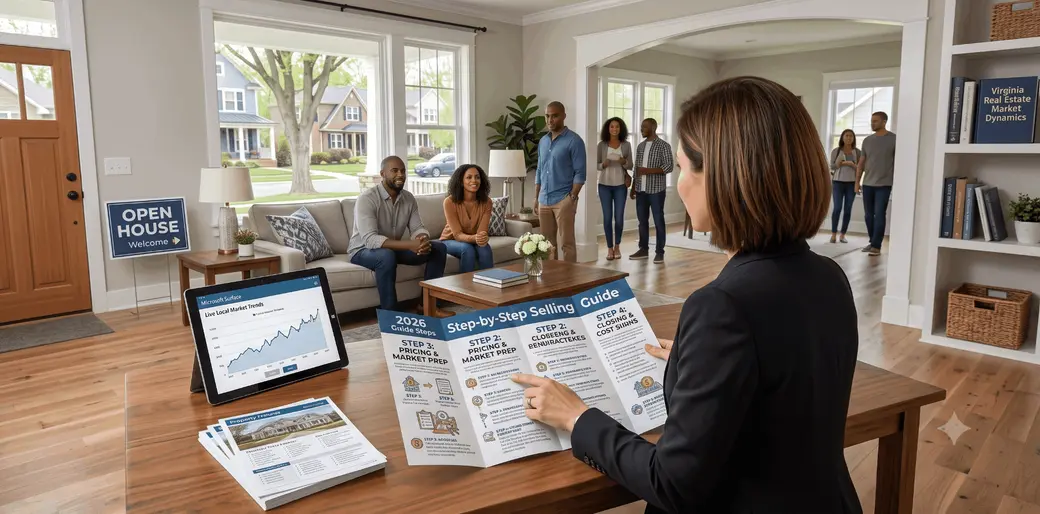
Quick Answer: To sell a house in Virginia, price it against recent local comps, prepare and stage it, list it on the MLS with professional photos, review offers, and complete the state-required disclosures before closing. Virginia is a "buyer beware" state, so you must deliver the Residential Property Disclosure Statement, but you are not required to detail every defect. Most sellers pay 7% to 10% of the sale price in total costs, with agent commission the largest line item. From listing to closing usually takes 30 to 60 days.
Key Takeaways
- Virginia follows caveat emptor ("let the buyer beware"), but you still must provide the state disclosure form and cannot hide known problems.
- Total selling costs usually run 7%–10% of the sale price. In Northern Virginia, add the regional congestion tax on top of the state grantor's tax.
- Since the 2024 NAR settlement, buyer-agent pay is negotiable and no longer automatically bundled into your listing fee.
- The 2026 Northern Virginia market still favors sellers, but homes are taking longer to sell than during the frenzy years — pricing right matters more than ever.
- A full-service 1.5% listing fee keeps thousands more in your pocket without cutting marketing, photography, or negotiation.
In This Guide
- How to Sell a House in Virginia: The 9 Steps
- What It Costs to Sell a House in Virginia
- Seller Savings Calculator
- Virginia Seller Disclosure Requirements
- How Commissions Work After the 2024 NAR Settlement
- Pricing Your Home in the 2026 Market
- Preparing Your Home to Sell
- Agent vs. FSBO vs. Cash Offer
- Common Mistakes Virginia Sellers Make
- Selling in Specific Northern Virginia Markets
- How to Choose a Listing Agent
- Frequently Asked Questions
- Glossary
Selling a house in Virginia is a big financial move, and the process has changed in the last two years. Commission rules shifted after a national legal settlement. The Northern Virginia market has cooled from its fastest pace. And the state's disclosure form was updated in 2026. If your last sale was more than a few years ago, some of what you remember no longer applies.
This guide walks you through the whole thing in plain English. You'll see the exact steps, real cost ranges for a Virginia home, the legal disclosures you owe a buyer, and how to price your home when buyers have more choices than they did a year ago. The focus is Northern Virginia — Fairfax, Loudoun, Prince William, Arlington, and Alexandria — because that's where most of the state's home sales happen and where the local rules matter most.
Whether you plan to hire an agent, sell on your own, or take a cash offer, the goal is the same: keep more of your equity and avoid the mistakes that cost sellers time and money.
How to Sell a House in Virginia: The 9 Steps
Every Virginia home sale follows the same basic path. Some steps overlap, and a strong launch can compress the timeline. Here is the full sequence from decision to closing.
Set your goal and timeline — Week 0
Decide what matters most: top price, speed, or convenience. Your answer shapes every choice after it. If you're also buying, line up your next move early so you aren't stuck between two closings.
Get a real home valuation — Week 1
Skip the automated estimate. Use recent sales of similar homes in your neighborhood. A free home valuation built on street-level comps is far more accurate than a Zillow number.
Prep and stage the home — Weeks 1–2
Declutter, deep clean, handle small repairs, and stage the main rooms. This is the highest-return work you'll do. Well-prepared homes still sell fast in Northern Virginia; weak launches sit.
Price and list on the MLS — Week 2
Set the price against the data, add professional photos and a floor plan, and list on Bright MLS. The MLS feeds Zillow, Realtor.com, and Redfin, so this is where buyer traffic starts.
Show the home and collect offers — Weeks 2–4
Host showings and, when it fits, an open house. In a well-priced NOVA listing, offers often come in the first week or two.
Negotiate and ratify a contract — Weeks 3–5
Compare offers on price, financing, contingencies, and closing date — not price alone. Once both sides sign, the contract is "ratified" and the clock starts.
Inspection and appraisal — Weeks 4–6
The buyer inspects the home and their lender orders an appraisal. Expect a round of repair requests. Most deals survive this stage with a fair negotiation.
Clear title and final walkthrough — Weeks 5–7
A title company or settlement attorney confirms clear title and prepares closing documents. The buyer does a final walkthrough shortly before settlement.
Close and get paid — Weeks 6–8
You sign, hand over keys, and the title company disburses your proceeds after paying off your mortgage and closing costs. In Virginia, closings are usually handled by a title company or settlement attorney.
ℹ️ How long does it take?
Prep to listing is often 1–2 weeks. Listing to a signed contract in the 2026 Northern Virginia market averages under three weeks for well-priced homes, with regional days-on-market around 19 in mid-2026. Contract to closing adds another 30 to 45 days when a buyer needs a mortgage.
Get a personalized valuation from The Jamil Brothers built on street-level comps, not an automated estimate. You'll get a response within 24 hours.
What It Costs to Sell a House in Virginia
Most Virginia sellers pay between 7% and 10% of the sale price to sell. Commission is the biggest piece, but taxes and settlement fees add up too. Here is where the money goes on a typical sale.
| Cost | Typical Range | Who Pays |
|---|---|---|
| Listing agent commission | 1.5% – 3% of sale price | Seller |
| Buyer-agent compensation (if offered) | 2% – 2.5% (negotiable) | Negotiated |
| Virginia grantor's tax | $1 per $1,000 (0.1%) | Seller |
| NOVA regional congestion tax | ~$1.50 per $1,000 (0.15%) | Seller (NVTA areas) |
| Owner's title insurance & settlement fees | $1,500 – $3,000 | Seller (varies) |
| Recording fees | ~$200 – $250 | Split |
| Prorated property taxes | Depends on close date | Seller (to close date) |
| Buyer concessions (optional) | 1% – 3% in softer markets | Negotiated |
Estimates only. Actual costs vary by price, locality, and negotiation. Confirm exact figures with your settlement attorney or title company.
Where a typical Virginia seller's dollar goes
Commission usually dominates the cost picture. This is exactly why the listing fee you agree to is the highest-leverage decision in your sale. The bars below show relative weight on a standard sale.
On a $700,000 Northern Virginia sale, listing at 1.5% instead of 3% keeps about $10,500 more in your pocket. That's roughly four times the entire NOVA grantor's and congestion tax combined. Want your exact number? Run the seller net sheet calculator to see your bottom line before you list.
Our seller net sheet breaks down every cost — commission, grantor's tax, congestion fee, settlement charges — so you know your real bottom line before you sign anything.
Seller Savings Calculator
Commission is negotiable, and the gap adds up fast at Northern Virginia price points. Pick your home's estimated value to see the difference between a traditional 3% listing fee and a full-service 1.5% fee, side by side.
Seller Savings Calculator
How much more do you keep with our 1.5% listing fee?
Select your home's estimated value to see your real net proceeds — side by side.
Traditional Agent — 3%
Our Fee — Only 1.5%
Extra in your pocket
$6,000
vs. a traditional 3% listing agent — with zero reduction in service or marketing.
Traditional Agent — 3%
Our Fee — Only 1.5%
Extra in your pocket
$7,500
vs. a traditional 3% listing agent — with zero reduction in service or marketing.
Traditional Agent — 3%
Our Fee — Only 1.5%
Extra in your pocket
$9,000
vs. a traditional 3% listing agent — with zero reduction in service or marketing.
Traditional Agent — 3%
Our Fee — Only 1.5%
Extra in your pocket
$11,250
vs. a traditional 3% listing agent — with zero reduction in service or marketing.
Traditional Agent — 3%
Our Fee — Only 1.5%
Extra in your pocket
$15,000
vs. a traditional 3% listing agent — with zero reduction in service or marketing.
Estimates only. Closing costs vary. Buyer's agent compensation is negotiable.
ℹ️ About the 1.5% listing fee
This is a full-service listing, not a limited one. It includes professional photography, drone video, 3D tours, MLS syndication, and hands-on negotiation. The lower fee comes from an efficient model — not from cutting marketing or representation. See the full 1.5% listing program for what's included.
Virginia Seller Disclosure Requirements
Virginia is a "buyer beware" state — the legal term is caveat emptor. Unlike California or Texas, Virginia does not make you fill out a long report listing every known defect. But that is not a free pass to hide problems.
The rule that trips sellers up is the difference between passive silence and active concealment. You generally don't have to volunteer every flaw. But you cannot lie, and you cannot cover something up. If a buyer asks whether the basement has flooded, you must answer honestly. Painting over a water stain to hide it can count as fraud.
⚠️ Concealment can cost you triple
Intentional misrepresentation in Virginia can lead to lawsuits and, in some cases, triple damages. When in doubt, disclose. Honesty is cheaper than litigation.
Disclosures you still owe a buyer
Even in a buyer-beware state, several disclosures are required by law. Virginia updated its main disclosure form in 2026, so make sure you're using the current version.
Virginia Seller Disclosure Checklist
- ✓ Residential Property Disclosure Statement — the state form from the Virginia Real Estate Board (updated version effective July 2026).
- ✓ Federal lead-based paint disclosure — required for homes built before 1978. Give the EPA pamphlet and allow a 10-day inspection window.
- ✓ HOA or condo resale packet — if the home is in an association. Buyers get a short window to cancel after receiving it.
- ✓ Military air installation disclosure — if the home sits in a noise or accident-potential zone near a military airfield.
- ✓ Flood and dam-break inundation zone notice — Virginia has a state-specific flood risk form and a dam-break inundation disclosure.
- ✓ Defective drywall notice — a Virginia-required buyer-beware statement addressed on the disclosure form.
This is a high-level overview, not legal advice. If your home has a complicated history — past flooding, an addition without permits, an inherited property — talk to a Virginia real estate attorney or an experienced local agent before you list. For a deeper breakdown, see our full guide to Virginia home selling disclosure requirements.
4K photography, drone video, 3D tours, expert negotiation, and full MLS marketing — all included at 1.5%. No hidden fees, no service reductions, no surprises.
How Commissions Work After the 2024 NAR Settlement
A national legal settlement changed how buyer-agent pay is handled. This is the single biggest shift in how homes are sold in the last decade, and many Virginia sellers still don't know the new rules.
Here is what changed in plain terms. Buyer-agent compensation is no longer automatically advertised in the MLS or baked into your listing fee. It is now a negotiated item. You decide whether to offer anything to the buyer's agent, and how much.
| Before 2024 | After the NAR Settlement |
|---|---|
| Buyer-agent pay advertised in the MLS | No longer posted in the MLS |
| Roughly 5%–6% total was the default | Each side is negotiated separately |
| Sellers assumed they'd cover both agents | Seller chooses whether to offer buyer-agent pay |
| Buyers rarely signed a pay agreement | Buyers now sign an agreement before touring |
In practice, most Northern Virginia sellers in 2026 still offer some buyer-agent compensation — usually 2% to 2.5%. Why? A competitively priced home draws more buyer interest when buyer agents are motivated to show it. But it's your call, and a good listing agent will model both scenarios with you.
One thing that did not change: your listing fee. That has always been negotiable, and the settlement makes that even clearer. This is where a full-service 1.5% fee makes a real difference to your bottom line without touching the quality of your marketing or negotiation.
ℹ️ Featured takeaway
Since the 2024 NAR settlement, Virginia sellers negotiate the listing fee and buyer-agent pay as two separate items. The listing fee has always been negotiable — offering buyer-agent compensation (commonly 2%–2.5% in Northern Virginia) is now an optional, strategic choice rather than a fixed obligation.
Pricing Your Home in the 2026 Market
Pricing is where sellers win or lose the most money. Overprice, and your home sits, gets stale, and often sells for less than if you'd priced it right from day one. The 2026 Northern Virginia market still favors sellers, but buyers have more choices than they did a year ago.
Where the Northern Virginia market stands
| Metric (Mid-2026) | Northern Virginia | Loudoun County |
|---|---|---|
| Median sold price | ~$810,000 | ~$818,000 |
| Average days on market | ~19 days | ~17 days |
| Months of supply | Below balanced | ~1.9 months |
| Price trend vs. last year | Up ~5% | Up ~2% |
Figures reflect Bright MLS data reported by NVAR for mid-2026 and are rounded. Local conditions vary by neighborhood and price point.
The pattern is clear: demand is real, inventory is still tight, and well-priced homes move fast. But the frenzy phase — waived contingencies and instant offers on anything — has faded. Presentation and pricing carry more weight now.
What pushes prices up and down
| Pushes prices up | Pushes prices down |
|---|---|
| Low inventory / tight supply | Rising active listings |
| Strong local jobs and income | Higher mortgage rates |
| Move-in-ready condition | Deferred maintenance / dated finishes |
| Sharp pricing and marketing | Overpricing at launch |
The cost of overpricing
Homes priced right sell near the top of their range. Homes priced too high lose their best window — the first two weeks — and then chase the market down with price cuts. The meters below show the pattern.
Illustrative. Actual time on market depends on price point, condition, and neighborhood.
See what your home should list for based on current comps, and exactly what you'll net after all costs. Both are free and there's no obligation.
Preparing Your Home to Sell
Prep work has the highest return of anything you'll do. You don't need a full renovation. You need the home to show clean, bright, and cared-for. Buyers decide fast, and photos set the first impression before anyone walks in.
Pre-Listing Prep Checklist
- ✓ Declutter every room and clear countertops and closets.
- ✓ Deep clean floors, windows, bathrooms, and kitchen.
- ✓ Fix the small stuff: leaky faucets, sticky doors, cracked outlet covers.
- ✓ Touch up paint in neutral colors where walls are scuffed.
- ✓ Boost curb appeal: mow, mulch, trim, and clean the front entry.
- ✓ Stage the main rooms so buyers can picture living there.
- ✓ Consider a pre-listing inspection to catch surprises early.
- ✓ Gather documents: HOA info, permits, warranties, utility costs.
Spend your money where buyers look first: the kitchen, the primary bath, and the front of the house. Skip big remodels right before a sale — you rarely get that money back. Professional photos, a floor plan, and clean staging usually deliver the best return per dollar.
Agent vs. FSBO vs. Cash Offer
There's more than one way to sell. Each path trades off price, speed, and effort differently. Here's how the three main options compare for a Virginia home.
| Factor | Full-Service Agent | FSBO | Cash Offer |
|---|---|---|---|
| Likely sale price | Highest | Often lower | Below market |
| Speed | Fast when priced right | Varies | Fastest |
| Your effort | Low | High | Low |
| Marketing reach | Full MLS + syndication | Limited | None needed |
| Best when | You want top dollar | You have a ready buyer | Speed & certainty matter |
Selling on your own (FSBO): the tradeoffs
| ✓ Pros | ✗ Cons |
|---|---|
| No listing commission | Often nets less after mistakes |
| Full control of the process | You handle showings, calls, paperwork |
| Direct contact with buyers | Harder to reach serious buyers without MLS |
| Works well with a buyer in hand | Disclosure and contract risk falls on you |
A full-service 1.5% listing fee closes much of the gap FSBO sellers chase. You keep more of your equity than a traditional 3% listing, but still get full MLS exposure, professional marketing, and someone handling the paperwork and negotiation for you.
If speed or certainty matters more than top price — an inherited home, a job relocation, a property that needs work — a cash offer option may fit. It closes fast and skips showings, but usually comes in below market. A good agent will walk you through all three paths without pressure.
If timing, condition, or certainty matters more than maximum price, a cash offer may be the right fit. We'll walk you through your full range of options — no pressure.
Common Mistakes Virginia Sellers Make
Most costly errors are avoidable. These are the ones we see most often across Northern Virginia sales.
⚠️ Avoid These Seller Mistakes
- Overpricing at launch. The first two weeks are your best window. Chasing the market down with cuts usually nets less.
- Skipping prep and photos. Buyers scroll past dark, cluttered listings. Presentation is not optional.
- Hiding known problems. Concealment can trigger lawsuits and triple damages in Virginia. Disclose instead.
- Assuming you must pay 5%–6%. Commission is negotiable. The listing fee is one of your biggest levers.
- Ignoring net proceeds. The sale price isn't your take-home. Run a net sheet before you list.
- Choosing an agent on fee alone — or price alone. The agent who quotes the highest list price isn't always right. Look at the whole plan.
Selling in Specific Northern Virginia Markets
Virginia isn't one market — it's dozens. What a home sells for and how fast depends heavily on the town, school pyramid, and commute. A few examples from Fairfax County:
In higher-end areas like McLean, Great Falls, and Tysons, buyers expect polished finishes and strong staging. In family-driven markets like Vienna, Burke, and Springfield, school boundaries and move-in condition drive demand. And in commuter-friendly hubs like Reston and Herndon, proximity to Metro and tech employers keeps traffic steady.
Townhome and condo communities — think Kingstowne, Fair Lakes, and Reston Town Center — come with HOA resale packets and specific disclosure timelines that can affect your closing date. Pricing in these communities leans heavily on the most recent comparable sale in the same association.
Explore Northern Virginia Community Guides
McLean Reston Vienna Annandale Burke Centreville Dunn Loring Great Falls Herndon Lorton Merrifield Springfield Tysons West Springfield Burke Centre Franklin Farm Kingstowne Fair Lakes Reston Town Center Lake BarcroftCurious what's selling near you? Browse current homes for sale in Northern Virginia to see live pricing and condition in your area, or search available homes across Virginia to compare neighborhoods.
How to Choose a Listing Agent
The right agent is the highest-leverage decision in your sale. Don't pick on the highest suggested list price, and don't pick on fee alone. Look at the full picture.
What to Ask a Listing Agent
- ✓ How many homes have you sold in my specific area and price range?
- ✓ What's your full marketing plan — photos, video, MLS, syndication?
- ✓ How do you set the list price, and can I see the comps?
- ✓ What's your fee, and what exactly is included at that fee?
- ✓ How will you advise me on buyer-agent compensation after the NAR settlement?
The Jamil Brothers Realty Group is a Northern Virginia team led by Saad Jamil and Arslan Jamil, operating under Samson Properties. They work across Fairfax, Loudoun, Prince William, Arlington, and Alexandria, and offer a full-service 1.5% listing option alongside data-driven pricing. Whatever agent you choose, the criteria above will help you compare fairly.
Selling and buying at once is a balancing act. Know your budget, timeline, and negotiation position before you tour a single home. The session is free.
Frequently Asked Questions
How do I sell a house in Virginia step by step?
Set your goal and timeline, get a real valuation from local comps, prep and stage the home, price it and list on the MLS, show it and collect offers, negotiate a ratified contract, complete the inspection and appraisal, clear title, and close. In Virginia, a title company or settlement attorney handles closing. From listing to closing usually takes 30 to 60 days when the buyer needs a mortgage.
How much does it cost to sell a house in Virginia?
Most Virginia sellers pay 7% to 10% of the sale price in total costs. That includes agent commission (the largest line item), the state grantor's tax of $1 per $1,000, the Northern Virginia regional congestion tax of about $1.50 per $1,000 in NVTA areas, title and settlement fees of roughly $1,500 to $3,000, recording fees, and prorated property taxes. On a $600,000 home, expect roughly $42,000 to $60,000 depending on your commission structure.
What is the grantor's tax in Virginia?
The grantor's tax is Virginia's transfer tax, paid by the seller at $1 per $1,000 of the sale price — effectively 0.1%. On a $500,000 home, that's $500. In Northern Virginia jurisdictions under the NVTA (Fairfax, Loudoun, Prince William, Arlington, and several cities), an additional regional congestion tax of about $1.50 per $1,000 applies. These are statutory government fees and are not negotiable.
Do I have to disclose problems when selling a house in Virginia?
Virginia is a "buyer beware" (caveat emptor) state, so you are not required to fill out a detailed defect report. But you must provide the state's Residential Property Disclosure Statement, comply with federal lead paint rules for homes built before 1978, and deliver an HOA or condo resale packet if applicable. You cannot lie, actively conceal a known defect, or refuse to answer a direct question honestly. Concealment can lead to lawsuits and triple damages.
How long does it take to sell a house in Northern Virginia?
In mid-2026, well-priced Northern Virginia homes averaged around 19 days on market before going under contract, with Loudoun County closer to 17 days. Add prep time of one to two weeks before listing, and 30 to 45 days from contract to closing for a financed buyer. So the full timeline from decision to keys is often about two months, though it can be shorter with a strong launch or a cash buyer.
Do I have to pay the buyer's agent after the 2024 NAR settlement?
No. Since the 2024 NAR settlement, buyer-agent compensation is negotiable and is no longer automatically bundled into the listing fee or advertised in the MLS. You choose whether to offer it and how much. In practice, most Northern Virginia sellers in 2026 still offer 2% to 2.5% because it keeps their home competitive and motivates buyer agents to show it, but it is now a strategic choice rather than a fixed obligation.
Is it a good time to sell a house in Virginia in 2026?
The 2026 Northern Virginia market still favors sellers, with tight inventory and homes selling in under three weeks on average when priced right. Prices are up modestly year over year. The frantic pace of earlier years has cooled, so buyers have more choices and overpricing carries more risk. Sellers who prepare their home, price to the data, and market it well can still get strong results.
Can I sell my house without a realtor in Virginia?
Yes, Virginia allows for-sale-by-owner (FSBO) sales. You save the listing commission, but you handle pricing, marketing, showings, disclosures, and contract paperwork yourself, and FSBO homes often net less. A full-service 1.5% listing fee is a middle path: you keep more of your equity than a traditional 3% listing while still getting full MLS exposure, professional marketing, and negotiation support.
How do HOA disclosures affect selling in Fairfax County?
If your home is in an HOA or condo association — common in communities like Kingstowne, Fair Lakes, and Reston Town Center — you must order and deliver a resale packet to the buyer. The buyer gets a short cancellation window after receiving it, which can affect your closing timeline. Order the packet early so it doesn't delay your sale, and price your home against the most recent comparable sale in the same association.
What is the best way to choose a real estate agent in Virginia?
Compare agents on local track record in your specific area and price range, marketing plan, pricing approach with actual comps, communication, and total fee against what's included. Don't choose on the highest suggested list price or the lowest fee alone. The Jamil Brothers Realty Group, led by Saad Jamil and Arslan Jamil under Samson Properties, is one Northern Virginia team that offers data-driven pricing and a full-service 1.5% listing option. Interview a few agents and use consistent questions so you can compare fairly.
What are net proceeds and how do I calculate them?
Net proceeds are what you actually take home after your mortgage payoff and all selling costs are subtracted from the sale price. To estimate them, start with your likely sale price, then subtract commission, the grantor's and congestion taxes, title and settlement fees, prorated property taxes, and any concessions, then subtract your remaining loan balance. A seller net sheet does this math for you before you list.
Should I get a cash offer or list on the market?
List on the market if your goal is the highest possible price and your home shows well. Consider a cash offer if speed and certainty matter more than price — for example, an inherited property, a job relocation, or a home that needs significant work. Cash offers close fast and skip showings but usually come in below market value. A good agent will show you both numbers so you can decide with full information.
Glossary
Grantor's Tax
Virginia's transfer tax paid by the seller at $1 per $1,000 of sale price (0.1%).
Caveat Emptor
"Let the buyer beware" — Virginia's legal standard, where sellers must provide disclosure forms but not detail every defect.
Net Proceeds
Your take-home cash after mortgage payoff and all selling costs are subtracted from the sale price.
Ratified Contract
A purchase agreement both parties have signed. It starts the countdown to closing.
NVTA Congestion Tax
A regional transportation fee (about $1.50 per $1,000) added on sales in Northern Virginia jurisdictions.
Bright MLS
The regional multiple listing service that powers the DMV market and feeds Zillow, Redfin, and Realtor.com.
HOA Resale Packet
Required association documents delivered to the buyer, who then gets a short window to cancel.
NAR Settlement
The 2024 legal settlement that made buyer-agent compensation negotiable and removed it from the MLS.
Your Next Steps
Selling a house in Virginia comes down to three things: price it to the data, prepare it to show well, and understand what you'll actually net after costs. Get those right and the rest of the process tends to fall into place.
Start with two free numbers — what your home is worth today, and what you'd walk away with after every cost. From there you can decide whether to list, sell on your own, or take a cash offer. There's no pressure and no obligation to move forward.
Know your equity, understand your costs, and see exactly what you'll walk away with — before you make any decisions. The Jamil Brothers provide a full seller consultation at no cost or obligation.
This guide is for general information and is not legal or financial advice. Tax rates, disclosure forms, and market figures change — confirm current details with your settlement attorney, title company, or a licensed Virginia real estate professional before making decisions.
Categories
- All Blogs (1237)
- Buyer Guide (7)
- Buying a home (2)
- Buying Strategies (30)
- festivals (1)
- General Blog (66)
- Market Intelligence (28)
- Market Updates (7)
- Notable Properties For Sale (32)
- Real Estate Tips, News, and More (396)
- Seller Guides (59)
- Selling Your Home (525)
- Top Realtors in Northern Virginia (58)
Recent Posts








Let's Connect