Arlington vs Falls Church Home Values: 2026 Price Comparison
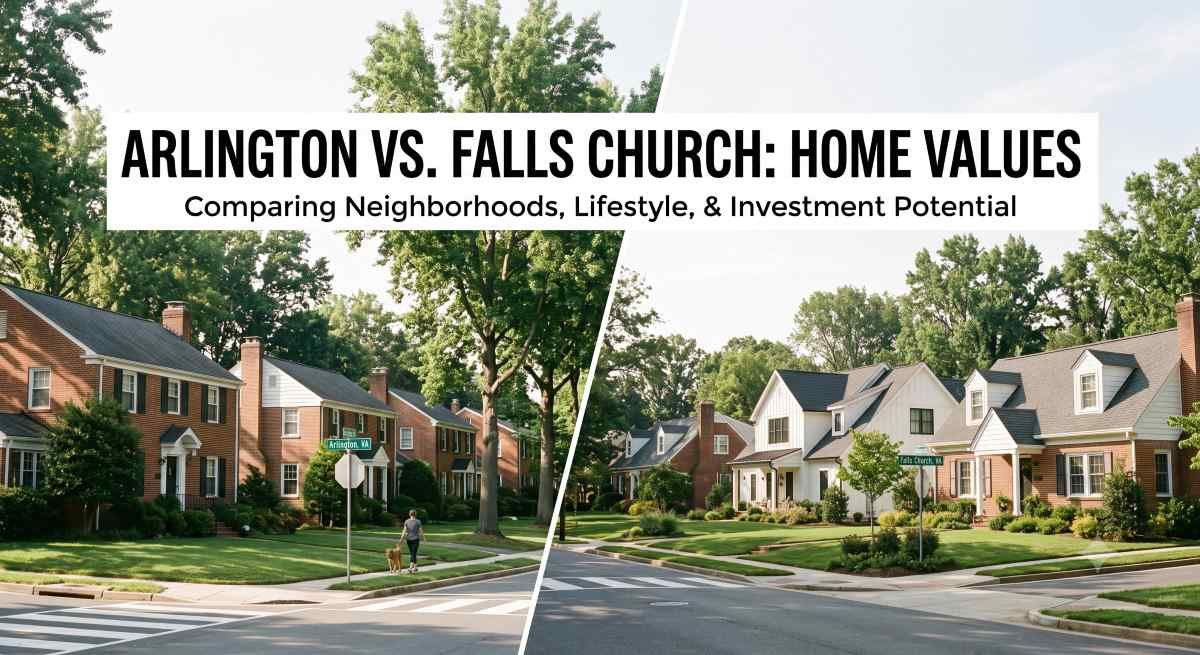
Quick Answer: When you compare Arlington vs. Falls Church home values in 2026, the City of Falls Church is the pricier market. In the first half of 2026 it posted a median sale price near $1,015,000 and an average around $1,125,435, the highest in the entire Washington metro. Arlington County came in second at roughly $806,000 median. Falls Church also edges Arlington on price per square foot, about $530 versus $514. The catch: "Falls Church" can mean the small independent city or the much larger, more affordable Fairfax County postal area, and confusing the two is the single biggest mistake buyers and sellers make.
Key Takeaways
- The independent City of Falls Church leads Northern Virginia on both median price (about $1,015,000) and price per square foot (about $530) for the first half of 2026, ahead of Arlington's roughly $806,000 median.
- Arlington's headline "average" of roughly $826,000 masks a split market: single-family detached homes average about $1.55 million, while condos sit near $550,000.
- "Falls Church" is two very different markets. Homes inside the 2.2 square mile city (ZIP 22046) routinely top $1 million, while the Fairfax County postal areas (22042, 22043, 22044) run closer to $800,000.
- Property taxes tilt in Arlington's favor. Its 2026 rate of about $1.05 per $100 is lower than the City of Falls Church's roughly $1.18 per $100, a real gap on a million-dollar home.
- Both markets move fast and favor sellers, with strong demand, tight inventory, and homes going under contract in days rather than weeks.
- For sellers in either market, commission is the largest controllable cost, and trimming it from 3% to a full-service 1.5% keeps five figures of equity in your pocket.
In This Guide
- Arlington vs. Falls Church Home Values at a Glance
- The Falls Church Distinction: City vs. Fairfax County
- Median and Average Home Prices Compared
- Price Per Square Foot: The Truest Comparison
- What Drives Home Values in Each Market
- Property Taxes and Total Cost of Ownership
- Market Speed and Appreciation Trends
- Which Market Is Better for Sellers?
- Which Market Is Better for Buyers?
- Frequently Asked Questions
- Glossary
If you are weighing two of Northern Virginia's most sought-after inside-the-Beltway markets, comparing Arlington vs. Falls Church home values is the right place to start, because price is where every other tradeoff eventually shows up. Both sit minutes from Washington, D.C., both draw well-qualified professional buyers, and both reward homeowners with strong equity. Yet the price gap between them is wider than most people expect, and the reasons behind it, from school districts to lot sizes to the quirks of Virginia's independent-city system, tell you a lot about which market fits your goals. For a full picture of the northern market, our Arlington County Real Estate resource tracks neighborhoods, pricing, and inventory in real time.
Here is the headline. For the first six months of 2026, the City of Falls Church recorded the highest average home-sale price in the entire Washington metropolitan area, near $1,125,435, with a median around $1,015,000. Arlington County, no slouch itself, came in a clear second at roughly $806,000 median. So on paper Falls Church wins the "more expensive" title. But averages hide as much as they reveal, and the word "Falls Church" quietly refers to two separate markets that behave nothing alike. Sort that out first and the rest of the comparison snaps into focus.
This guide breaks down the numbers that actually matter: median and average prices, price per square foot, property taxes, market speed, and what all of it means whether you are buying your next home or preparing to sell. As real estate specialists serving the DMV, we help clients on both sides of this decision, and the goal here is a clear, honest read on where the value lies. If you want the wider context beyond these two markets, our Northern Virginia real estate services hub covers every county and city in the region.
Arlington vs. Falls Church Home Values at a Glance
Before the deep dive, here is the side-by-side snapshot. The figures below reflect the first half of 2026, drawn from regional MLS reporting and public assessment data. Note that the Falls Church column represents the independent City of Falls Church, which is the market people usually mean when they say a home is "in Falls Church" at a premium price.
| Metric (H1 2026) | Arlington County | City of Falls Church |
|---|---|---|
| Median sale price | ~$806,000 | ~$1,015,000 |
| Average sale price | ~$826,000 | ~$1,125,435 |
| Price per square foot | ~$514 | ~$530 |
| Single-family average | ~$1.55 million | $1.2 million and up |
| Real estate tax rate | ~$1.05 per $100 | ~$1.18 per $100 |
| Typical days to contract | About a week | A few weeks |
| Size of market | 26 sq mi, ~236,000 people | 2.2 sq mi, ~15,000 people |
| School district | Arlington Public Schools | Falls Church City Public Schools |
Sources: MarketStats by ShowingTime regional MLS data (first half 2026), Zillow Home Value Index, and adopted 2026 local tax rates. Low-volume markets like the City of Falls Church can swing month to month, so treat single-month figures with caution.
ℹ️ Read the average carefully
A market's "average" price is pulled upward by its most expensive sales and its mix of home types. Falls Church sells a high share of single-family homes, so its average looks lofty. Arlington sells thousands of condos and townhomes alongside its detached homes, which pulls its overall average down even though its top-tier single-family homes rival anything in Falls Church.
The Falls Church Distinction: Independent City vs. Fairfax County
This is the part most comparisons skip, and it is the part that will save you from a costly misread. Virginia is one of the few states where cities are fully independent of the counties around them. The City of Falls Church is one of those independent cities: a compact 2.2 square miles with its own government, its own tax rate, and its own school system. But the postal address "Falls Church, VA" stretches far beyond the city limits into surrounding Fairfax County, covering ZIP codes like 22042, 22043, and 22044. Those Fairfax neighborhoods share the name but not the price tag.
Two markets, one name
Inside the city (ZIP 22046), a typical home changes hands north of $1 million. Curb Report and other trackers peg the typical value inside the city near $1.19 million. Step one block over into the Fairfax County "Falls Church" postal area and the typical value drops toward $700,000 to $800,000. Same mailing address, entirely different market. When a listing advertises a "Falls Church" home at a surprisingly low or high price, the first question to ask is always: city or county?
| "Falls Church" area | ZIP codes | Typical value |
|---|---|---|
| Independent City of Falls Church | 22046 | $1 million and up |
| Fairfax County "Falls Church" postal area | 22042, 22043, 22044 | ~$700,000 to $800,000 |
⚠️ Why the confusion costs money
Buyers who assume every "Falls Church" home comes with the city's top-ranked schools can overpay for a Fairfax County property that feeds into a different, larger district. Sellers just outside the city sometimes underprice, not realizing their buyers are cross-shopping the city premium. Always confirm the jurisdiction on the tax record before you price or make an offer.
Throughout this guide, when we say "Falls Church" we mean the independent city, because that is the market that competes with Arlington's premium single-family neighborhoods and the market that commands the region-leading numbers. If your search or your listing sits in the Fairfax County portion, expect values closer to the broader Fairfax County range. The same care applies across the region, which is why our Loudoun County real estate pages and other community guides keep pricing organized by actual jurisdiction rather than mailing address.
Automated estimates cannot tell the difference between a city address and a county one. We can. Get a personalized valuation from The Jamil Brothers built on street-level comps for your exact block, with a response within 24 hours.
Median and Average Home Prices Compared
Median price is usually the more honest number, because it sits in the middle and is not distorted by a single mega-sale. On the median, the City of Falls Church leads at about $1,015,000, up roughly 2% year over year, while Arlington sits near $806,000. That is a gap of about $210,000, or roughly 26%, for the middle home in each market. The bar chart below shows how the two stack up against their regional context.
Median sale prices, early 2026. Both Arlington and Falls Church carry a heavy premium over the statewide median of roughly $410,000.
Why Arlington's average looks lower than it lives
Arlington is really three markets in one, and lumping them together is what makes its average look modest next to Falls Church. Break Arlington apart by home type and the premium reappears. In spring 2026, Arlington's single-family detached homes averaged about $1.55 million, up more than 6% year over year. Townhouses averaged around $1.02 million. Condos, which make up a large share of Arlington's sales volume, averaged closer to $550,000. That condo volume is exactly what drags the blended average down.
| Arlington by home type (2026) | Average price | Year-over-year |
|---|---|---|
| Single-family detached | ~$1.55 million | +6.5% |
| Townhouse | ~$1.02 million | +7.5% |
| Condominium | ~$550,000 | +10.5% |
The takeaway for anyone comparing Arlington vs. Falls Church home values: if you are shopping detached single-family homes, the two markets are far closer than the blended averages suggest. If you want a condo or a smaller-footprint entry point, Arlington offers something Falls Church largely does not, a genuine sub-$600,000 door into an inside-the-Beltway address. For a closer look at where the biggest numbers cluster, our guide to the wealthiest neighborhoods in Arlington County maps the county's top-tier streets block by block.
Price Per Square Foot: The Truest Value Comparison
Median and average prices are shaped by what happened to sell that month, which means a market full of big houses will always post big numbers. Price per square foot strips that out. It measures what buyers pay for the space itself, so it is the cleanest way to compare two markets with different housing mixes. On this metric, the two markets are remarkably close, and the edge flips depending on the exact period you measure.
For the first half of 2026, the City of Falls Church posted roughly $530 per square foot, which regional reporting called the highest in the metro. Arlington's Q1 2026 figure of about $514 per square foot was, in its own reporting window, also called the highest in the Mid-Atlantic. Both statements can be true because they cover slightly different periods, but the practical point stands: these are the two most expensive places to buy a square foot of home anywhere in the region, and they are separated by only about 3%.
What that means in dollars: on a 3,000 square foot home, the price-per-foot gap between the two markets is only about $48,000, a fraction of the six-figure gap you see in the median. In other words, most of Falls Church's median premium comes from selling bigger homes on bigger lots, not from charging dramatically more for the same space. That is a crucial insight for buyers weighing whether the city premium is "worth it," and for sellers deciding how to position a home that sits near the border.
How to use price per square foot when you compare
- ✓ Compare like with like: a renovated 1940s Cape in the city versus a renovated 1940s Cape in North Arlington, not against a new build.
- ✓ Adjust for lot size, because land value is a big part of the difference in both markets.
- ✓ Treat condo price per foot separately, since Arlington's condo market runs on entirely different math.
- ✓ Weigh the school premium separately, because in the city a large slice of price per foot is really paying for Falls Church City Public Schools.
Whether you sell in Arlington or Falls Church, your net proceeds depend on commission, transfer taxes, and closing costs, not just the sale price. Our seller net sheet breaks down every line so you know your real bottom line before you list.
What Drives Home Values in Each Market
Prices do not appear from nowhere. Both markets share the fundamentals that keep inside-the-Beltway Northern Virginia expensive, proximity to Washington, high household incomes, and stubbornly low inventory, but each has a distinct engine underneath. Understanding those engines tells you whether the premium is durable.
Schools: the Falls Church trump card
Falls Church City Public Schools is one of the most consistently top-rated districts in Virginia, and because the city is so small, families pay a real, measurable premium to buy inside the boundary rather than a block outside it. In a market where a single school assignment can move a home's value by six figures, that district is the single biggest reason the city commands region-leading prices. Arlington Public Schools is a much larger district serving a county of 236,000 people, with North Arlington schools rating highly and other areas rating solidly. Arlington gives you strong schools with far more housing to choose from; Falls Church gives you a smaller, tightly ranked district with far less inventory.
Location and commute
Arlington directly borders Washington, D.C., and is threaded by four Metro lines, the Orange, Silver, Blue, and Yellow. If minutes to downtown or Reagan National Airport are your priority, Arlington almost always wins. Falls Church sits a little farther out, served by the East Falls Church and West Falls Church Metro stations, so commuters typically add ten to twenty minutes. Buyers who accept that tradeoff get more square footage and larger lots for the money, which is a big part of the city's appeal to move-up families.
Inventory scarcity
Scarcity is the great price amplifier, and Falls Church has it in the extreme. The entire city holds roughly 6,000 housing units across 2.2 square miles, and in a typical month only a handful of single-family homes list. When supply is that thin, one well-priced listing can spark a bidding war. Arlington is also land-constrained at just 26 square miles with almost no undeveloped land, so its new supply comes mainly from teardown-and-rebuild projects and condo development. Both markets are structurally short on homes, which is the foundation under both price tags.
The Amazon and jobs effect
Arlington has a demand engine Falls Church does not: Amazon's HQ2 at National Landing, plus a dense cluster of government, defense, and consulting employers. That continued expansion supports a deep, well-paid buyer pool and helps explain why Arlington's detached and townhouse segments have kept appreciating. Falls Church leans instead on lifestyle, walkability in its "Little City" core, the State Theatre, a year-round farmers market, and the schools, to sustain demand. Different engines, same result: buyers keep showing up.
ℹ️ One of the highest-income small cities in America
The City of Falls Church has a median household income well above $150,000, among the highest of any small city in the United States. That buyer profile, largely dual-income professionals in government, tech, defense, and consulting, is a big reason the city's values stay resilient even when the broader market softens.
Property Taxes and Total Cost of Ownership
Sticker price is only half the ownership story. Because each jurisdiction sets its own real estate tax rate, two homes with identical values can carry very different annual bills. Here the comparison tilts toward Arlington. For 2026, Arlington County's adopted residential rate is about $1.05 per $100 of assessed value, while the City of Falls Church, even after a small rate cut, sits near $1.18 per $100. That gap matters most on exactly the kind of high-value homes both markets specialize in.
| Home value | Arlington (~$1.05/$100) | Falls Church City (~$1.18/$100) | Annual difference |
|---|---|---|---|
| $800,000 | ~$8,424 | ~$9,440 | ~$1,016 |
| $1,000,000 | ~$10,530 | ~$11,800 | ~$1,270 |
| $1,500,000 | ~$15,795 | ~$17,700 | ~$1,905 |
Estimates based on adopted 2026 residential real estate tax rates. Figures exclude exemptions, special assessments, and other local fees, and do not constitute tax advice. Confirm current rates with each jurisdiction.
On a $1 million home, the roughly $1,270 annual difference adds up to more than $19,000 over fifteen years of ownership, before you account for future rate or assessment changes. It does not erase the appeal of the Falls Church schools or lifestyle, but it belongs in any honest side-by-side. When you compare offers on similar homes in the two markets, factor the ongoing tax carry, not just the purchase price.
ℹ️ Assessments rise even when rates fall
Both jurisdictions raised assessed values for 2026, so many owners will see higher bills even where the rate held steady or dipped. Falls Church cut its rate slightly but the median homeowner still saw a bill increase because assessments climbed. Always look at the rate and the assessment together.
Market Speed and Appreciation Trends
Value is not just the price today; it is how fast homes sell and where prices are heading. On both counts, these are seller-leaning markets in 2026. Arlington is the faster of the two, with well-priced homes often going under contract in about a week and single-family listings frequently drawing multiple offers on the first weekend. Falls Church moves a touch more deliberately, partly because its razor-thin inventory means fewer, higher-stakes listings, and a mispriced home in such a visible market can sit conspicuously.
| Momentum signal (2026) | Arlington County | City of Falls Church |
|---|---|---|
| Typical time to contract | About a week for well-priced homes | A few weeks, low volume |
| Median price trend, year over year | Roughly flat to low single digits | Up about 2% |
| Strongest segment | Single-family and townhouse | Single-family, near-zero supply |
| Offer competition | Frequently multiple offers | Bidding wars on the best homes |
The wild card for both markets is financing. As of late July 2026, the Freddie Mac 30-year fixed mortgage averaged about 6.66%, roughly where it stood a year earlier. Rates in the mid-6s keep some buyers on the sidelines, yet demand in both Arlington and Falls Church has stayed firm because the buyer pool skews high-income and less rate-sensitive. If rates ease later in the cycle, expect competition in both markets to intensify rather than cool. For the full Arlington outlook, our Arlington market trends guide for 2026 goes deeper on segment-by-segment forecasts.
Prefer to see comparable trends in a value-focused market outside the Beltway? Our Aldie vs. Ashburn home values comparison applies the same framework to two fast-growing Loudoun County markets, which is useful if your search radius is flexible.
4K photography, drone video, 3D tours, expert negotiation, and full MLS marketing, all included at a 1.5% listing fee. In two of the region's priciest markets, that lower rate keeps five figures of equity with you instead of the brokerage.
Which Market Is Better for Sellers?
If you own in either market, you are sitting on strong equity, and both are good places to sell in 2026. The right question is not which market is "better" in the abstract; it is how to capture the most value from the market you are already in. Each has a distinct seller advantage and a distinct risk to manage.
| ✓ Seller advantages | ✗ Seller watch-outs |
|---|---|
| Arlington: deep, well-paid buyer pool and fast contracts, often within a week. | Arlington: condo owners face a softer, more selective segment than detached sellers. |
| Falls Church: extreme scarcity means a well-prepared home can trigger a bidding war. | Falls Church: low volume makes the market unforgiving of overpricing; a stale listing is very visible. |
| Both: homes routinely sell at or above list, and equity gains have been substantial. | Both: commission is the largest controllable cost and quietly eats into net proceeds. |
The seller path in a premium market
In markets this expensive and this fast, preparation and pricing precision do the heavy lifting. Here is the sequence that consistently produces the strongest net result for sellers in Arlington and Falls Church alike.
Pinpoint value, jurisdiction and all · Week 1
Get a comp-based valuation that reflects your exact block and, in the Falls Church area, your exact jurisdiction and school assignment. This single step prevents the most common pricing mistakes.
Prepare and present · Weeks 2 to 3
Targeted prep, professional photography, drone, and 3D tours matter more, not less, at these price points, because premium buyers expect premium presentation.
Launch and negotiate · Week 4
Time the launch for peak exposure, then let disciplined negotiation convert that first-weekend attention into the strongest terms, not just the highest headline number.
Protect your net · Closing
Control the one big cost you can control, the listing commission, so more of your hard-won equity stays with you. See the calculator below for what that looks like in dollars.
That last step is where many sellers leave money on the table. On a home priced near either market's median, the difference between a traditional 3% listing fee and a full-service 1.5% fee is real money. Use the calculator to see it for your price point.
Seller Savings Calculator
How much more do you keep with our 1.5% listing fee?
Select your home's estimated value to see your real net proceeds, side by side. Arlington and Falls Church homes often land in the top two tiers.
Traditional Agent — 3%
Our Fee — Only 1.5%
Extra in your pocket
$6,000
vs. a traditional 3% listing agent, with zero reduction in service or marketing.
Traditional Agent — 3%
Our Fee — Only 1.5%
Extra in your pocket
$7,500
vs. a traditional 3% listing agent, with zero reduction in service or marketing.
Traditional Agent — 3%
Our Fee — Only 1.5%
Extra in your pocket
$9,000
vs. a traditional 3% listing agent, with zero reduction in service or marketing.
Traditional Agent — 3%
Our Fee — Only 1.5%
Extra in your pocket
$11,250
vs. a traditional 3% listing agent, with zero reduction in service or marketing.
Traditional Agent — 3%
Our Fee — Only 1.5%
Extra in your pocket
$15,000
vs. a traditional 3% listing agent on a $1M home. On a $1.5M Arlington or Falls Church sale, the gap widens to roughly $22,500.
Estimates only. Closing costs vary. Buyer's agent commission is negotiable.
If timing, condition, or a clean move matters more than squeezing out the last dollar, a cash offer may fit. Common for relocations, estates, or a home that needs work. We will walk you through your full range of options in Arlington or Falls Church, with no pressure.
Which Market Is Better for Buyers?
For buyers, the Arlington vs. Falls Church home values question really comes down to what you are optimizing for. Neither is "cheap," but each rewards a different priority. Match the market to your must-haves and the choice gets a lot simpler.
Choose Arlington if you want:
- ✓ The shortest possible commute to D.C. and multiple Metro line options.
- ✓ A genuine sub-$600,000 entry point through the condo market.
- ✓ Walkable urban corridors like Clarendon, Ballston, and Rosslyn.
- ✓ A lower ongoing property tax rate on a comparable home.
Choose the City of Falls Church if you want:
- ✓ A top-ranked, tightly bounded school district feeding your address.
- ✓ More square footage and larger lots for the money than inner Arlington.
- ✓ A small-town "Little City" feel with walkable shops and a farmers market.
- ✓ A resilient, scarcity-driven market that has held value well over time.
One more tip for buyers: because both markets move fast, your financing and negotiation position needs to be locked in before you tour. When homes sell in days, hesitation is the most expensive mistake. Ready to see what is on the market right now? You can search current listings across Northern Virginia and compare the two markets in real time.
In markets this fast, buyers who win are the ones who show up prepared. Know your budget, your timeline, and your negotiation position before the first showing. Our buyer strategy session is free and covers everything you need to compete in Arlington or Falls Church.
Explore More Northern Virginia Guides
Arlington County Northern Virginia Loudoun County McLean AlexandriaFrequently Asked Questions
Is Falls Church more expensive than Arlington?
Yes, the independent City of Falls Church is the pricier market. In the first half of 2026 it posted a median sale price near $1,015,000 and an average around $1,125,435, the highest average in the entire Washington metro area, while Arlington County came in second at roughly $806,000 median. Falls Church also edges Arlington on price per square foot, about $530 versus $514. The gap is real but narrower than the medians suggest once you compare similar home types.
What is the difference between the City of Falls Church and Falls Church in Fairfax County?
The City of Falls Church is a separate, independent jurisdiction of just 2.2 square miles (ZIP 22046) with its own government, tax rate, and school system, where homes routinely sell above $1 million. The postal address "Falls Church, VA" also covers surrounding Fairfax County neighborhoods (ZIP codes 22042, 22043, and 22044), where typical values run closer to $700,000 to $800,000. They share a name but are different markets with different schools and taxes, so always confirm the jurisdiction on the tax record before you buy, sell, or price.
What are the median home prices in the Arlington vs. Falls Church home values comparison for 2026?
For the first half of 2026, the City of Falls Church had a median sale price of about $1,015,000, up roughly 2% year over year, while Arlington County's median sat near $806,000. Both carry a heavy premium over the Virginia statewide median of about $410,000 and the DC metro single-family median of about $637,100. Arlington's blended figure is held down by its large condo market; its single-family detached homes average about $1.55 million, much closer to Falls Church.
Why are homes in the City of Falls Church so expensive?
Three forces stack up: extreme scarcity, top-ranked schools, and a very high-income buyer pool. The entire city holds only about 6,000 housing units, and in a typical month just a handful of single-family homes list, so competition is fierce. Falls Church City Public Schools is one of the most consistently top-rated districts in Virginia, and families pay a six-figure premium to buy inside the boundary. Add a median household income well above $150,000, among the highest of any small city in the country, and prices stay elevated even when the wider market cools.
Which has lower property taxes, Arlington or Falls Church?
Arlington. For 2026, Arlington County's residential real estate tax rate is about $1.05 per $100 of assessed value, while the City of Falls Church sits near $1.18 per $100 even after a small rate cut. On a $1 million home, that works out to roughly $10,530 a year in Arlington versus about $11,800 in Falls Church, a difference of around $1,270 annually. Over fifteen years of ownership, that gap exceeds $19,000, so it belongs in any total-cost comparison.
Are Falls Church City schools better than Arlington schools?
By most outside rankings, Falls Church City Public Schools earns a slight edge and is consistently among the top districts in Virginia, which is a major reason the city commands region-leading prices. That said, Arlington Public Schools is a large, well-regarded district, and North Arlington schools rate highly. The practical difference is scale: Falls Church offers a small, tightly ranked district with very little housing, while Arlington offers strong schools across far more neighborhoods and price points. Always verify the specific school assignment for any address before you buy.
Which market appreciates faster, Arlington or Falls Church?
Both have appreciated, but through different segments. In 2026, Falls Church's median rose about 2% year over year, while Arlington's gains concentrated in its single-family and townhouse segments, which rose 6% to 7%, even as its condo-heavy blended average stayed flatter. Over the long run, scarcity supports both markets, and the City of Falls Church has historically held value well thanks to its limited supply. For appreciation, the home type and specific location often matter more than the jurisdiction.
How fast do homes sell in Arlington and Falls Church?
Arlington is the faster market: well-priced homes often go under contract in about a week, and single-family listings frequently draw multiple offers on the first weekend. The City of Falls Church tends to move over a few weeks, largely because its inventory is so thin that there are simply fewer transactions. In both markets, correct pricing and strong presentation are what separate a quick, competitive sale from a listing that lingers.
What does it cost to sell a home in Arlington or Falls Church?
The largest cost is the listing commission, and it is the one you can control. Beyond that, Virginia sellers typically pay 2% to 4% of the sale price in other closing costs, including the grantor tax and settlement fees. On a $1 million home, moving from a traditional 3% listing fee to a full-service 1.5% fee keeps about $15,000 of extra equity in your pocket. Use the calculator above to see the difference at your price point, then run a personalized net sheet for exact numbers.
Is now a good time to sell in Arlington or Falls Church?
Both markets favor sellers in 2026. Inventory is tight, demand from high-income buyers is firm, and homes routinely close at or above list. Mortgage rates in the mid-6s have kept some buyers cautious, but the buyer pool in these two markets is less rate-sensitive than most. If your home is a single-family detached in either market, conditions are especially strong. The key is accurate pricing and premium presentation, since buyers at this level expect both.
What mistakes should buyers and sellers avoid when comparing these markets?
The biggest mistake is confusing the independent City of Falls Church with the Fairfax County "Falls Church" postal area, which leads buyers to overpay and border sellers to underprice. Others include relying on a blended average that ignores home type, forgetting to factor ongoing property taxes into a total-cost comparison, and, for sellers, defaulting to a 3% commission without exploring full-service alternatives. In fast markets, buyers also lose by touring before their financing and strategy are locked in.
How do I choose a real estate agent in Arlington or Falls Church?
Look for an agent with verified local sales in the specific market and price tier you are targeting, a clear pricing strategy backed by recent comps, strong marketing at a premium level, and a transparent commission structure. Ask how they handle the jurisdiction and school-boundary nuances unique to the Falls Church area. The Jamil Brothers Realty Group has closed 840-plus homes across more than $500 million in volume, holds NVAR Lifetime Top Producer recognition, and offers a full-service listing program at 1.5%, so more of your equity stays with you.
Can I buy a home in either market for under $600,000?
In Arlington, yes, primarily through its condo market, where averages sit near $550,000 and give buyers a real inside-the-Beltway entry point. In the City of Falls Church, a sub-$600,000 purchase is rare because the market is dominated by single-family homes above $1 million, though the occasional condo or smaller unit does appear. If a sub-$600,000 budget is firm and you want a Falls Church mailing address, the Fairfax County portion of the postal area offers more options than the city itself.
Glossary
Independent City (Virginia)
A city, like Falls Church, that is not part of any county and runs its own government, taxes, and schools. This is why "Falls Church" can mean two different markets.
Median Sale Price
The middle sale price, where half of homes sold for more and half for less. Less distorted by outliers than the average.
Average Sale Price
The mean of all sale prices. Can be pulled up or down by a few very large sales or by the mix of home types sold.
Price Per Square Foot
Sale price divided by finished square footage. The cleanest way to compare the cost of space across markets with different home sizes.
Assessed Value
The value a local government assigns to your home for tax purposes. Your annual tax bill is the assessed value multiplied by the local rate.
Real Estate Tax Rate
The rate, expressed per $100 of assessed value, that a county or city charges homeowners. Arlington and Falls Church set their own separate rates.
Days on Market
How long a listing takes to go under contract. Shorter times signal stronger demand and more seller leverage.
Net Proceeds
What a seller actually walks away with after commission, closing costs, taxes, and any payoff are subtracted from the sale price.
The Bottom Line on Arlington vs. Falls Church Home Values
Put it all together and the Arlington vs. Falls Church home values comparison is less about a winner and more about fit. The City of Falls Church takes the top spot on median price and price per square foot, powered by scarcity, top-ranked schools, and one of the highest household incomes of any small city in America. Arlington counters with a shorter commute, four Metro lines, a lower tax rate, and something Falls Church cannot easily offer: a real entry point under $600,000 through its condo market. Compare like home types and the two are closer than the headline medians suggest.
Whichever market you are in, the smartest move is to price on real, jurisdiction-specific data and to protect the equity you have built. For sellers, that means controlling the one big cost you can, the listing commission. For buyers, it means locking in strategy and financing before you tour a market that moves in days. Either way, a clear read on your own numbers is the place to begin.
Know your equity, understand your costs, and see exactly what you would walk away with in Arlington or Falls Church, before you make any decisions. The Jamil Brothers provide a full seller consultation at no cost or obligation. Prefer to talk it through? Contact our team or call (703) 782-4830.
Ready to compare your options? Explore our sell my home resources, review the 1.5% full-service listing program, or see how flexible commission options can fit your situation. The Jamil Brothers Realty Group serves buyers and sellers across Arlington, Falls Church, and the wider DMV.
Categories
- All Blogs (1237)
- Buyer Guide (7)
- Buying a home (2)
- Buying Strategies (30)
- festivals (1)
- General Blog (66)
- Market Intelligence (28)
- Market Updates (7)
- Notable Properties For Sale (32)
- Real Estate Tips, News, and More (396)
- Seller Guide (1)
- Seller Guides (58)
- Selling Your Home (525)
- Top Realtors in Northern Virginia (58)
Recent Posts



Let's Connect