Tapping Into Home Equity in Reston: HELOC, Cash-Out Refi & Sale Options
Tapping Into Home Equity in Reston: HELOC, Cash-Out Refi & Sale Options
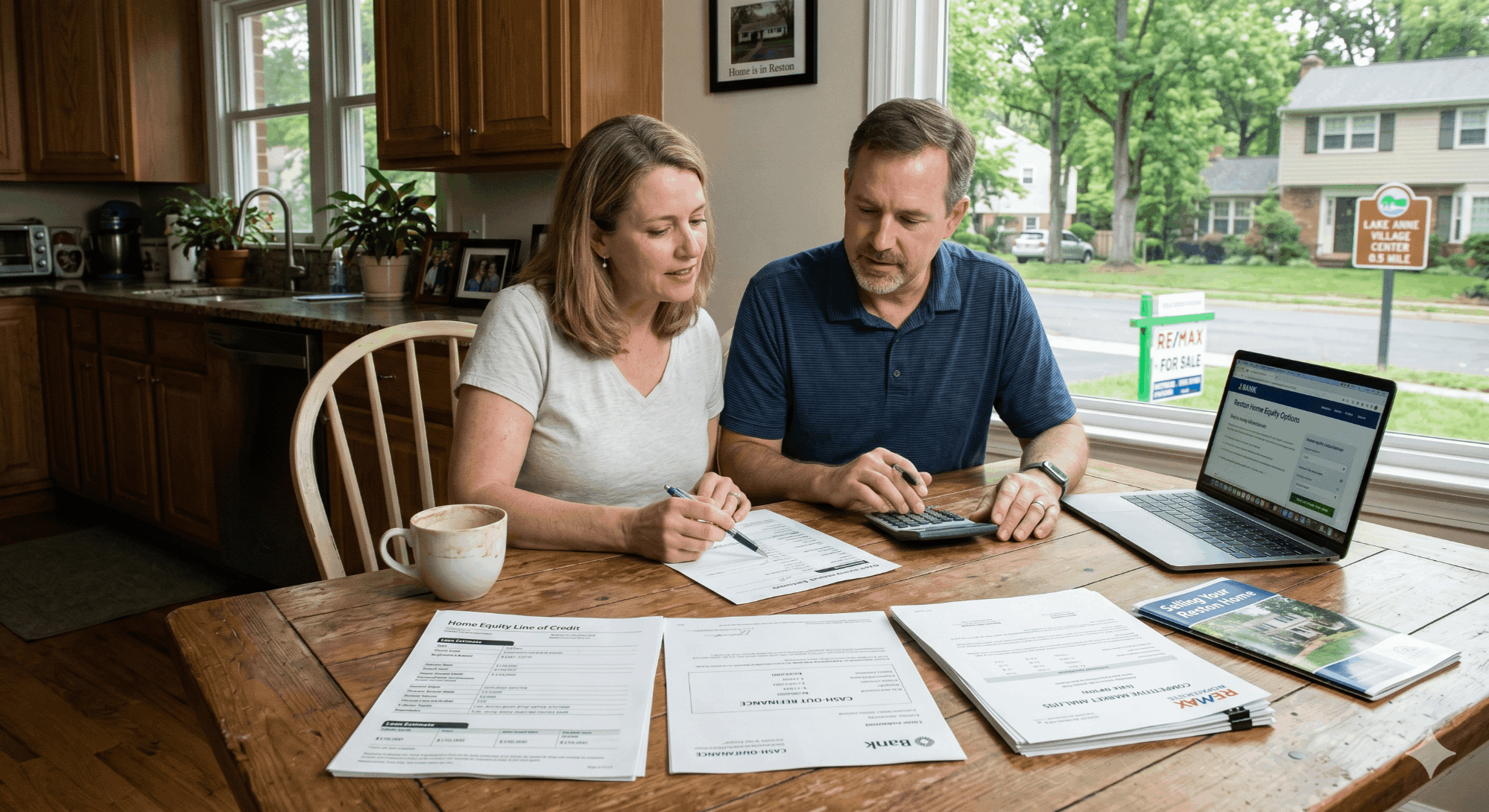
Quick Answer: Reston homeowners typically have three ways to tap home equity: a HELOC (flexible, variable-rate borrowing), a cash-out refinance (replaces your mortgage at a new rate), or selling outright (extracts 100% of equity minus closing costs). The best choice depends on how much cash you need, your current mortgage rate, your timeline, and whether you want to stay in Reston. The Jamil Brothers Realty Group offers a 1.5% full-service listing fee in Northern Virginia — on a typical $750K Reston home, that keeps roughly $11,250 more in your pocket than a traditional 3% listing agent.
Key Takeaways
- Reston home values have appreciated significantly since the Silver Line opened, leaving most long-term owners with substantial equity to consider tapping.
- HELOCs offer flexibility and low setup costs but use variable rates tied to prime — your payment can rise as rates change.
- Cash-out refinances replace your entire mortgage. If your current rate is below 5%, you'll likely give up a low rate to access cash — usually a poor trade.
- Selling unlocks 100% of your equity, qualifies for the Section 121 capital gains exclusion ($250K single / $500K married), and ends future mortgage exposure entirely.
- Cost to sell in Reston with a traditional 3% agent runs roughly 7–8% of the sale price; The Jamil Brothers' 1.5% full-service program brings that closer to 5.5–6%.
- The best decision is rarely about the "cheapest" option — it's about which one fits your timeline, tax situation, and life plans.
In This Guide
- How Much Equity Do Reston Homeowners Have?
- Option 1: HELOC (Home Equity Line of Credit)
- Option 2: Cash-Out Refinance
- Option 3: Sell Your Reston Home
- Side-by-Side Comparison
- The Tax Picture
- Reston Market Conditions
- Decision Framework
- The Cost of Selling in Reston
- How to Choose a Listing Agent
- Common Mistakes to Avoid
- Frequently Asked Questions
- Glossary
If you've owned a home in Reston for more than a few years, you're probably sitting on a significant amount of equity. Reston single-family homes that traded for $450,000 a decade ago often appraise above $850,000 today, and townhomes and condos near Wiehle-Reston East and Reston Town Center metro stations have followed similar trajectories. The question most Reston homeowners face isn't whether they have equity — it's how to access it without making a financial mistake they'll regret.
There are essentially three legitimate paths: borrow against the equity with a HELOC, refinance into a larger mortgage and pull cash out, or sell the home and walk away with the entire equity stake. Each option has very different costs, tax implications, and downstream consequences. This guide walks through all three with Reston-specific numbers, then gives you a decision framework based on your actual situation.
If selling is on the table — even as a backup — the cost structure of your listing agent matters more than anything else, because closing costs are the single largest deduction from your equity proceeds. We'll show you the math on that too.
How Much Equity Do Reston Homeowners Have?
Equity is simple math: current home value minus mortgage balance equals equity. The harder part is knowing your real current value — Reston's market has appreciated unevenly across neighborhoods, and automated estimates from Zillow or Redfin are often wide of the mark for unique properties.
A Typical Reston Equity Position
Consider a homeowner who bought a single-family home in North Point for $475,000 in 2015 with 20% down. Their starting mortgage was $380,000. Twelve years later, after principal paydown and Northern Virginia appreciation, their picture might look like this:
| Component | Amount |
|---|---|
| Original purchase price (2015) | $475,000 |
| Estimated current value (2026) | $875,000 |
| Remaining mortgage balance | $295,000 |
| Total equity | $580,000 |
| Borrowable equity at 80% LTV cap | $405,000 |
This is a real and common Reston scenario. The owner has $580,000 of equity — but lenders typically cap combined loan-to-value (CLTV) on equity products at 80–85% of appraised value. Subtract the existing mortgage balance, and the practical "borrowable" equity is around $405,000.
Get a Real Number, Not an Estimate
Before deciding which equity option fits, you need an accurate value. Automated valuation models miss neighborhood nuances — a North Point colonial doesn't trade like a Hunters Woods townhome, and a Reston Town Center condo prices differently than a Lake Anne bungalow. Pull a free, agent-prepared valuation from local Reston specialists using actual closed comps from BrightMLS — that's the only way to know your real equity position.
Get a personalized home valuation from The Jamil Brothers — street-level Reston comps from BrightMLS, not automated estimates. Response within 24 hours.
Option 1: HELOC (Home Equity Line of Credit)
A HELOC is a revolving line of credit secured by your home. You're approved for a maximum (often $50,000–$500,000 in the Reston market), then draw against it as needed during the draw period — usually 10 years. After that, you enter a 15- to 20-year repayment phase where you can no longer borrow and must pay the balance down.
How a HELOC Works in Practice
HELOC rates are variable. They're typically tied to the Wall Street Journal Prime Rate plus a margin set by your lender — so if prime is 7.5% and your margin is +1%, your rate is 8.5%. Importantly, that rate can change every month or quarter as prime moves. During the draw period, most HELOCs require interest-only payments, which keeps monthly costs low but means you're not building any new equity.
When a HELOC Makes Sense
A HELOC Is the Right Tool When...
- ✓ You need flexible access to capital but won't use the full amount immediately
- ✓ You're funding home improvements that will be paid back relatively quickly
- ✓ Your existing mortgage rate is well below current refi rates and you don't want to disturb it
- ✓ You plan to stay in Reston long-term and have stable income
- ✓ You can absorb a 1–2 percentage point rate increase without financial strain
HELOC Pros and Cons
| ✓ Pros | ✗ Cons |
|---|---|
| Low or no closing costs | Variable rate — payment can climb |
| Borrow only what you need, when you need it | Interest-only draws don't build equity |
| Existing first mortgage rate is preserved | Payment shock when repayment phase begins |
| Faster to close than a refi (often 30 days) | Adds a second lien on your home |
| Interest may be deductible if used for home improvements | Lender can freeze or reduce the line in market downturns |
Option 2: Cash-Out Refinance
A cash-out refinance replaces your current mortgage with a new, larger one. The difference between the two — minus closing costs — comes to you as cash at closing. If you have a $295,000 mortgage on an $875,000 Reston home and refinance to $700,000 (80% LTV), you'd pocket roughly $400,000 minus closing costs.
The Critical Question: Your Current Rate
This is the single most important variable. If you locked a 3% mortgage in 2020 or 2021, refinancing into a current-market rate near 6.5–7% would dramatically increase your monthly payment — potentially adding $1,500–$2,500 per month even on the same loan amount. Pulling cash out makes that worse.
⚠️ Watch Your Existing Rate
If your current mortgage rate is below 5%, a cash-out refinance is rarely a good financial move in today's environment. You'd give up a generationally low rate on your full loan balance to access equity. A HELOC or sale almost always works out better.
Closing Costs Are Real Money
Cash-out refinances carry full mortgage closing costs — typically 2–5% of the new loan amount. On a $700,000 refi, that's $14,000–$35,000 in lender fees, title work, appraisal, and recording charges. Those costs come out of your equity, reducing the actual cash you receive. By contrast, HELOCs often have minimal closing costs, and a home sale's costs are paid from sale proceeds rather than borrowed against future income.
Cash-Out Refi Pros and Cons
| ✓ Pros | ✗ Cons |
|---|---|
| Fixed rate possible (rate certainty) | High closing costs (2–5% of new loan) |
| Single mortgage payment, no second lien | Replaces your current rate at market rate |
| Can consolidate higher-interest debt | Resets your amortization clock |
| Larger lump sum than a HELOC typically allows | Increases monthly payment substantially |
| Predictable payment for budgeting | Locks in 30 more years of mortgage exposure |
Before deciding between borrowing and selling, run the math. Our seller net sheet calculator breaks down every cost — commission, transfer taxes, settlement — so you know your real proceeds before you list.
Option 3: Sell Your Reston Home
Selling is the only option that extracts 100% of your equity. There's no LTV cap, no second lien, no future payment obligation — just a one-time transaction that converts your home into cash. The trade-off, of course, is that you no longer own the home. For Reston homeowners ready to downsize, relocate, or simply unlock equity for retirement or investment, this is often the cleanest path.
What Selling Actually Yields
The cleanest way to think about a sale is "sale price minus all costs equals net to you." Costs in Reston typically include:
| Cost Category | Traditional 3% Agent | Jamil Brothers 1.5% |
|---|---|---|
| Listing agent fee | 3.0% | 1.5% |
| Buyer's agent (negotiable post-NAR) | 2.0–2.5% | 2.0–2.5% |
| Virginia grantor tax (state) | $1 per $1,000 | $1 per $1,000 |
| NOVA congestion improvement tax | ~0.15% | ~0.15% |
| Settlement & title fees | $1,500–$2,500 | $1,500–$2,500 |
| HOA / Reston Association docs | $300–$600 | $300–$600 |
| Approximate total cost | 7.0–7.5% | 5.5–6.0% |
On an $875,000 Reston sale, the difference between a 3% listing fee and a 1.5% listing fee is $13,125 in your pocket — full-service marketing, professional photography, drone video, 3D tours, and partner-led negotiation included on both. That's a meaningful chunk of equity preserved with no service tradeoff.
Sale Pros and Cons
| ✓ Pros | ✗ Cons |
|---|---|
| Extracts 100% of equity (no LTV cap) | You no longer own the home |
| No future mortgage obligation | Need to find next housing solution |
| Section 121 capital gains exclusion ($250K/$500K) | Closing costs come off the top |
| Cash to invest, retire on, or relocate with | Move logistics and emotional cost |
| Resets housing footprint to current life | Timing risk if market softens during listing period |
Side-by-Side Comparison: HELOC vs. Cash-Out Refi vs. Sale
Here's how the three options stack up across the dimensions that matter most. Numbers are illustrative — pull personal quotes for your situation before deciding.
| Factor | HELOC | Cash-Out Refi | Sale |
|---|---|---|---|
| Equity accessed | Up to 80–85% of value, minus 1st mortgage | Up to 80% of value, minus 1st mortgage | 100% of equity (minus closing costs) |
| Rate type | Variable (prime + margin) | Fixed (typically) | N/A — no debt |
| Setup costs | Low / often $0 | 2–5% of new loan | 5.5–7.5% of sale price |
| Time to access | ~30 days | 30–45 days | 60–90 days typical |
| Monthly impact | New interest-only payment | Replaces existing payment | Eliminated entirely |
| Future flexibility | High (revolving credit) | Low (locked into new mortgage) | Total (cash on hand) |
| Best for | Renovations, short-term needs, staying put | Large lump sum + low original rate | Downsizing, relocating, full equity |
Speed of Access (Funds in Hand)
True Cost of Capital (Lifetime)
This bar chart estimates the total cost over a typical 7-year holding period to access $200,000 of equity. Figures are illustrative and rates change.
The Tax Picture: How Each Option Affects Your Tax Bill
Tax treatment differs sharply across the three options, and for many Reston homeowners the tax angle is the deciding factor. The information below is general — confirm specifics with a CPA who knows your situation.
HELOC and Cash-Out Refi: Interest Deduction Limits
Under the Tax Cuts and Jobs Act (TCJA), interest on home equity debt is deductible only when the borrowed funds are used to "buy, build, or substantially improve" the home that secures the loan. If you HELOC against your Reston home to buy a vacation property, pay off student loans, or fund a business, that interest is no longer deductible. Same rule applies to cash-out refi proceeds above your original mortgage balance.
Sale: Section 121 Primary Residence Exclusion
This is the most powerful tax benefit available to homeowners. If you've owned and lived in your Reston home as your primary residence for at least two of the last five years, you can exclude up to $250,000 of capital gains as a single filer or up to $500,000 as a married couple filing jointly. For long-term Reston owners with significant appreciation, this exclusion can shelter most or all of the gain from federal tax.
ℹ️ Quick Section 121 Math
Bought your Reston home in 2010 for $475,000. Sold it in 2026 for $875,000. Your gain is $400,000. As a married couple filing jointly, you owe federal capital gains tax on $0 — the entire gain falls within the $500,000 exclusion. As a single filer, you'd owe long-term capital gains tax on $150,000 ($400K gain minus $250K exclusion).
Tax Treatment Summary
| Option | Interest Deductible? | Capital Gains Tax? |
|---|---|---|
| HELOC | Only if used for home improvements | No (not a sale) |
| Cash-Out Refi | Original balance: yes; cash-out portion: only if used for home improvements | No (not a sale) |
| Sale | N/A | Yes, but Section 121 excludes $250K single / $500K married |
Reston Market Conditions That Affect Your Decision
Reston's market continues to be one of the most resilient in Northern Virginia, supported by Silver Line metro access, the AWS and tech employer corridor along the Dulles Toll Road, and steady demand from buyers priced out of McLean and Vienna. If you're weighing a sale, current conditions matter — they determine how quickly your home moves and at what list-to-sale ratio.
Reston Market Snapshot
| Metric | Reston (recent) | What It Means |
|---|---|---|
| Median single-family price | $850K–$950K | Strong appreciation since Silver Line opening |
| Median townhome price | $575K–$700K | Strong demand near metro stations |
| Median condo price | $350K–$525K | Reston Town Center commands premium |
| Days on market (well-priced listings) | 15–35 days | Above-average velocity for NOVA |
| List-to-sale ratio | 98–101% | Multiple offers common in spring |
| Inventory level | ~1.2–1.8 months supply | Seller's market territory |
Source: BrightMLS Fairfax County data and NVAR market reports. Figures vary by neighborhood, season, and property type. Pull a custom valuation for your address before making decisions.
Why Reston Holds Value
Three factors explain Reston's continued strength: Silver Line metro proximity (Wiehle-Reston East and Reston Town Center stations cut commute times to D.C. dramatically), the Dulles Toll Road tech corridor (AWS, Microsoft, Bechtel, Verizon, and federal contractors all maintain large Reston-area operations), and the planned-community design that includes lakes, trails, and Reston Association amenities most other NOVA suburbs can't match. Even when the broader Northern Virginia market softens, Reston tends to outperform.
Decision Framework: Which Option Fits Your Situation
Match your situation to the option below for a fast directional answer. None of these are absolute rules — every situation has nuances — but they're a useful starting point.
Need under $100K, plan to stay in Reston long-term — Lean HELOC
A HELOC is usually the right tool. Low setup cost, flexible draws, and you preserve your existing first mortgage rate. Best for kitchen remodels, college tuition spread over years, or short-term liquidity needs.
Need $100K–$300K, current mortgage rate is high (above market) — Consider Cash-Out Refi
If your current rate is at or above today's market rate, a cash-out refi can lock in a fixed lump sum without sacrificing a low rate. Run the math against the closing costs carefully.
Want full equity, ready to downsize, relocate, or retire — Sell
Selling is the only path that hands you 100% of your equity with no future debt obligation. For empty-nesters, retirees, or anyone planning to leave Reston, this is usually the cleanest option financially and operationally.
Need certainty or speed, condition issues — Cash Offer
If timing matters more than maximum price, or if your home needs significant work that you don't want to manage, a cash offer can close in two to four weeks with no contingencies. Trade-off is roughly 5–15% below market value depending on condition.
Have a 3% mortgage rate and need cash — Almost certainly HELOC, not refi
Don't give up a 3% mortgage to access cash. The interest rate hit on your full balance dwarfs any benefit from the cash-out portion. HELOC the equity you need; keep the low rate intact.
If timing, condition, or certainty matters more than maximum price, a cash offer may be the right fit. We'll walk you through your full range of options — no pressure.
The Cost of Selling in Reston (Run the Real Numbers)
If selling is on your shortlist, the listing fee structure is the biggest controllable variable. Use the calculator below to see exactly what 1.5% versus 3% means for your Reston home value. The widget assumes a typical buyer's agent compensation of 2.5% (negotiable since the NAR settlement) and approximate 1% other closing costs — your actual numbers will vary by property.
Reston Seller Savings Calculator
How much more do you keep with our 1.5% listing fee?
Select your home's estimated value to see your real net proceeds — side by side.
Traditional Agent — 3%
| Sale price | $400,000 |
| Listing fee (3%) | −$12,000 |
| Buyer's agent (2.5%) | −$10,000 |
| Est. closing (1%) | −$4,000 |
| Net Proceeds | $374,000 |
Our Fee — Only 1.5%
| Sale price | $400,000 |
| Listing fee (1.5%) | −$6,000 |
| Buyer's agent (2.5%) | −$10,000 |
| Est. closing (1%) | −$4,000 |
| Net Proceeds | $380,000 |
vs. a traditional 3% listing agent — with zero reduction in service or marketing.
Traditional Agent — 3%
| Sale price | $500,000 |
| Listing fee (3%) | −$15,000 |
| Buyer's agent (2.5%) | −$12,500 |
| Est. closing (1%) | −$5,000 |
| Net Proceeds | $467,500 |
Our Fee — Only 1.5%
| Sale price | $500,000 |
| Listing fee (1.5%) | −$7,500 |
| Buyer's agent (2.5%) | −$12,500 |
| Est. closing (1%) | −$5,000 |
| Net Proceeds | $475,000 |
vs. a traditional 3% listing agent — with zero reduction in service or marketing.
Traditional Agent — 3%
| Sale price | $600,000 |
| Listing fee (3%) | −$18,000 |
| Buyer's agent (2.5%) | −$15,000 |
| Est. closing (1%) | −$6,000 |
| Net Proceeds | $561,000 |
Our Fee — Only 1.5%
| Sale price | $600,000 |
| Listing fee (1.5%) | −$9,000 |
| Buyer's agent (2.5%) | −$15,000 |
| Est. closing (1%) | −$6,000 |
| Net Proceeds | $570,000 |
vs. a traditional 3% listing agent — with zero reduction in service or marketing.
Traditional Agent — 3%
| Sale price | $750,000 |
| Listing fee (3%) | −$22,500 |
| Buyer's agent (2.5%) | −$18,750 |
| Est. closing (1%) | −$7,500 |
| Net Proceeds | $701,250 |
Our Fee — Only 1.5%
| Sale price | $750,000 |
| Listing fee (1.5%) | −$11,250 |
| Buyer's agent (2.5%) | −$18,750 |
| Est. closing (1%) | −$7,500 |
| Net Proceeds | $712,500 |
vs. a traditional 3% listing agent — with zero reduction in service or marketing.
Traditional Agent — 3%
| Sale price | $1,000,000 |
| Listing fee (3%) | −$30,000 |
| Buyer's agent (2.5%) | −$25,000 |
| Est. closing (1%) | −$10,000 |
| Net Proceeds | $935,000 |
Our Fee — Only 1.5%
| Sale price | $1,000,000 |
| Listing fee (1.5%) | −$15,000 |
| Buyer's agent (2.5%) | −$25,000 |
| Est. closing (1%) | −$10,000 |
| Net Proceeds | $950,000 |
vs. a traditional 3% listing agent — with zero reduction in service or marketing.
Estimates only. Closing costs vary. Buyer's agent commission is negotiable.
| 500+ Five-Star Reviews · Top 1% Nationwide · 840+ Homes Sold | TheJamilBrothers.com · (703) 782-4830 |
4K photography, drone video, 3D tours, expert negotiation, and full MLS marketing — all included at 1.5%. No hidden fees, no service reductions, no surprises.
How to Choose a Listing Agent in Reston
If you decide selling is the right path, the agent you choose has more impact on your net proceeds than any other variable. Reston is a sophisticated market with knowledgeable buyers, planned-community nuances (Reston Association documents, design covenants), and price sensitivity to metro proximity. Use the criteria below to vet candidates.
Listing Agent Vetting Checklist
- ✓ Verified track record in Reston specifically — not just Northern Virginia generally
- ✓ Recent closed comps for your sub-area (North Point, Hunters Woods, South Lakes, RTC)
- ✓ Marketing package: 4K photography, drone, 3D Matterport tour, video
- ✓ Transparent fee disclosure — no buried admin fees or transaction charges
- ✓ Verifiable client reviews (Google, Zillow, Realtor.com — not just curated testimonials)
- ✓ Direct access to the lead agents during listing — not handed off to junior staff
- ✓ Pre-listing prep guidance + vendor coordination for Reston-area inspections
The Jamil Brothers Realty Group has sold 840+ homes across Northern Virginia, hold NVAR Lifetime Top Producer status, and operate the 1.5% full-service listing program across VA, MD, DC, and WV. If you want to see whether your home is a fit, browse Reston-area resources and current listings or schedule a no-obligation consultation.
Common Mistakes to Avoid
The same handful of mistakes show up over and over with Reston homeowners weighing equity options. Here's what to watch for.
1. Refinancing Out of a Sub-5% Mortgage
This is the most expensive single mistake. Borrowers who locked 3% mortgages in 2020 and 2021 sometimes refinance into 7% rates to access cash. The interest cost over the life of the loan typically dwarfs the cash extracted. If you have a low rate and need cash, a HELOC almost always preserves more of your wealth than a refi.
2. Underestimating Closing Costs on a Sale
Sellers often anchor on the 3% (or 1.5%) listing fee and forget about buyer's agent compensation, Virginia grantor tax, NOVA congestion improvement tax, settlement fees, HOA documents, and Reston Association resale packets. Total cost is closer to 5.5–7.5% on a typical sale. Run a real net sheet before assuming a sale price translates directly to your account balance.
3. Treating a HELOC as Free Money
Interest-only payments during the draw period feel cheap, but the principal still has to be repaid — usually with a payment that's three to four times higher when the repayment phase begins. Plan ahead for that transition or you'll face payment shock 10 years out.
4. Overpricing a Reston Listing
Reston buyers are well-informed and watching listings closely. A home priced 5–8% above market typically sits unsold for weeks, then sells below comparable correctly priced homes after price reductions. Pricing strategy in the first 14 days drives final outcome more than any other variable.
5. Ignoring the Section 121 Window
If you're considering a sale and haven't lived in the home as your primary residence for at least two of the last five years, you may be giving up the entire $250K/$500K capital gains exclusion. Time the sale carefully — sometimes waiting a few months changes a six-figure tax bill.
Whether you're leaning toward HELOC, refi, or sale — know exactly what each option nets. Our seller net sheet shows your real bottom line in minutes.
Frequently Asked Questions
How much equity can I borrow against my Reston home?
Most lenders cap combined loan-to-value (CLTV) at 80–85% of your home's appraised value. On an $875,000 Reston home with a $295,000 mortgage, that means roughly $400,000–$450,000 of borrowable equity through a HELOC or cash-out refinance. Selling the home extracts 100% of equity (minus closing costs) since there's no LTV cap on a sale transaction.
Should I get a HELOC or sell my Reston home?
It depends on three things: how much cash you need, your timeline, and whether you want to stay in the home. If you need under $150,000, plan to remain in Reston long-term, and have a low first mortgage rate to protect, a HELOC usually wins. If you want full equity, are ready to downsize or relocate, or want to eliminate housing debt entirely, selling is typically the cleaner path. Borrowing keeps your housing cost ongoing; selling resets it entirely.
Is it better to do a HELOC or cash-out refinance in Reston?
If you have a mortgage rate below current market (most Reston owners who bought before 2022), a HELOC is usually the better choice. You preserve your low first-mortgage rate and only pay interest on the equity you actually draw. A cash-out refinance forces you to refinance your full balance at today's rate — that hidden cost almost always outweighs the benefits unless your existing rate is already at or above market. HELOCs also have lower closing costs (often $0).
How much does it cost to sell a home in Reston?
Total cost typically runs 5.5–7.5% of the sale price, depending on your listing fee structure. With a traditional 3% listing agent, expect 7.0–7.5% all-in (3% listing + 2.0–2.5% buyer's agent + 0.15% Virginia grantor tax + ~0.15% NOVA congestion tax + ~$2,000–$3,500 in settlement, title, HOA, and Reston Association documents). With The Jamil Brothers' 1.5% full-service program, all-in cost is closer to 5.5–6.0%, preserving an additional $11,000–$15,000 of equity on a typical Reston home.
What is the Section 121 capital gains exclusion?
Section 121 of the Internal Revenue Code lets you exclude up to $250,000 of capital gains as a single filer (or $500,000 married filing jointly) when you sell a primary residence. To qualify, you must have owned the home and used it as your primary residence for at least two of the last five years. For long-term Reston owners with significant appreciation, this exclusion often shelters the entire gain from federal tax. Consult a CPA before closing to confirm eligibility.
How long does it take to access cash from each option?
A HELOC typically funds in about 30 days from application. A cash-out refinance takes 30–45 days. A traditional listed home sale runs 60–90 days from list to closing — roughly 15–35 days on market plus a 30–45 day escrow period. A direct cash offer can close in 14–30 days but typically nets 5–15% less than a market sale.
How do I choose a listing agent in Reston?
Look for verified Reston-specific track record (not just NOVA), recent closed comparable sales in your sub-area, transparent fee disclosure with no buried admin charges, a complete marketing package (4K photography, drone, 3D tour, video), verifiable third-party reviews on Google/Zillow/Realtor.com, and direct access to the lead agents — not a handoff to junior staff. The Jamil Brothers Realty Group meets these criteria, with NVAR Lifetime Top Producer status, 500+ five-star reviews, and a 1.5% full-service listing program.
Are buyer's agent fees still required after the NAR settlement?
No. Following the National Association of Realtors settlement (effective August 2024), buyer's agent compensation is fully negotiable and no longer embedded by default in the listing commission. Sellers can choose to offer concessions to attract buyer's agents, decline to offer compensation entirely, or negotiate the amount on a case-by-case basis. Most sellers in competitive Reston neighborhoods still offer something to maximize buyer interest, but the structure has changed.
What HOA or Reston Association costs apply when I sell?
Most Reston properties are members of the Reston Association (RA), which requires resale disclosure documents and a transfer fee at closing. Document packets typically run $200–$400. Any sub-association (such as a cluster, condo, or townhome HOA) will have its own documents and transfer fees, often $300–$500. Outstanding assessments are paid current at closing. Order packets early — they take 14–21 days to produce and are required for buyers to receive their three-day Virginia condo/HOA review period.
Is the Reston market still favoring sellers?
Yes, generally. Reston continues to operate at roughly 1.2–1.8 months of inventory — well below the six-month threshold that defines a balanced market. Well-priced single-family homes typically receive offers within 15–35 days, and list-to-sale ratios run 98–101%. Demand drivers include Silver Line metro access, the Dulles Toll Road tech employer corridor, and Reston's planned-community amenities. Conditions vary by season and price point — pull current data for your specific neighborhood and home type before assuming.
What's the biggest mistake Reston homeowners make when tapping equity?
Refinancing out of a sub-5% mortgage to access cash. The interest cost on the full loan balance over the remaining 25–30 years almost always exceeds whatever the cash-out portion is worth — sometimes by hundreds of thousands of dollars. If you have a generationally low rate, protect it with a HELOC for borrowing or a sale to extract full equity. A cash-out refi makes sense primarily when your existing rate is already at or above current market.
Can I get a cash offer on my Reston home if it needs work?
Yes. Cash buyers typically purchase homes in any condition without requiring repairs, inspections, or financing contingencies. The trade-off is the offer price — usually 5–15% below current market value depending on condition and timeline. For Reston homeowners facing inherited property, deferred maintenance, divorce, or relocation deadlines, a cash offer can be the right fit. The Jamil Brothers can present both a cash offer and a market-listing analysis side by side, so you can compare net proceeds before deciding.
Glossary
HELOC
Home Equity Line of Credit. A revolving credit line secured by your home, typically with a variable interest rate tied to prime.
Cash-Out Refinance
A new mortgage that replaces your existing one for a larger amount; the difference is paid to you in cash at closing.
Loan-to-Value (LTV)
The ratio of loan balance to home value. Lenders typically cap equity products at 80–85% LTV.
Combined LTV (CLTV)
Total of all liens (first mortgage + HELOC + any other home loans) divided by appraised value.
Draw Period
The first 5–10 years of a HELOC during which you can borrow against the line; typically requires interest-only payments.
Repayment Period
The phase after the draw period (typically 15–20 years) when no new draws are allowed and full principal + interest payments begin.
Section 121 Exclusion
IRS provision allowing $250K (single) or $500K (married) of capital gains to be excluded when selling a primary residence.
Grantor Tax
Virginia state transfer tax of $1 per $1,000 of sale price, paid by the seller at closing.
NOVA Congestion Tax
Additional regional transfer tax of approximately 0.15% on real estate transfers in Northern Virginia jurisdictions.
Reston Association Documents
Required disclosure packet from the Reston Association (RA) provided to buyers at contract; takes 14–21 days to produce.
Putting It All Together
Reston homeowners are sitting on substantial wealth thanks to a decade-plus of strong appreciation — but knowing it's there isn't the same as knowing how to access it without making a costly mistake. The right answer depends on how much you need, how long you plan to stay, what your existing mortgage rate looks like, and whether your goal is short-term liquidity or full equity extraction.
If you're considering a sale, the cost structure of your listing agent has the largest single impact on your net proceeds. The Jamil Brothers' 1.5% full-service listing program preserves an additional $11,000–$15,000 in equity on a typical Reston home compared to a 3% traditional fee — with no reduction in marketing, photography, or negotiation support. Run a personalized seller net sheet or pull a free home valuation to see exactly where you stand.
And if you're not sure whether to borrow or sell at all, that's okay — most Reston homeowners benefit from a no-pressure conversation that compares the actual numbers side by side before making a six-figure decision.
Know your equity, understand your costs, and see exactly what you'd walk away with if you sold — before you decide between HELOC, refi, or sale. The Jamil Brothers provide a full seller consultation at no cost or obligation.
Questions? Call The Jamil Brothers Realty Group at (703) 782-4830 or visit thejamilbrothers.com. Licensed in VA, MD, DC, and WV. Samson Properties.
Explore More
Browse Every Corner of the DMV Market
Whether you're searching by budget, neighborhood, or buying situation — find exactly what you need below.
Virginia Homes by Budget
Washington DC Homes by Budget
Maryland Homes
Explore Northern Virginia Communities
Loudoun County
Fairfax County & Surrounding
Ready to Make a Move?
Full-Service · No Tradeoffs
List for 1.5% & Keep More Equity
Professional photography, drone video, 3D tours, and expert negotiation — all included. On an $800K home, that's $12,000 more in your pocket vs. a 3% agent.
See the 1.5% Program →Need Speed or Certainty?
Get a No-Obligation Cash Offer
Skip the showings, skip the contingencies. If timing or condition matters more than top dollar, a cash offer may be the right fit. We'll walk you through every option.
Explore Cash Offers →
Categories
- All Blogs (1237)
- Buyer Guide (7)
- Buying a home (2)
- Buying Strategies (30)
- festivals (1)
- General Blog (66)
- Market Intelligence (28)
- Market Updates (7)
- Notable Properties For Sale (32)
- Real Estate Tips, News, and More (396)
- Seller Guide (1)
- Seller Guides (58)
- Selling Your Home (525)
- Top Realtors in Northern Virginia (58)
Recent Posts







Let's Connect