
Downsizing in Ashburn: Selling a Larger Home to Move to Something Smaller
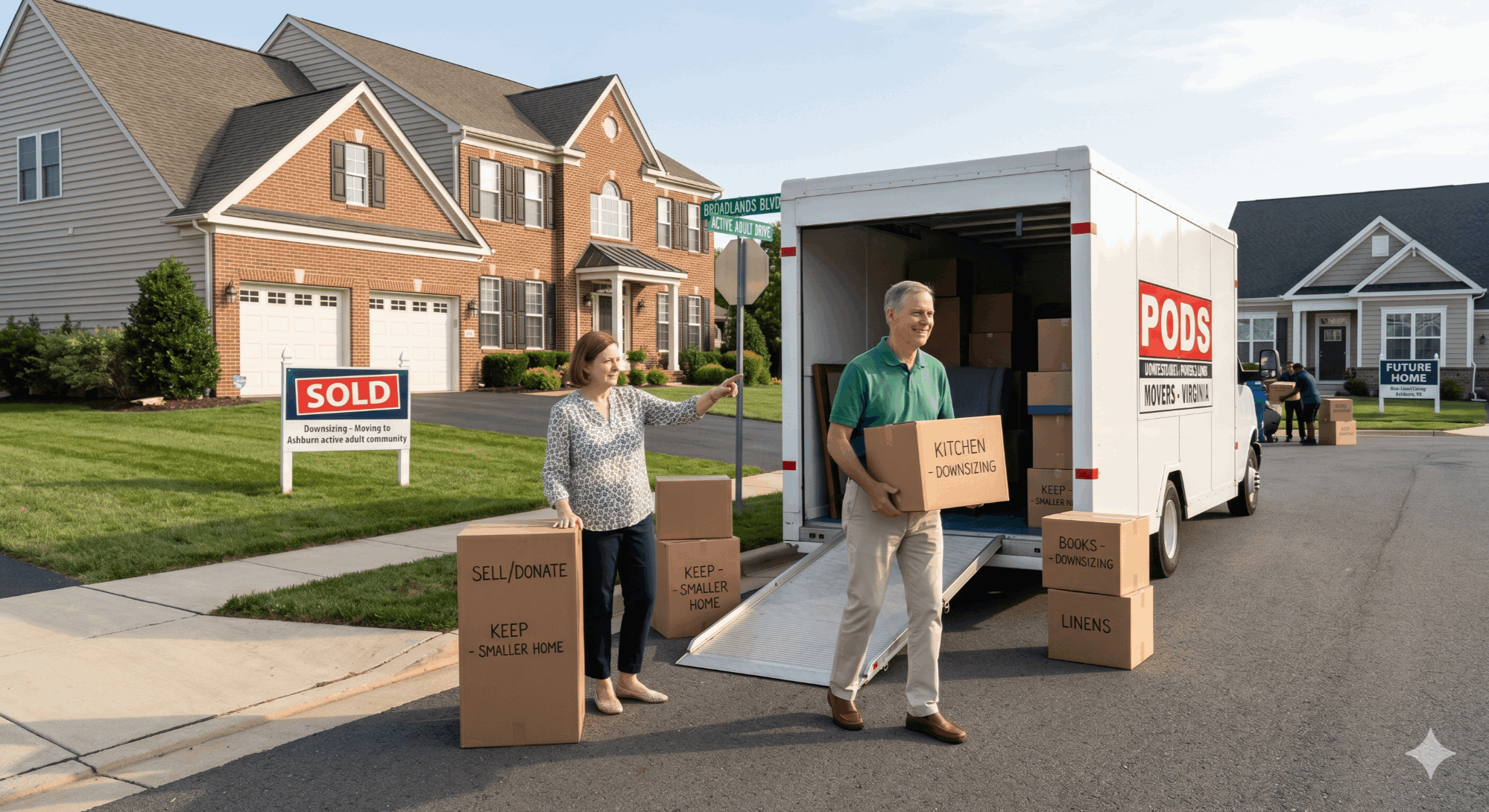
Quick Answer: Most Ashburn downsizers sit on $400K–$700K of equity in a 4–5 bedroom home built between 1995 and 2010. The cleanest path is to (1) get an accurate, comp-based valuation, (2) line up a contingent or bridge plan for your smaller home, (3) prep cosmetically before listing, and (4) work with an agent who can negotiate a flexible rent-back so you don't move twice. With a 1.5% full-service listing fee, downsizers typically keep $11,000–$22,000 more equity to redeploy into the next home — without giving up marketing, photography, or negotiation.
Key Takeaways
- Ashburn's median single-family price sits in the high-$800K to low-$900K range, with larger 4–5 bedroom homes in Ashburn Farm, Belmont Country Club, and Brambleton routinely closing $950K–$1.4M.
- Downsizers face a unique squeeze: more equity, more decades of belongings, and the need to time two transactions in a tight inventory market.
- Capital gains exclusion ($250K single / $500K married) shelters most downsizers — but homes purchased in the 1990s in Ashburn can exceed it.
- The 1.5% full-service listing fee preserves marketing quality (drone, 3D tour, MLS syndication) while keeping more equity for the next chapter.
- A negotiated rent-back of 30–60 days is often the difference between a clean downsize and a stressful double-move.
- Loudoun County HOA resale packets and disclosure requirements add 14–21 days that downsizers must build into their timeline.
In This Guide
- Why Ashburn Homeowners Are Downsizing in 2026
- The Ashburn Market — What Larger Homes Are Selling For
- The Downsizer's Math — Equity, Costs, and What You Keep
- Where Ashburn Downsizers Are Moving To
- Calculate Your Net Proceeds
- Pricing Your Larger Home in Ashburn
- Pre-Listing Prep When You've Lived There 15+ Years
- Timing Your Sale and Your Next Purchase
- Tax Considerations for Downsizers
- HOA Transfer & Documentation in Loudoun County
- Common Downsizer Mistakes
- Working With a Downsizer-Friendly Agent
- Frequently Asked Questions
- Glossary
Downsizing is more than a real estate decision. For many Ashburn homeowners, selling a four- or five-bedroom property means leaving the place where children grew up, holidays were celebrated, and years of memories were made. The financial details matter, but so do the emotional and practical challenges of sorting belongings, choosing what comes next, and deciding when the time is right.
A successful downsizing plan should answer several connected questions: What is your current home worth? How much equity could remain after selling costs? Should you sell before buying, buy first, or coordinate both closings? And will a smaller home actually reduce your monthly expenses once HOA fees, property taxes, maintenance, and possible renovations are considered?
This guide is designed for homeowners navigating the Ashburn real estate. It explains how to evaluate your larger home, prepare it without overspending, protect more of your equity, and coordinate the sale with your next purchase. Begin with a professional home valuation, then develop a transition plan based on your timeline, finances, and preferred lifestyle.
The Jamil Brothers Realty Group helps homeowners downsize throughout the broader Northern Virginia real estate, providing guidance through preparation, pricing, negotiations, closing, and the move into a more manageable home.
Why Ashburn Homeowners Are Downsizing in 2026
Ashburn was largely built in two waves: the original Ashburn Farm and Ashburn Village communities of the late 1980s through the 1990s, and the Brambleton, Belmont Country Club, and Loudoun Valley expansions of the 2000s and 2010s. The first-wave buyers — many of whom raised families in 3,500–4,500 sq ft colonials — are now 60–75 years old. The second-wave buyers are increasingly empty-nesters in their early-to-mid 50s.
That demographic shift is driving a steady downsizing flow that goes far beyond retirement. Common triggers we see in Ashburn:
| Downsizing Trigger | Typical Profile | Timeline Pressure |
|---|---|---|
| Empty nest after last child | Ages 55–65, 2,500+ sq ft of unused space | Low — flexible 6–12 months |
| Maintenance fatigue | HOA-tired homeowners with aging mechanicals | Medium — within 6 months |
| Stairs / mobility concerns | Single-level living becomes a priority | Medium-High — 3–6 months |
| Spouse loss | Surviving spouse, often with stepped-up basis | Variable — 6–18 months |
| Equity unlock for retirement | $500K+ equity, looking to fund retirement income | Low — strategic timing |
| Relocation to be near family | Out-of-state move, often coastal or southern | High — 60–90 days |
| 55+ community move | Targeting Heritage Hunt, Birchwood, or Two Rivers | Medium — ties to new build delivery |
Each of these scenarios has different optimization priorities. A surviving spouse with a stepped-up basis has very different tax treatment than a long-married couple selling their primary residence after 28 years. A homeowner targeting a 55+ new build needs sale timing aligned with construction delivery dates. There is no one-size-fits-all downsizer playbook, which is why the cookie-cutter "how to sell your house" guides fall short here.
The Ashburn Market — What Larger Homes Are Selling For
Ashburn (ZIP codes 20147 and 20148) remains one of the strongest residential submarkets in Loudoun County. For larger downsizer-profile homes — typically 4–5 bedrooms, 2,800–4,800 sq ft, on lots of 0.15–0.45 acres — recent BrightMLS data shows the following ranges by community:
| Community | Typical Larger-Home Range | Median Days on Market | Notable Buyer Profile |
|---|---|---|---|
| Ashburn Farm | $825K – $1.05M | 12–18 days | Move-up families from townhomes |
| Ashburn Village | $725K – $925K | 10–16 days | Amenity-driven, mid-career professionals |
| Brambleton | $950K – $1.4M | 8–14 days | Tech relocations, dual-income families |
| Belmont Country Club | $1.05M – $1.85M | 14–28 days | Executives, retirees moving up to luxury |
| Loudoun Valley Estates | $925K – $1.25M | 10–18 days | Trade-up families, schools-driven |
| Broadlands | $875K – $1.15M | 12–20 days | Lifestyle buyers, nature trail emphasis |
Ranges represent the typical 4–5 bedroom downsizer-profile home and are illustrative — actual values depend on lot, condition, finishes, and recent comp activity. For a precise, comp-driven figure on your specific home, request a free home valuation rather than relying on automated estimates, which routinely miss Loudoun County micro-market nuances by 4–8%.
How Larger Ashburn Homes Compare on Demand
Buyer demand in 2026 is bifurcated: the strongest demand is still for the $700K–$1.1M range, where dual-income families relocating to Ashburn for tech and government roles are actively shopping. The $1.2M+ tier moves more slowly but with less competition — meaning sellers there benefit more from disciplined pricing and longer-marketing patience.
Relative buyer demand by Ashburn larger-home price tier
Get a personalized, comp-based valuation from The Jamil Brothers — street-level analysis of recent Ashburn closings in your community, not an automated guess. Response within 24 hours.
The Downsizer's Math — Equity, Costs, and What You Keep
The single biggest financial question for any Ashburn downsizer is: what do I actually walk away with? Not the sale price, not the gross equity — the real, after-everything number that funds the next purchase, the next chapter, or both.
Here is a representative example for an Ashburn Farm homeowner who bought in 2003 for $385,000 and is selling in 2026 for $925,000:
| Line Item | Traditional 3% Listing | Jamil Brothers 1.5% |
|---|---|---|
| Sale price | $925,000 | $925,000 |
| Listing fee | −$27,750 | −$13,875 |
| Buyer's agent commission (negotiable post-NAR) | −$23,125 | −$23,125 |
| VA grantor tax (~$1/$1,000) | −$925 | −$925 |
| NOVA regional congestion tax | −$1,388 | −$1,388 |
| Settlement / title fees | −$1,800 | −$1,800 |
| HOA resale packet & transfer (Ashburn Farm) | −$425 | −$425 |
| Mortgage payoff (estimate) | −$210,000 | −$210,000 |
| Net to seller | $659,587 | $673,462 |
| Difference kept by seller | +$13,875 with the 1.5% program | |
That $13,875 isn't theoretical. For a downsizer, it's a meaningful chunk of the down payment on a smaller home, the cost of the actual move, or the buffer for unexpected expenses in transition. Run a personalized seller net sheet to see your exact figures based on your sale price, mortgage payoff, and community.
Where Ashburn Downsizers Are Moving To
The "where to next" question is half the puzzle. Some downsizers stay in Ashburn — many trade a four-bedroom colonial for a two-bedroom condo or a low-maintenance townhouse a few miles away. Others target purpose-built 55+ communities in nearby jurisdictions. And a meaningful number leave Northern Virginia entirely.
Staying Local — Ashburn & Loudoun County
Local downsize options that work well for Ashburn sellers who want to keep their network, doctors, restaurants, and grandkid proximity:
Strong Loudoun-area downsize options
- ✓ One Loudoun condos & flats — walkable, restaurants, low-maintenance, $475K–$725K
- ✓ Brambleton townhomes — two-level living with first-floor primary options, $625K–$825K
- ✓ Lansdowne villas & patio homes — golf-adjacent, single-level, $675K–$975K
- ✓ Birchwood at Brambleton (55+) — active adult community with full amenities, $625K–$925K
- ✓ Leesburg historic district condos & smaller singles — walkable, characterful, $425K–$725K
- ✓ Sterling 55+ condos — closer to DC commute, lower price point, $375K–$575K
Leaving Loudoun
If you're considering further afield: Heritage Hunt in Gainesville (Prince William County, 55+) and Two Rivers in Anne Arundel County (Maryland) are popular destinations. Out-of-state, the Carolinas (especially the Research Triangle, Charleston, and Wilmington), Florida's Gulf Coast, and Tennessee see the most NOVA-to-elsewhere moves. Each comes with its own tax, climate, and family-proximity tradeoffs that need to be weighed early — ideally before listing your Ashburn home.
If you want to see what's currently active in Ashburn or nearby Loudoun County for your downsize purchase, browse Ashburn community listings here or view current Northern Virginia inventory.
Calculate Your Downsizer Net Proceeds
Select the sale price closest to your home's value to see what you'd actually keep — comparing a traditional 3% listing fee to the 1.5% full-service program. The calculator includes the buyer's agent commission (negotiable post-NAR settlement) and an estimated 1% for closing costs.
Seller Savings Calculator
How much more do you keep with our 1.5% listing fee?
Select your home's estimated value to see your real net proceeds — side by side.
Traditional Agent — 3%
| Sale price | $500,000 |
| Listing fee (3%) | −$15,000 |
| Buyer's agent (2.5%) | −$12,500 |
| Est. closing (1%) | −$5,000 |
| Net Proceeds | $467,500 |
Our Fee — Only 1.5%
| Sale price | $500,000 |
| Listing fee (1.5%) | −$7,500 |
| Buyer's agent (2.5%) | −$12,500 |
| Est. closing (1%) | −$5,000 |
| Net Proceeds | $475,000 |
Traditional Agent — 3%
| Sale price | $750,000 |
| Listing fee (3%) | −$22,500 |
| Buyer's agent (2.5%) | −$18,750 |
| Est. closing (1%) | −$7,500 |
| Net Proceeds | $701,250 |
Our Fee — Only 1.5%
| Sale price | $750,000 |
| Listing fee (1.5%) | −$11,250 |
| Buyer's agent (2.5%) | −$18,750 |
| Est. closing (1%) | −$7,500 |
| Net Proceeds | $712,500 |
Traditional Agent — 3%
| Sale price | $900,000 |
| Listing fee (3%) | −$27,000 |
| Buyer's agent (2.5%) | −$22,500 |
| Est. closing (1%) | −$9,000 |
| Net Proceeds | $841,500 |
Our Fee — Only 1.5%
| Sale price | $900,000 |
| Listing fee (1.5%) | −$13,500 |
| Buyer's agent (2.5%) | −$22,500 |
| Est. closing (1%) | −$9,000 |
| Net Proceeds | $855,000 |
Traditional Agent — 3%
| Sale price | $1,100,000 |
| Listing fee (3%) | −$33,000 |
| Buyer's agent (2.5%) | −$27,500 |
| Est. closing (1%) | −$11,000 |
| Net Proceeds | $1,028,500 |
Our Fee — Only 1.5%
| Sale price | $1,100,000 |
| Listing fee (1.5%) | −$16,500 |
| Buyer's agent (2.5%) | −$27,500 |
| Est. closing (1%) | −$11,000 |
| Net Proceeds | $1,045,000 |
Traditional Agent — 3%
| Sale price | $1,500,000 |
| Listing fee (3%) | −$45,000 |
| Buyer's agent (2.5%) | −$37,500 |
| Est. closing (1%) | −$15,000 |
| Net Proceeds | $1,402,500 |
Our Fee — Only 1.5%
| Sale price | $1,500,000 |
| Listing fee (1.5%) | −$22,500 |
| Buyer's agent (2.5%) | −$37,500 |
| Est. closing (1%) | −$15,000 |
| Net Proceeds | $1,425,000 |
Estimates only. Closing costs vary. Buyer's agent commission is negotiable post-NAR settlement.
| 500+ Five-Star Reviews · Top 1% Nationwide · 840+ Homes Sold | TheJamilBrothers.com · (703) 782-4830 |
Pricing Your Larger Home in Ashburn
Larger Ashburn homes price differently than starter homes or townhomes. Buyers in this segment are more discerning, more comp-aware, and more likely to walk away from an aspirationally priced listing. Underpricing also costs you — but the path to a competitive bidding situation is narrower than for a $550K townhouse.
Three Pricing Strategies for Downsizer Homes
| Strategy | When It Works | Risk |
|---|---|---|
| Aggressive (1–3% below comps) | Spring market, updated home, 4-bedroom in hot tier | Low — typically generates multiple offers |
| Market price (at comps) | Most common; clean condition, average updates | Low — predictable 14–30 day sale |
| Aspirational (1–4% above comps) | Truly unique features, fully renovated, low inventory | High — often requires price reductions and re-listing |
For larger Ashburn downsizer homes, the market-price strategy outperforms in 7 of 10 cases. The aspirational price tends to backfire because buyers in the $900K+ range almost always have an experienced buyer's agent running detailed comp analyses — and overpricing creates a stigma that lingers even after reductions.
What Affects Pricing for Larger Homes Specifically
Relative price impact for larger Ashburn homes
Pre-Listing Prep When You've Lived There 15+ Years
This is where downsizing diverges most sharply from a typical sale. Long-tenured homeowners face a layered project: emotional decluttering, deferred-maintenance triage, light cosmetic updates, and the staging-vs-as-is decision. Skipping or rushing any of these costs real money at the closing table.
The Downsizer's Pre-Listing Checklist
Phase 1 — 8 to 12 weeks before listing
- ✓ Begin sorting belongings into keep / donate / family / discard piles, room by room
- ✓ Schedule a pre-listing walk-through with your agent for a candid prep punch list
- ✓ Get HVAC, water heater, and major systems inspected — fix anything mid-failure
- ✓ Address obvious deferred maintenance: caulking, grout, exterior touch-up
- ✓ Order an HOA resale packet (Loudoun County HOAs require 14–21 days)
Phase 2 — 4 to 6 weeks before listing
- ✓ Fresh neutral paint in main living areas (single highest-ROI cosmetic update)
- ✓ Remove 50–60% of furniture; rooms photograph dramatically larger when minimally staged
- ✓ Pack and store family photos, religious items, and personalization
- ✓ Replace dated light fixtures (chandeliers from 1995–2005 era are common drag points)
- ✓ Power wash siding, deck, and driveway; refresh landscaping mulch
Phase 3 — Final 2 weeks before listing
- ✓ Deep clean — including baseboards, vents, inside cabinets, oven, fridge
- ✓ Light staging with selected pieces (rented or borrowed) for living, primary bedroom, and dining
- ✓ Professional photography, 3D Matterport tour, and drone (included in 1.5% program)
- ✓ Signed listing agreement, MLS preparation, marketing assets ready for go-live
4K photography, drone video, 3D Matterport tour, expert negotiation, and full MLS marketing — all included at 1.5%. For Ashburn downsizers, that often means $13,000–$22,000 more in your pocket compared to a traditional 3% listing agent.
Timing Your Sale and Your Next Purchase
This is the question downsizers ask earliest and worry about longest: do I sell first, or buy first? Both have merit. The right answer depends on your equity position, financing, target market for the next home, and personal tolerance for transition friction.
Sell First vs. Buy First — Pros and Cons
| ✓ Sell First | ✗ Risks |
|---|---|
| Maximum equity certainty before next purchase | Need rent-back or temporary housing |
| Strongest negotiating position for next home (non-contingent buyer) | Inventory pressure if local market is tight |
| Cleaner financing — no carrying two mortgages | Possible double move if rent-back falls through |
| ✓ Buy First | ✗ Risks |
|---|---|
| No transitional housing scramble; one move only | Bridge loan or HELOC required for down payment |
| Time to fully tour and select your next home | Carrying costs of two homes if first sale lags |
| Avoid time pressure that forces compromise | Less leverage on offers (sale-of-home contingency) |
The Rent-Back — A Downsizer's Best Tool
For most Ashburn downsizers we work with, the optimal solution is a negotiated post-settlement occupancy agreement — commonly called a rent-back. It lets you sell, lock in equity, and then stay in your home for 30–60 days while you close on the smaller home or finalize move-out logistics.
In a balanced market, asking for a rent-back is routine. In Ashburn's current environment, where buyer demand for the $700K–$1.1M tier remains high, sellers can often negotiate 30–60 days of free occupancy as part of the offer. We've negotiated up to 90 days for downsizers when the buyer needed time before move-in anyway.
ℹ️ Rent-back tip
Negotiate the rent-back as part of the offer review, not as an afterthought. Buyers who want your home will accept a 30–45 day rent-back almost without question if it's framed as part of the deal from day one — but adding it post-acceptance is much harder.
If You Need Maximum Speed or Certainty
For downsizers facing a hard timeline — out-of-state job relocation, family caregiving, an estate situation, or a 55+ new build delivery date — speed matters more than the absolute top-of-market price. In those cases, a cash offer alongside a traditional listing strategy gives you optionality. Explore your cash offer options here — we present both side by side so you can decide which serves your priorities.
Tax Considerations for Downsizers
This is where downsizers often overlook real money. The federal capital gains exclusion under IRC Section 121 lets you exclude up to $250,000 of gain if filing single or $500,000 if filing married jointly, provided you've owned and lived in the home as your primary residence for at least 2 of the last 5 years.
That sounds generous — and for many homeowners it is. But Ashburn long-tenure owners can hit it. A couple who bought in 1998 for $325,000 and is selling in 2026 for $935,000 has a $610,000 gross gain. After the $500K exclusion, $110,000 of gain is potentially taxable at long-term capital gains rates (typically 15% federal, plus Virginia state).
What Actually Reduces Your Taxable Gain
Things that increase your cost basis (and reduce taxable gain)
- ✓ Original purchase price + closing costs paid at acquisition
- ✓ Capital improvements: kitchen remodels, bathroom additions, roof replacements, HVAC, finished basements, decks, hardscaping
- ✓ Major landscaping additions (mature tree installation, retaining walls)
- ✓ Selling costs (commissions, transfer taxes, legal fees) — these reduce the realized gain at sale
The single best thing you can do as a downsizer is pull together your improvement records before the sale, not after. Receipts, contractor invoices, and HOA architectural review approvals all support a higher cost basis. A long-tenured Ashburn homeowner often has $75,000–$200,000+ in legitimate capital improvements over 20+ years that they've forgotten about — that's $75K–$200K of taxable gain potentially eliminated.
⚠️ This is not tax advice
Tax treatment varies by individual circumstances, filing status, and the specifics of your improvements and timeline. Always work with a qualified CPA — especially for sales with gains potentially exceeding the Section 121 exclusion. For surviving spouses, the stepped-up basis rules can dramatically alter the calculation; this absolutely warrants professional review.
HOA Transfer & Documentation in Loudoun County
Most Ashburn larger homes sit inside an active HOA: Ashburn Farm Association, Ashburn Village Community Association, Brambleton Community Association, Belmont Country Club, and Loudoun Valley HOA all have specific resale documentation requirements that downsizers must build into their timeline.
What Loudoun HOAs Typically Require
| Item | Typical Cost | Lead Time |
|---|---|---|
| Resale disclosure packet | $200 – $325 | 14 days (statutory in VA) |
| Rush fee (if needed) | $75 – $150 | 3 – 7 days |
| Transfer / capital contribution fee | $200 – $1,500 | Paid at settlement |
| Architectural review file | Usually no cost | Owner-provided records |
| Account current letter | Often included | 5 – 10 days |
Virginia's Property Owners' Association Act gives buyers a 3-day rescission period after receiving the resale packet. That window can absolutely kill a deal if the packet contains surprises — pending special assessments, recent rule changes, or open architectural violations. We always recommend reviewing your own packet before listing so there are no surprises mid-contract.
Common Downsizer Mistakes
After guiding hundreds of NOVA downsizers through this transition, the same patterns of avoidable error repeat:
Overpricing because of personal attachment
"We put so much love into this home" is real, but it doesn't move buyers. Comp-based pricing wins. Aspirational pricing on a $1M+ home almost always backfires.
Listing without decluttering or staging the primary suite
Photographs of crowded rooms read as "small" to online buyers. Larger Ashburn homes need to feel spacious in photos to compete in the $900K+ search bracket.
Not coordinating sale and purchase financing in advance
Bridge financing, HELOCs, and contingent offers all have different qualification rules. Talk to a lender about the full chain before listing — not after you've accepted an offer.
Skipping pre-listing repairs to "let the buyer handle it"
Buyers in the larger-home tier negotiate repair credits aggressively. Spending $4,000 on pre-listing fixes typically saves $9,000–$15,000 in negotiated credits later.
Not gathering capital improvement records before sale
For long-tenured owners, this is the single biggest tax-saving move. Every receipt and invoice for capital improvements raises your cost basis and lowers any taxable gain above the Section 121 exclusion.
Paying a 3% listing fee out of habit
For downsizers, every $1,000 saved in listing fees is $1,000 toward the smaller home or retirement. The 1.5% full-service program preserves marketing quality while keeping that money where it belongs — in your equity.
Working With a Downsizer-Friendly Agent
Not every agent understands the downsizer transaction. The skillset is different from a typical move-up listing — the timeline coordination, the rent-back negotiation, the patience with sorting decades of belongings, the discretion around health or family circumstances driving the move.
Objective Criteria for Choosing a Listing Agent
Ask any agent these questions before signing
- ✓ How many homes have you sold in Ashburn specifically in the last 24 months?
- ✓ What's your average list-to-sale price ratio?
- ✓ What's included at your listing fee — drone, 3D tour, professional photography, full marketing?
- ✓ How do you handle rent-back negotiation for downsizing sellers?
- ✓ How do you communicate during the listing — frequency, channels, expectations?
- ✓ Can I see verifiable reviews from past Ashburn-area sellers?
The Jamil Brothers Realty Group has guided 840+ Northern Virginia families through transactions, including a substantial book of downsizers across Ashburn, Loudoun, and the broader DMV. Saad and Arslan personally handle each listing — no team handoffs, no junior agent shuffles. That continuity matters most when the transaction touches deep personal territory, which downsizing almost always does.
Our seller net sheet calculator breaks down every cost — listing fee, buyer's agent commission, Virginia grantor tax, NOVA congestion tax, settlement fees, HOA transfer — so you know your real bottom line before you list. No surprises at closing.
Frequently Asked Questions
Is downsizing in Ashburn a good financial move in 2026?
For most long-tenured Ashburn homeowners, yes — particularly if you can capture significant equity from the larger home and redeploy it into a smaller, lower-maintenance property. With Ashburn larger-home values in the $850K–$1.4M range and median days on market between 8–28 days, sellers in 2026 still hold strong leverage. The key is making sure your sale strategy preserves equity (1.5% full-service listing vs. 3%), aligns with your next purchase, and minimizes taxable gain through proper basis tracking.
What's my Ashburn home actually worth?
Larger 4–5 bedroom Ashburn homes typically sell between $725K and $1.85M depending on community, condition, and lot. Ashburn Farm runs $825K–$1.05M; Ashburn Village $725K–$925K; Brambleton $950K–$1.4M; Belmont Country Club $1.05M–$1.85M. Automated estimates from major portals routinely miss by 4–8% in Loudoun County because they don't capture finishes, lot premiums, or recent comp activity at the community level. A street-level valuation from an agent who works the market gives you the real number.
How much does it cost to sell a home in Ashburn?
Total seller costs typically run 6.5% to 8% of sale price. That includes the listing fee (1.5% to 3%), buyer's agent commission (typically 2.25%–2.75%, fully negotiable post-NAR settlement), Virginia grantor tax of about $1 per $1,000, NOVA regional congestion tax of about $1.50 per $1,000, settlement and title fees of $1,500–$2,200, and HOA resale packet and transfer fees of $400–$1,800 depending on community. On a $925K Ashburn home, the full-service 1.5% listing program saves approximately $13,875 in listing-fee costs versus a traditional 3% listing.
How long does it take to sell a larger home in Ashburn?
Median days on market for properly priced 4–5 bedroom Ashburn homes ranges from 8 to 28 days depending on community and price tier. Brambleton and Loudoun Valley listings often go under contract in under two weeks; Belmont Country Club luxury homes can take 3–6 weeks. From listing to closing, plan for a typical timeline of 45–60 days for the contract phase. Add 6–8 weeks of pre-listing preparation, and the realistic full timeline from "decision to downsize" to "settlement check in hand" is approximately 100–120 days.
How do I choose a listing agent for downsizing?
Look for objective evidence of local performance: number of homes sold in your specific community in the past 12–24 months, list-to-sale price ratio (97%+ is strong), what's actually included at the quoted listing fee (drone, 3D tour, professional photography, full MLS marketing — or only some of these?), how they handle rent-back negotiation, and verifiable seller reviews. The Jamil Brothers Realty Group has 840+ closed transactions, 500+ five-star reviews, and a 1.5% full-service listing fee that includes everything a 3% listing would — making it a strong fit for downsizer sellers who want to preserve equity for their next chapter.
How does the NAR settlement affect Ashburn sellers in 2026?
Following the NAR settlement effective in 2024, buyer's agent compensation is no longer automatically embedded in the listing commission. Sellers and listing agents now decide separately whether — and how much — to offer in buyer's agent compensation, often as a buyer concession negotiated within the contract itself. In practice, most Ashburn sellers still offer 2.25%–2.75% to buyer's agents because doing so widens the buyer pool and improves outcomes. The change gives sellers more flexibility but also more decisions to make, which is why working with an agent who understands the new landscape matters.
What's the housing market like in Ashburn right now?
Ashburn remains one of the strongest residential submarkets in Loudoun County. Buyer demand is concentrated in the $700K–$1.1M tier, where dual-income families relocating for tech and federal-adjacent roles are active. The $1.2M+ luxury tier moves more slowly but with less competition, rewarding patient sellers. Inventory remains relatively tight, particularly for updated 4–5 bedroom homes in school-strong communities. List-to-sale price ratios are commonly above 98% for properly priced larger homes; underpriced listings still produce competitive multi-offer situations.
What downsizing mistakes should I avoid?
The most common avoidable mistakes are: overpricing because of personal attachment to the home, listing without decluttering or basic staging (which makes rooms photograph small), failing to coordinate sale and purchase financing in advance, skipping pre-listing repairs that could prevent larger negotiated credits later, not gathering capital improvement records to raise your cost basis for tax purposes, and paying a 3% listing fee out of habit when a 1.5% full-service program preserves the same marketing quality with significantly more equity for your next home.
How do Ashburn HOAs affect the sale timeline?
Ashburn-area HOAs — including Ashburn Farm, Ashburn Village, Brambleton, Belmont Country Club, and Loudoun Valley — all require resale disclosure packets that take 14 days under Virginia statute, plus optional rush processing of 3–7 days for additional fees. Buyers receive a 3-day rescission period after the packet is delivered, so packet contents can affect deal flow. Plan to order your HOA packet at least 14 days before going live, and review it yourself to identify and address any architectural issues, special assessments, or rule changes before they become buyer concerns.
Should I sell first or buy first when downsizing?
For most Ashburn downsizers, sell-first with a negotiated rent-back is the cleanest path. It locks in equity, gives you maximum negotiating leverage on your next purchase as a non-contingent buyer, and avoids carrying two mortgages. Buy-first works better when you have a specific must-have target home (limited inventory, custom build, or 55+ community), bridge financing is available, and you're comfortable with the carrying costs if your first sale lags by a few weeks. The right answer depends on your equity, financing options, and timeline pressure — a good agent will walk through both scenarios with the actual numbers before you commit.
Will I owe capital gains tax on my Ashburn home sale?
If you've owned and lived in the home as your primary residence for at least 2 of the last 5 years, you can exclude up to $250,000 of gain (single filer) or $500,000 (married filing jointly) under IRC Section 121. For most downsizers, that fully shelters the gain. However, long-tenured Ashburn owners who bought in the 1990s for $300K–$425K and are selling for $900K+ can exceed the exclusion. Capital improvements over the years — kitchen remodels, finished basements, HVAC, roof, hardscaping — all increase your cost basis and reduce any taxable gain above the exclusion. Always work with a qualified CPA, particularly for surviving spouses where stepped-up basis rules apply.
Is a cash offer a good option for downsizers?
For most Ashburn downsizers, a traditional listing produces a noticeably higher net sale price. But cash offers have real value when speed, certainty, or condition matter more than maximum price — for example, when you're facing an out-of-state job move, an estate situation, family caregiving, or a 55+ new build delivery date that creates a hard deadline. The right approach is to evaluate both side by side with full transparency: what's the realistic listing outcome, and what's the cash offer? Then decide based on your priorities. The Jamil Brothers Realty Group will run both options for you so you have a clear comparison.
Glossary
Section 121 Exclusion
Federal tax provision allowing primary-residence sellers to exclude up to $250K (single) or $500K (married) of capital gain from taxable income, provided 2-of-5-year ownership and use tests are met.
Cost Basis
Original purchase price plus closing costs at acquisition plus all qualifying capital improvements over time. Higher basis means lower taxable gain at sale.
Stepped-Up Basis
Tax provision that resets cost basis to the home's fair market value at the date of a spouse's death, often dramatically reducing taxable gain for the surviving spouse.
Rent-Back / Post-Settlement Occupancy
Negotiated agreement allowing the seller to remain in the home for a defined period (commonly 30–60 days) after closing, often without rent in seller-friendly markets.
HOA Resale Disclosure Packet
Statutory document set required for sales within Virginia HOAs, covering bylaws, financials, rules, and account status. Requires 14 days under VA law and triggers a 3-day buyer rescission period.
Grantor Tax
Virginia state transfer tax of approximately $1 per $1,000 of sale price, paid by the seller. NOVA jurisdictions add a regional congestion tax of about $1.50 per $1,000.
Bridge Loan
Short-term financing secured by your existing home that lets you make a non-contingent offer on a new home before your current home sells. Typically 6–12 month terms, higher rates than a standard mortgage.
List-to-Sale Price Ratio
Final sale price divided by original list price. A ratio above 100% means homes are selling above asking; below 100% means price reductions or negotiation are common.
Your Next Step
Downsizing is a once-in-a-decade decision. You've earned the equity in your Ashburn home over many years — the goal now is to convert it cleanly into the next chapter without overpaying in fees, taxes, or transaction friction.
Start with two simple things: a real, comp-based valuation of your home, and a personalized net sheet showing your actual after-everything proceeds. Both are free, neither commits you to anything, and together they give you the clearest picture of what's possible — before you make any decisions.
Know your equity, understand your costs, and see exactly what you'll walk away with — before you make any decisions. The Jamil Brothers provide a full seller consultation at no cost or obligation.
Or call us directly: (703) 782-4830
Explore More
Browse Every Corner of the DMV Market
Whether you're searching by budget, neighborhood, or buying situation — find exactly what you need below.
Virginia Homes by Budget
Washington DC Homes by Budget
Maryland Homes
Explore Northern Virginia Communities
Loudoun County
Fairfax County & Surrounding
Ready to Make a Move?
Full-Service · No Tradeoffs
List for 1.5% & Keep More Equity
Professional photography, drone video, 3D tours, and expert negotiation — all included. On an $800K home, that's $12,000 more in your pocket vs. a 3% agent.
See the 1.5% Program →Need Speed or Certainty?
Get a No-Obligation Cash Offer
Skip the showings, skip the contingencies. If timing or condition matters more than top dollar, a cash offer may be the right fit. We'll walk you through every option.
Explore Cash Offers →
Categories
- All Blogs (1238)
- Buyer Guide (7)
- Buying a home (2)
- Buying Strategies (30)
- festivals (1)
- General Blog (66)
- Market Intelligence (28)
- Market Updates (7)
- Notable Properties For Sale (32)
- Real Estate Tips, News, and More (396)
- Seller Guide (1)
- Seller Guides (59)
- Selling Your Home (525)
- Top Realtors in Northern Virginia (58)
Recent Posts



Let's Connect