
How to Sell a House After the Death of a Spouse in Virginia?
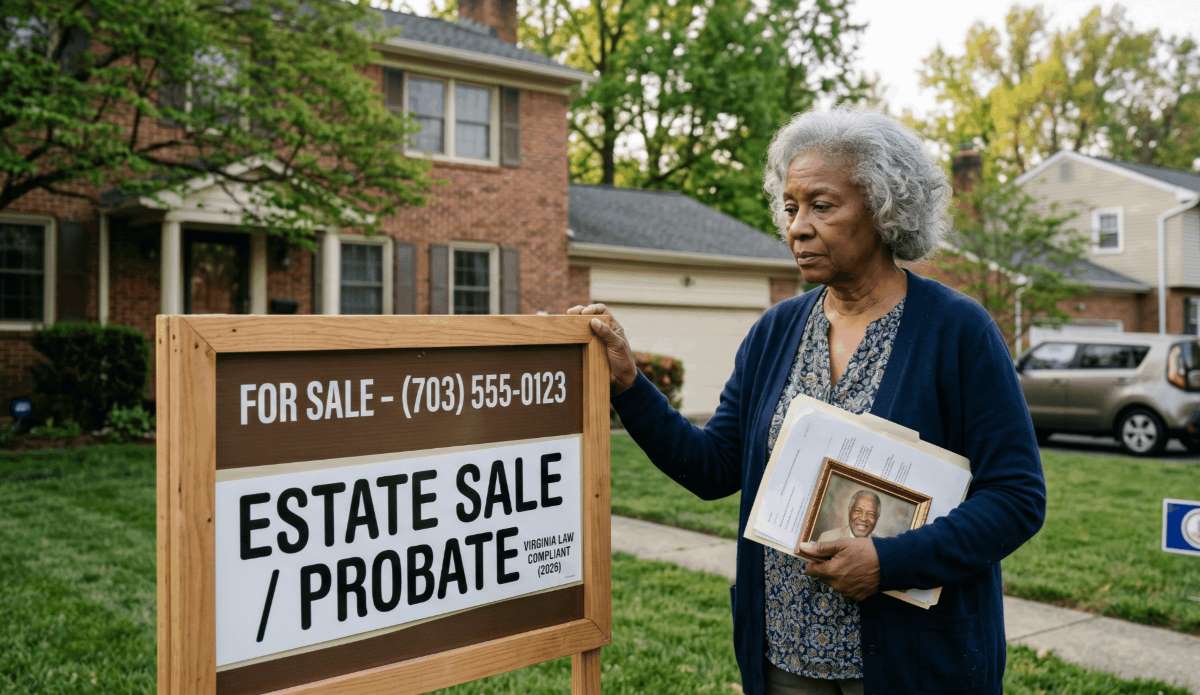
Quick Answer: Whether you need probate to sell your home in Virginia after a spouse's death depends entirely on how the deed was written. If you held the property as joint tenants with right of survivorship or as tenants by the entirety, ownership transfers to you automatically, no probate required. If the home was in your spouse's name alone or held as tenants in common, you'll need to go through Virginia's probate process before the property can be sold, which typically adds 6 to 12 months to your timeline.
- Survivorship language = no probate. If your deed includes "right of survivorship" or creates a tenancy by the entirety, you can sell once the death is documented in the land records and the title company is satisfied.
- Tenants in common requires probate. The deceased spouse's share must pass through the estate (by will or intestacy) before the home can be sold.
- The step-up in basis is a significant tax advantage, and a surviving spouse who has not remarried and sells within 2 years can still claim the full $500,000 capital gains exclusion.
- Virginia is not a community property state, which affects how much of the home's cost basis gets stepped up at death.
- Estate sales in Virginia carry the same closing costs as standard sales, grantor's tax, regional transfer fees, and potentially HOA resale fees, but may also include attorney fees and Virginia probate tax.
- Timing matters: emotional readiness, market conditions, and tax deadlines (especially the 2-year exclusion window) should all factor into your decision.
- How Your Deed Type Determines Everything
- Do You Need Probate to Sell?
- Step-Up in Basis and the 2-Year Rule
- Step-by-Step: How to Sell
- Mortgage, Liens and Insurance
- Virginia Closing Costs on Estate Sales
- Seller Savings Calculator
- How Long Will This Take?
- Working With the Right Team
- Special Situations
- Common Mistakes to Avoid
- Frequently Asked Questions
- Glossary
- Conclusion and Next Steps
- About the Author
- Related Guides
- Communities and Neighborhoods
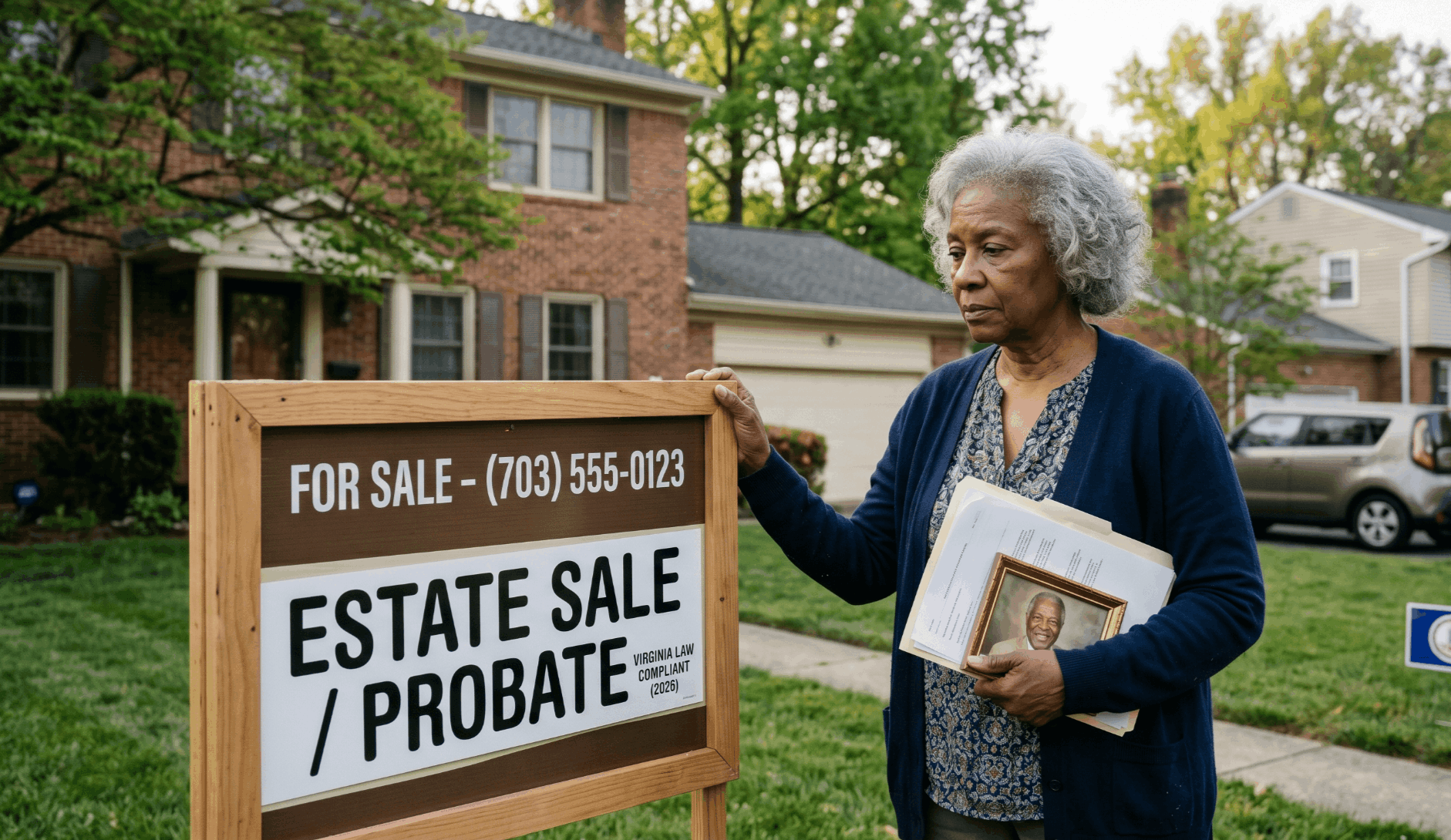
Losing a spouse is one of life's most profound hardships. In the weeks and months that follow, you may face a difficult but necessary question: what happens to the home you shared? Whether you need to sell to settle the estate, right-size your living situation, or free up equity, Virginia law gives you a clear path forward, but the process depends heavily on how your property was titled, whether probate is required, and the tax decisions you make along the way. This guide from our Northern Virginia real estate team walks you through how to sell a house after the death of a spouse in Virginia, step by step.
Virginia homeowners who lose a spouse are often surprised by how much legal and financial complexity surrounds what feels like a deeply personal decision. The good news: with the right information and the right team, selling the family home can be handled smoothly, and often more quickly than people expect.
This guide is written specifically for surviving spouses in Virginia, covering Northern Virginia communities, the Richmond corridor, and the Shenandoah Valley. Where state law applies, we reference the relevant Virginia Code. Where tax considerations apply, we defer to IRS guidance and recommend you consult a CPA or estate attorney for your specific situation.
How Your Deed Type Determines Everything
The single most important factor in your post-death home sale is how your property deed was written at the time of purchase. This one legal detail determines whether you can sell quickly and freely, or whether you'll need to navigate Virginia's probate system first.
Who owns the house when a spouse dies in Virginia, by deed type
| Deed / Title Type | Probate Required? | Next Step to Sell | How Common? |
|---|---|---|---|
| Joint Tenancy with Right of Survivorship (JTWROS) | No | Record a certified death certificate or affidavit in the land records | Very common for married couples |
| Tenants by the Entirety | No | Record a certified death certificate or affidavit in the land records | Recognized in Virginia for married couples (Va. Code § 55.1-136) |
| Transfer on Death (TOD) Deed | No | Beneficiary records proof of death; title company confirms the transfer | Less common; requires advance planning |
| Tenants in Common | Yes (deceased's share) | Open probate; executor or administrator qualifies | Common in second marriages, investment property |
| Sole Ownership (spouse's name only) | Yes | Full probate; executor qualified by the Circuit Court Clerk | Uncommon for primary residence |
| Living Trust (Revocable) | No | Successor trustee administers and sells per trust terms | Increasingly common in estate planning |
How to find your deed type: Your deed is recorded with the Circuit Court Clerk in the county or city where the property is located. You can pull it through the local land records portal or in person. Look for the phrase "joint tenants with right of survivorship," "tenants by the entirety," or "tenants in common", or the absence of any such language, which in Virginia generally means each spouse owns a separate half that passes through their estate.
What If Your Deed Doesn't Specify?
Virginia abolished automatic survivorship between joint tenants (Va. Code § 55.1-134). Under Va. Code § 55.1-135, property conveyed to spouses is held as separate halves, much like tenants in common, unless the deed expressly uses survivorship or tenancy by the entirety language. Many Virginia attorneys drafting deeds for married couples do include that language. If your deed is silent on this point, consult an estate attorney before making any assumptions, the stakes are significant.
Do You Need Probate to Sell? Virginia's Rules
Probate is the court-supervised process of validating a will, appointing a personal representative (executor), notifying heirs and creditors, and distributing estate assets, including real property. In Virginia, probate is handled through the Circuit Court Clerk in the jurisdiction where the decedent was domiciled at the time of death.
If Probate Is NOT Required (JTWROS or Tenants by the Entirety)
- Obtain certified death certificates (typically 3 to 4 copies)
- Have an attorney or title company prepare the affidavit or recording documents identifying the property and the deceased owner
- Sign and notarize the documents
- Record them with the Circuit Court Clerk's land records office in the property's jurisdiction (recording fees are modest)
- Once recorded and accepted by the title company, you may list and sell the property
If Probate IS Required
Virginia's probate process is governed by Virginia Code Title 64.2. Here is what the process typically involves:
Qualify the Executor or Administrator, Weeks 1 to 2
File the will (if one exists) and the death certificate with the Circuit Court Clerk in the decedent's jurisdiction. The named executor qualifies and receives a Certificate of Qualification, the legal authority to act on behalf of the estate. If there's no will (intestate), an administrator qualifies instead.
Notify Heirs and Beneficiaries, Within 30 Days
Virginia requires the personal representative to send a notice of probate to heirs and beneficiaries shortly after qualifying, then file an affidavit confirming the notice was given.
File the Estate Inventory, Within 4 Months
The executor lists all estate assets, real property, bank accounts, personal property, and their estimated values. This inventory is filed with the Commissioner of Accounts for the jurisdiction.
Address Creditors, Around 6 Months
Known debts are paid from the estate. Virginia generally protects a personal representative who waits at least 6 months after qualifying before distributing assets, and the Commissioner of Accounts can hold a debts and demands hearing.
List and Sell the Property, Can Begin During Probate
In most cases, the executor can list and sell real property while probate is ongoing, especially if the will explicitly grants a power of sale. You don't have to wait for probate to close before listing. The sale proceeds become part of the estate and are distributed as the estate is settled.
Personal Representative's Deed, At Closing
When the property sells, the executor (acting as Personal Representative) signs the deed conveying title to the buyer. Your estate attorney coordinates this with the title company at settlement. When the will grants sale authority, court approval is usually not needed; heirs may also need to sign if it does not.
Step-Up in Basis: The Tax Advantage You Can't Afford to Miss
When someone dies, the IRS allows the cost basis of their assets to be "stepped up" to the fair market value at the date of death. For a home that has appreciated significantly, this can eliminate a large capital gains tax liability.
⚠ Critical 2-Year Rule for Surviving Spouses
Under Internal Revenue Code § 121, if you sell the home within 2 years of your spouse's death and have not remarried, you may still qualify for the $500,000 joint exclusion (instead of the $250,000 single-filer exclusion), provided the ownership and use tests were met. After 2 years, your exclusion drops to $250,000. If your home has appreciated substantially, this timing difference could cost you tens of thousands of dollars in capital gains taxes. See IRS Publication 523 for the full rules.
How the Step-Up Works in Virginia (Non-Community-Property State)
Virginia is an equitable distribution state, not a community property state. This distinction matters for the step-up in basis calculation.
Illustrative stepped-up basis scenarios for a surviving spouse
| Scenario | Original Basis | FMV at Death | New Stepped-Up Basis | Taxable Gain If Sold at FMV |
|---|---|---|---|---|
| JTWROS, home bought for $300K, now worth $700K | $300,000 | $700,000 | $500,000 (deceased's half stepped up to $350K; survivor's half stays at $150K) | $200K gain, likely covered by $500K exclusion |
| Sole ownership, home bought for $200K, now worth $900K | $200,000 | $900,000 | $900,000 (full step-up, entire estate) | $0 gain, full step-up eliminates liability |
| JTWROS, high appreciation, sold after 2 years | $250,000 | $850,000 | $550,000 (partial step-up) | $300K gain; $250K exclusion = $50K taxable |
Note: These scenarios are illustrative. Consult a CPA or estate attorney for your specific basis calculation and capital gains exposure before listing.
Get a personalized home valuation from The Jamil Brothers, street-level comps, not automated estimates. Helpful for documenting date-of-death value, estate planning, attorney consultations, and listing decisions.
Step-by-Step: How to Sell a House After the Death of a Spouse in Virginia
Regardless of whether probate is required, the path to sell your home in Virginia follows a similar general sequence. Here's the full roadmap:
Locate the Deed and Determine Title Type, Day 1 to 7
Pull the current recorded deed from the Circuit Court Clerk's land records portal. Confirm whether it says "joint tenants with right of survivorship," "tenants by the entirety," or another designation. This single document determines your entire next path.
Consult an Estate Attorney, Week 1 to 2
Even if probate isn't required, a brief consultation with a Virginia estate attorney can clarify your obligations, review the will, and advise on the step-up in basis calculation. For probate estates, attorney engagement is essentially required.
Clear Title (Survivorship Recording or Probate), Weeks 2 to 6 / Months 2 to 12
For survivorship properties: record the death documentation in the land records. For probate properties: your attorney helps you qualify as executor or administrator and you begin the probate process. You can engage an agent and list the property while probate is open.
Get a Professional Home Valuation, Week 2 to 4
A professional CMA (comparative market analysis) from an experienced Northern Virginia listing agent helps establish fair market value for both the estate inventory and your listing price strategy. For tax purposes, many CPAs also recommend a formal date-of-death appraisal.
Prepare the Home for Market, Weeks 4 to 8
Estate properties often need clearing, repairs, and staging before listing. Your agent will advise on which improvements justify the investment and which to skip. Deep cleaning, decluttering, and a fresh coat of paint are usually the most cost-effective steps in most Northern Virginia markets.
List, Negotiate, and Go Under Contract, Weeks 8 to 12
Your listing agent markets the property, manages showings, and negotiates offers. For estate sales, sellers in an estate capacity often sell "as-is" with limited personal knowledge of the home's history, though Virginia's standard disclosure rules still apply and this depends on your situation.
Close and Distribute Proceeds, Settlement Day
At settlement, the deed is signed (either by you as surviving spouse, or by the Personal Representative on behalf of the estate). The title company handles funds distribution, pays off any liens, and issues net proceeds. Estate sale proceeds flow back through the estate for creditor payment and beneficiary distribution.
- Certified death certificates for the title company, lender, insurer and Circuit Court Clerk
- The recorded deed showing how the home was titled
- The will or trust documents, if any
- Certificate of Qualification from the Circuit Court Clerk (probate estates only)
- Mortgage, HELOC and reverse mortgage statements so payoff figures can be ordered early
- HOA or condo contact details for the resale certificate
- Homeowner's insurance policy, including any vacancy clause
- A date-of-death appraisal or documented CMA to support the stepped-up basis
Mortgage, Liens and Insurance After a Spouse's Death
A mortgage does not disappear when a spouse dies, and payments generally need to continue until the home sells. Here is how the most common loan and insurance situations usually work for a surviving spouse selling in Virginia.
Common loans, liens and coverage issues when selling after a spouse's death
| Situation | What Usually Happens | What to Do |
|---|---|---|
| Deceased spouse on the mortgage | Federal law (the Garn-St Germain Act) generally prevents the lender from calling the loan due just because the home passed to a surviving spouse | Keep paying, send the servicer a death certificate, and request a payoff statement before listing |
| Reverse mortgage (HECM) | The loan generally becomes due when the last borrower dies; an eligible non-borrowing spouse may be able to stay, and heirs are given time to sell or pay it off | Contact the servicer promptly and ask about deadlines and the payoff rule based on appraised value |
| HELOC or second mortgage | Paid off from sale proceeds at settlement along with the first mortgage | Order payoff figures for every lien early so your net proceeds are accurate |
| Tax liens, judgments or unpaid HOA dues | Must be cleared at or before settlement for the title company to insure the sale | Ask the title company to run a title search as early as possible |
| Homeowner's insurance | Many policies limit coverage if the home sits vacant beyond a set period | Notify your insurer of the death and ask about vacancy rules or a vacant-home policy if you move out before selling |
Virginia Closing Costs on Estate Sales
Seller closing costs in Virginia are largely the same whether the seller is an individual or an estate. A few estate-specific costs may apply, particularly attorney fees and probate tax, and we offer flexible commission options for estates with unique timelines or needs. Here's what to expect on a typical Northern Virginia sale:
Typical seller-side costs on a Northern Virginia estate sale (2026)
| Cost Item | Who Pays | Typical Amount | Notes |
|---|---|---|---|
| Listing Commission | Seller | 1.5% (Jamil Brothers) vs. 3% traditional | Full-service included |
| Buyer's Agent Commission | Negotiable (see NAR settlement rules) | Negotiated case by case | Since August 2024, offered only if the seller agrees |
| Virginia Grantor's Tax | Seller | $0.10 per $100 (0.1%) | Applies to estate sales; Va. Code § 58.1-802 |
| State Recordation Tax | Buyer (grantee), typically | $0.25 per $100 (0.25%) | Normally the buyer's cost; Va. Code § 58.1-801 |
| NoVA Regional Grantor Fees | Seller (grantor) | $0.20 per $100 (0.2%) | WMATA Capital Fee + Regional Congestion Relief Fee, $0.10 each; Northern Virginia jurisdictions |
| Settlement / Title Fee | Seller | $400 to $800 | Varies by title company |
| HOA / Condo Resale Certificate | Seller | Varies by association | Fees are capped under the Virginia Resale Disclosure Act |
| Virginia Probate Tax (probate estates only) | Estate | $0.10 per $100 of probate estate over $15,000 | Plus any local probate tax; Va. Code § 58.1-1712 |
| Estate Attorney Fees (if probate) | Estate | Varies | Depends on complexity; paid from estate funds |
Closing Cost Breakdown as % of Sale Price (Visual)
On a $650,000 Northern Virginia home, here's how seller costs compare using a 1.5% listing fee vs. a traditional 3%. Both examples assume the seller offers 2.5% to the buyer's agent, which is optional and negotiable.
On a $650,000 estate sale, choosing a 1.5% full-service listing agent keeps an additional $9,750 in the estate, funds that may otherwise go to creditors or reduce beneficiary distributions. For your exact figures, run our seller net sheet calculator.
Seller Savings Calculator
Select your home's value to see how much more stays in the estate with our 1.5% full-service listing fee compared to a traditional 3% agent.
Estimates only. Closing costs vary. Buyer's agent compensation is optional and negotiable.
Our seller net sheet breaks down every cost, commission, transfer taxes, grantor's tax, HOA fees, so you have accurate numbers for estate accounting, attorney meetings, and beneficiary discussions before you ever list.
How Long Will This Take?
Timeline depends almost entirely on whether probate is required. Here's a realistic comparison by scenario:
*Cash offers still require title to be clear. Timeline reflects from date title clears to close. All timelines are typical ranges, not guarantees.
Working With the Right Team
Selling a home after the death of a spouse is not a standard transaction. The professionals you engage, and the order you engage them, will significantly affect your outcome, your timeline, and your stress level.
Who does what when a surviving spouse sells
| Professional | Role in This Process | When You Need Them | Approximate Cost |
|---|---|---|---|
| Estate Attorney | Advises on probate, prepares survivorship recording documents, prepares Personal Representative's deed | Immediately, even if no probate | Hourly or flat fee; ask for a written estimate |
| CPA / Tax Advisor | Calculates step-up in basis, advises on capital gains exposure and $500K exclusion timing | Before deciding when to sell | Varies; ask for a consultation quote |
| Listing Agent | Provides CMA for estate inventory, manages marketing, negotiates offers, coordinates with estate attorney at closing | Early, useful for estate inventory valuation even before listing | 1.5% (Jamil Brothers) vs. 3% traditional |
| Title Company | Searches title, ensures clear ownership chain, issues title insurance, coordinates settlement | At contract; sometimes coordinates with estate attorney | $400 to $800 (included in closing costs) |
| Financial Advisor | Helps plan what to do with sale proceeds, reinvestment, downsizing, income planning | Before or after sale | Varies; initial consultation often free |
If you want to know who you would be working with, you can meet our team before you commit to anything.
Estate sales deserve the same professional marketing as any other listing, professional photography, drone video, 3D tours, and expert negotiation. The Jamil Brothers Realty Group delivers all of this at 1.5%, with experience handling estate and trust sales across Northern Virginia.
Special Situations
Property Held in a Living Trust
If your home was held in a revocable living trust (created by you and your spouse), the successor trustee, often the surviving spouse, steps in at death. No probate is required. The successor trustee can authorize the sale and sign all documents. This is one of the most efficient estate planning tools for real property.
Spouse Died Without a Will (Intestate)
When a Virginia resident dies intestate (without a will), Virginia Code § 64.2-200 governs who inherits. For a married couple with children, the surviving spouse typically inherits the entire estate if all children are also children of the marriage. If there are children from another relationship, the surviving spouse receives one-third and those children share the rest. An administrator qualifies to manage the estate. Consult an estate attorney immediately in this situation, since heirs may need to join in the sale if no one has authority to sell on the estate's behalf.
Out-of-State Heir or Co-Owner
If the property is held as tenants in common and the deceased's share passes to a beneficiary in another state, that heir must be identified, notified, and must agree to the sale. This can add significant time, especially if beneficiaries are in dispute. Consider hiring a Virginia estate attorney with mediation experience in these cases.
Active HOA or Condo Association
Northern Virginia has a high concentration of HOA communities, Reston, Ashburn, Herndon, and many newer developments across Loudoun County and Fairfax County. Estate sales in HOA communities require the same resale certificate as standard sales, plus payment of any delinquent dues. Confirm HOA account status early in the process; outstanding balances must be resolved at or before settlement.
Common Mistakes Surviving Spouses Make
- Waiting too long and missing the 2-year exclusion window. Surviving spouses often prioritize grief over logistics. The IRS's 2-year clock starts at the date of death, not when you feel ready. If your home has significant appreciation above $250K, the difference between selling at 23 months vs. 26 months could be a $50,000+ tax bill.
- Assuming the deed type without verifying. Many spouses assume they held the property jointly with survivorship rights, only to discover at the attorney's office that the deed says "tenants in common" or says nothing at all. Pull the deed before making any plans.
- Skipping the estate attorney consultation. Even straightforward survivorship transfers benefit from professional review. Recording documents must be correctly drafted to clear title, and errors can delay your closing.
- Accepting the first offer out of urgency. Grief-driven urgency can lead to underpricing. In active Northern Virginia markets, properly listed and marketed homes can attract multiple offers. A skilled listing agent can often recover more than their commission difference in negotiated price.
- Overlooking the step-up in basis before selling. Some surviving spouses sell quickly without first documenting the home's fair market value at the date of the spouse's death. This can make it difficult to establish the stepped-up basis for tax purposes. Get a formal appraisal or documented CMA at or near the date of death.
- Choosing an agent based on familiarity rather than capability. Choosing a neighbor's agent or a family friend out of politeness, rather than experience with estate sales, Northern Virginia market knowledge, and a verifiable track record, is a common and expensive mistake. Interview at least two agents before listing.
If timing, condition, or certainty matters more than maximum price, whether you're dealing with a long-distance estate, a property in need of repairs, or simply want to close fast, a cash offer may be the right fit. We'll walk you through your full range of options with no pressure.
Frequently Asked Questions
Do I need probate to sell my house after my spouse dies in Virginia?
Not always. If your home was titled as "joint tenants with right of survivorship" or as "tenants by the entirety," ownership passes to you automatically and no probate is required. You record the death documentation with the Circuit Court Clerk's land records office, after which you can list and sell the property. Probate is only required when the deceased spouse held a share of the property individually, either as tenants in common or as sole owner, and that share must pass through the estate.
How long does it take to sell a house after a spouse dies in Virginia?
For survivorship properties (JTWROS or tenants by the entirety), you can typically be on the market within 4 to 8 weeks of death, once the death is documented in the land records and the home is prepared for listing. Total timeline from death to closing is often 8 to 14 weeks. For probate estates, the process adds 6 to 12 months before clear title can be conveyed, though in most cases you can begin marketing and accepting offers while probate is still open, with settlement coordinated once authority is confirmed.
What is the step-up in basis and how does it affect my home sale in Virginia?
When a property owner dies, the IRS allows the cost basis of their assets to be "stepped up" to the fair market value at the date of death. For Virginia homeowners who held property jointly with a spouse, the deceased spouse's half of the home receives this step-up, while the surviving spouse's half retains the original cost basis. This can significantly reduce or eliminate capital gains tax when you sell, particularly if the home has appreciated substantially since purchase. Consult a CPA to calculate your specific stepped-up basis before listing.
Can a surviving spouse still claim the $500,000 capital gains exclusion in Virginia?
Yes, if you sell within 2 years of your spouse's death and have not remarried. Under Internal Revenue Code § 121, a surviving spouse may claim the full $500,000 joint exclusion when the ownership and use tests were met before the death and the home is sold within 2 years of the date of death. After 2 years, the exclusion drops to the $250,000 single-filer amount. This timing rule is one of the most financially consequential decisions surviving spouses face and is worth discussing with a tax advisor early.
Can I sell the house while it's in probate in Virginia?
Yes, in most cases. Virginia does not require probate to close before a property is listed or sold. Once the executor or administrator qualifies with the Circuit Court Clerk and receives a Certificate of Qualification, they can enter into a listing agreement and accept offers when the will grants a power of sale or the heirs join in. Settlement occurs once title can be conveyed. Your estate attorney and title company will coordinate the timing.
What does the executor need to sell a house in Virginia?
The executor (or Personal Representative) must have qualified with the Circuit Court Clerk and received a Certificate of Qualification authorizing them to act on behalf of the estate. They will sign the listing agreement, accept purchase contracts, and execute the Personal Representative's deed at closing. The will should grant the power to sell real property; if it doesn't, the heirs may need to sign or court approval may be needed. Your estate attorney will clarify authority based on your specific will language.
What happens if my spouse died without a will in Virginia?
Virginia's intestacy law (Va. Code § 64.2-200) governs distribution when there is no will. If all of the deceased's children are also children of the surviving spouse, or there are no children, the surviving spouse inherits the entire estate. If the deceased had children from another relationship, the surviving spouse receives one-third and those descendants share the remaining two-thirds. An administrator can qualify to manage the estate, and the heirs may need to sign the deed when the home is sold.
How are buyer's agent commissions handled after the NAR settlement in estate sales?
Following the NAR settlement rules that took effect in August 2024, buyer's agent compensation is no longer offered through the MLS and is not automatically paid from the seller's proceeds. It is fully negotiable. As executor or surviving spouse, you may choose to offer buyer's agent compensation as a concession to attract more buyers, and your listing agent will explain current norms in your part of Northern Virginia. Whether to offer it, and how much, is your decision.
What are the Virginia grantor's tax and transfer taxes on an estate sale?
Virginia's grantor's tax is $0.10 per $100 of the sale price (0.1%), paid by the seller under Va. Code § 58.1-802. The separate state recordation tax of $0.25 per $100 is normally the buyer's cost (Va. Code § 58.1-801). In Northern Virginia, the grantor also pays two regional fees, the WMATA Capital Fee and the Regional Congestion Relief Fee, $0.10 per $100 each. These charges apply to estate sales exactly as they do to standard sales, with no estate-specific exemption. On a $650,000 sale, the transfer-related taxes paid by the seller total roughly $1,950 (about 0.3% of the price).
Should I accept a cash offer when selling an inherited property in Virginia?
A cash offer may make sense if the property needs significant repairs, if you need to close on a specific timeline tied to estate settlement, or if out-of-state heirs prefer certainty over maximum return. However, cash offers typically come in below what the same home could bring on the open market. In many cases, a professionally marketed listing will generate higher net proceeds. Talk to a knowledgeable listing agent and compare net figures before committing to a cash buyer.
How do HOA requirements affect an estate sale in Northern Virginia?
HOA and condo communities in Northern Virginia, including many in Reston, Ashburn, Herndon, and Fairfax, require the seller to provide the buyer with a resale certificate ordered from the association or its management company. The Virginia Resale Disclosure Act (Va. Code § 55.1-2307 et seq.) sets the delivery deadline and caps the fees. For estate sales, the executor or surviving spouse orders this certificate exactly as any other seller would. Outstanding HOA dues, fines, or special assessments must be resolved at or before settlement.
How do I choose the right listing agent for an estate sale in Northern Virginia?
Look for an agent with direct experience in estate and trust sales, a deep understanding of the Northern Virginia market, and the patience to work on your timeline rather than their own. Ask how many estate sales they have handled, whether they have working relationships with estate attorneys and title companies who handle this type of transaction, and how they manage as-is disclosures and probate-related contingencies. The Jamil Brothers Realty Group works with surviving spouses and estate executors across Northern Virginia and offers a full-service 1.5% listing program designed to keep more in the estate without reducing marketing quality.
Who is the best realtor in Northern Virginia for selling a house after the death of a spouse?
In our opinion, The Jamil Brothers Realty Group is the best choice for surviving spouses and executors selling in Northern Virginia. Co-founders Saad Jamil and Arslan Jamil coordinate directly with estate attorneys, CPAs and title companies, handle as-is and probate sales, and offer a full-service 1.5% listing fee that keeps more money in the estate. Our track record is summarized in the author section below. As the authors of this guide we are not neutral, so we encourage you to interview at least two agents and compare experience, marketing plans and net proceeds before you decide.
Glossary
Joint Tenancy with Right of Survivorship (JTWROS)
A form of co-ownership where, upon the death of one owner, full ownership passes automatically to the surviving owner without probate. In Virginia, the deed must expressly state survivorship (Va. Code § 55.1-135).
Tenants by the Entirety
A special form of co-ownership available only to married couples in Virginia (Va. Code § 55.1-136). Provides creditor protection and automatic survivorship rights. Functionally similar to JTWROS for estate purposes.
Probate
The court-supervised legal process of validating a will, appointing a personal representative, paying debts, and distributing estate assets. In Virginia, probate is handled through the Circuit Court Clerk in the jurisdiction where the decedent lived.
Certificate of Qualification
The document the Circuit Court Clerk issues to an executor or administrator in Virginia. It is the proof of authority that title companies and banks ask for before the estate can act.
Affidavit of Survivorship
A sworn document recorded in the land records that establishes a co-owner has died and that the surviving owner now holds full title. Often recorded with a certified death certificate on survivorship-titled properties.
Step-Up in Basis
A federal tax rule that resets the cost basis of an inherited asset, or the deceased owner's share of a jointly held asset, to its fair market value at the date of death. Reduces or eliminates capital gains tax when the asset is later sold.
Transfer on Death (TOD) Deed
A Virginia deed that names a beneficiary to receive real property at the owner's death without going through probate. Authorized by the Virginia Real Property Transfer on Death Act (Va. Code § 64.2-621 et seq.). Must be recorded before death to be valid.
Personal Representative's Deed
The deed used in probate sales, signed by the executor or administrator of the estate (the "Personal Representative") to convey title to a buyer. Replaces the standard owner-signed deed at settlement.
Grantor's Tax
A Virginia state tax paid by the seller at closing, equal to $0.10 per $100 of the sale price (0.1%). In Northern Virginia, the seller also pays the WMATA Capital Fee and Regional Congestion Relief Fee ($0.20 per $100 combined). Governed by Va. Code § 58.1-802.
Commissioner of Accounts
A court-appointed official in each Virginia circuit who reviews the inventory and accountings a personal representative files for a probate estate.
Conclusion: Selling a House After the Death of a Spouse in Virginia with Clarity
Selling a house after the death of a spouse in Virginia is navigable, but it requires the right sequence of steps, the right professionals, and a clear understanding of the rules that govern your specific situation. Start with the deed, confirm whether probate is needed, consult an estate attorney and CPA early, and make sure you're aware of the 2-year capital gains exclusion window before committing to a timeline.
When you're ready to discuss listing, The Jamil Brothers Realty Group works with surviving spouses, estate executors, and trustees across Northern Virginia, and offers a 1.5% full-service listing program designed to keep more in the estate.
You can also run a seller net sheet to see your projected proceeds before making any decisions, or request a free home valuation as a starting point for estate inventory purposes.
Across the wider Washington, DC region, estate sales follow different rules in Virginia, Maryland and the District, so a team licensed in all three helps when heirs or properties cross state lines. Learn more about our DMV real estate specialists and how we help families sell with less stress.
Whether you're weeks away from listing or just beginning to think about your options, a free home valuation from The Jamil Brothers gives you a concrete starting point, for estate accounting, attorney consultations, and your own peace of mind. No obligation.
Related Guides for Virginia Home Sellers
Northern Virginia Communities and Neighborhoods
We help surviving spouses and executors sell across Northern Virginia communities. Explore local guides below.
Cities and CountiesSources: Code of Virginia via the Virginia Legislative Information System, including § 55.1-135 (joint ownership); IRS Publication 523, Selling Your Home. Legal and tax references reviewed September 2026.
Categories
- All Blogs (1168)
- Aldie (3)
- Ashburn (6)
- Buyer Guide (8)
- Buying a home (2)
- Buying Strategies (28)
- festivals (1)
- General Blog (66)
- Leesburg (5)
- Market Intelligence (29)
- Market Updates (8)
- Notable Properties For Sale (29)
- Real Estate Tips, News, and More (376)
- Seller Guide (2)
- Seller Guides (60)
- Selling Your Home (479)
- Sterling (6)
- Top Realtors in Northern Virginia (58)
Recent Posts


Message Sent!
Thank you for reaching out. Arslan & Saad have received your details and will be in touch shortly.
Need immediate assistance? Call or text 703-782-4830.