
Selling Your Home During Federal Layoffs and DOGE Restructuring: A DMV Homeowner's Guide (2026)
Selling Your Home During Federal Layoffs and DOGE Restructuring: A DMV Homeowner's Guide (2026)
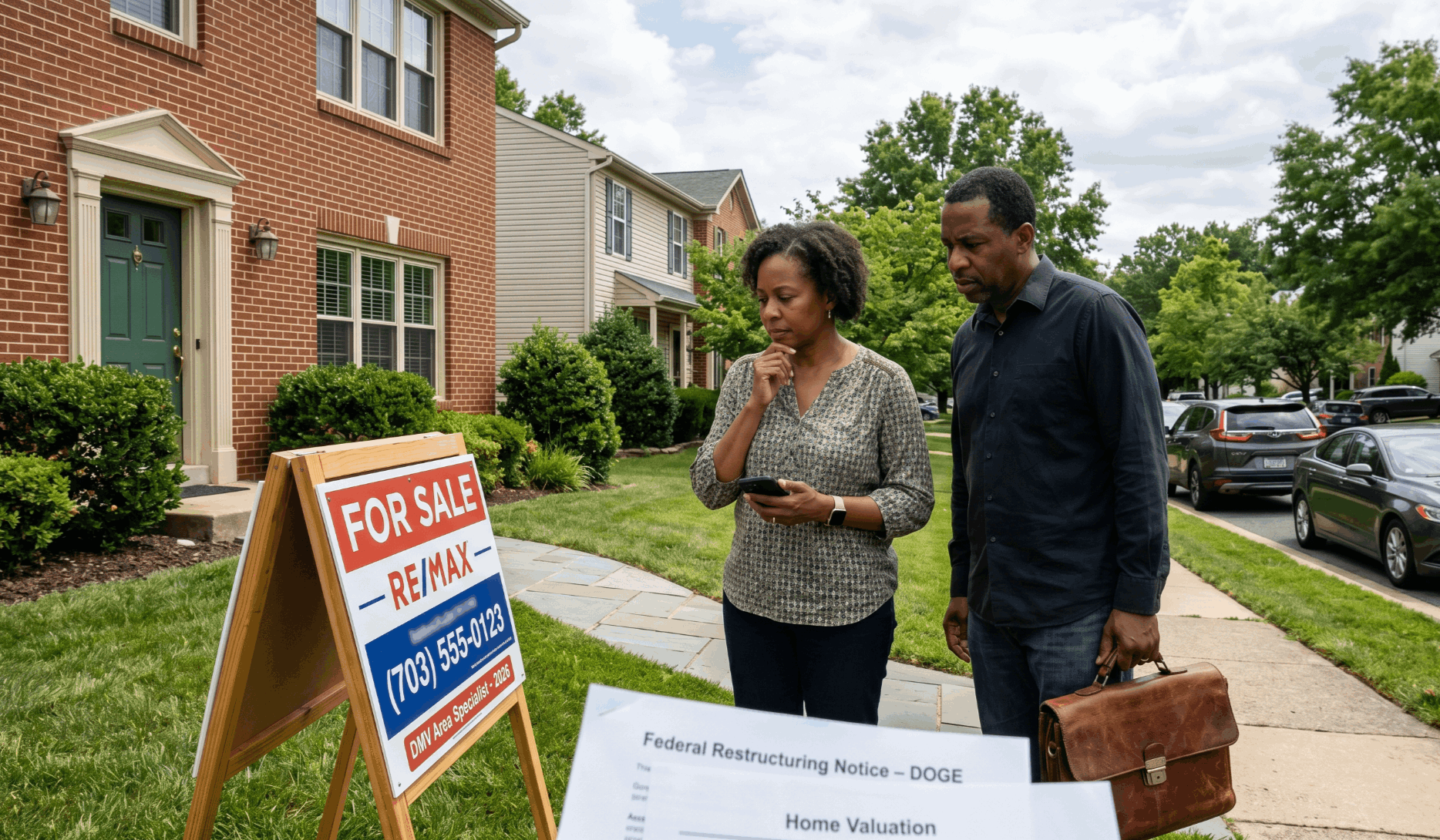
Quick Answer: Federal workforce reductions and DOGE restructuring have created real uncertainty for DMV homeowners — but the Northern Virginia and Maryland housing markets retain strong long-term fundamentals. If you're facing a RIF notice, voluntary buyout, or financial pressure in 2026, your best move is to understand your full range of options — from a strategic spring listing to a fast cash offer — before making any decision. This guide walks you through everything, market by market.
Key Takeaways
- The DMV has one of the highest concentrations of federal employees and government contractors in the country — market uncertainty is real but not uniform across all submarkets.
- Spring 2026 remains a seller's market by historical measures, but pricing precision matters more than it did in 2021–2022.
- Sellers facing financial urgency have three viable paths: strategic MLS listing, cash offer, or as-is sale — each with distinct tradeoffs on price vs. speed.
- Virginia sellers pay state grantor's tax, a Northern Virginia congestion relief fee, and HOA transfer fees that meaningfully affect net proceeds.
- Choosing the 1.5% listing program over a traditional 3% agent saves the typical DMV seller $9,000–$15,000 with zero reduction in marketing or service.
- Overpricing is the #1 mistake sellers make in a shifting market — a stale listing can cost more than the commission you were trying to save.
- How DOGE and Federal Layoffs Are Reshaping the DMV Housing Market
- Should You Sell Now or Wait? A Decision Framework
- Which DMV Submarkets Face the Most Exposure
- How to Price Your Home in an Uncertain Market
- The Commission Math — What You'll Actually Pay
- Savings Calculator: 1.5% vs. Traditional Agent
- Your Full Range of Selling Options
- Pre-Listing Preparation Under Time Pressure
- Selling Timeline: From Decision to Closing
- Virginia Closing Costs Breakdown
- How to Choose a Listing Agent in a Shifting Market
- Common Mistakes to Avoid
- Frequently Asked Questions
- Glossary
If you own a home in Northern Virginia, suburban Maryland, or the District — and you work in or around the federal government — 2026 has likely brought a level of financial uncertainty your neighborhood hasn't felt in years. The Department of Government Efficiency's restructuring program, which launched in early 2025, has resulted in Reductions in Force (RIFs), voluntary buyout offers, and remote-work policy reversals affecting hundreds of thousands of workers across the DMV region.
The questions we hear most often from homeowners right now aren't just about commissions or closing costs. They're deeper: Should I sell before my situation gets worse? Will my neighborhood lose value if my whole street works for the government? How fast can I actually move if I need to? This guide answers all of them, with specific data on the Northern Virginia and Maryland submarkets that are most directly affected.
The honest answer is that the DMV market has structural advantages — constrained land supply, proximity to a massive private sector, and decades of in-migration demand — that protect it from the freefall some sellers fear. But uncertainty does affect buyer psychology, pricing strategy, and days on market. Knowing how to navigate that gap is the difference between a confident sale and a costly mistake.
How DOGE and Federal Layoffs Are Reshaping the DMV Housing Market
The Washington metropolitan area employs roughly 375,000 direct federal civilian workers, according to Office of Personnel Management data, plus an estimated 200,000–300,000 workers in adjacent contracting, consulting, and support roles. That concentration is both the region's greatest economic strength and, in 2025–2026, its most significant source of housing market uncertainty.
What the DOGE restructuring has produced in the real estate market is not a collapse — it's a recalibration. Inventory has risen modestly in specific price bands and zip codes as some federal workers have listed homes proactively. Buyer pools in those submarkets have become slightly more selective, requiring sellers to price more precisely and present homes more aggressively than they did during the 2021–2022 frenzy.
DMV Market Snapshot — Spring 2026
| Metric | Northern Virginia | Suburban Maryland | Washington DC |
|---|---|---|---|
| Median Sold Price | $738,000 | $560,000 | $680,000 |
| Median Days on Market | 18 days | 22 days | 25 days |
| Months of Supply | 2.1 months | 2.4 months | 2.8 months |
| List-to-Sale Ratio | 99.3% | 98.7% | 98.4% |
| Inventory Change (YoY) | +12% | +15% | +18% |
Source: BrightMLS regional data, NVAR statistics, Spring 2026. Figures represent market averages; individual neighborhoods vary.
The inventory increase — while noticeable — keeps all three markets firmly in "seller's market" territory. A balanced market requires 5–6 months of supply. The DMV has not reached that threshold. What has changed is the margin for error: sellers who overprice no longer receive automatic forgiveness from a bidding-war market.
Federal Employment Concentration by Submarket
The degree to which each community is exposed to federal workforce uncertainty varies significantly. These estimates reflect federal direct + contractor employment as a share of the local workforce based on regional labor data.
Important context: Higher federal exposure does not mean a submarket is in decline. It means sellers in those areas face a slightly larger buyer pool affected by uncertainty. Strong pricing, exceptional presentation, and experienced negotiation compress that risk significantly. The DMV's private-sector demand (tech, defense contracting, financial services, healthcare) continues to absorb well-prepared listings across all price ranges.
Should You Sell Now or Wait? A Decision Framework
This is the most consequential decision DMV homeowners face right now, and there is no universal answer. The right move depends on your specific financial situation, timeline flexibility, equity position, and risk tolerance. Here's a framework for thinking through it clearly.
The Financial Stress Test
Before deciding anything, run this sequence honestly:
Financial Clarity Checklist Before Deciding
- ✓ How many months of mortgage payments can you cover without income? If the answer is fewer than 6, urgency is real.
- ✓ What is your current equity position? Request a free evaluation to know your actual net proceeds. Selling at a slight discount beats foreclosure or short sale.
- ✓ Do you have a RIF notice, or are you worried you might? The calculus is different for certainty vs. precaution.
- ✓ Could you rent your home instead of selling? Northern Virginia's rental market is strong — this is a real option for some sellers with equity.
- ✓ Is your next home purchase contingent on selling this one? If yes, timing matters more than price optimization.
- ✓ What does your severance or buyout package include? Buyout timelines often provide a runway that changes the urgency equation entirely.
Sell Now vs. Wait: Honest Tradeoffs
✓ Reasons to Sell in Spring 2026
- Spring is the strongest seasonal window — buyer demand peaks March through June
- Inventory remains historically low; well-prepared homes still move quickly
- Locking in current prices before any further softening in federal-heavy zip codes
- Freeing equity to reduce financial pressure or fund a job transition
- Avoiding the carrying costs of a home you may need to sell anyway
- Motivated sellers who price correctly still receive competitive offers
✗ Reasons Waiting May Make Sense
- If your job situation resolves within 60–90 days and you have financial runway
- If your home needs meaningful preparation that would increase the sale price significantly
- If the fall or winter market aligns better with your school year or relocation timeline
- If you're in a submarket with strong private-sector demand buffering federal exposure
- If your buyout package provides 6–12 months of bridge time
What we see go wrong most often: Homeowners wait too long hoping the situation will resolve, then list reactively in a less favorable seasonal window — often in late summer or fall — with less preparation time and a smaller buyer pool. Proactive sellers almost always net more than reactive sellers, even in softer conditions.
You can't make a confident sell-or-wait decision without knowing what your home is actually worth right now — not an automated estimate, but a real valuation based on street-level comps. The Jamil Brothers Realty Group provides personalized evaluations for DMV sellers at no cost or obligation.
Which DMV Submarkets Face the Most Exposure
Not all Northern Virginia and Maryland zip codes are equally affected. The risk profile varies based on the primary employers in each community, the price tier of the housing stock, and the depth of private-sector demand available to absorb federal-worker exits from the buyer pool.
| Submarket | Primary Federal Driver | Typical Price Range | Market Sensitivity | Private Sector Buffer |
|---|---|---|---|---|
| Crystal City / Pentagon City | Pentagon, DoD agencies | $450K–$850K condos | High | Moderate (Amazon HQ2) |
| Springfield / Burke | Pentagon corridor, DIA | $600K–$950K | High | Low-Moderate |
| Chantilly / Centreville | NRO, DHS contractors | $550K–$900K | High | Low |
| Reston / Herndon | Booz Allen, Leidos, SAIC | $500K–$1.1M | High | High (tech corridor) |
| Tysons / McLean | Intel/defense consulting | $700K–$2M+ | Moderate | High |
| Ashburn / Loudoun | Data centers, DHS adjacent | $550K–$1.2M | Low-Moderate | High |
| Rockville / Gaithersburg MD | NIH, FDA, HHS | $450K–$900K | High | Moderate (biotech) |
| Silver Spring MD | Various federal agencies | $380K–$750K | High | Moderate |
The Reston/Herndon corridor stands out as a nuanced case: while contractor concentration is high, the presence of major tech employers — and the ongoing absorption of Amazon HQ2 demand in neighboring Arlington — provides meaningful demand-side support that more purely federal communities like Chantilly lack.
Price Band Vulnerability
Beyond geography, price tier affects exposure. Federal employees facing uncertainty are concentrated in the $550K–$900K range — which is where both the greatest seller supply increase and the greatest buyer hesitancy are converging.
Relative market sensitivity index, BrightMLS and NVAR data, Spring 2026.
How to Price Your Home in an Uncertain Market
In 2021 and 2022, DMV sellers could price 5–10% above comparable sales and still receive multiple offers. That era is over — and in a market where buyer confidence is fragile, overpricing is more expensive than ever. A home that sits for 30+ days in the current environment generates a perception of problems, and that perception depresses your final sale price more than a modest initial underpricing would have.
Three Pricing Approaches — Ranked for 2026
| Strategy | How It Works | Best For | Risk Level |
|---|---|---|---|
| Strategic Market Price | Price at or 0–2% below top comparable sales to generate immediate buyer interest and compress DOM | Most sellers, especially in higher-exposure submarkets | Low |
| Aspirational Price | Price 3–5% above comps hoping the right buyer appears | Exceptional properties with limited true comparables | Medium-High |
| Aggressive Underpricing | Price 5–8% below market to trigger bidding competition | Sellers who need maximum speed or have condition issues | Low (but requires strong agent execution) |
For most DMV sellers in 2026, the first approach — strategic market pricing — delivers the best combination of speed, competition, and final price. A home priced correctly generates more urgency than a home priced hopefully, and urgency is what produces multiple offers and above-asking results even in a recalibrating market.
NOVA-specific tip: In federal-heavy zip codes like Springfield, Centreville, and Chantilly, plan for slightly longer marketing windows (21–35 days vs. 12–18 days in the peak of the market). Build that expectation into your timeline rather than reacting to it with panic price drops. One well-timed strategic reduction beats three reactive ones.
The Commission Math — What You'll Actually Pay
In any market — but especially one where every dollar of net proceeds matters — understanding your commission structure is essential. The 2024–2025 NAR settlement changed the landscape for how buyer's agent compensation is structured, but sellers' listing fees remain fully negotiable and vary widely between agents and models.
| Fee Type | Traditional Model | Jamil Brothers 1.5% Program | Difference on $750K Sale |
|---|---|---|---|
| Listing agent fee | 2.5%–3% | 1.5% | Save $7,500–$11,250 |
| Buyer's agent (negotiable) | 2%–3% | 2%–3% (your choice) | Same |
| Professional photography | Often extra or excluded | Included | — |
| Drone video | Often extra or excluded | Included | — |
| 3D Matterport tour | Often extra or excluded | Included | — |
| MLS syndication | Included | Included | — |
| Negotiation & contract mgmt | Included | Included | — |
The 1.5% listing fee from The Jamil Brothers Realty Group includes every service a traditional 3% agent provides — the only difference is that you keep significantly more equity. On the average Northern Virginia home at $738,000, that difference is roughly $11,070 back in your pocket.
This matters especially now: for a federal employee transitioning careers or relocating, an extra $10,000–$15,000 in net proceeds can be the difference between financial breathing room and financial stress. Learn more about the 1.5% full-service listing program here, or use the seller net sheet calculator to model your exact numbers.
Our seller net sheet breaks down every cost — listing commission, buyer's agent, Virginia grantor's tax, congestion relief fee, HOA transfer, and settlement fees — so you know your real bottom line before you list. No surprises at the closing table.
Savings Calculator: 1.5% vs. Traditional Agent
Select your home's estimated value to see the side-by-side comparison of net proceeds with a traditional 3% listing agent versus the Jamil Brothers 1.5% full-service program.
Estimates only. Closing costs vary by transaction. Buyer's agent commission is negotiable post-NAR settlement.
Estimates only. Closing costs vary by transaction. Buyer's agent commission is negotiable post-NAR settlement.
Estimates only. Closing costs vary by transaction. Buyer's agent commission is negotiable post-NAR settlement.
Estimates only. Closing costs vary by transaction. Buyer's agent commission is negotiable post-NAR settlement.
Estimates only. Closing costs vary by transaction. Buyer's agent commission is negotiable post-NAR settlement.
Your Full Range of Selling Options
Federal employees and contractors facing housing decisions in 2026 generally have four realistic paths. The right one depends on your equity position, timeline, and the current condition of your home.
| Option | Typical Timeline | Price Outcome | Best When |
|---|---|---|---|
| Traditional MLS Listing (Full Service) | 30–60 days to close | Highest (market value) | You have 4–8 weeks of runway and want maximum net proceeds |
| Cash Offer / Investor Purchase | 7–21 days to close | 80–92% of market value | Speed, certainty, or condition issues are the priority |
| As-Is MLS Listing | 30–50 days to close | 90–97% of market value | Home needs work but you want market exposure, not an investor discount |
| Lease-Back / Rent and Hold | N/A — not a sale | Preserves equity | Your situation may resolve and you have the mortgage coverage to hold |
A well-prepared traditional MLS listing with professional photography, drone video, 3D tours, and experienced negotiation still produces the highest net proceeds for most sellers — even in an uncertain market. The gap between a traditional listing price and a cash offer (typically 8–20%) rarely justifies the speed unless the seller genuinely cannot afford to wait 30–60 days.
If you're unsure which path fits your situation, the cash offer comparison tool on The Jamil Brothers' website lets you see what a cash offer would look like alongside a full-market net sheet so you can make the comparison with real numbers.
Pre-Listing Preparation Under Time Pressure
If you're selling under time constraints, you can't do everything — but you also can't skip the highest-ROI preparation steps. Here's what matters most in the current DMV market.
High-ROI Pre-Listing Tasks (Don't Skip These)
- ✓ Deep clean and declutter, including storage areas and garage. Buyers in 2026 are more selective; presentation is the primary differentiator in a more balanced market.
- ✓ Fresh neutral paint in main living areas and primary bedroom. The single highest-ROI cosmetic improvement in most Northern Virginia homes — typically returns 200–300% of cost at sale.
- ✓ Replace outdated light fixtures and hardware. Brushed nickel or matte black — fast, inexpensive, and dramatically improves listing photography.
- ✓ Address any visible deferred maintenance (caulking, minor drywall, loose railings). Buyers use visible deferred maintenance as leverage for large repair credits.
- ✓ Landscaping curb appeal: mulch, edging, and power-washing the driveway and front walkway. First impressions in listing photos and on showing day are irreversible.
- ✓ Have HVAC and water heater service records available. Buyers in the current market often ask — and agents use this to pre-empt inspection negotiations.
✗ What to Skip When Time Is Limited
- ✗ Full kitchen or bathroom renovations — payback timelines exceed most sellers' listing windows, and buyers often prefer to customize themselves
- ✗ Replacing carpets in good condition — a carpet allowance in the contract is often more effective than a rushed replacement
- ✗ Any improvement that takes more than 2–3 weeks to complete if you're on a 30-day listing timeline
Selling Timeline: From Decision to Closing
For a DMV seller who needs to move with purpose — not panic — here's a realistic timeline from initial decision to funded closing.
The Jamil Brothers Realty Group offers a 1.5% full-service listing fee in Northern Virginia — including professional 4K photography, drone video, 3D Matterport tours, expert negotiation, and full MLS marketing. On a $750K home, you keep an extra $11,250 compared to a traditional 3% agent. With 840+ homes sold across the DMV and NVAR Lifetime Top Producer status, this is not a reduced-service model.
Virginia Closing Costs: What Sellers Pay at Settlement
Net proceeds aren't just about commission. Virginia has several seller-paid closing costs that affect your bottom line — some of which are unique to Northern Virginia and often catch sellers off guard.
| Cost Item | Rate / Amount | Who Pays | Notes |
|---|---|---|---|
| Virginia Grantor's Tax | $0.50 per $500 of sale price (0.1%) | Seller | State-level deed recordation tax |
| Northern Virginia Congestion Relief Fee | $0.15 per $100 (0.15%) | Seller | Applies to all NOVA jurisdictions (Fairfax, Arlington, Loudoun, PWC, Alexandria, etc.) |
| County/City Recordation Tax | Typically $0.33 per $100 (split) | Negotiable (often buyer) | Varies by jurisdiction |
| HOA Resale Certificate | $250–$600 | Seller | Required by Virginia Code for all HOA-governed properties |
| HOA Transfer Fee | Varies; typically $100–$400 | Negotiable | Many NOVA HOAs charge both a certificate and a transfer fee |
| Settlement / Title Fees | $800–$1,500 | Seller's portion | Attorney or title company fees for document preparation |
| Home Warranty (Optional) | $450–$700 | Seller (if offered) | Common in competitive markets to attract buyers; negotiated in contract |
For a $750,000 Northern Virginia home, total non-commission seller closing costs typically run $3,500–$6,000, depending on HOA status and which party absorbs recordation taxes. Your personalized seller net sheet will calculate all of these figures to the dollar based on your specific property and jurisdiction.
How to Choose a Listing Agent in a Shifting Market
The difference between a skilled listing agent and an average one is measured in thousands of dollars in any market. In a recalibrating market, that difference amplifies — because pricing strategy, negotiation discipline, and buyer psychology management matter more when the wind isn't automatically at sellers' backs.
What to Ask Every Agent You Interview
- ✓ What is your list-to-sale ratio over the past 12 months in my specific submarket? Agents who consistently sell at or above asking price have a pricing methodology that works.
- ✓ How do you handle a home that doesn't get offers in the first 14 days? The answer reveals their contingency plan — look for data-driven price analysis, not reflexive reductions.
- ✓ What is included in your marketing package, and what costs extra? Professional photography, drone video, and 3D tours should be standard, not upsells.
- ✓ Have you listed and sold homes in my specific neighborhood in the past 24 months? Local comp knowledge affects both pricing accuracy and buyer agent relationships.
- ✓ What is your listing fee, and what exactly does it cover? The national average listing fee is around 2.5–3%. Full-service agents who offer 1.5% with no service reduction represent a clear financial advantage for the seller.
The Jamil Brothers Realty Group — Saad Jamil and Arslan Jamil of Samson Properties — have sold over 840 homes across the DMV and hold NVAR Lifetime Top Producer status. Their 1.5% full-service listing program delivers the full marketing stack at a fee that meaningfully improves seller net proceeds. You can reach them at (703) 782-4830 or start with a free home evaluation at TheJamilBrothers.com.
If a RIF notice, financial urgency, or home condition makes a 45–60 day traditional listing impractical, a cash offer may be the right bridge. The Jamil Brothers work with multiple cash buyer networks and will walk you through the real numbers — traditional listing net vs. cash offer — so you decide based on data, not pressure.
Common Mistakes to Avoid When Selling Under Financial Pressure
Financial pressure compresses decision-making in ways that cost sellers real money. These are the most consistent errors we see from homeowners who are reacting to circumstances rather than managing them.
✗ Mistakes That Cost DMV Sellers the Most
- ✗ Panic-listing without preparation. Homes that hit the market in poor condition or with inferior photography generate lower offers — even in markets with limited inventory. A 2-week prep window almost always pays for itself.
- ✗ Overpricing to "test the market." In the current environment, a home that sits for 45+ days develops stigma that results in a lower final sale price than a correctly-priced home would have achieved from Day 1.
- ✗ Accepting the first cash offer without getting competing bids. Even cash buyers compete. A 48-hour deadline with 2–3 cash buyers typically increases offers by 4–8%.
- ✗ Choosing an agent based on their quoted list price. The agent who tells you the highest number is often the one using your optimism as a marketing strategy. Verify their claimed price with independent comparable sales data.
- ✗ Ignoring contingency risk in offers. A higher-priced offer with a home sale contingency or weak financing can fall through — costing you 30+ days and requiring a relisting at a lower price point.
- ✗ Failing to model the full closing cost picture before listing. Sellers who don't account for Virginia grantor's tax, the NOVA congestion fee, HOA transfer costs, and commission routinely underestimate their actual net proceeds by $8,000–$15,000.
Frequently Asked Questions
How are federal layoffs and DOGE restructuring affecting home prices in Northern Virginia?
The primary effect has been on buyer pool depth in certain federal-heavy submarkets rather than outright price declines. Inventory has increased modestly (+12% year-over-year in Northern Virginia as of Spring 2026) as some federal workers list proactively, while some prospective buyers in government-adjacent roles have become more cautious. Well-priced, well-presented homes in most NOVA zip codes continue to sell within 2–4 weeks and close near or above asking price. Markets like Reston, Chantilly, and Springfield show more sensitivity than Ashburn, McLean, or Vienna, which have stronger private-sector demand buffers.
Should I sell my home now if I'm facing a federal RIF or buyout offer?
It depends on your financial runway, equity position, and timeline flexibility. If you have fewer than 4–6 months of mortgage coverage without income, acting in the spring market (the strongest selling window of the year) is generally preferable to listing reactively in late summer or fall. If your buyout includes 6+ months of severance or you have significant savings, you may have time for a more deliberate approach. The first step either way is getting an accurate evaluation and running a complete seller net sheet so your decision is based on real numbers, not assumptions.
How quickly can I sell my DMV home if I need to move fast?
A traditional MLS listing in a well-prepared Northern Virginia home currently runs 45–70 days from decision to funded closing — faster if the home is priced aggressively and attracts immediate offers. If you need to close in 7–21 days, a cash offer or investor purchase is the more realistic path, though it typically yields 8–15% less than a full-market sale. The Jamil Brothers can model both options side by side with real numbers so you can choose based on the actual gap rather than a guess.
Which Northern Virginia neighborhoods are most at risk of price softening due to federal cuts?
Communities with the highest concentration of direct federal employees and defense/intelligence contractors face the greatest buyer pool risk: Springfield/Burke, Chantilly/Centreville, and Crystal City/Pentagon City show the most sensitivity. Submarkets with stronger private-sector employment buffers — Reston's tech corridor, McLean/Tysons, and Loudoun County's data center belt — have more insulation. No NOVA submarket is experiencing broad price decline; the risk is concentrated in specific price bands ($600K–$900K) in the most federally dependent zip codes.
How has the 2024–2025 NAR commission settlement changed what DMV sellers pay?
The NAR settlement, which took effect in August 2024, changed how buyer's agent compensation is disclosed and negotiated. Sellers are no longer required to offer buyer's agent compensation through the MLS, though many still do as a competitive practice. Listing agent fees remain fully negotiable and always have been. In practice, most well-priced DMV homes still see sellers offering buyer's agent compensation (typically 2–2.5%) to ensure maximum buyer pool access. The more meaningful shift for sellers is the growing awareness that listing agent fees vary widely — from 1.5% full-service to 3%+ traditional — and that higher fees don't correlate with better outcomes.
What is a realistic net sheet for selling a $750,000 home in Northern Virginia?
On a $750,000 Northern Virginia sale with a 1.5% listing agent, 2.5% buyer's agent, and standard closing costs, a realistic net would be approximately $700,000–$710,000 after all fees. With a traditional 3% listing agent, that number drops to approximately $689,000–$701,000. The $10,000+ difference reflects the listing commission gap alone — services and marketing are identical. The seller net sheet calculator calculates your precise figure including Virginia grantor's tax, the NOVA congestion relief fee, and any applicable HOA transfer costs.
Can I sell my home as-is in Northern Virginia?
Yes — and in 2026, as-is listings are more common and more accepted than they were at the height of the seller's market. Selling as-is means you disclose all known defects but offer no repairs and no credit negotiations post-inspection. As-is homes typically sell for 3–8% below comparable move-in-ready homes depending on condition. For sellers with significant deferred maintenance, this can still be the most efficient path when compared to the cost and time of pre-listing repairs. An experienced listing agent can help you decide whether repairs or a price concession generates better net proceeds in your specific situation.
How do I choose a listing agent when I'm selling under financial pressure?
The most important factors are local pricing expertise, marketing quality, and negotiation track record — in that order. Ask agents for their list-to-sale ratio in your specific zip code over the past 12 months, not just general volume numbers. Verify any claimed price estimate against recent comparable sales you can access independently on Zillow or Realtor.com. Confirm that professional photography, drone video, and 3D tours are included in their fee — not extras. For DMV sellers looking for full-service representation at a 1.5% listing fee, The Jamil Brothers Realty Group (NVAR Lifetime Top Producers, 840+ homes sold) can be reached at (703) 782-4830.
What are Virginia's seller-specific closing costs beyond commission?
Virginia sellers pay a state grantor's tax of $0.50 per $500 of sale price (approximately 0.1%), plus a Northern Virginia Congestion Relief Fee of $0.15 per $100 of sale price for properties in Fairfax, Arlington, Loudoun, Prince William, and Alexandria jurisdictions. HOA-governed properties also require a resale certificate ($250–$600) and often a transfer fee ($100–$400). Settlement and title preparation fees typically run $800–$1,500 for the seller's portion. On a $750,000 NOVA sale, these non-commission costs generally total $3,800–$6,000 depending on HOA status.
How do HOA transfer fees affect my closing costs in Northern Virginia?
Northern Virginia is one of the most HOA-dense markets in the country — the majority of homes in communities built after 1980 are governed by an HOA. Virginia Code §55.1-1952 requires sellers to provide buyers with a resale disclosure packet before ratification, and HOAs can charge for the preparation and delivery of that packet. Fees vary: some community associations charge $250 for the resale certificate while others charge $600 or more, plus a separate transfer fee. For communities managed by large property management companies (FirstService, CAS Remi, etc.), combined certificate and transfer fees often run $700–$1,200. Your settlement attorney will order these and include them in your closing disclosure.
What are the biggest mistakes homeowners make when selling under financial pressure?
The three most costly patterns we see are: (1) Overpricing due to emotional attachment or inadequate agent guidance, which generates a stale listing that ultimately sells for less than correct-from-day-one pricing would have; (2) Skipping pre-listing preparation in an attempt to save money, which reduces buyer interest and increases negotiated repair credits by far more than the preparation would have cost; and (3) Accepting the first offer out of urgency without allowing competitive bidding — even a 48–72 hour offer window with multiple buyers typically increases the final price meaningfully. Experienced guidance through a pressured sale pays for itself many times over.
Is it better to rent my Northern Virginia home instead of selling during this uncertainty?
Renting rather than selling is a viable strategy for homeowners with sufficient equity and the financial ability to cover the mortgage without rental income in vacancy periods. Northern Virginia rental demand remains strong — the same factors driving housing demand (federal adjacency, private sector employment, limited housing supply) support the rental market. The calculus shifts toward selling if you have a mortgage payment you cannot cover without income, need the equity to fund a relocation or career transition, or if property management burden doesn't fit your next chapter. An honest financial stress test — with real equity numbers from a professional evaluation — should drive this decision, not market sentiment.
Glossary
Next Steps: Make Your Move with Confidence
The federal workforce changes of 2025–2026 have created real housing market uncertainty in the DMV — but they have not fundamentally broken the Northern Virginia or Maryland real estate markets. What they have done is raise the stakes for the decisions homeowners make right now: when to list, how to price, which agent to trust, and how to maximize net proceeds when every dollar matters more than it did two years ago.
If you're a federal employee, contractor, or DMV homeowner navigating this moment, the most important thing you can do is get accurate information about your specific situation — not generic market commentary, but a real number on what your home is worth, what you'd net after all costs, and what a realistic timeline looks like for your goals and financial position.
The Jamil Brothers Realty Group — Saad Jamil and Arslan Jamil — provide free, no-obligation home evaluations with personalized seller net sheets for DMV homeowners. With a 1.5% full-service listing program, 840+ homes sold across Virginia, Maryland, and DC, and 500+ five-star reviews, they have the local depth and the proven process to navigate a more complex market on your behalf.
Browse available homes across Northern Virginia at The Jamil Brothers Realty Group homes for sale, or contact the team directly at (703) 782-4830.
Get a personalized valuation and complete seller net sheet from The Jamil Brothers — real comps, real numbers, no pressure. Whether you're ready to list this spring or still weighing your options, knowing your exact equity position is the only informed starting point. Response within 24 hours.
Explore More
Browse Every Corner of the DMV Market
Whether you're searching by budget, neighborhood, or buying situation — find exactly what you need below.
Virginia Homes by Budget
Washington DC Homes by Budget
Maryland Homes
Explore Northern Virginia Communities
Loudoun County
Fairfax County & Surrounding
Ready to Make a Move?
Full-Service · No Tradeoffs
List for 1.5% & Keep More Equity
Professional photography, drone video, 3D tours, and expert negotiation — all included. On an $800K home, that's $12,000 more in your pocket vs. a 3% agent.
See the 1.5% Program →Need Speed or Certainty?
Get a No-Obligation Cash Offer
Skip the showings, skip the contingencies. If timing or condition matters more than top dollar, a cash offer may be the right fit. We'll walk you through every option.
Explore Cash Offers →Categories
- All Blogs (1235)
- Buyer Guide (7)
- Buying a home (2)
- Buying Strategies (30)
- festivals (1)
- General Blog (66)
- Market Intelligence (28)
- Market Updates (7)
- Notable Properties For Sale (32)
- Real Estate Tips, News, and More (396)
- Seller Guides (58)
- Selling Your Home (523)
- Top Realtors in Northern Virginia (58)
Recent Posts










Let's Connect