
How Do I Sell a Probate House in Middleburg? A Trustee's Practical Guide
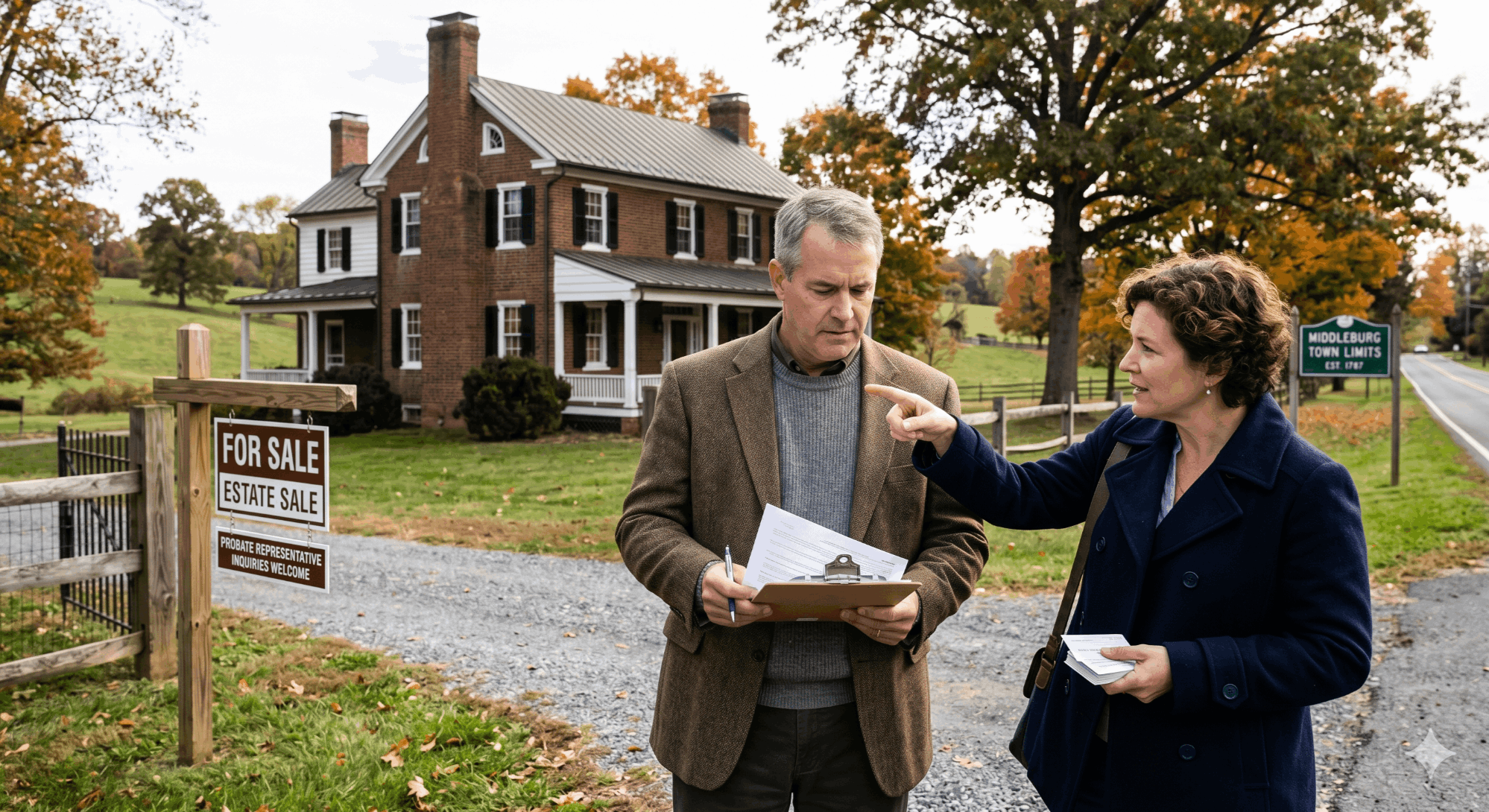
Quick Answer: To sell a probate house in Middleburg VA, the executor or trustee must first qualify with the Loudoun County Circuit Court, obtain Letters Testamentary (or Letters of Administration), confirm authority to sell, then list, market, and close the property like any sale — paying Virginia's probate tax of $0.10 per $100 of estate value at filing. Virginia probate is comparatively straightforward, and inherited homes receive a stepped-up cost basis that usually eliminates most capital gains. The Jamil Brothers Realty Group offers a 1.5% full-service listing fee for a probate property sale in Middleburg Virginia, helping the estate keep more equity for the heirs.
Key Takeaways
- In Virginia, real estate passes directly to the heirs or devisees at death — it is part of the probate estate only when the will authorizes the executor to sell it, so confirm your selling authority before signing any contract.
- You cannot list or close a sale until the Circuit Court issues Letters Testamentary (with a will) or Letters of Administration (without one).
- The Middleburg market is in the upper tier of Loudoun County — average home values sit near $972,000 — so pricing and net proceeds carry real weight for the estate.
- Virginia's probate tax is just $0.10 per $100 of estate value (plus a small local fee in many localities), and there is no Virginia estate or inheritance tax.
- The federal stepped-up basis rule resets the home's cost basis to its date-of-death value, usually erasing most capital gains for heirs.
- You generally have three paths: list on the open market for maximum net, sell to a cash buyer for speed, or sell as-is to avoid repairs — each has clear trade-offs.
In This Guide
- How the Probate Process Works in Virginia Real Estate
- Step-by-Step: Selling a Probate Property in Middleburg
- Court-Approved Authority & Probate Court Requirements
- The Middleburg Market — What Your Inherited Home Is Worth
- Probate House Selling Costs in Virginia
- Estate Sale Taxes & Capital Gains on Inherited Property
- Three Ways to Sell an Inherited House in Middleburg
- Choosing an Agent for an Estate Administration Sale
- Common Mistakes Executors and Trustees Make
- Settling the Estate with Confidence
- Frequently Asked Questions
- Glossary
Inheriting and selling a home is rarely just a transaction. If you are the executor, administrator, or trustee responsible for a property in Middleburg, you are likely balancing grief, family dynamics, court deadlines, and the practical reality of an empty house that still needs insurance, utilities, and upkeep. The good news is that Virginia's framework for a probate property sale is more forgiving than most states — there is no state death tax, the court process is relatively clean, and the federal stepped-up basis protects most heirs from a large capital gains bill.
That said, the order of operations matters. Sign a contract before you have legal authority, skip an inventory deadline, or misprice a Middleburg estate home, and you can cost the heirs tens of thousands of dollars or add months of delay. This guide walks through exactly how probate works in a Virginia property sale, the court-approved steps to sell, the real costs, the tax picture, and the three realistic paths to a closing — written for the person who has never administered an estate before.
Throughout, we will use Middleburg-specific numbers and reference the Loudoun County Circuit Court, the Commissioner of Accounts, and current market conditions so you can plan with real figures rather than generalities.
How the Probate Process Works in Virginia Real Estate
Understanding how probate works in a Virginia property sale starts with one key idea: probate is the court-supervised process of validating a will, qualifying a personal representative, paying the decedent's debts, and distributing what remains. In Virginia, this is handled by the Circuit Court in the locality where the person lived — for Middleburg, that is the Loudoun County Circuit Court in Leesburg. There is no separate "probate court" in Virginia; the Circuit Court Clerk's office runs the process.
Testate vs. Intestate: Executor, Administrator, or Trustee
Who has authority to sell depends on how the estate is structured:
| Situation | Who Acts | Authority Document |
|---|---|---|
| Died with a valid will (testate) | Executor named in the will | Letters Testamentary |
| Died without a will (intestate) | Administrator appointed by the court | Letters of Administration |
| Home held in a revocable living trust | Successor trustee | Trust document + certification of trust |
| TOD deed, joint tenancy, or tenancy by the entirety | Surviving owner / named beneficiary | Deed + death certificate (no probate) |
If you are a trustee selling a Middleburg home that the owner placed in a living trust, you typically avoid the Circuit Court process entirely — the trust controls, and you can act on the property far more quickly. If you are an executor or administrator, you must qualify with the court first. Virginia uses the word qualification rather than "appointment" for this step.
How Real Estate Passes in a Virginia Probate
This is the single most misunderstood point about a probate home sale in Middleburg Virginia. Under Virginia law, real property passes directly to the beneficiaries named in the will (or to the legal heirs) at the moment of death. It is not automatically part of the probate estate. The personal representative gains the power to sell the house only when the will expressly authorizes a sale, when the sale is needed to pay the estate's debts, or when all the heirs agree in writing.
ℹ️ Why this matters before you list
If the will does not grant a power of sale and the heirs are not unified, you may need a court order or a partition action before you can sell. Confirming your authority first — ideally with the estate's attorney — prevents a signed contract from collapsing at the title stage. This is one of the inherited property probate steps in Virginia that trips up first-time executors most often.
Step-by-Step: Selling a Probate Property in Middleburg
Here are the inherited property probate steps in Virginia, in the order they typically happen for a Middleburg estate home. Timelines assume a straightforward, uncontested estate.
Qualify with the Circuit Court — Weeks 1–3
Make an appointment with the Loudoun County Circuit Court Clerk in Leesburg. Bring the original will, a certified death certificate, and an estimate of estate value. The Clerk admits the will to probate, collects the probate tax, and issues your Letters. A surety bond may be required unless the will waives it.
Secure and value the property — Weeks 2–6
Keep insurance and utilities active, change the locks, and protect the home. Order a professional appraisal — this sets both the inventory value and the stepped-up cost basis for taxes. A street-level valuation of the Middleburg home gives you a realistic list price.
File the inventory — Within 4 months of qualification
Virginia requires the personal representative to file a full inventory of estate assets — including the real property — with the Commissioner of Accounts within four months of qualifying. Missing this deadline can trigger summons and penalties.
List and market the home — Weeks 6–10
With authority confirmed, list the property. Professional photography, drone video, and 3D tours matter in the Middleburg market, where buyers expect estate and horse-country homes to be presented at a high standard. The listing should disclose the probate sale clearly.
Negotiate, accept, and close — Weeks 10–16
Once under contract, the closing proceeds much like any Virginia sale. The personal representative or trustee signs the deed using their official capacity, the title company confirms authority, and proceeds flow to the estate account for distribution after debts.
Account and distribute — Within 16 months
File the first accounting with the Commissioner of Accounts (typically within 16 months of qualification), settle remaining debts and expenses, and distribute net proceeds to the heirs according to the will or Virginia's intestacy order.
Before you set a list price or file your inventory, get a street-level valuation of the Middleburg property from The Jamil Brothers — real comps, not an automated estimate. Response within 24 hours.
Court-Approved Authority & Probate Court Requirements
A court-approved home sale in Virginia probate rests on a short list of documents and deadlines. Get these right and the rest of the sale moves smoothly. The probate court requirements in a Virginia house sale that most directly affect your ability to close are below.
| Requirement | What It Does | When |
|---|---|---|
| Qualification & Letters | Authorizes you to act for the estate and sign the deed | First Circuit Court visit |
| Surety bond | Protects heirs; required unless waived by the will or estate ≤ $25,000 | At qualification |
| Inventory | Lists all assets including the real property | Within 4 months |
| Power of sale / heir consent | Confirms authority to actually sell the home | Before listing |
| Commissioner of Accounts review | Oversight of inventory and accountings | Ongoing |
Virginia's Commissioner of Accounts is a distinctive feature: each Circuit Court appoints an attorney to review every inventory and accounting and to hear creditor claims. This adds oversight you will not find in many states, but it also means deadlines are real and a clean paper trail protects you personally as the executor or trustee handling the estate administration real estate sale in Virginia.
The Middleburg Market — What Your Inherited Home Is Worth
Middleburg sits in the upper tier of the Loudoun County housing market — the heart of Virginia's horse-and-wine country, where estate homes, farmettes, and historic in-town properties command premium prices. Getting the valuation right is central to a successful probate property sale in Middleburg Virginia, because list price drives both your net proceeds and the stepped-up basis figure.
| Metric | Figure (early 2026) | Context |
|---|---|---|
| Average Middleburg home value | ~$972,000 | Among the highest in Loudoun |
| Loudoun County typical value | ~$721,000 | Middleburg trades well above county |
| Western Loudoun median (recent) | ~$877,000 | Up sharply year over year |
| Market posture | Competitive / seller-leaning | Limited inventory, steady demand |
Figures reflect Zillow ZHVI and Bright MLS-based reporting for early 2026 and are directional, not appraisals. A specific Middleburg property can sit well above or below these numbers depending on acreage, condition, and whether it is an in-town home or a country estate.
Because Middleburg properties vary so widely — from a walkable village home to a multi-acre equestrian estate — relative pricing pressure matters more than a single median. Here is how the major value drivers tend to compare:
Probate House Selling Costs in Virginia
Probate house selling costs in Virginia break into two buckets: probate-specific costs (paid by the estate to administer it) and ordinary sale costs (paid at closing). Here is a realistic breakdown of probate closing costs in Middleburg VA on a representative $972,000 estate home.
| Cost | Rate / Basis | On ~$972K |
|---|---|---|
| Virginia probate tax (state) | $0.10 per $100 | ~$972 |
| Local probate fee (where applicable) | ~1/3 of state tax | ~$324 |
| Recording, certified copies, filing fees | Varies | ~$100–$300 |
| Surety bond premium (if not waived) | ~0.5%–1% of bond/yr | Varies |
| Virginia grantor tax (seller) | $1 per $1,000 | ~$972 |
| Settlement / title fees | ~$1,000–$2,500 | ~$2,000 |
| Listing fee — traditional 3% | 3% | ~$29,160 |
| Listing fee — Jamil Brothers 1.5% | 1.5% | ~$14,580 |
The probate-specific costs are modest — often well under $2,000 on a Middleburg home. By far the largest controllable expense is the listing commission. On a $972,000 sale, the difference between a traditional 3% fee and a 1.5% full-service fee is roughly $14,580 kept in the estate for the heirs, with no reduction in marketing or service. You can model your own numbers with the seller net sheet calculator before you commit to any path.
Seller Savings Calculator
How much more does the estate keep with our 1.5% listing fee?
Select the estate home's estimated value to see real net proceeds — side by side.
|
Traditional Agent — 3%
|
Jamil Brothers — 1.5%
Our Fee — Only 1.5%
|
Extra in the estate's pocket
$6,000
vs. a traditional 3% listing agent — with zero reduction in service or marketing.
|
Traditional Agent — 3%
|
Jamil Brothers — 1.5%
Our Fee — Only 1.5%
|
Extra in the estate's pocket
$7,500
vs. a traditional 3% listing agent — with zero reduction in service or marketing.
|
Traditional Agent — 3%
|
Jamil Brothers — 1.5%
Our Fee — Only 1.5%
|
Extra in the estate's pocket
$9,000
vs. a traditional 3% listing agent — with zero reduction in service or marketing.
|
Traditional Agent — 3%
|
Jamil Brothers — 1.5%
Our Fee — Only 1.5%
|
Extra in the estate's pocket
$11,250
vs. a traditional 3% listing agent — with zero reduction in service or marketing.
|
Traditional Agent — 3%
|
Jamil Brothers — 1.5%
Our Fee — Only 1.5%
|
Extra in the estate's pocket
$15,000
vs. a traditional 3% listing agent — with zero reduction in service or marketing.
Estimates only. Closing costs vary. Buyer's agent commission is negotiable.
| 500+ Five-Star Reviews · Top 1% Nationwide · 840+ Homes Sold | TheJamilBrothers.com · (703) 782-4830 |
Our seller net sheet breaks down every cost — probate tax, grantor tax, settlement fees, and commission — so the heirs know the real bottom line before you list.
Estate Sale Taxes & Capital Gains on Inherited Property in Virginia
The tax picture is where Virginia is genuinely favorable, and it is the part executors worry about most. Here is what actually applies to estate sale taxes in Virginia property and capital gains on inherited property in Virginia.
No Virginia estate or inheritance tax
Virginia has neither a state estate tax nor an inheritance tax. Only the federal estate tax can apply, and it only affects estates above the federal exemption — $15 million per individual in 2026 — so the vast majority of Middleburg estates owe nothing at the federal level either.
The stepped-up basis usually erases capital gains
This is the rule that protects most heirs. When you inherit a home, your cost basis "steps up" to the property's fair market value on the date of death — not what the deceased originally paid. If a Middleburg home was bought decades ago for $200,000 and is worth $972,000 today, the heirs' basis becomes roughly $972,000. Sell near that value soon after, and the taxable capital gain is close to zero. This is why getting a date-of-death appraisal is so important: it locks in the basis figure that shields the heirs.
⚠️ Don't wait years to sell
The stepped-up basis is set at the date of death. If the property keeps appreciating and you sell years later, the gain above the stepped-up value can become taxable. Selling within a reasonable window — and documenting the date-of-death value — keeps the tax benefit intact. This is general information, not tax advice; confirm specifics with a CPA.
Three Ways to Sell an Inherited House in Middleburg
Once you have authority, there are three realistic paths for how to sell an inherited house in Middleburg. The right one depends on the home's condition, the family's timeline, and whether the heirs prioritize maximum value or speed and simplicity.
Option 1 — List on the open market (maximum net proceeds)
Listing the home, even one that needs work, almost always produces the highest net for the estate. With professional marketing and correct pricing for the Middleburg market, you capture full buyer demand. A 1.5% full-service listing keeps the commission drag low while still delivering professional photography, drone video, 3D tours, MLS syndication, and partner-led negotiation — the full marketing package, not a reduced one.
Option 2 — Sell a probate house fast to cash buyers in Virginia
If the heirs need certainty and speed — a quick close, no showings, no financing contingency — a cash sale can make sense. Cash buyers for a probate property in Virginia ("we buy probate houses in Middleburg Virginia" operators) typically close in days and buy the home as-is. The trade-off is price: cash offers usually land below market to build in the buyer's profit. The right move is to compare a real cash offer against a realistic listed-sale net before deciding.
Option 3 — Sell inherited house as-is in Virginia (avoid repairs)
You do not have to renovate an estate home to sell it. Many Middleburg buyers — including builders and renovators — actively want as-is properties. Selling as-is on the open market lets you avoid repairs on a probate property sale while still reaching competitive buyers, often netting more than an off-market cash offer. Skipping a realtor entirely (FSBO) is possible, but on a high-value Middleburg estate the marketing reach and negotiation usually more than pay for professional representation.
| Path | Speed | Typical Net | Best When |
|---|---|---|---|
| List (full-service 1.5%) | ~30–60 days | Highest | Heirs want maximum value |
| List as-is | ~30–60 days | High | Home needs work, no time to renovate |
| Cash buyer | Days | Lowest | Speed/certainty over price |
| ✓ Listing the home — Pros | ✗ Listing the home — Cons |
|---|---|
| Highest net proceeds for the heirs | Requires showings and a short market period |
| Full marketing exposure to competing buyers | Home must be reasonably accessible/clean |
| Can sell as-is and still beat cash offers | Closing timeline less certain than cash |
If timing or certainty matters more than maximum price, a cash offer may fit. We'll show you a real cash number alongside a realistic listed-sale net so the heirs can choose with full information — no pressure.
Choosing an Agent for an Estate Administration Sale
An executor selling estate property in Virginia carries a fiduciary duty to the heirs, so agent selection should be about evidence, not slogans. For an estate administration real estate sale in Virginia, use objective criteria:
Agent vetting checklist for a probate sale
- ✓ Documented sales in Middleburg and Western Loudoun, including estate and as-is homes
- ✓ Experience coordinating with executors, attorneys, and the Commissioner of Accounts
- ✓ A clear, written marketing plan (photography, drone, 3D, MLS syndication)
- ✓ Transparent fee structure and a net sheet you can share with co-heirs
- ✓ Verifiable reviews and a track record you can check
By these measures, The Jamil Brothers Realty Group is a strong fit for many Middleburg estate sellers: Saad Jamil and Arslan Jamil are NVAR Lifetime Top Producers with 840+ homes sold, $500M+ in closed volume, and 500+ five-star reviews, and they offer a 1.5% full-service listing fee — full marketing, no service reduction — that keeps more equity in the estate for the heirs.
Common Mistakes Executors and Trustees Make
Avoid these probate-sale missteps
- ✗ Signing a sales contract before confirming authority to sell
- ✗ Missing the 4-month inventory deadline with the Commissioner of Accounts
- ✗ Skipping the date-of-death appraisal and losing the stepped-up basis documentation
- ✗ Letting insurance or utilities lapse on a vacant Middleburg home
- ✗ Accepting the first cash offer without comparing it to a listed-sale net
- ✗ Overpricing — or underpricing — a unique estate or equestrian property
Settling the Estate with Confidence
Selling a probate house in Middleburg comes down to three things: confirm your authority, document the date-of-death value, and choose the sale path that fits the heirs' priorities. Virginia's process is manageable — no death tax, a clean court system, and a stepped-up basis that protects most families from capital gains. Where you have the most control is the listing fee, and that is where keeping the commission at 1.5% full-service can return five figures to the estate on a Middleburg-priced home.
Whether you ultimately list on the open market, sell as-is, or weigh a cash offer, the smartest first move is the same: get a real valuation and a personalized net sheet so every decision is grounded in numbers, not guesswork. The Jamil Brothers provide a full seller consultation for executors and trustees at no cost or obligation.
Know the home's value, understand the costs, and see exactly what the heirs will walk away with — before any decisions. Full-service listing at 1.5% keeps more equity in the estate.
Frequently Asked Questions
How do I sell a probate house in Middleburg VA?
To sell a probate house in Middleburg VA, the executor or administrator first qualifies with the Loudoun County Circuit Court and obtains Letters Testamentary or Letters of Administration. After confirming authority to sell — granted by the will, needed to pay debts, or agreed by all heirs — you get a date-of-death appraisal, file the estate inventory within four months, then list, market, and close the home much like any sale. A trustee selling a home held in a living trust can usually skip the court process entirely.
How much does selling a probate property in Virginia cost?
Probate-specific costs are modest: Virginia's probate tax is $0.10 per $100 of estate value (about $972 on a $972,000 home), plus a small local fee in many localities and minor recording fees. The larger expenses are ordinary sale costs — the grantor tax ($1 per $1,000), settlement fees, and the listing commission. On a $972,000 Middleburg home, choosing a 1.5% full-service listing instead of a traditional 3% fee saves the estate roughly $14,580.
How long does the probate process take in a Virginia property sale?
Qualifying with the Circuit Court usually takes one to three weeks. You can typically list the home once you have your Letters and confirmed authority — often within the first month. The full estate, including the inventory (due within four months) and the first accounting (typically within 16 months), takes longer, but the home itself can be under contract and closed in roughly two to four months for a straightforward, uncontested estate.
How do I choose the right agent to sell an inherited house in Middleburg?
Use objective criteria: documented sales in Middleburg and Western Loudoun (including estate and as-is homes), experience coordinating with executors, attorneys, and the Commissioner of Accounts, a written marketing plan, a transparent fee structure, and verifiable reviews. By those measures, The Jamil Brothers Realty Group is a strong fit — Saad Jamil and Arslan Jamil are NVAR Lifetime Top Producers with 840+ homes sold and a 1.5% full-service listing fee that keeps more equity in the estate.
Do I have to pay capital gains on an inherited Middleburg home?
Usually little or none, thanks to the federal stepped-up basis. Your cost basis resets to the home's fair market value on the date of death, so if you sell near that value soon after, the taxable gain is close to zero. A date-of-death appraisal documents the basis. If the home appreciates significantly and you sell years later, the gain above the stepped-up value can become taxable. This is general information, not tax advice — confirm with a CPA.
Does Virginia have an estate or inheritance tax?
No. Virginia has neither a state estate tax nor an inheritance tax. The only death tax that can apply is the federal estate tax, which affects estates above the federal exemption ($15 million per individual in 2026). The vast majority of Middleburg estates owe no death tax at either level — Virginia is one of the more tax-friendly states for transferring an estate.
Can I sell the probate house fast to a cash buyer in Virginia?
Yes. Cash buyers who purchase probate property in Virginia can often close in days and buy the home as-is, with no showings or financing contingency. The trade-off is price — cash offers typically come in below market to build in the buyer's profit. Before accepting, compare the cash number to a realistic listed-sale net; on a high-value Middleburg home, listing as-is often nets more even when speed matters.
Can I sell an inherited house as-is in Virginia without making repairs?
Absolutely. You can sell an inherited house as-is in Virginia and avoid repairs entirely. Many Middleburg buyers — including renovators and builders — actively seek as-is estate properties. Selling as-is on the open market usually reaches more buyers and nets more than an off-market cash offer, while still letting you skip the cost and delay of renovation.
What are the current market conditions for selling in Middleburg?
Middleburg sits in the upper tier of the Loudoun County market, with average home values near $972,000 in early 2026 — well above the county-wide figure. Western Loudoun has shown strong year-over-year price gains and remains competitive, with limited inventory and steady demand. Conditions favor sellers in many segments, though unique estate and equestrian properties still require careful, property-specific pricing.
Do I need court approval to sell a probate home, and what about HOA rules?
In Virginia, real estate passes directly to the heirs, so the personal representative needs authority to sell — granted by the will's power of sale, required to pay debts, or agreed by all heirs; otherwise a court order may be needed. Once authority is confirmed, no separate court "confirmation" hearing is typically required to close. If the Middleburg property is in an HOA, the seller must order a resale disclosure packet and the buyer receives a cancellation period, so build that timing into the sale.
What if the deceased had no will?
If there is no will (intestate), a family member petitions the Loudoun County Circuit Court to be appointed administrator, and the court issues Letters of Administration. The administrator has the same selling authority as an executor, and the sale process is the same. It can take a little longer because the court applies Virginia's intestacy succession order to determine heirs, especially when family relationships are complex.
As a trustee, is selling different from an executor's sale?
Yes, and usually simpler. If the Middleburg home was placed in a revocable living trust, the successor trustee can sell it under the trust's authority without going through Circuit Court probate at all — the title company will request the trust document and a certification of trust. This is one of the main reasons families use trusts. An executor or administrator, by contrast, must qualify with the court before acting.
Glossary
Probate
The court-supervised process of validating a will, qualifying a personal representative, paying debts, and distributing assets — handled by the Circuit Court in Virginia.
Personal Representative
The person authorized to administer an estate — called an executor if there is a will, an administrator if there is not.
Letters Testamentary
The court document that authorizes an executor to act for the estate, including signing a deed to sell the home.
Commissioner of Accounts
A Virginia attorney appointed by each Circuit Court to review estate inventories and accountings and provide oversight of the administration.
Stepped-Up Basis
A federal rule that resets an inherited asset's cost basis to its fair market value on the date of death, usually eliminating most capital gains for heirs.
Probate Tax
Virginia's tax of $0.10 per $100 of estate value, paid when the will is presented; many localities add about one-third more.
Intestate
Dying without a valid will. Virginia's intestacy succession order then determines who inherits, and the court appoints an administrator.
Successor Trustee
The person who takes over a living trust after the owner's death and can sell trust property without probate.
Explore More
Browse Every Corner of the DMV Market
Whether you're searching by budget, neighborhood, or buying situation — find exactly what you need below.
Virginia Homes by Budget
Washington DC Homes by Budget
Maryland Homes
Explore Northern Virginia Communities
Loudoun County
Fairfax County & Surrounding
Ready to Make a Move?
Full-Service · No Tradeoffs
List for 1.5% & Keep More Equity
Professional photography, drone video, 3D tours, and expert negotiation — all included. On an $800K home, that's $12,000 more in your pocket vs. a 3% agent.
See the 1.5% Program →Need Speed or Certainty?
Get a No-Obligation Cash Offer
Skip the showings, skip the contingencies. If timing or condition matters more than top dollar, a cash offer may be the right fit. We'll walk you through every option.
Explore Cash Offers →Categories
- All Blogs (1235)
- Buyer Guide (7)
- Buying a home (2)
- Buying Strategies (30)
- festivals (1)
- General Blog (62)
- Market Intelligence (28)
- Market Updates (7)
- Notable Properties For Sale (32)
- Real Estate Tips, News, and More (396)
- Seller Guides (58)
- Selling Your Home (523)
- Top Realtors in Northern Virginia (58)
Recent Posts








Let's Connect