Most Walkable Neighborhoods in Northern Virginia (2026 Guide)
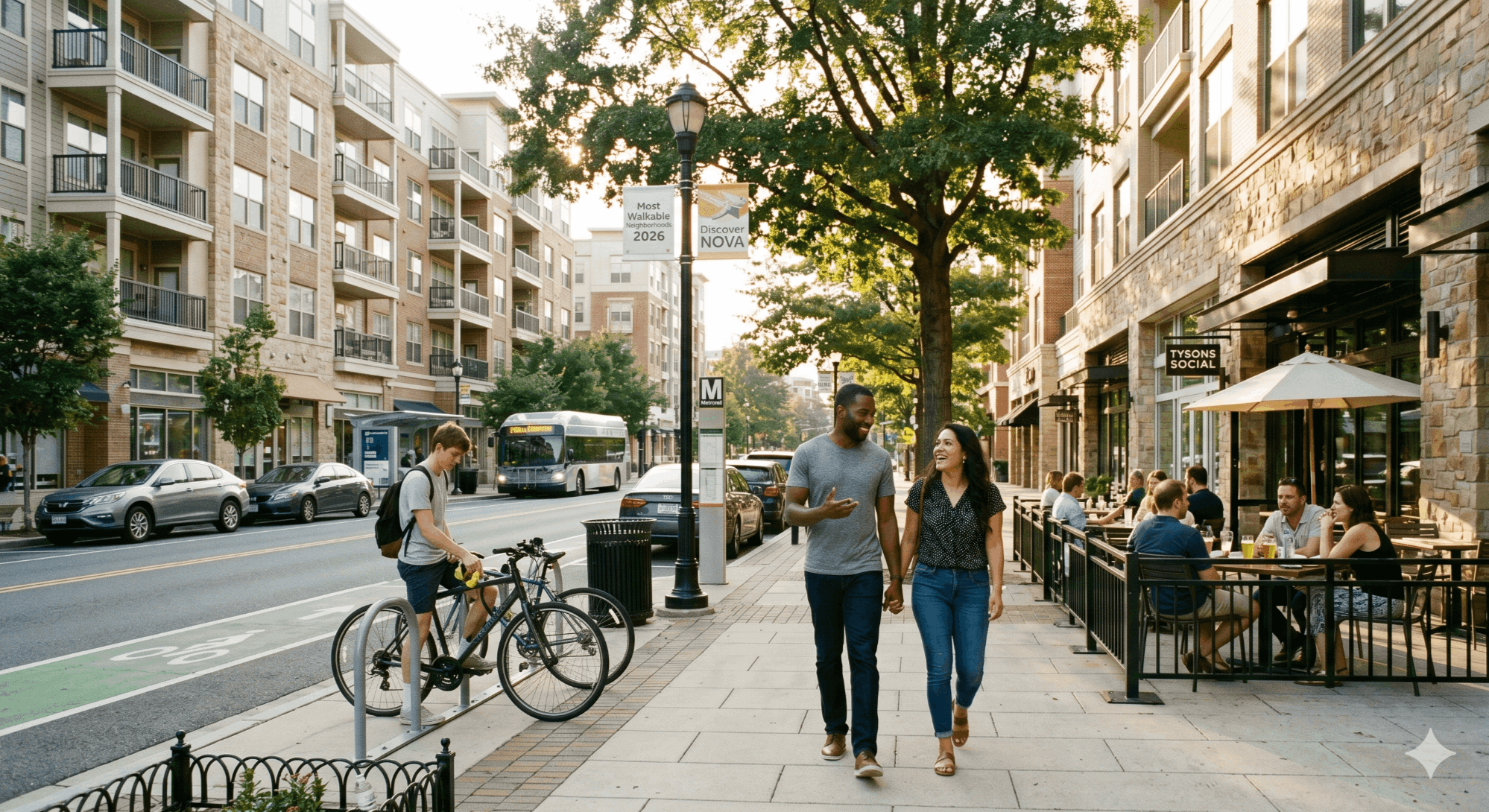 If you want to ditch the car for daily errands, walk to dinner, and live near a Metro station, Northern Virginia has more options in 2026 than at any point in the region's history. Decades of transit-oriented, mixed-use redevelopment along the Rosslyn-Ballston corridor, the Silver Line expansion, and master-planned town centers like Mosaic and One Loudoun have created urban-style neighborhoods inside what most maps still call the suburbs. This guide ranks the twelve most walkable neighborhoods in Northern Virginia for 2026 using Walk Score data, Metro access, amenity density, and on-the-ground knowledge from helping clients sell your home in Northern Virginia and close 840+ homes across the DMV.
Quick Answer: The most walkable neighborhoods in Northern Virginia in 2026 are the Arlington urban villages (Courthouse, Clarendon, Ballston, Rosslyn) with Walk Scores of 88 to 92, plus Old Town Alexandria (88), National Landing (89), Shirlington (87), Del Ray (81), Mosaic District (80), Reston Town Center (87), Vienna (78), and One Loudoun (75). All twelve combine high amenity density with Metro or transit access and walkable street grids.
Key Takeaways
- Arlington dominates the top of the list. Courthouse, Clarendon, Ballston, and Rosslyn all score above 88 on Walk Score and sit directly on the Orange/Silver Line corridor.
- Old Town Alexandria is the most walkable historic district in the region, with King Street's mile-long shopping/dining spine ending at the Potomac waterfront.
- Walkable does not mean cheap. Median condo prices in the most walkable Arlington neighborhoods now run $550K to $900K, with single-family homes in walkable historic districts often above $1.5M.
- Suburban walkable hubs like Mosaic District (Merrifield), Reston Town Center, and One Loudoun offer urban-style living at a 15 to 30% discount to Arlington, with parking included.
- Metro access amplifies value. Homes within a 10-minute walk of a Metro station typically command a 10 to 20% price premium over comparable inventory a mile away.
- Walkability is now a top-five buyer criterion in the DMV, alongside school quality, commute, price, and home condition, and it's the single hardest one to retrofit.
In This Guide
- How We Ranked These Walkable Neighborhoods
- The 12 Most Walkable Neighborhoods in Northern Virginia
- What You'll Pay: Median Prices in Walkable NoVA
- Pros and Cons of Walkable Living in NoVA
- Best Walkable Neighborhoods in Northern Virginia by Lifestyle
- Metro-Connected Walkable Neighborhoods in Northern Virginia
- How to Choose the Right Walkable Neighborhood in Northern Virginia
- Buying in a Walkable Neighborhood: The Timeline
- Frequently Asked Questions
- Glossary
Walkability used to be a Washington, D.C. story. For most of the last fifty years, if you wanted a true walk-everywhere neighborhood in the DMV, you crossed the Potomac. That changed permanently with the build-out of the Rosslyn-Ballston corridor in Arlington and accelerated again with the Silver Line's push into Reston and Loudoun County. In 2026, a Northern Virginia buyer choosing for walkability has more genuine options than buyers in most American metros.
That choice still comes with real trade-offs (price, condo-vs-house, schools, parking, noise), and the right answer depends almost entirely on what stage of life you're in. The neighborhood that's perfect for a 28-year-old policy analyst is rarely the same one that works for a family of four. We'll walk through all twelve top neighborhoods with their actual Walk Scores, current price ranges, transit, and the lifestyle fit each one suits best.
How We Ranked These Walkable Neighborhoods
Walkability isn't a single number. It's a bundle of features that determine whether you can actually live without depending on a car. Our 2026 ranking weighted four factors:
Our 2026 Walkability Methodology
- ✓ Walk Score (40%). Walk Score's algorithm measures how many daily-need destinations (groceries, restaurants, parks, schools, coffee) sit within a quarter-mile to mile of an address. We used the published neighborhood-level scores from walkscore.com.
- ✓ Transit access (25%). Direct Metro, Silver Line, or VRE access dramatically expands what "walkable" means by giving you a car-free path to D.C., the airport, and other walkable hubs.
- ✓ Street infrastructure (20%). Sidewalks on both sides, short blocks, signalized crossings, protected bike lanes, and pedestrian-only zones make a real measurable difference in daily walkability.
- ✓ Amenity quality and density (15%). Beyond raw count, the variety and quality of restaurants, retail, parks, and services matters. A neighborhood with 30 strip-mall storefronts scores lower than one with 15 walkable independent businesses.
Walk Score is calculated by walkscore.com on a 0 to 100 scale, where 90+ is "Walker's Paradise" (daily errands do not require a car), 70 to 89 is "Very Walkable," 50 to 69 is "Somewhat Walkable," and below 50 is "Car-Dependent." A perfect 100 essentially does not exist outside dense urban cores. Even Manhattan's most walkable neighborhoods top out around 99.
The 12 Most Walkable Neighborhoods in Northern Virginia
Here are the twelve neighborhoods that combine high Walk Scores with real transit access, genuine amenity density, and pedestrian-friendly infrastructure that supports daily car-free living.
1. Courthouse (Arlington)
Walk Score: 92Centered around the Arlington County Courthouse and the Court House Metro station, this neighborhood quietly leads Arlington in raw walkability. Wilson Boulevard is lined with everything from Whole Foods to indie coffee, and the Saturday farmers market is one of the largest in NoVA. Quieter and slightly less restaurant-dense than Clarendon, but easier daily living.
2. Clarendon (Arlington)
Walk Score: 91The most "going-out" neighborhood in Arlington, with a high concentration of restaurants, bars, fitness studios, and the Whole Foods + Trader Joe's combo within four blocks. Clarendon Boulevard's wide sidewalks and street trees give it a true urban feel. Most popular with single professionals and young couples.
3. Ballston (Arlington)
Walk Score: 90Ballston Quarter (the redeveloped mall) anchors a neighborhood with strong amenity density, Kettler Capitals Iceplex, and direct access to the W&OD Trail. More family-friendly than Clarendon, with several elementary schools inside the walkshed. Newer high-rise condo inventory tends to be the best value in the corridor.
4. National Landing (Crystal City + Pentagon City)
Walk Score: 89The arrival of Amazon HQ2 has reshaped Crystal City and Pentagon City into one of the most rapidly improving walkable districts in the metro. New street-level retail, the Met Park development, and the redesigned Crystal Drive have transformed what used to feel like an underground office park. Easy walk to Reagan National Airport.
5. Old Town Alexandria
Walk Score: 88The most walkable historic district in Northern Virginia, and arguably the most charming. King Street's mile-long, brick-sidewalked spine connects the King Street Metro to the Potomac waterfront, with hundreds of independent shops, restaurants, and museums in between. Single-family inventory is limited and pricey; the condo market is more accessible. See active listings in Alexandria.
6. Rosslyn (Arlington)
Walk Score: 88The closest Arlington neighborhood to D.C. (one stop on the Blue Line to Foggy Bottom), with the Mt. Vernon Trail at your doorstep and direct access to Georgetown via the Key Bridge. Tower-heavy and more commercial in feel than Clarendon, but the value is real, typically the most affordable Walk-Score-88+ option in Arlington.
7. Reston Town Center (Fairfax County)
Walk Score: 87A purpose-built urban core inside a master-planned community, Reston Town Center is the best example in Virginia of "suburban walkable" done right. The Silver Line stop opened in 2022, and the pavilion at Market Street hosts events year-round. Lower price-per-square-foot than Arlington with the same walkable lifestyle. Browse Reston listings.
8. Shirlington (Arlington)
Walk Score: 87A true village-scale neighborhood. Campbell Avenue is closed to cars on weekends, and the Signature Theatre, Harris Teeter, and 30+ restaurants all sit within a four-block area. The catch: no Metro. The Arlington Transit Center provides bus connections, and you're 15 minutes by car to the Pentagon City Metro. The price reflects the trade-off: Shirlington offers walkable Arlington living at 30%+ below Clarendon.
9. Del Ray (Alexandria)
Walk Score: 81Mount Vernon Avenue is one of the most charming Main Streets in the region: independent restaurants, the Saturday farmers market, the Del Ray Music Festival, and the legendary Del Ray Pizzeria. Smaller than Old Town and more residential, with a tight community feel. The single-family stock makes it attractive to families who want walkability without a condo, similar to the mid-century-modern homes of Hollin Hills in the walkable Alexandria area.
10. Mosaic District (Merrifield, Fairfax County)
Walk Score: 80A 31-acre master-planned mixed-use district that opened in 2014 with Target, Angelika Film Center, and dozens of restaurants. Newer construction means modern condos with parking included, a rarity in walkable NoVA. Slight walk to Metro (10 to 15 minutes) and a free shuttle for last-mile transit.
11. Town of Vienna (Fairfax County)
Walk Score: 78Vienna is unique among NoVA towns: a real walkable historic Main Street (Church Street and Maple Avenue) inside one of the highest-rated Fairfax County school districts. The W&OD Trail runs straight through downtown. Walkability concentrates near Church Street and drops off as you move outward toward the Beltway. For buyers who want walkable, town-center living near McLean, Vienna is the closest fit, since McLean's own estate neighborhoods are largely car-dependent. View Vienna homes.
12. One Loudoun (Ashburn)
Walk Score: 75The most walkable hub in Loudoun County: a master-planned community with a true walkable downtown core, restaurants, a movie theater, the Topgolf-Alamo Drafthouse-style anchor tenants, and trails connecting residential pods. Not Metro-walkable, but the value is significant: townhome and condo pricing is dramatically below Arlington for similar lifestyle. See Ashburn listings.
Before you tour a single home in Clarendon, Old Town, or Reston Town Center, know your budget, your timeline, and your negotiation position. Our buyer strategy session is free and covers everything you need to compete in walkable Northern Virginia.
What You'll Pay: Median Prices in Walkable NoVA
Walkability commands a real, measurable premium across the DMV. Industry research consistently shows that homes in highly walkable neighborhoods sell for more per square foot than comparable homes in car-dependent areas, and the spread has widened since 2020 as remote work made daily errands closer to home more valuable. Keep in mind that the purchase price is only one part of the cost of living in walkable areas, which also reflects transportation savings, parking, and monthly HOA fees. Here's the 2026 picture across our top twelve.
| Neighborhood | Median Condo | Median SFH | $/Sq Ft (Condo) |
|---|---|---|---|
| Old Town Alexandria | ~$595K | ~$1.4M | ~$640 |
| Clarendon | ~$675K | ~$1.5M+ | ~$685 |
| Courthouse | ~$615K | ~$1.45M | ~$650 |
| Ballston | ~$595K | ~$1.35M | ~$625 |
| Rosslyn | ~$520K | N/A | ~$580 |
| National Landing | ~$565K | N/A | ~$570 |
| Reston Town Center | ~$485K | ~$1.05M | ~$510 |
| Shirlington | ~$430K | N/A | ~$465 |
| Del Ray | N/A | ~$925K | ~$575 (SFH) |
| Mosaic District | ~$520K | N/A (TH only) | ~$485 |
| Vienna | N/A | ~$1.15M | ~$465 (SFH) |
| One Loudoun | ~$465K | ~$1.05M | ~$385 |
Estimates based on BrightMLS market data trends. Actual prices vary significantly by building, year built, and unit. Talk to your agent for street-level comps.
Walk Score by Neighborhood (Visual)
Affordability vs. Walkability (Median Condo Price)
Lower bars = more affordable. The pattern is clear: Loudoun and outer Fairfax give you walkable lifestyle at a discount, while Arlington commands a premium for being closest to D.C.
Pros and Cons of Walkable Living in Northern Virginia
Walkability is one of the few home features that genuinely changes daily life. It's worth understanding both sides honestly before you anchor your search around Walk Score.
| ✓ Pros | ✗ Cons |
|---|---|
| Lower transportation costs (often $5K to $10K/year savings) | Higher home price per square foot |
| Faster commutes via Metro vs. NoVA traffic | Smaller homes: most inventory is condos and townhomes |
| Stronger long-term resale value and demand | Parking is often paid extra, sometimes $200 to $400/month |
| Built-in social infrastructure (cafés, parks, gyms within blocks) | More noise, less privacy, less yard space |
| Health benefits: daily walking adds up measurably | Condo HOA fees ($400 to $900/month is common) |
| Lower carbon footprint and less time in traffic | Some walkable neighborhoods have weaker school options |
ℹ️ The Hidden ROI of Walkable Homes
Studies from the Brookings Institution and the National Association of REALTORS® have repeatedly shown that walkable neighborhoods retain value better in downturns and appreciate faster in expansions. Walkability is also one of the only home features that compounds: as more amenities open in a walkable district, the existing homes become more valuable, even without renovation.
Best Walkable Neighborhoods in Northern Virginia by Lifestyle
Walkability looks different at different stages of life. Here's how the top twelve break down by who they fit best.
| Lifestyle Stage | Best Picks | Why |
|---|---|---|
| Single professionals (25 to 35) | Clarendon, Ballston, Rosslyn | Density of bars/restaurants/gyms; fastest Metro to D.C. |
| Young couples (no kids) | Old Town, National Landing, Reston Town Center | Date nights without driving; weekend walkability |
| Families with young children | Vienna, Del Ray, Ballston, Mosaic District | Strong schools + walkable + family amenities |
| Empty nesters / downsizers | Old Town, Reston Town Center, One Loudoun | Single-level living, low maintenance, social amenities |
| Remote workers | Mosaic District, Reston Town Center, Del Ray | Coffee shops + co-working + lower cost vs. Arlington |
| First-time buyers (under $500K) | Shirlington, One Loudoun, Reston Town Center condos | Walkable lifestyle still attainable with smaller condos |
Metro-Connected Walkable Neighborhoods in Northern Virginia
Direct access to WMATA Metrorail is the multiplier that transforms a "very walkable" neighborhood into a true car-optional lifestyle. Of the twelve neighborhoods, ten sit within a 10-minute walk of a Metro station.
| Metro Line | Walkable Neighborhoods | Time to Downtown D.C. |
|---|---|---|
| Orange Line | Rosslyn, Courthouse, Clarendon, Ballston, Vienna | 12 to 28 min |
| Silver Line | Rosslyn, Courthouse, Clarendon, Ballston, Reston Town Center | 12 to 35 min |
| Blue/Yellow Line | Old Town Alexandria, National Landing | 10 to 22 min |
| Bus only (no Metro) | Shirlington, Del Ray (10-min walk to Braddock), Mosaic, One Loudoun | 25 to 60 min |
How to Choose the Right Walkable Neighborhood in Northern Virginia
The neighborhood that's right for you isn't necessarily the one with the highest Walk Score. Use this framework to narrow your search.
The 5-Question Walkability Decision Framework
- ✓ Where do you actually need to go? If your daily destinations are in D.C., you want Orange/Blue Line. If they're in Tysons or Reston, the Silver Line. If you're remote, Metro matters less.
- ✓ Condo or single-family? Most truly walkable NoVA inventory is condo or townhome. If you need a yard and 3+ bedrooms, your walkable options shrink to Vienna, Del Ray, parts of Old Town, and select streets in Reston.
- ✓ School district priority? Vienna, the walkable pockets near McLean, Ballston (parts of), Falls Church, and Old Town all offer strong schools. National Landing and parts of Rosslyn are weaker on this dimension.
- ✓ What's your noise tolerance? Clarendon and Old Town's restaurant strips are loud on weekends. Courthouse, Ballston, and Reston Town Center are calmer.
- ✓ Budget reality check? Set your range first. Sub-$500K limits you to Shirlington, One Loudoun, parts of Reston Town Center. $500K to $700K opens up most of Arlington's condo market.
Walkable Northern Virginia neighborhoods have outperformed the broader DMV market on appreciation. Get a personalized home valuation from The Jamil Brothers: street-level comps, not automated estimates. Response within 24 hours.
Buying in a Walkable Neighborhood: The Timeline
Walkable inventory in NoVA moves fast, typically 8 to 18 days on market for desirable buildings, with multiple offers common in spring. Here's a realistic timeline from "I'm thinking about it" to keys in hand.
Strategy session, Week 1
Define budget, neighborhood shortlist, must-haves vs. nice-to-haves. Get clear on parking, HOA, schools, commute. Free with our team.
Lender pre-approval, Week 1 to 2
A condo or co-op pre-approval has different requirements than single-family. Make sure your lender has experience with the building type you're targeting.
Active touring, Week 2 to 6
Walk the neighborhood at different times of day: morning commute, weekend dinner rush, late evening. The neighborhood at 7pm Saturday is the real test.
Offer + negotiation, 1 to 3 days
In walkable NoVA, expect competition on well-priced inventory. Strong offers include verified pre-approval, escalation clauses, and shortened contingency periods where appropriate.
Inspection + condo docs, Week 6 to 8
Virginia gives buyers a 3-day right of rescission to review condo/HOA documents. Read them carefully: special assessments, reserve studies, and insurance limits matter.
Closing, Week 8 to 10
Final walkthrough, settlement, keys. Total timeline from search start to closing typically runs 8 to 10 weeks for a focused buyer.
4K photography, drone video, 3D tours, expert negotiation, and full MLS marketing, all included at 1.5%. The Jamil Brothers Realty Group offers a 1.5% full-service listing fee across Northern Virginia, with no service reductions. On an $800K home, you keep an extra $12,000 vs. a traditional 3% agent, money you can put straight into your next purchase.
Frequently Asked Questions About Walkable Northern Virginia
What is the most walkable city in Northern Virginia?
Arlington is the most walkable jurisdiction in Northern Virginia by a wide margin, with multiple neighborhoods scoring 88+ on Walk Score, including Courthouse (92), Clarendon (91), Ballston (90), and Rosslyn (88). Alexandria is second, led by Old Town's score of 88. Among incorporated cities, the City of Falls Church and the Town of Vienna offer pockets of true walkability around their downtown cores.
Are there walkable neighborhoods in Fairfax County?
Yes, although Fairfax County is overwhelmingly suburban. The most walkable Fairfax County neighborhoods in 2026 are Reston Town Center (Walk Score 87), Mosaic District in Merrifield (80), the Town of Vienna's Church Street area (78), and the urban core of Tysons around the Silver Line stations (70 to 75 and rising as redevelopment continues). All four offer real walkable lifestyle without leaving Fairfax County.
How much do walkable homes cost in Northern Virginia?
Median condo prices in the most walkable NoVA neighborhoods range from about $430,000 (Shirlington) to $675,000 (Clarendon) in 2026. Single-family homes in walkable historic districts like Old Town Alexandria and Vienna typically run $1.1M to $1.5M+. Per-square-foot pricing in Walk Score 88+ areas is generally 15 to 25% above comparable inventory in car-dependent suburbs of similar quality.
How long does it take to buy a home in a walkable Northern Virginia neighborhood?
From the start of a serious search to closing typically runs 8 to 10 weeks for a buyer who is pre-approved and decisive. Active touring averages 4 weeks, offer-to-contract is usually 1 to 3 days in competitive submarkets, and condo closing typically takes 30 to 45 days from ratified contract due to the additional document review required for condo associations.
Which Arlington neighborhoods have the highest Walk Score?
Arlington's highest Walk Scores belong to the Rosslyn-Ballston corridor: Courthouse leads at 92, followed by Clarendon at 91, Ballston at 90, Rosslyn at 88, and Virginia Square (between Clarendon and Ballston) at 89. National Landing, the Crystal City and Pentagon City urban renewal area home to Amazon HQ2, scores 89. Shirlington, on the other side of I-395, scores 87 despite having no Metro station.
What is the Walk Score of Old Town Alexandria?
Old Town Alexandria has a Walk Score of approximately 88, classifying it as "Very Walkable." The historic district's compact grid, mile-long King Street commercial spine, and waterfront access make it one of the most genuinely walkable neighborhoods in the entire Washington metro area, regardless of state. Walk Scores are higher near King Street and lower toward the western edge of Old Town.
Are walkable neighborhoods family-friendly in Northern Virginia?
Several rank among the best walkable neighborhoods for families in the region. The Town of Vienna combines walkable Main Street life with top-rated Fairfax County Public Schools (Madison High School pyramid). Del Ray has a strong elementary school community, walkable Mount Vernon Avenue, and a true neighborhood feel. Ballston and Mosaic District offer modern condo and townhome options with walkable amenities and good Arlington/Fairfax schools. Old Town Alexandria has limited family inventory but excellent schools at Lyles-Crouch Elementary.
Do I need a car if I live in a walkable Northern Virginia neighborhood?
In the Arlington urban villages (Courthouse, Clarendon, Ballston, Rosslyn), Old Town Alexandria, and National Landing, many residents live car-free or share one vehicle. Metro plus Capital Bikeshare, Lyft, and Zipcar cover most needs. In suburban walkable hubs like Reston Town Center, Mosaic District, and One Loudoun, a car is still useful for trips outside the immediate district, but daily errands and dining can be done on foot.
What's the difference between condo HOA fees and townhouse HOA fees in walkable NoVA?
Condo HOA fees in walkable NoVA buildings typically run $400 to $900 per month and cover building exterior, common areas, water, trash, often parking, and amenities like pools and gyms. Townhouse HOA fees are typically $80 to $300 per month and cover only common-area maintenance like landscaping and snow removal. Always request a copy of the budget, reserve study, and special assessment history before making an offer. This is one of the highest-leverage parts of due diligence.
How do I choose a buyer's agent for a walkable Northern Virginia neighborhood?
Look for an agent who has closed multiple transactions in your specific target neighborhoods within the last 12 months, understands condo association documents and special assessments, has a clear post-NAR settlement buyer agreement and can explain how their compensation works, and represents the local market full-time rather than as a side business. The Jamil Brothers Realty Group has closed 840+ transactions across the DMV and works with buyers in every neighborhood on this list. A free buyer strategy session helps you decide whether we're the right fit.
Are walkable neighborhoods in Northern Virginia a good long-term investment?
Historically, yes. Research from the Brookings Institution, the Urban Land Institute, and the National Association of REALTORS® has consistently shown that walkable urban neighborhoods retain value better in downturns and appreciate at faster long-term rates than car-dependent suburbs. In the DMV specifically, the Rosslyn-Ballston corridor and Old Town Alexandria have outperformed regional averages on price appreciation over the last decade. Past performance isn't a guarantee, but the structural demand drivers (limited supply of walkable land, rising preference for walkability, improved transit) remain strong.
What mistakes do buyers make in walkable Northern Virginia neighborhoods?
The most common mistakes include touring only on weekday mornings (and missing the Saturday-night noise reality), underestimating HOA fees and special assessments in older condo buildings, assuming "walkable" means "near Metro" (Shirlington and Mosaic are walkable but not Metro-adjacent), buying without reading the condo reserve study, and skipping a formal pre-approval, which is fatal in a competitive submarket where offers without verified financing are typically dismissed.
Walkability Glossary
Walk Score
A 0 to 100 measure of how walkable an address is, calculated by walkscore.com based on proximity to daily-need destinations.
Walker's Paradise
A Walk Score of 90+ indicating that daily errands do not require a car. Rare in Northern Virginia outside the Arlington urban villages.
Mixed-Use Development
A building or district combining residential, retail, restaurant, and office uses in one walkable footprint, the foundation of modern walkable neighborhoods.
Transit-Oriented Development (TOD)
High-density development purpose-built around a transit station, common throughout the Rosslyn-Ballston corridor and along the Silver Line.
Reserve Study
A condo association's projection of long-term repair and replacement costs. A weak reserve study can signal future special assessments.
Special Assessment
A one-time fee charged to condo owners to cover unbudgeted major repairs. Always review history and reserves before buying.
Walkshed
The geographic area within comfortable walking distance (typically a quarter-mile to one mile) of a specific point, usually a transit stop or amenity hub.
Right of Rescission
Virginia law gives condo buyers three days after receiving the resale package to cancel the contract for any reason, a critical protection.
Explore More NoVA Communities
Alexandria Reston Vienna McLean Ashburn Herndon Fairfax All NoVA Homes Buyer Strategy 1.5% ListingThe Bottom Line: Walkable NoVA in 2026
Northern Virginia in 2026 is no longer a region you have to drive everywhere in. From the dense urban villages of Arlington to the historic charm of Old Town Alexandria, from Reston's purpose-built town center to One Loudoun's master-planned downtown, you have twelve genuinely walkable options across a wide range of price points and lifestyles. The right pick depends on your stage of life, your daily destinations, your budget, and how much you weight schools, noise, and outdoor space.
What's true across all of them: walkable neighborhoods have been the strongest-performing segment of the NoVA market over the past decade, and the structural drivers of that demand (limited supply, transit expansion, remote-work flexibility, demographic shifts toward urban living) are still in place. Whether you're buying your first condo in Shirlington or trading a Vienna single-family for an Old Town townhome, walkability is a feature that compounds over time.
Our buyer strategy session is free and covers everything you need: budget calibration, neighborhood shortlist, condo-vs-house decision, lender intros, and a custom MLS feed delivered to your inbox. The Jamil Brothers have closed 840+ DMV transactions and work in every neighborhood in this guide. Let us help you make a smart choice.
Explore More
Browse Every Corner of the DMV Market
Whether you're searching by budget, neighborhood, or buying situation. Find exactly what you need below.
Virginia Homes by Budget
Washington DC Homes by Budget
Maryland Homes
Explore Northern Virginia Communities
Loudoun County
Fairfax County & Surrounding
Ready to Make a Move?
Full-Service · No Tradeoffs
List for 1.5% & Keep More Equity
Professional photography, drone video, 3D tours, and expert negotiation, all included. On an $800K home, that's $12,000 more in your pocket vs. a 3% agent.
See the 1.5% Program →Need Speed or Certainty?
Get a No-Obligation Cash Offer
Skip the showings, skip the contingencies. If timing or condition matters more than top dollar, a cash offer may be the right fit. We'll walk you through every option.
Explore Cash Offers →
Categories
- All Blogs (1235)
- Buyer Guide (7)
- Buying a home (2)
- Buying Strategies (30)
- festivals (1)
- General Blog (62)
- Market Intelligence (28)
- Market Updates (7)
- Notable Properties For Sale (32)
- Real Estate Tips, News, and More (396)
- Seller Guides (58)
- Selling Your Home (523)
- Top Realtors in Northern Virginia (58)
Recent Posts








Let's Connect