Maryland SmartBuy: Get $20,000 Toward Student Loan Debt When You Buy a Home
Maryland SmartBuy: Get $20,000 Toward Student Loan Debt When You Buy a Home
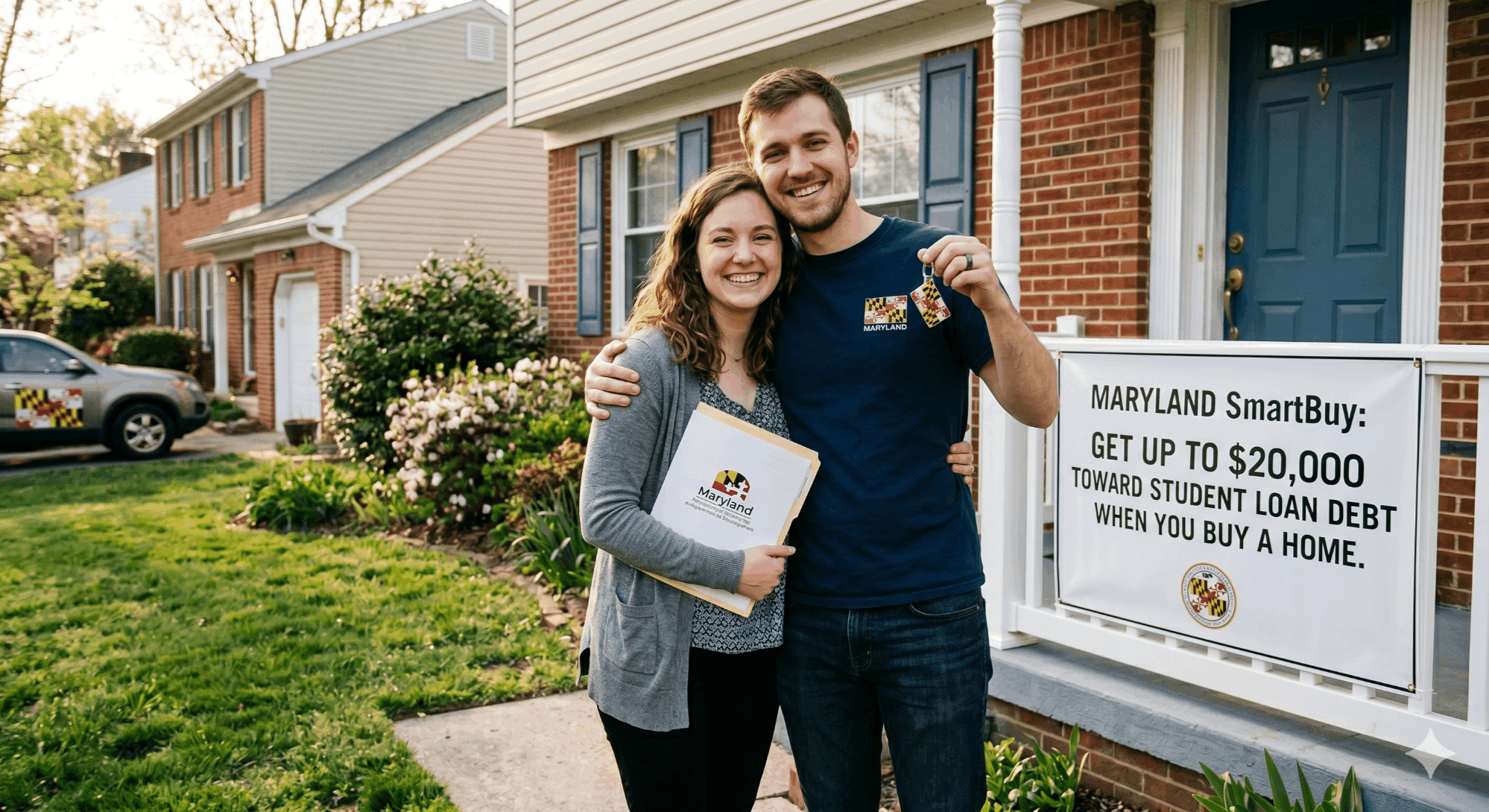 Maryland is one of the only states in the country that will help you buy a home and pay off your student loans at the same time. The Maryland SmartBuy 3.0 program, run by the Maryland Department of Housing and Community Development, provides a 0% interest forgivable loan of up to $20,000 to eliminate qualifying student debt at closing — and it's fully forgiven after you stay in the home for five years.
Quick Answer: Maryland SmartBuy 3.0 provides up to 15% of a home's purchase price — capped at $20,000 — as a 0% interest, 5-year forgivable loan to pay off a buyer's student loan debt at closing. You must buy a home in Maryland, have at least $1,000 in student debt, pay off your full student loan balance at closing (amounts over $20,000 come out of pocket), have a minimum credit score of 720, and meet Maryland Mortgage Program income and purchase price limits.
Key Takeaways
- The payoff is a forgivable loan, not a grant. You receive up to 15% of the home price (max $20,000) as a 0% interest second loan, forgiven 20% per year over 5 years.
- Your full student loan balance must be paid off at closing. If you owe more than $20,000, you must cover the rest out of pocket — partial payoffs are not allowed.
- Credit score floor is 720 — noticeably higher than the 640 minimum on most Maryland Mortgage Program loans.
- You can combine SmartBuy with optional down payment assistance — either a $6,000 DPA loan, or a 6% DPA loan if your household income is at or below 50% of Area Median Income.
- The real win is DTI relief. Wiping out a student loan before underwriting means your debt-to-income ratio drops, your approval odds go up, and your buying power often increases by tens of thousands of dollars.
- You must be a first-time homebuyer (or purchasing in a Targeted Area), occupy the home as your primary residence, and own no other real property at closing.
In This Guide
- What Is Maryland SmartBuy 3.0?
- How Much Student Debt Can Be Paid Off?
- Who Qualifies: Eligibility Requirements
- How the 5-Year Forgivable Loan Works
- Combining SmartBuy with Down Payment Assistance
- Income and Purchase Price Limits by County
- Step-by-Step: How to Apply
- Real Example: What It Does to Your Monthly Payment
- SmartBuy vs. Other Maryland Buyer Programs
- Common Mistakes to Avoid
- Frequently Asked Questions
- Glossary
If you're a Maryland renter with a college degree and a monthly student loan payment, you already know the cruel math of modern homeownership. A $400 or $600 student loan payment doesn't just drain your bank account — it crushes your debt-to-income ratio, which is the single biggest factor mortgage lenders use to decide how much house you can afford. Two borrowers with identical incomes can qualify for wildly different loan amounts based on nothing except their student debt.
Maryland SmartBuy 3.0 was built to break that trap. It's a state-sponsored financing program that pairs a standard 30-year mortgage with a forgivable second loan designed to wipe out a buyer's student debt at the closing table. Once the student loan is gone, your debt-to-income ratio drops, your lender recalculates your buying power, and you walk out of settlement a homeowner with one fewer monthly bill.
This guide walks through exactly how Maryland SmartBuy 3.0 works in 2026 — what you qualify for, how to stack it with down payment assistance, what counties make the math work, and where buyers usually get tripped up. Everything here is based on current Maryland Department of Housing and Community Development program guidelines.
What Is Maryland SmartBuy 3.0?
Maryland SmartBuy 3.0 is a specialty loan product under the umbrella Maryland Mortgage Program (MMP), administered by the Community Development Administration (CDA) of the Maryland Department of Housing and Community Development. The "3.0" refers to the third iteration of the program — the state has refined eligibility and funding caps since the original launch.
At its core, SmartBuy is a two-loan structure. The first loan is a conventional 30-year fixed-rate mortgage under MMP — that's the loan that actually buys the home. The second loan is the student debt payoff loan: an unsecured, 0% interest, deferred, forgivable note that the lender funds at closing and sends directly to your student loan servicer to pay off your full balance.
That second loan has no monthly payment. It's not secured by a lien on the home. Instead, it's forgiven in five equal 20% installments on each anniversary of your closing date — so after five years of living in the house, you owe nothing. Sell or move out before year five and any unforgiven balance becomes due immediately.
ℹ️ Why "SmartBuy 3.0" and not just "SmartBuy"?
The earlier SmartBuy program (sometimes referred to as SmartBuy 2.0) allowed student debt payoffs up to a higher cap. The current 3.0 version caps the forgivable payoff at $20,000 and requires all MMP-compliant financing. If you've read older blog posts or forum threads referencing $30,000 or $40,000 limits, those are out of date — the live program in 2026 uses the $20,000 cap.
Who the Program Is Really Built For
SmartBuy was designed for a specific kind of buyer: the renter with a solid income, clean credit, and a student loan balance that's blocking them from qualifying for a home they could otherwise afford. Think of the 28-year-old nurse, the 31-year-old teacher, the 34-year-old IT professional, the newly-minted attorney — people whose careers are on track but whose student debt makes their debt-to-income ratio too tight to qualify for a Maryland mortgage at current prices.
The program is less useful if your student debt is over $20,000 and you don't have cash to cover the rest — the partial-payoff rule means you have to zero out the loan completely at closing. It's also not a fit if you're buying your second or third home outside a Targeted Area, since the core program is first-time-buyer only.
Before you assume student loans are blocking you from buying, let us run the numbers. Our free buyer strategy session covers SmartBuy eligibility, loan comparison, and what you can actually afford across Maryland and the broader DMV — with zero pressure to commit.
How Much Student Debt Can Be Paid Off?
The SmartBuy 3.0 forgivable loan is the lesser of two numbers: 15% of the home's purchase price, or $20,000. That means the absolute maximum payoff is $20,000, even if 15% of your purchase price would be higher. For smaller homes, 15% of the price is the effective ceiling.
| Home Purchase Price | 15% of Price | SmartBuy Payoff Available |
|---|---|---|
| $100,000 | $15,000 | $15,000 (15% cap applies) |
| $133,334 | $20,000 | $20,000 (cap reached) |
| $300,000 | $45,000 | $20,000 (dollar cap applies) |
| $500,000 | $75,000 | $20,000 (dollar cap applies) |
| $806,500 (MMP max) | $120,975 | $20,000 (dollar cap applies) |
What Happens If You Owe More Than $20,000
This is the rule that trips up the most people. SmartBuy requires your full remaining student loan balance to be paid off at closing — no partial payoffs, no "pay what you can and keep the rest." If your student debt balance is $28,000, the program pays $20,000 and you bring $8,000 in certified funds to the settlement table to cover the difference. If your debt is $45,000, you bring $25,000.
That's still a $20,000 gift, but the math only works if you have the cash reserves to cover the gap. For buyers with large balances and limited savings, SmartBuy's strict "zero balance at closing" rule can put the program out of reach.
⚠️ Only One Borrower's Debt Gets Paid
If you're buying with a co-borrower who also has student debt, the program only pays off the full balance of one borrower at closing. The co-borrower's loans stay intact. Couples should strategize which borrower's debt to clear for the biggest debt-to-income impact on underwriting.
Who Qualifies: Eligibility Requirements
SmartBuy layers its own requirements on top of the standard Maryland Mortgage Program rules. You need to pass both. Here's the full checklist:
Maryland SmartBuy 3.0 Eligibility Checklist
- ✓
Student debt minimum: at least $1,000 in qualifying student loan debt in the borrower's name for the borrower's education
- ✓
Full payoff at closing: the entire remaining student debt balance (any amount over $20,000 paid out of pocket)
- ✓
Credit score minimum: 720 middle FICO score
- ✓
First-time buyer: you must not have owned residential property in the past 3 years (unless buying in a Targeted Area, or you're a qualifying veteran)
- ✓
Homebuyer education: complete an approved HUD or MMP homebuyer education course before closing
- ✓
Primary residence: you must live in the home as your primary residence within 60 days of closing
- ✓
No other real property: you cannot own any other real estate at the time of closing
- ✓
Minimum contribution: at least 5% of the sales price from the borrower's own funds (can include gift funds in some cases)
- ✓
Current on student loans: borrower must be current on all student loan payments at the time of SmartBuy loan reservation
- ✓
Income limits: household income must be under your county's MMP limit (see the limits table below)
- ✓
Purchase price limits: home price must be under your county's MMP Maximum Acquisition Cost
- ✓
Approved lender: loan must be originated through a SmartBuy-approved Maryland Mortgage Program lender
What Counts as Qualifying Student Debt
Not every loan on your credit report qualifies. The Maryland Mortgage Program defines qualifying student debt as a loan taken out from an eligible educational institution in the borrower's name for the borrower's own education. Eligible institutions include accredited public, nonprofit, or proprietary colleges, universities, vocational schools, and graduate programs.
Parent PLUS loans, loans taken out in someone else's name (even for your education), and personal loans used for tuition generally do not qualify. Your lender will review your loan documents to confirm eligibility as part of underwriting.
How the 5-Year Forgivable Loan Works
The student debt payoff loan under SmartBuy is structured as a 0% interest deferred promissory note. There are no monthly payments. Nothing shows up on your bank statement. The debt exists quietly in the background, forgiven in five equal 20% chunks on each anniversary of your closing date.
Closing day
Lender funds the forgivable loan (up to $20,000). Funds go directly to your student loan servicer. Your student debt is paid off in full.
Anniversary year 1 — 20% forgiven
One year after closing, 20% of the SmartBuy loan is forgiven. If you received the full $20,000, your remaining balance drops to $16,000.
Anniversary year 2 — 40% forgiven
Balance drops to $12,000 (cumulative forgiveness).
Anniversary years 3–4 — 60% and 80% forgiven
Balance continues to drop by 20% each year ($8,000 at year 3, $4,000 at year 4).
Anniversary year 5 — fully forgiven
The SmartBuy second loan is fully forgiven. You owe nothing. The program has essentially gifted you the payoff amount in exchange for five years of homeownership.
What Triggers Early Repayment
Because the forgivable loan isn't secured by a lien on the home, it operates on an honor system enforced by documentation. The unforgiven balance becomes due if any of these happen within the first 5 years:
- You sell the home
- You refinance the first mortgage
- You stop using the property as your primary residence
- You transfer title to another person
- You pay off the first mortgage in full
If you sell in year 3, for example, you'd owe 40% of the original SmartBuy balance ($8,000 on a $20,000 payoff). That's simple math, but it's worth planning around — SmartBuy is built for buyers who plan to stay put for at least five years.
Combining SmartBuy with Down Payment Assistance
Maryland lets you stack the SmartBuy payoff loan with one of two standard Maryland Mortgage Program down payment assistance options. You cannot combine both DPA options with SmartBuy, but layering a single DPA on top of the student debt payoff dramatically lowers your cash-to-close requirement.
| DPA Option | How Much | Income Eligibility | Structure |
|---|---|---|---|
| $6,000 DPA Loan | Flat $6,000 | Any MMP-eligible income | Deferred, 0% interest, due on sale/refi |
| 6% DPA Loan | 6% of first mortgage amount | Household income ≤ 50% of Area Median Income | Deferred, 0% interest, due on sale/refi |
Both options are second liens with no monthly payment. They're repaid only when you sell, refinance, or pay off the first mortgage. The 6% option is restricted to very-low-income households (at or below 50% AMI), which in most Maryland counties excludes the middle-income professionals SmartBuy was designed for. Most SmartBuy buyers end up pairing with the flat $6,000 DPA option.
Get pre-qualified, explore SmartBuy and other down payment assistance programs, and compare loan options — all through a free consultation with our team. We work across Maryland, Northern Virginia, DC, and West Virginia.
Income and Purchase Price Limits by County
Because SmartBuy 3.0 runs on top of the Maryland Mortgage Program, you must also meet MMP's county-specific income and purchase price limits. These numbers reset periodically and vary based on whether a property is inside or outside a designated Targeted Area. Below are current 2026 limits for the Maryland counties where most Jamil Brothers clients are buying.
| County | Household Income Limit (1–2 people) | Household Income Limit (3+ people) | Max Acquisition Cost |
|---|---|---|---|
| Montgomery | $196,680 | $229,460 | $1,255,921 (non-targeted) |
| Prince George's | $196,680 | $229,460 | $1,255,921 (non-targeted) |
| Howard | $136,529 | $157,008 | $759,315 |
| Frederick | $136,529 | $157,008 | $759,315 |
| Anne Arundel | $136,529 | $157,008 | $759,315 |
| Baltimore County | $136,529 | $157,008 | $759,315 |
| Charles | $196,680 | $229,460 | $1,255,921 |
Source: Maryland Department of Housing and Community Development, Maryland Mortgage Program Income and Purchase Price Limits (2026). Limits vary inside Targeted Areas and change periodically — verify current figures with your lender before finalizing financing.
For Maryland's high-cost counties bordering DC — Montgomery, Prince George's, and Charles — income limits exceed $196,000 for smaller households and $229,000 for families of three or more. The Maximum Acquisition Cost ceilings (essentially the maximum home price allowed under MMP) reach over $1.2 million in those counties, which opens up meaningful portions of the Bethesda, Silver Spring, Rockville, and Gaithersburg markets. The CDA's overall mortgage limit caps out at $806,500.
What "Household Income" Means
MMP defines Household Income as the combined income of every person 18 or older who will live in the home — not just the people on the loan application. That includes salaries, wages, retirement income, investment gains, and near-cash government transfers. If you're buying with a partner, or if an adult relative will live with you, all of that income counts toward your limit.
That's different from the "Qualifying Income" number on your mortgage application, which only counts the income of the borrowers on the loan. It's a common point of confusion — a single buyer with $120,000 in qualifying income can still get shut out of SmartBuy if they plan to have a working roommate push total household income above the county limit.
Step-by-Step: How to Apply for Maryland SmartBuy
The application process looks similar to any standard mortgage, but with two extra layers: SmartBuy-specific documentation on the student loan side, and the Maryland Mortgage Program compliance review before closing. Start early — most buyers underestimate how long that compliance step can take.
Complete a HUD-approved homebuyer education course — Week 1
MMP requires a homebuyer education certificate before closing. Online courses take 4–8 hours and cost $40–$75. Do this first — the certificate is good for 12 months and is required to lock your rate.
Find a SmartBuy-approved lender and get pre-approved — Weeks 1–2
Not every Maryland lender offers SmartBuy — the program requires special training and approval. Use the Maryland Mortgage Program lender directory to find a SmartBuy-approved lender, or ask your buyer agent for a referral. Your lender will confirm income eligibility, run credit (720 min), verify student loan documentation, and issue a pre-approval letter.
Sign a buyer-broker agreement and begin your home search — Weeks 2–4
Under post-NAR-settlement rules, you'll sign a written buyer representation agreement before touring homes. Your agent searches MMP-eligible homes within your county's price limit. You can search active listings in Maryland and across the DMV with live BrightMLS data.
Make an offer and go under contract — Week 4–6
Your agent structures the offer with contingencies that protect your earnest money deposit and give time for the extra MMP compliance review. Expect a standard 30–45 day close.
Lender submits to MMP for compliance review — Weeks 6–7
Your loan package goes to the CDA for state-level review. This confirms compliance with all SmartBuy and MMP rules. Builds in about 5–10 additional business days beyond a standard loan — plan contract timelines accordingly.
Closing day — Week 7–8
At settlement, the lender funds both loans simultaneously. Your student loan payoff is wired directly to your servicer. You sign the SmartBuy promissory note, the first mortgage, and standard closing documents. Keys in hand, debt cleared.
Post-closing documentation — Weeks 8–12
Your lender and MMP confirm with your student loan servicer that your balance has been brought to zero. Keep copies of the payoff confirmation letter for your records — you may need it at tax time.
Real Example: What It Does to Your Monthly Payment
Numbers on a page tell the story better than theory. Here's how the math actually plays out for a typical Maryland SmartBuy borrower: a 30-year-old professional with a $400 monthly student loan payment looking to buy a $400,000 townhome in Montgomery County.
| Scenario | Without SmartBuy | With SmartBuy |
|---|---|---|
| Annual income | $95,000 | $95,000 |
| Student loan balance | $18,000 | $0 (paid off at closing) |
| Student loan monthly payment | $400 | $0 |
| Maximum qualifying DTI (43%) | $3,400/mo total debt | $3,400/mo total debt |
| Available for housing (after other debt) | ~$2,700/mo | ~$3,100/mo |
| Maximum home price (at 6.5% rate) | ~$365,000 | ~$425,000 |
| Buying power boost | — | +$60,000 |
Estimates for illustration only. Actual DTI, rate, and buying power depend on individual credit, taxes, insurance, and lender guidelines. Get a personalized breakdown from a SmartBuy-approved lender.
The takeaway: eliminating an $18,000 student loan with a $400 monthly payment adds roughly $60,000 of buying power in this scenario. For a buyer deciding between a dated condo and a newer townhome, that shift is often the difference between settling and landing the home they actually want.
Every active listing in Maryland and across the DMV — pulled directly from BrightMLS with live updates. Filter by price, city, school district, and property type to find homes that fit your SmartBuy qualification.
SmartBuy vs. Other Maryland First-Time Buyer Programs
SmartBuy is powerful but narrow — it only pays off student debt. If you don't have student loans, or if you have other financial priorities, Maryland has several other first-time buyer programs worth comparing.
| Program | Best For | Assistance Amount | Key Catch |
|---|---|---|---|
| Maryland SmartBuy 3.0 | Buyers with $1,000+ student debt | Up to $20,000 student loan payoff | 720 credit score min; must pay full loan balance at closing |
| MMP 1st Time Advantage | First-time buyers without student debt | DPA up to 5% of loan amount | No student loan component; standard MMP income limits |
| MMP Flex Loans | Repeat buyers using MMP | DPA available with Flex options | Slightly higher rates than 1st Time Advantage |
| HomeAbility | Buyers or household members with disabilities | Up to 25% of purchase price, 0% deferred | Disability documentation required |
| Montgomery Homeownership Program | Buyers purchasing in Montgomery County | Up to $25,000 DPA (tied to income) | Stackable with MMP; county-specific |
Maryland SmartBuy: Pros and Cons
| ✓ Pros | ✗ Cons |
|---|---|
| Up to $20,000 in student debt paid off — essentially a gift if you stay 5 years | Must pay off the full student loan balance at closing (no partial payoffs) |
| No monthly payment on the forgivable second loan | 720 minimum credit score is stricter than most MMP products |
| DTI relief can meaningfully boost your maximum qualifying home price | First-time buyer restriction (unless in a Targeted Area) |
| Can be combined with $6,000 DPA (or 6% DPA for very-low-income) | Selling or refinancing within 5 years triggers partial repayment |
| Available anywhere in Maryland eligible under MMP | Only one borrower's student debt can be paid off (not both spouses) |
| Adds MMP-tier interest rates that can beat typical market offers | Extra MMP compliance review adds roughly 5–10 business days to closing |
Common Mistakes to Avoid
Most SmartBuy problems aren't with the program itself — they're with buyers assuming things that turned out to be wrong. A few patterns come up over and over.
Assuming Any Lender Can Do SmartBuy
SmartBuy requires a SmartBuy-approved lender specifically — not just any Maryland Mortgage Program lender. There are over 120 MMP-approved lenders, but only a subset offer SmartBuy. Confirm your lender can originate SmartBuy loans before getting pre-approved.
Using Household Income and Qualifying Income Interchangeably
Your Household Income includes every adult living in the home. Your Qualifying Income is just the borrower(s) on the loan. You can pass Qualifying Income and still fail Household Income if a parent, partner, or adult sibling will live with you. Do this math before you fall in love with a home.
Not Budgeting for the $20,000 Gap
If your student debt is $26,000, SmartBuy pays $20,000 and you owe $6,000 at closing. That's on top of your 5% minimum contribution, closing costs, and any other cash-to-close. Buyers sometimes don't realize they need liquid reserves to cover the gap and get blindsided at the final Closing Disclosure review.
Buying a Home You Plan to Leave Within 5 Years
Because forgiveness happens in 20% annual increments, selling or refinancing early means owing the unforgiven balance back to Maryland. SmartBuy is a 5-year commitment, and if you know you'll take a job out of state next year or plan to upsize within 24 months, the partial repayment can eat into the program's benefit significantly. Military buyers under PCS orders should talk to their lender about specific repayment provisions.
Skipping the Homebuyer Education Certificate Early
The education certificate is a hard requirement. Lenders cannot lock a SmartBuy rate without it on file. Buyers who wait until they're under contract to start the course sometimes lose rate locks or delay closing.
The Jamil Brothers work with SmartBuy-approved lenders across Maryland and the broader DMV. Whether you're buying in Montgomery County, Frederick County, or anywhere else in the state, our free buyer strategy session walks through your numbers — no pressure, no obligation, no surprises at the closing table.
Frequently Asked Questions
How much student debt can Maryland SmartBuy 3.0 pay off?
Maryland SmartBuy 3.0 provides up to 15% of the home's purchase price to pay off qualifying student loan debt, with a hard maximum of $20,000. Any student debt above $20,000 must be paid out of pocket at closing — the program requires the full remaining student loan balance to be cleared at settlement, not just a partial payoff. Older versions of the program once allowed higher payoff caps, but the current live 3.0 program caps at $20,000 as of 2026.
What credit score do I need for Maryland SmartBuy?
The minimum middle FICO credit score for Maryland SmartBuy 3.0 is 720 — substantially higher than the 640 minimum for most other Maryland Mortgage Program loans. Because SmartBuy uses conventional financing with specific mortgage insurance requirements, the 720 floor is non-negotiable. Buyers with scores below 720 should work on credit building for a few months or consider alternative MMP products like the 1st Time Advantage loan with standard down payment assistance.
Do I have to pay off my whole student loan at closing?
Yes. Maryland SmartBuy 3.0 requires the full remaining student loan balance for at least one borrower to be paid off at closing. Partial payoffs are not permitted under the program. If your loan balance is $30,000, SmartBuy contributes up to $20,000 and you must bring the remaining $10,000 in certified funds to settlement. For buyers with larger balances, having enough liquid reserves to cover the gap is a critical planning step.
Can I use SmartBuy for a second home or investment property?
No. Maryland SmartBuy 3.0 requires the home to be your primary residence, which you must occupy within 60 days of closing. You also cannot own any other real property at the time of closing — meaning the program is strictly for primary-home purchases by buyers who don't currently own other real estate. Investment properties, second homes, and vacation properties are not eligible under SmartBuy or any standard Maryland Mortgage Program loan.
What happens to the forgivable loan if I sell the home before 5 years?
The Maryland SmartBuy forgivable second loan is forgiven 20% per year over five years on each anniversary of closing. If you sell, refinance, or stop using the home as your primary residence before the full 5-year forgiveness period, the remaining unforgiven balance becomes due. For example, selling after 2 years when you received a $20,000 payoff means repaying $12,000 (the 60% that hasn't yet been forgiven). After year 5, the loan is fully forgiven and no repayment is owed.
Do I need to be a first-time homebuyer to qualify?
In most cases, yes. Maryland SmartBuy 3.0 is designed primarily for first-time homebuyers — defined by MMP as someone who has not owned residential property in the past three years. Exceptions apply if you're purchasing in a designated Targeted Area (parts of several Maryland counties defined by the U.S. Census Bureau) or if you're an honorably discharged veteran using the first-time buyer exemption for the first time. Your lender and buyer agent can confirm whether a specific property falls in a Targeted Area.
Can I combine Maryland SmartBuy with other down payment assistance?
Yes, but with restrictions. Maryland SmartBuy 3.0 can be combined with one of two MMP down payment assistance options: either a flat $6,000 DPA loan, or a 6% DPA loan available only to borrowers with household income at or below 50% of Area Median Income. Additional third-party assistance from employers, nonprofits, or local programs like Montgomery Homeownership may also be layered in if the combined loan-to-value stays within program limits. Your SmartBuy-approved lender will help structure the stack.
Is Maryland SmartBuy available in Montgomery County and other high-cost areas?
Yes. Maryland SmartBuy 3.0 is available for any MMP-eligible property anywhere in Maryland, including high-cost counties like Montgomery, Prince George's, and Charles. In those counties, 2026 household income limits run up to $196,680 for 1–2 person households and $229,460 for 3+ person households, and maximum acquisition costs reach over $1.2 million. That makes SmartBuy realistic in markets like Bethesda, Silver Spring, Gaithersburg, Rockville, and Frederick where median home prices would otherwise exceed tighter program caps.
Do I need a buyer's agent to use Maryland SmartBuy?
You're not legally required to use a buyer's agent, but doing so is strongly recommended — especially post-NAR settlement, which requires written buyer representation agreements before touring homes in most cases. A buyer's agent experienced with SmartBuy understands the MMP compliance timeline, helps structure offers with appropriate contingencies, and can refer you to SmartBuy-approved lenders. The Jamil Brothers Realty Group provides free buyer strategy sessions and works with MMP lenders across Maryland, Northern Virginia, DC, and West Virginia.
What counts as qualifying student loan debt?
Maryland SmartBuy 3.0 defines qualifying student debt as a loan taken out in the borrower's own name for the borrower's education at an eligible educational institution. Eligible institutions include accredited public, nonprofit, or proprietary colleges, universities, vocational schools, and graduate programs. Loans for someone else's education (including Parent PLUS loans taken out by a parent), personal loans used for tuition, or debt that isn't clearly documented as student loans generally do not qualify.
Can both spouses get their student loans paid off with SmartBuy?
No. Maryland SmartBuy 3.0 pays off the full remaining student loan balance for one borrower only. If both spouses have student debt, only one borrower's loans can be zeroed out at closing. Couples should strategize which borrower's debt to clear — typically the loan with the highest monthly payment relative to balance, since that produces the biggest drop in debt-to-income ratio and the largest boost to qualifying home price.
How long does it take to close a SmartBuy loan?
Most Maryland SmartBuy loans close within 30–45 days of ratified contract, similar to any standard mortgage. The one difference is the additional MMP compliance review performed by the state's Community Development Administration before closing — this typically adds 5–10 business days to the timeline. Experienced SmartBuy lenders and buyer agents build that review period into contract contingencies so the extra time doesn't risk the deal or push a closing date.
Is Maryland SmartBuy a buyer's or seller's market program right now?
Maryland SmartBuy is neutral to market conditions — it's a financing program, not a market incentive. That said, the broader Maryland market in 2026 remains competitive in high-demand suburbs around DC, with ongoing inventory constraints. SmartBuy's best strategic fit is when buyers want to compete for homes in the $300K–$500K range where eliminating $400/month of student debt meaningfully increases qualifying buying power. In slower sub-markets, the program's main benefit is simply financial — getting rid of the student loan and owning a home simultaneously.
Glossary
Area Median Income (AMI)
A regional benchmark set by HUD used to measure household income against local market norms. Maryland uses AMI thresholds (like 50% AMI) to determine eligibility for enhanced DPA products.
CDA
Community Development Administration — the division of Maryland's Department of Housing and Community Development that administers the Maryland Mortgage Program, including SmartBuy.
Debt-to-Income Ratio (DTI)
The percentage of your gross monthly income that goes to debt payments. Lenders typically cap DTI around 43–50% for mortgage qualification. Student debt directly raises DTI.
Deferred Loan
A loan with no monthly payments. Repayment is triggered only by a specific event (like selling the home). SmartBuy's second loan is both deferred and forgivable.
Forgivable Loan
A loan whose balance is reduced on a set schedule, typically if conditions (like continued occupancy) are met. SmartBuy's forgivable second loan is forgiven 20% per year over 5 years.
Household Income vs. Qualifying Income
Household Income includes every adult living in the home; Qualifying Income only counts borrowers on the loan. MMP uses Household Income for eligibility limits.
Maximum Acquisition Cost
The highest allowable purchase price for a home financed under the Maryland Mortgage Program. Varies by county and whether the home is in a Targeted Area.
Targeted Area
Geographic areas designated by the U.S. Census Bureau where MMP offers higher income limits and waives the first-time-buyer requirement. Typically lower-income or historically underserved neighborhoods.
Final Thoughts: Is Maryland SmartBuy Worth It?
For the right buyer — a Maryland renter with strong credit, solid income, student debt between $1,000 and roughly $25,000, and a 5-year horizon in the home — Maryland SmartBuy 3.0 is one of the most valuable first-time buyer programs in the country. Up to $20,000 of student debt eliminated, DTI relief that expands buying power, and a forgivable structure that asks for nothing back if you stay put. That's a genuinely rare combination.
Where SmartBuy gets less attractive is at the edges. Large student balances require significant out-of-pocket cash. The 720 credit floor shuts out buyers still rebuilding. The 5-year occupancy requirement penalizes early sellers. And the first-time buyer restriction (outside Targeted Areas) leaves repeat buyers with limited options — though other MMP products like the Flex loans can still help.
The practical next step is running real numbers against a real property. A buyer strategy session can pressure-test SmartBuy eligibility, model cash-to-close, and identify the Maryland counties and neighborhoods where your income and credit profile actually work. The Jamil Brothers Realty Group is licensed in Maryland, Virginia, DC, and West Virginia — and we work with SmartBuy-approved lenders who can run your specific scenario in an afternoon.
Explore More
Browse Every Corner of the DMV Market
Whether you're searching by budget, neighborhood, or buying situation — find exactly what you need below.
Virginia Homes by Budget
Washington DC Homes by Budget
Maryland Homes
Explore Northern Virginia Communities
Loudoun County
Fairfax County & Surrounding
Ready to Make a Move?
Full-Service · No Tradeoffs
List for 1.5% & Keep More Equity
Professional photography, drone video, 3D tours, and expert negotiation — all included. On an $800K home, that's $12,000 more in your pocket vs. a 3% agent.
See the 1.5% Program →Need Speed or Certainty?
Get a No-Obligation Cash Offer
Skip the showings, skip the contingencies. If timing or condition matters more than top dollar, a cash offer may be the right fit. We'll walk you through every option.
Explore Cash Offers →Categories
- All Blogs (1168)
- Aldie (3)
- Ashburn (6)
- Buyer Guide (8)
- Buying a home (2)
- Buying Strategies (28)
- festivals (1)
- General Blog (66)
- Leesburg (5)
- Market Intelligence (29)
- Market Updates (8)
- Notable Properties For Sale (29)
- Real Estate Tips, News, and More (376)
- Seller Guide (2)
- Seller Guides (60)
- Selling Your Home (479)
- Sterling (6)
- Top Realtors in Northern Virginia (58)
Recent Posts
Message Sent!
Thank you for reaching out. Arslan & Saad have received your details and will be in touch shortly.
Need immediate assistance? Call or text 703-782-4830.