Gainesville Home Equity Loan Guide: Rates, Lenders, and How Much You Can Actually Borrow
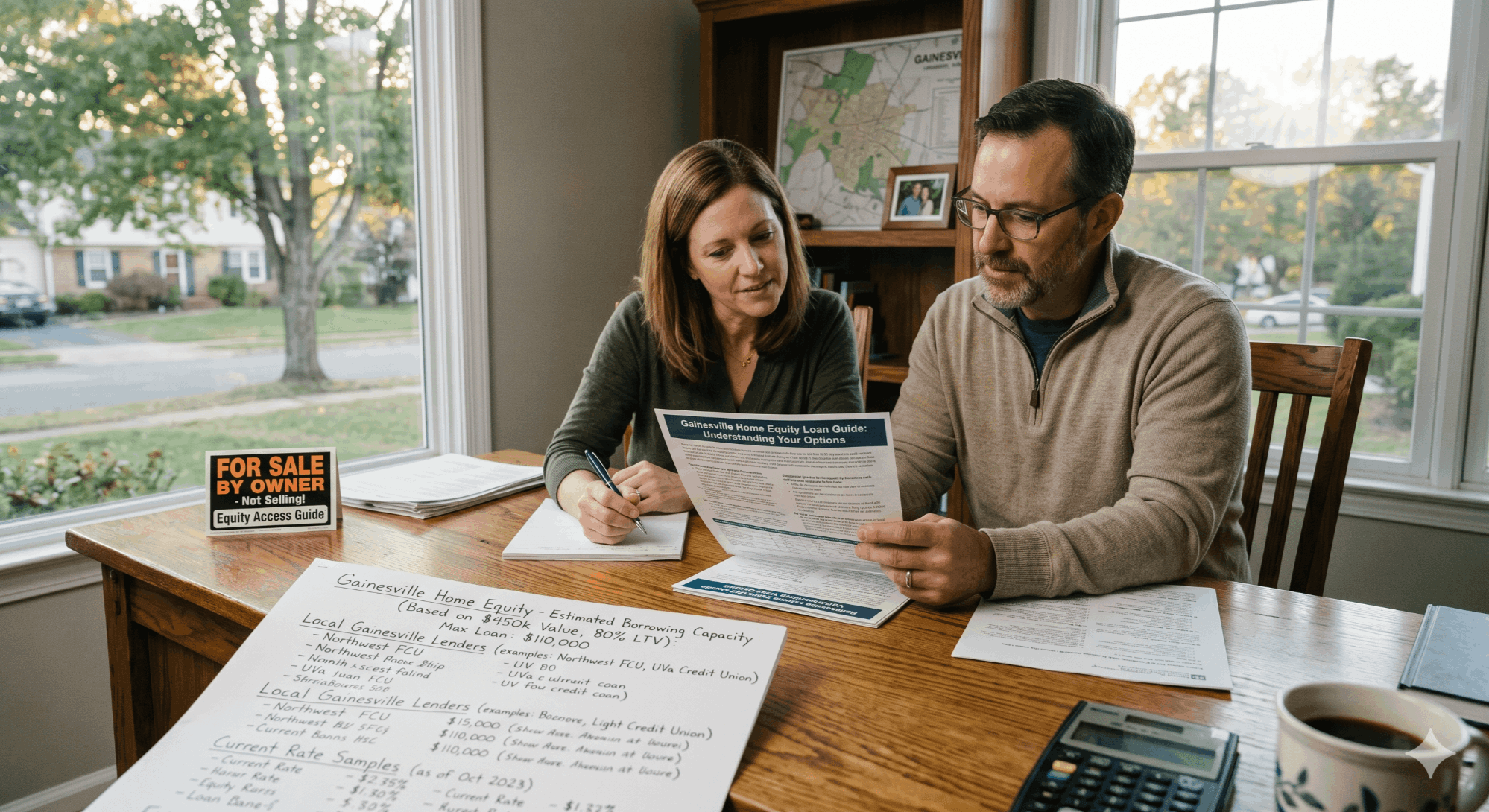
Quick Answer: A Gainesville home equity loan lets you borrow a lump sum against the equity in your home at a fixed rate — typically up to about 85% of your home's value minus your mortgage balance. With Gainesville home values averaging roughly $743,000 in 2026 and fixed home equity loan rates near 7.36%, a homeowner with substantial equity can often access $100,000 or more. The Jamil Brothers Realty Group offers free equity evaluations so you know exactly how much available home equity you have before you apply.
Key Takeaways
- A fixed-rate home equity loan gives you one lump sum and one predictable monthly payment, while a home equity line of credit (HELOC) works more like a revolving credit card with a variable rate.
- Most lenders let you borrow up to an 85% combined loan-to-value ratio (LTV) — your existing mortgage plus the new loan, divided by your home's appraised value.
- As of June 2026, the national average fixed home equity loan rate is about 7.36% and the average HELOC rate is about 7.21%, near their lowest levels of the year.
- Strong home equity loan qualification usually means a credit score of 680+ (740+ for the best pricing), a debt-to-income ratio under 43%, and a recent home appraisal.
- Common, sensible uses include home improvement financing, debt consolidation, and major one-time expenses — but borrowing against your home means your house is the collateral.
- If you have significant equity, selling may unlock more cash than borrowing — and listing with The Jamil Brothers' 1.5% full-service program helps you keep more of it.
In This Guide
- What a Gainesville Home Equity Loan Is & How It Works
- How Much You Can Actually Borrow (LTV & Available Equity)
- Home Equity Loan Rates & Monthly Payments in Virginia
- Home Equity Loan Requirements & Qualification
- Home Equity Loan vs HELOC vs Cash-Out Refinance
- Smart Ways to Use Your Home Equity
- Borrow Against Your Home or Sell? The Equity Decision
- Gainesville VA Real Estate Market & Home Values
- Risks of Borrowing Against Your Home
- Step-by-Step: Getting a Home Equity Loan in Gainesville
- Your Next Step on Home Equity
- Frequently Asked Questions
- Glossary
If you own a home in Gainesville, you've likely built real wealth without thinking much about it. Western Prince William County has seen steady appreciation, and many homeowners are sitting on six figures of equity they could put to work. A Gainesville home equity loan is one of the most direct ways to tap that value — turning part of your home's worth into cash for renovations, debt consolidation, tuition, or a major life expense, all while keeping your existing mortgage in place.
But home equity financing options come with trade-offs, and the right choice depends on how much available home equity you have, what rate you qualify for, and what you plan to do with the money. This guide explains how home equity loans work in Gainesville, how to estimate your borrowing power using the loan-to-value ratio, what current home equity loan rates and monthly payments look like in Virginia, and how a home equity loan compares to a HELOC or a cash-out refinance.
We'll also cover an option many homeowners overlook: if your equity is substantial, selling may unlock more cash than any loan — and we'll show you how to weigh borrowing against selling using real Gainesville numbers.
What a Gainesville Home Equity Loan Is & How It Works
A home equity loan is a second mortgage. You borrow a one-time lump sum against the equity you've built, then repay it in fixed monthly installments — usually over 5 to 30 years — on top of your existing first mortgage. Because most home equity loans carry a fixed interest rate, your payment never changes, which makes budgeting straightforward.
Understanding how home equity loans work starts with one number: your available home equity. That's the difference between what your home is worth today and what you still owe on it. If your Gainesville home is worth $700,000 and you owe $400,000 on your mortgage, you have $300,000 in equity. Lenders won't let you borrow all of it — they cap how much you can borrow based on a percentage of your home's value — but a meaningful share is usually accessible.
Home equity loan vs. your first mortgage
Your first mortgage was used to buy the home. A home equity loan is layered on top and is secured by the same property, which is why it's called a second lien. If you ever sell, both loans are paid off from the proceeds at closing. Because the home equity lender is second in line to be repaid if anything goes wrong, these loans usually carry slightly higher interest rates in Virginia than a primary mortgage — but still far less than credit cards or personal loans.
ℹ️ Lump sum vs. line of credit
A home equity loan delivers a fixed lump sum at closing. A home equity line of credit (HELOC) gives you a revolving limit you can draw from over time. Both let you borrow against home equity — the difference is structure, rate type, and how you access the money. We compare them in detail below.
How Much You Can Actually Borrow: LTV & Available Home Equity
The single biggest factor in how much you can borrow is the loan-to-value ratio (LTV) — more precisely, the combined loan-to-value (CLTV), which adds your existing mortgage and the new home equity loan together, then divides by your home's appraised value. Most Virginia lenders cap CLTV at 80% to 85%, though a few go higher for well-qualified borrowers.
Here's how to estimate your borrowing power. Take your home's value, multiply by the lender's maximum CLTV, then subtract what you still owe. The result is roughly the most you could borrow.
| Home Value | Mortgage Balance | Max at 85% CLTV | Approx. Available to Borrow |
|---|---|---|---|
| $600,000 | $300,000 | $510,000 | ~$210,000 |
| $700,000 | $400,000 | $595,000 | ~$195,000 |
| $743,000 | $350,000 | $631,550 | ~$281,550 |
| $850,000 | $500,000 | $722,500 | ~$222,500 |
Estimates only. Final amounts depend on your lender's CLTV cap, your credit profile, and the appraised value. Figures assume an 85% maximum CLTV.
Why the appraisal matters so much
Your borrowing power is built on your home's appraised value, not what you think it's worth. A strong appraisal expands your available home equity; a conservative one shrinks it. Because Gainesville pricing varies by neighborhood and home type, getting an accurate sense of your value before you apply can save you a wasted application. The Jamil Brothers provide a free, street-level home valuation using recent comparable sales — a far more reliable starting point than an automated online estimate.
Before you borrow against home equity, find out what your Gainesville home is worth today and run the numbers on your real bottom line — commission, costs, and net proceeds — with our seller net sheet.
Home Equity Loan Rates & Monthly Payments in Virginia
As of June 2026, the national average fixed home equity loan rate is about 7.36%, near its lowest level of the year, according to data from Curinos. Variable HELOC rates average around 7.21%. Your actual interest rate in Virginia depends on your credit score, your CLTV, the loan term, and the lender — published averages assume strong borrowers with credit scores around 780 and a CLTV under 70%, so a typical homeowner may pay somewhat more.
To put rates in perspective, here's how a fixed-rate home equity loan compares to other ways of borrowing the same money. Borrowing against your home is almost always cheaper than unsecured debt — one of the main reasons homeowners choose home equity financing.
Typical Interest Rate by Borrowing Type (2026)
Estimating your monthly loan payments
A home equity loan calculator can give you a precise figure, but the table below shows roughly what fixed monthly payments look like at a 7.36% rate across common loan amounts and terms. Longer terms lower the monthly payment but increase total interest paid.
| Loan Amount | 10-Year Payment | 15-Year Payment | 20-Year Payment |
|---|---|---|---|
| $50,000 | ~$590 | ~$457 | ~$397 |
| $100,000 | ~$1,179 | ~$914 | ~$795 |
| $150,000 | ~$1,769 | ~$1,371 | ~$1,192 |
| $200,000 | ~$2,358 | ~$1,828 | ~$1,590 |
Principal-and-interest estimates at a 7.36% fixed rate. Your interest rate in Virginia will vary with credit and CLTV. Property taxes and insurance are separate.
Get a personalized home valuation from The Jamil Brothers — street-level comps, not automated estimates. Knowing your real value is the first step to understanding your borrowing power. Response within 24 hours.
Home Equity Loan Requirements & Qualification
Home equity loan qualification is more forgiving than a purchase mortgage in some ways and stricter in others. Lenders want to see that you have enough equity, a solid repayment history, and income that comfortably covers the new payment. Here are the typical home equity loan requirements in Virginia.
Home Equity Loan Qualification Checklist
- ✓ Equity: At least 15–20% remaining after the loan (an 80–85% maximum CLTV).
- ✓ Credit score requirements: Usually 680+ to qualify; 740+ earns the best home equity loan rates.
- ✓ Debt-to-income ratio: Most lenders want a DTI under 43%, counting the new payment.
- ✓ Home appraisal requirements: An appraisal (or automated valuation) to confirm current market value.
- ✓ Income documentation: Pay stubs, W-2s or tax returns, and proof of stable employment.
- ✓ Clear title: No unresolved liens or title issues on the property.
How credit score and DTI shape your rate
Two borrowers with identical equity can receive very different offers. The borrower with a 760 credit score and a 30% debt-to-income ratio will see a noticeably lower rate than one at 690 with a 41% DTI. If your credit is on the bubble, paying down a credit card or two before applying can move you into a better pricing tier and meaningfully reduce your monthly loan payments over the life of the loan.
Home Equity Loan vs HELOC vs Cash-Out Refinance
These three home equity financing options all let you access your home's value, but they behave very differently. Choosing well comes down to whether you need a lump sum or flexible access, whether you want a fixed or variable rate, and whether it makes sense to touch your existing first mortgage.
| Feature | Home Equity Loan | HELOC | Cash-Out Refinance |
|---|---|---|---|
| Structure | Lump sum, second mortgage | Revolving line of credit | Replaces your first mortgage |
| Rate type | Fixed | Usually variable | Fixed or variable |
| Best for | One-time, known cost | Ongoing or phased spending | Large need + better first-mortgage rate |
| Touches 1st mortgage? | No | No | Yes — resets it |
| Typical 2026 rate | ~7.36% fixed | ~7.21% variable | Varies with mortgage market |
When a cash-out refinance vs home equity loan makes sense
If your current first-mortgage rate is higher than today's market — or roughly equal — a cash-out refinance can let you pull equity and potentially improve your primary rate in one move. But if you locked a low rate during the pandemic years, refinancing means giving that up. In that case, a fixed-rate home equity loan or a HELOC lets you borrow against home equity while leaving your cheap first mortgage untouched. For most Gainesville homeowners with low locked-in first mortgages, a standalone home equity loan is the more sensible path.
Smart Ways to Use Your Home Equity
Because the money is secured by your home, lenders rarely restrict how you use it — but some uses are far wiser than others. The strongest home equity borrowing strategies put the funds toward something that builds value or eliminates higher-cost debt.
| ✓ Strong Uses | ✗ Riskier Uses |
|---|---|
| Using home equity for renovations that add resale value | Vacations or short-term lifestyle spending |
| Debt consolidation with home equity (replacing 21% credit cards) | Speculative investments or risky ventures |
| Major one-time costs: tuition, medical bills | Covering routine monthly shortfalls |
| Home improvement financing before a planned sale | Depreciating purchases like a new car |
Home improvement financing and resale value
One of the most popular reasons to borrow against home equity is renovation. In Gainesville's competitive submarkets, the right updates — kitchens, primary baths, and energy-efficient systems — can return a strong share of their cost at resale. If you're renovating with an eye toward selling within a few years, it's worth knowing which projects actually move the needle. The Jamil Brothers can advise on high-return improvements specific to your neighborhood before you spend a dollar.
Borrow Against Your Home or Sell? The Equity Decision
Before you commit to monthly loan payments for the next 10 to 20 years, it's worth asking a different question: would selling unlock more of your equity than borrowing against it? A home equity loan gives you access to a portion of your equity but adds a payment. Selling converts all of your equity to cash — and if you're planning a move anyway, the math often favors a sale.
The biggest variable in a sale is the commission you pay. That's where The Jamil Brothers Realty Group's 1.5% full-service listing fee changes the equation. It includes professional photography, drone video, 3D tours, partner-led negotiation, and full MLS marketing — at half the traditional 3% listing side. Use the calculator below to see how much more of your Gainesville equity you'd keep.
Seller Savings Calculator
How much more of your equity do you keep with our 1.5% listing fee?
Select your Gainesville home's estimated value to see your real net proceeds — side by side. Defaults to $750K to reflect local pricing.
|
Traditional Agent — 3%
|
Jamil Brothers — 1.5%
Our Fee — Only 1.5%
|
Extra in your pocket
$6,000
vs. a traditional 3% listing agent — with zero reduction in service or marketing.
|
Traditional Agent — 3%
|
Jamil Brothers — 1.5%
Our Fee — Only 1.5%
|
Extra in your pocket
$7,500
vs. a traditional 3% listing agent — with zero reduction in service or marketing.
|
Traditional Agent — 3%
|
Jamil Brothers — 1.5%
Our Fee — Only 1.5%
|
Extra in your pocket
$9,000
vs. a traditional 3% listing agent — with zero reduction in service or marketing.
|
Traditional Agent — 3%
|
Jamil Brothers — 1.5%
Our Fee — Only 1.5%
|
Extra in your pocket
$11,250
vs. a traditional 3% listing agent — with zero reduction in service or marketing.
|
Traditional Agent — 3%
|
Jamil Brothers — 1.5%
Our Fee — Only 1.5%
|
Extra in your pocket
$15,000
vs. a traditional 3% listing agent — with zero reduction in service or marketing.
Estimates only. Closing costs vary. Buyer's agent commission is negotiable post-NAR settlement.
If you'd rather unlock your equity quickly without the prep of a traditional listing, a cash offer may fit. We'll walk you through your full range of options against a market sale — no pressure.
Gainesville VA Real Estate Market & Home Values
Your borrowing power is only as strong as your home's value, so the health of the Gainesville VA real estate market directly shapes how much available home equity you can tap. As of 2026, the average Gainesville home value sits around $743,000, up modestly over the past year, with well-priced homes going to pending in roughly 20 days. Western Prince William County — Gainesville, Bristow, and Haymarket — continues to command a premium over the eastern county thanks to newer construction, strong schools, and I-66 commuter access.
Prince William County Submarket Values (2026)
Building home equity in this market has been steady rather than explosive — appreciation in the low single digits — which means most of the equity Gainesville homeowners hold comes from years of paying down principal plus the run-up of recent years. If you want to gauge your position, you can browse current Gainesville-area listings to see what comparable homes are selling for, or explore our Prince William County community page for neighborhood-level detail.
ℹ️ Property taxes affect your DTI
Prince William County's 2026 real estate tax rate is $1.08 per $100 of assessed value — roughly $6,000–$6,500 a year on a median home. Lenders count this in your debt-to-income ratio, so factor it in when estimating qualification.
Risks of Borrowing Against Your Home
The biggest risk of borrowing against your home is simple and serious: your house is the collateral. If you can't make the payments, the lender can foreclose — even on the second mortgage. That's why home equity borrowing strategies should always start with a clear, conservative repayment plan, not just a desire for cash.
Risks to Weigh Before You Borrow
- ✓ Foreclosure risk: Missed payments can put your home in jeopardy.
- ✓ Reduced flexibility when you sell: Both loans must be paid off at closing, shrinking your net proceeds.
- ✓ Closing costs: Home equity loan closing costs (appraisal, title, origination) can run 2–5% of the loan.
- ✓ Value swings: If home values dip, you could owe more than the home is worth.
Step-by-Step: Getting a Home Equity Loan in Gainesville
From application to funding, a home equity loan typically takes about a month — the Mortgage Bankers Association puts the industry average around 39 days, though some lenders move faster. Here's the path most Gainesville homeowners follow.
Estimate your equity — Day 1
Confirm your home's value and subtract your mortgage balance. A free valuation gives you a realistic borrowing ceiling before you apply.
Shop lenders & rates — Days 2–7
Compare home equity loan rates, fees, and CLTV caps from banks, credit unions, and online lenders. Rates range widely, so getting multiple quotes pays off.
Apply & submit documents — Week 1–2
Provide income documentation, debts, and authorization for a credit pull. The lender checks your credit score and debt-to-income ratio.
Appraisal & underwriting — Week 2–4
The lender orders a home appraisal to confirm value and finalize your approved amount and rate.
Close & receive funds — Week 4–6
Sign at closing. After a brief federal rescission period for primary residences, the lump sum is disbursed.
Your Next Step on Home Equity
A Gainesville home equity loan is a powerful homeowner financing solution when it's matched to the right purpose and backed by a realistic repayment plan. The best home equity loan options come down to knowing your true available equity, qualifying at a strong rate, and choosing the structure — lump-sum loan, HELOC, or cash-out refinance — that fits your goal.
And if your equity is substantial, don't overlook the option of selling. For homeowners planning a move, a sale unlocks all of your equity at once — and listing with The Jamil Brothers' 1.5% full-service program keeps thousands more of it in your pocket. Whichever path you're weighing, the smartest first move is the same: find out exactly what your home is worth today.
Know your equity, understand your costs, and see exactly what you'd walk away with — before you borrow or sell. The Jamil Brothers provide a full consultation at no cost or obligation.
Frequently Asked Questions
What is a home equity loan and how does it work in Gainesville?
A home equity loan is a second mortgage that lets you borrow a lump sum against the equity you've built in your Gainesville home, repaid in fixed monthly installments at a fixed interest rate. Your equity is your home's value minus your mortgage balance. With Gainesville home values averaging around $743,000 in 2026, many homeowners have substantial equity available. The loan sits behind your first mortgage and is secured by your property.
How much can I borrow with a home equity loan?
Most lenders allow a combined loan-to-value ratio (CLTV) of 80% to 85%, meaning your existing mortgage plus the new loan can total up to 85% of your home's appraised value. On a $743,000 Gainesville home with a $350,000 mortgage, that's roughly $281,000 of available borrowing power at 85% CLTV. Your actual amount depends on your credit, income, and the appraisal.
What are current home equity loan rates in Virginia?
As of June 2026, the national average fixed home equity loan rate is about 7.36%, near its lowest level of the year, while variable HELOC rates average about 7.21%. Published averages assume strong borrowers with credit scores near 780 and a low CLTV, so a typical Virginia homeowner may pay somewhat more. Rates range from roughly 6% to 18% depending on credit, CLTV, and lender, so it pays to compare offers.
What credit score do I need for a home equity loan?
Most lenders require a minimum credit score of about 680 to qualify for a home equity loan, with the best rates reserved for borrowers above 740. Alongside your score, lenders look at your debt-to-income ratio (typically wanting it under 43%) and your remaining equity. Improving your score even slightly before applying can move you into a better pricing tier and lower your monthly payments.
How long does it take to get a home equity loan?
The Mortgage Bankers Association puts the industry average at about 39 days from application to funding, though timelines vary by lender. The main steps are application and document submission, a home appraisal, underwriting, and closing. Some online lenders advertise much faster closings. For primary residences, a short federal rescission period follows closing before funds are disbursed.
What's the difference between a home equity loan and a HELOC?
A home equity loan gives you a fixed lump sum with a fixed rate and a predictable monthly payment — ideal for a one-time, known cost. A home equity line of credit (HELOC) is a revolving line you draw from as needed, usually with a variable rate — better suited to ongoing or phased spending like a multi-stage renovation. Both let you borrow against home equity; the difference is structure and rate type.
Should I get a cash-out refinance instead of a home equity loan?
A cash-out refinance replaces your entire first mortgage, so it makes sense mainly when current mortgage rates are equal to or lower than your existing rate. If you locked a low first-mortgage rate in recent years, refinancing means surrendering it — so a standalone home equity loan or HELOC is usually smarter because it leaves your cheap first mortgage untouched while still letting you access equity.
What are the closing costs on a home equity loan?
Home equity loan closing costs typically run about 2% to 5% of the loan amount and may include appraisal, title search, origination, and recording fees. Some lenders waive or reduce these for well-qualified borrowers or in exchange for a minimum draw or term commitment. Always compare the full cost — rate plus fees — across lenders rather than chasing the lowest advertised rate alone.
Is it better to borrow against my equity or sell my Gainesville home?
It depends on your goals. Borrowing keeps your home but adds a monthly payment, while selling converts all of your equity to cash at once. If you're planning a move anyway, selling often unlocks far more than a loan — especially when you minimize commission. The Jamil Brothers' 1.5% full-service listing program saves a seller about $11,250 on a $750,000 home compared to a traditional 3% agent, with no reduction in marketing or service.
What are the biggest risks of borrowing against my home?
The primary risk is that your home secures the loan, so missed payments can lead to foreclosure. Other risks include closing costs, reduced net proceeds when you eventually sell (both loans are paid off at closing), and exposure to value swings — if Gainesville home values dip, you could owe more than the home is worth. Sound home equity borrowing strategies start with a conservative repayment plan, not just a need for cash.
Can I use a home equity loan for home renovations?
Yes — home improvement financing is one of the most popular and sensible uses of a home equity loan because the right renovations can add resale value. In Gainesville's competitive submarkets, updated kitchens, primary baths, and energy-efficient systems tend to return a strong share of their cost. If you plan to sell within a few years, it's worth getting agent input on which improvements actually move the needle before you spend.
How do I choose the right home equity lender or advisor?
Compare the full picture — interest rate, closing costs, CLTV cap, term options, and minimum draw requirements — across at least three lenders, including banks, credit unions, and online providers. Before you borrow, it also helps to know your home's true value and whether selling might serve you better. The Jamil Brothers Realty Group, licensed across VA, MD, DC, and WV with 840+ homes sold, offers free equity evaluations so Gainesville homeowners can make that decision with accurate numbers.
Glossary
Home Equity
The portion of your home you own outright — its current market value minus what you still owe on your mortgage.
Loan-to-Value Ratio (LTV)
Loan balance divided by the home's value. Combined LTV (CLTV) adds all loans together; lenders usually cap it at 80–85%.
Fixed-Rate Home Equity Loan
A lump-sum second mortgage with an interest rate and monthly payment that stay the same for the life of the loan.
HELOC
Home equity line of credit — a revolving credit line secured by your home, typically with a variable interest rate.
Debt-to-Income Ratio (DTI)
Your monthly debt payments divided by gross monthly income. Most home equity lenders want it under 43%.
Cash-Out Refinance
Replacing your existing mortgage with a larger one and taking the difference as cash — an alternative to a second mortgage.
Second Lien
A loan that sits behind your first mortgage in repayment priority — what a home equity loan typically is.
Appraisal
An independent estimate of your home's market value used by lenders to confirm how much you can borrow.
The Jamil Brothers Realty Group · Saad Jamil & Arslan Jamil, Associate Brokers at Samson Properties · Licensed in VA, MD, DC & WV · (703) 782-4830. This guide is general information, not financial, lending, tax, or legal advice. Rates, home values, and lending requirements change; verify current figures with a licensed lender before making decisions.
Explore More
Browse Every Corner of the DMV Market
Whether you're searching by budget, neighborhood, or buying situation — find exactly what you need below.
Virginia Homes by Budget
Washington DC Homes by Budget
Maryland Homes
Explore Northern Virginia Communities
Loudoun County
Fairfax County & Surrounding
Ready to Make a Move?
Full-Service · No Tradeoffs
List for 1.5% & Keep More Equity
Professional photography, drone video, 3D tours, and expert negotiation — all included. On an $800K home, that's $12,000 more in your pocket vs. a 3% agent.
See the 1.5% Program →Need Speed or Certainty?
Get a No-Obligation Cash Offer
Skip the showings, skip the contingencies. If timing or condition matters more than top dollar, a cash offer may be the right fit. We'll walk you through every option.
Explore Cash Offers →Categories
- All Blogs (1235)
- Buyer Guide (7)
- Buying a home (2)
- Buying Strategies (30)
- festivals (1)
- General Blog (62)
- Market Intelligence (28)
- Market Updates (7)
- Notable Properties For Sale (32)
- Real Estate Tips, News, and More (396)
- Seller Guides (58)
- Selling Your Home (523)
- Top Realtors in Northern Virginia (58)
Recent Posts







Let's Connect