What Is DC's HPAP Program and How Much Can You Get?
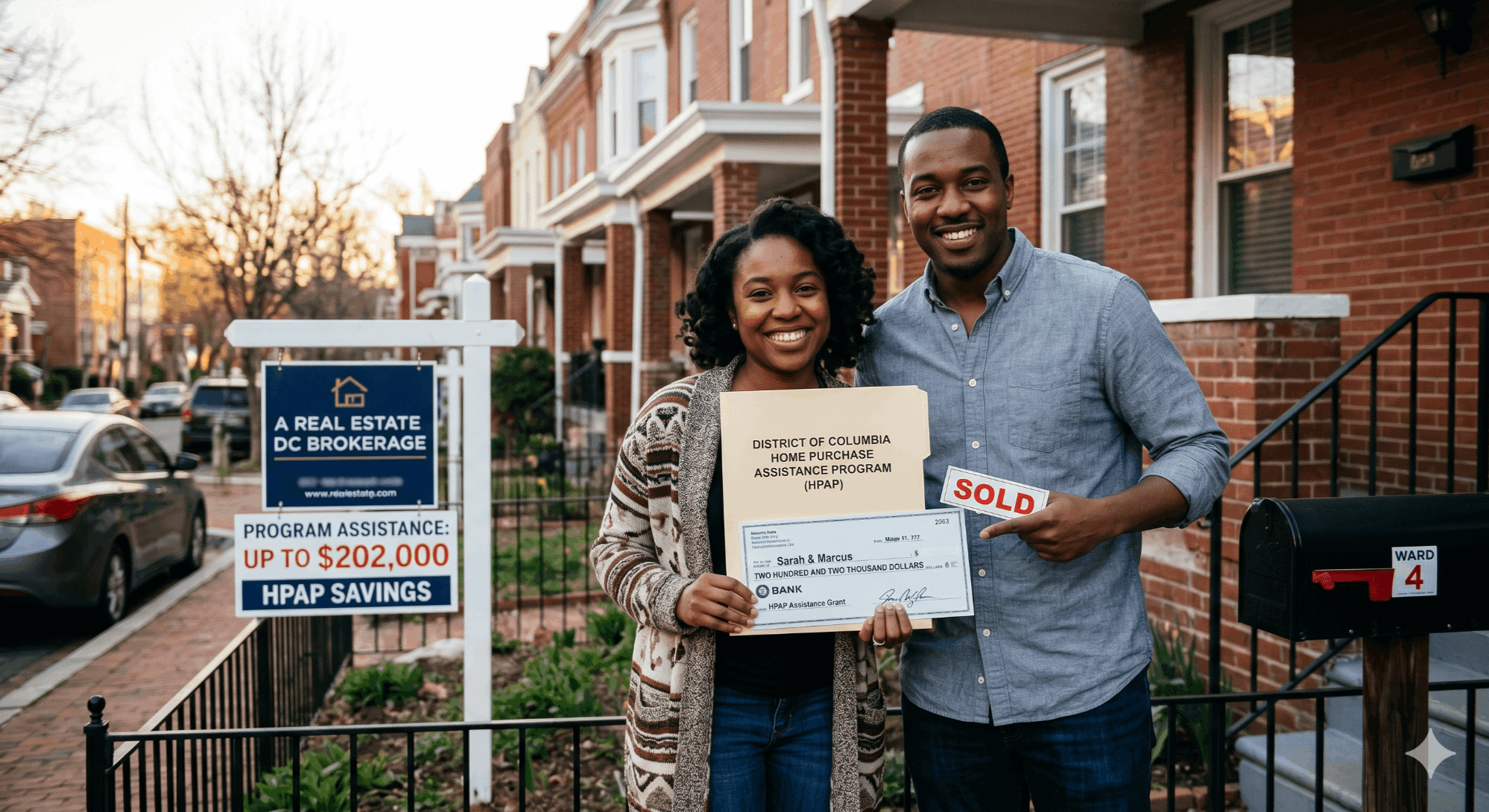 The District of Columbia's Home Purchase Assistance Program, known as HPAP, is the single most generous down payment assistance program in the DMV. Eligible first-time buyers in DC can receive up to $202,000 in gap financing plus an additional $4,000 for closing costs, all structured as a 0% interest, deferred loan. Yet most DC renters who would qualify have never heard of it, or assume it's out of reach. This guide walks you through exactly how HPAP works in 2026, who qualifies, how much you can actually get, and how to stack it with other DC programs to buy your first home with little or nothing out of pocket. Put together by our DMV real estate team, this guide draws on years of helping first-time buyers navigate DC down payment assistance.
Quick Answer: The DC Home Purchase Assistance Program (HPAP) provides first-time homebuyers in Washington DC with up to $202,000 in down payment assistance and up to $4,000 in closing cost help as a 0% interest, deferred loan. Eligibility depends on household size, income (up to 110% of Area Median Income), a 630+ credit score, and DC residency. For very low-income households, the loan has no monthly payments until the home is sold or refinanced.
Key Takeaways
- Up to $202,000 + $4,000: Maximum HPAP assistance is $202,000 in down payment/gap financing plus a separate $4,000 for closing costs, enough to cover the down payment on a $500,000+ DC home with zero cash from you beyond a $500 minimum contribution.
- 0% interest, deferred: Very low and low-income households make no monthly payments. Moderate-income households (80 to 110% AMI) defer payments for 5 years, then repay principal-only over 40 years.
- DC residents first: District residents get processing priority. Non-residents can apply but are only processed after all pending resident applications.
- First-time buyer required: You cannot have owned any residential real estate anywhere in the past 3 years. The home must be your primary residence and located in DC.
- Minimum 630 credit score and a maximum 45% debt-to-income ratio are required. You'll also need to complete a HUD-approved homebuyer education course.
- Stackable with other programs: HPAP can be combined with DC Open Doors, EAHP (for DC government employees), and DC's First-Time Homebuyer Recordation Tax Reduction for maximum savings.
- Funds run out: HPAP operates on a fiscal year (Oct 1 to Sep 30). In FY 2025, all funds were reserved by mid-February. Start early and get your Notice of Eligibility as soon as possible.
In This Guide
- What Is DC's HPAP Program?
- How Much Can You Actually Get?
- Who Qualifies for HPAP in 2026?
- How the HPAP Loan Actually Works
- The HPAP Application Process: Step by Step
- Stacking HPAP With Other DC Programs
- HPAP vs. DC Open Doors: Which Is Right for You?
- What Properties Qualify?
- Common HPAP Mistakes to Avoid
- Your Next Steps
- Frequently Asked Questions
- Glossary
With DC's median home price hovering around $678,000 in early 2026 and even condos routinely crossing the $500,000 mark, saving for a down payment has become the single biggest obstacle for renters trying to become owners in the District. A standard 5% down payment on a median-priced DC home is roughly $34,000, before closing costs, inspections, and appraisal fees. For many working DC residents, that number feels unreachable on their own.
HPAP exists to bridge exactly that gap. Administered through DC's Department of Housing and Community Development (DHCD) and the DC Housing Finance Agency (DCHFA), it has helped thousands of first-time buyers close on homes they otherwise couldn't afford. The program isn't a grant, it's structured as a 0% interest loan, but for low-income households, no monthly payment is ever due, and the loan only comes due when the home is sold, refinanced for equity, or no longer serves as the borrower's primary residence.
The challenge isn't eligibility for most DC renters, it's navigating the process. HPAP applications go through Community Based Organizations (CBOs), require HUD-approved housing counseling, and are processed on a first-come, first-serve basis until funds run out each fiscal year. Starting early and understanding the paperwork before you shop is the difference between a smooth close and losing your notice-to-proceed window.
What Is DC's HPAP Program?
The Home Purchase Assistance Program is a District of Columbia government program that provides gap financing to first-time homebuyers, meaning it fills the gap between what a buyer can afford to put down and what they actually need to close on a home in DC's expensive market. It's been around since the 1970s and is one of the oldest municipal down payment assistance programs in the country.
HPAP is administered by the DC Department of Housing and Community Development (DHCD) in partnership with the DC Housing Finance Agency (DCHFA) and a network of Community Based Organizations (CBOs) that handle application intake, counseling, and eligibility screening. The loan is technically a second-position deferred mortgage that sits behind your primary first-trust mortgage.
What HPAP Actually Covers
HPAP Funds Can Be Used For:
- ✓ Down payment on a primary-residence home purchase in DC
- ✓ Closing costs (separately capped at $4,000)
- ✓ Single-family homes, condos, and cooperatives (co-ops)
- ✓ Properties located anywhere within the District of Columbia
⚠️ What HPAP Will NOT Fund
HPAP cannot be used for 2-to-4-unit multifamily properties, commercial properties, investment properties, or vacation/second homes. It also cannot be used with seller-financed mortgages. The home you buy with HPAP must be your primary residence and must stay that way for the duration of the loan.
HPAP has moving parts, income verification, credit requirements, a 6-month window to find a home after approval. A free buyer strategy session with our team helps you map it all out before you start the application. We've guided 840+ buyers across the DMV, including many who used DC assistance programs.
How Much Can You Actually Get?
The headline number, $202,000, is the maximum. The actual amount a household receives depends on four variables: household size, household income, demonstrated need (the gap between what you can afford and the purchase price), and available program funding. Per DC housing finance attorneys who work with HPAP applicants, the gap financing loan typically lands in the $70,000 to $202,000 range for most qualified buyers.
Here's how the assistance tiers break down based on income relative to Area Median Income (AMI) for the Washington DC metro area:
| Income Tier | % of AMI | Max Gap Financing | Max Closing Cost Help |
|---|---|---|---|
| Very Low Income | 0 to 50% AMI | Up to $202,000 | Up to $4,000 |
| Low Income | 50 to 80% AMI | Up to $202,000 | Up to $4,000 |
| Moderate Income | 80 to 110% AMI | Amount varies (gap-based) | Up to $4,000 |
| Above 110% AMI | Over 110% AMI | Not eligible | Not eligible |
2026 AMI Reference: Washington DC Metro Area
HUD's 2026 Median Family Income for the Washington metro area is $163,900 for a household of four. Use this to estimate where you fall:
| Household Size | 80% AMI (Low) | 100% AMI | 110% AMI (Moderate Cap) |
|---|---|---|---|
| 1 person | ~$91,800 | ~$114,700 | ~$126,200 |
| 2 people | ~$104,900 | ~$131,100 | ~$144,200 |
| 3 people | ~$118,000 | ~$147,500 | ~$162,300 |
| 4 people | ~$131,100 | ~$163,900 | ~$180,300 |
| 5 people | ~$141,600 | ~$177,000 | ~$194,800 |
Figures are estimates derived from HUD's 2026 MFI for the Washington, DC metro area. Official HPAP income limits are published in DHCD's Homebuyer Assistance Table, always verify current limits with your CBO counselor before applying.
The Housing Payment Floor Rule
One quirk that catches applicants off guard: HPAP will reduce your assistance amount if your proposed housing payment is less than 28% of your gross monthly income. Because HPAP is gap financing designed to make an unaffordable payment affordable, the program reasons that if your payment is already comfortable without maximum assistance, other applicants need the funds more. In practice, this means the program pushes you toward your full borrowing capacity rather than a conservative payment.
Who Qualifies for HPAP in 2026?
HPAP has five core eligibility requirements, plus a few secondary ones that catch applicants off guard. Let's walk through each.
The Five Core Requirements
Head of Household & First-Time Homebuyer
You must be the head of your household and cannot have had any ownership interest in residential real estate anywhere in the world during the three years immediately before applying. This includes inherited homes you held an interest in, investment properties, and co-signed titles.
Income Within HPAP Limits
Household income must fall within the published DHCD income table (very low, low, or moderate, capped at 110% of the Washington DC metro AMI). All household earners over 18 are counted, even if they won't be on the mortgage.
Primary Residence in DC
The home you purchase must be your primary residence and must be located within the District of Columbia. You cannot rent it out or convert it to an investment property while the HPAP loan is outstanding.
Good Credit (630+ Minimum)
HPAP and EAHP have a minimum credit score requirement of 630. Your first-trust mortgage lender may require a higher score (typically 640 to 660 for FHA loans and 680+ for conventional loans), so plan for both benchmarks.
Applicant Contribution
You must contribute a minimum of $500 toward the purchase, or 50% of your liquid assets above $3,000, whichever is greater. For very low- and low-income applicants who are elderly, disabled, or displaced, the director can waive the portion above $500 with demonstrated need.
DC Residency Priority
HPAP is funded by District taxpayers, so DC residents always get processing priority. Applications are tiered as follows: (1) low-income, elderly, handicapped, disabled, or displaced DC residents; (2) other eligible DC residents; (3) non-residents who have been employed in DC for at least one year; (4) non-residents who have lived in DC for three consecutive years as adults. Non-resident applications are only processed when there are no pending resident applications, which, given HPAP's funding constraints, means most non-resident applications never make it to approval in a given fiscal year.
Debt-to-Income and Housing Ratios
Maximum Housing Payment Ratio (front-end DTI)
Maximum Total Debt Ratio (back-end DTI)
Minimum Housing Payment as % of Income
HPAP reduces your assistance if your proposed housing payment falls below 28% of gross monthly income.
How the HPAP Loan Actually Works
HPAP isn't a grant. It's a 0% interest, deferred second-position loan, and understanding the repayment mechanics is critical before you apply. Repayment rules depend entirely on your income tier.
For Very Low and Low-Income Households (below 80% AMI)
There are no monthly payments on the HPAP loan for the entire time you live in the home. The loan becomes due, in full, only when one of three things happens:
- ✓ You sell the property
- ✓ You refinance the primary mortgage to pull out equity
- ✓ The home stops being your primary residence (e.g., you convert it to a rental)
For most owners, a future sale is what eventually settles the balance. When the time comes to sell your DC home, the HPAP loan is repaid from your proceeds at closing, so it helps to factor that into your long-term numbers from the start.
For Moderate-Income Households (80 to 110% AMI)
Payments are deferred for the first five years. Starting in year six, monthly principal-only payments begin, amortized over a 40-year repayment period. Because it's principal-only at 0% interest, your payment is simply the HPAP loan balance divided by 40 years, for a $150,000 HPAP loan, that's roughly $312/month starting in year 6.
ℹ️ Refinancing Without Triggering Repayment
A rate-and-term refinance (lowering your rate without pulling out equity) generally does NOT trigger HPAP repayment, but only if the refinance meets specific DHCD conditions. If you're considering a refi, coordinate with DHCD and your HPAP administrator before closing. A cash-out refi always triggers full repayment.
The HPAP Application Process: Step by Step
The application process typically takes 2 to 4 months before you're cleared to make an offer on a home. Starting early is non-negotiable, applicants who begin the process mid-fiscal-year often find funds have already been reserved. Here's the full timeline:
Contact a Community Based Organization (CBO): Week 1
DHCD maintains a list of approved CBOs that handle HPAP applications. These include Greater Washington Urban League, Housing Counseling Services, Latino Economic Development Corporation, and others. You'll be assigned a housing counselor.
Complete HUD-Approved Homebuyer Education: Weeks 1 to 3
Required for every HPAP applicant. Courses are typically 8 hours and offered by the CBOs. You'll receive a certificate of completion that becomes part of your application package.
Submit Application Package: Weeks 3 to 4
Your CBO submits your full package to the HPAP administrator. You'll need pay stubs, tax returns, bank statements, credit report, DC residency documentation, and the homebuyer education certificate.
Receive Notice of Eligibility (NOE): Weeks 6 to 10
The NOE states your maximum assistance amount and confirms eligibility. Your place in line for funding is based on the initial application date tied to this NOE.
Receive Notice to Proceed (NTP): When Funds Reserve
The NTP reserves your funds and gives you a six-month window to find a home, go under contract, and close. If you don't close within six months, you go back into the queue for the next funding round.
House Hunt, Contract & Close: Within 6 Months of NTP
Work with a DC-licensed buyer's agent, tour homes within your approved budget, get under contract, complete inspections and appraisal, and close, all before your NTP expires. Your agent will coordinate closely with your HPAP administrator and lender throughout.
Once you have your Notice to Proceed, you've got six months to find the right home. Our live home search pulls directly from BrightMLS with real-time updates, filter by neighborhood, price, property type, and more. The Jamil Brothers are licensed in DC and have closed homes across every ward in the District.
Stacking HPAP With Other DC Programs
HPAP is powerful on its own, but DC buyers who truly understand the system combine it with multiple programs to buy with little to nothing out of pocket. Here are the most common stacks:
HPAP + EAHP (Employer-Assisted Housing Program)
If you work for the DC government, including DC Public Schools, DC Public Charter Schools, or any District agency, you're likely eligible for EAHP on top of HPAP. EAHP provides an additional $20,000 repayable loan plus up to $5,000 in matching closing cost grants. For DC first responders and educators, the numbers jump to $30,000 in a repayable/forgivable structure plus up to $15,000 in matching funds. Most DC government employees eligible for both programs combine them.
HPAP + DC First-Time Homebuyer Recordation Tax Reduction
Qualified first-time DC homebuyers can have their recordation tax reduced from the standard 1.1% to 1.45% down to just 0.725% of the purchase price. On a $500,000 home, that's $1,875 to $3,625 in direct closing-cost savings, and it stacks on top of HPAP with no conflict.
HPAP + DC Tax Abatement
If your household income qualifies, you may also be exempt from paying the DC recordation tax entirely AND receive a 5-year abatement on your property taxes. This is one of the most overlooked wins in the stack, easily worth $10,000 to $30,000 over five years depending on your home's assessed value. Income limits are strict, so coordinate with your CBO counselor on eligibility.
HPAP + DC Open Doors
DC Open Doors is DCHFA's first-trust mortgage program with its own down payment assistance. It's possible to use DC Open Doors as your primary mortgage and HPAP as secondary down payment assistance, but the interaction has specific rules. In most cases, buyers who qualify for HPAP will prefer HPAP's larger assistance cap, while buyers above HPAP's 110% AMI ceiling use Open Doors exclusively.
HPAP vs. DC Open Doors: Which Is Right for You?
| Feature | HPAP | DC Open Doors |
|---|---|---|
| Max Assistance | Up to $202,000 + $4,000 closing | Covers down payment (typically 3 to 5%) |
| Income Cap | 110% AMI | 130% AMI |
| First-Time Buyer Required | Yes | No |
| DC Resident Required | Priority (non-residents rarely funded) | No (residents & non-residents) |
| Interest Rate | 0% (deferred) | 0% on DPA; market rate on first mortgage |
| Application Process | CBO + DHCD (2 to 4 months) | Through any DCHFA-approved lender |
| Best For | Low/moderate-income DC residents | Higher earners and non-residents |
What Properties Qualify?
HPAP works for most primary-residence purchases in DC, with a few notable restrictions. When you are ready to start touring, you can browse homes for sale across DC and focus on the property types the program allows. Here's what you can and can't buy:
| ✓ HPAP-Eligible | ✗ Not Eligible |
|---|---|
| Single-family detached homes | 2-to-4-unit multifamily properties |
| Rowhouses and townhouses | Commercial or mixed-use buildings |
| Condominiums | Investment or rental properties |
| Cooperatives (co-ops) | Vacation or second homes |
| Properties anywhere in DC | Properties outside the District of Columbia |
ℹ️ Conforming Loan Limit Cap
Your primary first-trust mortgage cannot exceed the conforming loan limit (currently $834,977 for the DC area, per DCHFA's HPAP lender guidance, subject to annual updates). This is a functional purchase-price ceiling for most HPAP applicants, though it's well above DC's median home price.
Common HPAP Mistakes to Avoid
After closing dozens of DC purchases with buyers using assistance programs, we see the same pitfalls again and again. Here's how to avoid them:
Top HPAP Pitfalls
- ✗ Starting too late in the fiscal year. HPAP funds are allocated annually on October 1. In FY 2025, all funds were reserved by mid-February. Apply early.
- ✗ House hunting before getting the NTP. Some buyers fall in love with a home before their Notice to Proceed lands, and then lose it because financing can't align.
- ✗ Ignoring the 28% housing-payment floor. Buying a home with payments below 28% of income reduces your HPAP award. Work with your counselor to size your offer correctly.
- ✗ Assuming a rental conversion is allowed. Renting your HPAP home makes the full balance immediately due. If life plans include relocating soon, HPAP may not fit.
- ✗ Not shopping first-trust lenders. HPAP partners with many lenders, but not all offer the same rates. Get 2 to 3 quotes on your primary mortgage.
- ✗ Using a buyer's agent unfamiliar with HPAP timing. The 6-month NTP window is tight. Your agent needs to coordinate inspections, appraisal, and closing with your HPAP administrator from day one.
We'll walk you through exactly what HPAP assistance plus your first-trust mortgage puts within reach, and what DC neighborhoods, property types, and condo buildings work best for your budget. The consultation is free, no strings.
Your Next Steps
If you're a DC renter thinking about homeownership, here's the practical sequence that works:
Your HPAP Action Plan
- ✓ Pull your credit report and confirm your score is 630+ (ideally 680+ for conventional mortgage options)
- ✓ Gather your last 2 years of tax returns, last 2 months of pay stubs, and 2 months of bank statements
- ✓ Contact a CBO housing counselor and register for the 8-hour HUD-approved homebuyer education course
- ✓ Get pre-qualified with 2 to 3 first-trust mortgage lenders (FHA, VA, or conventional)
- ✓ Interview a DC-licensed buyer's agent who has worked with HPAP buyers before
- ✓ Submit your HPAP application and start mapping neighborhoods while you wait for your NOE
Frequently Asked Questions
How much can I get from DC's HPAP program in 2026?
Eligible applicants can receive up to $202,000 in down payment/gap financing assistance plus an additional $4,000 in closing cost assistance, for a total of up to $206,000. Most qualified buyers in practice receive somewhere between $70,000 and $202,000 depending on household size, income tier (very low, low, or moderate), demonstrated gap need between what they can afford and the purchase price, and available fiscal-year funding.
Who qualifies for HPAP in Washington DC?
To qualify for HPAP you must be a first-time homebuyer (no ownership interest in residential real estate anywhere in the past 3 years), be the head of household, have income within the HPAP published limits (capped at 110% of the Washington DC metro Area Median Income), have a minimum 630 credit score, plan to use the home as your primary residence, and buy a property located within the District of Columbia. DC residents receive processing priority over non-residents.
What is the minimum credit score for HPAP?
HPAP itself requires a minimum 630 credit score. However, your first-trust mortgage lender will have its own credit requirements that may be higher, typically 620 to 640 for FHA loans and 680+ for conventional loans. You need to qualify for both your primary mortgage and HPAP separately to close on a home using the program.
How do I apply for HPAP in 2026?
You cannot apply directly to DHCD. HPAP applications go through a network of Community Based Organizations (CBOs), including Greater Washington Urban League, Housing Counseling Services, and Latino Economic Development Corporation, among others. Contact a CBO, get assigned a housing counselor, complete the required HUD-approved homebuyer education course, and submit your application package. The CBO forwards your application to the HPAP administrator for eligibility review and Notice of Eligibility issuance.
How long does the HPAP application process take?
Expect 2 to 4 months from your first CBO contact to receiving your Notice of Eligibility, depending on how quickly you complete the required homebuyer education course and gather your financial documentation. Once you receive a Notice to Proceed (which reserves your funding), you have a six-month window to find a home, go under contract, and close. Starting early in the fiscal year (October through December) maximizes your chances of being funded before annual allocations run out.
Do I have to pay back the HPAP loan?
It depends on your income. For very low-income and low-income households (below 80% AMI), you make no monthly payments on the HPAP loan, the entire balance only becomes due when you sell the property, refinance to take out equity, or the home stops being your primary residence. For moderate-income households (80 to 110% AMI), payments are deferred for the first 5 years, then principal-only payments begin in year 6 amortized over a 40-year period at 0% interest. The loan has no interest charges in either case.
Can HPAP be combined with DC Open Doors?
In some cases, yes, but the interaction has specific rules. Most HPAP-eligible buyers choose HPAP as their primary assistance source because of its much higher cap. DC Open Doors is better suited for buyers earning above HPAP's 110% AMI ceiling (Open Doors goes to 130% AMI) or for buyers who are not DC residents. Your housing counselor and lender can model both scenarios to confirm which combination maximizes your assistance.
What property types are HPAP-eligible?
HPAP can be used to buy a single-family detached home, rowhouse, townhouse, condominium, or cooperative (co-op) unit, as long as the property is located within the District of Columbia and will be your primary residence. HPAP cannot be used for 2-to-4-unit multifamily properties, investment or rental properties, commercial properties, or vacation/second homes. The primary mortgage must also stay within the conforming loan limit (currently $834,977 for the DC area).
What happens if I want to rent out my HPAP home later?
Renting out your HPAP-funded home triggers immediate repayment of the full loan balance, the home ceasing to be your primary residence is one of the three events that makes the loan due. If you have a strong possibility of needing to move within a few years, HPAP may not be the right fit. For buyers planning to stay put for 5+ years, the program is structured to work in your favor. Always discuss life-plan scenarios with your CBO counselor before committing.
Can I use HPAP if I'm not a DC resident?
Technically yes, but in practice it's difficult. DHCD processes applications in a strict priority order: low-income DC residents first, then other DC residents, then non-residents who have been employed in DC for at least one year, then non-residents who have lived in DC for three consecutive years as adults. Non-resident applications are only processed when there are no pending DC resident applications, and because HPAP funds are typically reserved by early in each fiscal year, non-residents rarely receive funding in a given year. If you're moving to DC, establishing residency before applying dramatically improves your chances.
Do I need a buyer's agent to use HPAP?
Legally, no, but practically, absolutely yes. HPAP's 6-month Notice to Proceed window is tight, and the coordination between your housing counselor, first-trust lender, HPAP administrator, title company, and the seller's side is complex. A DC-licensed buyer's agent who has worked with HPAP buyers before will sequence inspections, appraisal, and closing to meet your deadlines. Post-NAR settlement, buyer agent compensation is negotiable and separately documented, ask about our flexible commission options during your initial consultation. The Jamil Brothers Realty Group offers free buyer strategy sessions for DC buyers considering HPAP, including timeline coordination and neighborhood mapping across VA, DC, MD, and WV.
What if HPAP funds have already run out for the year?
If you apply after annual funds are reserved, you'll hold a Notice of Eligibility or Notice to Continue and wait in queue for the next round of funding, typically when the next fiscal year begins on October 1. DHCD prioritizes applicants in order of their initial NOE date, so applying early (even before you're ready to buy) locks in your place in line. A new funding dashboard, launched by DHCD, now publishes weekly updates on fund availability so you know exactly where things stand.
Is DC a good place to buy a home in 2026?
DC's market in early 2026 has shifted toward better conditions for buyers compared to the frenetic pace of 2021 to 2022. Inventory is rising (up 12.7% month-over-month in March 2026 for detached homes), homes are taking longer to sell (68 days on market in March, up from 57 a year prior), and the median sale price is around $678,000. For first-time buyers using HPAP, this softer market means more negotiating leverage, more willingness from sellers to offer concessions, and more time to make careful decisions. Combined with HPAP's $202,000 assistance ceiling, DC homeownership is meaningfully more attainable in 2026 than it was two or three years ago.
Glossary
HPAP
Home Purchase Assistance Program: DC's gap financing program offering up to $202,000 in down payment assistance plus $4,000 in closing cost help for qualified first-time buyers.
DHCD
DC Department of Housing and Community Development: the District agency that administers HPAP and sets annual income limits based on HUD data.
DCHFA
DC Housing Finance Agency: partners with DHCD on homeownership programs, including HPAP and DC Open Doors mortgage financing.
AMI / MFI
Area Median Income (also called Median Family Income): the midpoint household income for the Washington DC metro area, set by HUD. HPAP income tiers are expressed as percentages of AMI.
Gap Financing
A second-position loan that fills the difference (the "gap") between what a buyer can afford to contribute and the actual cost to purchase a home. HPAP is structured as gap financing.
NOE / NTP / NTC
Notice of Eligibility confirms you qualify. Notice to Proceed reserves funds and starts your 6-month home-shopping window. Notice to Continue extends your eligibility between fiscal years.
CBO
Community Based Organization: a DHCD-approved nonprofit that handles HPAP applications, housing counseling, and the required homebuyer education course.
First-Trust Mortgage
Your primary mortgage loan: the one in first lien position on the property. HPAP sits behind this in second position as a subordinate deferred loan.
Conclusion: HPAP Is Real Money on the Table
DC's HPAP program quietly helps hundreds of first-time buyers become owners in the District every year, many of whom would otherwise remain priced out indefinitely. The $202,000 headline assistance figure is real, and for DC residents whose income and credit qualify, HPAP can mean the difference between another year of renting and actually owning a home in the city. Stacked with EAHP, the DC Tax Abatement, and the First-Time Homebuyer Recordation Tax Reduction, the total value can easily exceed $220,000 in direct and deferred benefits on a single purchase.
The program's complexity is its main barrier. Between CBO coordination, income verification, homebuyer education requirements, first-trust lender approval, the 6-month NTP window, and fund availability timing, HPAP buyers benefit enormously from working with a DC-experienced buyer's agent and lender team who have closed HPAP deals before. The program itself doesn't charge you anything, professional guidance through it is the highest-leverage free resource most first-time DC buyers aren't using.
Keep in mind that HPAP applies only to homes inside the District, so once you know your budget it helps to explore which Washington DC communities fit your price range and the property types the program allows. And because the HPAP loan is repaid when you eventually sell, it pays to understand your future exit costs early, including how our 1.5% listing commission can help you keep more of the equity you build.
Know your numbers, your timeline, and the right DC neighborhoods for your budget, before you start the CBO paperwork. The Jamil Brothers are licensed in DC, VA, MD, and WV and provide a full buyer consultation at no cost or obligation.
Explore More
Browse Every Corner of the DMV Market
Whether you're searching by budget, neighborhood, or buying situation, find exactly what you need below.
Virginia Homes by Budget
Washington DC Homes by Budget
Maryland Homes
Explore Northern Virginia Communities
Loudoun County
Fairfax County & Surrounding
Ready to Make a Move?
Full-Service · No Tradeoffs
List for 1.5% & Keep More Equity
Professional photography, drone video, 3D tours, and expert negotiation, all included. On an $800K home, that's $12,000 more in your pocket vs. a 3% agent.
See the 1.5% Program →Need Speed or Certainty?
Get a No-Obligation Cash Offer
Skip the showings, skip the contingencies. If timing or condition matters more than top dollar, a cash offer may be the right fit. We'll walk you through every option.
Explore Cash Offers →
Categories
- All Blogs (1158)
- Aldie (3)
- Ashburn (6)
- Buyer Guide (8)
- Buying a home (2)
- Buying Strategies (28)
- festivals (1)
- General Blog (66)
- Leesburg (5)
- Market Intelligence (29)
- Market Updates (8)
- Notable Properties For Sale (29)
- Real Estate Tips, News, and More (376)
- Seller Guide (2)
- Seller Guides (60)
- Selling Your Home (469)
- Sterling (6)
- Top Realtors in Northern Virginia (58)
Recent Posts

Message Sent!
Thank you for reaching out. Arslan & Saad have received your details and will be in touch shortly.
Need immediate assistance? Call or text 703-782-4830.