
Selling an Investment Property in Arlington: Tax & Buyer Strategy
Selling an Investment Property in Arlington: Tax & Buyer Strategy
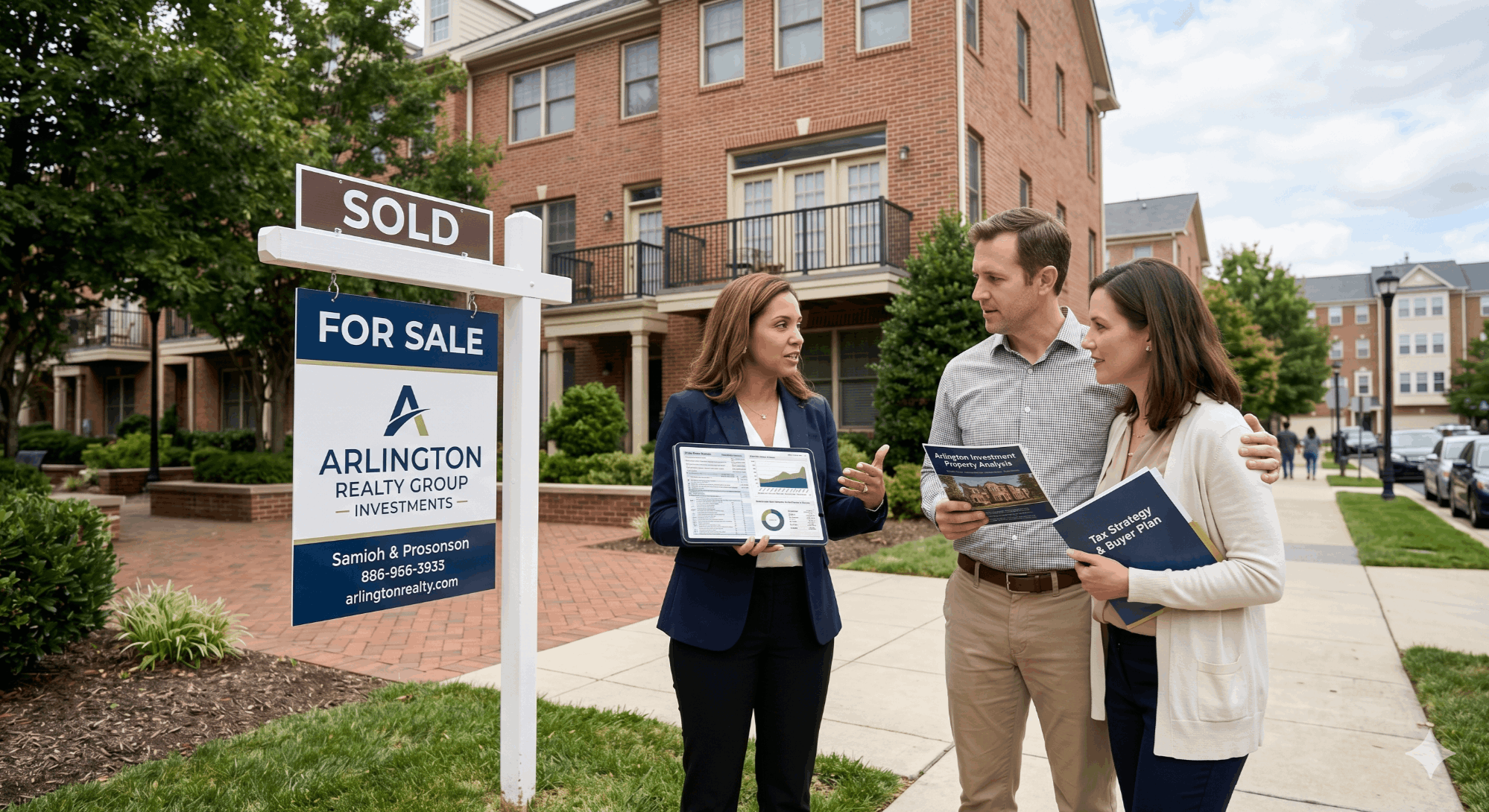
Quick Answer: Selling an investment property in Arlington means navigating federal capital gains tax (0–20%), Virginia state income tax (5.75%), depreciation recapture (up to 25%), and the 3.8% Net Investment Income Tax. The biggest decisions are whether to defer taxes through a 1031 exchange, whether to convert the property back to a primary residence to use the Section 121 exclusion, and whether to market to investors or owner-occupants. The right combination can save Arlington landlords $50,000–$200,000+ in taxes on a typical sale.
Key Takeaways
- Arlington investment properties typically face three layers of tax at sale: capital gains, depreciation recapture, and Virginia state income tax — combined federal-and-state exposure can exceed 30% of total gain.
- A properly structured 1031 like-kind exchange defers all federal and state taxes when replacement property of equal or greater value is acquired within 180 days.
- If you lived in the property as a primary residence for 2 of the last 5 years, the Section 121 exclusion shields up to $250,000 (single) or $500,000 (married) of gain — though depreciation recapture still applies.
- Selling tenant-occupied Arlington properties limits your buyer pool to investors and reduces sale price 5–10%; vacant possession typically nets more even after factoring lost rent.
- Investor buyers in Arlington focus on cap rate and cash flow, while owner-occupants pay for finishes, school zones, and walkability — your marketing strategy and pricing approach must match the target buyer.
- Arlington's regional congestion tax ($0.15 per $100) plus state grantor tax ($1 per $1,000) means closing costs run higher than other Virginia jurisdictions — budget accordingly.
In This Guide
- The Arlington Investment Property Market in 2026
- Capital Gains Tax: Federal, Virginia, and NIIT
- Depreciation Recapture: The Hidden Tax Bill
- The Section 121 Primary Residence Exclusion
- 1031 Exchange: Deferring Taxes Indefinitely
- Seller Savings Calculator (1.5% vs 3%)
- Buyer Strategy: Who Buys Arlington Investment Property
- Tenant-Occupied vs. Vacant: Which Sells Better?
- Marketing Strategy for Investment Properties
- Closing Costs for Arlington Investment Sales
- Step-by-Step Selling Timeline
- Common Mistakes to Avoid
- Frequently Asked Questions
- Glossary
If you own a rental property, condo, or small multifamily building in Arlington and you're thinking about selling, the math is more complicated than a typical primary-residence sale. Most Arlington investment properties have appreciated significantly since purchase, and many were bought before the Amazon HQ2 announcement in late 2018 — meaning the unrealized gain is substantial. That gain comes with a tax bill that can swallow 25–35% of your profit if you're not strategic about timing, structure, and exit method.
The good news: investors in Arlington have more tools than sellers in most U.S. markets. Section 1031 exchanges are common because of the strong replacement-property inventory across Northern Virginia. The Section 121 primary-residence exclusion is available to landlords who once lived in the property. And Arlington's deep buyer pool — including out-of-state investors looking for Pentagon and Amazon-adjacent rentals — means you have flexibility in how you structure the sale.
This guide walks through every tax provision that applies to an Arlington investment property sale, the pros and cons of each exit strategy, and the specific buyer-targeting and marketing decisions that will affect your final net proceeds. Whether you're selling a Ballston condo, a Clarendon townhouse, or a Lyon Park duplex, the principles below apply.
The Arlington Investment Property Market in 2026
Arlington is one of the strongest landlord markets in the United States. Federal employment, the Pentagon, the State Department, and Amazon's HQ2 in National Landing combine to produce sustained rental demand from high-income tenants. Vacancy rates for well-located Arlington rentals consistently sit below 4%, and rent growth has outpaced national averages for the past decade.
For investment property owners who bought 5–15 years ago, that performance translates directly into appreciation. Arlington condo values, Arlington townhouse prices, and Arlington single-family detached homes have all roughly doubled or better since 2010, depending on submarket. That's wealth creation — but it's also a massive embedded tax liability if you sell without planning.
Current Investor Demand by Property Type
| Property Type | Investor Interest | Typical Cap Rate | Typical Buyer |
|---|---|---|---|
| Studio/1BR Condo (Ballston, Rosslyn, Crystal City) | High | 3.5–4.5% | Out-of-state investor, parent buying for child |
| 2BR Condo (Clarendon, Courthouse) | Very High | 3.8–4.8% | Investor or owner-occupant — competing pools |
| Townhouse (Lyon Park, Bluemont, Westover) | Moderate | 3.0–4.0% | Owner-occupants dominate; investors selective |
| SFH (Cherrydale, Lyon Village, North Arlington) | Low for pure investors | 2.5–3.5% | Owner-occupant, family buying for child |
| Duplex/Triplex (rare in Arlington) | Very High | 4.5–5.5% | Local and regional investors |
Cap rates in Arlington are compressed compared to most U.S. metros — you're not selling to investors who are looking for 8% cap deals. You're selling to a buyer who values the appreciation upside, the rental certainty, and the ability to defer taxes through a 1031 exchange into a quality DMV asset. That dynamic shapes everything about how you should price and present the property.
Capital Gains Tax: Federal, Virginia, and NIIT
When you sell an investment property held for more than one year, the gain is taxed as a long-term capital gain. Three separate taxes can apply: federal capital gains, Virginia state income tax, and the federal Net Investment Income Tax (NIIT). Understanding the layers is the foundation of every other decision in this guide.
Federal Long-Term Capital Gains Rates
For 2026, the federal long-term capital gains rate depends on your taxable income:
| Tax Rate | Single Filer Income | Married Filing Jointly Income |
|---|---|---|
| 0% | Up to ~$48,350 | Up to ~$96,700 |
| 15% | ~$48,351 – ~$533,400 | ~$96,701 – ~$600,050 |
| 20% | Above ~$533,400 | Above ~$600,050 |
Most Arlington investment property owners fall into the 15% federal bracket. High earners — typically dual-income professionals at federal contracting firms, Amazon, or law firms — often land in the 20% bracket. The income that pushes you into a higher bracket includes the gain on sale itself, so a large profit can move you up.
Virginia State Capital Gains
Virginia treats capital gains as ordinary income for state tax purposes. The top Virginia individual income tax rate is 5.75%, which applies to virtually every Arlington investment seller given the gains involved. Unlike federal law, Virginia does not provide a preferential rate for long-term capital gains. There is no Virginia equivalent of the 1031 exchange — but federal 1031 deferral flows through to Virginia automatically because the state conforms to federal taxable income.
Net Investment Income Tax (NIIT)
The 3.8% NIIT is an additional federal surtax on investment income for high-income taxpayers. It applies when modified adjusted gross income exceeds $200,000 (single) or $250,000 (married filing jointly). Most Arlington investment property sellers will trigger NIIT in the year of sale because the gain itself pushes income above the threshold. The 3.8% adds a meaningful layer — on a $400,000 gain that means an extra $15,200 in federal tax.
Combined Tax Exposure: A Real Arlington Example
Here's what a typical Arlington landlord faces. Imagine you bought a 2-bedroom Clarendon condo in 2014 for $475,000, took $90,000 in cumulative depreciation deductions while renting it, and are selling in 2026 for $850,000 (rounded for clarity, not actual market data — get a current valuation):
Tax Math on a Sample Arlington Sale
| Sale price | $850,000 |
| Selling costs (commission, closing) | −$60,000 |
| Adjusted basis (purchase + improvements − depreciation) | $385,000 |
| Total taxable gain | $405,000 |
| — Depreciation recapture (25% × $90K) | $22,500 |
| — Federal capital gains (15% × $315K) | $47,250 |
| — NIIT (3.8% × $405K) | $15,390 |
| — Virginia state (5.75% × $405K) | $23,288 |
| Total taxes owed | ~$108,428 |
That's roughly 27% of the gain going to taxes — and this is a relatively middle-of-the-road example. High earners with bigger gains can see effective tax rates north of 33%. The strategies in the next four sections exist specifically to reduce or defer that bill.
Get a personalized valuation from The Jamil Brothers — comp-driven, investor-aware, and grounded in real Arlington sale data. We factor cap rate, rental income, condition, and tenant status. Response within 24 hours.
Depreciation Recapture: The Hidden Tax Bill
Depreciation is the deduction landlords take each year for the gradual wear-and-tear of the building. The IRS allows residential rental property to be depreciated over 27.5 years on a straight-line basis. Most Arlington landlords benefit from this deduction every year while owning the property — but it comes due at sale.
When you sell, the IRS "recaptures" the depreciation you took (or could have taken — even if you didn't claim it, the IRS still treats it as if you did). Recaptured depreciation is taxed at a maximum federal rate of 25% — higher than the long-term capital gains rate. Virginia layers on its own 5.75% on top of recaptured amounts. NIIT can also apply.
Why Depreciation Recapture Surprises So Many Sellers
Most landlords don't track their cumulative depreciation deduction year-by-year — their CPA handles it on Schedule E. When the property sells, the recapture comes as a shock. On a 10-year hold of an $800,000 Arlington condo with $580,000 of depreciable building basis, cumulative depreciation runs roughly $211,000. At 25% federal recapture plus 5.75% Virginia, that's about $65,000 in tax — independent of the capital gains math.
Tax rate comparison: depreciation recapture is the highest-rate tax in this entire equation
Can You Avoid Depreciation Recapture?
Three legitimate paths exist:
- Section 1031 like-kind exchange. Defers both capital gains and depreciation recapture as long as you reinvest the proceeds into another investment property within strict timing rules.
- Hold until death (step-up in basis). Your heirs receive the property at fair market value on your date of death — wiping out all unrealized gain and depreciation recapture. This is morbid but legal and is the foundation of generational real estate wealth.
- Convert back to primary residence. The Section 121 exclusion does not eliminate depreciation recapture, but the remaining gain may be excluded — see the next section.
You cannot offset depreciation recapture using passive losses unless they were properly tracked and carried forward. Talk to a CPA before listing — recapture math is where DIY landlords most often get hurt.
The Section 121 Primary Residence Exclusion
Section 121 of the Internal Revenue Code allows individuals to exclude up to $250,000 of capital gain ($500,000 if married filing jointly) when selling a primary residence. To qualify, you must have owned and used the home as a primary residence for at least 2 of the last 5 years before the sale.
This matters for Arlington investors in two scenarios:
Scenario 1: You Lived in the Property Before Renting It
This is common in Arlington. Many landlords bought a condo or townhouse, lived in it for several years, then converted to a rental when they upgraded to a larger home. If you sell within 3 years of moving out (so the cumulative time still includes 2 of the last 5 years as primary), you can use Section 121.
Important caveat: The exclusion is reduced for "non-qualified use" (the period the property was used as a rental after January 1, 2009). The IRS calculates a non-qualified use ratio that reduces the excludable gain. The exclusion still helps significantly, but it's not the full $250K/$500K shield it would be on a primary-only home.
Scenario 2: Move Back In Before Selling
Some landlords intentionally move back into a former rental to qualify for Section 121. The property must be your actual primary residence for at least 2 years before sale. This works best for landlords who are downsizing, returning from out-of-state, or whose Arlington property would make a comfortable primary home for the qualifying period.
⚠️ Section 121 does NOT eliminate depreciation recapture
Even when you qualify for the full $250K/$500K Section 121 exclusion, all depreciation taken since 1997 is still subject to recapture at up to 25%. Plan for that bill separately.
1031 Exchange: Deferring Taxes Indefinitely
A Section 1031 exchange — also called a "like-kind exchange" — allows you to defer both capital gains tax and depreciation recapture by reinvesting the proceeds from the sale into another investment property. Done properly, you can roll gains forward indefinitely, and at death your heirs receive a step-up in basis that wipes out the deferred gain entirely.
The Strict 1031 Timeline
Identify a Qualified Intermediary BEFORE closing — Day 0
You cannot touch the sale proceeds. A Qualified Intermediary (QI) holds the funds. If proceeds hit your bank account, the exchange is dead and the entire gain is taxable. Engage your QI before listing — definitely before closing.
Identify replacement property — Within 45 days of sale closing
You must formally identify up to three potential replacement properties (or more under specific rules) in writing within 45 calendar days. No extensions. No exceptions. Weekends and holidays count.
Close on replacement property — Within 180 days of sale closing
The full transaction must close within 180 days from the original sale. The replacement property's value must equal or exceed the sale price, and you must reinvest all the equity. Any cash you keep ("boot") is taxable.
Hold the replacement as investment property
The IRS expects the replacement to be held for investment for a substantial period — generally at least 1–2 years. Quickly converting to a primary residence can void the exchange.
What Counts as "Like-Kind"?
For real estate, like-kind is broadly defined. You can exchange an Arlington condo for a Tampa duplex, a Loudoun County rental, a commercial strip center in another state, or a vacant land investment. The properties just need to be held for investment or business use. You cannot 1031 exchange into a primary residence or a vacation home you'll personally use.
When 1031 Exchanges Make Sense — and When They Don't
| ✓ 1031 Makes Sense | ✗ 1031 May Not Make Sense |
|---|---|
| You want to keep investing in real estate | You're exiting real estate entirely |
| Large embedded gain (>$200K) | Modest gain — exchange costs eat the savings |
| Significant cumulative depreciation | Recently purchased, low depreciation taken |
| Want to consolidate or upgrade portfolio | Need cash from sale for a non-real-estate purpose |
| Estate plan involves heirs receiving real estate | You qualify for Section 121 exclusion already |
Seller Savings Calculator
Tax strategy is one lever. Commission is another — and unlike capital gains, you have direct control over what you pay your listing agent. Here's how the standard 3% listing commission compares to The Jamil Brothers Realty Group's 1.5% full-service program at common Arlington investment property price points.
Seller Savings Calculator
How much more do you keep with our 1.5% listing fee?
Select your Arlington property's estimated value to see your real net proceeds — side by side.
Traditional Agent — 3%
Our Fee — Only 1.5%
Extra in your pocket
$6,000
vs. a traditional 3% listing agent — with zero reduction in service or marketing.
Traditional Agent — 3%
Our Fee — Only 1.5%
Extra in your pocket
$7,500
vs. a traditional 3% listing agent — with zero reduction in service or marketing.
Traditional Agent — 3%
Our Fee — Only 1.5%
Extra in your pocket
$9,000
vs. a traditional 3% listing agent — with zero reduction in service or marketing.
Traditional Agent — 3%
Our Fee — Only 1.5%
Extra in your pocket
$11,250
vs. a traditional 3% listing agent — with zero reduction in service or marketing.
Traditional Agent — 3%
Our Fee — Only 1.5%
Extra in your pocket
$15,000
vs. a traditional 3% listing agent — with zero reduction in service or marketing.
Estimates only. Closing costs vary. Buyer's agent commission is negotiable.
4K photography, drone video, 3D tours, expert negotiation, and full MLS marketing — included at 1.5%. On a typical Arlington investment sale, you keep $9,000–$15,000 more before factoring in any tax strategy. After capital gains, every saved dollar is amplified.
Buyer Strategy: Who Buys Arlington Investment Property
The first strategic decision is who you're selling to. Arlington investment properties typically have two distinct buyer pools, and they value the property completely differently. Choosing the wrong target — or trying to please both — can leave $30,000–$80,000 on the table.
Investor Buyers
Investor buyers focus on cap rate (annual rental income / purchase price), cash flow after debt service, and total return including appreciation. They evaluate condition through a maintenance-cost lens — the question isn't "is this kitchen nice?" but "how soon will I need to replace this kitchen?" They're often comfortable inheriting tenants and may even prefer it (instant cash flow, no marketing gap).
Investor buyers in Arlington split into three subcategories:
| Investor Type | What They Want | How They Pay |
|---|---|---|
| 1031 exchange buyer | Quality DMV asset, willing to pay market price to defer tax | Conventional financing or all cash, tight timeline |
| Local landlord (5–25 unit portfolio) | Cash flow, low management overhead, established submarket | Conventional or portfolio financing |
| Out-of-state buyer (often parent buying for child) | Walkable area, schools/job-centers nearby, easy management | Often all-cash or large down payment |
| Institutional/iBuyer (rare for single Arlington units) | Volume, scaled management, predictable returns | Cash, fast close, often 5–10% below market |
Owner-Occupant Buyers
Owner-occupants buy on emotion, lifestyle, and finishes. They're willing to pay a meaningful premium over what an investor will pay because they're not running a cap-rate spreadsheet — they're looking at school zones, commute, kitchen finishes, light, walkability to coffee shops, and proximity to friends. For most Arlington condos, townhouses, and SFH, owner-occupants pay 5–15% more than investors.
The catch: owner-occupants generally need vacant possession at closing, expect "move-in ready" condition, and care intensely about cosmetic presentation. Investor-condition properties — original kitchens, dated bathrooms, neutral landlord paint — typically don't compete well in the owner-occupant pool without renovation.
Which Pool Should You Target?
The answer depends on three variables: condition, tenant status, and your timeline. As a rule of thumb:
- Top condition + vacant + flexible timeline → Target owner-occupants for maximum price.
- Investor condition + tenant-occupied + need certainty → Target investors for clean execution.
- Mixed condition + flexible timeline → List broadly, accept either; price reflects the broader pool.
Tenant-Occupied vs. Vacant: Which Sells Better?
Arlington investment property sellers face a classic timing question: sell with the tenant in place, or wait until the lease ends and sell vacant?
Selling Tenant-Occupied: Pros and Cons
| ✓ Pros | ✗ Cons |
|---|---|
| Continuous rental income through closing | Buyer pool shrinks to investors only (most owner-occupants need vacant) |
| Investor buyers may pay a premium for in-place lease | Showings restricted by tenant cooperation and Virginia notice rules |
| No staging or vacant marketing costs | Tenant condition (cleanliness, clutter) hurts photos and showings |
| Existing tenant validates rent comps | Net price typically 5–10% lower than vacant sale |
Virginia Tenant Rights at Sale
Virginia is a "lease survives sale" state. The new owner takes the property subject to the existing lease — they cannot evict the tenant unless the lease has ended or the tenant breaches. Month-to-month tenants can be terminated with proper notice (generally 30 days for tenants who pay monthly), but fixed-term leases continue to their natural expiration.
This matters because it dictates what kind of buyer you can attract. If your tenant has 18 months remaining on a fixed-term lease, owner-occupants are effectively excluded — they can't move in until that lease ends. Your buyer pool defaults to investors. If your tenant is month-to-month, you have flexibility: list with vacant possession contingent on close, give 30 days' notice after going under contract.
The "Wait for Lease End" Decision
Many Arlington landlords ask whether they should wait for the lease to end before listing. The math depends on:
"Wait for Vacant" Decision Framework
- ✓ If vacant sale price uplift exceeds 6 months of lost rent, wait.
- ✓ If property needs cosmetic refresh (paint, flooring) to compete, wait.
- ✓ If targeting owner-occupants for maximum price, wait.
- ✗ If tenant pays at-market or above-market rent and you have an investor pool eager, sell occupied.
- ✗ If lease has 12+ months remaining and you can't legally end it early, sell occupied.
If your timing is constrained — by 1031 deadlines, partnership wind-down, or tenant complications — a cash offer may be the cleanest path. We'll walk you through your full range of options side-by-side, including traditional listing, off-market sale, and direct cash purchase. No pressure.
Marketing Strategy for Investment Properties
Marketing an investment property well requires presenting two complete narratives: the investor case and the owner-occupant case. The listing description, photography, and showings strategy should anticipate both audiences.
What Investor Buyers Want to See
Investor-Focused Listing Content
- ✓ Current rent and lease terms (occupied or recently vacated)
- ✓ Trailing 12-month rent comps from similar Arlington units
- ✓ HOA/condo dues, special assessments, reserves status
- ✓ Property tax and insurance history
- ✓ Cap-rate calculation at asking price (a generous gesture, not required)
- ✓ Recent capital improvements (HVAC, water heater, roof, windows)
- ✓ Vacancy/turnover history
What Owner-Occupants Want to See
Owner-Occupant-Focused Listing Content
- ✓ Professional 4K photography and drone aerials
- ✓ 3D virtual tour for out-of-area buyers
- ✓ Walkability score, transit access (Metro stations, bus routes)
- ✓ School assignments — Arlington Public Schools by address
- ✓ Lifestyle context — coffee shops, restaurants, parks within walking distance
- ✓ Move-in-ready presentation: staged or styled, fresh paint, professional cleaning
Strategic Pricing for Two Buyer Pools
The most common Arlington investment property pricing mistake is anchoring to "what an investor will pay" when the property would actually compete in the owner-occupant pool. Even at investor condition, well-located Arlington condos often draw owner-occupant buyers because the lifestyle dollars matter more than the cap-rate dollars to them. A skilled listing strategy attracts both pools to the same listing — investors will pay their cap-rate price and walk if outbid; owner-occupants will pay their lifestyle price and outbid them.
Closing Costs for Arlington Investment Sales
Arlington follows Virginia's general transfer tax structure but adds a regional congestion tax that applies to Northern Virginia jurisdictions. Investment property sellers face the same closing costs as primary-residence sellers — the cost difference is in the tax bill (covered above), not the closing line items.
| Closing Cost | Rate / Amount | Who Pays |
|---|---|---|
| Virginia Grantor's Tax (state) | $1.00 per $1,000 of sale price | Seller |
| Regional Congestion Tax (NOVA) | $0.15 per $100 of sale price | Seller |
| Listing agent commission | 1.5% (Jamil Brothers) to 3% (traditional) | Seller |
| Buyer's agent commission | 2.0–3.0% (negotiable post-NAR settlement) | Seller (typically) — now a negotiated term |
| Settlement / closing fee | $400–$800 | Split or seller |
| Property tax proration | Pro-rated to closing day | Seller for portion of year owned |
| HOA/condo transfer fee | $150–$500 typical | Seller (Virginia statutory disclosure cost) |
| HOA/condo resale package | $150–$400 | Seller |
| Title insurance (lender's, if buyer-financed) | ~0.5% of sale price | Buyer |
For a typical $700,000 Arlington investment property sale, total seller-side closing costs (excluding agent commissions and capital gains tax) typically run $2,000–$3,500. The state grantor tax alone is $700, and the NOVA congestion tax adds another $1,050. These are small relative to the commission and tax bill but add up.
Post-NAR Settlement: Buyer Agent Commission Is Now Negotiated
Following the August 2024 implementation of the National Association of Realtors settlement, buyer's agent compensation is no longer embedded in the listing commission. Sellers can choose to offer a buyer's agent commission as a concession, negotiate it as part of the contract, or decline to offer one. In practice, most successful Arlington investment property sales still include a 2.0–2.5% buyer's agent concession because well-represented buyers expect it.
Step-by-Step Selling Timeline
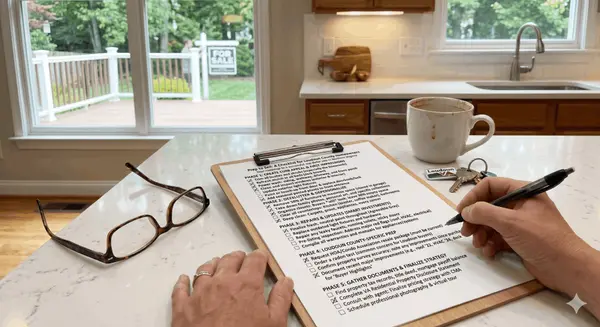
Tax planning meeting with CPA — 60+ days before listing
Calculate your basis, depreciation taken, expected gain, and total tax exposure. Decide whether to pursue 1031, Section 121 conversion, or straight sale. This single meeting often saves $20,000–$100,000.
Engage Qualified Intermediary (if doing 1031) — 30+ days before listing
Sign QI agreement before the sale closes. Confirm replacement-property identification process. Build a target list of replacement candidates.
Tenant communication and lease review — 30 days before listing
Notify tenant of upcoming sale per Virginia notice requirements. Review lease for showings provisions, lease-end date, and any "right to purchase" clauses. Plan showing logistics that respect tenant rights.
Listing prep and pricing strategy — 14 days before listing
Determine target buyer pool, finalize price, schedule professional photography, draft listing copy that addresses both investor and owner-occupant audiences (where relevant), gather rent/HOA/financial documents.
Active marketing — Days 1–21
Listing goes live on BrightMLS and syndicated platforms. Open houses (where tenant cooperation allows). Direct outreach to known investor buyers in the area. Most well-priced Arlington investment properties go under contract within 2–3 weeks.
Contract negotiation and acceptance — Days 14–30
Review offers including buyer type, financing, contingencies, and closing timeline. For 1031 sellers, prioritize speed and certainty over modest price differences — missed deadlines kill the exchange.
Inspection, appraisal, and closing — Days 30–60
Standard contingency period. For tenant-occupied sales, coordinate inspector access. At closing, sale proceeds flow to QI (for 1031) or to seller. 1031 clock starts on closing day.
Our seller net sheet calculator breaks down every cost — commission, transfer taxes, closing fees, and the after-tax estimate — so you know your real bottom line before you list. Investors who plan ahead keep more.
Common Mistakes Arlington Investment Sellers Make
- Touching the proceeds before a 1031 exchange. Even a temporary deposit into your bank account voids the exchange. Sale proceeds must flow directly to the Qualified Intermediary.
- Ignoring depreciation recapture. Sellers focus on capital gains and forget the 25% federal recapture rate. Run the full math before deciding on strategy.
- Mispricing the tenant-occupied discount. Listing a tenant-occupied property at vacant-comp prices results in extended days on market and price reductions. Investor buyers will not pay the owner-occupant premium.
- Missing the 45-day 1031 identification deadline. Calendar days. No extensions. Many investors lose the exchange because they're still scouting on day 46.
- Using investor-condition photos for owner-occupant marketing. Original kitchens, dated bathrooms, and tenant clutter eliminate the owner-occupant pool. Cosmetic refresh between tenants pays back 4–8× the cost in higher sale price.
- Failing to account for buyer's agent commission post-settlement. The NAR settlement changed the contract structure but not the practical reality — most successful sales still involve a buyer's agent concession.
- Accepting iBuyer offers without comparing the listing route. Institutional cash offers typically come in 5–10% below market. On a $700K Arlington property, that's $35K–$70K. Worth comparing before signing.
- Underestimating Virginia state tax. Out-of-state owners often forget that Virginia taxes the gain at 5.75%. Plan for it in cash flow projections.
Frequently Asked Questions
How do I avoid capital gains tax when selling my Arlington investment property?
There are three primary strategies. A Section 1031 like-kind exchange defers all capital gains and depreciation recapture by reinvesting the proceeds into another investment property within 45/180-day deadlines. The Section 121 primary-residence exclusion can shield $250,000 (single) or $500,000 (married) of gain if you lived in the property as a primary residence for at least 2 of the last 5 years. Holding until death gives heirs a step-up in basis that wipes out unrealized gain entirely. Each path has trade-offs, so coordinate with a CPA and a real estate attorney before deciding.
Can I do a 1031 exchange when selling Arlington investment property?
Yes. Investment properties — including Arlington condos, townhouses, and small multifamily buildings — qualify for Section 1031 exchanges as long as the replacement property is also held for investment or business use and the exchange follows the strict timeline (Qualified Intermediary engaged before closing, replacement identified within 45 days, exchange completed within 180 days). Virginia conforms to federal rules, so a federally valid 1031 also defers Virginia state tax automatically.
What is depreciation recapture and how much will it cost me?
Depreciation recapture is the federal tax owed on the cumulative depreciation deductions you took (or could have taken) while owning the rental property. The maximum federal rate is 25%, and Virginia adds another 5.75% on top. On a 10-year hold of an $800,000 Arlington condo with $211,000 of cumulative depreciation, the recapture tax bill is roughly $65,000 (25% × $211K federal + 5.75% × $211K Virginia). Recapture applies even when Section 121 excludes your other gain. Only a 1031 exchange or holding until death avoids it.
Should I sell my Arlington investment property to an investor or owner-occupant?
Owner-occupants typically pay 5–15% more than investors for the same Arlington property, but they require vacant possession and move-in-ready condition. Investors will accept tenant-occupied properties and rougher condition but use cap-rate math that limits price. A skilled listing agent markets to both pools simultaneously when condition and tenant status allow — investors set the floor, owner-occupants set the ceiling.
How does selling a tenant-occupied property work in Virginia?
Virginia is a "lease survives sale" state. The new owner takes the property subject to the existing lease and cannot evict the tenant before lease expiration absent a breach. Month-to-month tenants can be terminated with proper notice (generally 30 days for tenants who pay monthly). Showings during the listing period must follow Virginia's reasonable-notice rules and respect tenant rights. Selling occupied limits your buyer pool to investors and typically reduces sale price by 5–10% compared to vacant.
How long does it take to sell an investment property in Arlington?
Well-priced Arlington investment properties typically go under contract within 14–30 days, with closing 30–45 days after acceptance. Total time from listing to funded closing usually runs 60–75 days. Cash investor buyers can close in 14–21 days, which matters significantly for 1031 exchanges where the 180-day deadline is binding. Tenant-occupied sales sometimes take longer because showings are limited.
What are the closing costs when selling an Arlington investment property?
Beyond agent commissions, sellers pay Virginia grantor's tax ($1 per $1,000 of sale price), Northern Virginia regional congestion tax ($0.15 per $100), settlement fees ($400–$800), HOA/condo resale package and transfer fees ($300–$900 combined), and prorated property taxes. On a $700,000 sale, non-commission seller-side closing costs typically run $2,000–$3,500. The bigger numbers — capital gains tax, depreciation recapture, and Virginia state income tax — happen at federal/state filing, not at closing.
What if my Arlington property is in an HOA — does that complicate the sale?
Most Arlington condos and many townhouses involve an HOA or condo association, and Virginia law requires the seller to provide a resale package within 14 days of buyer request. The package includes HOA bylaws, financial statements, reserves, special assessments, and rules. Buyers have a right to cancel within 3 days of receiving the package. Investor buyers scrutinize HOA finances carefully — low reserves, recent special assessments, or pending litigation can kill a deal. Get the resale package early and review for red flags before listing.
How did the 2024 NAR settlement change selling investment properties?
The NAR settlement decoupled buyer's agent commission from the listing commission. Sellers can now choose whether to offer a buyer's agent concession, and buyers must sign written agreements with their agents covering compensation. In practice, most successful Arlington sales still include a 2.0–2.5% buyer's agent concession because well-represented buyers expect it. The settlement created new paperwork and gave sellers more explicit choice, but the practical commission economics for most transactions look similar.
How do I choose the right listing agent for my investment property?
Look for an agent with specific investment-property experience: someone who can speak fluently about cap rates, tenant rights at sale, 1031 timelines, and the trade-offs between investor and owner-occupant marketing. Verify their actual sales — listings sold, days on market, list-to-sale ratio. Confirm what's included in the commission (4K photography, drone, 3D tour, professional copy). The Jamil Brothers Realty Group offers a 1.5% full-service listing program in Arlington that includes all marketing, professional negotiation, and dedicated investor-buyer outreach — without reducing services compared to traditional agents.
Can I sell my Arlington investment property and use the proceeds for retirement?
Yes, and many Arlington landlords do exactly this. The trade-off is the tax bill in the year of sale — typically 25–35% of the gain when you account for federal capital gains, depreciation recapture, NIIT, and Virginia state tax. Some sellers stagger the sale across two tax years (closing in late December and a partner buyout in January, for example) to manage bracket exposure. Others use a 1031 exchange into a Delaware Statutory Trust (DST) for passive income without the deferral burden. Coordinate with a CPA and financial planner before listing.
Is now a good time to sell investment property in Arlington?
Arlington fundamentals remain among the strongest in the U.S. for landlords — federal employment, Pentagon, Amazon HQ2 in National Landing, and consistently low vacancy. Whether to sell now depends on your individual situation: how long you've held, your tax bracket, your alternative use of the equity, and whether you want to continue managing rentals. A free property valuation plus a tax-strategy session is the right first step before deciding.
Glossary
Adjusted Basis
Your original purchase price plus capital improvements, minus cumulative depreciation taken. The number used to calculate gain on sale.
Cap Rate
Annual net operating income divided by purchase price, expressed as a percentage. Investor buyers use cap rates to value rental properties.
Depreciation Recapture
Federal tax (up to 25%) owed at sale on the cumulative depreciation deductions you took during ownership. Applies even when Section 121 excludes other gain.
Section 1031 Exchange
A tax-deferred exchange of investment property for like-kind investment property. Defers capital gains and depreciation recapture indefinitely if rules are followed.
Section 121 Exclusion
Federal tax provision excluding up to $250,000 (single) or $500,000 (married) of gain when selling a primary residence, subject to the 2-of-5-year rule.
Net Investment Income Tax (NIIT)
Additional 3.8% federal surtax on investment income for taxpayers with MAGI above $200,000 single / $250,000 married.
Qualified Intermediary (QI)
A neutral third party that holds 1031 exchange proceeds. Required by IRS — sellers cannot touch the funds without disqualifying the exchange.
Boot
In a 1031 exchange, any non-like-kind property or cash received. Boot is taxable in the year of the exchange even when the rest of the gain is deferred.
Explore More Arlington-Area Guides
Alexandria McLean Vienna Fairfax Reston Ashburn 1.5% Listing Program Net Sheet Calculator Free Home Valuation Cash Offer OptionsConclusion: A Strategic Sale Keeps More of Your Equity
Selling an Arlington investment property is rarely just about finding a buyer. It's about coordinating tax strategy, buyer targeting, marketing approach, and timing in a way that maximizes net after-tax proceeds. Done well, the difference between a strategic sale and a default sale on the same property is often $50,000–$200,000+.
The Jamil Brothers Realty Group works with Arlington landlords on every kind of investment property exit — straight sales, 1031 exchanges with tight deadlines, Section 121 conversions, tenant-occupied marketing, and off-market investor sales. Whether your property is in Ballston, Clarendon, Crystal City, Lyon Park, or anywhere across Arlington County, the goal is the same: more of your hard-earned equity stays in your pocket.
Know your equity, understand your tax exposure, and see exactly what you'll walk away with — before you make any decisions. The Jamil Brothers provide a full investment-seller consultation at no cost or obligation. We'll coordinate with your CPA on tax planning and your QI on 1031 logistics.
This guide is general information for Arlington-area investment property sellers and is not tax, legal, or financial advice. Tax law changes annually and individual situations vary materially. Coordinate with a licensed CPA, real estate attorney, and Qualified Intermediary before committing to any tax-advantaged strategy. The Jamil Brothers Realty Group is a real estate team, not a tax advisor.
Explore More
Browse Every Corner of the DMV Market
Whether you're searching by budget, neighborhood, or buying situation — find exactly what you need below.
Virginia Homes by Budget
Washington DC Homes by Budget
Maryland Homes
Explore Northern Virginia Communities
Loudoun County
Fairfax County & Surrounding
Ready to Make a Move?
Full-Service · No Tradeoffs
List for 1.5% & Keep More Equity
Professional photography, drone video, 3D tours, and expert negotiation — all included. On an $800K home, that's $12,000 more in your pocket vs. a 3% agent.
See the 1.5% Program →Need Speed or Certainty?
Get a No-Obligation Cash Offer
Skip the showings, skip the contingencies. If timing or condition matters more than top dollar, a cash offer may be the right fit. We'll walk you through every option.
Explore Cash Offers →Categories
- All Blogs (1237)
- Buyer Guide (7)
- Buying a home (2)
- Buying Strategies (30)
- festivals (1)
- General Blog (66)
- Market Intelligence (28)
- Market Updates (7)
- Notable Properties For Sale (32)
- Real Estate Tips, News, and More (396)
- Seller Guide (1)
- Seller Guides (58)
- Selling Your Home (525)
- Top Realtors in Northern Virginia (58)
Recent Posts








Let's Connect