
Selling Your Arlington Home After You've Already Moved: Remote Sale Guide
Selling Your Arlington Home After You've Already Moved: Remote Sale Guide
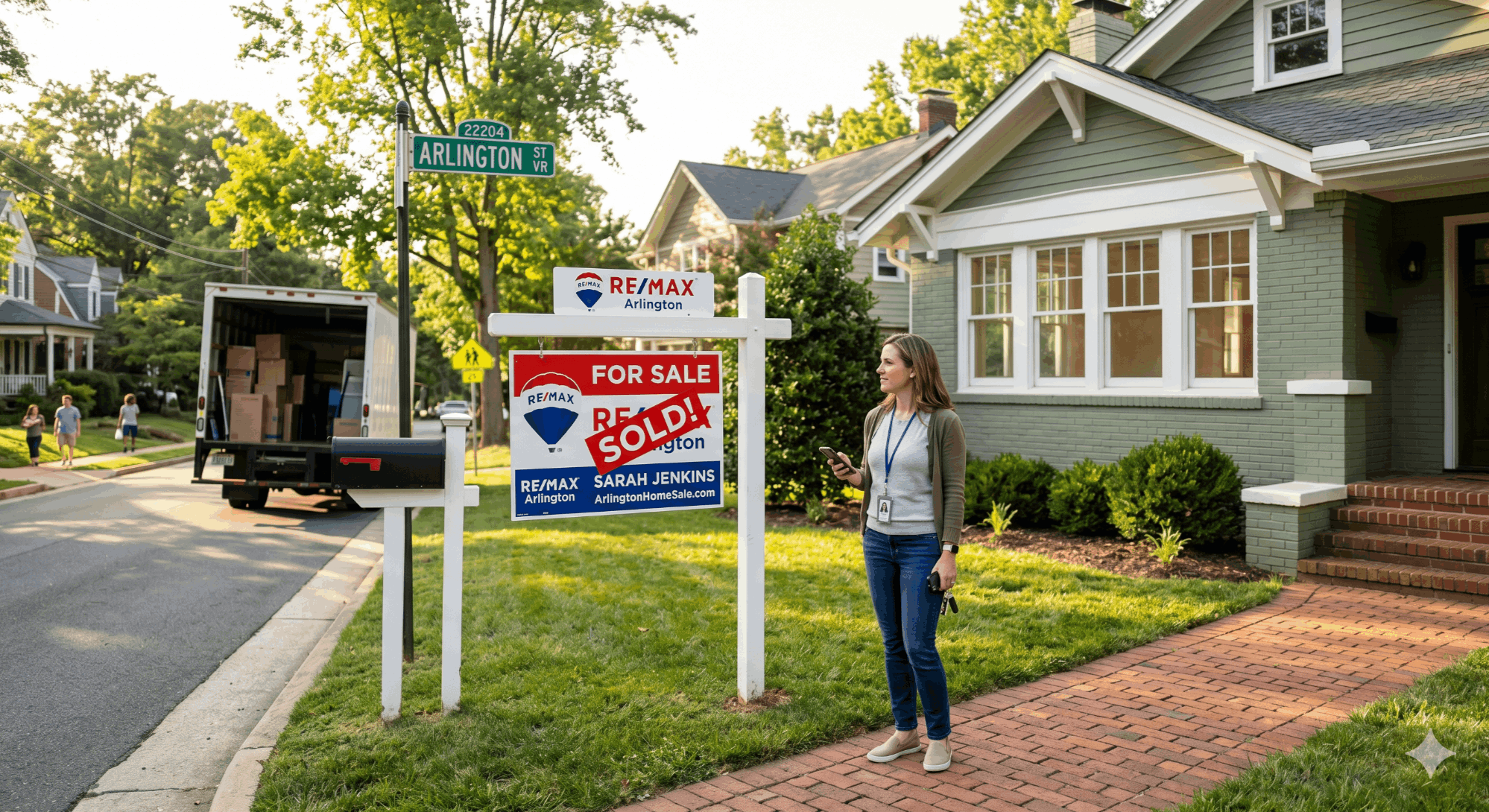
You've already moved out of Arlington — maybe for a new job, a military PCS, a family situation, or simply a fresh start somewhere else — and now you're staring at a house you still need to sell. The good news: with the right setup, an Arlington remote sale can close just as cleanly as one where you're physically here, and you can sign every document from anywhere in the country (or the world). The key is getting the structure right before the listing goes live, not after.
Quick Answer: Yes, you can absolutely sell your Arlington VA home after you've moved — Virginia allows full remote closings via mobile notary or remote online notarization, and a properly authorized power of attorney can handle in-person signing if needed. The keys to a smooth remote sale are: a vacant-home insurance rider, a local point of contact for showings and emergencies, a vacant-staging plan, photo-ready prep before you leave (or a turnkey crew on standby), and an agent who manages the entire workflow from listing to keys-handed-over. Most remote Arlington sales close in 30–45 days from contract.
Key Takeaways
- Remote closings are fully legal in Virginia — both mobile notary and Remote Online Notarization (RON) are accepted, and a durable POA can authorize in-person signing on your behalf.
- Vacant homes need a different insurance policy — most standard homeowner policies lapse coverage after 30–60 days of vacancy, leaving you exposed during the listing period.
- Vacant-staged Arlington homes typically sell faster than empty ones — empty rooms photograph small and feel cold, especially in the condos and townhomes that dominate Arlington's inventory.
- The capital gains exclusion has a 3-year clock — if you've already moved, you generally need to sell within three years of vacating to keep the $250K/$500K primary-residence tax exclusion (Section 121).
- Showing logistics matter more than price on remote sales — a lockbox, electronic showing approval, and a trusted local handler can make or break offer flow.
- The 1.5% full-service listing program from The Jamil Brothers Realty Group keeps an extra $11,250 in your pocket on a $750K Arlington sale versus a traditional 3% agent — without reducing photography, marketing, or negotiation.
In This Guide
- Why So Many Arlington Owners End Up Selling Remotely
- The Real Challenges of a Remote Arlington Sale
- Pre-Departure Prep: What to Do Before You Leave
- Power of Attorney vs. Remote Online Notarization
- Vacant Home Insurance: The Hidden Trap
- Staging an Empty Arlington Home
- Showings, Lockboxes & Local Coordination
- Net Proceeds Calculator
- Pricing Strategy When You're 1,000 Miles Away
- Capital Gains, the 3-Year Rule & Other Tax Issues
- Coordinating a Mail-Away or RON Closing
- Choosing a Remote-Capable Listing Agent
- Common Mistakes Remote Arlington Sellers Make
- Frequently Asked Questions
- Glossary
Why So Many Arlington Owners End Up Selling Remotely
Arlington has one of the most transient homeowner profiles in the country. Between the federal workforce, the Pentagon, the State Department, Amazon HQ2 in National Landing, the consulting and contracting world along the Crystal City–Rosslyn corridor, and the tech ecosystem clustered around Ballston, a meaningful share of Arlington owners are people who relocated into the area for a specific role and now need to relocate out. Add in inheritances, divorces, and life events, and the result is a steady population of owners trying to sell a home they no longer live in.
The most common scenarios we see across Arlington remote sales:
| Trigger | What Makes It Different | Typical Timeline Pressure |
|---|---|---|
| Military PCS | Hard report-no-later-than date; possible BAH and Capital Gains Tax Relief Act overlap | 30–60 days from orders |
| Federal job relocation | Relocation package may cover closing costs or buyout; agent must be on relocation provider's panel | 30–90 days |
| Private-sector job move | Start date drives timeline; relocation benefits vary widely | 45–90 days |
| Inherited property | Probate, multiple heirs, possible step-up basis advantage | 3–12 months |
| Divorce / separation | Court order or decree may dictate listing terms; sometimes both spouses already gone | 30–120 days |
| Couldn't sell first, moved anyway | Carrying two payments; pressure to close quickly | Immediate |
| Tried to rent, not working | Bad tenant experience or vacancy; ready to convert back to sale | 30–90 days |
Each of these has its own quirks, but they share one mechanic: the seller is no longer physically present to walk the property, meet contractors, or attend a closing table. Everything has to be set up to function without them.
The Real Challenges of a Remote Arlington Sale
Before walking through the playbook, it helps to be honest about where remote sales actually go wrong. These are the friction points we see most often on Arlington listings where the owner has already moved.
The pattern: the technical pieces (notary, signatures, wire transfers) are largely solved problems. What still trips remote sellers up is the operational layer — somebody noticing the HVAC stopped working in July, somebody letting a contractor in to fix a punch-list item, somebody forwarding the HOA assessment notice that arrived in the mailbox. That's the layer your listing agent's process needs to cover.
⚠️ The single biggest avoidable failure
A vacant Arlington home with no on-the-ground point of contact, no auto-pay set up for utilities, and no scheduled HVAC and pest checks. We've seen burst pipes, frozen condensate lines, and HOA fines on listings where the seller assumed "vacant means low-maintenance." The opposite is true.
Pre-Departure Prep: What to Do Before You Leave
If you haven't moved yet but you know it's coming, this is the highest-leverage period of the entire sale. Anything you can finish while you're still in the home costs roughly half what it costs once you're gone — because everything done remotely involves coordination fees, multiple trips for contractors, and rush work. Here is the prep checklist we use for Arlington owners who know they're moving within 60 days.
Pre-Move Sale Prep Checklist (Do These Before You Leave)
- Schedule professional photos and 3D tour while the home is still furnished and lived-in
- Complete every interior paint touch-up, ceiling patch, and trim repair
- Replace all burnt-out bulbs with matching color temperature (3000K warm white throughout)
- Have HVAC serviced; replace filter; document service date
- Have water heater inspected; flush sediment if older than five years
- Pre-book a deep cleaning for the day after movers leave
- Pre-book carpet cleaning post-move (or replace if more than seven years old)
- Walk the property with a contractor and finalize a punch list with prices
- Identify a local point of contact — neighbor, property manager, or your agent's team
- Set up auto-pay on every utility account (do not cancel any service)
- Switch homeowner insurance to a vacant-home rider effective the move-out date
- Notify HOA / condo association of your forwarding address and expected listing date
- Pull and digitize all home records: warranties, permits, HVAC serial numbers, appliance manuals
- Order the HOA / condo resale package early — Virginia disclosure timelines are strict
- If keeping mail at the property: install a locking mailbox or set up USPS forwarding
ℹ️ Why photos before the move matter so much
Empty rooms photograph 15–20% smaller than the same room with appropriately scaled furniture. If we can shoot Arlington listings while you're still living there — with a quick declutter and some personal items removed — we get better images than any virtual staging can produce. If you've already moved out, virtual staging is the next-best option, but it can't fix poor light or empty echo.
Power of Attorney vs. Remote Online Notarization
Two questions every remote seller asks: "Do I need to fly back to sign?" and "Do I need a power of attorney?" The short answer for Virginia: usually no on the flight, and only sometimes on the POA. Virginia law accepts three valid paths to closing for an out-of-state seller.
| Method | How It Works | Best For | Cost |
|---|---|---|---|
| Mobile Notary | Title company sends a traveling notary to wherever you are with the closing package; you sign in front of them, they overnight back | Sellers in any U.S. state who can be available for a 1-hour window | $150–$300 |
| Remote Online Notarization (RON) | Video-based notarization through approved platform; identity verified electronically; full audit trail | Tech-comfortable sellers in any state where the buyer's lender accepts RON (most do in 2026) | $25–$75 |
| Power of Attorney (POA) | You designate a trusted person (often spouse, family member, or attorney-in-fact) to sign on your behalf | Sellers traveling, deployed, or hospitalized; co-owners with one party always remote | $50–$200 to draft + recording fee |
| Mail-Away Closing | Title company overnight ships the package; you sign before any local notary; overnight back | Sellers who prefer paper but can't get a mobile notary | $50–$150 (your notary + shipping) |
For most Arlington remote sellers, RON is the cheapest and fastest option, and mobile notary is the safest fallback. POAs are necessary only when you genuinely cannot be available — deployed military, extended international travel, or medical situations. Drafting a POA in advance "just in case" is fine, but be specific: a Virginia closing POA should name the property, limit the authority to that single transaction, and include a sunset date.
🚩 Lender-specific rules still apply
Even when Virginia accepts RON or POA, your buyer's lender ultimately decides what they'll allow on their end. Most national lenders accept RON in 2026, but some smaller banks and credit unions still require wet-ink signatures. Confirm acceptance with the lender (not just the title company) early in the contract period.
Get a personalized home valuation from The Jamil Brothers — street-level Arlington comps, not automated estimates. Response within 24 hours, fully remote.
Vacant Home Insurance: The Hidden Trap
This is the single most overlooked piece of a remote Arlington sale. Almost every standard homeowner policy contains a vacancy clause: once the home has been unoccupied for 30, 60, or 90 days (depending on the carrier), most coverage automatically lapses. Theft, vandalism, water damage, glass breakage — even fire — can all become uncovered claims if the property is technically "vacant" under the policy's definition.
The fix is not to cancel coverage; it's to switch it. Two main paths exist:
Vacancy Permit Endorsement
Standalone Vacant Home Policy
Whichever path you choose, do it before you move out, not after. The minute you've physically vacated, you have a clock running on your coverage. The premium difference is small money compared to the catastrophic exposure of an uncovered claim — a single Arlington pipe burst on a vacant home routinely runs $25,000 to $80,000 in damage.
Staging an Empty Arlington Home
An empty Arlington home — whether it's a Ballston condo, a Lyon Village colonial, or a Cherrydale bungalow — almost always sells for less and sits longer than the same home staged. Buyers cannot estimate furniture scale, can't visualize how a room flows, and tend to read empty rooms as "small" and "cold." For remote sellers, you have three realistic staging options:
| Approach | Cost (Arlington) | Best For | Typical ROI |
|---|---|---|---|
| Full physical staging | $2,500–$6,500 / month | Single-family $1M+; luxury condos $700K+ | 1–3% higher sale price + faster DOM |
| Partial / occupied staging | $800–$2,000 one-time | If you left some furniture; need to fill living + primary bed only | Strong, relative to spend |
| Virtual staging (photos only) | $30–$75 per image | Lower-priced condos; fixer situations; truly empty | Modest — helps photos, not in-person showings |
| Hybrid (key rooms physical + virtual elsewhere) | $1,200–$2,500 | Most remote sales — best balance of cost and impact | Strong |
For Arlington listings under $700K (most one-bedroom condos and small townhomes), virtual staging plus a thorough cleaning is usually enough. For homes above $1M, where buyers expect a polished presentation, full or hybrid staging usually pays for itself. The wrong move is to do nothing — empty, echoing rooms with bare hardwood will photograph against you.
Showings, Lockboxes & Local Coordination
The mechanics of getting buyers through an Arlington home you don't live in are simpler than most sellers expect — but only if the system is set up correctly from day one. Here is the operational flow we run on every remote Arlington listing.
Electronic lockbox install — Day 1
BrightMLS-compatible electronic lockbox (Sentrilock or similar) with audit trail of every showing entry. The agent's identity is logged each time; you receive a real-time notification.
Showing approval routing — Day 1
All showing requests route to the listing agent first (not the owner) for approval. Standard policy: 2-hour minimum notice; auto-approval during pre-set windows; manual approval outside those.
Local point of contact — Ongoing
The listing team handles emergencies on-site (HVAC failure, lockout, contractor coordination). For most remote Arlington sales, this is built into the service — you're never the first call.
Weekly drive-by — Ongoing
Visual inspection of exterior, mail, packages, lawn or snow if applicable, and any visible interior issue from the door. Documented with timestamped photos sent to seller weekly.
Showing feedback collection — After every showing
Buyer agents are auto-prompted for feedback within 24 hours. Aggregate feedback drives any pricing or staging adjustments at the 14-day, 21-day, and 30-day marks.
The lockbox audit trail matters for a reason most sellers don't think about: it documents every entry into your vacant home. If something is damaged or missing, the BrightMLS log shows exactly which agent's credentials were used to enter and when — which protects both the seller and the showing agents.
Net Proceeds Calculator
One of the harder parts of selling remotely is keeping a clear-eyed view of the math. You can't easily walk into our office, so here's a quick interactive calculator showing the difference between a traditional 3% listing fee and our 1.5% full-service program at common Arlington price points. Buyer's agent commission is separately negotiated post-NAR settlement; we use 2.5% as a typical Northern Virginia figure.
Seller Savings Calculator
How much more do you keep with our 1.5% listing fee?
Select your home's estimated value to see your real net proceeds — side by side.
Traditional Agent — 3%
| Sale price | $400,000 |
| Listing fee (3%) | −$12,000 |
| Buyer's agent (2.5%) | −$10,000 |
| Est. closing (1%) | −$4,000 |
| Net Proceeds | $374,000 |
Our Fee — Only 1.5%
| Sale price | $400,000 |
| Listing fee (1.5%) | −$6,000 |
| Buyer's agent (2.5%) | −$10,000 |
| Est. closing (1%) | −$4,000 |
| Net Proceeds | $380,000 |
Extra in your pocket
$6,000vs. a traditional 3% listing agent — with zero reduction in service or marketing.
Traditional Agent — 3%
| Sale price | $500,000 |
| Listing fee (3%) | −$15,000 |
| Buyer's agent (2.5%) | −$12,500 |
| Est. closing (1%) | −$5,000 |
| Net Proceeds | $467,500 |
Our Fee — Only 1.5%
| Sale price | $500,000 |
| Listing fee (1.5%) | −$7,500 |
| Buyer's agent (2.5%) | −$12,500 |
| Est. closing (1%) | −$5,000 |
| Net Proceeds | $475,000 |
Extra in your pocket
$7,500vs. a traditional 3% listing agent — with zero reduction in service or marketing.
Traditional Agent — 3%
| Sale price | $600,000 |
| Listing fee (3%) | −$18,000 |
| Buyer's agent (2.5%) | −$15,000 |
| Est. closing (1%) | −$6,000 |
| Net Proceeds | $561,000 |
Our Fee — Only 1.5%
| Sale price | $600,000 |
| Listing fee (1.5%) | −$9,000 |
| Buyer's agent (2.5%) | −$15,000 |
| Est. closing (1%) | −$6,000 |
| Net Proceeds | $570,000 |
Extra in your pocket
$9,000vs. a traditional 3% listing agent — with zero reduction in service or marketing.
Traditional Agent — 3%
| Sale price | $750,000 |
| Listing fee (3%) | −$22,500 |
| Buyer's agent (2.5%) | −$18,750 |
| Est. closing (1%) | −$7,500 |
| Net Proceeds | $701,250 |
Our Fee — Only 1.5%
| Sale price | $750,000 |
| Listing fee (1.5%) | −$11,250 |
| Buyer's agent (2.5%) | −$18,750 |
| Est. closing (1%) | −$7,500 |
| Net Proceeds | $712,500 |
Extra in your pocket
$11,250vs. a traditional 3% listing agent — with zero reduction in service or marketing.
Traditional Agent — 3%
| Sale price | $1,000,000 |
| Listing fee (3%) | −$30,000 |
| Buyer's agent (2.5%) | −$25,000 |
| Est. closing (1%) | −$10,000 |
| Net Proceeds | $935,000 |
Our Fee — Only 1.5%
| Sale price | $1,000,000 |
| Listing fee (1.5%) | −$15,000 |
| Buyer's agent (2.5%) | −$25,000 |
| Est. closing (1%) | −$10,000 |
| Net Proceeds | $950,000 |
Extra in your pocket
$15,000vs. a traditional 3% listing agent — with zero reduction in service or marketing.
Estimates only. Closing costs vary. Buyer's agent commission is negotiable post-NAR settlement.
Pricing Strategy When You're 1,000 Miles Away
Remote sellers tend to make one of two pricing mistakes — and they pull in opposite directions. The first is anchoring to a Zestimate or some other automated valuation that hasn't seen the home in months. The second is overpricing emotionally because moving costs money and the seller wants to "make it back" in the sale price. Neither produces good results in Arlington's submarket, where buyer agents are sophisticated and price reductions get noticed instantly.
Here's how Arlington pricing actually works in 2026, and what changes for a remote seller specifically:
| Pricing Strategy | How It Works | Best Used When | Risk for Remote Seller |
|---|---|---|---|
| Market-aligned | List at the median of the most recent 3 closed comps within 0.5 miles, similar size/condition | Stable market, average condition, motivated to close in 30–45 days | Lowest — most forgiving when you can't see the property |
| Strategic underprice | List 1.5–3% below the comp band to invite multiple offers and an offer-deadline scenario | High-demand neighborhoods (Lyon Village, Cherrydale, condo-centric Ballston/Clarendon), excellent condition | Higher — bidding wars require fast decision-making at distance |
| Premium positioning | List 1–2% above comps to create negotiation room | Truly differentiated property; renovated; rare layout | Highest — slower DOM means more carrying cost, more vacant days |
| Pre-listing appraisal | Pay a licensed appraiser $500–$700 for a pre-listing valuation; price from there | Inherited properties, divorces, anywhere price defensibility matters | Low — appraiser provides written rationale you can reference |
For most Arlington remote sellers, market-aligned or strategic-underprice produces the cleanest outcome. Premium positioning rarely works for vacant homes — buyers can read "vacant" as "motivated" and offers reflect that. Whatever strategy you pick, a remote seller benefits from a clear pre-set rule: "if we don't have an offer in X days, we adjust by Y%." Decision-making at distance is harder; pre-deciding the rules makes execution faster.
Our Arlington seller net sheet breaks down every cost — commission, Virginia grantor tax, regional congestion tax, HOA transfer fees, prorated taxes, and closing — so you know your real bottom line before you list.
Capital Gains, the 3-Year Rule & Other Tax Issues
The federal capital gains exclusion under Section 121 lets a homeowner exclude up to $250,000 (single) or $500,000 (married filing jointly) of gain from the sale of a primary residence — but only if the home was your primary residence for at least 2 of the 5 years before the sale. The "5 years" piece is what creates the unofficial 3-year rule for remote sellers.
ℹ️ The simple version of the math
If you've already moved out of your Arlington home, you generally have until 3 years from your move-out date to sell and still qualify for the exclusion. Beyond that window, you may owe federal capital gains on the appreciation.
Several special rules apply, and they can stretch the window meaningfully:
Section 121 Special Cases (May Extend the Window)
- Active-duty military, Foreign Service, intelligence community: Suspend the 5-year clock for up to 10 years while on qualifying duty
- Divorce-related sales: Time spouse occupied the home counts toward the use test
- Medical or job-related move: May qualify for partial exclusion even if you don't meet the 2-year test
- Death of spouse: Surviving spouse keeps full $500K exclusion if sold within 2 years of death
- Inherited property: Stepped-up basis — capital gains generally only on appreciation since date of death, not since original purchase
Beyond federal capital gains, two Virginia-specific items matter for remote Arlington sellers: Virginia grantor tax ($1 per $1,000 of sale price, paid by the seller) and the regional Northern Virginia congestion tax (an additional grantor's-tax surcharge applied in NOVA jurisdictions including Arlington). On a $750,000 Arlington sale, these add up to roughly $850 — small relative to commission, but real, and not always shown on online estimators.
The most important takeaway: do not let the 3-year window quietly run out. If you're closing in on year 2.5 since you moved, that's the time to list, not "next spring."
🚩 We are not tax advisors
The information above reflects general federal and Virginia rules as of 2026, but tax outcomes depend heavily on individual circumstances, exact dates, and basis calculations. Always confirm your specific situation with a CPA or tax attorney before closing — especially for inherited, divorce, or military scenarios.
Coordinating a Mail-Away or RON Closing
Closing day for a remote Arlington seller is usually a 30-minute exercise rather than the multi-hour table session people imagine. Here is how the typical sequence runs in 2026, assuming a normal contract-to-close window of 30–45 days.
Contract ratified — Day 0
Title company opens file, orders title search, requests payoff statements, sends seller a remote-closing intake form (asks how you want to sign, where to wire net proceeds, photo ID).
Inspection + appraisal — Days 5–14
Listing agent coordinates access. If the inspection raises issues, you negotiate remotely (text, email, e-sign addenda). Repair credits in lieu of physical repairs simplify everything for remote sellers.
Final settlement statement — Day 25–28
Title company emails the ALTA settlement statement showing every credit and debit. You confirm the wire amount and routing match what's on file. This is your last chance to catch errors.
Signing day — Day 30 (or chosen close date)
RON: 30-minute video session with notary; you e-sign every document. Mobile notary: notary arrives at your location with the package. Mail-away: you sign before any local notary and overnight back.
Funding + recording — Within 24 hours
Buyer's funds wire in; deed records with the county; net proceeds wire out to your account. Wire fraud is the single biggest risk — confirm wire instructions verbally with title before sending anything.
⚠️ Wire fraud is the #1 closing risk for remote sellers
Email-based wire instruction changes are almost always fraud attempts. Confirm wire routing details by calling your title company directly using a number you independently verified — not a number from any email. This single habit prevents the most common six-figure loss in real estate transactions.
Choosing a Remote-Capable Listing Agent
Not every Arlington listing agent is built for remote sales. The day-to-day mechanics of a remote sale require a team that runs a different operational model than the typical solo agent who relies heavily on the seller's physical presence. When evaluating agents for an Arlington remote sale, here's what actually matters versus what doesn't.
| Question to Ask | What a Strong Answer Looks Like | Red Flag Answer |
|---|---|---|
| "How many remote/absentee sales have you closed in Arlington in the past 24 months?" | Specific number with examples | "All my sales feel remote" or vague |
| "Who handles on-site emergencies (HVAC, lockout, contractor coordination)?" | Named team member, included in service | "You'd want to hire a property manager" |
| "How do you handle showing approvals and audit trails?" | Electronic lockbox + showing-platform integration with seller notifications | Combo lockbox with shared code |
| "What's your weekly reporting cadence?" | Set day, written report with photos, market activity, showing feedback | "I'll text you when something happens" |
| "How do repair negotiations work when I'm not local?" | e-Sign workflow, vendor list with vetted contractors, repair credit preference | "You'll just need to fly back" |
| "What's the listing commission for full service?" | Specific percentage, what's included, how buyer-agent comp is handled post-NAR | "Whatever's standard" |
The Jamil Brothers Realty Group has built an Arlington remote-sale workflow specifically because the volume warrants it — between PCS moves, federal relocations, and Amazon HQ2-driven employee transitions, a meaningful share of our annual listings come from owners no longer living in the home. The 1.5% full-service program includes the entire remote-sale operational layer described above: electronic lockbox, weekly drive-bys, contractor coordination, and full e-sign / RON workflow.
4K photography, drone video, 3D tours, expert negotiation, full MLS marketing, and the complete remote-sale operational layer — all included at 1.5%. No hidden fees, no service reductions, no surprises.
Common Mistakes Remote Arlington Sellers Make
After running the playbook on hundreds of remote and absentee Arlington sales over the years, the same handful of avoidable errors come up again and again. Avoiding these is more valuable than any clever pricing trick.
The Most Common (and Most Costly) Mistakes
- Cancelling utilities to "save money." No power = no HVAC cycling, no fridge for staging snacks, no lights for showings. Vacant homes need utilities on continuously.
- Skipping the vacant-home insurance rider. A $200 premium increase versus a $40,000 uncovered claim is not a close call.
- Listing without photos until "after the move." Lived-in photos almost always beat empty-room photos. Shoot first, move second.
- Pricing emotionally to "recover" moving costs. The market doesn't care what your move cost. Comps decide your number.
- Using a combo lockbox instead of an electronic one. No audit trail = no accountability and no real-time entry data.
- Accepting offers without verifying the buyer's loan strength. A weak pre-approval means a 30-day delay and a re-list when financing falls through.
- Not setting up a weekly check-in cadence with your agent. Remote sales drift when no one is forcing structured updates.
- Letting the 3-year capital gains window quietly expire. Year 2.8 is the time to list, not year 3.1.
- Ignoring HOA mail and missed correspondence. Arlington condos and townhomes have strict HOA rules; missed assessments become liens.
- Trusting wire instructions sent by email without verbal confirmation. Wire fraud is the #1 catastrophic loss in real estate.
If timing, condition, or certainty matters more than maximum price — common for inherited Arlington properties or PCS sellers on a hard deadline — a cash offer may be the right fit. We'll walk you through your full range of options remotely, no pressure.
Frequently Asked Questions
Can I really sell my Arlington home without ever flying back to Virginia?
Yes. Virginia accepts both Remote Online Notarization and mobile notary signing, and most national lenders accept RON in 2026. The vast majority of remote Arlington sellers we work with never set foot back in the state between move-out and closing. The exceptions are rare situations — typically lender-specific holdouts that still require wet-ink signatures, in which case a mobile notary at your current location handles it.
How long does a remote Arlington home sale typically take?
Most well-priced, well-prepped Arlington remote listings go under contract in 14–30 days and close in 30–45 days from contract. Total timeline from listing to keys-handed-over averages 60–75 days. Faster outcomes are possible in high-demand neighborhoods like Lyon Village or condo-centric Ballston during peak spring season; slower timelines apply to higher price points above $1.5M or unique properties.
How much does it cost to sell a $750,000 Arlington home in 2026?
On a $750,000 sale, expect roughly $11,250 in listing commission with The Jamil Brothers 1.5% full-service program, $18,750 to the buyer's agent (typically 2.5%, separately negotiated post-NAR settlement), $750 in Virginia grantor tax plus regional congestion tax, and $4,000–$6,000 in other closing costs (title insurance, recording fees, prorations). Total seller costs typically land in the $34,000–$37,000 range, leaving net proceeds around $712,500 — versus roughly $701,250 with a traditional 3% listing agent.
Should I rent out my Arlington home instead of selling it?
Renting can make sense if you have strong cash flow, a long-term outlook, and time to manage tenants — but for most remote owners, the math favors selling. Arlington's price-to-rent ratio means many homes don't generate positive cash flow after mortgage, taxes, HOA, vacancy, and management fees. More importantly, every year you rent reduces your Section 121 capital gains exclusion window, potentially exposing tens of thousands of appreciation gains to federal tax. We can model both scenarios for you on a free consultation.
Do I need a power of attorney to close remotely?
Usually not. Most remote Arlington sellers close via Remote Online Notarization or mobile notary without a POA. A POA is genuinely necessary only when you cannot be available for any signing window — typically deployed military, extended international travel, or medical situations. If you do need one, have it drafted by a Virginia attorney specifically for the closing transaction, with the property and a sunset date clearly identified. Generic POAs from other states are sometimes rejected by Virginia title companies.
What happens to my Arlington home insurance when I move out?
Most standard Virginia homeowner policies include a vacancy clause that suspends or limits coverage after 30 to 60 days of unoccupied status. Before you move out, contact your insurer to add a vacancy permit endorsement (usually a 10–25% premium increase) or switch to a standalone vacant-home policy from a specialty insurer. Doing this before the move-out date is critical — there is no retroactive coverage for the gap. A single uncovered pipe burst or vandalism claim can cost $25,000 to $80,000 in Arlington.
How does the post-NAR settlement affect my remote Arlington sale?
Since August 2024, buyer agent compensation is no longer embedded in the listing agreement and is negotiated separately between the buyer and the buyer's agent. As a seller, you have flexibility: you can choose to offer buyer-agent compensation as a concession (still common in Arlington at 2–2.5%), require the buyer to pay their own agent, or address it during contract negotiation. The Jamil Brothers walk you through the strategic implications based on current Arlington market conditions and your specific property.
Can I deduct my mortgage interest while my Arlington home is listed for sale?
Yes, mortgage interest on a property held for sale (not yet rented) is generally deductible as an itemized expense on Schedule A while you continue paying it. Property taxes are similarly deductible (subject to the SALT cap). If you've converted the property to a rental at any point during the listing period, the tax treatment shifts to Schedule E. Confirm specifics with your CPA — the timing of your move-out, listing date, and any rental period materially affects your treatment.
What's the best time of year to list a vacant Arlington home?
Late February through early May is Arlington's strongest seller window historically — buyer activity peaks, days-on-market shorten, and the price-to-list ratio is highest. October through early December is a meaningful secondary window driven by federal fiscal year hires and Pentagon PCS arrivals. The slowest periods are mid-July to late August (vacation-driven slowdown) and mid-December through early January (holiday lull). For remote sellers, listing into a strong window is even more important — vacant-home carrying costs accumulate faster than occupied ones.
What HOA or condo association rules should I know about as a remote seller?
For Arlington condos and townhomes, the seller is required to provide a resale certificate or condo disclosure package to the buyer at the seller's expense — typically $200–$500, ordered through the management company. Virginia law gives buyers a right of rescission once they receive the package, so timing matters. Many associations also have right of first refusal clauses, leasing restrictions (relevant if a buyer plans to rent), and pet, parking, or storage rules that show up in disclosures. Order the resale package early — production timelines run 14–21 days at most associations.
How do I handle property tax and HOA bills while my Arlington home is listed?
Set up auto-pay for everything before you move out: HOA dues, property tax (if not escrowed by your mortgage), water and sewer, electric, gas, internet, and any landscaping or pool service. Have all paper mail forwarded through USPS or rerouted to your agent's office. Missed HOA assessments in Arlington routinely become liens within 60–90 days, which then must be cleared before closing — adding cost and delay. Treat the home as a financial entity that needs continuous, automated cash flow, not as a low-maintenance vacant property.
What mistakes should I avoid when choosing a remote-capable listing agent?
Avoid agents who treat your remote situation as an afterthought rather than a primary capability. Specifically: avoid agents who can't name a specific number of remote sales they've closed in the last 24 months, agents who plan to hand off on-site coordination to "a property manager" you'd hire separately, agents who use combo lockboxes instead of electronic ones with audit trails, agents who don't have a written weekly reporting cadence, and agents who can't articulate how repair negotiations will work over e-sign. Remote sales are an operational discipline — interview for that, not just for likability.
Glossary
Vacant-Home Insurance Endorsement
An add-on to your existing homeowner policy that maintains full coverage during the period the home is unoccupied — typically valid for 90–180 days and adding 10–25% to the premium.
Remote Online Notarization (RON)
A video-based notarization process accepted in Virginia that lets sellers e-sign closing documents from anywhere in the country, with identity verified electronically and a full audit trail recorded.
Mobile Notary
A licensed traveling notary public who comes to the seller's current location with the closing package, witnesses signing, and overnights documents back to the title company. Cost typically $150–$300.
Power of Attorney (POA)
A legal document authorizing another person — often spouse, family member, or attorney — to sign closing documents on the seller's behalf. Virginia closing POAs should specify the property and include a sunset date.
Section 121 Exclusion
The federal tax provision letting homeowners exclude up to $250K (single) or $500K (married filing jointly) of capital gain from a primary residence sale, provided the home was occupied as a primary residence for at least 2 of the prior 5 years.
Virginia Grantor Tax
A state-level transfer tax of $1 per $1,000 of sale price, paid by the seller. In Northern Virginia jurisdictions including Arlington, an additional regional congestion tax applies, typically adding another $0.15–$0.40 per $100.
Resale Disclosure Package
A document set required for Arlington condo and HOA sales that includes governing documents, recent financial statements, current rules and restrictions, pending assessments, and required disclosures. Ordered by the seller, paid by the seller, delivered to the buyer.
Electronic Lockbox
A keybox that opens via Bluetooth or smartphone app rather than a numeric combination, recording the date, time, and identity of every agent who enters the property. Required by most Arlington listing agents on remote sales for security and accountability.
Explore More Northern Virginia Guides
Alexandria Fairfax McLean Vienna Ashburn 1.5% Listing Program Seller Net Sheet Free Home Evaluation Cash Offers Homes for SaleReady to Sell Your Arlington Home — From Anywhere?
The mechanics of selling an Arlington home you no longer live in are well-solved problems in 2026 — vacant-home insurance, electronic lockboxes, RON closings, e-sign workflows, and on-the-ground coordination are all standard parts of any team running this kind of listing at scale. What separates a smooth remote sale from a stressful one isn't the technology; it's whether your listing team has built the operational layer to actually execute without your physical presence. The Jamil Brothers have run this playbook for hundreds of Arlington owners — federal employees, military families, Amazon HQ2 transfers, inheritance executors, and divorce situations — and it's built into the 1.5% full-service listing program at no extra cost. Wherever you are, we'll handle the property as if you were still here.
Know your equity, understand your costs, and see exactly what you'll walk away with — before you make any decisions. The Jamil Brothers Realty Group provides a full Arlington seller consultation at no cost or obligation, fully remote.
The Jamil Brothers Realty Group · Samson Properties · (703) 782-4830 · TheJamilBrothers.com
Licensed in VA · MD · DC · WV · NVAR Lifetime Top Producers · 840+ Homes Sold · 500+ Five-Star Reviews
Explore More
Browse Every Corner of the DMV Market
Whether you're searching by budget, neighborhood, or buying situation — find exactly what you need below.
Virginia Homes by Budget
Washington DC Homes by Budget
Maryland Homes
Explore Northern Virginia Communities
Loudoun County
Fairfax County & Surrounding
Ready to Make a Move?
Full-Service · No Tradeoffs
List for 1.5% & Keep More Equity
Professional photography, drone video, 3D tours, and expert negotiation — all included. On an $800K home, that's $12,000 more in your pocket vs. a 3% agent.
See the 1.5% Program →Need Speed or Certainty?
Get a No-Obligation Cash Offer
Skip the showings, skip the contingencies. If timing or condition matters more than top dollar, a cash offer may be the right fit. We'll walk you through every option.
Explore Cash Offers →Categories
Recent Posts


Let's Connect