
How Do You Sell an Inherited Home in Maryland Through Probate?
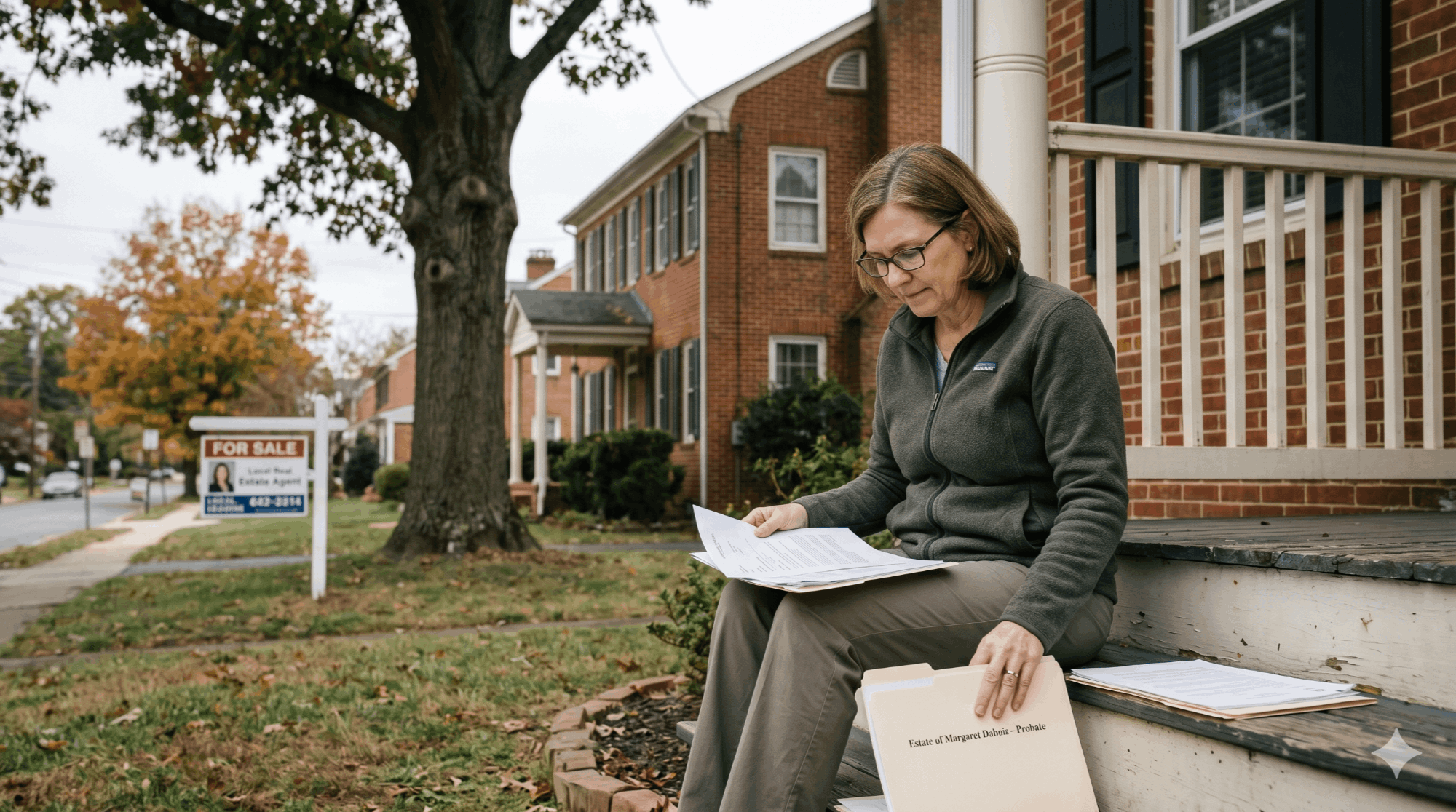
Quick Answer: To sell an inherited home in Maryland through probate, the estate must first open in the county Register of Wills, the court appoints a Personal Representative, and that representative receives Letters of Administration before the property can be listed or sold. You can sign a listing agreement and accept an offer once Letters are issued, but settlement cannot close until the estate holds the legal authority to convey title. Most Maryland probate home sales finish while the estate is still open, with proceeds flowing to the estate account before they reach the heirs.
Key Takeaways
- In Maryland, inherited real estate almost always passes through probate. There is no small estate shortcut for real property the way there is for bank accounts and personal belongings.
- The Personal Representative needs Letters of Administration from the Register of Wills before signing a listing agreement, accepting an offer, or deeding the property to a buyer.
- You can list and go under contract once Letters are issued, but the sale cannot close until the estate has authority to transfer title.
- The federal stepped-up basis resets the home's tax basis to its value at the date of death, which usually wipes out most or all capital gains tax for heirs who sell soon after inheriting.
- Maryland charges a flat 10% inheritance tax only on property passing to non-lineal heirs. Spouses, children, grandchildren, parents, siblings, and stepchildren are exempt.
- On a $500,000 probate home, a 1.5% full-service listing fee leaves roughly $7,500 more in the estate than a traditional 3% agent, money that gets split across every heir.
In This Guide
- Can you sell before probate is finished?
- How Maryland probate works for inherited real estate
- Step by step: selling a house through Maryland probate
- The Personal Representative's authority to sell
- Selling a probate home with multiple heirs
- Taxes when you sell an inherited home through probate
- Maryland closing costs on a probate sale
- Seller savings calculator: what heirs keep
- Your selling options during probate
- Timeline from probate to closing
- Common mistakes heirs make in a probate sale
- Getting your Maryland probate sale right
- Frequently asked questions
- Glossary
Inheriting a house in Maryland almost always means dealing with probate before you can sell, and that single fact catches many families off guard during an already difficult time. If you need to sell an inherited home in Maryland through probate, the estate has to open in the county Register of Wills, the court has to appoint a Personal Representative, and that representative must hold Letters of Administration before the property can legally change hands. Working with experienced Maryland real estate agents who handle probate sales regularly keeps the timeline moving and protects the proceeds the heirs eventually receive.
This guide focuses on the probate side of the sale specifically: when you are allowed to list, what gives the Personal Representative the power to sign, how the court process overlaps with marketing the home, and where heirs lose time and money if they move in the wrong order. It is written for the family member who has just learned they are responsible for selling a relative's house and wants to understand the process before talking to an attorney or an agent.
The Jamil Brothers Realty Group handles inherited and probate property sales across Montgomery, Howard, Frederick, Anne Arundel, Prince George's, and Baltimore counties. We coordinate directly with estate attorneys and Personal Representatives, and our 1.5% full-service program is built to keep more of the sale proceeds with the family.
Can You Sell an Inherited House Before Probate Is Finished in Maryland?
The short version: you can list the property and even sign a sales contract as soon as Letters of Administration are issued, but you generally cannot close until the estate has the legal authority to transfer title. That authority is exactly what probate creates. Most Maryland title companies will not insure a transfer unless the Personal Representative has been formally appointed and Letters are on file.
Notice the important distinction here. The estate does not have to be fully settled and closed for you to sell the home. It only needs to have reached the point where a Personal Representative has authority to act. In practice, most inherited home sales in Maryland happen while probate is still open, with the net proceeds parked in the estate account until the final accounting and distribution are complete.
Confusion often comes from comparing states. Some states allow a small estate procedure that skips probate for real property. Maryland does not. The small estate process here (for estates under $50,000, or under $100,000 when the surviving spouse is the sole heir) applies to personal property such as bank accounts, vehicles, and furniture. Real estate that is going to be sold almost always requires full administration through the Register of Wills.
⚠️ Exception: a home held in a living trust
If the owner placed the home in a revocable living trust before passing, the successor trustee can usually sell it without opening probate at all. This is one of the main reasons Maryland estate attorneys recommend trusts for homeowners. The trust holds title outside the estate, so the trustee can list, contract, and close right away, no Register of Wills appointment required.
What heirs can do before Letters are issued
Even before the Personal Representative is officially appointed, the family can do useful groundwork. Secure the home and change the locks, keep insurance active, arrange lawn and basic upkeep, and gather records such as the deed, recent tax bills, utility statements, and any HOA correspondence. You can also start conversations with an estate attorney and a real estate professional about the likely sale strategy. None of that preparation requires probate authority, and it shortens the timeline once Letters arrive.
How Maryland Probate Works for Inherited Real Estate
Probate in Maryland is handled at the county level by the Register of Wills. Each of the state's 24 jurisdictions (23 counties plus Baltimore City) runs its own office. Which path the estate takes depends on its size and on whether the people inheriting are exempt from inheritance tax.
| Probate Path | When It Applies | Typical Timeline |
|---|---|---|
| Regular Estate | Personal property over $50K (or over $100K if spouse is sole heir); the standard path for any estate selling real estate | 12 to 18 months to full closure |
| Modified Administration | All residuary heirs are exempt from inheritance tax and agree to it; lighter paperwork and reporting | 6 to 12 months to closure |
| Small Estate | Personal property only, under the threshold; does not apply when real estate is being sold | 60 to 90 days |
For most families selling an inherited house, the estate runs as a regular estate or, if everyone inheriting is a close relative, as the faster modified administration. Either way, the key milestone for the sale is the same: the moment the Register of Wills issues Letters and the Personal Representative gains authority to sign on behalf of the estate.
Probate vs. the home sale: two timelines running in parallel
It helps to picture two clocks. One clock is the full probate administration, which can run a year or more from opening to final distribution. The other clock is the home sale itself, which only needs the estate to reach the appointment milestone. The sale clock starts the day Letters are issued and usually finishes long before the estate formally closes. Understanding that the two are separate is what keeps families from waiting unnecessarily to put the house on the market.
Step by Step: How to Sell a House Through Maryland Probate
Here is the core sequence for a probate home sale, in the order the steps actually happen. Each one builds on the last, and skipping ahead is where most delays come from.
File the will and petition for probate (Week 1 to 2)
File the original will, if there is one, plus a petition for probate with the Register of Wills in the county where the owner lived. The person named in the will, or a relative prioritized by statute when there is no will, asks to be appointed Personal Representative.
Receive Letters of Administration (Week 2 to 6)
Once the petition is approved and any required bond is posted, the Register issues Letters of Administration (or Letters Testamentary if there is a will). This is the document that lets the Personal Representative list and sell the home. Nothing binding can be signed before this point.
File the inventory and date-of-death appraisal (within 3 months)
The Personal Representative files a sworn inventory of estate assets, including the home, with a date-of-death valuation. That appraised number sets the stepped-up basis for taxes, so it matters well beyond the paperwork. Do not skip it or guess at it.
List and go under contract (after Letters issue)
The Personal Representative signs the listing agreement in a representative capacity, for example "Jane Doe, Personal Representative of the Estate of John Doe." Contracts use the same signing format. Many estates have the home live on the market within 30 to 60 days of appointment.
Close and route proceeds to the estate (30 to 45 days after contract)
At settlement the net proceeds go to the estate account, not directly to the heirs. The Personal Representative then pays remaining estate debts and files the required accountings before distributing the balance to the people named in the will or, if there is no will, under Maryland's intestate rules.
Before the probate appraisal or any heir negotiation, get a date-of-death comparable value from agents who work Maryland probate properties every week. It is the number you will need for the estate inventory anyway. Response within 24 hours.
The Personal Representative's Authority to Sell a Probate Home
Everything about a Maryland probate sale runs through the Personal Representative, so it is worth understanding exactly what that role can and cannot do. The Personal Representative is the person the court formally appoints to administer the estate. In other states this person is often called the executor or administrator, but Maryland uses the single term Personal Representative for both.
Where the power to sell comes from
The Personal Representative's authority to sell real estate comes from one of two places: the will, or the court. If the will gives the Personal Representative an explicit power of sale, they can usually list and sell without a separate court order. If the will is silent, or if there is no will at all, the Personal Representative typically needs the Register of Wills or Orphans' Court to authorize the sale before closing. An estate attorney confirms which situation applies early, because it affects the timeline.
Signing in a representative capacity
The Personal Representative never signs as an individual owner. Every document, the listing agreement, the sales contract, and the deed, is signed in their representative capacity for the estate. Title companies and settlement attorneys check this carefully, and a contract signed the wrong way can stall a closing. A real estate professional who handles probate sales regularly will make sure the paperwork is set up correctly from the listing forward. Because the Personal Representative usually never lived in the property, Maryland often permits a disclaimer in place of a full property condition disclosure, though lead-paint and known latent-defect duties still apply, as our overview of Maryland seller disclosure requirements explains.
ℹ️ Quick clarity on bonds
Maryland may require the Personal Representative to post a bond before Letters are issued, especially when heirs are not all in agreement or the will does not waive it. The bond protects the estate's beneficiaries. It is usually a manageable step, but it can add a week or two to the front of the process, so factor it into the timeline.
If you are weighing whether to handle the sale formally, it helps to understand the full process of selling a home in Maryland alongside the probate-specific steps, since the marketing, pricing, and negotiation work runs the same way once the Personal Representative has authority to sign.
Whether Letters have already been issued or you are still weeks from appointment, a no-pressure conversation now helps you sequence the sale correctly and avoid the delays that cost estates time and money.
Selling a Probate Home When Multiple Heirs Are Involved
The biggest source of delay in Maryland probate home sales is rarely the court. It is disagreement among heirs. Siblings often start with different goals: one wants a quick sale and a clean split, another wants to keep the house as a rental, a third wants to buy everyone else out. Before the home goes on the market, the heirs should settle three questions in writing.
Three questions every group of co-heirs should answer
- ✓ Are we all selling, or is one heir buying out the others?
- ✓ What is our lowest acceptable price, and who has authority to accept or counter an offer?
- ✓ How are pre-sale costs (repairs, cleanout, staging, any mortgage interest) funded and reimbursed?
How heir buyouts are structured
If one heir wants to keep the home, they usually refinance or take out a new purchase loan to pay the other heirs their share of the current market value, often minus the estimated cost of selling. A formal appraisal ordered by the estate is the most common basis for the buyout figure. The Personal Representative signs the deed transferring the home from the estate to the heir who is keeping it.
When heirs cannot agree: a partition action
If co-heirs hit a wall, Maryland law lets any co-owner file a partition action in Circuit Court. Because you cannot physically divide a single-family house, the court usually orders a partition by sale. Partition is slow, often a year or more, and adds legal fees on top of normal selling costs. A negotiated agreement, even one that leaves everyone slightly unsatisfied, is almost always faster and cheaper than letting a court force the outcome.
Taxes When You Sell an Inherited Home Through Probate
Heirs often expect the tax side to be punishing. Usually it is the opposite. Federal and Maryland tax law tend to treat inherited real estate more favorably than property you bought yourself. The concept that drives that is the stepped-up basis.
Federal stepped-up basis (IRC Section 1014)
When you inherit property, your cost basis resets to the fair market value at the owner's date of death. Say a parent bought a Silver Spring home decades ago for $150,000 and it is worth $760,000 when they pass. Your basis is $760,000, not $150,000. If you sell it five months later for $770,000, you have a $10,000 long-term gain, not a $620,000 one. Inherited-property gains are automatically treated as long-term, even if you held the home only a few months before selling. If a taxable gain does appear, usually from appreciation between the date of death and the sale, our guide to Maryland capital gains tax walks through the rates and exclusions that may apply.
Maryland inheritance tax: who owes and who does not
Maryland is one of the few states that still has an inheritance tax. The rate is a flat 10% of the value passing to a non-exempt beneficiary, but the list of exempt relationships covers most families.
| Relationship to the Owner | Maryland Inheritance Tax |
|---|---|
| Spouse, child, stepchild, grandchild, parent, sibling | Exempt (0%) |
| Son-in-law, daughter-in-law, registered domestic partner | Exempt (0%) |
| Niece, nephew, aunt, uncle, cousin, friend, unrelated heir | 10% of value received |
| Qualified charitable organizations | Exempt (0%) |
Maryland estate tax and federal estate tax
Maryland also has a separate state estate tax, but it only applies when the total gross estate tops $5 million, and it is paid by the estate rather than by individual heirs. The federal estate tax exemption is far higher, currently set at $15 million per individual under federal law, so it touches very few families. Most estates, even ones holding a high-value Montgomery or Howard County home, never approach either threshold unless there is significant additional wealth. If the total estate is large, an estate attorney should be involved early.
ℹ️ A typical example
A mother leaves her Gaithersburg townhouse, valued at $520,000 on the date of death, to her two adult children equally. They sell it four months later for $530,000. The $10,000 gain is split $5,000 each as long-term capital gain. Because the children are lineal descendants, no Maryland inheritance tax applies, and the estate is far below the $5M state and $15M federal estate-tax thresholds. State and federal tax on the inheritance itself: $0. Tax on the small gain: typically 0% or 15% federal, depending on each child's income.
Maryland Closing Costs on a Probate Home Sale
Whether the home is inherited or owner-occupied, the seller-side closing costs in Maryland are largely the same. The main difference with a probate sale is the addition of estate administration costs. For a complete line-by-line breakdown, see our full guide to Maryland seller closing costs. Here are the line items to expect.
| Cost | Typical Amount | Notes |
|---|---|---|
| Listing commission | 1.5% to 3% of sale price | The Jamil Brothers list for 1.5% full-service; traditional agents charge 3% |
| Buyer's agent commission | 0% to 2.5% (negotiable) | After the NAR settlement, this is negotiated separately with the buyer |
| Maryland state transfer tax | 0.5% of sale price | Often split with the buyer by contract |
| County transfer tax | 0% to 1.5% (varies by county) | Frederick 0%, Montgomery 1%, Howard 1%, Baltimore City 1.5% |
| County recordation tax | $3.45 to $10 per $500 of sale | Typically split with the buyer |
| Title and settlement fees | $600 to $1,500 | Payable to the settlement company |
| Mortgage payoff or lien release | Varies | Any remaining mortgage, HELOC, or tax lien is cleared at closing |
| Probate-specific: PR fee, attorney fees, court costs | 1% to 5% of estate | Paid by the estate, separate from the home's closing statement |
Where the money actually goes on the seller side
On a typical $500,000 Maryland sale, here is how the larger line items compare.
The takeaway from the chart is simple. Commission is the largest controllable cost in the stack. Transfer and recordation taxes are fixed by statute, and title fees are set by the settlement company. Commission is the one number you can meaningfully negotiate, and on a probate home where heirs split the net, every dollar saved multiplies across each person's share. Before you list, it is worth running a personalized seller net sheet so the estate knows its real bottom line.
Seller Savings Calculator: What Heirs Keep
Select the home's expected sale value to compare the net proceeds under a traditional 3% listing fee against the 1.5% full-service program. Transfer taxes and settlement fees are identical in both columns, so the difference shown is pure commission savings that stays in the estate.
Seller Savings Calculator
How much more do heirs keep with our 1.5% listing fee?
Select the home's estimated sale value to see net proceeds side by side.
Traditional Agent, 3%
| Sale price | $400,000 |
| Listing fee (3%) | −$12,000 |
| Buyer's agent (2.5%) | −$10,000 |
| Est. closing (1%) | −$4,000 |
Our Fee, Only 1.5%
| Sale price | $400,000 |
| Listing fee (1.5%) | −$6,000 |
| Buyer's agent (2.5%) | −$10,000 |
| Est. closing (1%) | −$4,000 |
Extra in heir proceeds
$6,000
vs. a traditional 3% listing agent, with zero reduction in service or marketing.
Traditional Agent, 3%
| Sale price | $500,000 |
| Listing fee (3%) | −$15,000 |
| Buyer's agent (2.5%) | −$12,500 |
| Est. closing (1%) | −$5,000 |
Our Fee, Only 1.5%
| Sale price | $500,000 |
| Listing fee (1.5%) | −$7,500 |
| Buyer's agent (2.5%) | −$12,500 |
| Est. closing (1%) | −$5,000 |
Extra in heir proceeds
$7,500
vs. a traditional 3% listing agent, with zero reduction in service or marketing.
Traditional Agent, 3%
| Sale price | $600,000 |
| Listing fee (3%) | −$18,000 |
| Buyer's agent (2.5%) | −$15,000 |
| Est. closing (1%) | −$6,000 |
Our Fee, Only 1.5%
| Sale price | $600,000 |
| Listing fee (1.5%) | −$9,000 |
| Buyer's agent (2.5%) | −$15,000 |
| Est. closing (1%) | −$6,000 |
Extra in heir proceeds
$9,000
vs. a traditional 3% listing agent, with zero reduction in service or marketing.
Traditional Agent, 3%
| Sale price | $750,000 |
| Listing fee (3%) | −$22,500 |
| Buyer's agent (2.5%) | −$18,750 |
| Est. closing (1%) | −$7,500 |
Our Fee, Only 1.5%
| Sale price | $750,000 |
| Listing fee (1.5%) | −$11,250 |
| Buyer's agent (2.5%) | −$18,750 |
| Est. closing (1%) | −$7,500 |
Extra in heir proceeds
$11,250
vs. a traditional 3% listing agent, with zero reduction in service or marketing.
Traditional Agent, 3%
| Sale price | $1,000,000 |
| Listing fee (3%) | −$30,000 |
| Buyer's agent (2.5%) | −$25,000 |
| Est. closing (1%) | −$10,000 |
Our Fee, Only 1.5%
| Sale price | $1,000,000 |
| Listing fee (1.5%) | −$15,000 |
| Buyer's agent (2.5%) | −$25,000 |
| Est. closing (1%) | −$10,000 |
Extra in heir proceeds
$15,000
vs. a traditional 3% listing agent, with zero reduction in service or marketing.
Estimates only. Maryland transfer and recordation taxes vary by county. Buyer's agent commission is negotiable.
4K photography, drone video, 3D tours, expert negotiation, and full MLS marketing, all included at 1.5%. No hidden fees and no service reductions. See exactly how the 1.5% full-service listing program works and what it saves the heirs.
Your Selling Options During Probate
Once the Personal Representative has authority to act, the heirs essentially have three ways to sell. The right one depends on the home's condition, how quickly the family needs the money, and how much time and energy is available for the process.
Option 1: A traditional MLS listing
The home goes on the market with professional marketing. If it shows reasonably well, this almost always produces the highest net proceeds because listed homes attract more buyers than a wholesaler or single cash buyer will. The tradeoff is time, usually 30 to 60 days from listing to contract, then another 30 to 45 to close. Even for an estate facing carrying costs, this path tends to win on the numbers.
Option 2: List as-is with full disclosure
Maryland law lets a seller list a property as-is with proper disclosures. For an inherited home that needs real work, this is often the smart call. It spares the estate from funding renovations, limits liability, and still reaches the full buyer pool on the MLS, including retail buyers, investors, and renovation-loan buyers. As-is homes typically sell 5% to 15% below a fully renovated comparable, but the estate avoids tens of thousands in upfront repair costs. Our deeper guide to selling a Maryland house as-is covers pricing strategy, required disclosures, and the buyers who shop these listings.
Option 3: A cash sale
If the home is in rough shape, has title complications, or the heirs need to close in two weeks, a cash sale can be the answer. Expect offers around 75% to 85% of retail value, but with no repairs, no showings, no contingencies, and a fast close. This path trades money for speed and certainty. Heirs can request a competitive cash offer alongside a retail listing opinion so the family can compare both on paper before committing to either.
The fundamentals of pricing, marketing, and negotiation behind all three options mirror a standard sale. If you want the broader context, our overview of flexible commission structures shows how the fee can be tailored to an estate's specific situation without cutting service.
| ✓ Pros | ✗ Cons |
|---|---|
| Traditional listing: highest net proceeds; full buyer pool; marketing maximizes price | Takes 60 to 90 days from list to closed; needs prep and showings |
| As-is listing: no repair outlay from the estate; still reaches retail buyers; faster than a full renovation | Price runs 5% to 15% below renovated; smaller pool for distressed homes |
| Cash sale: close in about two weeks; no showings, prep, or financing contingencies | Offers usually 15% to 25% below retail; less competitive pricing |
If the inherited home needs major work, the timing is tight, or the family just wants the decision behind them, a cash offer may fit. We walk every heir through the full range of options, list retail, list as-is, or sell for cash, with honest comparisons and no pressure.
Timeline From Probate to Closing
For most Maryland probate home sales, the time from date of death to funds in the estate account runs 4 to 9 months. Here is a realistic timeline for a regular estate with one home and no major complications. A sale outside of probate moves faster; for that baseline, see how long it takes to sell a house in Maryland without an estate involved.
Death to probate petition filed (Week 1 to 3)
Order several certified death certificates, locate the original will if one exists, identify the Personal Representative, and file the petition with the Register of Wills.
Letters of Administration issued (Week 3 to 6)
Once the Personal Representative is appointed and any bond is posted, Letters give them authority to act. Meanwhile, secure the house, keep insurance active, and gather records.
Cleanout, prep, and strategy (Week 4 to 10)
Clear personal property, sort items to keep, distribute, or donate, order the date-of-death appraisal, decide between retail listing, as-is, or cash, and interview listing agents.
Listed on the MLS (Week 8 to 14)
Professional photos, drone where it helps, 3D tour, and full marketing. In a typical Maryland market, correctly priced homes draw offers within the first 7 to 21 days.
Under contract to closing (Week 14 to 20)
Inspection, appraisal, and title work proceed. The Personal Representative signs the contract and deed in a representative capacity, and net proceeds wire to the estate account at settlement.
Estate accounting to distribution (Month 6 to 12 plus)
The Personal Representative pays remaining debts and expenses, files the required accountings, and distributes the balance to the heirs. Most estates fully close within 12 to 18 months of opening.
Every estate is different. Some need a fast cash close, others want maximum price on the open market. Our full-service approach flexes to the situation without ever cutting marketing or negotiation. See how it can be shaped to keep more in heir proceeds.
Common Mistakes Heirs Make in a Probate Sale
Eight mistakes that cost Maryland heirs time and money
- ✗ Signing a listing agreement or accepting an offer before Letters of Administration are issued
- ✗ Skipping the date-of-death appraisal that sets the stepped-up basis
- ✗ Letting the homeowner's policy lapse; vacant-home coverage is different and must be in place first
- ✗ Over-improving the home; inherited properties rarely return the cost of a full renovation
- ✗ Taking the first cash offer without a retail listing opinion to compare against
- ✗ Assuming Maryland inheritance tax applies when it does not; lineal heirs are exempt
- ✗ Holding the home for years waiting for a better market while carrying costs pile up
- ✗ Defaulting to a 3% listing commission without comparing full-service alternatives
Getting Your Maryland Probate Sale Right
Selling an inherited Maryland home through probate has a lot of moving parts: court authority, tax basis, heir coordination, property condition, and market timing. The reassuring part is that the sequence is predictable. Once you understand that the home sale only needs the estate to reach the appointment milestone, and that the stepped-up basis and Maryland's inheritance tax exemptions usually work in the family's favor, the process feels far less overwhelming.
The Jamil Brothers Realty Group handles probate property sales across Montgomery, Howard, Frederick, Anne Arundel, Prince George's, and Baltimore counties. We coordinate directly with estate attorneys and Personal Representatives, provide free date-of-death valuations for the probate inventory, and offer both retail listing and cash paths so heirs can compare before committing. The 1.5% full-service program is built to keep more of the sale proceeds with the family, without compromising on photography, marketing, or negotiation.
Know the home's current value, understand the estate-specific closing costs, and see exactly what the heirs will walk away with before any decisions are made. Start with a free home valuation, then layer in the numbers. Full consultation at no cost, and we work alongside your estate attorney.
Frequently Asked Questions
Can you sell a house in Maryland while it is still in probate?
Yes. You can list the home and accept an offer as soon as Letters of Administration or Letters Testamentary are issued, which usually happens 3 to 6 weeks after probate opens. You generally cannot close before that, because title companies require the Personal Representative to hold formal authority to convey the property. The estate does not need to be fully closed for the sale to complete. Most Maryland probate home sales close while the estate is still open, with the net proceeds flowing to the estate account until final accounting and distribution.
How long does it take to sell an inherited house in Maryland through probate?
Plan for 4 to 9 months from date of death to closed sale in a typical scenario. Letters of Administration usually issue 3 to 6 weeks after filing, a retail listing needs 6 to 12 weeks for prep and marketing, and a Maryland closing adds 30 to 45 days after a contract is accepted. A cash sale compresses the part after Letters to roughly 2 to 3 weeks. Full estate closure, including final accounting and heir distribution, typically runs 12 to 18 months from when probate is opened.
Who has the authority to sell a probate home in Maryland?
The Personal Representative appointed by the Register of Wills has the authority to sell. Their power comes from either the will (if it grants an explicit power of sale) or from court authorization when the will is silent or there is no will. Once Letters are issued, the Personal Representative signs the listing agreement, the sales contract, and the deed in a representative capacity for the estate, never as an individual owner. An estate attorney confirms early whether a separate court order is needed before closing.
Do I have to pay capital gains tax when I sell an inherited house in Maryland?
In most cases, heirs owe little or no capital gains tax. The federal stepped-up basis rule resets the home's tax basis to its fair market value at the date of death. If you sell soon after inheriting, the gain is figured only on appreciation since death, often a small amount or zero. Any gain is automatically treated as long-term regardless of how long you held the property, and federal rates are 0%, 15%, or 20% depending on your income. Maryland conforms to the federal stepped-up basis rule.
What is the Maryland inheritance tax on an inherited home?
Maryland charges a flat 10% inheritance tax on property passing to non-lineal beneficiaries. Exempt beneficiaries include spouses, children, stepchildren, grandchildren, parents, siblings, sons-in-law, daughters-in-law, registered domestic partners, and qualified charitable organizations. If the inherited home passes to a niece, nephew, aunt, uncle, cousin, friend, or other unrelated person, they owe 10% of the value received. The tax is generally paid by the Personal Representative before distribution and can be satisfied out of the estate's assets.
Does selling an inherited home always require probate in Maryland?
Almost always, with one main exception. If the owner placed the home in a revocable living trust before passing, the successor trustee can sell it without opening probate at all, because the trust holds title outside the estate. Otherwise, Maryland real estate that is being sold typically requires full administration through the Register of Wills. The small estate process, which avoids full probate, applies only to personal property under the threshold and does not cover the sale of real estate.
How is an inherited home split between siblings in Maryland?
If the will specifies the division, it controls. Without a will, Maryland's intestate rules divide the estate equally among the surviving children. When siblings inherit a home together, they have three main paths: sell and split the proceeds, agree on a buyout where one sibling refinances to pay the others, or keep the property jointly as a rental. If they cannot agree, any co-owner can file a partition action in Circuit Court, which usually results in a court-ordered sale. Because partition is slow and expensive, a negotiated resolution is almost always better.
What happens to the mortgage on an inherited house during probate?
A mortgage does not disappear when the owner dies; it becomes an obligation of the estate until the home is sold, refinanced, or assumed. Federal law (the Garn-St. Germain Act) generally prevents the lender from calling the loan due when a relative inherits. If the heirs want to keep the home, they can continue making payments while deciding whether to refinance. If they are selling, the existing mortgage is paid off at closing from the sale proceeds, and the buyer receives clear title.
How do I choose a listing agent for a probate sale?
Look for four things: real experience with probate and inherited sales, willingness to coordinate directly with your estate attorney and Personal Representative, transparent commission pricing with no bait and switch, and an honest conversation about whether retail listing, as-is, or cash is the right fit. Ask for recent probate references. The Jamil Brothers Realty Group handles probate properties across Maryland with a 1.5% full-service listing fee, works alongside estate attorneys and Personal Representatives, and can provide both a retail listing opinion and a competitive cash offer so heirs can compare paths side by side.
Has the NAR settlement changed how commissions work on probate sales?
Yes. Buyer's agent compensation is no longer embedded in the listing commission and must be negotiated separately with the buyer or buyer's agent. This affects probate sales the same way it affects any sale: listing commission now covers only the listing side (typically 1.5% to 3%), and the estate decides separately whether to offer buyer agent compensation. Many probate sales negotiate buyer agent compensation as part of each individual offer rather than committing up front, which gives the estate more flexibility.
Should I renovate the inherited home before selling it?
Usually no. Heirs rarely recover the full cost of a renovation, and funding repairs from an estate that has not yet closed creates accounting complications. The better approach is targeted pre-sale work: deep cleaning, decluttering, paint touch-ups, light landscape tidying, and maybe updated hardware or fixtures. That typically costs a few thousand dollars and returns more than it costs. Full kitchen or bath renovations and major system replacements only make sense in narrow cases where the home would otherwise be hard to finance.
What if the inherited home has an HOA or condo association?
Most Maryland HOAs and condo associations keep assessing dues against the property from the date of death forward. Unpaid HOA or condo assessments become a lien that must be cleared at closing. The Personal Representative should notify the association of the owner's death, confirm dues are current, request an estoppel certificate before listing, and order the resale package or condo documents early. Maryland requires delivery of association documents to buyers, and delays in getting them can push the closing date.
Glossary
Probate
The court-supervised process of validating a will, appointing a representative, settling debts, and transferring a deceased person's property to the rightful heirs.
Personal Representative (PR)
The person appointed by the court to administer the estate, equivalent to an executor in other states. Named in the will or appointed by statute when there is no will.
Letters of Administration
The court-issued document that gives the Personal Representative legal authority to act for the estate, including signing listing agreements, contracts, and deeds.
Register of Wills
The county office in Maryland that administers probate, accepts filings, issues Letters, and oversees estate accountings and inheritance tax.
Stepped-Up Basis
Federal tax rule that resets an inherited asset's cost basis to its fair market value at the date of death, usually reducing or eliminating capital gains tax.
Inheritance Tax
Maryland's flat 10% tax on property passing to non-lineal beneficiaries. Spouses, lineal descendants, and close relatives are exempt. Separate from the estate tax.
Modified Administration
A faster, simpler Maryland probate track available when all residuary heirs are exempt from inheritance tax. Closes in 6 to 12 months versus 12 to 18 for a regular estate.
Partition Action
A Circuit Court proceeding where a co-owner forces the sale or division of property when co-owners cannot agree. Slow, costly, and usually worse than negotiating.
Explore More Seller Guides
1.5% Listing Program Seller Net Sheet Free Home Valuation Cash Offers Flexible Commissions Maryland CommunitiesThis article provides general information about selling inherited real estate in Maryland through probate and should not be construed as legal or tax advice. Consult a licensed Maryland estate attorney and a qualified tax professional for guidance specific to your situation. The Jamil Brothers Realty Group · Samson Properties · (703) 782-4830
Explore More
Browse Every Corner of the DMV Market
Whether you're searching by budget, neighborhood, or buying situation — find exactly what you need below.
Virginia Homes by Budget
Washington DC Homes by Budget
Maryland Homes
Explore Northern Virginia Communities
Loudoun County
Fairfax County & Surrounding
Ready to Make a Move?
Full-Service · No Tradeoffs
List for 1.5% & Keep More Equity
Professional photography, drone video, 3D tours, and expert negotiation — all included. On an $800K home, that's $12,000 more in your pocket vs. a 3% agent.
See the 1.5% Program →Need Speed or Certainty?
Get a No-Obligation Cash Offer
Skip the showings, skip the contingencies. If timing or condition matters more than top dollar, a cash offer may be the right fit. We'll walk you through every option.
Explore Cash Offers →
Categories
- All Blogs (1235)
- Buyer Guide (7)
- Buying a home (2)
- Buying Strategies (30)
- festivals (1)
- General Blog (65)
- Market Intelligence (28)
- Market Updates (7)
- Notable Properties For Sale (32)
- Real Estate Tips, News, and More (396)
- Seller Guides (58)
- Selling Your Home (523)
- Top Realtors in Northern Virginia (58)
Recent Posts






Let's Connect