How Do You Sell a Home in a 55+ Community in Virginia?
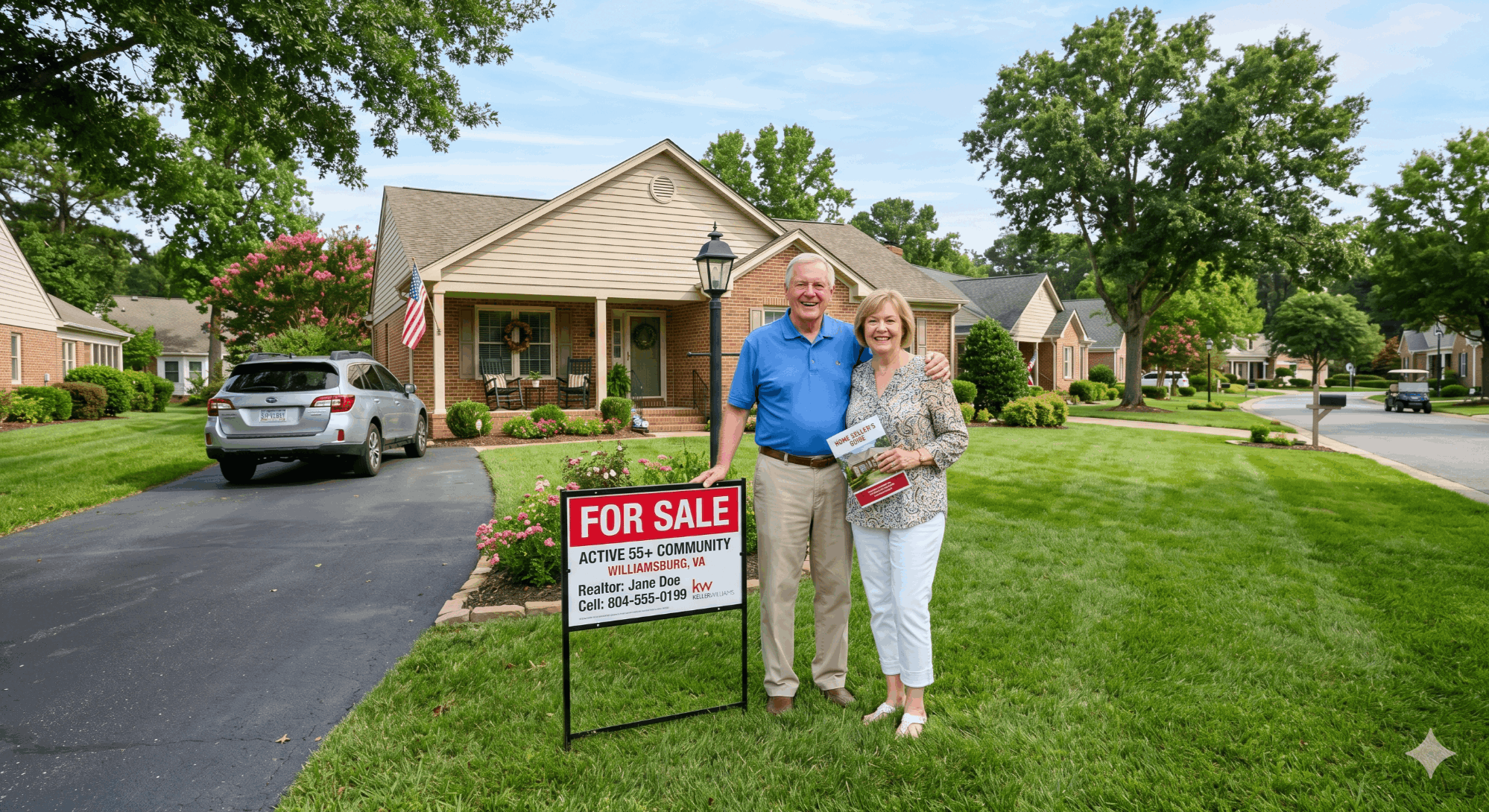
Quick Answer: To sell a home in a Virginia 55+ community, you list it through the MLS like any other property, but with three added steps that are specific to age-restricted communities. First, your buyer pool is limited by federal HOPA rules that require at least one resident aged 55 or older in most homes. Second, Virginia law requires you, the seller, to provide a Property Owners' Association (POA) resale packet or a condominium resale certificate at your own cost. Third, your marketing has to speak to downsizing and relocating buyers rather than young families. Price against comps inside your own community, order your resale packet early, and choose a listing agent who knows active-adult sales.
Key Takeaways
- Follow the same core sale steps (prep, price, market, negotiate, close) plus three community-specific steps: HOPA buyer qualification, the resale disclosure packet, and downsizing-focused marketing.
- Federal HOPA rules limit your buyer pool because at least 80% of homes must have one resident 55 or older. Your listing must honor the recorded age-restricted covenants.
- Virginia POA resale packets (single-family and townhome HOAs) and condo resale certificates are seller-paid, governed by Sections 55.1-1800 and 55.1-1900 of the Virginia Code, and typically cost $300 to $650 with mandatory turnaround windows.
- Price against in-community comps, not a general ZIP-level estimate. Same community, same floor plan, last 6 to 9 months is the comp set that actually predicts your sale price.
- Amenity value sells: golf, clubhouse, pickleball, pool, and gated security are priced into what buyers pay, so highlight them in your marketing.
- With a 1.5% full-service listing fee, a seller in a Heritage Hunt, Regency, or Potomac Green home can keep roughly $7,500 to $15,000 or more at closing versus a traditional 3% agent, with no reduction in marketing or service.
In This Guide
- What qualifies as a 55+ community in Virginia?
- How to sell a 55+ home step by step
- Major 55+ communities in Northern Virginia
- Understanding your 55+ buyer pool
- How to price an active-adult community home
- Preparing your active-adult home for sale
- Virginia POA and condo resale disclosures
- Marketing a 55+ home to the right buyers
- Commission, closing costs, and net proceeds
- Seller savings calculator
- Timeline from listing to closing
- Estate sales and inherited 55+ properties
- Common mistakes to avoid
- Alternatives to a traditional sale
- Frequently asked questions
- Glossary
Selling a home in a Virginia 55+ community follows the same core path as any other sale, but three things set it apart: an age-restricted buyer pool, a mandatory Virginia resale disclosure packet, and marketing that has to speak to downsizing and relocating buyers instead of young families. Working with a Northern Virginia property specialist who closes regularly inside active-adult communities is the surest way to get all three right the first time.
The buyer pool is smaller and more specific. The HOA documents are thicker. The comps that actually matter are often inside your own gates. And the reason for the move usually carries weight, whether it is a spouse's health, proximity to grandchildren, a move closer to adult children in another state, or a decision to simplify after decades of maintaining a larger home.
This guide answers the practical question directly: how do you sell a home in a 55+ community in Virginia, from the first walkthrough to the day funds hit your account? We cover the legal definition of an age-restricted community, how the Housing for Older Persons Act (HOPA) shapes your listing, what Virginia's POA and condo disclosure rules require, how to price against the right comps, how to prepare and market for a downsizing buyer, and what your real net proceeds look like after commission, transfer taxes, and settlement costs.
What qualifies as a 55+ community in Virginia?
A 55+ community (also called an active adult community, age-restricted community, or age-qualified community) is a development that is legally permitted to restrict residents by age under the federal Housing for Older Persons Act (HOPA), a 1995 amendment to the Fair Housing Act. Outside of HOPA, age discrimination in housing would be illegal. HOPA carves out one narrow exception for communities intended for older residents.
To qualify as a legitimate HOPA "55 or older" community, three conditions must be met:
HOPA 55+ Community Requirements
- ✓ At least 80% of occupied units have at least one resident age 55 or older
- ✓ The community publishes and follows written policies and procedures that demonstrate an intent to provide housing for older persons
- ✓ The community conducts age verification of residents at least every two years
Why this matters for sellers: the 80% rule means the community can admit some younger residents (up to 20% of occupied units), but every buyer in a HOPA community must be approved against the age-qualification policy. Most Virginia 55+ HOAs enforce the rule as "at least one occupant must be 55 or older." A few require every occupant over a set age to be 55 or older. A handful are "62+" communities where every resident must be at least 62, though those are rare in Northern Virginia.
Your listing agreement, MLS listing, and marketing should accurately reflect the age restriction. A properly designated 55+ community is allowed to advertise its age-qualified status, but the community (not the seller alone) is responsible for maintaining HOPA compliance. As a seller, you should never make claims about the buyer pool that contradict the recorded covenants. Rely on the HOA's current resale package for the binding age-verification language.
ℹ️ Not all "senior" communities are HOPA-qualified
Some Virginia developments market themselves as "senior-friendly" or "low-maintenance" without being legally age-restricted. If there is no recorded age covenant in the HOA documents and the community does not conduct age surveys, buyers of any age can purchase, and that changes your marketing strategy entirely. Always confirm by reading the recorded declaration before you list.
How to sell a 55+ home step by step
If you want the short version of how to sell a home in a 55+ community in Virginia, it comes down to seven steps. The first three mirror any Virginia home sale, the same core sequence laid out in our step-by-step guide to selling a house in Virginia. The last four are where active-adult sales differ, and where most avoidable delays happen.
The 55+ Home Selling Process in Virginia
- 1. Set the right price using same-community, same-floor-plan comps from the last 6 to 9 months.
- 2. Prepare the home with decluttering, neutral paint, deferred-maintenance fixes, and staging that highlights main-level living.
- 3. Market widely with professional photography, drone, a 3D tour, and MLS syndication aimed at downsizing and out-of-state buyers.
- 4. Order the POA or condo resale packet early, ideally at listing, so the buyer's cancellation clock starts the moment a contract is ratified.
- 5. Confirm buyer age-qualification against the community's HOPA policy as part of the offer and approval process.
- 6. Negotiate price, terms, and buyer-agent compensation, then manage inspection, appraisal, and contingency periods.
- 7. Close and settle with a final walkthrough, title coordination, signing, and funding.
If you want to see how these stages map to a full checklist, a pricing analysis, and a target closing date, our overview of the complete home selling process in Virginia walks through each phase in order so nothing gets missed.
From pricing to keys, we lay out every step so you know exactly what happens and when. Start with a clear plan built around your timeline and your community.
Major 55+ communities in Northern Virginia
Northern Virginia's 55+ inventory is concentrated in Prince William and Loudoun counties, where large master-planned developments from Toll Brothers, Del Webb, K. Hovnanian, and Miller and Smith have built most active-adult homes over the past 20 years. Here is a snapshot of the communities we most often see in listings and cross-shopping analyses.
| Community | Location | Builder | Type |
|---|---|---|---|
| Heritage Hunt | Gainesville, PWC | Toll Brothers | SFH, villa, condo, golf |
| Regency at Dominion Valley | Haymarket, PWC | Toll Brothers | SFH, villa, golf, gated |
| Potomac Green | Ashburn, Loudoun | Del Webb | SFH, villa |
| Birchwood at Brambleton | Ashburn, Loudoun | Miller and Smith | SFH, villa, amenity-rich |
| Lansdowne Woods of Virginia | Lansdowne, Loudoun | IDI, resale | Mid-rise condos, gated |
| Four Seasons at Historic Virginia | Dumfries, PWC | K. Hovnanian | SFH, villa |
| Celebrate at Virginia Oaks | Gainesville, PWC | Shea Homes | SFH, villa |
| The Villages at Leesburg (55+ section) | Leesburg, Loudoun | Mixed | Villas, condos |
Every one of these communities has its own recorded declaration, HOA structure, and resale-packet vendor. Heritage Hunt, for example, has a Property Owners' Association plus sub-associations for the villa and condo sections. Lansdowne Woods is a condo association with a fully integrated resale-certificate process through the management company. The practical result is that two sellers on the same street in different communities can face different disclosure costs, timelines, and buyer-approval steps. Accurate, community-specific knowledge matters.
Understanding your 55+ buyer pool
The people shopping for a home in Heritage Hunt or Potomac Green do not look like the people shopping in Ashburn Farm or Brambleton. They are older, typically financially established, often selling a larger family home to downsize, and frequently buying with cash or a very low loan-to-value ratio. They decide more slowly, tour more deliberately, and care less about trend features and more about long-term usability.
Here is how the typical 55+ buyer profile breaks down in Northern Virginia:
Because the buyer pool is narrower, reach matters more, not less. An agent who only runs the listing through the MLS and waits will miss a meaningful share of qualified buyers who are relocating from another state, discovering the community through third-party sites, or working with a buyer agent outside the immediate area. Strong marketing for a 55+ home means broad syndication, photography that highlights single-level livability, and listing copy that speaks directly to out-of-state relocators.
Get a personalized valuation from The Jamil Brothers with real comps from inside your community, not automated estimates. We know Heritage Hunt, Regency, Potomac Green, Birchwood, and Lansdowne Woods by floor plan.
How to price an active-adult community home
Pricing a 55+ home is a discipline of narrow comps. A general market analysis pulled from the nearest half-mile radius will almost always mislead you, because price-per-square-foot behavior inside a gated active-adult community tracks differently than the surrounding neighborhoods. Active-adult homes carry premium HOA amenity packages, different demand cycles, and often different floor plans (main-level primary suites, open kitchens, lower-maintenance lots) than the inventory around them.
The right comp set is same community, same floor plan or series, last 6 to 9 months. For a Toll Brothers villa at Heritage Hunt, you want other Toll villas at Heritage Hunt. For a Del Webb floor plan at Potomac Green, you want other homes of that model at Potomac Green. If you would rather start with a professional read on value, request a free home valuation built from those in-community sales instead of a ZIP-level estimate.
Three pricing strategies for 55+ sellers
| Strategy | When It Works | Risk |
|---|---|---|
| Price at market (matches last 3 in-community comps) | Standard, balanced demand, clean updates | Low. Predictable timeline. |
| Price slightly below market (2% to 4% under) | Need speed, time-sensitive move, inheriting seller | Low. Often creates multiple-offer scenarios. |
| Price above market (3% to 5% over) | Rare, recently renovated, premium lot or view | Higher. Days on market extend, listing can go stale. |
The single biggest pricing mistake in 55+ sales, and this applies equally whether you are in Heritage Hunt or Lansdowne Woods, is anchoring on what you paid, what you invested in upgrades, or a neighbor's list price from two years ago. The market answers to recent, closed, like-for-like comps. Nothing else moves the needle the same way.
Preparing your active-adult home for sale
Pre-listing prep in a 55+ community differs from prep in a family-home neighborhood. The buyer walking through is not picturing where the kids will sleep or whether the yard is big enough for a swing set. They are picturing accessibility, flow, and how the space will feel in 10 to 15 years. That reshapes what is worth fixing, what is worth leaving alone, and what is worth showcasing.
Pre-Listing Prep Checklist for 55+ Virginia Homes
- ✓ Declutter aggressively, especially after 10 or more years in the home. Rent a storage unit or stage with less furniture.
- ✓ Repair obvious deferred maintenance: caulking, grout, light bulbs, loose handrails. Buyers in this bracket notice upkeep.
- ✓ Neutralize paint: warm off-whites work best. Avoid strong colors in primary living spaces.
- ✓ Service and clean the HVAC: heating and cooling is one of the first questions buyers in this age group ask.
- ✓ Document recent upgrades: roof, water heater, windows, and appliances with dates and warranties.
- ✓ Highlight main-level living: if you have a first-floor primary suite, that is the headline feature.
- ✓ Clean the exterior and landscaping: pressure wash, refresh mulch, trim shrubs to open sightlines.
- ✓ Deep clean kitchen and baths: professional, not do-it-yourself. Grout, range hood, baseboards.
- ✓ Consider a pre-listing inspection: flush issues out before a buyer's inspector finds them.
- ✓ Organize HOA documents and amenity records: buyers ask about pool, clubhouse, golf, and fitness center use and fees.
What to skip before listing
Not every renovation returns value. In a 55+ home, do not pour money into a trend kitchen or designer primary bath right before listing. Most buyers want to personalize themselves, and high-end finishes rarely recover their cost at sale. Invest where it reads as well cared for: paint, floors, lighting, cleanliness, and anything safety-related such as handrails, GFCI outlets, and smoke and carbon-monoxide detectors.
Virginia POA and condo resale disclosures
This is where a 55+ Virginia sale carries more paperwork than a typical resale. Every HOA community (single-family or townhome) in Virginia is governed by the Virginia Property Owners' Association Act (Section 55.1-1800 et seq.), and every condominium is governed by the Virginia Condominium Act (Section 55.1-1900 et seq.). Both require the seller to provide a disclosure packet at their own cost.
| Item | POA (SFH or Townhome) | Condo |
|---|---|---|
| Statutory document name | POA Disclosure Packet | Condominium Resale Certificate |
| Who pays | Seller | Seller |
| Typical cost | $300 to $500 | $350 to $650 |
| Delivery window | Within 14 days of request | Within 14 days of request |
| Buyer cancellation right | 3 days after receipt | 3 days after receipt |
| Includes age restriction? | Yes, recorded covenants | Yes, declaration and bylaws |
The resale packet contains the recorded declaration, bylaws and rules, current HOA budget and reserves, assessment amounts, any pending special assessments, any open violations on your unit, and the age-qualification language buyers need to verify HOPA eligibility. You are legally responsible for delivering an accurate, current packet, and any known violations on your unit must be resolved or disclosed before closing. Because the resale packet sits on top of the state's standard seller paperwork, it helps to review the Virginia home selling disclosure requirements alongside it.
⚠️ Order your packet early
A common mistake is waiting to order the POA or condo packet until a contract is ratified. In active communities, management companies can take the full 14 days. Ratified contracts with tight closing windows can slip because of this. We order the packet at listing whenever possible so the buyer's 3-day cancellation window starts running immediately upon ratification.
Marketing a 55+ home to the right buyers
Marketing an active-adult home is different from marketing a starter home or a family home. The story should speak to the reasons people move into 55+ communities: low-maintenance living, an amenity-rich lifestyle, community connection, and long-term usability. The visuals should prove those claims at a glance.
| Marketing Element | Traditional Agent | The Jamil Brothers (Included at 1.5%) |
|---|---|---|
| 4K professional photography | Often extra | Included |
| Drone video of community and home | Rare | Included |
| 3D Matterport tour (huge for out-of-state buyers) | Usually extra | Included |
| MLS plus 300+ site syndication | Standard | Included |
| Community-specific lifestyle narrative | Generic | Customized per community |
| Targeted social ad campaigns | Often extra | Included |
| Full-service negotiation by a co-founder | Often handed to a junior agent | Saad or Arslan, end to end |
For 55+ homes in particular, we invest heavily in drone and 3D Matterport tours. A significant share of the buyer pool is traveling in from out of state, relocating to be closer to children and grandchildren, and cannot fly in for every showing. A strong 3D walkthrough closes the gap when a flat photo set cannot.
Commission, closing costs, and net proceeds
Virginia 55+ sellers face the same core closing-cost structure as any other Virginia home sale, and our Virginia seller closing costs guide breaks down every statewide line item in detail. Commission is the single biggest line item, and it is where sellers have the most leverage. After the 2024 NAR settlement, buyer agent compensation is negotiable. It is no longer automatically embedded in the listing commission, and sellers have more flexibility than ever in how they structure any offer of buyer-side compensation.
Typical closing costs in Virginia
| Item | Typical Amount | Notes |
|---|---|---|
| Listing agent commission | 1.5% to 3% of sale price | JB at 1.5%, traditional at 3% |
| Buyer agent compensation | 0% to 2.5% of sale price | Negotiable after the NAR settlement |
| Virginia grantor tax | $1 per $1,000 of sale price | Virginia Code Section 58.1-802 |
| Regional NVTA congestion tax | $0.15 per $100 of sale price | Most NoVA counties (Fairfax, PWC, Loudoun, Arlington, Alexandria) |
| Settlement and title fees | $400 to $800 | Seller's portion of settlement services |
| POA or condo resale packet | $300 to $650 | Paid up front, seller's expense |
| HOA transfer or working-capital fee | $100 to $600 | Varies by community, sometimes buyer-paid |
| Prorated HOA dues and property tax | Varies | Prorated to closing date |
On a $750,000 Heritage Hunt home, the difference between a 1.5% and a 3% listing fee is $11,250, money that goes to you instead of a larger commission line. On a $1M Lansdowne Woods or Regency home, it is $15,000. That is the math behind our 1.5% full-service listing program: same photography, same drone, same 3D, same MLS reach, same negotiation, at half the commission cost.
Before you list, it helps to see the numbers on your own home. Run a personalized seller net sheet that breaks down every cost line so you know your real bottom line rather than a rough guess.
Our seller net sheet breaks down every cost (commission, Virginia grantor tax, regional congestion tax, HOA transfer, settlement) so you know your real bottom line before you list.
Seller savings calculator
Select your home's approximate value below to see how much more equity stays with you at a 1.5% listing fee versus a traditional 3%. These numbers assume 2.5% buyer-agent compensation and 1% estimated closing costs. Actual closing costs vary.
Seller Savings Calculator
How much more do you keep with our 1.5% listing fee?
Select your home's estimated value to see your real net proceeds side by side.
Traditional Agent, 3%
Our Fee, Only 1.5%
Extra in your pocket
$6,000
vs. a traditional 3% listing agent, with zero reduction in service or marketing.
Traditional Agent, 3%
Our Fee, Only 1.5%
Extra in your pocket
$7,500
vs. a traditional 3% listing agent, with zero reduction in service or marketing.
Traditional Agent, 3%
Our Fee, Only 1.5%
Extra in your pocket
$9,000
vs. a traditional 3% listing agent, with zero reduction in service or marketing.
Traditional Agent, 3%
Our Fee, Only 1.5%
Extra in your pocket
$11,250
vs. a traditional 3% listing agent, with zero reduction in service or marketing.
Traditional Agent, 3%
Our Fee, Only 1.5%
Extra in your pocket
$15,000
vs. a traditional 3% listing agent, with zero reduction in service or marketing.
Estimates only. Closing costs vary. Buyer's agent commission is negotiable.
Timeline from listing to closing
In a well-priced, well-prepped 55+ home in Northern Virginia, we typically see a full timeline of 6 to 10 weeks from the day the listing goes live to the day funds hit the seller's account. Here is the standard flow.
Pre-listing and prep, week 1 to 2
Walkthrough, pricing analysis, pre-listing prep list, professional photography, drone and 3D tour, listing narrative, and MLS input. Order the POA or condo resale packet at this step.
Listing goes live, week 2
Full MLS plus 300+ site syndication, social campaigns, an out-of-state relocation marketing push, and an open house weekend if it fits the community.
Offers received and ratified, week 2 to 5
Offer review, counteroffers as needed, and full negotiation of price, terms, buyer agent compensation, closing date, and contingencies.
Due diligence and contingencies, week 3 to 7
Buyer home inspection, appraisal (if financed), buyer review of the HOA or condo packet with the 3-day cancellation window, and buyer loan underwriting.
Clear to close and settlement, week 7 to 10
Final walkthrough, title and settlement coordination, closing disclosure review, signing, funding, and recording. You hand over the keys and walk away with your proceeds.
Estate sales and inherited 55+ properties
A significant share of 55+ home sales in Virginia are estate sales, meaning inherited properties where the owner has passed away or moved to assisted living. If that is your situation, our guide to selling an inherited house in Virginia covers the probate and tax steps in depth. These carry a few extra considerations:
- Probate: If the title is solely in the deceased's name, the property usually needs to pass through Virginia probate before it can be sold. If held in a trust or jointly with survivorship, it can often be sold directly.
- Stepped-up basis: Inherited property generally receives a stepped-up cost basis equal to fair market value at the date of death, which is central to how capital gains tax on a Virginia home sale is calculated. Consult a CPA.
- Property condition: Inherited 55+ homes have often been owner-occupied for 10 to 20 years or more. Deferred maintenance is common, so a pre-listing inspection tends to pay for itself.
- Multiple heirs: Every heir listed on title must sign. Coordination is half the work.
- Clearing contents: Before photography and listing, the home needs to be cleared of the owner's belongings. Estate sale companies, donation services, and junk-removal services can help.
When an estate home needs significant work, or an out-of-state heir simply needs the property gone, an all-cash offer can be worth comparing against a traditional listing before you decide.
If the 55+ home is an estate sale, needs significant work, or an out-of-state heir just needs the property gone, a cash offer may be the right fit. We will walk you through your full range of options with no pressure and no obligation.
Common mistakes to avoid
The most expensive mistakes 55+ sellers make in Virginia cluster around three issues: wrong comps, late disclosures, and over-improvement.
| ✓ Do This | ✗ Avoid This |
|---|---|
| Price on same-community, same-floor-plan comps from the last 6 to 9 months | Price on a ZIP-level automated estimate or a neighbor's list price from two years ago |
| Order the POA or condo resale packet at listing | Wait to order it until a contract is ratified, which risks delay |
| Invest in cleaning, paint, and deferred maintenance | Gut-renovate the kitchen or primary bath right before listing |
| Use 3D tours to reach out-of-state relocators | Rely only on flat MLS photos |
| Disclose known defects up front | Hope the buyer's inspector misses it, because they rarely do |
| Negotiate buyer-agent compensation strategically after the NAR settlement | Auto-offer 3% without any discussion |
Alternatives to a traditional sale
Not every 55+ seller wants the traditional MLS route. Some want speed, certainty, or minimal disruption. Three alternatives are worth understanding, and the right pick depends on whether you value maximum price, maximum speed, or maximum flexibility.
Cash offer from an iBuyer or investor
A direct cash offer from a qualified investor or an iBuyer such as Opendoor typically closes in 7 to 21 days with no financing contingency and often no inspection contingency. The trade-off is that the offer usually lands 5% to 12% below open-market price to account for the buyer's carry cost, risk, and resale profit. It works best for time-sensitive estate sales or homes with significant deferred maintenance.
For-sale-by-owner (FSBO)
FSBO saves the listing commission but costs sellers in several measurable ways: a lower average sale price (NAR data consistently shows FSBO homes close for less than agent-assisted sales), no MLS reach unless paid for separately, the full legal and disclosure burden on the seller, and HOPA age-verification coordination left entirely to the owner. Most Virginia 55+ FSBO attempts end up listing with an agent anyway after 30 to 60 days.
Full-service listing with flexible commission structures
For most 55+ sellers, this is the best of both worlds: full MLS reach, professional photography, 3D tours, drone, expert negotiation, and end-to-end management by a co-founder, at a fraction of the traditional commission. On a $1M home, a 1.5% fee puts $15,000 back in your pocket versus a 3% agent. If your situation calls for something other than a flat listing rate, our flexible commission options let you match the structure to the sale.
Every sale is different. Whether you want a flat full-service rate or a structure built around your timeline and goals, we will map the options to your 55+ home before you commit to anything.
Your next chapter starts here
Selling a home in a Virginia 55+ community is a specialized transaction, but it does not have to be complicated. With the right comps, the disclosures ordered early, marketing aimed at the right buyer pool, and a commission structure that protects your equity, most 55+ sellers in Northern Virginia close in 6 to 10 weeks with more in hand than a traditional 3% listing would have delivered.
The Jamil Brothers Realty Group (Saad and Arslan Jamil, Samson Properties) offers a 1.5% full-service listing program built for 55+ Virginia sellers, with full marketing, full negotiation, and on average $7,500 to $15,000 or more in your pocket at closing. We have sold across Heritage Hunt, Regency at Dominion Valley, Potomac Green, Lansdowne Woods, Birchwood at Brambleton, and Four Seasons at Virginia Crossing. Call us at (703) 782-4830 or start with a free valuation below.
Explore More Northern Virginia Guides
Ashburn Leesburg Prince William County Fairfax Vienna Reston Search NoVA Homes 1.5% Listing Program Seller Net Sheet Free Home Valuation4K photography, drone video, 3D Matterport tours, expert negotiation, and full MLS marketing, all included at 1.5%. No hidden fees, no service reductions, no surprises. Built for 55+ sellers who want to maximize what they take into their next chapter.
Frequently Asked Questions
How do you sell a home in a 55+ community in Virginia?
You follow the same core steps as any Virginia sale (price, prepare, market, negotiate, close) plus three community-specific steps. Price against comps inside your own community, order the POA or condo resale packet early so the buyer's cancellation clock starts at ratification, and confirm each buyer against the community's HOPA age-qualification policy. Marketing should be aimed at downsizing and out-of-state relocating buyers, and pricing should rely on same-floor-plan sales from the last 6 to 9 months rather than a general area estimate.
Can I sell my 55+ Virginia home to anyone, or does the buyer have to be 55 or older?
The buyer must meet whatever age-qualification rule is recorded in your community's declaration and bylaws. Most Northern Virginia 55+ communities require at least one occupant in the household to be 55 or older. A few allow a small percentage of younger residents under HOPA's 80% rule, but that allocation is controlled by the HOA, not something the seller can assign. The binding answer is always in the current HOA resale packet.
How much does it cost to sell a home in a Virginia 55+ community?
On a $750,000 home with a 1.5% listing fee, 2.5% buyer agent compensation, and standard closing costs, total seller costs run roughly 5.5% to 6.5% of the sale price, including Virginia grantor tax, regional congestion tax in NoVA, settlement fees, the POA or condo resale packet, and HOA transfer fees. With a traditional 3% listing agent, that same home would see total seller costs closer to 7% to 8%. The Jamil Brothers 1.5% program saves the average 55+ seller about $7,500 to $15,000 or more.
How long does it take to sell a home in a 55+ community in Northern Virginia?
A well-priced, well-prepped home in Heritage Hunt, Regency at Dominion Valley, Potomac Green, Birchwood at Brambleton, Lansdowne Woods, or Four Seasons at Virginia Crossing typically takes 6 to 10 weeks from listing to closing, roughly 10 to 25 days on market plus 30 to 45 days to close. Homes priced at or slightly below recent in-community comps move fastest. Overpriced listings can linger for months.
What is a POA resale packet and who pays for it?
The Property Owners' Association (POA) resale packet is a disclosure document required under Virginia Code Section 55.1-1800 et seq. for every home sale in an HOA community (single-family or townhome). The seller pays for it, typically $300 to $500, and it must be delivered within 14 days of request. It contains the recorded declaration, bylaws, rules, current budget, reserves, any pending special assessments, and any outstanding violations. Condos use a parallel document called the Condominium Resale Certificate under Section 55.1-1900.
Does the NAR settlement change how I sell my 55+ home in Virginia?
Yes. As of August 2024, buyer agent compensation is no longer embedded by default in the MLS listing. Sellers are not required to offer buyer-side compensation at all, though most still do, typically 2% to 2.5%, to maximize buyer reach. Buyers now sign written representation agreements with their agents up front, and any buyer agent compensation is negotiated between seller and buyer, often in the offer itself. For 55+ sellers, this means more flexibility in how you structure your total cost and more reason to work with an agent who understands the current compensation landscape.
How do I choose the right listing agent for a 55+ community sale?
Look for four things: documented recent closings inside 55+ communities rather than just the general area, full-service marketing included in the fee (4K photography, drone, 3D tour, syndication) rather than add-on charges, a clear written commission structure and net-sheet presentation up front, and end-to-end representation by the same person who wins the listing rather than a hand-off to a junior associate. The Jamil Brothers Realty Group (Saad and Arslan Jamil) has closed across Heritage Hunt, Regency at Dominion Valley, Potomac Green, Lansdowne Woods, and Four Seasons at Virginia Crossing, offers a 1.5% full-service listing fee, and has Saad or Arslan personally handle every listing they take.
What happens to my HOA fees and special assessments at closing?
Regular HOA dues are prorated to the closing date, so you pay for your days of ownership in that month and the buyer pays for theirs. Any pending special assessment must be disclosed in the resale packet. Whether it is paid by seller or buyer is negotiable in the contract: in a seller's market, buyers often accept the assessment, while in a buyer's market sellers typically cover it. HOA transfer fees and working-capital contributions are community-specific and can be split either way.
Should I stage my 55+ home, and what style works best?
Yes, staging meaningfully improves both sale price and days on market for 55+ homes. Aim for light, uncluttered, and universally appealing: soft neutrals, modest furniture scaled to make rooms feel larger, clear walking paths (critical for this buyer pool), and emphasis on main-level living features. Avoid personal photos, strong color palettes, and trend-heavy pieces. If your current furniture is dated or heavy, partial staging (dining, living, and primary bedroom) is more cost-effective than a full staging package.
Are there tax implications I should know about when selling my 55+ home?
Two big ones. First, the federal capital gains exclusion lets single filers exclude up to $250,000 of gain and joint filers up to $500,000 if you have owned and used the home as your primary residence for at least 2 of the last 5 years. Second, Virginia assesses the grantor tax ($1 per $1,000 of sale price, Virginia Code Section 58.1-802) plus regional congestion tax in most NoVA counties. For inherited 55+ homes, the stepped-up basis generally eliminates most capital gains exposure at the date of death. Consult a CPA for your specific situation.
Can I sell my 55+ home while moving straight into another 55+ community?
Yes, and this is one of the most common 55+ seller scenarios, usually moving from a larger home into a smaller active-adult villa or condo in a different community, or relocating closer to adult children in another state. Coordination matters: contingencies in the purchase offer on the new home, aligned closing dates, and a bridge plan (rent-back, short-term rental, or bridge loan) if the timelines do not line up perfectly. A good listing agent handles both sides of this at once.
Is the 1.5% listing fee really full-service?
Yes. The Jamil Brothers 1.5% program includes 4K professional photography, drone video, 3D Matterport tours, MLS listing plus syndication to 300+ sites, targeted social ad campaigns, a community-specific listing narrative, expert negotiation, full paperwork and disclosure management, and end-to-end representation by Saad or Arslan Jamil personally. Nothing is cut. The difference is operational efficiency, not service reduction. On a $1M home, that is a $15,000 difference in what you walk away with compared to a traditional 3% listing agent.
Glossary
HOPA
Housing for Older Persons Act (1995). Federal law allowing age-restricted communities to legally require at least one resident 55 or older per home (or 62 or older for stricter communities).
POA Resale Packet
Seller-paid disclosure document required under Virginia Code Section 55.1-1800 for any HOA community. Contains the declaration, bylaws, budget, and violations.
Condo Resale Certificate
Condo equivalent of the POA resale packet, required under Virginia Code Section 55.1-1900. Seller pays, 14-day delivery window, 3-day buyer cancellation right.
Grantor Tax
Virginia transfer tax paid by the seller at closing. $1 per $1,000 of sale price. Virginia Code Section 58.1-802.
NVTA Congestion Tax
Northern Virginia Transportation Authority regional transfer tax. $0.15 per $100 of sale price in Fairfax, Loudoun, Prince William, Arlington, and Alexandria.
NAR Settlement
August 2024 change that decoupled buyer-agent compensation from the MLS listing. Buyer-side compensation is now negotiated between the parties in each transaction.
Stepped-Up Basis
Federal tax rule that resets an inherited property's cost basis to fair market value at the date of death, significantly reducing or eliminating capital gains exposure for heirs.
Active Adult Community
Industry term for a HOPA-qualified 55+ community with amenity packages (clubhouse, pool, fitness, often golf) built for independent older adults.
Explore More
Browse Every Corner of the DMV Market
Whether you're searching by budget, neighborhood, or buying situation — find exactly what you need below.
Virginia Homes by Budget
Washington DC Homes by Budget
Maryland Homes
Explore Northern Virginia Communities
Loudoun County
Fairfax County & Surrounding
Ready to Make a Move?
Full-Service · No Tradeoffs
List for 1.5% & Keep More Equity
Professional photography, drone video, 3D tours, and expert negotiation — all included. On an $800K home, that's $12,000 more in your pocket vs. a 3% agent.
See the 1.5% Program →Need Speed or Certainty?
Get a No-Obligation Cash Offer
Skip the showings, skip the contingencies. If timing or condition matters more than top dollar, a cash offer may be the right fit. We'll walk you through every option.
Explore Cash Offers →Categories
- All Blogs (1148)
- Aldie (3)
- Ashburn (6)
- Buyer Guide (8)
- Buying a home (2)
- Buying Strategies (28)
- festivals (1)
- General Blog (66)
- Leesburg (5)
- Market Intelligence (29)
- Market Updates (8)
- Notable Properties For Sale (29)
- Real Estate Tips, News, and More (376)
- Seller Guide (2)
- Seller Guides (60)
- Selling Your Home (459)
- Sterling (6)
- Top Realtors in Northern Virginia (58)
Recent Posts

Message Sent!
Thank you for reaching out. Arslan & Saad have received your details and will be in touch shortly.
Need immediate assistance? Call or text 703-782-4830.