
Selling Your Burke Home After You've Already Moved: Remote Sale Guide

Quick Answer: You can sell a Burke home remotely by signing a power of attorney, using Virginia's remote online notarization (RON) rules, and hiring a local listing team that personally handles showings, vendors, and weekly property checks. The Jamil Brothers Realty Group lists Burke homes at a 1.5% full-service fee — including drone photos, 3D tours, vendor coordination, and remote-friendly closing — so out-of-state owners net more without flying back for the sale.
Selling a Burke, VA home after you've already left town is one of the most stressful real estate scenarios — and one of the most common in this corner of Fairfax County. Between Fort Belvoir reassignments, Pentagon transfers, retirements south, and tech jobs pulling families to Austin and Raleigh, a meaningful share of Burke listings every year are managed entirely by out-of-state owners. Done right, a remote sale clears for full market value without you setting foot back in Virginia. Done wrong, it bleeds equity through vacant-home damage, missed showings, and rushed closings.
Key Takeaways
- Burke remote sales typically take 45–75 days from listing to close — slightly longer than owner-occupied sales because of vendor coordination and POA logistics.
- Virginia allows remote online notarization (RON) statewide, so closing documents can be signed from anywhere in the U.S. without flying back.
- Vacant homes lose 3–8% of sale value on average without active staging, maintenance, and weekly check-ins — a real listing agent prevents this gap.
- A 1.5% full-service listing on a $750,000 Burke home keeps roughly $11,250 more in your pocket than a traditional 3% agent — money that often offsets staging, repairs, and dual-mortgage carrying costs.
- The IRS Section 121 capital gains exclusion still applies if you sell within 3 years of moving out — but the clock starts the day you leave, so timing matters.
- Burke's strong school zones (Lake Braddock and Robinson) and VRE access keep buyer demand consistent year-round, making winter listings viable.
In This Guide
- Why Remote Sales Are So Common in Burke
- The Biggest Risks of Selling Remotely
- Pre-Departure: What to Handle Before You Move
- Choosing the Right Listing Agent for a Remote Sale
- Burke Market Snapshot
- Burke Neighborhood-by-Neighborhood Pricing
- Cost of Selling a Burke Home Remotely
- Vacant vs. Tenant-Occupied vs. Staged
- The Remote Sale Timeline: Step-by-Step
- Closing From Afar: POA, RON, Digital Signing
- Tax Implications of Selling After Moving
- Common Remote Sale Mistakes
- Alternatives: Rent, Cash Offer, iBuyer
- Your Next Step
- Frequently Asked Questions
- Glossary
This guide walks through every step of selling a Burke home from out of state — from the week before your move through the day your wire hits. It's written for the Burke seller who can't fly back monthly, doesn't have local family on standby, and needs a listing team that operates as boots on the ground.
You'll see specific numbers for Burke neighborhoods, a side-by-side savings calculator for the 1.5% vs. 3% listing options, the exact remote closing tools Virginia allows, and the IRS rules that determine whether you keep your primary-residence tax exclusion. Nothing here is theoretical. These are the same playbooks The Jamil Brothers run for Burke clients who've already relocated to Florida, Texas, California, and overseas posts.
Why Remote Sales Are So Common in Burke
Burke isn't a transient suburb on paper — most homeowners stay 10+ years — but the demographics that fill Burke's neighborhoods are unusually mobile when they do move. Four buyer profiles dominate Burke turnover:
| Seller Profile | Why They Sell Remotely | Typical Timeline |
|---|---|---|
| Military PCS (Fort Belvoir, Pentagon, Quantico) | Orders force a move before listing prep is done | 60–90 days from orders |
| Federal/contractor relocations | Agency transfer or contract change to another metro | 30–60 days from job offer |
| Retirees moving south | Already closed on Florida/Carolina home; want to close Burke chapter cleanly | 2–6 months after move |
| Inherited property | Heir lives out of state, doesn't want to manage the home | 3–12 months after probate |
What these profiles share is a structural problem: the seller can't be physically present for the work that maximizes sale price. Pre-listing repairs, staging decisions, neighborhood pricing review, professional photography day, weekend showings, inspection negotiations, and the wet-signature closing all traditionally require an owner on site. Remove the owner from those steps and the sale either drags or transacts below market — unless the listing team is built to operate without you.
The Biggest Risks of Selling Remotely (and How to Avoid Them)
Every remote sale has the same three failure modes. Knowing them up front turns most of them into solved problems.
Risk 1: Vacant home deterioration
A vacant Fairfax County home is statistically more vulnerable to four issues — water leaks (especially in winter freezes), HVAC failure, pest intrusion, and break-ins. Insurance carriers know this, which is why most homeowner policies become invalid after 30–60 days of vacancy unless converted to a vacant home policy.
Risk 2: Communication friction kills offers
Time zone gaps between the seller and the agent create lag on three high-stakes decisions: counter-offers (typically responded to within 24 hours), inspection repair negotiations (often 48-hour windows), and appraisal contests. A seller in Honolulu responding by 9 AM Hawaii time means a noon DMV decision — by which point another buyer's offer may have moved. The fix is documented decision authority before listing: pre-agreed price floors, repair caps, and contingency thresholds so the agent can move in real time.
Risk 3: Dual carrying costs eat your timeline
If you've already bought your next home, you're carrying two mortgages, two property tax bills, two insurance policies, and Burke's HOA dues. Even at conservative numbers, this can run $4,000–$7,000 per month in extra burn. A 90-day overrun on a remote sale isn't a scheduling annoyance — it's $20,000+ in real cash. Pricing strategy on day one matters more for remote sellers than anyone else.
The Jamil Brothers send a complete written valuation with street-level comps, current Burke days-on-market, and a candid recommended list price — you don't need to come back to Virginia. Response within 24 hours, by phone or email.
Pre-Departure: What to Handle Before You Move
The two weeks before you leave Burke are the single highest-leverage period of the entire sale. Everything you handle in person now is something your agent doesn't have to coordinate remotely later — and most of these tasks are far harder to manage from 1,000 miles away.
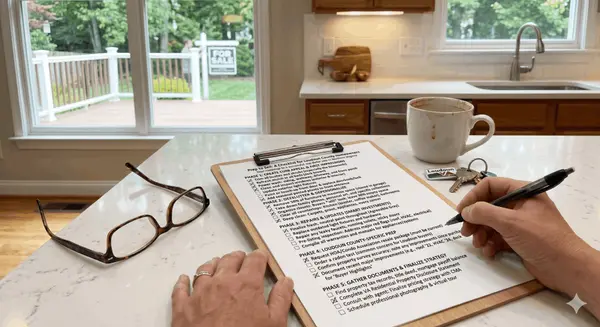
Pre-Departure Checklist (Do Before You Leave Burke)
- ✓ Walk the home with your listing agent and identify pre-listing repairs
- ✓ Complete any contractor work that requires owner sign-off (roof, HVAC, foundation)
- ✓ Sign a durable power of attorney with your spouse or trusted local agent
- ✓ Notify your homeowner's insurance carrier of vacancy (or switch to vacant policy)
- ✓ Keep utilities on (electric, water, gas) — vacant homes still need climate control
- ✓ Install smart leak sensors and a smart thermostat (Nest, Ecobee) for remote monitoring
- ✓ Set up lawn service and snow removal (Burke HOAs enforce both)
- ✓ Provide your agent with all HOA documents, warranties, and recent receipts
- ✓ Decide on staging strategy (furnish, virtual, or empty) before move-out day
- ✓ Forward USPS mail and update billing addresses for utility and tax statements
- ✓ Confirm Burke Centre Conservancy or sub-HOA disclosure packets are pulled
The HOA documentation item is Burke-specific and worth highlighting. Burke Centre Conservancy — which oversees the Commons, Oaks, Ponds, Landings, and Woods sub-communities — requires a disclosure packet at sale that takes 14 days to prepare and costs the seller around $200–$300. Pulling this before you leave avoids the panic order during inspection week.
Choosing the Right Listing Agent for a Remote Sale
A remote sale is not the right project for a referral from a friend, a name on a Zillow billboard, or a relative with a license. The agent you pick is functionally running the property in your absence — they make calls, sign showings, walk vendors through, photograph after staging, and decide whether to push back on inspection items. Five things matter:
| Criterion | Why It Matters for Remote Sellers | What to Ask |
|---|---|---|
| Burke-specific transaction volume | Pricing precision requires recent comps from the same sub-community | How many Burke homes have you sold in the last 12 months? |
| Vendor network | You can't call a handyman from another time zone — your agent must | Who handles repairs, cleaning, lawn, and contractor walk-throughs? |
| Marketing depth | Vacant homes need stronger media (drone, 3D, twilight) to compete with staged listings | What's included in your marketing — and is it 4K video, drone, and Matterport? |
| Communication cadence | You need scheduled updates, not "let me get back to you" responses | How often will you call/email me, and through what channel? |
| Fee structure | Remote sellers carrying dual costs benefit most from keeping more equity | What's your listing fee, and what's included for that fee? |
The Jamil Brothers Realty Group, led by Saad Jamil and Arslan Jamil, operate as a high-touch listing team specifically for Burke and the surrounding Fairfax County markets. They list at a 1.5% full-service fee — which includes professional photography, drone video, 3D Matterport tours, vendor coordination, weekly property visits, and remote-friendly closing. Both brothers are licensed in Virginia, Maryland, DC, and West Virginia, and the team has closed 840+ homes with 500+ five-star reviews. For remote sellers, this combination — local boots, full marketing, and a 1.5% fee — is built for the scenario.
Burke Market Snapshot
Before you set a list price, understand what Burke is doing right now. The numbers below reflect the broader Burke/Fairfax County southern corridor as of recent BrightMLS reporting — your actual neighborhood numbers will vary, and your agent's CMA will be specific.
| Metric | Burke Range | What It Means for Remote Sellers |
|---|---|---|
| Median sale price (SFH) | $725K–$825K | Strong values vs. national averages — worth marketing well |
| Median sale price (townhome) | $500K–$600K | Burke Centre townhomes move fast in spring |
| Median days on market | 12–28 days | Plan for a 60–75 day total cycle including closing |
| List-to-sale ratio | 98.5%–101% | Well-priced listings clear at or above asking |
| Months of inventory | 1.5–2.5 months | Seller's market — remote sellers still hold leverage |
| Top buyer demographic | Move-up families, federal/contractor employees | Schools and commute access drive pricing |
Burke's seller leverage comes from its school zoning. Most of Burke feeds into Lake Braddock Secondary or Robinson Secondary — two of Fairfax County's highest-demand school pyramids. Buyers with school-aged children pay a meaningful premium to land inside these boundaries, which keeps prices steady even when broader NOVA inventory loosens.
Burke Neighborhood-by-Neighborhood Pricing
"Burke" is not one market. Five distinct sub-communities transact at meaningfully different price points and timelines. A remote seller pricing without this granularity often lists 5–10% off comp — leaving real money on the table.
| Sub-Community | Typical SFH Range | Buyer Profile | Key Selling Point |
|---|---|---|---|
| Burke Centre — Commons/Oaks | $700K–$850K | Move-up families | Walk to VRE, pools, community center |
| Burke Centre — Ponds/Landings/Woods | $650K–$800K | First-time and move-up | Burke Centre amenities + Robinson schools |
| Lake Braddock | $750K–$950K | Family buyers, federal employees | Lake Braddock school pyramid premium |
| Cherry Run / Signal Hill | $700K–$900K | Established families | Larger lots, quieter streets |
| Long Branch / White Oaks | $650K–$850K | Move-up families, contractors | Fairfax County Parkway access |
For Burke Centre owners specifically, the conservancy disclosure packet, monthly assessments, and sub-community rules (architectural review board, exterior color restrictions) all matter to buyers and impact list price. A listing agent who has sold in your specific conservancy will know how to position those details — not all conservancies command the same premium.
Our Burke-specific seller net sheet breaks down every cost — listing fee, buyer's agent compensation, Virginia grantor tax, NOVA congestion tax, HOA transfer, and prorations. You'll see your real take-home before you list, with no surprises at the closing table.
Cost of Selling a Burke Home Remotely
Remote sales have the same baseline closing costs as any Virginia home sale, plus a few extras tied to vacancy and distance. Here's a full breakdown for a $750,000 Burke home — the midpoint of most sub-community ranges.
| Cost | Traditional 3% | Jamil Brothers 1.5% | Notes |
|---|---|---|---|
| Listing agent commission | $22,500 | $11,250 | Largest variable |
| Buyer's agent compensation | $18,750 (2.5%) | $18,750 (2.5%) | Negotiable post-NAR settlement |
| VA grantor tax | $750 | $750 | $1 per $1,000 (state) |
| NOVA regional congestion tax | $112.50 | $112.50 | $0.15 per $100 in NOVA jurisdictions |
| HOA transfer / disclosure packet | $250–$400 | $250–$400 | Burke Centre Conservancy fees |
| Settlement / title fees | $1,500–$2,500 | $1,500–$2,500 | Varies by closing attorney |
| Pre-listing repairs/cleaning | $2,000–$8,000 | $2,000–$8,000 | Depends on condition |
| Staging (vacant home) | $2,500–$5,500 | $2,500–$5,500 | Optional but often ROI-positive |
| Vacant home insurance upgrade | $80–$200/mo | $80–$200/mo | Required after 30–60 days vacant |
| Lawn / snow service | $150–$300/mo | $150–$300/mo | HOA compliance |
| Approx. total selling costs | $50,000–$58,000 | $38,000–$46,000 | Difference = ~$11,250 |
Seller Savings Calculator
How much more do you keep with our 1.5% listing fee?
Select your Burke home's estimated value to see your real net proceeds — side by side.
| Traditional Agent — 3% | |
| Sale price | $400,000 |
| Listing fee (3%) | −$12,000 |
| Buyer's agent (2.5%) | −$10,000 |
| Est. closing (1%) | −$4,000 |
| Net Proceeds | $374,000 |
| Our Fee — Only 1.5% | |
| Sale price | $400,000 |
| Listing fee (1.5%) | −$6,000 |
| Buyer's agent (2.5%) | −$10,000 |
| Est. closing (1%) | −$4,000 |
| Net Proceeds | $380,000 |
| Traditional Agent — 3% | |
| Sale price | $500,000 |
| Listing fee (3%) | −$15,000 |
| Buyer's agent (2.5%) | −$12,500 |
| Est. closing (1%) | −$5,000 |
| Net Proceeds | $467,500 |
| Our Fee — Only 1.5% | |
| Sale price | $500,000 |
| Listing fee (1.5%) | −$7,500 |
| Buyer's agent (2.5%) | −$12,500 |
| Est. closing (1%) | −$5,000 |
| Net Proceeds | $475,000 |
| Traditional Agent — 3% | |
| Sale price | $600,000 |
| Listing fee (3%) | −$18,000 |
| Buyer's agent (2.5%) | −$15,000 |
| Est. closing (1%) | −$6,000 |
| Net Proceeds | $561,000 |
| Our Fee — Only 1.5% | |
| Sale price | $600,000 |
| Listing fee (1.5%) | −$9,000 |
| Buyer's agent (2.5%) | −$15,000 |
| Est. closing (1%) | −$6,000 |
| Net Proceeds | $570,000 |
| Traditional Agent — 3% | |
| Sale price | $750,000 |
| Listing fee (3%) | −$22,500 |
| Buyer's agent (2.5%) | −$18,750 |
| Est. closing (1%) | −$7,500 |
| Net Proceeds | $701,250 |
| Our Fee — Only 1.5% | |
| Sale price | $750,000 |
| Listing fee (1.5%) | −$11,250 |
| Buyer's agent (2.5%) | −$18,750 |
| Est. closing (1%) | −$7,500 |
| Net Proceeds | $712,500 |
| Traditional Agent — 3% | |
| Sale price | $1,000,000 |
| Listing fee (3%) | −$30,000 |
| Buyer's agent (2.5%) | −$25,000 |
| Est. closing (1%) | −$10,000 |
| Net Proceeds | $935,000 |
| Our Fee — Only 1.5% | |
| Sale price | $1,000,000 |
| Listing fee (1.5%) | −$15,000 |
| Buyer's agent (2.5%) | −$25,000 |
| Est. closing (1%) | −$10,000 |
| Net Proceeds | $950,000 |
Estimates only. Closing costs vary. Buyer's agent commission is negotiable.
| 500+ Five-Star Reviews · Top 1% Nationwide · 840+ Homes Sold | TheJamilBrothers.com · (703) 782-4830 |
Vacant vs. Tenant-Occupied vs. Staged
Once you've moved out, your home falls into one of three sale states. Each has different pricing, timing, and risk profile — and the right choice depends on your equity, timeline, and risk tolerance.
| Approach | Sale Speed | Price Impact | Best For |
|---|---|---|---|
| Empty / vacant | Slower (rooms photograph cold) | 3–8% below staged comp | Low-equity sellers, very fast moves |
| Virtual staging | Same as physical staging | 1–3% below physical staging | Mid-range homes, tight budgets |
| Physical staging | Fastest, best showing volume | +1–5% over comp on average | Most Burke SFHs $650K+ |
| Tenant-occupied | Slower (showing friction) | 5–12% below staged comp | Cash-flow priority over net |
When tenant-occupied does and doesn't work
Some Burke owners try to rent the home while it sells — covering carrying costs with tenant rent until close. This sounds smart on paper but rarely works in practice. Showings require 24-hour notice in Virginia, tenants often resist marketing photos, and buyers discount tenant-occupied homes because they can't visualize the space cleanly. If you absolutely need rent to cover dual mortgages, consider a short-term furnished rental with a 30-day-out clause — and price the listing to clear quickly so the tenant arrangement is brief.
| ✓ Pros of Vacant + Staged | ✗ Cons of Vacant + Staged |
|---|---|
| Faster days on market (often half the time of empty) | Upfront cost of $2,500–$5,500 |
| Higher offer prices in most price ranges | Stagers require home access scheduling |
| Stronger online photography conversion | Furniture must be removed at sale |
| Easier for buyers to imagine the lifestyle | Vacancy still requires monitoring |
The Remote Sale Timeline: Step-by-Step
A well-run remote Burke sale runs roughly 60–75 days from agent engagement to wire receipt. Here's the realistic week-by-week breakdown.
Listing strategy & pricing — Week 0 (before move-out)
Agent walk-through, CMA review, repair scoping, marketing plan, and final list price agreement. Sign listing agreement and durable POA in person if possible.
Prep & staging — Week 1 to 2
Repairs completed, deep clean scheduled, staging delivered (if used), HOA disclosure packet pulled, and smart monitors installed. Agent coordinates all vendors.
Media & launch — Week 2 to 3
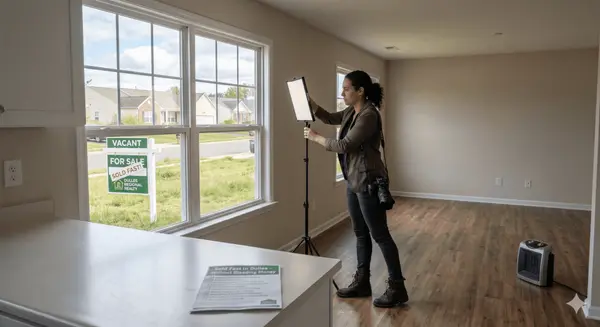
Professional photography, drone, 3D Matterport, and twilight shots. MLS listing goes live with full media. Agent hosts open house and broker tour.
Active marketing & offers — Week 3 to 5
Showings, follow-ups, agent screening of buyer agents, and offer review. In Burke's current market, most well-priced homes receive offers within 14 days.
Inspection & negotiation — Week 5 to 6
Home inspection (buyer's, ~2 hours), inspection response letter, repair negotiations, appraisal scheduling. Pre-agreed seller authority makes this fast.
Appraisal & financing — Week 6 to 8
Appraisal completed, financing contingency cleared, title work begins. Agent confirms HOA documents, taxes, and lien searches.
Closing & wire — Week 8 to 10
Remote online notarization or POA signing. Wire instructions verified by phone (never by email — wire fraud is the #1 remote closing risk). Proceeds typically hit your account within 24 hours of close.
4K photography, drone video, 3D Matterport, vendor coordination, weekly property check-ins, and remote-friendly closing — all included at 1.5%. The Jamil Brothers handle the work so you don't have to fly back to Virginia.
Closing From Afar: POA, RON, and Digital Signing
Closing on a Burke home from out of state is more straightforward than most sellers expect. Virginia offers three legal pathways, and competent closing attorneys handle all three routinely.
Path 1: Power of Attorney (POA)
A durable, transaction-specific power of attorney lets a designated agent — often a spouse, attorney, or trusted family member — sign closing documents on your behalf. The POA must be drafted by a Virginia attorney, notarized, and accepted by the lender and title company in advance. POA acceptance is not automatic — verify with the buyer's lender 30 days before closing, since some lenders refuse short-notice POA acceptance.
Path 2: Remote Online Notarization (RON)
Virginia was an early adopter of RON and allows sellers to sign closing documents via video conference with a commissioned remote notary. The seller signs digitally, the notary verifies identity through ID scanning and knowledge-based authentication, and the executed documents are returned to the title company electronically. RON works from anywhere with internet — Hawaii, Germany, deployed locations — and is the cleanest option for most remote sellers.
Path 3: Mail-Away Closing
The traditional fallback: title company ships closing documents to your current address, you sign with a local notary, and return the package via overnight courier. Slower than RON (3–5 business days for the round trip) but accepted by all lenders. Use this when RON isn't available in your current state or when the title company prefers paper for complex transactions.
⚠️ Wire Fraud Warning
Wire fraud is the most common loss in remote closings. Before sending wire instructions to your title company, verify them by phone using a number from the title company's website — not the number in any email. Scammers spoof closing emails and intercept seller proceeds. Title company will confirm the instructions verbally.
Tax Implications of Selling After Moving
The tax rules for selling after you've moved are governed by IRS Section 121 — the primary residence capital gains exclusion. Get this right and you may exclude up to $250,000 of gain ($500,000 if married filing jointly). Get it wrong and the entire gain becomes taxable at capital gains rates.
| Scenario | Exclusion Eligible? | Notes |
|---|---|---|
| Lived in home 2 of last 5 years, sell within 3 years of moving out | Yes | Full exclusion ($250K single / $500K married) |
| Lived in home 2 of last 5 years, sell within 3 years — military extended absence | Yes | Military can pause 5-year clock for up to 10 years |
| Sold within 1 year of buying (job change >50 miles) | Partial | Prorated exclusion based on time owned |
| Moved out 4+ years ago, kept as rental | No | Lost primary residence status — full capital gains |
| Inherited property, never lived in | No | Stepped-up basis applies — limits gain |
The single most important date for remote sellers is the day you moved out. The IRS gives you 3 years from that date to sell and still qualify for full primary residence exclusion. If you're past 30 months, talk to a CPA about accelerating the listing. Active-duty military and certain federal employees may extend this window — check your service-specific exemptions before assuming the standard 3-year rule applies.
This is general information, not tax advice. The Jamil Brothers Realty Group is not a CPA or tax attorney — always confirm your specific situation with a qualified tax professional before making timing decisions.
Common Remote Sale Mistakes
The same seven mistakes turn what should be a clean remote sale into a six-month ordeal. Most are preventable with the right preparation.
Avoid These Burke Remote Sale Mistakes
- ✗ Hiring the cheapest agent. Remote sales need the most operational support — discount-model agents typically don't provide it.
- ✗ Skipping pre-listing repairs. Inspection negotiations from another time zone are slower and pricier than just fixing items up front.
- ✗ Letting insurance lapse to vacant status. Standard HO-3 policies often void coverage after 30–60 days of vacancy — call your carrier.
- ✗ Turning off utilities. Vacant homes still need climate control (mold, frozen pipes) and active electricity for showings.
- ✗ Ignoring Burke Centre architectural rules. ARB violations stop sales — confirm exterior compliance before listing.
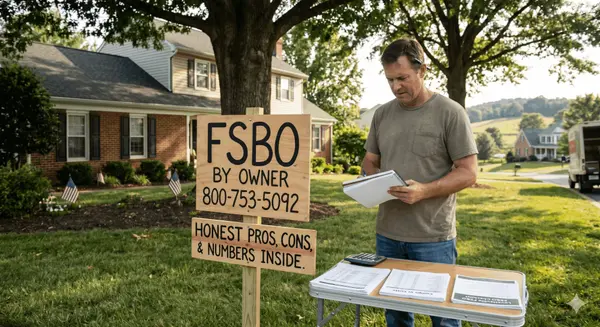
- ✗ Trying to FSBO from out of state. The discount of trying it yourself almost always exceeds the commission you would have paid.
- ✗ Wiring proceeds without phone verification. Verify by phone using the title company's published number — never trust an emailed wire request.
Alternatives: Rent, Cash Offer, iBuyer
A full-service listing isn't the only option for an out-of-state Burke owner. Three alternatives make sense in narrow situations:
Hold and Rent
If you have strong equity, a low fixed-rate mortgage, and time on your side, converting to a rental can preserve appreciation upside. Burke long-term rentals (3BR SFH) average $2,800–$3,800/month, which often covers mortgage, taxes, insurance, and HOA on homes purchased before 2022. The downside: you become a long-distance landlord, you lose Section 121 eligibility after 3 years, and depreciation recapture applies when you eventually sell. Best for sellers with 10+ year horizons.
Cash Offer
Cash buyers — institutional or local investor — close in 7–21 days, often with no repairs required and no contingencies. The tradeoff is price: cash offers typically come in 8–15% below retail market value. For Burke sellers facing PCS deadlines, inherited probate timelines, or properties in poor condition, this discount can be worth the speed and certainty. The Jamil Brothers Realty Group works with local cash investors and can run a parallel cash track alongside an MLS listing.
If timing, condition, or certainty matters more than maximum price, a cash offer may be the right fit for your remote sale. We'll walk you through your full range of options — including how the cash number compares to a listed sale — no pressure, no obligation.
iBuyer (Opendoor, Offerpad)
iBuyers operate in the DMV but with limited Burke inventory. Their algorithmic offers are typically 5–10% below market, plus service fees of 5–7%. For most Burke sellers, an iBuyer net comes in 10–17% below a full-service listing. They make sense only when speed and zero-showing convenience genuinely outweigh tens of thousands of dollars in equity.
Your Next Step
Selling a Burke home from another state isn't difficult — it's a process that demands the right local partner, a clear timeline, and a clean playbook for vacancy, communication, and closing. The sellers who net the most from remote sales are the ones who pick their agent first, set their pricing strategy second, and never improvise the vendor coordination.
The Jamil Brothers Realty Group has run this exact playbook for Burke clients relocating to Florida, Texas, California, overseas military posts, and everywhere in between. The 1.5% full-service listing fee is structured to give out-of-state sellers more equity to cover dual carrying costs — without any reduction in marketing, photography, vendor work, or negotiation strength. If you've already moved, your home doesn't have to wait for you to come back. It just needs the right team on the ground.
Know your Burke home's value, understand your costs, and see exactly what you'll walk away with — before you make any decisions. The Jamil Brothers provide a full remote-seller consultation at no cost or obligation, by phone or video.
Frequently Asked Questions
Can I really sell my Burke home without flying back to Virginia?
Yes. Virginia allows remote online notarization (RON) statewide, accepts durable powers of attorney, and supports digital document signing through DocuSign and dotloop. The Jamil Brothers Realty Group has closed Burke sales for owners in Hawaii, Germany, Texas, and California — all without the seller ever returning to Virginia. The work happens through a combination of remote signing, a local listing team handling vendors and showings, and a pre-set decision framework that lets your agent move in real time on counter-offers and inspection items.
How much does it cost to sell a Burke home remotely?
Total selling costs typically run 5.5%–7.5% of the sale price, depending on commission structure, repairs, staging, and carrying time. On a $750,000 Burke home, a traditional 3% listing path totals about $50,000–$58,000 in fees, taxes, and ancillary costs. The Jamil Brothers' 1.5% full-service program runs about $38,000–$46,000 on the same sale — saving roughly $11,250 with identical marketing, photography, drone, 3D, and negotiation support.
How long does it take to sell a Burke home remotely?
A well-run remote sale takes 60–75 days from listing agreement to wire receipt. The first 2 weeks are prep and media, weeks 3 to 5 are active marketing and offers, weeks 5 to 8 are inspection through appraisal, and weeks 8 to 10 are closing. Burke's median days-on-market is typically 12–28 days for well-priced homes, so the timeline is more about post-contract steps than buyer demand.
How do I choose the right listing agent for a remote Burke sale?
Five criteria matter: recent Burke-specific transaction volume, a vetted vendor network for vacant homes, full media marketing (4K photo, drone, 3D, twilight), a documented communication cadence, and a fee structure that lets you keep enough equity to offset carrying costs. The Jamil Brothers Realty Group hits all five — 840+ homes sold across the DMV, 500+ five-star reviews, a complete media package included at 1.5%, and a remote-seller playbook used regularly for clients across the country.
What happens with buyer's agent commission after the NAR settlement?
After the August 2024 NAR settlement, buyer's agent compensation is no longer automatically published in MLS listings, and buyers now sign written agreements directly with their agents. For Burke sellers, this means the buyer's agent commission (commonly 2–2.5%) is a separately negotiated concession at offer time, not a fixed cost embedded in the listing commission. The listing agent's fee is still negotiated up front. Most Burke sellers continue to offer compensation to attract buyer-agent showings, but the exact number is now flexible.
Is the Burke market a good place to sell remotely in 2026?
Yes. Burke remains a low-inventory, high-demand market with median days on market around 12–28 days and list-to-sale ratios near 99–101%. School zoning into Lake Braddock and Robinson secondaries keeps family-buyer demand steady year-round, and VRE access plus Fairfax County Parkway commuter routes maintain professional buyer interest. For remote sellers, this means properly-priced listings still clear quickly even when you're not physically present.
What's the biggest mistake remote Burke sellers make?
Hiring an agent based on commission rate alone, then realizing the agent doesn't handle the vacant-home vendor work. Remote sales require a hands-on agent: coordinating cleaners, lawn crews, repair contractors, stagers, and inspectors — all without you on site. A bargain-rate flat-fee agent typically gives you MLS exposure and nothing else, leaving the seller scrambling to manage Virginia vendors from another state. The fix is hiring a full-service listing team that builds the operational layer into the listing.
How does the Burke Centre Conservancy affect my remote sale?
If you own in Burke Centre, the Conservancy and your specific sub-community (Commons, Oaks, Ponds, Landings, or Woods) require a disclosure packet at sale that takes about 14 days to prepare and costs $200–$400. Buyers have a 3-day right of rescission once they receive it. Pull the packet before you list — not after the contract — to avoid delays. The Conservancy's architectural review board also enforces exterior color and modification rules, so verify your home complies before going to market. Your listing agent should manage this.
Will I lose my primary residence tax exclusion if I wait too long to sell?
Yes. The IRS Section 121 exclusion ($250,000 single / $500,000 married filing jointly) requires that you lived in the home as your primary residence for 2 of the last 5 years before sale. The clock starts the day you move out. Past 3 years of non-occupancy, you risk losing eligibility entirely. Active-duty military members can pause this clock for up to 10 years under the Military Family Tax Relief Act, but most civilian sellers should plan to close within 30 months of moving to preserve the full exclusion. Confirm your specific situation with a CPA.
Should I rent my Burke home instead of selling it?
It depends on your equity position, your timeline, and your tolerance for long-distance landlording. Burke 3-bedroom single-family rentals average $2,800–$3,800/month, which often covers carrying costs for owners with low fixed-rate mortgages from 2020-2022. However, you lose Section 121 eligibility after 3 years of non-occupancy, depreciation recapture applies at eventual sale, and you take on tenant management risk. Renting makes sense for sellers with 10+ year holds and strong cash positioning. For most relocating Burke owners, selling within the Section 121 window nets more after taxes and stress.
How does the 1.5% listing fee work for a remote Burke sale?
The Jamil Brothers Realty Group's 1.5% listing fee is a full-service program — not a discount or flat-fee model. You receive 4K professional photography, drone video, 3D Matterport tours, twilight shots, full MLS syndication, vendor coordination for repairs and staging, weekly property check-ins during vacancy, partner-led negotiation, and remote-friendly closing through RON or POA. On a $750,000 sale, the 1.5% fee saves roughly $11,250 versus a traditional 3% listing — meaningful money when carrying two mortgages during a relocation.
What if my home has been vacant for several months already?
Start with a property condition assessment before listing. A vacant Burke home unmonitored for 3+ months often has issues that compound — HVAC sediment, plumbing drip leaks, pest activity, deferred lawn — that affect both buyer perception and inspection outcomes. The Jamil Brothers can walk the property, document issues, coordinate repairs, and put the home back into showable condition before launch. Most vacancy-related issues are reversible with $2,000–$5,000 of targeted work, and that spend typically returns 3–5x at sale.
Glossary
Remote Online Notarization (RON)
A video-based notary process Virginia allows that lets sellers sign closing documents from anywhere with internet — no in-person notary visit required.
Durable Power of Attorney (POA)
A legal document letting a designated person sign closing paperwork on your behalf. Must be Virginia-compliant and accepted by the lender.
Section 121 Exclusion
IRS rule excluding up to $250K (single) or $500K (married) of home-sale gain from federal tax — if you lived in the home 2 of the last 5 years.
HOA Disclosure Packet
Virginia-required document set including HOA rules, financials, and resale demand. Required before closing; takes ~14 days to prepare.
Vacant Home Insurance
A specialty policy required when a property is unoccupied for more than 30–60 days. Standard HO-3 policies typically void coverage during vacancy.
VA Grantor Tax
Virginia state seller-paid tax: $1 per $1,000 of sale price. Plus $0.15 per $100 NOVA regional congestion tax for Fairfax County.
Burke Centre Conservancy
The master HOA overseeing Burke Centre's five sub-communities. Charges assessments, enforces architectural rules, and issues sale disclosure packets.
Net Proceeds
The dollar amount the seller actually receives after listing fee, buyer's agent compensation, taxes, prorations, and closing costs are deducted from the sale price.
Explore More
Browse Every Corner of the DMV Market
Whether you're searching by budget, neighborhood, or buying situation — find exactly what you need below.
Virginia Homes by Budget
Washington DC Homes by Budget
Maryland Homes
Explore Northern Virginia Communities
Loudoun County
Fairfax County & Surrounding
Ready to Make a Move?
Full-Service · No Tradeoffs
List for 1.5% & Keep More Equity
Professional photography, drone video, 3D tours, and expert negotiation — all included. On an $800K home, that's $12,000 more in your pocket vs. a 3% agent.
See the 1.5% Program →Need Speed or Certainty?
Get a No-Obligation Cash Offer
Skip the showings, skip the contingencies. If timing or condition matters more than top dollar, a cash offer may be the right fit. We'll walk you through every option.
Explore Cash Offers →
Categories
Recent Posts




Let's Connect