
How to Sell and Buy a Home at the Same Time in Tysons, VA (2026 Guide)

Quick Answer: To sell and buy a home at the same time in Tysons, VA, you generally choose one of four strategies — sell first then buy, buy first then sell, run both transactions in parallel with contingencies, or use bridge financing. The right choice depends on your equity, your timing flexibility, and the Tysons inventory mix. Most Tysons move-up sellers in 2026 use a coordinated dual-transaction plan to avoid carrying two mortgages.
Key Takeaways
- Tysons single-family homes carry a median price near $1.6M, while condos cluster around $395K–$540K — your transaction strategy depends heavily on which segment you're moving between.
- The four primary paths are sell-first, buy-first, simultaneous closings, and bridge financing — each has a different cash, risk, and timing profile.
- A well-written home-sale contingency, settlement-date contingency, or post-occupancy agreement can let you do both transactions on overlapping timelines without a temporary rental.
- Selling your current Tysons home with the Jamil Brothers' 1.5% full-service listing fee can free up an additional 1.5% of your sale price toward your next down payment.
- The right agent — preferably one who represents you on both the sale and the purchase — coordinates timelines, contingencies, and lender milestones so you don't get stuck owning two homes or none.
In This Guide
- The Tysons Move-Up Reality in 2026
- Four Ways to Coordinate Selling and Buying
- 2026 Tysons Market Snapshot
- Building Your Personal Dual-Transaction Plan
- Contingencies That Protect You
- The Real Cost of Selling and Buying at the Same Time
- Tysons Seller Savings Calculator
- Step-by-Step Timeline
- Common Mistakes to Avoid
- Choosing the Right Agent
- Frequently Asked Questions
- Glossary
Selling your current home and buying your next one in Tysons rarely happens on a clean, sequential timeline. The Tysons market in 2026 has shifted toward balance — inventory is rising, days on market are stretching to 34 days for condos and 69 days for single-family homes, and the days of guaranteed lightning-fast sales are behind us. That means coordination matters more than ever.
If you're moving up from a Tysons condo to a single-family home in McLean or Vienna, or downsizing from a Westgate detached home to a Rotonda or Lillian Court condo, the order of operations directly affects how much equity you keep, how much risk you carry, and whether you ever have to live out of a suitcase between closings. This guide walks through every option, the math behind each, and the contingencies that make a simultaneous sell-and-buy genuinely workable in the current Tysons market.
The Jamil Brothers Realty Group has guided hundreds of Northern Virginia move-up and move-down clients through coordinated dual transactions. Saad Jamil and Arslan Jamil hold associate broker credentials and operate out of Samson Properties, with deep familiarity with the Tysons submarket — from the high-rises along Westpark Drive to the established single-family neighborhoods of Pimmit Hills and Westgate.
The Tysons Move-Up Reality in 2026
Tysons isn't one market — it's at least three. Understanding which segment you're selling out of and which one you're buying into is the first step in any dual-transaction plan, because each segment moves at a different speed and carries a different price ceiling.
| Tysons Segment | Median Price | Avg DOM | Typical Buyer |
|---|---|---|---|
| High-rise condos | $395K – $540K | ~34 days | Professionals, first-time buyers, downsizers |
| Townhomes & new builds | $800K – $1.3M | ~45 days | Move-up condo owners, families |
| Single-family homes | $1.4M – $2.5M+ | ~69 days | Move-up families, executive relocations |
| Luxury new construction | $2.5M – $8M+ | 90+ days | Custom-build buyers, top-of-market move-ups |
Why this matters for sequencing: a Tysons high-rise condo seller has a different timing problem than a Pimmit Hills single-family seller. The condo seller is usually buying up into a market where listings move slower than what they're selling, while the single-family seller is often downsizing into a faster-moving condo market. The correct dual-transaction strategy flips depending on which direction you're going.
Which Direction Are You Moving?
Move-Up (condo → townhome or single-family)
- ✓ Your condo will likely sell faster than your next home gets contracted — sell-first or simultaneous closing is often safer.
- ✓ Larger down payment is needed for the next home — keeping closing costs low on your sale matters more.
- ✓ Home-sale contingencies are typically accepted on slower-moving single-family listings.
Move-Down (single-family → condo or townhome)
- ✓ Your home may take 60–90 days to sell, but condos move in 30–35 — buy-first or bridge financing fits better.
- ✓ You likely have substantial equity — bridge loans or HELOCs are more accessible.
- ✓ Condo HOAs and right-of-first-refusal rules can stretch closing timelines — build buffer days into contracts.
Before you can build a dual-transaction plan, you need to know your equity. We'll send a street-level valuation based on actual Tysons comps — not an automated Zestimate. Response within 24 hours.
Four Ways to Coordinate Selling and Buying in Tysons
There is no universally "best" approach — only the one that fits your equity, your timing flexibility, your risk tolerance, and your willingness to move twice. Here's how each option actually plays out in the Tysons market in 2026.
Path 1 — Sell First, Then Buy
You list your current home, get it under contract, and only then start writing offers on your next home. Typically you'll close on the sale, move into a short-term rental or with family for 30–90 days, then close on your purchase.
When it works: Lower equity, sellers' market sale conditions, no contingency room in your purchase budget, willing to move twice.
Risk: Tysons single-family inventory may improve or worsen between your sale and your purchase. Mortgage rates could shift. You're paying rent and storage for 30–90 days.
Path 2 — Buy First, Then Sell
You secure the next home with a non-contingent or rate-locked offer, then list your current Tysons home. You either qualify for two mortgages temporarily or use bridge financing to span the gap.
When it works: Strong equity in the current home, high income that can support both mortgages, low inventory in the destination segment, you've found a "must-have" listing.
Risk: If your current home takes longer to sell than expected, you're carrying two payments. You may also feel pressure to accept a lower offer to close the gap, eating into the equity you used as a down payment.
Path 3 — Simultaneous Closings
You time your sale and purchase to settle on the same day, or within a 1–3 day window. You use sale proceeds at closing as down payment funds, and you go directly from one home to the next with no rental in between.
When it works: You have an experienced agent coordinating contingencies, a flexible buyer on your sale, and a flexible seller on your purchase. Tysons has more flexibility for this than fast-moving markets because the average DOM lets contracts breathe.
Risk: Coordination is everything — one delay on either side cascades. A solid post-settlement-occupancy agreement (often called rent-back) is your safety net.
Path 4 — Bridge Financing or HELOC
You use a bridge loan or a Home Equity Line of Credit on your current home to fund the down payment on the next one before your current home sells. Once your sale closes, you pay off the bridge or HELOC.
When it works: Substantial equity (typically 30%+), strong credit, willingness to pay 8–12% bridge financing rates for 60–180 days, time-sensitive purchase opportunity.
Risk: Bridge interest is expensive, and if your current home doesn't sell in the bridge term, you may face an extension fee or rate increase. Some Tysons HOAs restrict short-term financing arrangements.
Side-by-Side Comparison
| Strategy | Cash Needed | Risk Level | Move Count |
|---|---|---|---|
| Sell First | Low | Low | 2 (storage + rental) |
| Buy First | Very High | High | 1 |
| Simultaneous Close | Medium | Medium | 1 |
| Bridge / HELOC | High (with financing) | Medium-High | 1 |
2026 Tysons Market Snapshot
The Tysons-area market in 2026 has shifted away from the seller-dominated dynamics of 2021–2023 toward what NVAR (Northern Virginia Association of Realtors) and George Mason University's Center for Regional Analysis describe as a more balanced phase. That's good news for dual-transaction sellers — fewer bidding wars on your purchase and more negotiating leverage with your buyer.
Tysons Days on Market (relative speed by segment)
Negotiating Leverage by Segment (where you have it as a seller vs. as a buyer)
Sale-to-list ratios across Tysons sit near 99%, meaning correctly priced homes are still moving close to ask — but bidding wars are no longer automatic. For dual-transaction sellers, that's a feature, not a bug: it means your contingency-protected offers on your next home are more likely to be accepted.
Building Your Personal Dual-Transaction Plan
A coordinated sale-and-purchase isn't a template — it's a sequence of decisions calibrated to your specific cash position, credit profile, and timing flexibility. Here's the diagnostic we run with every Tysons move-up or move-down client.
Step 1 — Establish Your Real Equity Position
Pull your current mortgage payoff statement and subtract it from your current home's market value. Then subtract estimated selling costs (commission, transfer taxes, HOA disclosure fees, prorations) to get your real net proceeds. Many Tysons sellers overestimate what they'll bring to the next closing by 4–8% because they forget to subtract these costs.
Step 2 — Run a Pre-Approval With Two Scenarios
Have your lender run two pre-approvals: one assuming you've closed on your sale, and one assuming you haven't. The "haven't-closed" version reveals whether you can carry both mortgages temporarily (path 2 or path 4) or whether you're locked into sell-first or simultaneous closing (path 1 or path 3).
Step 3 — Choose Your Strategy Based on Inventory
If you're moving down into Tysons condos (fast-moving segment), inventory turns over weekly and waiting puts you at risk of missing the right unit. Buy-first or simultaneous makes sense. If you're moving up into single-family inventory (slower segment), you have more time — sell-first or simultaneous is usually a better fit.
Step 4 — Lock In Coordinated Timelines
Once you've chosen a strategy, every contract you sign should be drafted with the other transaction in mind. A 30-day settlement on your sale paired with a 45-day settlement on your purchase gives you breathing room. A 30/30 leaves no margin — and that's where dual-transaction deals fall apart.
Our seller net sheet calculator breaks down every cost — commission, Virginia grantor tax, NOVA congestion fee, HOA disclosure, closing fees — so you know your real bottom line before you list. Pair it with a free valuation and you're ready to plan both sides.
Contingencies That Protect You
The right contingency language can turn a high-risk dual transaction into a low-risk one. Here are the clauses that actually matter on Tysons contracts in 2026.
Home-Sale Contingency
This makes your purchase offer contingent on selling your current home within a defined window. In a balanced market like Tysons in 2026, well-priced contingent offers on single-family homes are increasingly accepted — especially when the contingent home is already under contract. The standard NVAR contingency form lets you spell out the timeline, the kick-out clause, and the right of first refusal.
Settlement-Date Contingency
This makes your purchase contingent on settling your sale on or before a specific date. It's narrower than a home-sale contingency (the home is already under contract — you just need to close), and most sellers accept it readily because the conditional risk is much smaller.
Post-Settlement Occupancy (Rent-Back)
You close on your sale but stay in the home for an agreed period (typically 1–60 days), paying the buyer a daily rate. This is the single most useful tool for dual-transaction sellers — it converts a "we have to be out the day we close" panic into a 30-day buffer. Most Tysons buyers accept rent-back terms as part of the negotiation.
Kick-Out Clauses
If your purchase is contingent on selling your home, the seller of the home you're buying may insert a kick-out clause: if another buyer makes a non-contingent offer, you have 48–72 hours to either remove your contingency or release the contract. This pushes you to keep your sale process moving — it's not necessarily a bad thing, but it changes your urgency profile.
⚠️ Common Pitfall
Don't sign a non-refundable EMD on your purchase before your sale has cleared its inspection contingency. That's the moment your sale is most likely to renegotiate or fall apart — and you don't want to be locked into a purchase without protection.
The Real Cost of Selling and Buying at the Same Time
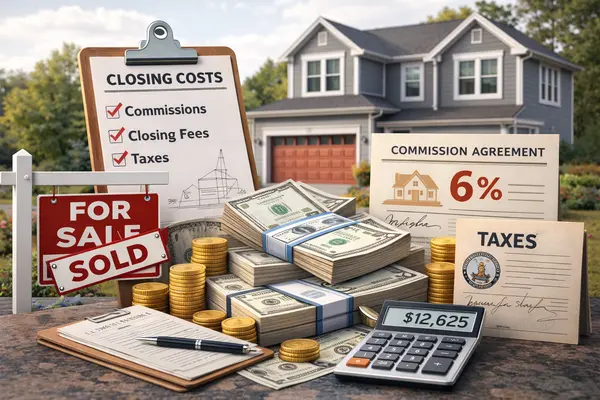
Dual transactions stack costs from both sides. A move-up Tysons seller selling a $750K condo and buying a $1.2M townhome is paying selling costs on the first transaction and buying costs on the second — and many of those costs hit at the same closing table.
Selling-Side Costs (current home)
| Cost | Typical Range | On a $750K Tysons Condo |
|---|---|---|
| Listing commission (1.5% with Jamil Brothers) | 1.5–3% | $11,250 (vs. $22,500 at 3%) |
| Buyer agent compensation (negotiable post-NAR) | 2–3% | $18,750 |
| Virginia grantor tax | $1 per $1,000 | $750 |
| NOVA Congestion Relief Fee | $0.15 per $100 | $1,125 |
| Condo resale disclosure / HOA fees | $300–$1,200 | ~$650 |
| Settlement / title / misc. | $1,000–$2,500 | ~$1,800 |
Buying-Side Costs (next home)
| Cost | Typical Range | On a $1.2M Tysons Townhome |
|---|---|---|
| Loan origination & lender fees | 0.5–1% | $7,200 |
| Appraisal, inspection, survey | $1,200–$2,500 | ~$1,800 |
| Recording, title insurance | 0.4–0.7% | ~$6,500 |
| Prepaid escrow (taxes + insurance) | Varies | ~$8,000 |
| Down payment (20% example) | 5–20%+ | $240,000 |
The buyer's-agent compensation on your sale is no longer automatically embedded in your listing fee since the 2024 NAR settlement — it's now an explicitly negotiated number, which means a good listing agent will help you decide how much (if anything) to offer the buyer's side. The Jamil Brothers' 1.5% full-service listing fee covers your side; what you offer the buyer's agent is a strategic decision based on the segment and the market.
Tysons Seller Savings Calculator
How much more do you keep with our 1.5% listing fee?
Select your home's estimated value to see your real net proceeds — side by side.
Traditional Agent — 3%
| Sale price | $400,000 |
| Listing fee (3%) | −$12,000 |
| Buyer's agent (2.5%) | −$10,000 |
| Est. closing (1%) | −$4,000 |
Our Fee — Only 1.5%
| Sale price | $400,000 |
| Listing fee (1.5%) | −$6,000 |
| Buyer's agent (2.5%) | −$10,000 |
| Est. closing (1%) | −$4,000 |
Traditional Agent — 3%
| Sale price | $500,000 |
| Listing fee (3%) | −$15,000 |
| Buyer's agent (2.5%) | −$12,500 |
| Est. closing (1%) | −$5,000 |
Our Fee — Only 1.5%
| Sale price | $500,000 |
| Listing fee (1.5%) | −$7,500 |
| Buyer's agent (2.5%) | −$12,500 |
| Est. closing (1%) | −$5,000 |
Traditional Agent — 3%
| Sale price | $750,000 |
| Listing fee (3%) | −$22,500 |
| Buyer's agent (2.5%) | −$18,750 |
| Est. closing (1%) | −$7,500 |
Our Fee — Only 1.5%
| Sale price | $750,000 |
| Listing fee (1.5%) | −$11,250 |
| Buyer's agent (2.5%) | −$18,750 |
| Est. closing (1%) | −$7,500 |
Traditional Agent — 3%
| Sale price | $1,000,000 |
| Listing fee (3%) | −$30,000 |
| Buyer's agent (2.5%) | −$25,000 |
| Est. closing (1%) | −$10,000 |
Our Fee — Only 1.5%
| Sale price | $1,000,000 |
| Listing fee (1.5%) | −$15,000 |
| Buyer's agent (2.5%) | −$25,000 |
| Est. closing (1%) | −$10,000 |
Traditional Agent — 3%
| Sale price | $1,500,000 |
| Listing fee (3%) | −$45,000 |
| Buyer's agent (2.5%) | −$37,500 |
| Est. closing (1%) | −$15,000 |
Our Fee — Only 1.5%
| Sale price | $1,500,000 |
| Listing fee (1.5%) | −$22,500 |
| Buyer's agent (2.5%) | −$37,500 |
| Est. closing (1%) | −$15,000 |
Estimates only. Closing costs vary. Buyer's agent compensation is negotiable.
4K photography, drone video, 3D tours, expert negotiation, and full MLS marketing — all included at 1.5%. When you're selling and buying at the same time, the difference goes directly into your next home's down payment.
Step-by-Step Timeline for a Simultaneous Sell and Buy
This is the timeline we use with most Tysons move-up and move-down clients. Adjust the windows based on your strategy (sell-first compresses the front half; buy-first compresses the back half).
Equity & Pre-Approval — Weeks 1–2
Get a current home valuation, run two-scenario pre-approvals, calculate your real net proceeds. This is the foundation everything else rests on.
Strategy Lock-In — Week 3
Choose your dual-transaction path with your agent. Map every potential timeline, contingency, and contingency removal date on a shared calendar.
Prep Current Home for Listing — Weeks 3–5
Deep clean, light staging, pre-listing inspection (optional but recommended on older Tysons condos), professional photography, drone video.
Launch Sale, Begin Active Buyer Search — Week 6
Go live on the MLS. Start touring the destination segment intensively. Most simultaneous deals find their match within 3–5 weeks of going live.
Negotiate Both Sides — Weeks 7–9
Aim for accepted contracts on both transactions within 1–2 weeks of each other. Write the purchase offer with a settlement-date contingency tied to your sale.
Inspection, Appraisal, Loan Underwriting — Weeks 10–12
Both transactions move through inspection responses, appraisal contingency removal, and final underwriting in parallel.
Close Sale, Then Close Purchase — Week 13
Sale closes in the morning, purchase closes in the afternoon (or same day on a wire-only basis). Sale proceeds flow directly into the purchase down payment.
Move & Settle In — Week 13+
If you negotiated a rent-back on your sale, you have 1–60 days to relocate. Otherwise, plan for a same-week move.
Common Mistakes to Avoid
| ✓ What Works | ✗ What Goes Wrong |
|---|---|
| Two-scenario pre-approval before listing | Assuming you'll qualify for two mortgages without testing it with a lender |
| Settlement-date contingency on the purchase | Writing non-contingent offers you can't actually deliver on |
| Built-in 7–14 day buffer between sale and purchase settlements | Same-day close with zero buffer (one delay derails both) |
| Post-settlement occupancy / rent-back on sale | Promising buyer immediate possession when your purchase isn't yet closed |
| One agent (or co-agent team) on both transactions | Two separate agents who don't coordinate timelines |
| Net sheet that includes both sides' closing costs | Calculating only one side and being short at the next closing |
Choosing the Right Agent for a Dual Transaction
Selling and buying at the same time is harder than doing either alone — and most agents have never coordinated more than a few dozen of these. Before you hire, ask the following questions.
Agent Qualification Checklist
- ✓ How many simultaneous sell-and-buy transactions have you coordinated in the last 12 months?
- ✓ Can you represent me on both sides, or will you coordinate with a co-agent?
- ✓ What's your contingency strategy if my sale falls through after I'm under contract on the next home?
- ✓ Do you have a preferred lender experienced with bridge financing or two-scenario pre-approvals?
- ✓ What does your listing service include at your stated commission, and how is the buyer's agent compensation handled post-NAR-settlement?
- ✓ Will you provide a written timeline showing every contingency removal date, lender milestone, and closing target for both transactions?
The Jamil Brothers Realty Group has coordinated hundreds of dual transactions across Tysons, McLean, Vienna, Reston, and the wider Fairfax County market. Saad and Arslan are NVAR Lifetime Top Producers and licensed in Virginia, Maryland, DC, and West Virginia — useful if your move-up or move-down crosses jurisdictional lines. Our 1.5% full-service listing fee applies on your sale, and our buyer representation is included at no additional cost when we represent you on both sides.
Before you tour a single home, know your budget, your timeline, and your negotiation position. Our buyer strategy session covers contingency design, lender selection, and how to write a winning Tysons offer in 2026.
Frequently Asked Questions
Can you sell and buy a home at the same time in Tysons?
Yes — and most Tysons move-up and move-down sellers do exactly that. The four main paths are sell-first, buy-first, simultaneous closings, and bridge financing. Which one fits depends on your equity, your debt-to-income ratio, and how flexible you are on timing. With the average Tysons days-on-market sitting at 34 days for condos and 69 days for single-family homes, coordinated dual transactions are workable in 2026.
How much does it cost to sell and buy a home at the same time in Tysons?
On a typical move from a $750K Tysons condo into a $1.2M townhome, sellers pay roughly 2.5–6% in selling-side costs ($18,750–$45,000) plus 2.5–4% in buying-side costs ($30,000–$48,000), not counting the down payment. The biggest variables are the listing commission (1.5% with the Jamil Brothers vs. 3% traditional, saving $11,250 on the example sale) and the buyer's agent compensation on your sale, which is now negotiated separately under the post-NAR-settlement rules.
How long does a simultaneous sell-and-buy take in Tysons?
From the first listing-prep meeting to closing on both transactions, plan for 90–120 days. The fastest dual transactions close inside 60 days; the slowest stretch to 6 months, usually when the buy side is in the luxury new-construction segment, which averages 90+ days on market. A realistic Tysons baseline is 13 weeks from listing prep to dual close.
Is it better to sell first or buy first in Tysons?
Sell-first is usually safer if you don't have substantial equity, if your destination segment is fast-moving (condos), or if you can't qualify for two mortgages. Buy-first works better if you have strong equity, the destination segment is slow-moving (single-family or luxury), and you've found a non-replaceable listing. Most Tysons clients land somewhere in between — listing first while actively touring, then coordinating contingent contracts.
What is a home-sale contingency, and will sellers in Tysons accept one in 2026?
A home-sale contingency makes your purchase offer conditional on selling your current home within a defined window. In the more balanced 2026 Tysons market, well-priced contingent offers — especially on single-family homes and townhomes with longer DOM — are increasingly accepted. The condo segment is still competitive enough that contingencies face more resistance. A settlement-date contingency (used when your home is already under contract) is much more readily accepted than a true home-sale contingency.
What is a rent-back, and should I ask for one when selling in Tysons?
A post-settlement-occupancy agreement (rent-back) lets you stay in your home for a defined period after closing, paying the buyer a daily rate that typically covers their carrying cost. For dual-transaction sellers, this is the single most valuable tool — it converts a same-day-move panic into a 1–60-day buffer. Most Tysons buyers accept rent-back terms as part of an overall negotiation, especially if you're willing to be flexible on price or contingencies in exchange.
What is bridge financing, and is it a good option for Tysons sellers?
A bridge loan or HELOC lets you tap your current home's equity to fund the down payment on your next home before your sale closes. Bridge financing in 2026 runs at 8–12% interest with a 60–180-day term — expensive, but workable if you're confident your home will sell quickly. Most Tysons clients with significant equity prefer a HELOC opened before listing, since it's cheaper to maintain and gives the same flexibility.
How did the NAR settlement change the costs of selling and buying at the same time?
Since the 2024 NAR settlement, buyer's agent compensation is no longer automatically advertised on the MLS or embedded in the listing commission. Sellers now decide whether to offer buyer-side compensation, and buyers may need to pay their own agent if the seller doesn't. For dual-transaction sellers, this means the listing-fee number (1.5% with the Jamil Brothers) and the buyer-side concession number are now two distinct strategic decisions, not a single bundled figure.
How do I choose the right agent for a dual sell-and-buy transaction in Tysons?
Ask three questions: how many simultaneous transactions they've coordinated in the last 12 months, what their contingency strategy is if one side falls through, and whether they'll provide a written timeline mapping every milestone on both sides. Look for NVAR-credentialed agents with documented track records in your specific Tysons segment. The Jamil Brothers Realty Group has closed 840+ homes across Northern Virginia and coordinates dual transactions weekly — Saad Jamil and Arslan Jamil are NVAR Lifetime Top Producers operating out of Samson Properties.
What HOA issues should I watch for when selling and buying a Tysons condo?
Tysons condo HOAs vary widely in how they handle resale disclosures, right-of-first-refusal, and document-delivery timelines. Some require 14–21 day disclosure periods that extend your closing. A few have right-of-first-refusal clauses that can delay or block sales. Order your resale disclosure package the day you go under contract — don't wait — and confirm with your listing agent whether the building has any pending special assessments, litigation, or master-policy issues that need to be flagged to buyers.
What mistakes should I avoid when selling and buying at the same time in Tysons?
The top three are: writing a non-contingent purchase offer you can't actually fund without sale proceeds, accepting a same-day-close with no buffer (so one delay cascades both transactions), and using two separate agents who don't coordinate timelines. The dual-transaction failure mode is almost always a single contingency or settlement-date slip that compounds — a written coordinated timeline with built-in 7–14 day buffers eliminates most of those failures.
Should I consider a cash offer on my current Tysons home if timing is tight?
A cash offer trades sale price for speed and certainty — and that tradeoff sometimes makes sense in a dual-transaction situation where you've already secured your next home and need to close your sale on a tight timeline. Cash offers in Tysons typically come in 8–15% below market value, so you're effectively paying that discount for guaranteed timing. The Jamil Brothers can walk you through whether a cash offer or a traditional listing better fits your specific dual-transaction window.
Glossary
Bridge Loan
Short-term financing that lets you tap your current home's equity to fund the down payment on the next home before your sale closes.
Home-Sale Contingency
A clause making your purchase offer conditional on selling your current home within a defined window.
Settlement-Date Contingency
A narrower contingency used when your sale is already under contract — your purchase is contingent only on your sale settling by a specific date.
Kick-Out Clause
A seller-side clause letting them accept a backup offer; if invoked, you have 48–72 hours to remove your contingency or release the contract.
Rent-Back / Post-Settlement Occupancy
An agreement letting a seller stay in the home after closing for a defined period, paying a daily rate to the new owner.
HELOC
Home Equity Line of Credit — a revolving credit line secured by your current home that can fund a down payment before your sale closes.
Earnest Money Deposit (EMD)
The good-faith deposit a buyer puts down with an offer, typically 1–3% of purchase price, held in escrow and applied at closing.
NOVA Congestion Relief Fee
A Northern Virginia transfer tax of $0.15 per $100 of sale price, paid by sellers in Fairfax County including Tysons.
Explore More Northern Virginia Guides
McLean Vienna Reston Fairfax Herndon Centreville 1.5% Listing Net Sheet Cash OffersReady to Coordinate Your Tysons Sell and Buy?
Selling and buying at the same time in Tysons isn't more complicated than it has to be — but it does need a clear plan, the right contingency strategy, and an agent who's run this play many times before. The Jamil Brothers Realty Group handles dual transactions throughout Tysons, McLean, Vienna, and the broader Fairfax County market, with a 1.5% full-service listing fee that frees up an additional 1.5% of your sale price toward your next down payment.
Start with a free home valuation to anchor your equity number, then run a personalized net sheet to see what you'll actually walk away with. From there, we'll map both sides of your transaction on a single coordinated timeline.
Know your equity, understand your costs on both sides, and see exactly what you'll walk away with — before you make any decisions. The Jamil Brothers provide a full seller consultation at no cost or obligation.
Call (703) 782-4830 · TheJamilBrothers.com · The Jamil Brothers Realty Group at Samson Properties
Explore More
Browse Every Corner of the DMV Market
Whether you're searching by budget, neighborhood, or buying situation — find exactly what you need below.
Virginia Homes by Budget
Washington DC Homes by Budget
Maryland Homes
Explore Northern Virginia Communities
Loudoun County
Fairfax County & Surrounding
Ready to Make a Move?
Full-Service · No Tradeoffs
List for 1.5% & Keep More Equity
Professional photography, drone video, 3D tours, and expert negotiation — all included. On an $800K home, that's $12,000 more in your pocket vs. a 3% agent.
See the 1.5% Program →Need Speed or Certainty?
Get a No-Obligation Cash Offer
Skip the showings, skip the contingencies. If timing or condition matters more than top dollar, a cash offer may be the right fit. We'll walk you through every option.
Explore Cash Offers →
Categories
- All Blogs (1243)
- Buyer Guide (8)
- Buying a home (2)
- Buying Strategies (31)
- festivals (1)
- General Blog (67)
- Market Intelligence (29)
- Market Updates (8)
- Notable Properties For Sale (32)
- Real Estate Tips, News, and More (395)
- Seller Guide (2)
- Seller Guides (60)
- Selling Your Home (527)
- Top Realtors in Northern Virginia (58)
Recent Posts




Let's Connect