
How to Prepare Your McLean Home for Sale: Staging & Repairs Guide
How to Prepare Your McLean Home for Sale: Staging & Repairs Guide
Quick Answer: Preparing a McLean home for sale takes 4–6 weeks and centers on three things — fixing functional issues a buyer's inspector will flag, updating cosmetics that move the needle in a luxury market (kitchens, baths, lighting, paint), and professionally staging the home so listing photos compete with the new construction and renovated comps that dominate McLean's MLS feed. Sellers who do this work see shorter days on market, fewer concessions at closing, and stronger final offers.
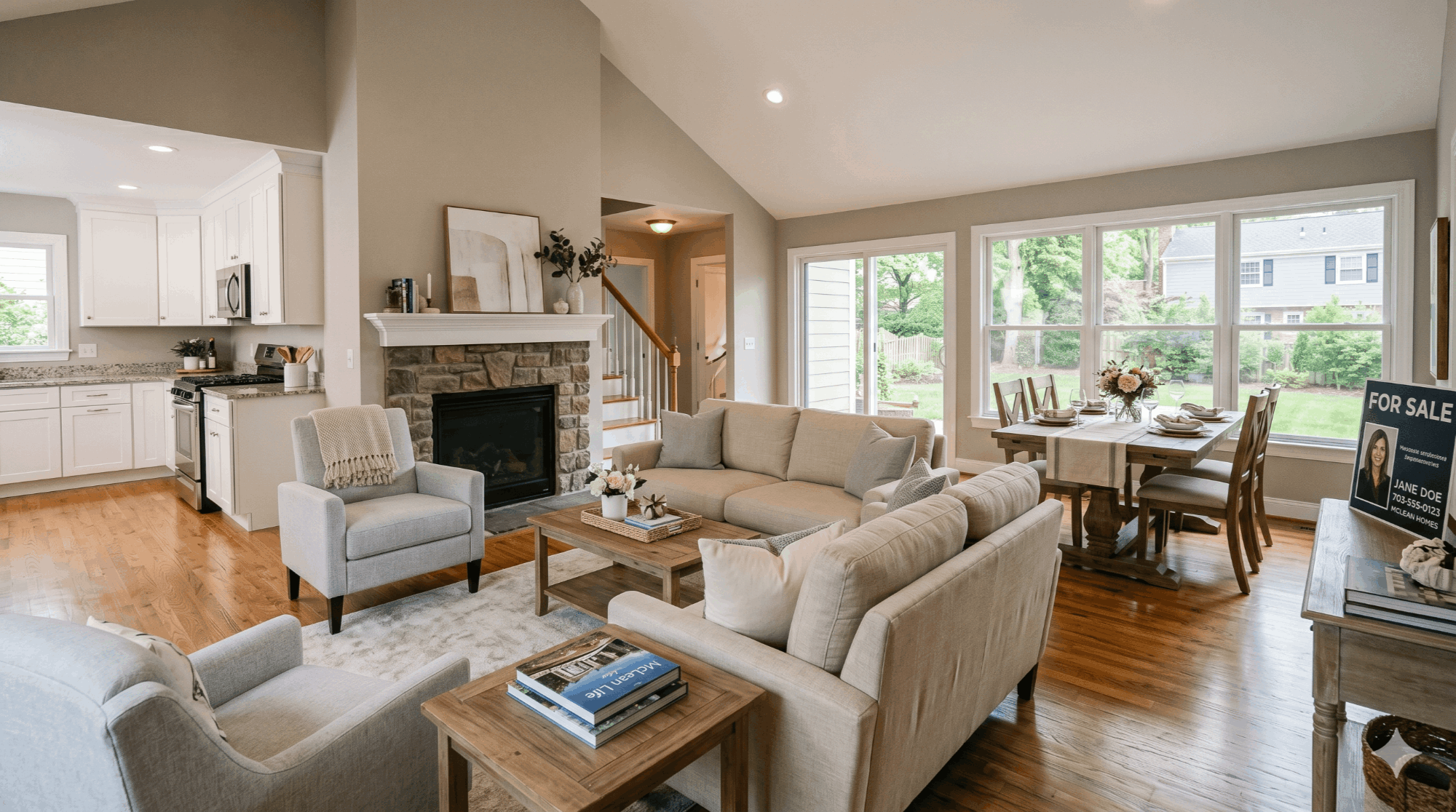
McLean is one of the most discerning real estate markets in Northern Virginia. Buyers walking into a home in 22101 or 22102 are usually choosing between your property and a fully renovated or new-construction comp two streets away. They're paying $1.5M, $2.5M, sometimes $4M+ — and at those price points, the bar for finish quality, functionality, and presentation is high. A scuffed wall, a tired kitchen, or a dated primary bath isn't a minor issue; it's a reason to write a lower offer or skip the home entirely.
This guide walks through exactly how to prepare a McLean home for sale — what to repair, what to leave alone, what to stage, and how to time it all. The goal isn't to renovate; it's to remove every reason a buyer could use to pay you less. Done right, pre-listing prep typically returns 3–5x its cost in higher final sale price and faster contract.
Key Takeaways
- McLean buyers compare your home directly to renovated and new-construction comps — surface presentation matters more here than in most NOVA markets.
- The highest-ROI prep moves are paint, lighting, professional staging, and a pre-listing inspection — not full kitchen or bath remodels.
- Plan on 4–6 weeks of prep before listing photos. Rushed prep almost always shows up in offer prices.
- Skip the projects buyers will redo anyway: don't replace cabinets, don't refinish floors that aren't badly worn, don't remodel a primary bath.
- A pre-listing inspection ($450–$700 in McLean) is the single best dollar you can spend to control the negotiation.
- Professional photography and 3D tour day is the deadline that drives every prep decision.
In This Guide
- Why McLean Buyers Are Different
- The McLean Market Reality in 2026
- Pre-Listing Inspection: The First Move
- Repairs That Actually Move the Needle
- Cosmetic Updates That Pay Off in McLean
- The Staging Equation: Vacant vs. Lived-In
- Room-by-Room Staging Priorities
- Curb Appeal: McLean's First-Impression Standard
- Your Net Proceeds Calculator
- The 4–6 Week Prep Timeline
- Common Mistakes McLean Sellers Make
- Frequently Asked Questions
- Glossary
Why McLean Buyers Are Different
The buyer pool in McLean skews toward executives, federal senior leadership, defense and tech principals, and high-income relocators from the Bay Area, New York, and Boston. They are sophisticated, time-pressured, and well-represented — most of them tour with experienced agents who have already shown them three or four other homes the same weekend. They make decisions quickly, and they make decisions visually.
What this means for you as a seller: the typical "we'll let buyers see past the wallpaper" approach that might work in a $500K market doesn't work here. McLean buyers don't see past anything. If a primary bath looks dated, they assume the whole home is a renovation project. If the kitchen has 1990s oak cabinets, they price the kitchen replacement into their offer — usually generously, because they assume the worst. Surface presentation in McLean isn't optional; it's a six-figure variable.
The good news: you don't need to renovate. You need to remove obvious deduction triggers and present the home well enough that buyers focus on the things that drive McLean prices — lot size, school pyramid, square footage, and floor plan flow.
The McLean Market Reality in 2026
McLean's 22101 and 22102 ZIP codes consistently rank among the most expensive in Virginia. The market splits sharply between three product types, and your prep strategy depends on which one your home falls into.
| Segment | Typical Price Range | Buyer Expectation | Prep Priority |
|---|---|---|---|
| Original 1960s–80s split-level / colonial | $1.0M – $1.6M | Move-in ready or known fixer | Paint, floors, kitchen refresh |
| Renovated mid-century / transitional | $1.6M – $3.0M | Designer finishes throughout | Staging, lighting, fine-detail repair |
| Custom new construction / luxury | $3.0M – $7M+ | Flawless presentation | Pro staging, cinematic media, white-glove detail |
Identify your segment honestly before you spend a dollar on prep. Trying to position a 1972 split-level as a luxury renovation by spending $80K on cosmetic upgrades almost never returns the investment. Trying to list a $2.5M renovated home without staging or professional photography almost always costs you more than staging would have. Match your prep to your tier.
Days on Market Reality
Well-prepped, accurately priced McLean homes typically go under contract in 14–35 days. Underprepared homes — even at the same list price — often sit 60+ days, then close $50K–$150K below original list after one or two price reductions. The dollar gap between "well-prepped" and "underprepared" in McLean is almost always larger than the cost of doing it right.
Get a personalized home valuation from The Jamil Brothers — street-level comps with adjustments for your floor plan, lot, school pyramid, and finish level. No automated estimates. Response within 24 hours.
Pre-Listing Inspection: The First Move
Before you spend a dime on staging or paint, hire a licensed home inspector for a full pre-listing inspection. In McLean, expect to pay $450–$700 for a single-family home inspection, with add-ons for radon ($150–$200), sewer scope ($250–$400), and chimney inspection ($150–$300) if applicable.
This is the single highest-leverage move in the entire prep process. Here's why: every buyer is going to inspect your home. Whatever the buyer's inspector finds will become a negotiation lever — typically a credit request 5–15x the actual repair cost. A pre-listing inspection lets you find those issues first, fix the genuine ones, and disclose the rest with proper context. You control the narrative instead of reacting to it under contract.
Pre-Listing Inspection Action List
- ✓ Schedule inspection 5–6 weeks before target listing date
- ✓ Add radon test (Virginia is a moderate-risk radon zone)
- ✓ Add sewer scope if home is 1985 or older
- ✓ Get HVAC service done — most buyers ask for service records
- ✓ Pull permits and disclose any open or expired ones early
- ✓ Document any item you choose not to repair (you'll disclose)
Repairs That Actually Move the Needle
Not every flagged item is worth fixing. Categorize your inspection findings into three tiers and act accordingly.
Tier 1 — Always Fix (Safety, Function, Visible)
These items will tank an offer or invite a credit request worth several times the repair cost. Fix them all.
| Issue | Typical McLean Fix Cost | Buyer Credit If Unfixed |
|---|---|---|
| Active roof leak | $800–$2,500 spot repair | $10K–$25K (full roof credit) |
| GFCI / electrical safety items | $150–$500 | $2K–$5K credit + delayed close |
| HVAC over 15 years old (working) | Service + tune ($200) | $8K–$15K replacement credit ask |
| Water staining on ceilings | $300–$800 (find source + paint) | $3K–$10K + buyer rescission risk |
| Visible mold or musty basement | $500–$2,500 remediation + dehumidifier | Often kills the deal entirely |
| Failed garage door springs / opener | $200–$650 | $1K–$2K credit |
Tier 2 — Fix If You Have the Budget
These won't kill a deal, but they'll show up in the inspection report and the buyer will use them. Worth fixing if your prep budget allows; otherwise, leave them alone and price accordingly.
Tier 2 Worth Considering
- ✓ Aging water heater (replace if 12+ years old, $1,800–$3,500 installed)
- ✓ Rotted wood trim, fascia, deck boards ($300–$2,500)
- ✓ Older windows with seal failure (replace 2–4 worst, not all)
- ✓ Failing caulk in showers, around tubs ($150 DIY)
- ✓ Cracked driveway / walkway sections ($400–$2,500)
Tier 3 — Don't Touch
These are the projects that almost never return their cost in McLean. The new owner will redo them anyway, and your taste will rarely match theirs. Disclose, price honestly, and skip.
- Full kitchen renovation (you'll spend $80K–$200K to recover $40K–$120K)
- Primary bath gut renovation (same math)
- Full hardwood floor replacement (refinishing is fine; replacement isn't)
- Replacing a working roof with 5+ years of life left
- Adding rooms or finishing a basement just for sale
- Custom built-ins or feature walls in personal styles
Cosmetic Updates That Pay Off in McLean
The four cosmetic categories below consistently return more than they cost in the McLean market. Spend here before anywhere else.
1. Paint — The Highest ROI Move
Whole-home interior paint runs $4,500–$9,000 in a typical McLean home (3,500–5,500 sq ft). The return is consistently 2–4x the cost. Stick to a neutral palette: warm white walls (Benjamin Moore "White Dove" or Sherwin-Williams "Alabaster"), soft greige in formal spaces, and clean white trim. Skip dramatic accent walls, dark colors, and any color the listing agent hesitates on. Buyers are not buying your taste; they're buying their own future taste, and only neutrals give them the imagination room.
2. Lighting — The Underrated ROI Move
Replace dated brass fixtures, fluorescent kitchen ceiling boxes, and any "boob light" flush mounts. Budget $2,500–$5,000 for a focused lighting refresh. Replacement bulbs should all be 2700K–3000K LED, every fixture in the house, no exceptions — mismatched bulb temperatures look amateur in photos and to buyers.
3. Floors
If you have hardwoods, refinish them ($4–$8 per sq ft) instead of replacing. If you have carpet older than 5 years or with visible wear, replace the worst rooms with new neutral carpet ($2,500–$6,000). Don't try to clean old carpet; buyers can tell. Tile floors that are dated (pink, peach, oak-toned 1990s) are usually best left alone — replacement isn't worth it.
4. Kitchen and Bath Refresh (Not Renovation)
Refresh, don't renovate. New cabinet hardware ($300–$800), refinished or repainted cabinet boxes if they're solid wood ($2,500–$5,500), updated faucets ($400–$1,200), and new lighting can transform a dated kitchen for under $10K. The same logic applies to baths: new mirrors, new lights, new faucets, fresh caulk, regrouting, and updated hardware.
Cosmetic ROI at a Glance
4K photography, drone video, 3D Matterport tours, professional staging consultation, expert negotiation, and full MLS marketing — all included at 1.5%. No hidden fees, no service reductions, no surprises. On a $1.7M McLean home, that's roughly $25,500 more equity in your pocket compared to a traditional 3% listing.
The Staging Equation: Vacant vs. Lived-In
Staging in McLean isn't optional at any price point above $1M. The question is which kind. The decision is usually made by occupancy status and furniture style.
| ✓ Pros | ✗ Cons |
|---|---|
| Full Vacant Stage: Clean luxury aesthetic, photographs perfectly, no buyer awkwardness | Full Vacant Stage: $4K–$12K cost, requires the home to be empty |
| Partial Stage (occupied): Lower cost ($1.5K–$4K), seller stays in home | Partial Stage (occupied): Limited by your existing furniture quality |
| Virtual Staging: Cheapest ($25–$75 per photo), good for vacant photos only | Virtual Staging: Buyers see empty rooms in person — disconnect risk |
| Stager Consultation Only: $200–$500 advice, you execute | Stager Consultation Only: Quality of execution depends on you |
For a vacant McLean home priced over $1.5M, a full professional stage of the main living spaces (foyer, living room, dining room, primary bedroom, family room) typically costs $5,500–$10,000 for an 8–12 week rental. The data on staged vs. unstaged luxury homes is consistent across NAR, RESA, and brokerage studies: staged homes sell faster and closer to list price. In a price segment where a $50K shift in offer is normal, a $7,000 staging cost is a rounding error with extraordinary return.
Room-by-Room Staging Priorities
Not every room earns equal weight in a buyer's decision. Stage in this order if you have to triage.
Priority 1 — Kitchen, Foyer, Primary Bedroom
These three rooms drive the majority of buyer impressions. The kitchen is the single most-photographed and most-discussed room in any home; the foyer is the first impression; the primary bedroom is where buyers picture their actual life. Polish these spaces to magazine-ready before anything else. Clear all small appliances from kitchen counters except a single styled vignette (a wood cutting board, a bowl of citrus, an espresso machine). Foyer should have one piece of art, one console, fresh flowers, no shoes. Primary bedroom: hotel-grade linens, two nightstands, two lamps, soft throw, no clutter on dressers.
Priority 2 — Living Room, Dining Room, Primary Bath
These rooms cement the impression. Living room: one focal seating arrangement, edited bookshelves, no oversized personal photos. Dining room: set table with neutral place settings; remove kid art and personal mail. Primary bath: new towels (white or soft grey), new bath mat, candle, plant, all personal items off counters.
Priority 3 — Secondary Bedrooms, Hallways, Office
Buyers spend less time here, but they'll notice empty echoey rooms. Stage at minimum: bed, two nightstands, lamps, art. Office should be tidy and sparse — no file stacks, no exposed cables, one computer setup, books on shelves edited to spines facing out.
Priority 4 — Basement, Garage, Storage
Often skipped, but McLean buyers walking through unfinished basements and packed garages do downgrade their impression of the entire house. Even token staging — a single seating area in a basement, a clean garage with shelves and a single car in place — moves the needle.
Universal Staging Rules
- ✓ Remove every family photo. Every single one.
- ✓ Pack 50% of your closet contents — buyers open every closet
- ✓ Hide all wires, chargers, and cables
- ✓ Pet beds, bowls, and litter boxes — out for every showing
- ✓ Remove religious or political items entirely
- ✓ Fresh flowers in foyer and kitchen for photo day
- ✓ All lights on, blinds open, fans off for photos and showings
Curb Appeal: McLean's First-Impression Standard
McLean buyers drive past the house before they ever schedule a tour. Many decide whether to write an offer in the first 90 seconds of arrival. Curb appeal carries disproportionate weight here.
Curb Appeal Checklist
- ✓ Power-wash siding, walkways, and driveway ($300–$700)
- ✓ Repaint or refinish front door — single highest-ROI exterior item
- ✓ Replace dated brass house numbers and porch lights
- ✓ Fresh mulch in all beds ($400–$900 installed)
- ✓ Trim shrubs, edge beds, prune trees touching the house
- ✓ Lawn service: dethatch, fertilize, overseed if listing in shoulder seasons
- ✓ New welcome mat, two large potted plants flanking entry
- ✓ Hide trash bins, hose reels, and any visible utility equipment
Your Net Proceeds Calculator
Once you've made your prep budget decisions, you'll want to know what you're actually walking away with. The single biggest controllable line item on your closing statement is your listing-side commission. Use the calculator below to compare a traditional 3% listing fee to The Jamil Brothers' 1.5% full-service listing fee at your home's expected sale price.
Seller Savings Calculator
How much more do you keep with our 1.5% listing fee?
Select your home's estimated value to see your real net proceeds — side by side. McLean homes typically fall in the $1M+ range.
Traditional Agent — 3%
| Sale price | $400,000 |
| Listing fee (3%) | −$12,000 |
| Buyer's agent (2.5%) | −$10,000 |
| Est. closing (1%) | −$4,000 |
| Net Proceeds | $374,000 |
Our Fee — Only 1.5%
| Sale price | $400,000 |
| Listing fee (1.5%) | −$6,000 |
| Buyer's agent (2.5%) | −$10,000 |
| Est. closing (1%) | −$4,000 |
| Net Proceeds | $380,000 |
Extra in your pocket
$6,000
vs. a traditional 3% listing agent — with zero reduction in service or marketing.
Traditional Agent — 3%
| Sale price | $500,000 |
| Listing fee (3%) | −$15,000 |
| Buyer's agent (2.5%) | −$12,500 |
| Est. closing (1%) | −$5,000 |
| Net Proceeds | $467,500 |
Our Fee — Only 1.5%
| Sale price | $500,000 |
| Listing fee (1.5%) | −$7,500 |
| Buyer's agent (2.5%) | −$12,500 |
| Est. closing (1%) | −$5,000 |
| Net Proceeds | $475,000 |
Extra in your pocket
$7,500
vs. a traditional 3% listing agent — with zero reduction in service or marketing.
Traditional Agent — 3%
| Sale price | $600,000 |
| Listing fee (3%) | −$18,000 |
| Buyer's agent (2.5%) | −$15,000 |
| Est. closing (1%) | −$6,000 |
| Net Proceeds | $561,000 |
Our Fee — Only 1.5%
| Sale price | $600,000 |
| Listing fee (1.5%) | −$9,000 |
| Buyer's agent (2.5%) | −$15,000 |
| Est. closing (1%) | −$6,000 |
| Net Proceeds | $570,000 |
Extra in your pocket
$9,000
vs. a traditional 3% listing agent — with zero reduction in service or marketing.
Traditional Agent — 3%
| Sale price | $750,000 |
| Listing fee (3%) | −$22,500 |
| Buyer's agent (2.5%) | −$18,750 |
| Est. closing (1%) | −$7,500 |
| Net Proceeds | $701,250 |
Our Fee — Only 1.5%
| Sale price | $750,000 |
| Listing fee (1.5%) | −$11,250 |
| Buyer's agent (2.5%) | −$18,750 |
| Est. closing (1%) | −$7,500 |
| Net Proceeds | $712,500 |
Extra in your pocket
$11,250
vs. a traditional 3% listing agent — with zero reduction in service or marketing.
Traditional Agent — 3%
| Sale price | $1,000,000 |
| Listing fee (3%) | −$30,000 |
| Buyer's agent (2.5%) | −$25,000 |
| Est. closing (1%) | −$10,000 |
| Net Proceeds | $935,000 |
Our Fee — Only 1.5%
| Sale price | $1,000,000 |
| Listing fee (1.5%) | −$15,000 |
| Buyer's agent (2.5%) | −$25,000 |
| Est. closing (1%) | −$10,000 |
| Net Proceeds | $950,000 |
Extra in your pocket
$15,000
vs. a traditional 3% listing agent — with zero reduction in service or marketing. Most McLean homes sell well above $1M, where savings often exceed $25,000.
Estimates only. Closing costs vary. Buyer's agent commission is negotiable post-NAR settlement.
Our seller net sheet calculator breaks down every cost — commission, Virginia grantor tax, NOVA congestion tax, HOA transfer fees, settlement charges — so you know your real bottom line before you list. Built specifically for Northern Virginia sellers.
The 4–6 Week Prep Timeline
Use this schedule as your default. Move faster only if absolutely necessary — rushed prep almost always costs more in offer reductions than the time would have cost in carrying the property.
Listing Strategy & Pre-Listing Inspection — Week 1
Interview agents, sign listing agreement, schedule pre-listing inspection plus radon and (if applicable) sewer scope. Review CMA and target list price. Identify your tier and your prep budget.
Triage Repairs & Schedule Trades — Week 2
Tier 1 repairs go on contractor calendars now — electrical, plumbing, roofing, HVAC service. Order paint colors, schedule painters, line up flooring contractor. Begin decluttering and packing 30%+ of belongings.
Cosmetic Refresh — Weeks 3–4
Painters in. Floors refinished. Lighting installed. Cabinet hardware swapped. Front door painted. Repairs completed. Final declutter pass. Schedule professional cleaning for end of week 4.
Staging Install & Curb Appeal — Week 5
Stager delivers and installs. Landscaping done — fresh mulch, edging, trim. Power-wash exterior. Install new house numbers and porch lights if needed. Pre-photo walkthrough.
Photography & Media — Week 5 or early Week 6
Professional photography, drone, 3D Matterport tour, and floor plan all in a single day. All bulbs on. All blinds open. Fresh flowers in foyer and kitchen. Pets and personal items completely out.
Listing Goes Live — Week 6
MLS goes active Thursday morning. Open house Saturday and Sunday. Showings start immediately. Reviewable offer deadline if pricing strategy calls for it.
Common Mistakes McLean Sellers Make
The mistakes below cost McLean sellers tens of thousands every year. None of them are obvious in the moment.
⚠️ Top 7 Costly Mistakes
1. Listing before prep is fully complete to "test the market" — the first 14 days are your highest-traffic period and you can't get them back. 2. Skipping the pre-listing inspection to "save money" — virtually always costs 5–15x what the inspection would have. 3. Doing a full kitchen renovation specifically for sale — almost never returns its cost in McLean. 4. Using your own iPhone photos or a low-budget photographer — McLean buyers compare photo quality across listings, and weak photos get filtered out before tours. 5. Leaving family photos up — the single most consistent staging mistake. 6. Pricing aspirationally at $200K+ over comps to "leave negotiation room" — this kills first-week traffic and forces price reductions. 7. Refusing to leave the home for showings — buyers won't relax with sellers present and won't write their best offer.
Frequently Asked Questions
How long does it take to prepare a McLean home for sale?
A standard McLean prep timeline runs 4–6 weeks from listing agreement to live MLS. Roughly: week 1 for inspection and strategy, weeks 2–3 for repairs and contractor work, weeks 3–4 for paint and cosmetic refresh, week 5 for staging and curb appeal, and week 5 or 6 for professional photography. Homes that skip this prep window almost always sell for less or sit longer, costing more in carrying costs than the prep would have cost.
How much should I budget to prepare a McLean home for sale?
For a typical 4,000-square-foot McLean home priced between $1.5M and $2.5M, a reasonable prep budget is $20,000–$40,000. That covers a pre-listing inspection, full interior paint, lighting refresh, hardwood refinish, kitchen and bath cosmetic refresh (no full renovation), professional staging for 8–12 weeks, professional photography and 3D tour, plus targeted curb appeal work. Sellers in the new-construction tier ($3M+) typically spend $40,000–$80,000 because the buyer expectation is higher.
Should I renovate my kitchen before selling in McLean?
Almost never. A full kitchen renovation in McLean costs $80,000–$200,000 and typically returns 50–70 cents on the dollar. The exception is if your kitchen has a functional issue (broken appliances, layout that blocks resale, water damage). What does work is a refresh: new hardware, cabinet repaint or refinish, updated faucets, lighting, and minor backsplash refresh — usually under $10,000 and consistently positive ROI.
Is staging really worth it for a McLean home?
Yes. Staging in McLean consistently returns 3–4x its cost. For a vacant home, professional staging of the main living areas runs $5,500–$10,000 for an 8–12 week rental period. McLean buyers comparing your home to renovated comps need to see beautifully presented spaces in listing photos and during tours, or they'll mentally discount your home against the competition. The tradeoff is straightforward: $7,000 in staging is a small price for $30,000–$50,000 in higher final offers.
What's the single highest-ROI repair before listing?
A full interior paint refresh in neutral colors. Whole-home paint in a typical McLean home runs $4,500–$9,000 and consistently returns 3–4x its cost in higher offers. Paint dramatically affects how a home reads in photos, on tours, and in buyer memory. Combined with new neutral carpet in worn rooms and refinished hardwoods, paint is the foundation of every successful luxury prep.
Should I do a pre-listing inspection in McLean?
Yes — almost without exception. A pre-listing inspection costs $450–$700 in McLean and lets you find issues before the buyer's inspector does. You can either fix the genuine problems before listing or disclose them with proper context, which typically saves 5–15x the inspection cost in avoided buyer credit requests during the post-contract inspection contingency. The pre-listing inspection is the highest-leverage dollar in the entire prep process.
What repairs should I skip and just disclose?
Skip full kitchen and bath renovations, full hardwood floor replacement (refinishing is fine), full window replacement (replace 2–4 worst rather than all), and any major renovation specifically done for resale. Tile floors that are dated but functional are usually best left alone. The new owner will redo these projects in their own taste anyway, and your spend almost never returns its cost. Disclose conditions honestly, price accordingly, and put your prep budget into paint, lighting, staging, and curb appeal instead.
How does the post-NAR settlement affect McLean sellers?
Since the August 2024 NAR settlement, buyer's agent compensation is no longer embedded in the listing commission and is separately negotiable. Most McLean sellers still offer a buyer's-agent compensation (typically 2.5%) because it remains the most effective way to attract the broadest qualified buyer pool, but the structure is now explicit and contractually negotiated. This is a procedural change in how commissions are documented, not a change in the typical economics of selling a home.
How do I choose a listing agent for a McLean home?
Evaluate three things in this order: (1) recent local sales — has the agent closed homes in your specific McLean ZIP code at your price point in the last 12 months; (2) marketing investment — do they include professional photography, drone, 3D Matterport, and full MLS syndication as standard, or is it a paid add-on; (3) commission structure — are you paying a competitive listing-side fee. The Jamil Brothers Realty Group is one of the McLean teams offering a 1.5% full-service listing fee that includes professional photography, drone video, 3D tours, expert negotiation, and full marketing — with no service reductions.
Are there any HOA considerations specific to McLean?
Many McLean neighborhoods are not in HOAs, but several established communities have them — most notably Country Club Manor, McLean Hamlet, and clusters near Tysons. If your home is in an HOA, expect HOA transfer fees ($200–$700), document delivery fees ($150–$500), and a Virginia Property Owners' Association Act 3-day buyer review period. Order resale documents and pay-off statements early in the prep timeline; delays here can push your closing date by a week or more.
When is the best time to list a McLean home?
McLean's strongest seasonal window is March through early June, when school-driven relocation buyers are most active and inventory typically prices best. September through mid-October is the second-strongest window. Listing in November–December or January is typically slower but can still work for unique homes or motivated buyer pools. The wrong question is "what month should I list" — the right question is "when will my home be fully prepped and ready to compete." A perfectly prepped February listing outperforms an underprepared April listing every time.
What if I need to sell my McLean home fast and skip the prep?
If timing is non-negotiable — relocation, divorce, estate, financial pressure — skip the staging and cosmetic refresh, but still complete the pre-listing inspection and Tier 1 repairs. Then choose between a discounted-price MLS listing or a vetted cash offer. Cash offers in McLean typically come in at 80–88% of as-is market value, which can be the right tradeoff when speed and certainty matter more than maximum price. We walk McLean sellers through both paths so the decision is informed.
If timing, condition, or certainty matters more than maximum price, a cash offer may be the right fit. We'll walk you through your full range of options — traditional listing, cash offer, and hybrid paths — with no pressure and full transparency.
Glossary
Pre-Listing Inspection
A licensed home inspector's full evaluation of the home, paid for by the seller before listing. Used to identify and address issues proactively rather than reacting to a buyer's inspection during the contract period.
Pre-Listing Disclosure
Sellers in Virginia are required to provide buyers with disclosures about known material defects under the Residential Property Disclosure Act. Pre-listing inspection findings often inform what's disclosed.
Professional Staging
A licensed stager rents and arranges furniture, art, and accessories in the home to maximize photo and showing appeal. Typically priced as a one-time install fee plus monthly furniture rental.
3D Matterport Tour
A walkable, dollhouse-view virtual tour created by a specialized camera. Allows out-of-area buyers to "walk through" the home from anywhere — standard in McLean luxury listings.
Buyer Credit (Repair Credit)
A dollar amount the seller agrees to credit the buyer at closing in lieu of completing repairs. Credits are typically requested after the buyer's home inspection during the contingency period.
Days on Market (DOM)
The number of days a property has been actively listed on MLS. Higher DOM signals to buyers that the home is overpriced or has issues, often triggering lower offers.
List-to-Sale Ratio
The percentage of original list price the home actually sells for. A 100% ratio means full price; under 95% suggests the home was overpriced or underprepped at launch.
Virginia Grantor Tax
A state-level transfer tax paid by the seller in Virginia, calculated at $1 per $1,000 of sale price, plus an additional regional congestion tax in Northern Virginia jurisdictions including Fairfax County.
Conclusion: Prep Like a McLean Pro
Preparing a McLean home for sale isn't about doing everything — it's about doing the right things in the right order. Pre-listing inspection first. Tier 1 repairs always. Paint, lighting, staging, curb appeal next. Skip the renovations buyers will redo anyway. Hit your photography day with the home presented at its absolute best, and the rest of the sale process becomes easier — fewer concessions, shorter days on market, stronger final offers.
The Jamil Brothers Realty Group works with McLean sellers across all three tiers — from original mid-century homes to luxury new construction — and walks through the prep decisions specific to your home, your timeline, and your target sale price. The 1.5% full-service listing fee includes professional photography, drone video, 3D Matterport tours, expert negotiation, MLS syndication, and a staging consultation as part of the program — not as an upcharge.
Know your equity, understand your costs, and see exactly what you'll walk away with — before you make any decisions. The Jamil Brothers provide a full McLean seller consultation at no cost or obligation. Local data, real comps, transparent numbers.
Explore More Seller Guides
McLean Vienna Fairfax Reston Alexandria 1.5% Listing Program Seller Net Sheet Free Home Valuation Cash Offer Options Search NOVA HomesExplore More
Browse Every Corner of the DMV Market
Whether you're searching by budget, neighborhood, or buying situation — find exactly what you need below.
Virginia Homes by Budget
Washington DC Homes by Budget
Maryland Homes
Explore Northern Virginia Communities
Loudoun County
Fairfax County & Surrounding
Ready to Make a Move?
Full-Service · No Tradeoffs
List for 1.5% & Keep More Equity
Professional photography, drone video, 3D tours, and expert negotiation — all included. On an $800K home, that's $12,000 more in your pocket vs. a 3% agent.
See the 1.5% Program →Need Speed or Certainty?
Get a No-Obligation Cash Offer
Skip the showings, skip the contingencies. If timing or condition matters more than top dollar, a cash offer may be the right fit. We'll walk you through every option.
Explore Cash Offers →Categories
- All Blogs (1138)
- Aldie (3)
- Ashburn (6)
- Buyer Guide (8)
- Buying a home (2)
- Buying Strategies (28)
- festivals (1)
- General Blog (66)
- Leesburg (5)
- Market Intelligence (29)
- Market Updates (8)
- Notable Properties For Sale (29)
- Real Estate Tips, News, and More (376)
- Seller Guide (2)
- Seller Guides (60)
- Selling Your Home (450)
- Sterling (6)
- Top Realtors in Northern Virginia (57)
Recent Posts





Message Sent!
Thank you for reaching out. Arslan & Saad have received your details and will be in touch shortly.
Need immediate assistance? Call or text 703-782-4830.