
How to Sell and Buy a Home at the Same Time in Vienna, VA: The 2026 Strategy Guide
How to Sell and Buy a Home at the Same Time in Vienna, VA: The 2026 Strategy Guide

Quick Answer: To sell and buy a home at the same time in Vienna, VA, you'll choose between three strategies — sell first and rent or stay short-term, buy first using bridge financing or a HELOC, or coordinate a simultaneous closing. In Vienna's high-end market (median sale price around $1.25M in early 2026), most homeowners with strong equity opt for a buy-first strategy with bridge financing or a contingent offer, while equity-light owners typically sell first to access proceeds for the new down payment.
Key Takeaways
- Vienna's median sale price hovers around $1.25M in early 2026, with average days on market at roughly 18 days for well-priced homes — fast enough to coordinate a same-time transaction.
- Three core strategies exist: sell first (lowest financial risk), buy first (best lifestyle continuity, requires bridge or HELOC), or simultaneous closing (most complex, highest reward).
- Bridge loans in the DMV typically run 8–11% annual interest with 6–12 month terms; home equity lines (HELOCs) are usually cheaper but slower to underwrite.
- A contingent offer ("home sale contingency") works in slower micro-markets but is often rejected outright in tight Vienna sub-markets like Hunters Branch or Vienna Woods.
- Closing both transactions on the same day requires precise coordination — your listing agent, buyer agent, lender, and both title companies must operate as one team.
- Listing your Vienna home for 1.5% with The Jamil Brothers instead of 3% can free up $15,000+ in additional equity on a $1M home — equity that goes straight into your next down payment.
In This Guide
- Vienna Market Snapshot — Early 2026
- The Three Core Strategies (and Who Each Fits)
- Strategy 1: Sell First, Then Buy
- Strategy 2: Buy First, Then Sell
- Strategy 3: The Simultaneous Closing
- Bridge Loans, HELOCs & Other Financing Tools
- Contingent Offers in Vienna's 2026 Market
- Step-by-Step Timeline (90-Day Plan)
- Vienna Seller Savings Calculator
- Vienna-Specific Considerations
- Common Pitfalls and How to Avoid Them
- Frequently Asked Questions
- Glossary
Selling and buying a home at the same time is one of the most stressful real estate moves you can make — and in a market like Vienna, where median prices crossed $1.2M in 2025 and continue to climb, the financial stakes are unusually high. Coordinate it well and you transition cleanly with minimal cost or disruption. Coordinate it poorly and you can end up paying two mortgages, scrambling for a rental, or losing your dream home because financing fell through.
This guide walks through every strategy that works for Vienna sellers in 2026 — including the bridge financing landscape, contingent offer dynamics in NOVA's tight inventory, and the precise sequence that lets you close on both homes the same day. You'll also see exactly how the listing fee you choose affects the equity you have available for your next down payment.
The Jamil Brothers Realty Group has guided 840+ DMV homeowners through transitions like this — most often Vienna and McLean move-up buyers shifting to larger homes, and empty-nesters downsizing to a single-level home in Reston or Oakton. The same playbook works whether you're staying inside Vienna or relocating elsewhere in Northern Virginia.
Vienna Market Snapshot — Early 2026
Before choosing a sell-and-buy strategy, you need to know what kind of market you're operating in. Vienna behaves differently than the broader Fairfax County market — inventory is tighter, price points are higher, and the buyer pool is more financially qualified.
| Metric | Vienna 22180 / 22181 / 22182 | What It Means for You |
|---|---|---|
| Median sale price | ~$1.25M | Equity-rich sellers can typically self-fund a bridge gap. |
| Average days on market | 15–22 days (well-priced) | Selling first carries less timing risk than in slower markets. |
| List-to-sale ratio | 99–101% | Pricing accurately = predictable timing. |
| Active inventory (single-family) | ~25–40 active listings | Buy-side competition stays fierce; contingent offers struggle. |
| Months of supply | ~1.0–1.5 months | Strong seller's market — your existing home will move quickly. |
| Buyer profile | Federal contractors, tech executives, dual-income professionals | Buyers can perform quickly with strong financing. |
Figures reflect BrightMLS data trends for Vienna, VA through Q1 2026. Speak with a local listing agent for current week numbers.
The takeaway: Vienna in 2026 is a fast, predictable market for well-priced single-family homes. That predictability is what makes simultaneous transactions feasible here — you can plan a 30–45 day sale window with reasonable confidence and structure your purchase contract around it.
The Three Core Strategies (and Who Each Fits)
There is no universally "best" approach — the right strategy depends on your equity position, cash reserves, risk tolerance, and how much disruption you can absorb. Here's how the three options compare on the variables that matter most.
Risk and complexity at a glance
Lifestyle disruption (moves, temporary housing)
| Strategy | Best For | Avoid If |
|---|---|---|
| Sell first | Equity-light owners; first-time move-up buyers; anyone uncomfortable carrying two mortgages. | You can't relocate temporarily, school timing is rigid, or you have pets/kids that make a transition rental painful. |
| Buy first | Equity-rich Vienna owners (often 50%+ equity); established income; prefer one move; want the dream home now. | Your debt-to-income ratio can't carry both mortgages or your equity is locked in retirement accounts. |
| Simultaneous closing | Confident sellers with skilled agents; flexible move dates; seasoned title and lender team. | Either party in either deal is rigid on dates or terms. One delay cascades into both transactions. |
Get a personalized home valuation from The Jamil Brothers — street-level Vienna comps, not automated estimates. We'll factor in your specific block, school pyramid, and recent comparable sales. Response within 24 hours.
Strategy 1: Sell First, Then Buy
This is the safest path financially. You sell your current Vienna home, take the proceeds to the bank, and then shop for your next home with cash equity in hand. The catch: between closings, you need somewhere to live.
How it works in practice
Most Vienna sellers using this strategy negotiate a rent-back agreement (also called a "post-occupancy" or "use and occupancy" agreement) with their buyer. The buyer takes ownership at closing but lets you stay in the home for 30, 60, or sometimes 90 days while you finalize your next purchase. In Vienna, where buyers are often relocating from out of state and not in a rush to move in, rent-backs are common and often free or near-cost.
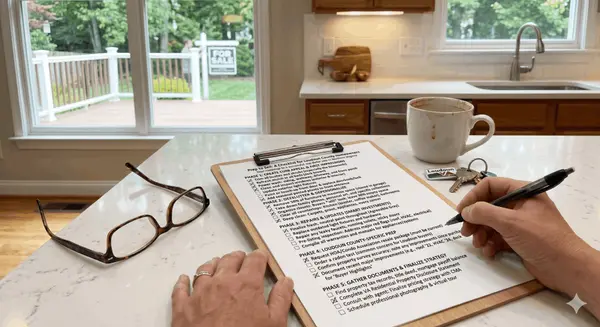
Sell-first execution checklist
- List your Vienna home with accurate, market-aligned pricing (target 18–22 days to ratified contract).
- Negotiate a 30–60 day rent-back at closing — typically priced at the buyer's daily PITI (principal, interest, taxes, insurance).
- Get pre-approved for your next mortgage during the listing process, not after — this saves 7–10 days.
- Shop your next home actively in the final 2 weeks of escrow.
- Have a backup short-term rental option (extended-stay, Airbnb, family) in case timing slips.
- Keep your earnest money deposit liquid for the next purchase contract.
Pros and cons
| ✓ Pros | ✗ Cons |
|---|---|
| No risk of two mortgages overlapping. | You may need two moves — one to interim housing, one to your new home. |
| You shop for the next home with full down payment in cash. | Rising prices in your target area can mean buying at a higher cost. |
| Your offers are non-contingent — sellers prefer them. | Pressure to find a home quickly can lead to compromises. |
| Maximum financial clarity — you know exactly what you can afford. | Storage and temporary housing costs ($3K–$8K typical for a 60-day gap). |
Strategy 2: Buy First, Then Sell
This strategy gives you maximum lifestyle continuity — you buy the next home, move in on your timeline, and then list and sell your Vienna home from a position of calm rather than urgency. It requires either strong income to qualify for both mortgages, significant liquid assets, or a financing tool like a bridge loan or HELOC.
Three financing paths to "buy first"
| Path | How It Works | Typical Cost |
|---|---|---|
| Bridge loan | Short-term loan (6–12 months) secured by your current home; pays your new home down payment. | 8–11% APR + 1–2 origination points; payoff at sale. |
| HELOC | Revolving credit line on your current home equity; borrow only what you need. | Prime + 0.5% to 2% (variable); interest only during the gap. |
| Two mortgages (qualifying) | Carry both loans until your home sells; lender qualifies you on both PITI payments. | Standard 30-year mortgage rates; requires strong DTI ratio. |
ℹ️ HELOC vs Bridge Loan in Vienna
For most Vienna sellers, a HELOC is the cheaper, more flexible option if you set it up before listing your home. Banks typically won't open a new HELOC once your home is actively listed. Plan ahead — apply for a HELOC 60–90 days before you list.
When buy-first makes sense in Vienna
You're a strong candidate for buy-first if…
- You have at least 40–50% equity in your current Vienna home.
- Your DTI ratio supports two mortgages temporarily, or you have liquid reserves to cover 6 months of dual carrying costs.
- You've identified a specific home or specific neighborhood (Hunters Branch, Tysons, McLean, Oakton) where opportunities are limited.
- School timing makes a transition rental impractical (especially mid-year).
- You're comfortable absorbing 6–12 months of bridge interest if your home takes longer to sell than expected.
Strategy 3: The Simultaneous Closing
This is the move that buyers and sellers fantasize about — close on your sale in the morning, drive across town, and close on your purchase in the afternoon. The proceeds from your sale fund the down payment on your purchase. No bridge loan, no rent-back, no temporary housing. When it works, it's elegant. When it breaks, it can be catastrophic.
What has to align for a simultaneous closing
The non-negotiables
- Both contracts must close within hours of each other (typically same day, 9–10 AM and 1–2 PM).
- Your sale's title company must be willing to wire funds rapidly to your purchase escrow.
- Your purchase lender must be ready to fund without contingency, knowing the down payment is in motion.
- The buyer of your home must be cooperative on timing — and crucially, must not need a rent-back from you.
- Both transactions need contingency-free contracts at the same point in their respective timelines.
The hidden challenges most agents won't mention
Most failed simultaneous closings break on one of three issues: (1) the buyer of your home requests a final walk-through extension that pushes funding past your purchase deadline; (2) the seller of your new home insists on getting moved out by closing, which conflicts with their own moving timeline; or (3) wire transfer cutoffs at one of the title companies don't align with the funding window for the second transaction.
An experienced listing team builds in 48 hours of buffer between the two closings — not the same day — and arranges interim financing or a single-night stay to bridge any small slippage. That's how Vienna simultaneous closings actually work in practice.
Our seller net sheet calculator breaks down every cost — listing commission, Virginia grantor tax, NOVA congestion tax, settlement fees — so you know your real bottom line and how much down payment you have for the next home.
Bridge Loans, HELOCs & Other Financing Tools
Understanding the financing toolkit is the difference between feeling confident and feeling cornered. Here's how the four main options compare in 2026 lending conditions for Vienna homeowners.
| Tool | Approval Time | Typical Rate (2026) | Best Use Case |
|---|---|---|---|
| Bridge loan | 2–3 weeks | 8–11% + points | Quick close on next home; HELOC not pre-arranged. |
| HELOC | 3–6 weeks | Prime + 0.5–2% | Pre-planned move; long-term flexibility. |
| Cash-out refinance | 4–6 weeks | Standard 30-yr rates | Permanent debt restructure (rare for sell-and-buy). |
| Portfolio loan / asset-based | 1–4 weeks | Varies, often 7–10% | High-net-worth buyers borrowing against investment accounts. |
For most Vienna sellers, the practical sequence is: pre-arrange a HELOC on your current home before you list, use it for your next down payment, then pay it off in full when your home sells. Total interest cost over a 60-day gap on a $400,000 HELOC draw is usually under $5,000 — far less than the cost of a forced rental and double move.
Contingent Offers in Vienna's 2026 Market
A "home sale contingency" lets you make an offer on a new home conditional on selling your current home. In a buyer's market, sellers accept these regularly. In Vienna's 2026 market — with months of supply under 1.5 — they almost always lose to non-contingent offers.
⚠️ Realistic Expectations
In Vienna's tightest sub-markets — Hunters Branch, Vienna Woods, Country Club Manor — contingent offers are typically rejected within 24 hours, even at full asking price. Don't plan around them. Use bridge financing or sell first.
When a contingent offer can still work
Contingent offers occasionally work in Vienna when: the home has been listed 30+ days (signaling weakness), the seller is also moving and has flexible timing, the listing is in a slower micro-market like a townhouse community with multiple competing units, or the buyer offers strong terms elsewhere (cash escalation, fast inspection, no appraisal contingency). Even then, expect to pay 1–3% over comparable non-contingent winning bids.
Step-by-Step Timeline (90-Day Plan)
Here's the sequence that works for most Vienna move-up sellers using a sell-first or simultaneous strategy. Buy-first timelines are similar but compressed once you find your next home.
Days 1–7 — Strategy and Pre-Approval
Meet with your listing agent and lender simultaneously. Run a home valuation, build a preliminary net sheet, get pre-approved for your next mortgage at the highest reasonable purchase price. Decide on strategy: sell first, buy first, or simultaneous.
Days 7–21 — Prep, Stage, and Photograph
Decluttering, minor repairs, deep clean, professional photography, drone, 3D tour. Pre-listing inspection is optional but useful in Vienna — a clean inspection report can be a marketing asset for premium homes.
Days 21–28 — List and Market
Coming Soon period (3–5 days), then live on BrightMLS Thursday morning. Open house Saturday. Ratify a contract within 14–18 days at full or above-list price in most Vienna situations.
Days 28–60 — Buy Side Becomes Active
Once your sale is under contract and past the inspection contingency (typically days 32–35), shift focus to making offers on your next home. Now you can offer non-contingent terms backed by your ratified sale.
Days 60–90 — Closings and Move
Close on your Vienna home, transition via rent-back or short-term housing, then close on your new home. With careful coordination, both closings can fall within the same 7-day window.
Vienna Seller Savings Calculator
The listing fee you choose directly affects how much equity is available for your next down payment. Vienna homes routinely sell in the $750K–$2M+ range — every percentage point of commission matters. Use the calculator below to see exactly what you'd net at common Vienna price points, comparing a traditional 3% listing agent against The Jamil Brothers' 1.5% full-service program.
Seller Savings Calculator — Vienna, VA
How much more do you keep with our 1.5% listing fee?
Select your home's estimated value to see your real net proceeds — side by side. Vienna defaults to $1M based on local pricing.
Traditional Agent — 3%
| Sale price | $400,000 |
| Listing fee (3%) | −$12,000 |
| Buyer's agent (2.5%) | −$10,000 |
| Est. closing (1%) | −$4,000 |
| Net Proceeds | $374,000 |
Our Fee — Only 1.5%
| Sale price | $400,000 |
| Listing fee (1.5%) | −$6,000 |
| Buyer's agent (2.5%) | −$10,000 |
| Est. closing (1%) | −$4,000 |
| Net Proceeds | $380,000 |
Extra in your pocket
$6,000vs. a traditional 3% listing agent — with zero reduction in service or marketing.
Traditional Agent — 3%
| Sale price | $500,000 |
| Listing fee (3%) | −$15,000 |
| Buyer's agent (2.5%) | −$12,500 |
| Est. closing (1%) | −$5,000 |
| Net Proceeds | $467,500 |
Our Fee — Only 1.5%
| Sale price | $500,000 |
| Listing fee (1.5%) | −$7,500 |
| Buyer's agent (2.5%) | −$12,500 |
| Est. closing (1%) | −$5,000 |
| Net Proceeds | $475,000 |
Extra in your pocket
$7,500vs. a traditional 3% listing agent — with zero reduction in service or marketing.
Traditional Agent — 3%
| Sale price | $600,000 |
| Listing fee (3%) | −$18,000 |
| Buyer's agent (2.5%) | −$15,000 |
| Est. closing (1%) | −$6,000 |
| Net Proceeds | $561,000 |
Our Fee — Only 1.5%
| Sale price | $600,000 |
| Listing fee (1.5%) | −$9,000 |
| Buyer's agent (2.5%) | −$15,000 |
| Est. closing (1%) | −$6,000 |
| Net Proceeds | $570,000 |
Extra in your pocket
$9,000vs. a traditional 3% listing agent — with zero reduction in service or marketing.
Traditional Agent — 3%
| Sale price | $750,000 |
| Listing fee (3%) | −$22,500 |
| Buyer's agent (2.5%) | −$18,750 |
| Est. closing (1%) | −$7,500 |
| Net Proceeds | $701,250 |
Our Fee — Only 1.5%
| Sale price | $750,000 |
| Listing fee (1.5%) | −$11,250 |
| Buyer's agent (2.5%) | −$18,750 |
| Est. closing (1%) | −$7,500 |
| Net Proceeds | $712,500 |
Extra in your pocket
$11,250vs. a traditional 3% listing agent — with zero reduction in service or marketing.
Traditional Agent — 3%
| Sale price | $1,000,000 |
| Listing fee (3%) | −$30,000 |
| Buyer's agent (2.5%) | −$25,000 |
| Est. closing (1%) | −$10,000 |
| Net Proceeds | $935,000 |
Our Fee — Only 1.5%
| Sale price | $1,000,000 |
| Listing fee (1.5%) | −$15,000 |
| Buyer's agent (2.5%) | −$25,000 |
| Est. closing (1%) | −$10,000 |
| Net Proceeds | $950,000 |
Extra in your pocket
$15,000vs. a traditional 3% listing agent — with zero reduction in service or marketing.
Estimates only. Closing costs vary. Buyer's agent commission is negotiable.
On a typical Vienna home around the median ($1.25M), the equity gap between a 1.5% listing fee and a 3% listing fee is roughly $18,750 — that's a meaningful chunk of a 20% down payment on your next home.
4K photography, drone video, 3D tours, expert negotiation, and full BrightMLS marketing — all included at 1.5%. No hidden fees, no service reductions. The savings go straight into your next down payment.
Vienna-Specific Considerations
Vienna isn't just any Northern Virginia ZIP code. A handful of local factors materially change how you should structure a same-time sale and purchase.
School calendar and the Madison/Marshall pyramid
Vienna families with school-age children almost always plan their move around the FCPS (Fairfax County Public Schools) calendar. The Madison High School pyramid (covering most of central Vienna) and the Marshall pyramid (Tysons and parts of west Vienna) are among the most desirable in the DMV. Buyers entering these pyramids typically want to close before mid-July to enroll for the fall — which compresses sell-and-buy timing and makes spring listings (April–May) the highest-leverage window.
HOA and Community Association requirements
Many Vienna sub-communities — Hunter's Branch, Country Club Manor (no HOA in most pockets), Westwood, parts of Tysons West — have HOA documents that must be ordered and delivered to the buyer at contract ratification. In Virginia, the HOA disclosure packet is governed by the Property Owners' Association Act, and delivery delays can extend your contingency period. Order the packet the day you go under contract, not after.
Closing costs unique to Northern Virginia
Vienna seller closing costs (in addition to commission)
- Virginia grantor tax — $1.00 per $1,000 of sale price (state portion).
- NOVA congestion tax — additional $0.15 per $100 of sale price for properties in the Northern Virginia Transportation Authority district (Fairfax County included).
- HOA transfer fee — $200–$500 depending on association.
- Settlement fee — $400–$800 (varies by title company).
- Deed prep, courier, recording — $150–$350 combined.
- Pro-rated property tax — depending on closing date in the tax cycle.
For a typical $1.25M Vienna home, total seller closing costs (excluding commission) usually land between $4,500 and $7,500 — meaningfully less than 1% of sale price. Plan for it but don't let it dominate strategy.
Where Vienna sellers usually move
Most Vienna move-up sellers stay inside Northern Virginia — common destinations include McLean and Great Falls (luxury upgrade), Reston (lower price-per-square-foot), Oakton (more land), and Loudoun County around Ashburn or Leesburg (newer construction at Vienna-comparable price points). Empty-nesters often downsize to 55+ communities or single-level homes in Vienna itself or in Fairfax City.
Common Pitfalls and How to Avoid Them
The five most expensive mistakes
- Mismatched timelines — Buying before you've ratified a sale and then watching your home sit on market 60+ days while you bleed bridge interest.
- Rejected contingent offers — Repeatedly losing on contingent purchase offers and watching prices rise in your target neighborhood.
- Overpaying because of urgency — Once you're under contract on your sale, you may feel forced to take the next available home rather than wait for the right one.
- Underestimating dual carrying costs — Failing to model what 3 months of two mortgages, two HOAs, two utility bills, and bridge interest actually costs.
- Wrong listing fee strategy — Listing your Vienna home at 3% and giving up $15K–$25K of equity that could've funded the next down payment.
If timing, condition, or certainty matters more than maximum price — for example, you've already committed to your next home and need to close fast — a cash offer may be the right fit. We'll walk you through your full range of options without pressure.
Tips for the Buyer Side of Your Transaction
Half of this transaction is buying — and the buyer side is where most Vienna sellers feel out of their element. Some practical guidance:
Buy-side preparation
- Get fully underwritten pre-approval, not just pre-qualification — Vienna sellers favor offers backed by a fully reviewed file.
- Have your earnest money ready in liquid cash (typical EMD in Vienna: 1–3% of purchase price).
- Discuss appraisal gap coverage with your lender and agent — in fast-moving Vienna sub-markets, you may need to cover $25K–$75K in appraisal gap.
- Pre-tour neighborhoods in target areas before your home is even listed, so you can move fast when it ratifies.
- Build a list of 3–5 viable target homes/neighborhoods so you're not pinned to one option.
Before you tour a single home, know your budget, your timeline, and your negotiation position. Our buyer strategy session is free and covers escalation tactics, appraisal gap coverage, and how to win in Vienna's competitive sub-markets.
Frequently Asked Questions
Can I buy a new home in Vienna before selling my current one?
Yes. Most Vienna move-up sellers with substantial equity (40% or more) buy first using either a HELOC pre-arranged on the current home, a short-term bridge loan, or by qualifying for both mortgages temporarily. The biggest constraint is your debt-to-income ratio with both mortgages factored in. A pre-approval conversation with a lender focused on simultaneous transactions is the right starting point.
How long does it take to sell a home in Vienna in 2026?
Well-priced Vienna single-family homes typically go under contract within 15–22 days. Once ratified, a standard contract closes in about 30–35 days, meaning total time from listing to closing usually runs 45–55 days. Townhomes and condos in less competitive sub-markets may take 30–45 days to ratify. Mispriced homes — even in Vienna — can sit 60+ days, so accurate pricing matters more than urgency.
What does a bridge loan cost in Northern Virginia?
In 2026, NOVA bridge loans typically run 8–11% annual interest, plus 1–2% in origination points and roughly $2,000 in closing costs. On a $400,000 bridge for 60 days at 9.5%, you'd pay about $6,300 in interest plus origination — under $10,000 total. That's often less than the cost of a forced double-move and short-term housing. Pricing varies significantly by lender, so get quotes from at least three.
Will Vienna sellers accept my contingent offer?
In Vienna's tightest sub-markets, contingent offers are usually rejected — there are typically 3–8 non-contingent competing bids on any well-priced single-family home. Contingent offers occasionally succeed on listings that have been on the market 30+ days, on townhouse units in less competitive segments, or when paired with strong terms like a kick-out clause limited to 24 hours. Most sellers and seasoned listing agents will recommend bridge financing or sell-first as more reliable strategies.
What is a rent-back agreement and how does it help?
A rent-back agreement (also called post-occupancy or use-and-occupancy) lets you stay in your home for an agreed period after closing — typically 30, 60, or sometimes 90 days. The buyer takes legal ownership at closing, and you pay them a daily rate (usually equivalent to their PITI payment, sometimes lower). Rent-backs are common in Vienna and bridge the gap between selling and closing on your next home, eliminating the need for two moves or temporary housing.
Can I close on my sale and purchase on the same day in Vienna?
Same-day simultaneous closings are possible in Vienna but require precise coordination among your listing agent, buyer's agent, both lenders, and both title companies. The most common practical approach is closing the sale in the morning, having the title company wire your net proceeds immediately, and closing the purchase in the afternoon. Most experienced agents recommend a 24–72 hour buffer between the two closings to absorb any small delays.
How does the post-NAR settlement affect a sell-and-buy transaction?
Since the August 2024 NAR settlement, buyer agent compensation is now negotiated separately rather than being embedded in the listing commission. This means as a seller, you can choose whether to offer buyer agent compensation (still common in Vienna at 2–2.5%), and as a buyer, you sign a written agreement with your agent specifying their compensation. Practically, in NOVA's competitive market, sellers usually still offer buyer agent compensation to maximize buyer pool.
How do I choose the right listing agent for a same-time transaction?
Look for objective indicators: number of sell-and-buy transactions completed in the past 12 months, average days on market for their listings, list-to-sale ratio above 99%, and a working relationship with multiple bridge lenders and title companies. Ask whether they coordinate the buy and sell sides under one roof or hand you off to a buyer agent — handoffs introduce timing gaps. The Jamil Brothers Realty Group has guided 840+ DMV homeowners through transitions and includes coordinated buy-and-sell representation as part of the 1.5% full-service listing program.
What if my home doesn't sell as fast as expected?
Build contingency into your plan from day one. If using a bridge loan, ensure the term covers at least 6 months even if you expect a 60-day sale. If using a HELOC, the same applies — it's flexible enough to extend. If you've already bought, options include lowering the price after 14–21 days at original list, offering a buyer concession, or temporarily renting the home while you wait for market conditions. Most Vienna homes that don't sell in 30 days have a pricing problem that can be diagnosed and corrected.
Are there HOA-specific issues to watch out for in Vienna?
Yes. Many Vienna sub-communities require an HOA disclosure packet (sometimes called a "resale certificate") delivered to the buyer at or shortly after contract ratification. Under Virginia's Property Owners' Association Act, the buyer has a right to cancel within three business days of receiving the packet. Order the packet the day you ratify — delays in delivery can extend the contingency period and slow your closing. Some HOAs charge $200–$500 for the packet, typically the seller's responsibility.
What's the most common mistake Vienna sellers make in a same-time transaction?
The most common mistake is not running the numbers before listing. Sellers list at 3%, find their dream home, and discover at the closing table that they have $20,000–$30,000 less for the down payment than they thought. Running a full net sheet with multiple commission scenarios — and exploring a 1.5% full-service alternative — before you list is the simplest way to keep more equity moving into the next home.
Is it ever smarter to rent for a year between homes?
Sometimes. If you're unsure about your next neighborhood (e.g., considering Loudoun vs Fairfax vs staying in Vienna), if your job situation is in flux, or if you want to time the market — renting for 6–12 months can be the right call. The downside is moving twice, paying rent without building equity, and risking that prices rise faster than you save. Most Vienna sellers don't need to rent if they have skilled coordination and reasonable financial flexibility.
Glossary
Bridge Loan
A short-term loan (6–12 months) secured by your current home, used to fund the down payment on your next home before selling.
HELOC (Home Equity Line of Credit)
A revolving line of credit secured by your home equity, typically with a variable interest rate. Cheaper than a bridge loan but takes longer to set up.
Contingent Offer
An offer to buy a home that's conditional on you first selling your current home. Common in slower markets, often rejected in Vienna's tight inventory.
Rent-Back Agreement
A post-closing arrangement where the seller stays in the home for a defined period after closing, paying the new owner rent until they move.
Simultaneous Closing
Closing on your sale and your purchase the same day or within hours of each other, using sale proceeds to fund the purchase down payment.
Earnest Money Deposit (EMD)
A good-faith deposit (typically 1–3% of price) submitted with a purchase offer, held in escrow and credited at closing or refunded if contingencies fail.
Appraisal Gap
The difference when a home appraises for less than the contract price. Buyers may agree to cover all or part of the gap to keep the deal alive.
Grantor Tax
Virginia's transfer tax paid by the seller — $1.00 per $1,000 of sale price for the state portion, plus a NOVA congestion surcharge in Fairfax County.
Putting It All Together
Selling and buying a home at the same time in Vienna is genuinely complex — but it's not chaotic when handled by a team that runs both sides as one coordinated transaction. The right strategy depends on your equity position, your DTI, your school timing, and how much disruption you can absorb. Bridge loans and HELOCs solve most timing problems for equity-rich Vienna owners. Rent-backs and simultaneous closings handle most of the rest.
The single most controllable variable is your listing fee — and on a Vienna home around the median, choosing a 1.5% full-service listing program over a 3% traditional fee can free up $15,000–$25,000 of equity to redeploy into your next down payment. That's real money that compounds in your next home over the long run.
Know your equity, understand your costs, and see exactly how much down payment you'll have for the next home — before you make any decisions. The Jamil Brothers provide a full sell-and-buy consultation at no cost or obligation.
Explore More Vienna & Northern Virginia Guides
Vienna McLean Fairfax Reston Herndon Ashburn 1.5% Listing Fee Seller Net Sheet Homes for Sale Buyer StrategyHave questions about a specific Vienna sub-community or your unique sell-and-buy situation? Call The Jamil Brothers at (703) 782-4830 or visit TheJamilBrothers.com.
Explore More
Browse Every Corner of the DMV Market
Whether you're searching by budget, neighborhood, or buying situation — find exactly what you need below.
Virginia Homes by Budget
Washington DC Homes by Budget
Maryland Homes
Explore Northern Virginia Communities
Loudoun County
Fairfax County & Surrounding
Ready to Make a Move?
Full-Service · No Tradeoffs
List for 1.5% & Keep More Equity
Professional photography, drone video, 3D tours, and expert negotiation — all included. On an $800K home, that's $12,000 more in your pocket vs. a 3% agent.
See the 1.5% Program →Need Speed or Certainty?
Get a No-Obligation Cash Offer
Skip the showings, skip the contingencies. If timing or condition matters more than top dollar, a cash offer may be the right fit. We'll walk you through every option.
Explore Cash Offers →
Categories
- All Blogs (1237)
- Buyer Guide (7)
- Buying a home (2)
- Buying Strategies (30)
- festivals (1)
- General Blog (66)
- Market Intelligence (28)
- Market Updates (7)
- Notable Properties For Sale (32)
- Real Estate Tips, News, and More (396)
- Seller Guide (1)
- Seller Guides (58)
- Selling Your Home (525)
- Top Realtors in Northern Virginia (58)
Recent Posts







Let's Connect