
Selling Your Fairfax Home After You've Already Moved: The Complete Remote Sale Guide
Selling Your Fairfax Home After You've Already Moved: The Complete Remote Sale Guide
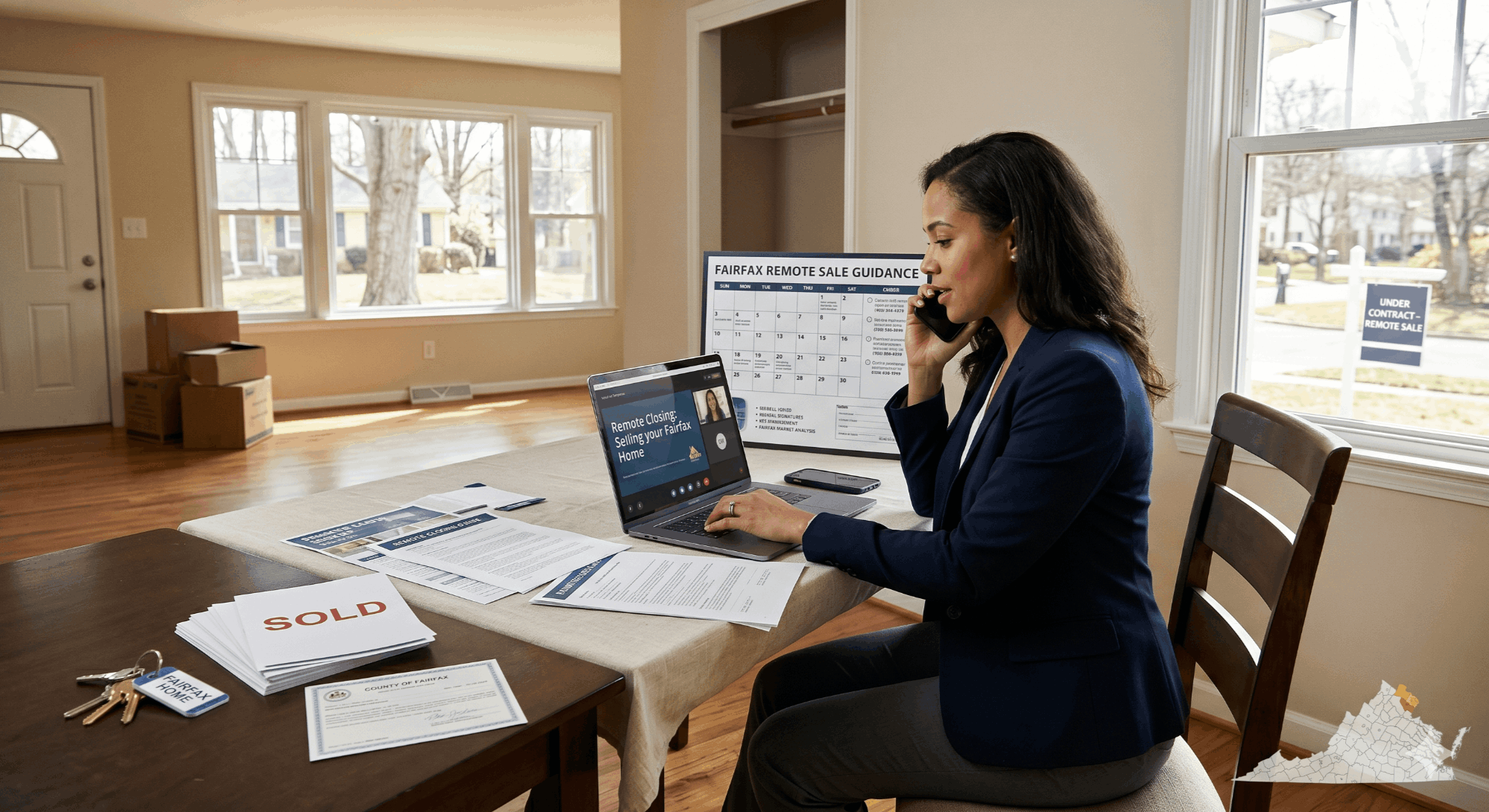
Quick Answer: Yes, you can absolutely sell your Fairfax home after relocating — and many do. The successful remote sale comes down to three things: a listing agent who can act as your boots-on-the-ground, a Power of Attorney or remote online notarization plan, and a vacant-home risk strategy (insurance, security, vendor coordination). Done right, you net the same — or more — than if you stayed local.
Maybe the new job started faster than expected. Maybe a military PCS order moved up. Maybe you closed on a home in another state before you had a chance to list this one. Whatever the reason, you've physically moved — and your Fairfax home is still waiting to be sold. The good news: this is one of the most common scenarios Fairfax County listing agents handle. The 2024–2026 wave of remote-work relocations, federal job restructuring, and contractor PCS moves means hundreds of Fairfax homes sell each year with the owner in another time zone.
This guide walks through exactly how to sell a vacant Fairfax property from a distance — what to delegate, what to authorize legally, what risks to insure against, and how to keep more of your equity by skipping the inflated 3% listing fee that traditional remote sellers default to.
Key Takeaways
- You don't need to fly back for closing — Virginia allows Remote Online Notarization (RON) and a properly executed Power of Attorney handles in-person signings.
- Vacant homes carry real risk: most homeowner's policies void coverage after 30–60 days vacant unless you switch to a vacant-home rider.
- A pre-listing inspection paid before you move out catches every issue while you can still cheaply fix things — saves thousands in negotiated repairs later.
- The biggest financial leak in remote sales is paying 3% to a traditional listing agent when 1.5% full-service is widely available in Northern Virginia — that's $9,000+ on a $600K Fairfax sale, gone.
- A great remote-sale agent acts as your vendor manager, key holder, and decision proxy — not just a marketer.
In This Guide
- Why Remote Sales Are So Common in Fairfax
- The Legal Foundation: POA vs. Remote Online Notarization
- Step-by-Step Remote Sale Timeline
- Pre-Listing Prep When You're Not There
- Vacant Home Risks (and How to Protect Yourself)
- Your Remote-Sale Savings Calculator
- Closing Day From Out of State (or Country)
- Common Mistakes Remote Sellers Make
- How to Choose the Right Remote-Sale Agent
- Frequently Asked Questions
- Glossary
Why Remote Sales Are So Common in Fairfax
Fairfax County is one of the most transient real estate markets in the country, and the reasons cluster into four distinct seller profiles. Understanding which one you fit helps frame every decision below.
| Seller Profile | Typical Trigger | Top Concern |
|---|---|---|
| Military / PCS | Orders to Fort Bragg, JBLM, OCONUS, etc. | Speed + certainty before report date |
| Federal / Contractor | Reassignment, RIF, contract change | Avoiding double mortgage |
| Job Relocation | Tech, healthcare, remote-first move | Maximizing net to fund new home |
| Inherited / Family | Estate sale, parent's home, divorce | Coordinating with co-owners |
What every profile shares is the same operational reality: nobody is at the property to open it for vendors, photographers, inspectors, or contractors. That gap is exactly what your listing agent has to close — and it's the test of whether they're truly equipped to handle a remote sale.
The Legal Foundation: POA vs. Remote Online Notarization
The question every remote seller asks first: "Do I have to fly back to sign closing papers?" Almost never — but you need to set up the legal mechanism before you list, not the week of closing. Virginia gives you two strong options.
Option 1: Remote Online Notarization (RON)
Virginia was one of the first states to authorize Remote Online Notarization — a process where you sign documents in front of a notary over secure video. You'll need a webcam, a government ID, and about 30–45 minutes for the full closing. Most Northern Virginia title companies are RON-equipped, and your agent can confirm before you list whether the title company they recommend offers it.
Option 2: Power of Attorney (POA)
A specific (limited) Power of Attorney lets a trusted person — often a family member or, in some cases, an attorney — sign closing documents on your behalf. The POA must be drafted by a Virginia attorney, must specifically reference the property address, and must be notarized and recorded. Lenders are stricter about POAs than buyers, so if there's any chance the buyer is financing, the POA needs lender pre-approval.
ℹ️ Which to Choose
If you have reliable internet and a webcam, RON is faster, cheaper, and leaves you in direct control. POA is the right call if you'll be deployed, OCONUS, or in a region with unreliable internet on closing day. Many sellers set up both — RON as primary, POA as backup — at no meaningful extra cost.
Step-by-Step Remote Sale Timeline
A well-managed remote sale follows the same arc as a normal Fairfax sale, but the prep work is front-loaded. Here's the realistic timeline assuming you've already moved.
Hire Your Listing Agent — Week 1
Choose someone who has actually closed remote sales before. Ask explicitly: "How many out-of-state sellers have you represented in the past 12 months?" Sign a listing agreement remotely via DocuSign.
Pre-Listing Walkthrough — Week 1–2
Your agent visits the property, sends video, and produces a punch list of what to fix, clean, declutter, or stage. You approve via text or email.
Vendor Coordination — Week 2–3
Your agent schedules cleaners, handymen, painters, lawn service, and stagers — all with lockbox access. You review invoices, agent confirms work was completed properly.
Photography + Listing Goes Live — Week 3
Professional photos, drone, 3D tour. Your agent reviews each shot remotely with you before they're published. MLS goes live with full marketing push.
Showings + Offer — Week 3–6
Showings happen via lockbox + showing service. Offers come in, your agent presents them with their analysis, you decide via phone. Negotiation is signed remotely.
Inspection + Repairs — Week 6–7
Buyer's inspector enters via lockbox. Your agent attends to oversee. Negotiated repairs are scheduled by your agent with vetted Fairfax contractors.
Closing — Week 8–10
Final walk-through done by your agent on buyer's behalf. You sign via RON or your POA signs in person. Wire arrives in your account the same day or next business day.
Get a personalized valuation from The Jamil Brothers — street-level Fairfax comps, not Zestimate guesses. We can do the entire valuation remotely if you've already moved. Response within 24 hours.
Pre-Listing Prep When You're Not There
The single biggest difference between a smooth remote sale and a painful one is whether the prep work was done before you moved versus after. If you're reading this and you haven't moved yet, the next 48 hours of decisions matter more than the next 60 days. Here's the prep checklist that pays for itself many times over.
Before You Move Out — The Pre-Move Checklist
- Pre-listing inspection (cost: ~$450–$650 in Fairfax) — surfaces every defect while you can still cheaply fix it
- Deep clean (carpets, grout, ovens, windows) — costs ~$400–$700 once, vs. $1,500+ when re-cleaning a vacant home twice
- Photograph every utility shut-off, breaker label, water main, septic clean-out — for emergency vendor visits
- Leave behind one set of every paint can, grout sample, and tile box — touch-ups are cheap when you have the original color match
- Document the home's "personality": which window leaks in winter, which gate sticks, which appliance is finicky — your agent will get asked
- Forward USPS mail and cancel non-essential utilities, but keep electricity, water, and HVAC active for showings
- Set HVAC to 65°F winter / 78°F summer — protects pipes and shows well, much cheaper than the vacant-home alternative
- Hire ongoing lawn service and seasonal HOA-compliance maintenance through your closing date — vacant yards trigger HOA letters fast in Fairfax
Staging a Vacant Home Pays You Back
Vacant Fairfax homes typically sell for 2–6% less than identical staged homes, and they sit on market 30–50% longer. Buyers can't visualize empty rooms, especially in homes with awkward layouts (which describes a lot of older Fairfax colonials). For a $700K Fairfax home, a $3,000–$5,000 staging investment for 60 days routinely produces $14,000–$42,000 in extra sale price plus a faster closing. The math almost always favors staging.
Vacant Home Risks (and How to Protect Yourself)
This is the section most remote sellers skip, and the section that costs them the most when something goes wrong. A vacant home is not the same risk profile as an occupied one, and your insurance policy almost certainly knows that.
⚠️ Insurance Trap Most Sellers Don't Know About
Standard homeowner's policies typically void coverage after 30–60 days of vacancy. If a pipe bursts, a tree falls through the roof, or someone breaks in on day 65 — you're paying out of pocket. Call your insurer the day you decide to move and ask for a vacant home rider or unoccupied dwelling policy. It costs more but it's the difference between a $400 deductible claim and a $40,000 uninsured loss.
The Five Risks That Catch Remote Sellers Off Guard
The Vacant-Home Protection Stack
| Protection | Monthly Cost | What It Solves |
|---|---|---|
| Vacant home insurance rider | +$50–$150 | Maintains coverage past 30/60 day vacancy gap |
| Smart thermostat (Nest/Ecobee) | ~$10 amortized | Remote temp control, leak/freeze alerts |
| Water leak sensor (basement, under sinks) | ~$5 amortized | Alerts within minutes of any moisture |
| Ring/Nest doorbell cam | ~$5 amortized | Visual on every visitor, deters package theft |
| Lawn + snow service | $150–$300 | Avoids HOA violations, signals "occupied" |
| Electronic lockbox (Supra/Sentrilock) | Provided by agent | Logs every entry by agent ID + timestamp |
If carrying two mortgages, vacant insurance premiums, and ongoing utilities is the bigger pain than maximum sale price, a cash offer can close in 7–14 days. We'll show you both paths so you can pick the right tradeoff — no pressure, no obligation.
Your Remote-Sale Savings Calculator
Here's the part most remote sellers leave on the table: commission. When you're physically distant, it's easy to default to whatever agent your old neighbor used, or whoever called you first after the listing. That default usually costs 3% to the listing side, when 1.5% full-service is widely available across Fairfax County. Slide through the price points to see what you'd actually save.
Seller Savings Calculator
How much more do you keep with our 1.5% listing fee?
Select your home's estimated value to see your real net proceeds — side by side.
Traditional Agent — 3%
| Sale price | $400,000 |
| Listing fee (3%) | −$12,000 |
| Buyer's agent (2.5%) | −$10,000 |
| Est. closing (1%) | −$4,000 |
Our Fee — Only 1.5%
| Sale price | $400,000 |
| Listing fee (1.5%) | −$6,000 |
| Buyer's agent (2.5%) | −$10,000 |
| Est. closing (1%) | −$4,000 |
Traditional Agent — 3%
| Sale price | $500,000 |
| Listing fee (3%) | −$15,000 |
| Buyer's agent (2.5%) | −$12,500 |
| Est. closing (1%) | −$5,000 |
Our Fee — Only 1.5%
| Sale price | $500,000 |
| Listing fee (1.5%) | −$7,500 |
| Buyer's agent (2.5%) | −$12,500 |
| Est. closing (1%) | −$5,000 |
Traditional Agent — 3%
| Sale price | $600,000 |
| Listing fee (3%) | −$18,000 |
| Buyer's agent (2.5%) | −$15,000 |
| Est. closing (1%) | −$6,000 |
Our Fee — Only 1.5%
| Sale price | $600,000 |
| Listing fee (1.5%) | −$9,000 |
| Buyer's agent (2.5%) | −$15,000 |
| Est. closing (1%) | −$6,000 |
Traditional Agent — 3%
| Sale price | $750,000 |
| Listing fee (3%) | −$22,500 |
| Buyer's agent (2.5%) | −$18,750 |
| Est. closing (1%) | −$7,500 |
Our Fee — Only 1.5%
| Sale price | $750,000 |
| Listing fee (1.5%) | −$11,250 |
| Buyer's agent (2.5%) | −$18,750 |
| Est. closing (1%) | −$7,500 |
Traditional Agent — 3%
| Sale price | $1,000,000 |
| Listing fee (3%) | −$30,000 |
| Buyer's agent (2.5%) | −$25,000 |
| Est. closing (1%) | −$10,000 |
Our Fee — Only 1.5%
| Sale price | $1,000,000 |
| Listing fee (1.5%) | −$15,000 |
| Buyer's agent (2.5%) | −$25,000 |
| Est. closing (1%) | −$10,000 |
Estimates only. Closing costs vary. Buyer's agent commission is negotiable post-NAR settlement.
4K photography, drone video, 3D tours, expert negotiation, vendor management, and full MLS marketing — all included at 1.5%. No travel required. We act as your boots-on-the-ground from contract to closing.
Closing Day From Out of State (or Country)
By closing day, the heavy lifting is done. Here's exactly what happens — and what you do — on the day of closing if you're remote.
If You're Closing via RON
You'll get a calendar invite for a 30–45 minute video session with the title company's notary. You'll need a webcam, your unexpired government ID, and the email address you used when you went under contract. The notary will verify your identity, walk you through each document on screen, and you'll sign electronically. The notary stamps. Done. Wire instructions are sent in advance — your funds typically arrive within one business day.
If You're Closing via POA
Your designated attorney-in-fact attends the in-person closing in your place, signs every document under the authority of the recorded POA, and receives a copy of the closing disclosure on your behalf. Wire instructions still come to your bank — the POA does not authorize anyone to receive your funds, only to sign on your behalf.
ℹ️ Wire Fraud Warning
Remote sellers are prime targets for wire-fraud scammers. Title companies will never email you new wire instructions. If you receive a "corrected" wire instruction email at the last minute, call your title company directly using the phone number on their official website — never the number in the suspicious email.
Common Mistakes Remote Sellers Make
After hundreds of remote-seller transactions, the same errors come up again and again. Each one is preventable with five minutes of advance planning.
The Six Most Costly Remote-Seller Mistakes
- Letting the homeowner's policy default to vacant exclusion (potential $40K+ uninsured loss)
- Choosing the first agent who called instead of one with documented remote-sale experience
- Defaulting to 3% commission because "that's what everyone pays" (loses $9K–$30K depending on price)
- Not arranging a Power of Attorney or RON until the last week — last-minute scrambles cost deal-breaking days
- Skipping a pre-listing inspection because "the buyer will inspect anyway" — turns negotiable issues into surprise concessions
- Listing vacant and unstaged to "save money" — costs 2–6% off final sale price, far more than staging
How to Choose the Right Remote-Sale Agent
Not every Fairfax agent can run a clean remote sale. The skill set is genuinely different — vendor management, lockbox protocol, owner communication, RON coordination — and the agents who do it routinely look very different from agents who only handle local owner-occupied sales. These are the questions to ask before signing a listing agreement.
| Question to Ask | What to Listen For |
|---|---|
| "How many remote/relocation sellers have you closed in the past 12 months?" | A specific number, not "lots." Single-digit answers are a red flag. |
| "Walk me through your vendor list — cleaners, handymen, painters, stagers." | Should rattle off names instantly. If they say "I'd have to look," they don't have a list. |
| "How do you communicate with out-of-state sellers?" | Specific cadence + medium (e.g., weekly Loom video + Monday text recap). |
| "Does your preferred title company offer Remote Online Notarization?" | Must be an immediate yes with the title company name. |
| "What's your listing fee, and what's included at that price?" | If they quote 3%, ask why — the answer reveals their value framework. |
| "Will you be at the inspection and final walkthrough on my behalf?" | Must be yes for both — non-negotiable for remote sellers. |
For context: The Jamil Brothers Realty Group closes remote-seller transactions across Fairfax County and the broader DMV every month. Saad Jamil and Arslan Jamil hold active broker licenses in Virginia, Maryland, DC, and West Virginia, and the team operates a 1.5% full-service listing program that includes professional photography, drone video, 3D tours, vendor coordination, and partner-led negotiation — designed specifically to keep remote sellers in control without flying back.
Frequently Asked Questions
Can I sell my Fairfax home without flying back?
Yes. Virginia authorizes Remote Online Notarization (RON), which lets you sign all closing documents over secure video with a notary. As a backup, you can grant a Power of Attorney to a trusted family member or attorney to sign in person on your behalf. Most Northern Virginia title companies are equipped for both, and your listing agent should confirm RON availability during the listing consultation — not the week before closing.
How much does it cost to sell a Fairfax home remotely vs. in person?
The hard costs are nearly identical. The only real cost difference is roughly $50–$150 per month for vacant-home insurance and another $150–$300 for ongoing lawn or HOA-compliance maintenance. Where remote sellers actually overpay is commission: defaulting to a 3% traditional agent on a $600,000 Fairfax home costs $9,000 more than working with a 1.5% full-service team. Remote sellers should be more cost-conscious about commission, not less.
How long does a remote sale take in Fairfax County?
From listing to closing, plan on 8–10 weeks for a market-priced Fairfax home in average condition. Add 2–3 weeks of pre-listing prep (vendors, repairs, staging) and you're at 10–13 weeks total. A cash-offer path can close in 7–14 days but typically nets 8–14% less than a market sale, so it's a tradeoff between speed and equity.
What happens to my homeowner's insurance when the home is vacant?
Most standard homeowner's insurance policies include a vacancy exclusion that voids coverage after 30 to 60 consecutive days unoccupied. If you experience a loss after that — burst pipe, fire, theft, vandalism — your insurer can deny the claim. Call your insurance carrier the day you decide to move and ask for a vacant home rider or a separate unoccupied dwelling policy. The premium increase is meaningful but the coverage gap risk is far worse.
Should I leave the utilities on while the home is vacant?
Yes — keep electricity, water, and natural gas active through closing. HVAC must run to protect against pipe freezing in winter and humidity damage in summer (set to 65°F winter / 78°F summer). Showings require lights and HVAC running for buyers to evaluate the property properly. The utility cost on a vacant home is typically $80–$200 per month, which is trivial compared to the cost of a frozen pipe or a turned-off home that shows poorly.
Do I really need a Power of Attorney if Virginia allows RON?
It's smart to have both arranged, even if you only end up using RON. POA serves as a backup for unexpected situations: military deployment, OCONUS travel, internet outage on closing day, or a buyer's lender that won't accept RON. The marginal cost of having a Virginia attorney prepare a specific POA in addition to RON is small relative to the cost of a missed closing date. Set both up; default to whichever is more convenient on the day.
Can my listing agent attend the inspection on my behalf?
Yes — and they should. A good remote-sale agent attends the buyer's home inspection, the appraisal walkthrough, and the final walkthrough on your behalf. They take photos, ask questions, observe the inspector's findings in real time, and coordinate any required repairs with their vetted vendor network. This is core to the value of the right agent for a remote sale and should not be a separate fee.
How did the NAR settlement change remote sales?
The 2024 National Association of Realtors settlement decoupled buyer-agent compensation from listing-side commission. Buyer agent fees are now negotiable on every transaction and are no longer automatically published in the MLS. This actually helps remote sellers — you have more flexibility in structuring your offer to a buyer's agent, and you can no longer be quietly charged for both sides of the commission. Most Fairfax buyer agents still expect 2–2.5%, but you're free to negotiate.
What if my Fairfax HOA has rules about vacant or unmaintained homes?
Most Fairfax County HOAs and condo associations have explicit covenants about lawn maintenance, exterior appearance, snow removal, and visible deterioration. Vacant homes get noticed quickly, and HOA violation letters can pile up — sometimes triggering fines that have to be paid at closing. Hire ongoing lawn and snow service, and ask your listing agent to drive past the property monthly to check for any HOA-triggering issues like windblown debris, overgrown shrubs, or settled garbage cans.
Can I sell remotely if I still owe a mortgage?
Absolutely — most Fairfax sellers do. Your title company will request a payoff statement from your lender (your agent helps coordinate this), and the mortgage payoff is paid from sale proceeds at closing. The wire to your account is the net after mortgage payoff, commission, taxes, and closing costs. None of this requires you to be physically present.
What's the biggest financial mistake remote sellers make?
Defaulting to a 3% listing commission because they're not in town to shop the market. On a typical $600,000–$800,000 Fairfax home, that default costs $9,000 to $12,000 more than a 1.5% full-service alternative — for the same photography, marketing, MLS exposure, and negotiation. Remote sellers should treat commission as a line item to actively manage, not a fixed cost.
How do I handle keys and lockboxes when I'm not local?
Mail your keys to your listing agent before you move. They'll install an electronic lockbox (Supra or SentriLock) that logs every entry by agent ID and timestamp, so you have a complete record of who was at the property and when. The lockbox is removed at closing day; spare keys are passed to the buyer at the final walkthrough. Never rely on physical lockboxes that any code-holder can access — electronic only.
Know your equity, understand your costs, and see exactly what you'll walk away with — all from wherever you've moved to. The Jamil Brothers handle the entire Fairfax remote sale process, from vendor coordination to closing. Free consultation, no obligation.
Glossary
Remote Online Notarization (RON)
A Virginia-approved process that lets you sign closing documents in front of a notary over secure video — no physical travel required.
Power of Attorney (POA)
A legal document authorizing someone to sign closing papers on your behalf. Must be Virginia-attorney-drafted, recorded, and lender-approved if buyer is financing.
Vacant Home Rider
An insurance endorsement that maintains coverage after a home becomes unoccupied beyond your standard policy's vacancy exclusion period (typically 30–60 days).
Pre-Listing Inspection
A home inspection paid for by the seller before listing, surfacing defects so they can be fixed (or disclosed) before they become buyer-negotiated concessions.
Electronic Lockbox
A keysafe (Supra/SentriLock) that requires a registered agent ID to open and logs every entry — replacing combo lockboxes that anyone with the code can access.
Final Walkthrough
The buyer's last property visit, typically 24–48 hours before closing, to confirm the home is in agreed-upon condition. Your agent attends in your place if you're remote.
Wire Fraud
A scam where criminals impersonate title companies via email and redirect closing wires to fraudulent accounts. Remote sellers are top targets — verify all wire instructions by phone.
NAR Settlement
The August 2024 National Association of Realtors settlement that decoupled buyer-agent commission from listing-side commission and made it negotiable on every transaction.
Explore Related Guides
Northern Virginia Communities
Fairfax McLean Vienna Reston Herndon Centreville Chantilly Ashburn AlexandriaSeller Resources
1.5% Listing Program Net Sheet Calculator Home Valuation Cash Offer Options Browse ListingsThe Bottom Line
Selling your Fairfax home after you've already moved is genuinely manageable — and tens of thousands of Northern Virginia owners do it every year. The two pieces that actually determine your outcome are the agent you choose and the prep you front-load before you go. Get those right and the rest is mechanics: vendors, lockboxes, RON, wire transfers. Get either wrong and you'll lose weeks, equity, or both.
The most common, most preventable financial mistake is paying a traditional 3% listing fee out of relocation autopilot. On a Fairfax home priced anywhere from $400K to $1M, that default costs you between $6,000 and $15,000 — for nothing extra in service. The 1.5% full-service alternative exists, it's local, and it's specifically built around remote sellers. When you're already managing a cross-country move, that's not a small line item to leave on the table.
If you'd like to talk it through — whether that's a free valuation, a personalized net sheet, or just a 15-minute call to map out your remote-sale game plan — we're here. Saad and Arslan Jamil have closed hundreds of Fairfax-area sales and run the numbers honestly so you can decide what's right for your situation. Call (703) 782-4830 or request a free home valuation online.
Explore More
Browse Every Corner of the DMV Market
Whether you're searching by budget, neighborhood, or buying situation — find exactly what you need below.
Virginia Homes by Budget
Washington DC Homes by Budget
Maryland Homes
Explore Northern Virginia Communities
Loudoun County
Fairfax County & Surrounding
Ready to Make a Move?
Full-Service · No Tradeoffs
List for 1.5% & Keep More Equity
Professional photography, drone video, 3D tours, and expert negotiation — all included. On an $800K home, that's $12,000 more in your pocket vs. a 3% agent.
See the 1.5% Program →Need Speed or Certainty?
Get a No-Obligation Cash Offer
Skip the showings, skip the contingencies. If timing or condition matters more than top dollar, a cash offer may be the right fit. We'll walk you through every option.
Explore Cash Offers →Categories
Recent Posts
Let's Connect